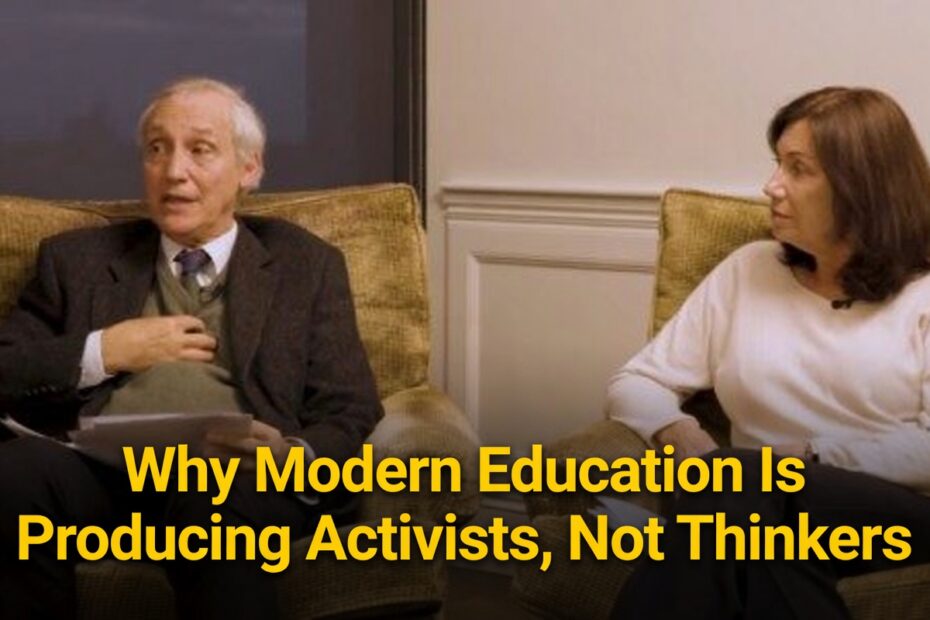
Editor’s Note: In this episode of John Anderson Media, host John Anderson sits down with Professor Simon Haines and Dr. Fiona Mueller to examine the critical state of modern education in Australia. The discussion explores why the current system is increasingly producing activists rather than critical thinkers, highlighting a growing disconnect between educational institutions and the community. Throughout the conversation, the guests offer insights into the historical roots of these challenges and propose a hopeful vision for restoring high-quality, knowledge-based learning. (June 19, 2026)
TRANSCRIPT:
Introduction: The Crisis in Australian Education
JOHN ANDERSON: We have the fastest falling rates of educational achievement in the OECD. What on earth do we think we’re doing not addressing this issue as a society? Well, my guests in this episode have a lot to say that’s very important. I’ve been looking forward to talking to them both, very fine Australians and good friends.
Professor Simon Haines is a prize-winning literary scholar who has held senior academic positions in Australia and elsewhere in the world. He’s a founding fellow of the Hong Kong Academy of the Humanities and was the inaugural CEO of the Ramsey Centre for Western Civilization here in Australia. He is currently the distinguished professor in the liberal arts at Campion College Australia, adjunct professor at the Australian Catholic University, and a director of Humanities for Life, a new not-for-profit advocacy company.
Dr. Fiona Mueller was head of ANU College at the Australian National University. And in 2016, she was appointed Director of Curriculum at the Australian Curriculum Assessment and Reporting Authority, commonly known as ACARA. In 2019, the Australian Financial Review placed her among the top 5 most influential people in education in Australia. She is an Adjunct Fellow with the Centre for Independent Studies in Sydney, and a senior fellow with Advance Higher Education in York in the United Kingdom. Since mid-2024, she’s been the director of research at the Page Research Center, which by way of disclaimer, I chair.
So in welcoming you both, it’s absolutely terrific to have this opportunity. And the topic could hardly be more important. I mean, it was no less a figure than Abraham Lincoln, who said something to the words that, “What is taught in the classroom today becomes the philosophy of government tomorrow.” Education matters. Welcome.
SIMON HAINES: Thank you, John. Great to be with you.
What Is Education?
JOHN ANDERSON: I know that a lot of people, parents in particular, are really beginning to wonder what their kids are being taught and how they’re being taught and how well they are being set up or not being set up in a very challenging world. Let me start with something really basic. What is education? Can I throw that to each of you? What is education? Surely it’s more than just sitting in a classroom.
DR. FIONA MUELLER: It’s so much more than that. Absolutely. And to answer the question, John, I would go back to the Latin verb educare, which literally means to nourish. So education is about nourishing the whole human being.
And in my particular view — I would add, just on my background, that I was a high school teacher for over 20 years, mainly of boys, I might add — my view about education has been formed very much by teaching the younger ones and then older ones at university and then subsequently policy.
But education is two things in my view. One is the utilitarian. So we prepare our young people to take their place in society in the most competent, confident way — literate, numerate, understanding various subjects that we regard as important, that we’ve come to after millennia of thinking about what is it that we want to learn about the world.
And the second part is the nourishing of their moral and their spiritual and their aesthetic and their intellectual development, and making sure that they are given every opportunity to enter the world as humans with responsibilities and rights in our society. So it’s both of those things.
JOHN ANDERSON: We’ve got a lot to explore there, and I’m going to come to Simon in a moment, but I can’t help making this comment as I go through. Two of my daughters are teachers and I have a son-in-law who’s a teacher, and it ain’t an easy profession. I know the utmost sympathy for teachers who are trying to do their best. But you’ve been with ACARA — we’ll come back to this, the whole question of the curriculum — and whether as a society we understand the importance of what’s happening is another matter. But your take, what is education?
Education as Induction into a Culture
SIMON HAINES: Okay, well, thanks, John. And you started with Abraham Lincoln. So let me respond by starting with H.G. Wells, slightly different figure, writing in the 1920s, so almost exactly 100 years ago in the gap between World War I and World War II. And Wells said, “Human history is a race between education and catastrophe.” And he knew what he was talking about, given that he was writing then. And I think that sense of urgency that he puts into the debate is one that we need to have now.
So having said that — and we’ll come back to the reason for the urgency, I’m sure, later on — just to return to what Fiona was saying about the etymology, it’s contested. Either leading forth out of a young person something that’s already in them, or as you said, nurturing and kind of training the mind. And the trouble with the leading out one is that it’s given rise to a lot of mistaken and damaging theories of child-centered education, as if everything was already in there and all the teacher has to do is bring it out.
Which is a Rousseauvian theory — it’s the way he thought about education in his very influential treatise called Émile.
This is also, John, just to cite another authority, a Socratic mistake. The Socratic method is often referred to as maieusis. And maieusis actually means a midwife. Socrates was called the midwife’s apprentice. And the idea is that the philosopher is helping the young person give birth to an idea. And again, that brings with it a sense that it’s all there inside. Student-centered is fine. They’ve got the ideas. All you have to do is release them. So misleading.
What we’ve got here is something much more like induction — inducing, introducing a young person into a culture or a civilization. That’s more like what it is. It’s not so much leading out of what’s in there as leading them into a culture. And I say this partly in keeping in mind what Jonathan Swift said humanity is, which is that we are not rational animals. We are animals that are capable of reason, and you have to be shown how to do the reasoning. It’s not innate.
And so I’d want to stress the idea that education is an induction — not education, but induction into a conversation, a culture, a community, something like that, a community of value and reason. And I just think it’s very important to think of it in that sense as a kind of liberation from almost the prison of your own mind, a liberation into a freedom of thought that wasn’t there before you were liberated, a liberation from closed-mindedness and narrow horizons into the great world that is human being. That’s what an education is.
And maybe just — I’ll end on this note, Fiona, which will resonate with you too — think of the original Socratic and Platonic myth, a metaphor of education, which is the cave. I’m sure you remember this one, that the human being is like a group of people sitting in the dark, looking at the back wall of a dark cave, and behind them is a fire, and the fire is casting shadows of them on the wall at the back of the cave, and they mistake those shadows for reality. And they haven’t yet even seen the reality of the fire, let alone the reality of the sunlight, the real daylight outside the cave. And so education is a matter of showing them out of the prison of the mind into the light beyond.
And so I put it all that way and just come back to Rousseau for a minute — probably do this again during the conversation, and I hope you don’t mind. But in Émile and other places, Rousseau thinks of Émile, his student, who he only allows one book. The only book Émile is allowed is Robinson Crusoe. Just one book. And that’s the story of a man by himself on a desert island. And then the tutor is the one that’s filling his student’s mind with all the things that the tutor wants to tell him. And this is indoctrination, not induction into a wider community of spirit and community of thought. So I’ll stop there.
How Australian Schools Have Changed
JOHN ANDERSON: Fiona, education in Australia has changed enormously. When we talk about inculcating, if you like, the ingredients for flourishing in Australia, I will recall teachers’ unions at times saying that they would reserve for themselves the right to teach values in the classroom. Whose values? What values? It’s obviously changed a lot and a lot of parents are very worried about it. How have our schools evolved and what are they — what’s education in our schools now looking like?
DR. FIONA MUELLER: That really goes to the heart, I think, of the concerns that people have. Exactly as you say, it’s about values and whose values. I might just add a little statistic now, just going back to an earlier point you made, that we are now at an historic low for enrolments in mainstream public schools.
SIMON HAINES: Right.
DR. FIONA MUELLER: So we’re down to 63%, give or take a few points.
JOHN ANDERSON: We’re in New South Wales. I understand it’s about 50/50 here.
DR. FIONA MUELLER: It’s something like that. The shift away from mainstream public education is increasing, accelerating. And the three choices that people are making — and I have to point to the classical liberal schools first because they are popping up around the country and doing exceptionally well. Homeschooling, another one, exponential rise. And a lot of that is sheeted home to a rejection by parents of the values that their children are encountering at school. And the third one is the low-fee independent schools. And there’s a whole range of those because our independent school sector, of course, is very diverse.
The values question is fascinating. And when you referred to your great-great-grandfather’s textbooks, it made me think of some of the textbooks I’ve looked at over time because I’m fascinated to see that shift. Where was the focus?
So essentially we introduced a British curriculum in the earliest days. Most education was through Catholic systemic provision. Gradually, of course, that became formalized. And we started with very much an Anglo-centric traditional — the evolved quadrivium — means of inculcating knowledge and values via a very traditional British view of the world. So your history and geography and a language, thankfully. I’m a teacher of languages, and everyone had to learn at least some Latin or French or something, which is no longer the case really, sadly.
But those values were very European, of course, in nature, and very much a patriotic flavor to them. So a love of country, the idea that there is something bigger than oneself, that there’s a reason why we want to have a good education. We don’t want to just produce literate and numerate robots. We actually want people who take responsibility for their lives, aspire to a better life perhaps than their parents had, certainly make a better life for their children if possible.
And those values were dominant throughout the last century. I think we made it much clearer in national policy documents and state and territory policy documents — because of course constitutionally the states and territories have responsibility for schooling — but the goals of education were, in my view, more clearly enunciated that you were not there just for yourself. There was not the sort of narrow focus on literacy and numeracy. There was some greater purpose to education.
And that is my great concern, and I think many parents share it, that what is it that we’re actually wanting our children to understand about their own country, about the world, and about the place of human beings in the world? And how we have evolved over millennia.
Indoctrination vs. Teaching How to Think
JOHN ANDERSON: Well, let’s bell the cat right now. I think an incredible number of Australians now believe their children are being indoctrinated, not taught how to think. Let’s be blunt. That’s what they think. And you can see it in the choices they’re making as they are obviously, many of them dissatisfied with the traditional choices in education. But we’ll talk more about this.
Tell us a bit about universities, meant to be places of higher learning. And at the time that my grandmother gained entrance to university — medicine at the University of Sydney, tragically wasn’t able to do it, but she was offered a place — only a tiny percentage of Australians went to university. Now a huge percentage, in my view, too many, I’m sorry to say that upfront, go to university. What is a university?
SIMON HAINES: And what’s it become?
JOHN ANDERSON: And what’s it become?
The Origins and Purpose of the University
SIMON HAINES: Yeah, I mean, the trouble is if you put an academic on the podium, he’ll give you a history lesson, you know. Starting with what’s a university, and then I guess we’ll get on to what’s it become in Australia a little bit later on. But these are some of the oldest institutions in the world. The first university that called itself universitas was Bologna. And that was in 1088, the year that William the Conqueror died. So this is a 1,000-year-old institution. I think the only older institutions in human history are the Catholic Church, the Icelandic Parliament, and somebody told me once there was a Japanese construction company that went back to about the 6th century. But these universities have been there for 1,000 years.
The next important thing to know about them is that the word means one turn, universum. One turn around. And the idea was that if you stood in the middle of a campus, you could see all the scholars all gathered together in one place. And the reason that was novel was that previously teachers had been located in one teacher’s schools or in the monasteries. So the idea that you pulled them out and put them in one place was novel. It also created a sense that the university is autonomous. It’s its own place. It’s independent of both the state and the church. So very deep in the DNA of universities is this idea that we’ll say what we want. We resist incursions from the outside. And I think that’s quite important to know about the origins of the thing. It treasures its autonomy.
And then the second thing to say is that the Bologna model, so this is right from the beginning, had two elements, right? The first one was professional training. So right from the beginning, universities taught doctors and lawyers. It was a private institution, and the wealthy families of Bologna wanted their sons to be doctors. And that’s fine, understandable, professional training. The second function that the university had from the start and still has is the function of higher knowledge, which in the 11th century meant two things. It meant theological knowledge of the divine, but also higher level knowledge of human being. So divine being and human being, that was higher knowledge. So from the very start, the universities had these two principal basic functions: to produce the professionals that society needed, but also there was an elevated notion of prestige truth knowledge, higher knowledge. And that’s the knowledge of unchanging forms of reality, whether divine or human.
And the next thing that happened was that a new dimension was added to that sense that there was a higher form of knowledge with Galileo and Copernicus and then Newton later on, that science itself was part of that higher, purer prestige form of knowledge. But it still retained that high-level importance. So the idea of science was that — Dante said this: mankind was not made like brutes but to pursue knowledge. Tennyson said later, “beyond the utmost bound of human thought.” It’s the Captain Kirk model: “to boldly go where no man has been before.” So that was all part of the kind of high-level epistemic function of the university, which sits alongside the practical prestige of the doctors and the lawyers.
And the next big change happened — so that’s the original model, and I would argue that there’s still a lot of that remaining in our own model. We still have the professional function. Our universities still produce doctors and lawyers. And we still have this kind of higher function that we look up to, which in our case now is mostly STEM. Science, technology, research. The next step was taken actually in Germany in the early 1800s when people began to realize, partly because of science, that knowledge had now kind of subdivided into so many different specialisms that nobody could teach or know all of it. This was when the word research first became important. You had to have a taxonomy of knowledge that covered everything. And because no one person could, you had to have loads and loads of no longer scholars but researchers.
And that model of the research university, because a lot of Germans then emigrated to the United States, was transmitted to the US. And what we think of as the research university was a thing that took off in America last century and arrived in Australia finally with the ANU, actually, in 1947. Which was our first research university. The research schools at the ANU were created as having more prestige and more status than the poor old teaching faculties, which were kind of the Cinderella in the room. So that’s the story.
The Trivium, the Quadrivium, and the Lost Foundation of Education
The final thing I want to say is the most important in a way, John, which is that in all of that story, the prestige of the professions and the prestige of higher knowledge, there was a Cinderella at the ball. And the Cinderella, which was buried in the foundation courses that everybody had to do in these universities, was a kind of STEM humanities hybrid called the trivium and the quadrivium. I don’t know whether this has come up in earlier podcasts.
JOHN ANDERSON: No.
SIMON HAINES: So the trivium were the three arts of language: logic, rhetoric, and grammar. The quadrivium was the four arts of number, which was arithmetic, geology, geometry, and cosmology. No, no, music.
DR. FIONA MUELLER: Music.
SIMON HAINES: Music. That’s right. Music, astronomy, geometry, and arithmetic.
DR. FIONA MUELLER: Yeah.
SIMON HAINES: And so that was considered as an essential foundation for whatever you went on to do next, whether you were going to be a doctor or a lawyer or a high-grade knowledge person, you had to do the foundation. The key thing in there is the bit of the trivium called rhetoric. Because what rhetoric was all about was not high knowledge and it was not being a good engineer. It was actually about being a good person. And rhetoric was founded on study of the ancients, particularly Cicero and Socrates and Plato, but also mythical, imagined ancient figures like Achilles and Odysseus. And the idea was that students would be given a kind of gallery of examples of what constituted the good life. So it was the character side of the old university — not grasping great truths, but what kind of person should you aim to be. It was a wisdom function, if you want to put it that way. It was good judgment. The original meaning of the word critic, which is from the Greek word for judgment — krisis is judgment — it’s what you do when the chips are down. That’s kind of almost a sign, a marker of how wise a person you are.
So that’s what this third suppressed kind of function was. And everybody did it in the first couple of years and then went on to be the prestigious doctor or scientist or philosopher or whatever it was. But the key thing to say about this third thing, which was called phronesis, this kind of wisdom, the key thing to say about it is that human nature was considered to be enduring and relatively unchanging. So whereas in the research university progressive model, the idea was that knowledge kept on having new bits added to it and your job as a scholar was to have your little specialism and add your little brick to the huge edifice of knowledge, the original foundation idea was that the rounded individual, the human individual, did not change. And this was what it was the business of that third element of a university education to teach.
And so what happened in America when the research model got transmitted from Germany in the 19th century was that the Americans did actually manage to preserve that third leg, if you like, in the liberal arts colleges, which I’m sure you’ve heard of. St. John’s College in Annapolis is one that I visited more than once. It’s still there. Still the same, still teaching this kind of great books liberal arts model, and it’s fantastic. The Chicago great books program, Mortimer Adler, people like this, is the same. Columbia has a core curriculum. Yale had a directed studies program. I think it still has.
And this happened because, interestingly, the flood of immigrants into the United States at the end of the 19th, early 20th century, as you’d know, was huge. Kind of dwarfed anything that we’re dealing with now, either here or in the UK. And the idea that arose amongst these senior educators like Adler and Scott Buchanan, Stringfellow Barr, was that America needed a common culture, something that everybody could share and join and be inducted, educated into. And that’s why this Great Books model was considered to be so important. So that’s where we ended up in Australia too at the end. But I think we might talk about Australia separately in a second.
Knowledge, Wisdom, and the Australian Curriculum
JOHN ANDERSON: Interestingly, my great-great-grandfather graduated as a doctor from Glasgow University in about 1825 or ’26, and I have his textbooks.
SIMON HAINES: Oh, wow.
JOHN ANDERSON: There’s surprisingly few that deal with medicine, a surprising number that seem to teach Latin, and two enormous volumes of theology. But the theology books were from Yale University in America, which was still a very young country.
SIMON HAINES: That’s interesting.
JOHN ANDERSON: Different altogether.
SIMON HAINES: That is interesting.
JOHN ANDERSON: We might come back to whether or not knowledge and intelligence are necessarily equated with wisdom. I’m not sure they always know each other.
SIMON HAINES: No.
DR. FIONA MUELLER: Yeah.
JOHN ANDERSON: Fiona, you’ve been on ACARA, which is the Australian Curriculum Assessment and Reporting Authority in Sydney, and you must have some insights. What is it about the people who run the curriculum, who shape it, that they don’t understand that the community is losing confidence? There’s no other way of putting it. We have doubled expenditure in real terms, or as good as, per child. The utter dishonesty from some of the activists about the Commonwealth spending more than the states and all the rest of it is so misleading in itself. Why can’t we just have some honesty here? It’s as obvious as the nose on the face that Australian parents, who after all make choices about their children’s education, want better, but we’re not getting it. That’s a loaded question, I know, but I reckon it’s a question our listeners will be asking.
DR. FIONA MUELLER: Of course. And in the end, it comes down to accountability. We have 4 national bodies, of which ACARA is one, responsible for national policies that then should cascade down to the states and territories and influence policy and practice in those school systems. We are so influenced by international movements. One of the problems is that for 60, 70 years probably, we have adopted every fad, every trend, every unsubstantiated idea that academics in particular and sometimes union activists and others have adopted and said, this is the way of the future. This is how we ought to do things.
JOHN ANDERSON: So they’re shaping — they’re seeking to pick up Lincoln’s idea — change the philosophy in the classroom, you’ll change the society.
DR. FIONA MUELLER: Absolutely.
JOHN ANDERSON: But what sort of society do they want?
DR. FIONA MUELLER: And most recently, if I can mention it, and I’m not sure about how this translates to universities, but certainly most recently since the ’90s, the most influential movement has been the globalist movement, that there are some 21st century competencies that really override everything else that we should do. So creativity, collaboration, communication, critical thinking — these magic words that float around the place and somehow are meant to be part of everything that we do.
And bizarrely, as a consequence, we are now seeing reforms that are trying to restore actual knowledge to the curriculum because we floated off in this direction of 21st century skills and competencies and somehow forgot that before you apply, before you try to think critically about something, you actually have to know about that subject. So those are the kinds of things we’ve been subjected to, and the curriculum has reflected those movements because they have been very powerful, picked up by powerful people.
And the same individuals, I would argue, have had a great deal of influence for many decades. Thus we have National Education Goals, for example — 2 national education goals, 30 words. I mean, there are 20 pages surrounding them in the Alice Springs Declaration, but I need to refer to them because they are the classic example of a policy statement that uses the right words but doesn’t actually mean anything. And yet that is the two national education goals. So the first one is that Australian education promotes excellence and equity. The second one is about creating confident, competent, creative citizens who are also active and informed members of the community. So anodyne, so ineffectual, so uninspiring in tone.
It’s not surprising that we then have an open door really for anyone who comes up with the latest and greatest idea and says, well, we should do this because we’re not clear about what it is we actually want our children to learn. What is it we aspire to as a nation for our youngest young citizens? And so it’s the old idea. If you have a vacuum, it will be filled. And we have an absolute intellectual vacuum, I believe, which lets the activists in.
The Influence of Ideology on Education
JOHN ANDERSON: As Karl Marx commented, that people deprived of their history are easily persuaded. That’s your point. We pick up fads and drop them as quickly as that.
SIMON HAINES: Not how —
JOHN ANDERSON: Unfortunately, not quickly enough to avoid doing a lot of damage in many cases. Now, the reality is that the people who run education, and frankly, who teach in the classroom, are the products of our universities.
SIMON HAINES: Exactly, exactly.
JOHN ANDERSON: How did the universities —
SIMON HAINES: How do we get there?
JOHN ANDERSON: Where is their commitment to the proper training of the individual’s mind so that they can think critically? That’s a big charge.
SIMON HAINES: Yeah, and a big question.
JOHN ANDERSON: But there’s a fair bit of evidence that people are not being taught to think critically.
The Activist Strand in Universities and Schools
SIMON HAINES: So if you’ll permit me, I’ve got kind of two strands of answers to that question, John. Basically, what’s happened to our universities has got two sides to it. One I would broadly call managerialism and also kind of gigantism, the huge size of the universities. But I won’t start with that because I want to follow on more from what Fiona was talking about, which is how did this activist strand get into the universities and then out of them largely, wouldn’t you say, through the faculties of education into the schools.
So let me start with that. And again, a little bit of a historical background. I mean, you know, you’re a young man, but you’d know that the 1960s were a kind of epoch in all of this, the era of the civil rights movement, much of which we would absolutely applaud. I’m not saying there was anything wrong with the big protests, the anti-Vietnam War protests. You might take one side or another, but these were a huge public mass protest phenomenon and they happened very largely on university campuses. Partly retaining that sense of autonomy that the university is independent of the state and of course originally the church, and therefore we’ve got every right to say these things and the government has no right to come on campus and intrude into our protests. That was important in the DNA of the protest movement from the start.
A generation later, so 30 years after, many of those young people who’d done all of that protesting, whose blood it was now in, had become the teachers. They were now the academics in the universities. And I want to offer you a quotation here, John, from a very, very distinguished Chicago social scientist, sociologist. He also taught widely. He was a polymath. He taught across languages and literatures as well. He had observed the academic scene at close quarters in the UK and in the US in the ’50s, the ’60s, the ’70s, the ’80s. His name was Edward Shils. I don’t know if you’ve heard of this guy.
JOHN ANDERSON: I have.
SIMON HAINES: You probably have. Well, this is the quote from him that really stays with me. He said, and forgive me just reading this out, “Some teachers nowadays think that the necessity and the desirability of the destruction of existing society and its institutions should be incorporated into the syllabuses which they prepare for their students. They think that as university teachers or as school teachers, they have a unique opportunity and a moral obligation. It’s a matter of personal responsibility to further the cause of revolution.”
So this has actually become, according to Shils, by the ’90s, one generation after the ’60s, part of the DNA of university academia, not just students.
Paulo Freire and Critical Pedagogy
DR. FIONA MUELLER: And if I may jump in.
SIMON HAINES: Yeah, please.
DR. FIONA MUELLER: Paulo Freire.
SIMON HAINES: Freire, I was going to mention. Yeah, totally.
DR. FIONA MUELLER: Most influential 1960s—
SIMON HAINES: Education theorist.
DR. FIONA MUELLER: Education theorist, exactly, from South America.
SIMON HAINES: Critical pedagogy was the theory.
DR. FIONA MUELLER: That’s right. And very much the separation of human society into the oppressed and the oppressors.
JOHN ANDERSON: This is the forerunner to critical theory.
DR. FIONA MUELLER: Absolutely.
SIMON HAINES: Absolutely right. And then at the end, exactly right.
JOHN ANDERSON: Which turns out to be anything but critical, by the way.
SIMON HAINES: Well, quite right. In the sense that I was using the word critical literally a minute ago.
JOHN ANDERSON: Objectivity.
SIMON HAINES: Yeah, yeah.
DR. FIONA MUELLER: And I can tell you for a fact, we have people now in 2026 who still adhere to that same theory. In the teaching profession, in teaching faculties and universities. I mean, they would say that it has evolved, but there’s very much this us and them notion. And absolutely, as Simon said, the idea that somehow schools and universities should be the place where children and young people learn to become activists, which is a complete misrepresentation of our national goal of creating active and informed citizens, because the rejection at the same time is of any knowledge of thousands of years of human development and the great achievements of Western civilization in particular. Without that knowledge, of course, you just get activists. You’re not actually getting those wonderful wise people that the early universities tried to produce.
The Dominance of Social Justice Education
SIMON HAINES: And I think there are figures that say that 70% of the curriculum in a lot of education faculties is Paulo Freire-type social justice education rather than how to be a better maths teacher or how to be a better teacher of reading and writing. So I think Fiona’s exactly right about that.
Just to finish Shils, he says, “They think such activities should be carried on with all the guarantees afforded by the rule of full academic freedom.” So people like we’re talking about here absolutely believe deep down inside that they have an obligation and an opportunity and that they are literally autonomous and freed to do this sort of thing, and that should be their job, and that activism should be what universities do rather than what we might think of as education.
And that’s very deeply now ingrained in the mindset of — look, let me not — not all academics, goodness, there’s a huge number still doing their best to do fantastic teaching and research jobs, but there’s a significant minority that do this. And because they make such a noise, that means that as far as the wider community is concerned, this is what universities have become. Even though they may actually only be a minority in numerical terms, they look like they’re the ones that are setting the pace, causing the tone.
DR. FIONA MUELLER: And that’s what parents are picking up, even though they might not be able to put words to it. They sense exactly that.
The Paradox of Liberalism
SIMON HAINES: I mean, if you think — sorry, John, I mean, just to finish this thought — this is actually something almost beyond the culture wars, which it’s all too easy to fall into, kind of a polarized us and them, you know, these awful people have this view, and but we the right people have this view. But there is something quite important to think about here in terms of what liberalism is and the kinds of distortion of liberalism that liberalism itself allows. It’s a paradox of liberalism, really.
If you think that the principal role of a university is to critique existing society in any one of — it’s usually 4 or 5 different ways, right? It’s usually critical race theory, or it’s gender theory, or it’s class theory, or it’s climate. The Four Horsemen of the modern apocalypse, if you like. If you think your job is to critique those aspects of society and others as well, then the more of you there are doing that, the more what you’re doing is amounting to a critique of liberal society itself. Whereas if you were doing this in a totalitarian society and being critical of its values, you’d end up in prison.
So what happens is that the more liberal the society is and the more people are allowed to go on doing this — and I’m not saying they shouldn’t — but the more we tolerate this, the more we’re moving towards a fundamental kind of rejection of the very liberalism which permitted these critiques to exist in the first place. And that’s the paradox. The more liberal the overarching society is, the more it’s at risk of liberalism being undermined by all these different critiques of itself.
And, you know, just to repeat, I’m not saying that we should respond by being illiberal and closing down those discussions. Of course not, because that would be to commit the same mistake that they’re committing. Very often the people making these critiques are seized by the notion of oppression, but what they do themselves is suppression. They suppress alternative points of view, as you know quite — this is what cancel culture has been all about. This is why, you know, in America there’s a strong movement that says white men should no longer be allowed to be classicists because classics has been a white discipline for too long, so white classicists should be suppressed. So something that sets out to be anti-oppression ends up as being suppressive.
But what we have to do as liberals is, I think, put our point of view clearly and firmly and loudly without trying to suppress the alternative point of view. And I think the point I’d like to make about all of this is that this is a tribal alliance of illiberalism. Instead of a world of complex human beings, each with a range of views who can disagree in a civil way and yet find things that they share as human beings, all human beings on this model now become categorized by just 1 or 2 or 3 or 4 key points of view. And the assumption is if you’ve got one of them, you’ve got all 4. The class preference, your gender preference, your race preference, your tribal preference.
JOHN ANDERSON: They do tend to become a creed. You have to adhere to every part of the creed.
SIMON HAINES: Recite the creed.
JOHN ANDERSON: The very charge they often make against people of faith.
Identity Politics as Regression
SIMON HAINES: Absolutely. And I think the mistake here that so often is made is that people who take these kinds of views think of themselves as progressive. But what this actually is, is the opposite. It’s regressive. It’s actually a return to a kind of pre-civil — almost like, you know the word, atavistic. It’s a return to a tribal, a pre-civilized condition of life. Almost like tribal warfare. It’s regressive. And I think people should realize that.
The other point I want to make is something I think about quite a lot in my own work, which is that this identity politics thing, which is what we’re talking about — the word identity is from the word for the same, idem. And this is kind of crucial because it means literally sameness, which is the opposite of diversity, right? It’s undiverse, it’s uniform, it’s monochrome.
And the final point I’d want to make — and then I’ll shut up, and maybe if you’ll let me talk about the other thing I was going to mention, which is kind of managerialism — is that the thing that’s always at the heart of the identity is always an idea. It’s a concept rather than an actual human being. And very often these angry protesters that you see in the street, even the person next to them isn’t there because they’re a fellow human being. They’re there because they agree about this particular concept, this particular idea, or this particular cause. So in a way, it’s almost dehumanized. It’s no longer seeing human beings as a real rich spectrum of attributes and dispositions. It’s you believe in this thing or these four things and you don’t. It’s an idea that you believe in, not a person. And I think that’s desperately upsetting.
And of course it’s been turbocharged by social media. Everything that’s happened since — what does Jonathan Haidt say — since 2012 when the—
JOHN ANDERSON: Screens hit the classroom.
SIMON HAINES: Screens hit the classroom, smartphones hit the home, social media took off, so triggering now happens to the individual. And I didn’t say that about Plato’s cave. Our equivalent nowadays is the screen. We’re all looking at the back of the cave, particularly young people. And that is exactly what Plato was talking about all those thousands of years ago.
School Disengagement and the Loss of Humanness
DR. FIONA MUELLER: So, two points, if I could just combine two things you mentioned, which made me think about school education. The notion that you have a robust exchange of ideas — and we talk about that more and more frequently in some circles now, how important that is as a way to developing your identity. You have to start as a young learner to absorb as much as possible, listen and be taught and guided and so on, in order to develop your identity.
The statistics around disengagement from school, detachment from school — some people say there are 50,000 students effectively detached from school in Australia. 50,000 who don’t go to school, who have no contact with the normal day-to-day expectations of learning. All of the things that we would hope young Australians would learn to do, develop a sense of confidence and positivity about the world. The statistics are telling us that in fact they feel very lost, disengaged, depressed, anxious. School refusal is a huge one.
So to go back to what we were talking about, rejection of mainstream public education — that is one of the reasons why homeschooling has taken off, all kinds of other alternatives are being considered by parents, because there isn’t the valuing of that humanness that once was essential to the development of the individual.
SIMON HAINES: Humanitas.
DR. FIONA MUELLER: Humanitas, exactly. And we put lots of lovely words around policies, but in fact, we have done exactly as Simon says. We have now corralled descriptions of identities and it has become tribal. And you choose which one you’re going to join because that gives you an identity, which in my book is completely different to developing your own sense of who you are in the world, making sense of the world and where you fit into it, and being able to look back on thousands of years of people doing exactly that. And that’s a good thing.
JOHN ANDERSON: But you see, the past is now painted as evil. Yeah. Something we have to be freed from. The past that we share surely is idiotic because we’re no more or less intelligent than people who’ve gone before us.
SIMON HAINES: Absolutely.
JOHN ANDERSON: They’ve grappled with all of the great issues. Why try and learn it all again for yourself? We don’t teach heroes anymore. That’s part of it.
DR. FIONA MUELLER: That’s part of it.
SIMON HAINES: That’s the suppressed third arm of the original university function that I was talking about.
JOHN ANDERSON: I recognize that. And that must be deliberate. Cut people off from their past, they’re easily persuaded.
Zombification and the Ideological Takeover
SIMON HAINES: Exactly. It is deliberate. And just a last word from me briefly on this. I think what we’ve seen is a kind of, and it might sound like a harsh word, but a kind of zombification that’s gone on amongst the people who want to promulgate these various different ideologies. It’s almost a fanatic’s way of thinking about things.
JOHN ANDERSON: Let’s popularize that word.
SIMON HAINES: Zombification.
JOHN ANDERSON: Can you say it again?
SIMON HAINES: Zombification.
JOHN ANDERSON: Let’s all remember zombification.
SIMON HAINES: Yeah. I mean, so the fundamental idea is that you absolutely have to tell everybody how unequal and unfair the world is. It’s ultimately, John, it’s a Rousseauvian notion. The world is thought of in terms of equality or inequality.
The Victim Mentality and Its Impact on Young Australians
JOHN ANDERSON: How, Fiona, do we get to a situation in Australia, one of the most fortunate societies the world has ever known, in one of the most wonderful countries in every sense, I would argue, politically, prosperity-wise, the environment we live in, where essentially we’re all told we’re victims unless you happen to be a young white male, well, when you’re a victim maker, in all probability. How did it get to this? I mean, what does it do to the psyche of a young person when they’re not told to be thankful and appreciative of the good things that they have? The focus is always on the negative, even to the point where it seems to me that involvement as citizens in a democracy is now painted as activism rather than positive contribution, engagement.
DR. FIONA MUELLER: It’s very much a Western phenomenon, isn’t it?
JOHN ANDERSON: It’s not just Australia.
DR. FIONA MUELLER: It’s not just Australia.
JOHN ANDERSON: We who have had it so good are now turning inward on ourselves, and the biggest sufferers are the very kids we’re talking about.
DR. FIONA MUELLER: And it is part of that liberal critique. It’s absolutely a part of that, that which simultaneously is perhaps our greatest strength, that we can look at ourselves and our history and critique it and say, we did that well, we didn’t do that well, we should think about again about how we approach things. But it opens the door— unless we defend what we truly stand for and believe in, we open the door to every ratbag activist who does not have our well-being and welfare in mind, who does not start from a place of goodwill, who sees us as weak.
And I just loop back very quickly to our National Education Goals. Again, they should be our strongest statement of what we stand for and what we aspire to for our forthcoming generations. If they do not do that job, what is there for teachers and school leaders and community leaders to use to guide our children and say, actually, within this liberal way of looking at the world, these are the things we hold to be absolutely key and what has made Australia great. But we are equivocal. We are just not confident when we’re not competent in a way to take that ground and hold it intellectually.
SIMON HAINES: And yet we have to.
DR. FIONA MUELLER: But we must.
Oikophobia and the Destruction of Civilization
SIMON HAINES: We absolutely must. Here’s another useful term, oikophobia. Have you come across this one?
DR. FIONA MUELLER: I have.
SIMON HAINES: Okay, so you know what I’m talking about here. So the kind of activist that we’re talking about is the person who in the end, oikos, is the hearth, the home. In the word economy, it’s the nomos, oikos is the law of the household. So the oikophobe is the person who actually wants to destroy their own house. And interestingly, if you look at the original root of the word civilization, which is a Proto-Indo-European word, K-E-I-K, that also means home. So the word civilization and the word hearth or home are basically the same word. And the oikophobe wants to destroy both.
And this is something that we have to resist. Otherwise, as Wells said, it could be catastrophe rather than education. But I want to talk about universities from another direction, but only if this works for you, which is the managerialist thing that’s also happened, which is contributing in some ways to this lack of trust.
JOHN ANDERSON: I think taxpayers are beginning to think the universities are pretty good at managerialism when it comes to their money?
The Crisis in Australian Universities
SIMON HAINES: Well, I mean, putting it bluntly, I think the Australian university model has come to be one of overreach, kind of hubris almost, profit-seeking in what ought to be a public good. I mean, our model is actually unlike the schools where you mentioned the English, the British. This is a Scottish 4-year degree university model, which is what Wentworth created at Sydney when he set it up in 1850. And that was fine for a long time.
But two huge things happened. One, just after the war, as I mentioned, when the research university idea took hold of everybody’s mind and we went down that track where research is more important than teaching. And I’ll get back to that in a minute. But also, the second big thing that happened was the Dawkins reforms in the late ’80s, which you probably remember very well. This was the arrival of mass tertiary education and the creation of what they called, you remember this, the Unified National System. One immediate bad consequence of which was the de-prestiging, no such word, of the VET sector, the CAEs and the VET, which were doing a very good job, but now were not universities anymore. So they looked as if they were less important. So mums and dads thought, the kids have to go to a university, not to one of these places.
And I had so many young people when I was a sub-dean in a university in the ’90s who came to me to say, “I didn’t actually want to come here and do a sociology degree. What I wanted was to be a carpenter, a builder, but mum and dad said I had to have a university degree.” So that was something kind of quite bad that went wrong with the sector, I think.
Some statistics, since Fiona had statistics. We have 40 universities in a country of 27 or 28 million, but they all attempt to converge on exactly the same model. They all try to be exactly the same kind of research-intensive teaching institution, teaching the same range of disciplines. And even though some are bigger than others, they all look much the same. We have the sector is worth I think it’s something like $40 billion and there are 130,000 people teaching in them. It’s a very big sector.
But a comparison, as you said, back in the ’70s, less than 5% of the demographic, the 19 and 20-year-olds, went to university. It’s now 50%. So it’s 10 times as big. Interestingly though, even given all of that, we have 1/10th the population of the United States, right? But they have 100 times as many tertiary institutions as we do. So the message here is that the range of choice available to a young school leaver for us is 1/10th what it is in the United States.
All you can really do in Australia is basically what most kids do, go to their own hometown, metropolitan, huge university. And they’re huge, John. I mean, I like to say Monash has the same population as Rockhampton. Our four largest universities would be in the same size group as the 10 largest American state universities. These are gigantic institutions, but they are monoversities, not just megaversities. They’re all the same. There’s no range of choice, there’s no diversity. And I think that’s something we need to try and think about. We need to try and imagine why is that.
And so the other point I want to make is that out of those, I think it’s something like 1.5 million students, one-third of them are international students because that’s where the money is. But out of the 130,000 staff, more than half are managers and bureaucrats. That is huge. And the number of bureaucrats in the sector has grown exponentially, even faster than the number of students. What hasn’t grown is the number of academic teaching staff. That’s actually stayed fairly flat. So therefore, staff-student ratios have gone through the roof.
There’s a huge amount of casualisation, disincentivisation of teaching. A sense that you can just never keep up with the ever-growing numbers of students. And increasing corporate-style managerialization of the sector, which is actually, I don’t know whether you’d agree, but it’s in nobody’s interest. And so I just remember, do you know David Graeber, the guy who wrote Bullshit Jobs? He refers to managerial feudalism. And his phrase is “the endless multiplication of previously unnecessary positions.” And this is—
JOHN ANDERSON: Well, you ought to be worried about AI.
SIMON HAINES: You know, I mean, and don’t even start me on the dead hand of TEQSA, the Tertiary Education Quality Standards Association or whatever it’s called. According to a review by the accountancy firm, I’ve forgotten which one, one of the Big Four, TEQSA is there to stifle all innovation or to provide an excuse for university managers not to innovate. So all of this, our universities are 2 to 3 times larger on average than the UK universities are. It is just unnecessary.
And on the international student front, I think even the universities themselves are now beginning to accept that this was overreach, overkill. 1 in 3 students in Australian universities is international. Some of the figures, there’s half a million of them nationwide. Out of every 1,000 people currently living in Australia, 20 are international students. I mean, these are crazy figures. 7 of the 8 largest Chinese universities in the world outside China itself are in Australia, and we’re a relatively small country.
So I think this is— and this isn’t— it’s not true to say this is a massive goodwill exercise because the student experience that they have when they come here is so bad that they actually go home saying, “I wish I hadn’t done that.” So there’s a lot of kind of playing with figures here because the extra revenue that they generate goes straight into Vice-Chancellor’s discretionary research funds, which they can then use to back preferred research projects. All of which yet again takes prestige away from the teachers and adds it to researchers who increase the rankings, who produce more international students, and so the hamster wheel keeps going round and round. And the people who end up disadvantaged and disincentivized are the teachers and Australian domestic students who are getting a worse and worse deal as a result of how this merry-go-round is all working.
Bureaucracy in Schools and the Silencing of Critics
DR. FIONA MUELLER: And we’re in the same boat in the school sector. I mean, the number of bureaucrats relative to, I don’t know the exact figure because it can be difficult to find, but the number of bureaucrats to pointy-end staff, to teachers, certainly is unprecedented.
SIMON HAINES: And it means it’s a metrics-run, corporate-style—
DR. FIONA MUELLER: Exactly where I was going. So it’s about writing reports and doing statistical evaluation and hoping that things will look better each year than they did the year before.
JOHN ANDERSON: And remaining remarkably unresponsive to all the mounting evidence that educational outcomes are declining.
SIMON HAINES: Exactly.
JOHN ANDERSON: And parents are unhappy and are looking for alternatives.
DR. FIONA MUELLER: But those of us who write about these things and speak about these things have been canceled for years. I mean, I haven’t even talked about, for example, civics and citizenship and nation building.
The Crisis of Civic Knowledge and Cultural Understanding
JOHN ANDERSON: Well, let’s go there. Let’s go there. The government’s own research shows that less than half of us have had any civics education worthy of the name in Australia. Now, given that 31% of us weren’t born here and probably weren’t educated here, perhaps a higher proportion of Australian-born people— I’m not trying to be prejudicial here, I’m just looking at the raw numbers— have actually had some civics education.
Nonetheless, it often isn’t taught or it’s not taught well or it’s taught from a jaundiced perspective. I’m reminded of something that Thomas Sowell’s been banging on about, the American thinker and economist. And he made the point that a civilization doesn’t appear out of nowhere. It’s got to be painstakingly built, vigorously defended, and above all understood. Because without understanding, it will fail. I think he’s as blunt as that.
Those things we don’t understand, we either neglect because we don’t understand their importance, or worse, we’re very open to becoming suspicious, hostile, antagonistic to. And I think that’s part of the story of our culture. We’re antagonistic in many ways to our culture. We don’t think those who went before us have given us a great democracy and something to be thankful for. I would suggest we are in grave danger of paying an unbelievable price for not understanding what we have, how we got it, and what’s needed to keep it running properly.
DR. FIONA MUELLER: I don’t think I could say it as well as you just did, John, but that has been my message now for probably 15 years or more. Attracting all kinds of criticism from the ones who reject what you have just stated, that the importance of understanding our history. I’m the child of a post-war immigrant. He came to Australia, fell in love with Australia, and was its greatest advocate. I grew up with that.
That is not the story of many of us, including teachers, including policymakers, including professional organization influencers. So we can never be guaranteed that the messaging will be as positive as it could be. You’re absolutely right. That puts pressure then on policy and on curriculum to make sure that what is delivered is as open, honest, balanced, but positive as possible. And that’s absolutely not what we have now.
And I would go so far as to suggest that the gap is so great, the void is so great now that it not only explains why we’re doing badly on the utilitarian side. So the literacy, numeracy, the PISA scores and all that. Yes, exactly. Our international assessment results, all of those areas where we’ve been sliding since the turn of the century. And incidentally, 40+% of Australians apparently are functionally illiterate, which is what, percent? 44%, based on an OECD test.
JOHN ANDERSON: And how many of those went to university, by the way?
DR. FIONA MUELLER: Well, so—
SIMON HAINES: Yes, all too many.
DR. FIONA MUELLER: Yeah. So is that true? Yeah. Yeah. It’s a staggering, staggering number.
JOHN ANDERSON: It’s a certain— go to university and still not be functionally literate, which I take it to mean literate enough to thrive and do well in your work.
SIMON HAINES: This is what employers are complaining about.
DR. FIONA MUELLER: And there are international benchmarks which describe exactly what you should be able to do.
Australia’s Falling Educational Standards
JOHN ANDERSON: Let’s come to international benchmarks. The OECD is the Organisation for the Sophisticated, Fortunate Countries That Are Democratic and Reasonably Prosperous. There’s about 35 of them. Australia’s one. My understanding is that we have the fastest falling rates of educational achievement and amongst the worst, if not the worst classroom behavior in the OECD. What on earth do we think we’re doing not addressing this issue as a society?
DR. FIONA MUELLER: John, it’s one of the reasons why the latest reforms emphasize this knowledge-rich curriculum and explicit teaching, which of course is turning the wheel around and using new jargon to describe the way we have tried to teach young members of society for thousands of years. You actually have to build knowledge systematically, carefully. You draw on the wisdom of elders and you assess that acquisition of knowledge regularly. You don’t just let people skate through and hope for the best and assume that they can read and write adequately so that they can go to university at the end of their time at school.
But what are we thinking? Again, I’m one of a small group who has asked that question repeatedly for decades. The answer is often everything is fine because we’re actually developing, we’re putting a greater emphasis on wellbeing and equity and we’re developing much more— Compassion. Much more active and responsible citizens in different ways. And that old traditional focus on—
JOHN ANDERSON: Fiona, that is absolutely unconvincing. There wouldn’t be a person listening to that who thinks that’s what’s happening with our children.
DR. FIONA MUELLER: But that is the messaging that we’ve shifted because that traditional narrow way of trying to impart knowledge was unsuccessful, apparently, that’s the claim. In many cases, and it was exclusionary and it did not meet current expectations of inclusivity, diversity, and so on. So we’ve replaced traditional approaches with that, that clearly did work and now are being reinvented. Knowledge-rich curriculum, explicit teaching, including at universities, as I understand. Absolutely.
SIMON HAINES: We’re going to talk about this in a second.
DR. FIONA MUELLER: Yeah. So we are actually going full circle. So all of that palaver that we seem to have needed to go through, going right back to the ’60s, and that’s where it came from, is slowly being reconsidered. And that’s very encouraging, I have to say.
A reflection of all of this, this loss of focus on the acquisition of knowledge and really setting high-quality expectations for young learners and explaining to them that— and making it— normalizing the fact once again that part of education is to prepare you for life as an active and knowledgeable and caring human being in your society.
Some of the evidence of how far we went down that particular rabbit hole is in the fact that in this current climate with the antisemitism problem, huge problem now in schools, we are finding out thanks to the Royal Commission. A fascinating aspect of that is that the federal government task force on antisemitism and using education as a means of trying to address the problems has actually— what I call— outsourced the work to an international body, to UNESCO, a globalist organization, to develop resources for us to use in our schools to, and I quote, “gain for students to gain literacy in contemporary antisemitism and to improve their intercultural capability and their understanding of what it means to be a responsible citizen.”
Now, if we had really robust national education goals, really clear expectations about what it is we expect our education system to do at the highest possible level, surely we wouldn’t have needed to depend on an international organization to help us develop resources in that particular area that’s so critical for our social cohesion?
Antisemitism, Ahistoricism, and the Failure of Higher Learning
JOHN ANDERSON: I would posit very simply that if history were properly taught in our schools, our people would understand that antisemitism has always ended up in tears for the victims as well as the perpetrators. The ultimate example, of course, ask a German. We are an ahistorical people and we have demeaned and narrowed ourselves as a result.
I feel this very strongly and I find it a tragedy that our places of higher learning, which never stop decrying our supposed forebears’ racism, have played host to some of the ugliest, most trite, immoral, and intellectually bankrupt antisemitism you could ever have imagined on their very front lawns.
SIMON HAINES: It’s unconscionable. But John, and we should talk about this, but given the time constraints, can I just continue with the theme that Fiona was speaking about and just mention reading? And then perhaps finish with a sort of more upbeat story about some of the good prospects for the future because the story isn’t all—
DR. FIONA MUELLER: We need upbeat.
The Power of Reading and the Case for Liberal Arts Education
SIMON HAINES: Isn’t all bad. I think we need upbeat. But on the reading issue, and this goes to what you’ve just been saying as well, I think. If you read the book called Weird: Why the West is Weird by a social anthropologist at Harvard called Joe Henrich, he wants to explain why the West is rich and democratic and industrialized. And the answer is actually reading.
And he says, if you look at the sudden massification of reading after Luther and after the Reformation and Gutenberg Bible, that led to an increase in literacy that’s just off the scale of anywhere else in the world ever. So literacy was actually what made— because it led to the Industrial Revolution. And Henrich says literacy, reading, was what made the West prosperous, eccentric, democratic, rich, and so on. And I think that’s something we mustn’t forget.
Reading is a very complex skill. And particularly in a world of AI, the more AI fills our lives, the more we need to read, not the less. The more we need the kind of human intelligence that only comes with grappling with long, complex texts in a small group. And this is something that we’ve lost track of. There are still many good teachers in universities who are trying to do this, but they’re outnumbered and kind of less visible than the kinds of things that we’ve been talking about.
This kind of evaluative way of thinking in language that only literature and philosophy in complex texts can teach you is something we must not let go of. And that’s why I want to end on the positive note, really, John and Fiona, because there are institutions that recognize this and there is a burgeoning classical liberal reading-focused movement going on at both secondary and tertiary level, particularly in the US, but also in Australia.
DR. FIONA MUELLER: And primary.
SIMON HAINES: And primary as well, exactly. And I think that’s something we need to remember. For example, the St. John’s College curriculum, which has been there since 1920, still regarded with huge prestige by American employers on Wall Street, for example. They’d rather have a St. John’s grad where the curriculum consists of 4 years of the intensive reading of 100 great books across the 4 years. They’d rather have them than a Harvard or a Yale educated person.
And I think that model, which also exists in Australia— Campion College Australia is our only true liberal arts college and it’s very successful. It’s only been there 20 years, but it’s going well. The Ramsey curriculums in 3 mainstream universities in Australia in 3 different cities, in Brisbane, in Sydney, and in Wollongong, producing some of the most amazing graduates.
JOHN ANDERSON: All in New South Wales?
SIMON HAINES: No, no, no. One in Brisbane. Oh, there’s one at UQ. Yeah, UQ. And so in fact, in some ways, UQ is having even better results. I think they told me the other day that the cutoff, the ATAR cutoff for the Ramsey course at UQ is the highest of any course in humanities in the whole country.
And if you talk to the students, they say that the experience in these courses— and Campion are the same— the experience in these courses of true reading and true education is off the scale better than what they get in other parallel arts majors in other degrees in the country. So this is really working and it is hopeful for the future.
And what I would actually say is that if there’s anybody out there who wants to make a big difference, either with philanthropy or with policymaking, a politician who wants to think of a new model. There are two ways we can go here. One is we can try to encourage universities at last to see that they should be public good education institutions, not huge corporatized for-profits, and should start trying to offer courses like those Ramsey ones, like the Campion one, like the St. John’s one within— maybe even make them compulsory, a short 2-year program of study within the existing medicine degree or legal degree or whatever. Why not do that? Not expensive.
Or the other way to go, let’s be ambitious. Rather than create one new liberal arts college, let’s create 100. They’re not that expensive. Rather than put your money into a huge celebrity architect-designed massive new building on a megaversity campus or into a fancy new sports facility, why not think what kind of difference you could make by creating 100 small liberal arts colleges right across the country? They’re not expensive. 15 kids around a table with a book, a teacher, and a room to be in. You could do it in your garden shed or in your lounge room. It doesn’t cost a lot of money. And how much more good you could do that way than by just building another gigantic building, much more expensive and doesn’t deliver a teaching outcome.
So given the success of these models and what the students say about them and how happy the teachers are teaching them, which is another important point, let’s incentivize teaching. Let’s incentivize this kind of intensive reading learning. Let’s nationalize it across the country on a big scale, broad scale. That would be my call.
DR. FIONA MUELLER: That would boost social cohesion.
SIMON HAINES: That would be a real game changer.
Closing Remarks
JOHN ANDERSON: We’ve had a long conversation. The time slipped by surprisingly. So thank you very much. And perhaps we can return again because education is so extraordinarily important. And it’s very obvious that parents in particular are looking for something better. So let’s absorb that message.
SIMON HAINES: Fantastic. Thank you very much.
DR. FIONA MUELLER: Thank you so much, John.
Related Posts
- How to Stand Out in an AI World by Thinking Better, Not Faster: Sol Rashidi (Transcript)
- Modern Wisdom: w/ Alex Petkas on True Story Of The Odyssey (Transcript)
- Reconstruction: Malcolm Gladwell Interviews Barack Obama (Transcript)
- Transcript: “How to Win Without Crushing Your Soul” – Graham Weaver
- Why Early Legal Action Matters After a Cryptocurrency Investment Scam