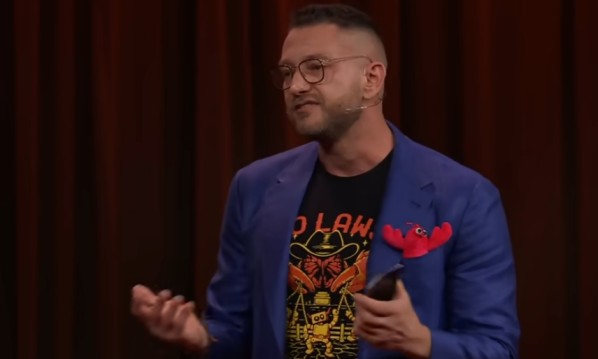
Editor’s Notes: In this TED talk, Peter Steinberger shares the fascinating journey of creating OpenClaw, an open-source AI agent that began as a personal experiment to rediscover his passion for coding. He illustrates how this “improvising” agent evolved from a simple WhatsApp bot into a global phenomenon, enabling non-programmers to build complex businesses like automated breweries and tutoring services. While acknowledging the potential risks and “scary” capabilities of such autonomous technology, Steinberger argues that OpenClaw is ultimately about democratizing access to innovation and empowering anyone to become a builder. He concludes by emphasizing that the future of AI lies in collaboration and specialization, with the “lobster” now permanently out of the tank. (April 18, 2026)
TRANSCRIPT:
What Is OpenClaw?
PETER STEINBERGER:
What’s OpenClaw? I’ve been programming since I was 14. Building software felt like playing a video game. I couldn’t stop until I did. I created a company. I poured a decade of my life into it. No venture capital. Every weekend. And then I sold the dream. And I felt absolutely nothing.
For three years, I was wondering, did Sarah B. travel? I’d changed countries twice. Nothing, nothing clicked. You know, I wake up every morning with everything I was supposed to want, and no reason, no reason to get out of bed.
The Holy Shit Moment
And then, in early 2025, I tried an experiment. I wanted to see what these new AI coding agents are all about. And I had what I can only describe as a holy shit moment. The boilerplate, the plumbing, all the boring parts that was software development, AI could do all of it. The bottleneck is no longer typing. It’s thinking. And thinking was the part I did 25 years.
Building software felt like playing a video game again. I was back.
44 Projects and a WhatsApp Bot
I built 44 projects in just a few months. And the latest one was a WhatsApp bot. I put it on my computer. It talks through the apps that you already know. And then I took it on a trip to Marrakesh. You know, just to navigate around, find restaurants, do translations.
And at first, it didn’t really feel right. It felt too much like a tool, not like a friend. You know, too many bullet points, too many tables. So I told it. Because those modern models, they are so smart. They know what WhatsApp is. They know how people talk. I just had to tell it. And then it felt right.
The Agent Figured It Out on Its Own
And you know how you talk to friends? At some point, I was walking around and I was sending it a voice message. And then I froze because I actually didn’t build voice in there. I had support for images, yeah, but even that took hours. So I was looking at the typing indicator and then the agent responded.
And I very vividly remember the situation. I was standing there and I was like, “How did you do that?” And the agent replied, I’m not kidding you. “The mad lad figured it out on its own.” And then it walked me through every single step.
How it got a message from me, but there was no file ending. So it inspected the file. It found that it was audio, but a weird format. So it converted it. And then it was looking for something to translate the audio. But I didn’t have it installed. But then it found an OpenAI key. It sent the whole thing to the server. It got it back. And then it replied. All of that in nine seconds.
Can you imagine? I didn’t build any of that. For me, this was the moment where I thought, this is something new. This is not a chatbot. Chatbots give up. Agents improvised.
Putting the Agent in a Public Discord
And you know, I was sold. I wanted to share this. I wanted to tell people on Twitter. And nobody really got it. It’s almost like you have to experience an agent. It’s kind of hard to explain. It took me a few weeks. And then I did something stupid.
And remember, this agent, by default, can do anything that you can do on your computer. So obviously, I put it in a public Discord and I invited random people. And I was looking at it the whole night. People were talking with it. People were having fun with it. People tried to hack it.
And when my eyes were like falling off almost, I exited the process and I went to bed. Though I forgot, I built a system to be resilient. So while I was walking to the bedroom, the agent happily put it up again and talked to everyone in the world.
The next morning, I woke up. Over 800 messages. I panicked. I pulled the plug. I read every single message just to see if the agent leaked my private life. Nothing happened, but it could have.
But that was the moment where it went viral. Today, the process is called OpenClaw. It’s pretty much the fastest growing open source project. Its mascot is a lobster. It claws into your machine. Chenxin Huang calls it the operating system for personal AI. But by far, my favorite quote is from a friend who looked at this statistic and said, “Peter, this is not hockey stick growth. This is triple pole.”
When Everything Explodes
And I was not ready. You know when something blows up like this, everything explodes. Hundreds of messages. Reporters calling me in the middle of the night. Security vulnerabilities. And then the AI company whose model most of my users loved sent me a trademark claim. I had to rename the whole thing while it was taking off.
You know, they even tried to push me away from the lobster. Like I was staring at the message. It was like, it’s not even the same animal.
And then they also cut off the model most of my users loved. You know, first the name, then the lobster, then the model. I was that close of just deleting the whole thing.
What People Are Building With OpenClaw
But then I learned what people are building with it. So at Claw Con in Vienna, because yes, we have conferences already, and people wear lobster headbands, I met Stefan and his 60-year-old dad Gerhard, a beer sommelier who never wrote a single line of code. They connected OpenClaw via Bluetooth, send it one prompt, and the agent did the whole 90-minute brew. Temperature ramps, hop additions, everything. And then they were like, “What are we doing with all this beer?” And the agent was, “Let’s make a website.” So they built a website, and then they added payments, and now they have a real product. And almost all of it was just done via the phone.
In China, installing OpenClaw is called raising lobsters. Thousands of people were lining up at the Tencent office in Shenzhen to get their lobster installed. Shenzhen even gives out subsidies for people running businesses on OpenClaw.
Now, if you install OpenClaw on your work machine, at least with the default settings, you might get fired. And then I met an entrepreneur in China who showed me a spreadsheet. Every employee, every day, one task automated by OpenClaw. If you miss too many days, you’re fired. So fired for using it, fired for not using it.
The Heartbeat Feature
After Marrakesh, I thought, this is incredible, and it’s also a little bit scary. How can we make it more scary? So I added a new feature, a heartbeat. You know, by default, the agent would only wake up when you send it a prompt. With the heartbeat, the agent would just wake up periodically, check your emails, check your calendar, follow up on loose ends. My initial prompt was simply, “Surprise me.” And yes, that’s kind of scary as it sounds.
So no large company would ship something like that. But I’m a random builder from Austria. I don’t have a legal department. I built this sandbox, this sandcastle, for me. And I made it open source so other people could play with it and other people could raise their imagination.
The Future of Agents
Imagine putting an agent into a meeting. Not for notes. We figured it out. A bidirectional model that can listen and hear at the same time. Somebody mentions a statistic, a sub-agent can spin off and check it for you. A decision is made, the agent can send a follow up before the meeting even ends.
In the future, you’re not just going to have one agent. You might have your work agent, your personal claw, maybe one for health, maybe one for a relationship. And they all should work together in a secure way. Because how did humanity level up? By specializing and collaborating. And agents are about to do the same.
Imagine a company, a small business that has 10 agents that all specialize taking over various parts of the business. We don’t even have a name for what it might become, but we’re about to find out. So I created the Open Claw Foundation. A non-profit, open source, forever.
Because what Open Claw did for many people was, it moved AI from this scary, nebulous thing into something that is fun, and useful, and maybe a bit weird. You know, lobsters, and pet pens, and bigger businesses. Because what we need in the future is more people spending more time with AI to better understand how powerful and transformative this technology really is.
In New York, at ClawCon, yes, we’re everywhere now, there were thousands of people that were discussing what the lobster did this week. A retiree in Shenzhen who automated their groceries. A teenager in Sao Paulo who built a tutoring business on Open Claw. Gerhard and his beer machine. None of them are programmers. All of them are builders.
Because that’s the real transformation. It’s not the technology, it’s the access. Agents change who can build things, and that door is not closing again. Because when you can prompt a prototype into existence in one hour, anything is possible. The next breakthrough can come from anyone, any country, any cafe. When even a burned out founder, staring at the screen, wondering if his spark is gone, can do something like that. It’s not gone, it’s just waiting. The lobster is loose, and it’s not going back into the tank. Thank you very much.
Q&A: Is Open Claw Reckless — or the Future?
UNIDENTIFIED SPEAKER: Come here. I mean, I think I want to say something personal to you, with love, but truth. You really terrify me. I’m serious, if Hollywood was to ever make a movie in which humanity opened Pandora’s Box and everything went crazy, you seriously could be cast as the star character. Because the story we’re told is that AI researchers are doing all this great stuff, but they’re taking all these great efforts to ensure safety and make sure nothing bad could happen. Do you take glee in seeing what might happen if you just put it out there? Is any part of you feeling that that’s a little bit reckless?
PETER STEINBERGER: I wouldn’t say so. I see my work as a window into the future. In the very beginning, there were all these scary moments. Now we have proper security layers. You can have your sandbox, you can put your lobster into a very small, tiny box and really control what it can do. There’s still some issues that we need to figure out, but the fact that so many people want this now will help to figure this out much faster.
UNIDENTIFIED SPEAKER: I’m glad you mentioned the security layer. You’re making a huge bet on human ingenuity using this incredible tool that suddenly can maximise the power of what any human can do. How many people in your community are taking the safety issue seriously and want to use open source, for example, to find smarter ways of just checking whether anything might be going wrong and giving an early alarm to someone or something like that?
PETER STEINBERGER: Most people are not as reckless of, number one, putting it into a public Discord. Strongly don’t recommend. Number two, I think I single-handedly increased Mac Mini sales by multiple percent. So most people give it their own little Mac Mini. Mine’s a little princess. Mine got a Mac Studio. It’s called the Castle. And that greatly reduces the actual risk, because you can only access what’s on that computer and maybe all your pictures are not there.
UNIDENTIFIED SPEAKER: Well, definitely if humanity goes down, I’ll be very grateful for at least the rise in Mac Mini sales for a period of time. You are amazing. You are amazing. And I think you’re actually right at the cutting edge of whether AI is going to be the biggest thing ever, or possibly a serious problem, and I hope you continue conversations with people here and just help us get smarter on how to do this the right way, because it is absolutely incredible what you’ve built. Thank you for sharing so honestly.
PETER STEINBERGER: Thank you so much.
Related Posts