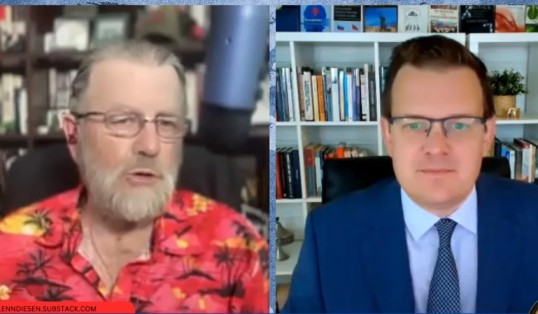
Read the full transcript of former CIA intelligence analyst Larry Johnson’s interview: “Iran Invited to Join the Turkey-Saudi-Pakistan Defence Pact?” on Greater Eurasia Podcast, August 25, 2026.
EDITOR’S NOTE: In this timely interview, Professor Glenn Diesen speaks with former CIA intelligence analyst Larry Johnson about rumors of an unofficial invitation for Iran to join the Turkey-Saudi-Pakistan defence pact. Johnson examines how such a development could reshape Middle Eastern security architecture, shifting it toward collective regional cooperation rather than traditional alliances, while also addressing broader implications for U.S. influence, energy markets, and the emerging multipolar order.
Introduction
GLENN DIESEN (00:00:00 – 00:00:12): Welcome back, everyone. We are joined again by Larry Johnson, a former CIA analyst, to discuss what’s going on, well, primarily in the Middle East. So thank you for coming back on the program.
LARRY JOHNSON (00:00:12 – 00:00:15): Mayhem, chaos, Middle East.
GLENN DIESEN (00:00:16 – 00:01:00): Yeah, that does summarize it. But there is also some, I guess, indications that order or structure might emerge in this chaos as it’s — well, that’s where it would emerge. That is, I read an article of yours arguing that this recent defense pact between Turkey, Saudi Arabia, and Pakistan, that it could have been the way people jumped on how to interpret it. I think it was — many people read into it, maybe their own biases. Some said this will be a new alliance against the Iranians. But you argued that the term “Islamic NATO” is misleading. I was wondering if you could explain why.
The Mecca Agreement and a New Regional Architecture
LARRY JOHNSON (00:01:01 – 00:07:57): Yeah, well, I’ve had fun with it because I called it the Middle East Treaty Organization — instead of NATO, we got METO, or “Me Too.” But I was initially skeptical when they did this, although it was clear it had been in the works for a while.
When the United States and Iran were meeting in Switzerland in June, the Iranians were — there was a meeting with the Iranian foreign minister as well as Pakistan, Turkey, and Egypt, all in Cairo at the same time. And so I presumed at the time they were talking about a regional security arrangement. But when it was announced two weeks ago with no Egypt present and no Iran present, I thought, well, okay, on paper, Turkey’s got the second largest army in NATO of all official NATO members. Previously it was the third largest, by counting Ukraine as a de facto member — Ukraine had the larger army. Saudi Arabia was ostensibly seen as the banker, the guys with the money, except they’re sort of bankrupt right now. They’re not in great financial straits. And then Pakistan brings nuclear weapons to the table. So an interesting alliance.
Well, then we got news yesterday that Asim Munir is in Iran now, and he was carrying with him both — bringing Iran into the Mecca Agreement, we’ll call it that. And there’s word that others are out there on the invitation list, or asking to get in, such as Bangladesh, Egypt, Syria. So this thing looks like it actually may be acquiring life, particularly if Iran comes in.
Now, at the same time, Munir is supposed to be talking to Iran as well about an expanded trade relationship. This is in the face of the US threat to punish any nations that trade with Iran. Now, this is not unusual in light of what Pakistan did back — I think it was in April — when the United States first announced this blockade. You know, it effectively stopped the offensive action, but announced the blockade of Iran. And within two days, Pakistan said, hey, we’re opening six overland routes from our ports on the southern coast of Pakistan that are going to go straight into Iran, six overland routes for trade.
And then when you step back and say, okay, how important is the trade relationship between Pakistan and Iran? Well, Iran supplies 70 percent of basically the propane gas, or the natural gas, that Pakistan uses. And street vendors use it for cooking, and people use it for heating homes in some cases in the winter, and also for industrial purposes. So Pakistan doesn’t have a good alternative source for that, so they need Iran. And my understanding is Iran imports rice from Pakistan. So the countries do have a basis for a mutually beneficial economic relationship.
So this, I think, is what we may be seeing — the foundations of this new international security architecture for the Middle East. Because if you recall, when Foreign Minister Araghchi was in Iran back at the end of April, and in St. Petersburg met with Putin, and afterwards Putin came out and said, hey, we need a new security architecture. And then one week later, Araghchi makes his pilgrimage to Beijing, and his meeting with Foreign Minister Wang Yi — Wang Yi says basically the same thing as Vladimir Putin. Now that’s not coincidence. Those two governments are coordinating a policy.
And then at the same time that they’re doing that, I think there are diplomatic moves that we’re simply not seeing, that are being kept below the surface, that are not being reported. Because China and Russia are serious about building this separate international political, economic — perhaps military — organization that’s going to be outside the control of the United States and NATO. Particularly on the economic front.
And that is where the United States keeps stepping — or Trump keeps shooting himself in the foot, or some other part of his — one of his other appendages, with his constant threats. Most recently, threatening to bomb countries that didn’t buy US Treasury bonds. Now, there is an effective sales technique — I hold a gun to your head, you want to buy my product? When you do that to enough countries, they start looking for another way to get out of that relationship.
And so now, in the past two weeks, he’s basically insulted, threatened South Korea, Oman, threatened to bomb them, had 50 percent tariffs on Canada.
So I guess what we’re seeing here is one of these historical watershed moments where the old order of petrodollar hegemony is coming unglued. And it’s not just on the economic front, it’s on the political front, it’s on the military front. And Trump doesn’t have a good answer for it. No.
Collective Security vs. Bloc Politics
GLENN DIESEN (00:07:57 – 00:11:25): Well, I often make the point — when I heard that there were maybe some possibilities of inviting Iran into this club, I was thinking that, well, historically, or in general, we have two types of regional security arrangements. That is, we have alliances in which country A and B cooperate against a non-member, like country C. And then you have collective security arrangements, where country A and B seek security with each other instead of against each other.
And I think that’s a very important distinction. If people really want to understand why we have a war in Europe now, one has to understand how we made that shift after the Cold War. Because initially, we did have agreements with the Russians — the Charter of Paris for a New Europe. We had an agreement where we would seek security with each other, not the bloc system against each other. That is, Russia was supposed to be included in the new security architecture. And in such a security arrangement, you seek indivisible security. So if it was in the Middle East, such as the Iranians, the Saudis — you agree Iran should not enhance its security at the expense of the Saudis, and then they find mechanisms of having this reciprocity.
What happened in Europe is — this was the agreement. We had a deal. We even, in ’94, developed the OSCE, our own security institution, which was inclusive. And then we came up with the idea, well, the Russians are weak, why are we doing this? Let’s expand NATO instead. And that’s kind of what NATO expansion represented. We threw away this collective security institution to go back to bloc politics. All this dream about the common European home of Gorbachev — all this went out the window. Instead, we said we’re going to return to bloc politics, and they won’t even be stable status quo bloc politics. We’re going to expand gradually to the east until we meet all these deeply divided societies — Georgia, Ukraine, Moldova — and there we’re going to have to fight it out about where the new dividing lines go, in a new redivided Europe.
I mean, why would anyone do this? And then usually the conclusion the Chinese, Russians, others are making is — for hegemony. If you’re a hegemon, you don’t want peace to break out. You want the world divided into obedient allies and weakened adversaries. So this is bloc politics, this is hegemonic politics. So that’s why the Chinese are quite concerned. They don’t want to replicate what would play into the bloc politics game. That’s why they often make the point that BRICS isn’t an alliance — it’s more than an alliance. It’s for countries to seek security with each other, not be dependent on going against the US.
So, I don’t know. I would be hopeful if Iran would be allowed to join this club, because — not just about Iran — it signifies security as indivisible security instead of this crazy hegemonic Game of Thrones war project. But what can Trump do if he wants to throw a stick into this? As you said, he threatened to bomb the hell out of Oman if they made any deals with Iran. Do you see any indications they might do something similar in terms of not having a collective security architecture in the Middle East?
Forty-Six Years of US-Iran Confrontation
LARRY JOHNSON (00:11:26 – 00:16:01): Yeah, they’re going to continue to try to use whatever remaining economic leverage they have over the Saudis, Qatar, Kuwait, Bahrain. That’s what’s really interesting, because some of the reports indicate that not only are they looking at Iran, but also Qatar, Bahrain, Kuwait — that there have been contacts with them and Iran over the last couple of weeks. And even though those countries have been hit by Iran, and Iran was going after the US military bases, Iran is still reaching out to them, saying, hey, we don’t have to constantly be at each other’s throats.
Now, this is the reality when you go back and look at the last 46 years of US policy in West Asia — from the time, starting from 1979, with the overthrow of the Shah and the rise of the Islamic Republic. The United States embarked on a policy of confrontation with Iran and subversion of the Iranian government. And it used, through CIA findings, the CIA to work with the Gulf Arabs, pitching it as, hey, this is basically a fight — Sunni versus Shia Islam. This is a fight against the true Muslims, against these upstarts, these apostates. And it wasn’t always in religious terms, but it started with the war — funding the war, helping fund the war with Saddam Hussein against Iran. Again, the United States played the role of a director in an orchestra, orchestrating the support for Iraq that came via the Saudis, Qatar, even the UAE.
Then the United States continued to — it was going simultaneously after both Russia after 1991 and after Iran. And it relied upon a relationship that developed in the 1980s with the mujahideen in Afghanistan — again, the very radical groups that the United States established relationships with through the CIA and through Pakistan. Pakistan played an enabling role in this as well.
And then once that war was over, it wasn’t, okay, everybody go back to their corners. The United States actually continued to play a dual track. On the one hand, we claimed that we were fighting a new war on terror. At the same time, we were funding the very groups that were engaged in that war on terror against us. And we did it in Bosnia, and then we did it with the Second Chechen War in Russia. And then it extended, once we went into Iraq, it extended there to building an alliance with the Mujahideen-e-Khalq and carrying out terrorist attacks against Iran. And it expanded in 2012, where Russia wasn’t so much the primary target anymore, as Iran became the primary target. And taking Bashar al-Assad out was both a way to put a finger in the eye of the Iranians as well as Russia.
So, like I said, we’ve seen this whole narrative — it’s actually been an integral part of US policy to support radical Islamists for the purpose of both weakening Russia and weakening Iran. And now it looks like the Gulf Arabs, who have been used as the piggy bank for all this — the United States would get them to fund it — and now I think they’re starting to say, wait a second, this has been hurting us, not helping us. And if they’re now ready to move away from that — I think all are ready except the UAE. The UAE is the one I think it’s still going to be, because of its — the Israelis have had control of that place for years. And I think it’s going to take — you’re going to see another military strike by Iran against the UAE in the coming weeks.
Iran, Sunni Extremism, and September 11
GLENN DIESEN (00:16:03 – 00:17:20): Well, the way the US financed these radical groups, and actually Iran fought them — I think people often fail to recognize this. Because whenever they talk about Iran, they talk in the same sentence as suicide bombers. It was a bit like they did with al-Qaeda — remember, before the invasion of Iraq, they mentioned September 11th and then Saddam Hussein in the same sentence enough times that people thought they were kind of the same groups almost, even though they despised each other. But it was the same with Iran.
I mean, a lot of these terror groups which have been terrorizing the region, and of course doing these attacks in the West as well — these are Sunni extremist groups. You don’t have that many Shiite suicide bomber groups at all. And so how do you see this? Because people often also ignore that after September 11th, the Iranians, who also do not care for the Sunni extremist groups, offered to help against the Taliban, help against al-Qaeda. And the US ended up joining — like in Syria — joining al-Qaeda instead, putting one of their leaders in power. I mean, you can’t make this up.
Rebranding Terrorists: From al-Jolani to al-Sharaa
LARRY JOHNSON (00:17:20 – 00:21:15): Yeah, it’s just nonsensical. And look, I wrote a piece — I was aware of all the past, in a disconnected fashion, US support for these Salafist groups. But it was only when I wrote a summary piece explaining why this charge that Iran is the number one sponsor of terrorism is just a lie — and it was fortunate Zero Hedge picked it up, but it was posted four or five days ago at sonar21.com, and I encourage people to read it — as I was going through it, it suddenly dawned on me. I said, hey, listen, because you step back and say, why would the United States provide financial support, through intelligence organizations, to the very groups that we claimed we’re fighting in a war on terror? Why would we? It’s contradictory. Why would we have Cofer Black calling up people saying, if you got any information about bin Laden, let us know, and yet other elements of the CIA were working with the bin Laden folks? Why would that happen?
And it comes down to getting Iran, destroying Iran. That was the primary target, and also Russia. So it was this two-edged policy that would cut both Russia and cut Iran. And yet, in that, it was never reconciled with our overt claims about, oh, we’re fighting a war on terror, and that’s why we’re in Afghanistan and why we’re in Iraq, etc.
And I think, apart from the fact that this policy has proved to be bankrupt — as you noted, one minute we’ve got a $10 million reward on the head of al-Jolani, next minute we help him trim his beard up, we put him in a high-end Bond Street suit, give him some wingtip shoes. He’s not wearing sandals anymore. And then we change his name and call him al-Sharaa, President al-Sharaa. And historically we’ve seen similar transformations. I mean, Menachem Begin — he was formerly part of the Irgun, a Zionist terrorist organization. And there was also — Yitzhak Shamir, I think, was also a member of a terrorist group in Israel. So we’ve done that before, but now we’re just being very blatant about it.
And now, I think, within the Gulf Arabs — they were promised, hey, if you do this, it’ll bring you security. Well, they’re not more secure now. They’ve suffered significant economic losses. Both the Saudis and Qatar — they’re in some tough financial straits right now. They’re living off their savings, so to speak. And the prospects for Qatar to start raking in the dollars again is quite limited. So a rational person is going to sit down and think, you know, we need to have positive relations with Iran so that the economy starts working again. And as they do that, then it’s a direct challenge, a direct slap in the face to Scott Bessent and to Donald Trump.
The Rebranding of al-Sharaa
GLENN DIESEN (00:21:18 – 00:22:40): Yeah, about the al-Jolani issue — I was most surprised about how quickly the whole rewrite was done. Because, you know, it’s not the first time you see this kind of operation, where you have to rebrand someone, but how quickly it was — because, as you said, he was still on the list of international terrorists. He was an al-Qaeda leader. And then, within a few days, they put a suit on him, they changed his name, and, oh, now he’s a moderate. Look at him. I mean, it didn’t take more. And all you needed was a media that thinks its job is to parrot the talking points of the government. No real problem there, no criticism.
But it’s not just the war issue, as you said — it’s also the economic problems now. And you, among other people, have said that the ability of the Trump administration to manipulate oil prices will only work for so long. And we now saw, after Trump announced “Economic D-Day,” that Bessent argued he was quite surprised — he couldn’t understand or explain why oil prices would be going up. Did you see the general control over the ability to manipulate energy markets coming to an end?
Three Phases of the Oil Shortage
LARRY JOHNSON (00:22:41 – 00:27:21): Oh yeah. You know, at least, in the movie Casablanca, Claude Rains, who played the police inspector — at least when he claimed he was surprised that there was gambling in the casino, you knew he knew there was gambling in the casino. But here’s Bessent, who genuinely seemed shocked — my God, why is the price of oil still going up? I announced that we’re going to do this thing and it should have come down. He was tacitly admitting that the administration had been manipulating the price of oil.
But I wrote another article that laid out and explained why. There are three phases we need to understand — this war has had a three-phase oil supply effect. Phase one, let’s say from February 28th to April 5th. During that period, even though the Strait of Hormuz was closed and there were no more wells — all the wells were starting to be shut down, they weren’t necessarily pumping — you already had tankers that had been filled up. They’re on the high seas, sailing to their destination. So as far as the refineries and the consumers were concerned, there wasn’t a shortage of oil. The oil was still coming in. But that all showed up around April 5th, plus or minus a week. Okay, then they got a problem.
And the United States — as we go back and look, other countries followed suit — said, okay, we’re tapping into the Strategic Petroleum Reserve. And people listening to this, think of it like — you’ve been building up your savings account for years, you’re now sitting on $60,000 in the bank, and your monthly expenses are $10,000, but you’ve lost your job. So you keep drawing the money out, you’re drawing $10,000 a month. You can only do that for like six months, and then you’re out of money. And that was what phase two was. Phase two was the United States and other countries in the world were drawing off those reserves and pretending like, hey, no problem here, we got plenty. The reality was they didn’t have plenty, because in drawing out of those reserves, there was still this shortage of sour crude — the heavier, sulfur crude that came out of the Persian Gulf. That was essential for creating diesel. And then you had the US combat efforts in the Persian Gulf, which were also laying additional demand on the supply of diesel. So the supply — they were able to manipulate the price of oil because the supply was being stabilized through these withdrawals from the petroleum reserve.
Roughly August 1st, that comes to an end. Now there’s an actual shortage. There’s no more to draw out of the reserves, and there’s no other country out there stepping up saying, yeah, we can increase our production. No. And in fact, what looks like is happening, starting this week, with Trump’s fight with Carney in Canada — Canada was a significant supplier of this sour crude to the United States, which was essential for making diesel and aviation fuel. Now, up to this point, despite past frictions, Canada still supplied that oil. Now that’s in question. If Canada says basically to Trump, screw you, we’re redirecting it to China, then the United States has got a real serious problem.
But this global shortage of diesel — or the shortage of diesel, it’s a global problem, as is the growing shortage of aviation fuel. And that’s simply because, once those 20 million barrels a day coming out of the Persian Gulf were basically cut off, that eliminated the ability of these refineries to produce all of the diesel and aviation fuel they had previously, because they need that particular brand of oil in order to do that in those refineries. So we’re now in the actual shortage stage. The people who thought back in February, okay, they’ve closed the strait, well, let’s watch — what the shortage affected, they didn’t see the effect. They thought, oh, never mind. Now it’s started.
Strategic Reserves and Global Fallout
GLENN DIESEN (00:27:22 – 00:28:58): A much worse situation now, though, because of this. When you draw down the strategic reserves to this degree, it’s not an indicator of confidence anymore — oh look, the government’s in control. It’s starting to show desperation, because there’s no plan B anymore. And I think when they drew down these reserves, the assumption was, we’ll get this thing over, then incrementally we’ll replenish — this is how governments should manage this. But of course, if they drew down the strategic reserves, and the situation will only get worse from here on, there could be real trouble.
Now again, I’m not sure if the Canadians would cut off the US, but it is interesting that you had the Canadian Prime Minister go out and give a speech saying that the Americans are trying to break us so they can own us. This is hardly a good move for the United States.
But what I want to ask, though, is about some of the other limitations of all this economic warfare. We see oil prices now go up — you can say that would be good for the United States, but one of the reasons they’re going up is because the Gulf states are being shut down. But when the Gulf states go into this economic crisis, as well as other countries around the world, certainly they will have to start to liquidate a bit — that is, to sell some of their US bonds. How much of that pain can the US absorb before things go really south?
Sweet vs. Sour Crude and the Hidden Costs
LARRY JOHNSON (00:28:59 – 00:33:07): Yeah, no, there’s no real margin for error anymore. And it’s important, when we’re talking about oil — I think the average person thinks a barrel of oil is a barrel of oil, but oil really comes, and I’m simplifying, but it comes in two flavors, like chocolate and vanilla — sweet and sour. And the characteristics of sour — and again, within that sour, there’s a range in terms of the viscosity of the oil, but it has a high sulfur content. You get oil that, basically, they can run through a pipe, down to this tar that comes out of Venezuela — very, very thick, it doesn’t easily or naturally flow through a pipeline. But the refineries that are set up to cook that oil, and to take out what they call the middle distillates, to extract diesel and aviation fuel — those refineries are not set up so that they could be used for the sweet crude.
And you get Trump talking about, see, we’re energy independent because we produce all this sweet crude. Well, 70 percent of our refineries are set up to deal with the sour. So the United States is actually a net importer of that sour crude. And this problem with the sour crude hits four geographic areas the hardest: the United States, in the Gulf of America, Gulf of Mexico, India, China, and then South Korea and Japan. Japan and South Korea have really suffered the most out of this. China suffered the least, because it had significant reserves, and now it’s buying, and it’s going to buy even more from Canada, and it’s getting oil out even through Iraq and Iran. So China’s not hurting. India’s had to rely more on Russia. But it’s still created a disruption in the global supply of diesel and aviation fuel. And that’s going to persist.
And that’s the fact — the average analyst tries to treat a barrel of oil as a barrel of oil as a barrel of oil, which is quite misleading. And then when you couple it with the additional economic fallout from the shortages of the Persian Gulf — the liquefied natural gas, Qatar was providing 25 percent of the world supply, that’s been curtailed. Helium, 40 percent — that was a byproduct of bringing out the liquefied natural gas, that’s cut off, and that means chipmakers are going to find — they’ve got to try to find alternatives, and they’re not easy alternatives. And then the urea and sulfur that account for about 30 to 35 percent of the global supply — that hits directly on the issue of fertilizer.
So it’s not just to focus on the economic consequences of the oil shortage — one has to recognize this is broader than that. And the longer the US keeps the blockade in place, the longer this disruption to the international economy. And yet here’s the United States — its play is what? To use threats. You do this or else we’re going to levy sanctions on you. And these countries go, we don’t need this kind of drama. They start selling the bonds. They start lessening their dependence on Washington, for the very purpose of not being in a position where they could be held hostage.
The Illusion of Market Control
GLENN DIESEN (00:33:10 – 00:35:00): Well, usually I’m just a bit surprised over how political leaders think they can control the market. I mean, they seem to overestimate themselves — not just Bessent. You see the same with the Europeans. When it went back with the Ukraine war, they decided, let’s cut ourselves off from Russian energy — a great idea — which meant the Europeans then had to go and try to snatch more of the energy coming out of the Middle East. Well, that’s where the Indians got their energy from mostly. So suddenly then India had to go to Russia, and then the Europeans start to lecture India about, oh, you shouldn’t buy immoral Russian energy — however, if you refine it, we’ll buy it off you.
I mean, the idea that they can control all of these things — I’m not sure where this is coming from, but it’s a very slow learning curve, it seems. But I wanted to pivot a little bit towards the war possibilities now, because if the economic war isn’t working out — that is, the whole goal of strangling the Iranian economy — they’re going to have to escalate on the war front. And you’ve probably seen all these comments they’ve been discussing now in Washington, the possibility of using tactical nuclear weapons against Iran, I guess, with the purpose of making it capitulate. We’ve seen several people make these comments. But again, I’m not sure if they’re rumors or if it’s true — how are you assessing this situation? Do you think the US could go down that road and actually use nuclear weapons?
Iran and the Non-Proliferation Treaty
LARRY JOHNSON (00:35:01 – 00:37:58): I can’t rule it out, but I think it’s unlikely — if for no other reason than there are still enough adults around Trump and within the Pentagon who understand the actual stakes involved in doing this.
Now, what is — if you want to call it interesting or troubling — a development is that the Majlis, the parliament, the legislature in Iran, is actively considering withdrawing from the Non-Proliferation Treaty, the NPT. And the rationale is simple — when Iran signed on to the NPT, it was signing on saying, okay, we recognize the need for controlling nuclear weapons, we recognize that we’re committing to not building a nuclear weapon, and we expect that under this treaty we’ll be treated accordingly — that we won’t face threats from countries with nuclear weapons, and that we’ll agree to inspections in conjunction with the International Atomic Energy Agency. They did all that. And what did it get them? They’ve been attacked twice within two years. They’ve had IAEA inspectors turn out to have been working in close coordination with Western intelligence organizations, providing locations of Iranian facilities and the names and identities of key scientists and engineers who were then subsequently executed, assassinated.
And so here is Iran, and Iran said, look, we play by your international rules, and what did it get us? It got us dead. You have killed our people. You have tried to destroy our enterprise. And so now, if they withdraw from the NPT, I think you will shortly see, after that, an announcement that they have developed a nuclear weapon, or that they’ve been authorized by the Ayatollah to build one. So that’s something to keep an eye on, because I think the Iranian leadership has drawn the correct conclusion, which is — if we’ve got a nuke, if we’re a nuclear power, the West is going to be less likely to attack us than before. And unlike Pakistan, Iran has an actual robust ability to deliver such weapons, because it has a much more advanced ballistic missile system, tested and proven in combat, than does, say, Pakistan, who has a nuke. But having a nuke, and then figuring out how to deliver it in a way that it’ll have an impact, is a whole different issue.
Iran’s Retaliation Strategy
GLENN DIESEN (00:38:01 – 00:38:29): Well, besides the Non-Proliferation Treaty, how do you see the Iranians possibly responding to the United States? Because now, as we discussed, Trump announced this “Economic D-Day” to strangle the Iranian economy. And effectively, the message of the US now to the world is, you’re either with us or against us — if you don’t abide by the sanctions, then we’ll come for you. How do you see the Iranians pushing back against this?
LARRY JOHNSON (00:38:30 – 00:39:49): Any Gulf Arab state that participates in that, and enables and facilitates the US sanctions, will then be a target of Iran — and not just a verbal target, but an actual physical target. Iran will attack their economic infrastructure to make sure, as they have said, if we are not going to be able to export oil, nobody is going to be able to export oil. And that includes Saudi Arabia. Nothing is going to come out — not only out of the Persian Gulf, but out of the Red Sea. And they will work with the Houthis to shut down Yanbu in particular.
So I think the candidate most likely to get attacked, within — if the United States goes forward with this plan and really tries to put some additional economic pain on Iran, which I would argue they’ve actually got limited ability to do, but nonetheless they’ll try — and if the UAE goes along with it — I mean, they announced preemptively the other day that they were cutting Iran off on all trade and economic relations. And so if the UAE persists in that, the UAE will be a target. They’ll be hit.
The Mecca Agreement: Confirming the Details
GLENN DIESEN (00:39:53 – 00:40:17): Well, just to circle back to the first thing we discussed — the head of Iran’s parliamentary news agency made a point that Iran had been invited to this Mecca Agreement. Have we actually seen anything develop there, or is it still — has it been confirmed? What is it that we know so far?
LARRY JOHNSON (00:40:18 – 00:41:20): We got — Pepe Escobar and I got information yesterday that Asim Munir was traveling to Iran today, and he has arrived, and he’s been there in meetings all day, with the express purpose of, one, formally inviting Iran to become part of the Mecca Agreement, and strengthening bilateral military and economic relations with Iran. And so if those reports are true — and they do appear to be true — then this is where I think Pakistan has made a decision that they’re no longer going to be on the leash of Washington. Washington keeps them on a leash like a dog, supposedly obedient to Donald Trump. And I think, in a sense, Pakistan is declaring its independence.
Saudi Arabia’s Shifting Position
GLENN DIESEN (00:41:23 – 00:41:52): But that would entail Saudi Arabia, though — I guess the key adversary of Iran, the one who has fought effectively a Cold War against Iran for all these years — more or less, to some degree at least, if not fully committing, at least leaning in the direction of putting an end to the whole anti-Iranian alliance system and finding a way of living in that region with the Iranians. How would all of this affect the United States?
LARRY JOHNSON (00:41:52 – 00:44:41): Well, we saw the first steps of that — was it two years ago, three? I’ve lost track of time, I don’t have the specific timeline in front of me — but through Chinese intervention, the Iranians and Saudis were reconciled. Yeah, so it was two years ago. Prior to that, they had been fighting this proxy war in Yemen, and the Iranians had basically been delivering some significant blows, via the Houthis, against the Saudi forces. China intervened, working behind the scenes, and got them both to basically step back, put their guns down, and start talking. And they started talking. So you have had more high-level contact since then between both the Iranian and the Saudi Arabian governments, with defense ministers meeting, etc.
And that is where I think it’s not just Pakistan playing a role as a mediator, but really the ultimate puppet master behind all this is China, and to a lesser extent Russia. Because they are, I think, dead serious about the need to get the United States out of the Persian Gulf, get the United States out of a variety of countries where the US has been there to stir up, using covert action, opposition to the existing governments or neighboring governments. And so I don’t see Iran and Saudi putting aside this reconciliation for right now. I think they actually — particularly for the Saudis — recognize that if they keep dancing to the music the United States is playing and wants them to dance to, it’s going to further damage Saudi Arabia economically in particular. Whereas if they can separate themselves, where they’re no longer dependent upon the United States, then there’s actually an open road here that the Chinese and Russians are offering, that frankly looks a lot more attractive than what the United States can offer. What the United States is offering is, buy our bonds, help us fund our deficits. And what’s in it for Saudi Arabia? They get to hold a bunch of worthless paper, or potentially worthless paper. Or now China’s saying, hey, we got bonds, and guess what, they’re backed by gold — they got some real backing. The Saudis, I think, will look at that and go, huh, I’m going with the Chinese.
A Former Mossad Chief’s Warning
GLENN DIESEN (00:44:45 – 00:46:26): Well, I remember, yeah, when the Chinese were mediating these efforts between the Saudis and Iranians to restore relations three years ago, I thought it was interesting that afterwards — this was more or less, to some extent, successful — the former head of Mossad, he actually came out to comment on the whole deal. That is, Efraim Halevy. He was arguing then that, well, if the Gulf states are going to end this alliance against Iran, then perhaps we should too. And again, the former head of Mossad arguing that, perhaps, why do we need a conflict with Iran? A lot of our issues can be resolved.
And so you kind of see that if peace breaks out, that whole alliance system can then collapse. And my first thought was, it could be an interesting out for the US, though. That is, if it really wants to pull out more of the Middle East, as the US National Security Strategy suggests it should, by focusing on the Western Hemisphere and East Asia. But as you say, what happens to the whole US economy then? Because the security architecture is also the reason why the Gulf states are pouring so much money into investing in US bonds. So I feel the US has put itself in a very difficult position where it can’t actually afford to make peace, because if peace breaks out, the whole financial system appears to be possibly coming crashing down. Well, yeah, it is.
The Hegelian Dialectic of US Decline
LARRY JOHNSON (00:46:28 – 00:50:01): This is sort of a — call it a Hegelian dialectic in its full glory. The United States is sowing the seeds of its own destruction through its current policies. It enjoyed being the hegemon, being the reserve currency, but the minute it decided the only way it could maintain its status as the reserve currency is through the use of force, threat, coercion, and sanction, that’s when it began losing its ability to maintain its status as the reserve currency.
Prior to the sanctions imposed upon Russia in 2022, the momentum for BRICS, and particularly for China and Russia in their economic cooperation, was not really there. It was just sort of limping along — maybe someday something will come of this. But then, I think it was end of January, first of February of 2023, when Xi Jinping flew to Moscow, met with Putin, and they came out of that pledging their friendship and solidarity. And, you know, I looked it up, you’re right, it’s three years — about a month after that is when China brought Saudi Arabia and Iran into Beijing, and those two countries restored diplomatic relations, first of March.
You think that is just a coincidence, that what Russia and China decided to start doing — expand their cooperation in the January-February timeframe — that this was just something China had nothing better to do, so let’s get the Saudis and Iranians reconciled? No, I think this is part of a broader strategic picture, or strategic structure, that Russia and China are erecting to refocus the security architecture — not just militarily, but economically.
And the acceleration of the development of CIPS, the Cross-Border Interbank Payment System, the increased use of the yuan as a settlement currency — like when the United States tried to sanction China on agricultural products, and China punched back, China went to Brazil and said, hey, we’ll buy up all of your soybeans. And now China is one of the major customers for Brazil, and the purchase is made not with US dollars but with their respective Chinese and Brazilian currencies, done through Chinese banks. So it’s now entirely outside of this once-dominant, US-controlled financial network.
And I think the United States is going to fight like hell, and maybe even engage in further wars, in an effort to try to preserve that status. But they can’t do it. I think it’s mission impossible for them.
Decoupling from US Control
GLENN DIESEN (00:50:04 – 00:51:09): That’s the problem of having this continuous effort to coerce countries into submission — after a while they will learn to decouple. This is why the Chinese developed an alternative to GPS as well. They discovered, what, 30 years ago, that the United States could just shut down the GPS of one of its ships going to Iran on some charges which proved to be false, just so — it essentially could shut down the shipping of any country, any operation. And they realized, well, I guess we can’t depend on it anymore.
I think this kind of technology is also what you see now in finance, in transportation corridors, and across the board. So it’s too tempting, I think, to abuse that administrative control over the international economy, but once you start to do that, countries will move away, and I think that’s what we see now. Big time.
So yes, anyway — well, Larry, thank you very much for taking the time. I always look forward to it.
LARRY JOHNSON (00:51:11 – 00:51:20): You know, that was — it the Rolling Stones song, “Paint It Black.” That’s what we’re sort of — painting a black picture, but so be it. It is what it is.
Closing Remarks
GLENN DIESEN (00:51:22 – 00:52:05): Well, it could be positive at the end, though. There’s a natural balancing always towards an equilibrium, and the whole lesson that countries have to learn is — if one abuses its position, if it uses too much military, others will balance it. If it abuses too many sanctions, others will learn to live without it. So I think the learning curve is not impressive, but hopefully, over time, an equilibrium can be restored where countries have these mechanisms in place that punish this kind of aggression. And so, on that desperate effort to have a positive last note — thank you again for taking the time. All right, my friend. Thanks so much.
LARRY JOHNSON (00:52:06 – 00:52:06): Take care, Glenn.
Related Posts
- Prof John Mearsheimer: Why Britain Uses Ukraine to Attack Russia (Transcript)
- Scott Ritter: How NATO & Russia Came to the Edge of Nuclear War (Transcript)
- Transcript of Professor Jiang Interview on Danny Jones Podcast
- Transcript of Boris Johnson Interview: ET World Leaders Forum 2026
- Jeffrey Sachs: The War on Russia & Iran Is Breaking the West (Transcript)