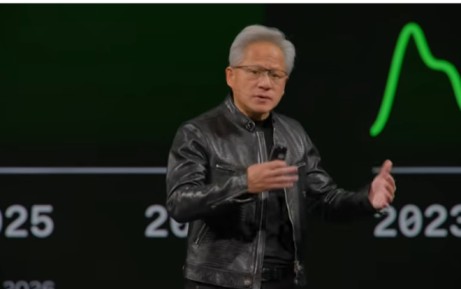
Editor’s Note: In this keynote address from NVIDIA GTC Taipei 2026, CEO Jensen Huang announces that the era of “agentic AI”—where intelligent agents autonomously reason, plan, and use tools to perform productive work—has officially arrived. He introduces groundbreaking hardware and software solutions, including the Vera Rubin system, designed specifically to power these sophisticated agents at scale. (June 1, 2026)
TRANSCRIPT:
Opening Video
VIDEO CLIP BEGINS:
This is how intelligence is made. A new kind of factory. Generator of tokens. The building blocks of AI. Tokens have opened a new frontier, turning data into knowledge, reason, action.
They reveal patterns in complexity we could never see. Mirror our cities to keep us safe. And lift us high above them. Tokens help robots learn from us. Work alongside us.
They go where we cannot. They go where we cannot. Lending us helping hands. Closing the gap between hope and healing. So that we breathe easier.
And the smallest hearts beat stronger. Tokens are helping us break new ground. On a scale never attempted. So we can reach… Star cloud one, separation confirmed.
To infinity and beyond. To infinity and beyond. Together, we take the next great leap into a bright new future built for all mankind. Built for all mankind. And here, in Taipei, is where it all begins.
VIDEO CLIP ENDS:
Welcome to GTC Taiwan
UNIDENTIFIED SPEAKER: Welcome to the stage, NVIDIA founder and CEO, Jensen Huang.
JENSEN HUANG: Welcome to GTC Taiwan. So great to see all of you. Very good to be home. I brought my parents home. Where are my parents? Everybody give a round of applause to my mom and dad.
And a round of applause for our pre-game show superstars, ladies and gentlemen. Look how adorable they are. The superstars of Taiwan.
There are so many of you here today. We are broadcasting this right now to 70 other watch parties across Taiwan. 70 different conferences are going at the same time. Everybody is watching this keynote.
We have so much to tell you and I have so many partners to thank. It is incredible how large our ecosystem in Taiwan has become. Most of the time when people think about ecosystem, they think about our software stack. They think about the developer ecosystem above the computing systems that NVIDIA builds.
But NVIDIA’s ecosystem spans all the way upstream to all of our supply chain here in Taiwan, where it all begins, and downstream all the way to data centers and eventually to end users. Today, we’re going to talk about almost all of the ecosystem. There are so many people to thank. I love my ecosystem here.
There are so many companies here. And some of my favorite ecosystem partners. So many. So many. Taiwan’s rich ecosystem. The richest ecosystem. The world’s best supply chain ecosystem. Unbelievable.
Well, thank you all for being here. And this year, our businesses together are growing incredibly. In fact, somebody told me last night that the annual GDP of Taiwan is going to grow almost 10%. And that’s incredible. Well, we have a lot to talk about. Let’s get going.
The Rise of Agentic AI
Two years ago when I was here, I started to talk to you about how AI has moved from generative AI and the other waves of AI that are coming. The next wave of AI was agentic AI. And today we can say that agentic AI has arrived, that useful AI has arrived.
Now what does this mean? This is GitHub. This is, of course, one of the first applications of agentic AI — software coding, one of the most valuable professions. Incredibly large ecosystem, 30 million, 40 million professional software developers, probably another couple of hundred who are students and enthusiasts and so on and so forth, but say 30, 40 million software developers in the world code for a living. And this represents most of them.
This is GitHub. The pull request is when they download software, they modify it, and commit is when they push it back up. And so if you could look at this, in 2023, the number of commits was 300 million. 2024, 400 million. 2025, 500 million commits. In the first few months of 2026, it has nearly tripled.
Now, what does that mean? 30 million software developers representing about $3 trillion worth of GDP — producing, that’s what they’re paid — $3 trillion worth of salaries per year, which is generating economic growth for the rest of the industries. Say $100 trillion of the world’s industries is impacted, is generated by $3 trillion worth of salary.
That $3 trillion, excuse me, $3 trillion worth of salary is now producing nearly three times as much output. It’s effectively a $9 trillion productivity from $3 trillion of salaries. Does that make any sense? The difference is absolutely extraordinary. This is the potential. This is the promise of AI.
The number of engineers, software engineers, is actually increasing. People talk about AI reducing jobs — complete nonsense. It’s causing more software engineers to be hired. And the reason for that is very simple. If you can hire a software engineer and you could generate $9 trillion worth of productive work, why wouldn’t you want to hire more software engineers?
If that line was flat, then obviously people will hire fewer software engineers. But because the output is so incredible, people want to hire more software engineers. This is going to show up in our economy somehow soon.
And so the first thing is useful AI has arrived. Now, what does that mean from the industry’s perspective? From the industry’s perspective, that means that tokens are now in extraordinary demand. Because if you could do this, you’re going to want to produce more of it.
And because tokens are now profitable units — tokens are now profitable units of revenues — because it is now profitable, the AI companies want to build a lot more tokens, generate a lot more tokens, build more AI factories, which is the reason why compute demand here in Taiwan has skyrocketed.
The compute pattern has changed. Everything has changed. So the first idea is that useful AI has arrived. AI is now a profit generator. AI is now a GDP generator. Behind it is a whole new kind of computing pattern.
Understanding the Agent Architecture
Not just a large language model, but an agent. Today, almost everything we’re going to talk about is going to be based on this. So let me take a quick moment and show you what I’m talking about.
Inside, this is an agent. It’s an agent application. In the old days, this would be application. This would be code. And this would be operating system. Application code running inside an application, inside an operating system.
Today, it is an agent, which consists of a large language model, or many, sitting inside a harness, and that harness helps it, orchestrates it, to do productive work. This is the input. When that input comes, it has to understand, observe, reason, act, use tools. That tool could be a spreadsheet, web browser, a data processing engine, database engine, for example. This is orchestrated — this harness orchestrates, this routing of information.
Every single time it touches either processing the context, understanding what is happening, reasoning about what to do, coming up with a plan that it acts on — that orchestration path is orchestrated by some software. And so this is fundamentally an agent. It deals with short-term memory, called working memory, long-term memory, just like we do — we have long-term memory. And so the memory management system is incredibly important.
This entire system is called an agent. The large language model is used to do the thinking, and the harness connects everything together, just like an operating system. And so this is the new computing model and this is what an agent is. It could do incredible things.
This is the big breakthrough. The simultaneous convergence of large language models that are now able to do a really good job thinking, reasoning, planning, using tools, and the fact that we have now these harnesses that manage memory, the orchestration, uses tools — we can now do amazing things.
Live Agent Demonstrations
Let me give you some examples. This is a prompt. This is the prompt. This is the code that is generated. And this comes out. This is the input. This is the input. And that’s the output. What do you guys think? It’s pretty amazing, right?
AUDIENCE: Yeah. Woo! Woo! Woo! Woo! Woo! Woo! Woo!
JENSEN HUANG: We use Claude Code here, but Codex does an incredible job as well.
Here’s another example. This is the input: “Create a GIF, NVIDIA green dots on black scatter, form Taiwan 101 building, more of 2 GTC Taipei 2026, more of 2 NVIDIA I logo, then scatter and repeat.” Right? So you saw that. That was the prompt.
Here’s the next one. “I lost my remote control battery clip. It looks like this. Create a CAD file.” It uses a tool. “Create a CAD file, ready for 3D printing to create a new one.” Make sense?
This is now the new computing pattern. Whereas we used to launch an application, click and type, we now replace that with explaining to the AI what we want — our intent — and the AI generates the code or uses tools and produces the necessary output. This is how computers are going to work in the future. This is agentic AI. For two years we’ve been building towards this and now it has arrived.
CUDA-X Libraries as Tools for Agents
Now, one of the big breakthroughs, of course, is tool use. A lot of people have said, “Jensen, AI is coming, agentic AI is coming, therefore all of the software companies are going to go out of business.” I said it’s exactly the opposite. Because there are going to be so many agents, the world is no longer limited by the number of people. Therefore, those agents are going to use more tools than ever. This is actually an incredible time to be a software company. But the software has to be presented to the agent in a way that the agent can use it. This is a big breakthrough.
And in fact, what we have done — as you know, what NVIDIA’s treasure is — is all of our CUDA libraries. I call them CUDA-X libraries. This is NVIDIA’s treasure. Today we’re able to now present these CUDA-X libraries to agents who can use them much more effectively than even humans. So this is a wonderful time for CUDA-X libraries.
VIDEO CLIP BEGINS:
UNIDENTIFIED SPEAKER: 20 years ago, we built CUDA, a single architecture for accelerated computing. We reinvented computing. A thousand CUDA-X libraries help developers make breakthroughs in every field of science and engineering. CUDA-X libraries are tools for agents.
CULITHO for computational lithography. CUOPT for decision optimization. cuDSS for direct sparse solvers. AIQ for deep research across structured and unstructured documents. Aerial for AI-RAN. Warp for differentiable physics. Parabricks for genomics.
At their foundation are algorithms, and they are beautiful.
VIDEO CLIP ENDS:
JENSEN HUANG: A round of applause for math. Math is beautiful.
The Disaggregated Computing Model and Vera Rubin
The computing pattern, the computing pattern of software is going to change. In fact, let’s come back to this. This is the agent. It is the ultimate disaggregated and distributed computing model. So many different computers are going to be activated in order to process this agent.
The agent consists of model, harness, tools and skills, and a runtime. All of that is running at different places in a data center. You can think of the model as the brain, the harness as the body, the tools that it uses — working in a runtime, think of it as a workshop. So this is a person, a worker working with tools in a workshop. Of course, this is being done at extraordinarily large scales.
And each one of those steps are running in a different part of the computer. You could see the large language model is thinking — context processing, observing, understanding the environment, reasoning, coming up with a plan, and acting on the plan. Every single time that happens, an entire rack of Grace Blackwell NVLink72 is activated. It’s thinking with a large language model.
Whenever it uses a tool, a CPU is used. That tool could be a C compiler. It could be Python. It could be JavaScript. Or it could be accelerated computing.
Today’s agents are relatively simple users of tools. Tomorrow they’re going to be very sophisticated users of tools, which is the reason why the CUDA-X libraries that I showed you are going to be incredibly popular with agents. They solve some of the most important problems the world knows. And all of our CUDA-X libraries are now going to come with skills that the AI could learn how to use. The CUDA-X library, some skills — basically a manual — the AI reads it and goes, “Aha, that’s how you use it.” The ability to use these libraries by agents is going to be incredible.
And so the tools run on CPUs and GPUs and large language models. The security harness runs on CPUs and a security processor called a DPU — NVIDIA’s BlueField. The orchestration of all this runs on a CPU. This is the entire harness and the CPU is orchestrating all of the work.
One of the hardest parts is memory. You could just imagine. The working memory is called KV caching. What to remember? Compaction — not just compression, but how to retrieve. Do you retrieve structured data? Do you retrieve unstructured data? What is the ontology, the relationship of all of these different data to itself? That entire processing is incredibly complicated. The memory system of AIs is going to cause the storage system to be completely revolutionized.
As you can see, every aspect of this computing model, this computing pattern, this new application called an agent, is fundamentally different than the way that applications used to run — a whole bunch of software sitting inside a binary, sitting inside an operating system.
This is the reason this disaggregated, this distributed, this heterogeneous computing problem is precisely the reason we built our next generation, Vera Rubin. Vera Rubin is not one chip. Vera Rubin is not a GPU only. It starts with the GPU, but Vera Rubin is incredible.
This entire thing is Vera Rubin. From end to end, it has GPUs, Vera Rubin, NVLink 72. It is orchestrated by Vera CPUs that I’m going to tell you more about. The storage systems, revolutionary. Vera, along with CX9, our software stack called DOCA, the security processor that’s inside so that everything is encrypted at rest, in motion, as well as in use. Everything across this is secure because the AI model is so precious. This is the reason why this entire system obeys confidential computing.
Each one of these systems would be a complete revolution in itself. Vera Rubin is the most ambitious endeavor in the history of our company.
NVIDIA DSX: Building AI Factories at Scale
JENSEN HUANG: The whole company worked on Vera Rubin across all 40,000 engineers, not to mention all of you. All of you participated in the creation of this entire system. Vera Rubin is really a miracle, and it’s not just one chip, it is so many. Well, it’s even beyond that. A long time ago, NVIDIA used to be a GPU company.
But over the years, we’ve evolved to become a systems company. You’re looking here now for the most complex systems, most complex and ground-up system ever designed. But ultimately, our customers, our partners don’t want to buy computers. They want to build AI factories, which is the reason why NVIDIA has really started to transform ourselves yet again. You could see so much of our technology is now at the entire infrastructure scale.
Our partners are at infrastructure scale. Power generators, cooling systems, the grid providers. So many industrial companies are now part of our ecosystem because ultimately we’re trying to build an entire stack, just like GPUs, just like when we were building Grace Blackwell NVLink 72, just like now, we are building a full stack system so that our customers could build amazing AI infrastructure. Let’s take a look.
VIDEO CLIP BEGINS:
UNIDENTIFIED SPEAKER: The world is racing to build AI factories, the largest infrastructure build out in human history.
AI factories are incredibly complex, every layer. Chip, rack, network, power, cooling, grid must be designed together from end to end because compute is revenues. NVIDIA DSX is the Blueprint, a reference design for building and operating AI factories at maximum efficiency and profitability.
It starts with DSXSim. With the DSXSim Omniverse Blueprint, partners design and validate an NVIDIA Vera Rubin AI factory before a single rack lands. They plan the layout, simulate the power and cooling, design the network, validate every integration, test every change in the digital twin.
The factory powers on. DSX OS takes over and provisions, operates, monitors, and remediates the infrastructure, turning the installed systems into trusted, multi-tenant, resilient, AI-ready capacity.
Today’s AI factories over-provision power by up to 40%. DSX Max LPS lets operators safely deploy more GPUs inside the same power budget, adding billions in annual revenue. Breakthrough hot liquid cooling at 45 degrees Celsius uses less water and energy. More power going to revenue generating compute. Incredible.
Dynamic power allocation steers power from rack to rack, recovering stranded watts, sending them where work is happening. In-rack power smoothing flattens peak current spikes and power surges.
Throughout the factory, teams of AI agents work with DSX Max LPS, continuously coordinating to balance cooling and power to meet workload demand. DSX AI factories are flexible energy assets that operate cooperatively with the grid. DSX FLEX reads real-time grid signals and dynamically adjusts factory power when the grid needs relief.
A hundred gigawatts of AI factories will come online before the end of the decade. NVIDIA DSX AI factories run at highest efficiency, produce the lowest cost tokens, and make the grid stronger.
VIDEO CLIP ENDS:
The AI Factory Ecosystem
JENSEN HUANG: I’ve shown you ecosystem slides of the past, where NVIDIA’s computing layers and software and computing stacks are integrated into other people’s platforms, third-party platforms and libraries that serves end markets. That was a computing ecosystem. This is an AI factory ecosystem. This is way downstream of all of you.
Upstream of me is all of you, and downstream of us is this ecosystem. Because NVIDIA ultimately is not just building a GPU, not just building a system. We’re helping customers build these AI factories, these AI infrastructure that is so immensely complex. Each one of these at one gigawatt level started at $20, $30 billion dollars. It is at $50, $60 billion dollars, and soon it will be $80, $100 billion dollars per gigawatt.
$100 billion dollars into an AI factory. It must work the first time and must work right away. The cost of capital is incredible. The complexity is incredible. So as you see, we used to design a chip inside a computer.
And then we simulated a system inside a computer. Today, you saw just now, everything was built in Omniverse. I’ve been working with Omniverse with all of you for a long time. This was the dream come true. So that we can build these gigantic systems as large as the world wants to build inside a digital framework, inside a digital simulator, in a digital world, long before we break ground and put our money to work.
So this is our ecosystem, we call it DSX. RTX is for our GPU, DGX is for our systems, and now DSX, basically infrastructure.
Global AI Cloud Partners
JENSEN HUANG: Because of the work that we do here across this entire stack, including our systems and software, it’s the reason why we can work with small companies and enable them to be world class AI clouds. Every one of these I’m about to show you are small companies just recently. Now CoreWeave is worth $50, $60, $70 billion dollars and growing incredibly fast.
Recently, we worked with Nebius and again, they’re growing incredibly fast. Each one of these clouds have incredible customers. Cursor, the software coding company, Black Mountain Labs, Image Generation, World Labs, World Foundation Model, Revolut, the leading financial services AI company, and Shopify.
Here’s another one. This is NScale, and their customers are British Telecom, Google. Google is using one of our AI clouds. Thinking Machines, a Frontier Labs company, was super exciting. Here’s Naver Cloud in Korea, Bank of Korea, Hyundai, so many incredible companies. Here’s one in India, Yoda, incredible companies. Here’s one based in Singapore, building in Australia, Together AI. AI Singapore. This is one in Indonesia.
Each one of these companies are serving regional as well as global customers. AI is going to run everywhere. Every company will be powered by it. Every region will build it. Indosat here in Indonesia. Here in Taiwan, GMI.
It’s okay to clap. So incredible, incredible, incredible companies, incredible opportunity.
Compute is Revenue
JENSEN HUANG: But all of them need several things. Of course, they need the computing stack. This entire stack underneath, this is what made NVIDIA famous. All of our hardware and software and libraries, our connection into the world’s ecosystem of third-party developers makes it possible for anyone to stand up an AI cloud. However, the AI cloud is so complex now.
This is the software version. This is the computer science version. The money version, the asset version is what I showed you earlier. It’s a giant factory. Having this ability alone is not enough, which is the reason why NVIDIA has become an AI infrastructure company.
Now doing this well and becoming incredibly good at helping customers build AI factories and deploying AI factories is incredibly important. The reason for that is this: compute is revenue now. Compute is profit. The absence of revenues and profit is loss.
And so it’s really important to realize that this is an example of an AI infrastructure coming online. It could be coming online quickly. It could take a while. Its throughput could be high. It could be low. Its resilience and reliability could be good or bad, and its lifetime of usefulness could be long or short. Because this represents $50, $60, going to $100 billion dollars. This curve matters greatly.
Which is the reason why NVIDIA is such a great partner. Working with us, because of our fully integrated capability, we didn’t just come up with a PowerPoint slide. We created the entire infrastructure. We connected everything together. We built out billions and billions of it ourselves to make sure that everything works well.
As a result of that, our time to first token, our time to first inference, our time to training turned on is much faster. Second, because our throughput per watt, our tokens per watt is utterly world class. And the reason for that is because we integrate everything, we design everything from the ground up, we simulate the entire system, and we use extreme co-design. Just like I showed you just now with the Vera Rubin Rack, everything was designed in order to deliver on this incredible throughput.
If your data center, if your factory has 1 gigawatt, it will not have more. One gigawatt means one gigawatt. That’s all the power generation you could do. If you have one gigawatt of power, then throughput per watt is revenues. Because every token is profitable. Every token is revenues. This is the future. Compute is revenues. Performance per watt is your revenues.
Choosing the wrong architecture just because the chips are cheaper doesn’t make sense. You need to make sure that your revenues per watt — the more you buy, the more you make — and so tokens per watt. And then lastly, reliability. If you ever get a chance to see these data centers, there are so many moving parts, millions of cables. The ability for all of those computers to work harmoniously, reliability is extremely low. It is just extremely difficult.
We have now been operating very large scale for a very long time. That experience matters. That difference, mean time between interrupts, extremely important.
And then lastly, this is very hard. The lifetime of these systems — the software is changing all the time. Four years ago, which is in the time of Hopper, AI has completely changed. Six years ago, this is the timeframe of Ampere, AI has completely changed. We started out talking about CNNs. Then we talked about transformers, and then we talked about a mixture of experts. Now we’re talking about agentic systems.
Every single generation, every single few months, the software industry is coming up with new technology. If your architecture is not flexible, if your ecosystem is not rich, then this curve cannot be long. You cannot predict how long your system can last. I can. NVIDIA systems are all over the world. Software developers start with NVIDIA CUDA. And by definition, therefore, the ecosystem, the useful asset is going to be much longer.
The difference is essentially cost. You could think of it as revenues, but the other side of revenues is cost. If the life of the asset is long, the TCO is low. This is the difference. This is what it looks like when compute — the more you buy, the more you make.
Now all of you are experiencing this with me, isn’t that right? All of your demand, your factories are working so hard, your people are working so hard all across Taiwan because everybody wants to make money. They realize that AI, useful AI is here. Profitable AI is here. Compute demand is incredibly high and compute demand is the constraint. And so let’s go work super, super hard and help the world stand up AI factories everywhere. This is why it’s so important.
Vera Rubin: Now in Full Production
JENSEN HUANG: I’m so happy. Here I am standing in front of you. Vera Rubin is in full production. The supply chain we created for Vera Rubin is twice as large as Grace Blackwell. It’s incredible. And what used to take two hours to assemble one Grace Blackwell rack now only takes five minutes. So not only is the capacity higher, the throughput is a lot faster, and we need it all to support the demand. This ecosystem is extraordinary. Millions of square feet has been put online to support Grace Blackwell and preparing now, ramping up now, Vera Rubin. I want to thank all of you. Vera Rubin is now in full production. Thank you. Let’s take a look.
VIDEO CLIP BEGINS:
UNIDENTIFIED SPEAKER: Large language models generate answers. Now AI agents can do work. But processing agentic AI is a whole different kind of problem.
Agents observe, reason, plan, use tools. They manage massive context, juggling working memory and long-term memory. They spin up sub-agents, specialists on demand.
NVIDIA Vera Rubin is a multi-rack pod scale system built to process agentic AI and is now in full production. The manufacturing, automation, and orchestration across the supply chain. A miracle to witness.
Our journey started when we launched the first AI supercomputer, NVIDIA DGX1. Over the next decade, we pushed every chip and system to the limit. From Pascal and the first NVLink to Grace Blackwell, the first rack-scale AI supercomputer, and now Vera Rubin, the first multi-rack pod-scale supercomputer built for the agentic age.
It starts at TSMC. The seven new chips that make up Vera Rubin take shape through hundreds of processing steps. Three nanometer process, CoWoS-R and CoWoS-L packaging, HBM4 memory from Micron, SK Hynix and Samsung.
The Vera Rubin Compute Board. Six trillion transistors with over 18,000 components on one board. Vera Rubin NVL72 does the thinking, prompt and context understanding, reasoning, and planning.
Next, a new modular compute tray, streamlined with a new PCB midplane design. Superchips, ConnectX-9 SuperNICs, and BlueField 4 DPUs, all made in place, with no cables for resiliency at AI factory scale.
Eighteen compute trays, nine hot swappable NVLink switch trays, new high-efficiency manifolds, liquid-cooled busbars carrying over 5,000 amps — the equivalent of 20 electric cars at full acceleration. Together, 1.3 million components form this third generation MGX rack design.
Congratulations to Microsoft for their operational Vera Rubin NVL72 engineering rack. Congratulations to Dell and CoreWeave as well for standing up their Vera Rubin NVL72 engineering rack.
Then the Vera CPU rack. 256 CPUs in a single liquid cooled rack, orchestrating the models, shuffling memory, launching tools.
At Foxconn and Quanta, Groq 3 LPX takes shape. 256 Groq 3 LPUs across 16 trays, 40 petabytes per second of SRAM bandwidth for ultra-low latency. While NVL72 generates tokens at the highest throughput, Groq LPX generates them at the lowest latency.
Vera BlueField 4 STX, where AI keeps its memory. Storage processing accelerated by BlueField 4, connecting memory, storage, and in-silicon security.
And NVIDIA Spectrum-X Ethernet Photonics, the world’s first Ethernet switch with 200 gigabit co-packaged optics, TSMC’s Coupe Process, chip scale packaging, and ultra high-powered laser dies on indium phosphide.
Vera Rubin, five connected rack scale systems, a supercomputer for AI agents, 150 supply chain partners across Taiwan, millions of square feet of factory floor, hundreds of sites, chips, packages, systems, and data centers pushed to the limits of size, power, and scale.
This is what we call extreme co-design. We did this with Taiwan. Together, we reinvented computing for the age of AI. Taiwan was with us at the beginning, and here today as we bring Vera Rubin to the world. Thank you, Taiwan.
Ladies and gentlemen, Vera Rubin.
VIDEO CLIP ENDS:
JENSEN HUANG: Vera Rubin was not just built for AI. Vera Rubin was not built just to run AI. Vera Rubin was built to run agents. This is an agentic system.
Vera Rubin: The Next Generation AI Computing System
Imagine the complexity, which is the reason why agents is the last computer science breakthrough. It has taken this many years for agents to realize its potential and become useful. It stands to reason that the computer that runs it is the most advanced in the world. This is Vera Rubin. Let’s take a look.
JENSEN HUANG: Can we bring out Vera Rubin, please? And Janine, do we have the racks, the systems? It looks heavy. This is Vera Rubin. Vera Rubin NVLink 72.
This is the Grok LPX. At the next GTC, I’m going to talk to you about a lot more of this. Today, we have so much to talk to you about. This is Vera CPU rack. 256 CPUs, all liquid cooled.
Let me tell you about Vera in just a moment. This is the Vera Bluefield storage processing system and also security system. And of course, this is our Mellanox networking, the world’s first CPO. This is Vera Rubin. Incredible technology all coming together.
Now when we built Hopper, we built Hopper, as you know, for pre-training. Pre-training was the most important application, the most important workload we were working on at the time. Then when we worked on Grace Blackwell, everybody said, “Jensen, you know, NVIDIA is really good at pre-training. Inference is so easy.” Do you remember that?
People used to say inference is so easy. We could do that too. But as you know, inference equals money. And the models, MoEs are so complicated. And to do it at incredibly high response time, fast interactivity, and high throughput at the same time is incredibly hard, which is the reason why we created NVLink 72.
Today, NVIDIA’s token cost is the lowest in the world, not by 10%, by X factors, orders of magnitude, all because we did extreme co-design, all because we understood the computing model, the computing pattern of inference, and we were able to create NVLink 72. Now, with Vera Rubin, it is beyond inference. It is now inference in an agentic system. This is Vera Rubin. No cables, no hoses, no fans.
What used to take — the last time when I showed this to you, we had cables everywhere. The cables were amazing to look at. But now there’s a PCB in the middle which connects both sides. What used to take two hours now takes five minutes. The reliability and the resilience of Vera Rubin is going to be off the charts.
This is our Vera CPU tray. The most advanced CPUs that has ever been built. I’m going to show you that in just a second. This is our storage tray. Two Vera CPUs, four CX9, incredible amounts of software.
This is our new LPX, LPU-30, the Grok system, designed for very low latency inference. The throughput is delivered by Vera Rubin and extended with NVLink 72. If you want to extend that even further, you can have Grok LPUs. Here we have the Vera Rubin NVLink switch tray. This is the switches in the middle and this is revolutionary.
Because of Vera Rubin’s, because of NVLink 72 and the NVLink switches that we created and invented. And this is our ethernet switches for scale out. What’s amazing is we introduced these two systems for Grace Blackwell. These two systems were created for Grace Blackwell and today NVIDIA is the largest networking company in the world. I’m so proud of the networking team. This is such an incredible enabler for everything that we do.
I’m going to now talk to you about the next major industry we’re going to be part of.
Thank you. Zaijian. I think there are 2,000 people back there pulling that.
Vera CPU: Built for the Age of AI
Okay, let’s talk about CPUs. Vera CPUs. CPUs built for the age of AI.
All of the CPUs until now were created for people. We were the users. We were the renters. The way we use CPUs, we live in a world counted by seconds. The way we rent CPUs in the cloud, each one of them — the more CPU cores you have, the more you can rent. The economics of the old CPU, the use case of the old CPU, fundamentally different than agents.
Agents are impatient. They don’t live in a world that is in seconds. They live in a world that’s in nanoseconds. When it uses a tool, it wants the response time to be as fast as possible. When it accesses a database, it has to come back as soon as possible. Every moment that the agent is waiting keeps it from going to the next step, the next step, the next step. It is vital that we make the CPUs as low latency as possible, as interactive as possible.
So we created Vera CPU for the age of AI. Now, inside our system, it’s used for three different ways. The first way, of course, is Vera Rubin for thinking, and inside the Vera Rubin rack there are already two CPUs. As you know, we are building and selling millions of Vera Rubins. We have sold millions of Grace Blackwells.
NVIDIA already is one of the largest CPU makers in the world. In the Vera Rubin rack are two CPUs. One for orchestrating and managing the GPUs, managing the KV cache, dealing with all of the software that runs in the rack. We also have the Grace Bluefield that is used for security and isolation. The Vera compute is used for the harness, the orchestration of the AI models, tool use, accessing the database. And the data servers are right here — Vera Bluefield.
The fastest storage servers, the fastest storage system the world has ever made. The reason why this is so vital is because agents are accessing memory so incredibly fast. These systems, the storage server and the CPUs, are now the critical path of the most expensive part of the data center. This is the most expensive for a good reason. The economics of the AI factory is tokens.
And the tokens are created here. And so of course, you want to manufacture and generate as many tokens as possible. This is where you put all of your economics. And this has to not be in the way. And so, Vera CPU has great pressure on the CPU architecture, which is the reason why we built a brand new architecture from the ground up, a CPU the world has never seen before.
We call it Vera. This is CPU for agents. All the CPUs of the past, we built for humans. This CPU is built for agents.
The Four Pillars of Vera CPU Architecture
Well, there are four things to keep in mind. The four takeaways.
The first takeaway is that the instructions per clock of Vera has to be incredibly good because we need the latency to be short. We need the processing time — single threaded performance. Not throughput, single threaded performance has to be world class, absolutely the best. Single threaded performance, which is the reason why the IPC, the instructions per clock of Vera, is so high. It’s the highest in the world. 10 instructions fetched, decoded, and executed per clock.
Number two. The bandwidth necessary to move data in and out for the CPU has to be utterly world class. The second thing is bandwidth per core. The third is just bandwidth, period.
We’re moving — remember, I said earlier, agentic systems is fundamentally disaggregated and distributed. When computing is disaggregated and distributed, networking becomes the problem. Therefore, we have to move the data around as fast as possible between the CPU cores and between the CPU and the storage, the CPU and the GPU. The bandwidth around the system and inside the CPU core has to be utterly world class.
This is the first CPU that’s been built in a long time that is literally at radical limits, with a fabric that connects all of the CPU cores that is speed of light. 3.6 terabytes per second. No chiplet stacks, no chip boundary crossings, because we need to have everything — because the CPU cores are talking to each other with extremely high bandwidth. They’re not rented core per core per core. They’re all working together.
The cross-sectional bandwidth of Vera is off the charts. It’s the first one to be PCI Express Gen 6. It is also the first one to have LPDDR5 with 1.2 TB per second. Two to three times the bandwidth of the highest performance CPUs on the outside, three times the bandwidth on the inside. The bandwidth per core and the bandwidth period is world class.
Now remember, I showed you earlier, the number of CPU cores, the number of CPUs is going to be quite high. And the reason for that is very simple. We created CPUs for humans in the past. And humans, there are only 1 billion of us. There will be billions of agents and these agents are going to be using the CPUs with very little patience, because the cost of the GPU they sit next to is too high and therefore too valuable, too precious.
Therefore these CPUs are going to be both performant, but they also have to be extremely energy efficient. So that we can cram as much CPU as we can into the factory without taking away power from the token generation, which we know is how we make money.
These four properties — instructions per clock or single threaded performance, bandwidth per core, the total bandwidth around the chip and inside the chip, and energy efficiency — defines Vera. It is absolutely world class. When you compare it to the highest performance x86, it is just off the charts. When you compare it in real single threaded performance, real performance, it’s off the charts. It is incredible to be able to deliver 5% improvement on CPUs. It is incredible to be able to deliver 10%. But this kind of performance speed-up is just unheard of.
This is NVIDIA Vera. What do you think? Let’s take a look.
VIDEO CLIP BEGINS:
UNIDENTIFIED SPEAKER: Agentic AI changes the role of the CPU. The CPU is now the conductor, and the GPU is the orchestra.
Traditional CPUs were built for a different era, maximizing cores per socket, slice them up, virtualize, rent by the hour. In the age of agents, the CPU is now a bottleneck to GPU utilization, directly affecting token throughput, latency, and user experience.
NVIDIA Vera is the CPU built for the agentic loop, combining NVIDIA’s custom data center CPU core with the scalable coherency fabric for the right balance of performance cores and bandwidth to maximize AI factory output.
At the heart of Vera is the NVIDIA Olympus Core, built for modern data center workloads, branch heavy Python runtimes, tool calls, and sandbox code execution. Each core is tuned for throughput. A neural branch predictor, evaluating two taken branches per cycle. A 10-wide decode engine brings in more work each cycle. A large out-of-order engine keeps instructions moving. Advanced prefetchers with a novel graph engine anticipating the next data path.
But fast cores only matter when data arrives correctly and on time. Vera is the first CPU to use LPDDR5X memory while correcting multiple errors simultaneously without compromising bandwidth. Vera achieves 40% lower peak memory latency versus x86, keeping cores fed on time through retrieval, analytics, and sandbox execution.
NVIDIA’s second generation scalable coherency fabric unifies all 88 Olympus cores on a monolithic mesh with separate dies for memory and I/O. Cores are not split across chiplets, enabling 50% faster core-to-core communication than traditional CPUs. And memory coherent NVLink chip-to-chip connects GPUs directly to the fabric.
Beyond GPUs, NVLink chip-to-chip can scale Vera up to multiple sockets, enabling massive bandwidth between CPUs. Vera delivers 1.8 times the agentic sandbox performance of x86 CPUs. Standalone Vera racks run agent sandboxes, tools, code, and data pipelines. Tightly coupled to Rubin GPUs, Vera keeps accelerated workflows moving. NVIDIA Vera Bluefield 4 STX powers context memory and AI storage.
Compute, networking, storage. Vera is the CPU for the age of agents.
VIDEO CLIP ENDS:
Vera CPU Performance: Real-World Benchmarks
JENSEN HUANG: This is going to be our new major growth driver. The reviews are already coming out and it’s pretty good. That’s pretty good stuff.
Now, remember, Grace and Vera are also the most highly qualified CPUs in the world of AI because every single data center, every single cloud, every single enterprise, every company that works with NVIDIA on AI has already qualified Grace. The entire software stack has already been optimized for Grace. Every company will be qualifying Vera. Vera will be the most optimized agentic CPU in the world.
Simply because it’s going to go with Vera Rubin. Simply because we made the big hard switch. In fact, during Grace Blackwell’s transition, the biggest risk was going from external CPU x86 into Grace Blackwell. That transition was extremely dangerous, but we did it with incredible execution. Now Grace is literally synonymous with Grace Blackwell. When people say Blackwell, they say Grace Blackwell, because it is utterly now everywhere. Every company’s software stack has been optimized for it. Everybody’s security stack has been optimized for it. And now here comes Vera. I’m super excited about that.
Now look at some of the performance numbers. Speedups is one thing. It is extremely hard to speed up SQL. SQL, the most famous domain specific language, DSL, that has ever been created. Before SQL, before CUDA, there was SQL. Before OpenGL, there was SQL. Invented by IBM. Today it is the structured database engine of the planet. Everybody uses SQL. This is SQL running three times faster. Not 10% faster, not 25% faster, three times faster. Incredible.
This is real time — the next one is real time stream processing. Remember, your AI is going to be not just reading documents. Your AI is going to be watching for telemetry, especially inside a factory, inside a stock exchange. You’re going to be looking for telemetry continuously. The burst of data that’s coming in goes into a CPU.
This is Vera CPU running real-time stream processing for New York Stock Exchange. Lynn Martin, the president of New York Stock Exchange, has been so gracious to partner with us. This system is run all over the world in real-time stream processing. Vera CPU, six times — all because of the bandwidth, the single threaded instruction execution, the bandwidth inside between the cores, the bandwidth outside. Vera is completely revolutionary. That’s Vera.
X factors is something you talk about when you’re talking about GPUs. It is quite rare that somebody talks about X factors on real workload, real workload that is associated with CPUs.
NVIDIA Vera CPU and the Agent Economy
JENSEN HUANG: So I’m so proud of the team. You guys did such a great job. We have an extraordinary roadmap coming. But what’s really exciting is almost everybody is supporting Vera. They’re as excited as we are.
This is Vera opening up. It’s opened up a brand new market. Agents, agents is a new workload. We built CPUs for humans in the past. We need CPUs for agents, agentic systems.
The properties are different. Why would the old CPUs be the same? We are building millions and millions of Veras, millions of Veras. And to go to market with us, Taiwan’s ODMs and computer makers, all the OEMs, and you could see the early adopters. The early adopters are the agent companies. This is the beginning of a new market, a market that never existed before. It’s not going to take away from the old markets, but this is a new market. CPU for agents.
And this market will surely be larger than the last. And the reason for that is because there’ll be a lot more agents than there are people, and the agents are very impatient. So, NVIDIA Vera CPU. Thank you. This is the most important slide, really.
The NVIDIA Agent Toolkit for Enterprise AI
This is the takeaway. The takeaway here is that this is the application pattern. This is the computing pattern of the next decade. Agents, harnesses, orchestrating large language models. Every company will run it.
Every company will be an agent company. Every company will have agents running inside. Every company will see that agents will need its own operating system. Every company’s asking us, “How do we run agents safely? How do we build agents for our own workloads?”
And so we have the NVIDIA Agent Toolkit for Enterprise AI. You’ve seen me build this in plain sight. Almost everything that NVIDIA does, as you know, at every GTC, if you go back and look at my GTC five years ago or 10 years ago, you will see today. This, you’ve seen me talking about for several years now, because we’ve been building for this moment. There are four things that companies need in order to build agents as a service or build agents to operate.
The first thing you need is you need models. Of course, large language models. The smarter the better, the cheaper the better, the faster the better. The second is you need a harness to orchestrate the whole thing. The third, these models want to use tools, and these tools come with its skills.
And I showed you CUDA-X libraries, those are going to be amazing tools for the agents in the future. And then lastly, you need a runtime. You need the operating system that holds it all together. This is the NVIDIA toolkit for agents. It includes models that you can modify.
NVIDIA’s world-class open models, and I want to show you more. You can run agents from anybody. You could run Cloud Code, incredible agent. Codex, incredible agent. You could run it inside this harness called Open Shell, which will be highly secure for your inside the enterprise. The shell protects the agent, keeps it grounded in security policies.
Privacy is protected. Its rights and privileges are given. Its identity is protected. And so this Open Shell is being adopted all over the world. NVIDIA Open Shell is open source.
You’re going to see so many companies adopt it. Red Hat, Canonical, Microsoft, it’s going to be adopted everywhere. This is an important — this is the runtime, and this runtime is fully optimized for the NVIDIA AI platform, which is everywhere. So you can run Open Shell in any cloud, on-prem, and even on-device. So you have now tools and libraries that they can use.
You have models that you can modify or use as is, or you have agents. This would be OpenClaw, Hermes, another incredible harness. These agentic harnesses can now run on-prem or for you anywhere. So four things, and this represents the operating system of the modern enterprise.
Chip Design SuperAgents: NVIDIA and Cadence
Now, how do we use this? One of my favorite use cases of agents is chip designers. It is the single most important thing that NVIDIA does. And so, of course, we have to partner with Cadence to build SuperAgent, a chip design SuperAgent. It is orchestrated by Codex or Cloud Code.
It has RTL and architecture diagrams or schematics or specifications as input and whatever you need to fix. And together we created some super agents that are optimized for the NVIDIA runtime with Nemotron. Let’s take a look. It’s really incredible.
VIDEO CLIP BEGINS:
UNIDENTIFIED SPEAKER: Cadence and NVIDIA are partnering to build chip design agents.
Hundreds of thousands of NVIDIA chips come together to make the AI factories that power the world’s frontier AI models. Designing these chips and the systems they run in is one of the hardest engineering challenges. Trillions of transistors, three-dimensional circuits, microscopic scale, every gate, every wire, synchronized to picoseconds, must work in perfect harmony with no margin for error. Physical prototypes are too slow and too costly. So engineers work in the digital realm.
Each chip begins as a set of architectural specifications, then translated into RTL, the language of chip design. RTL must be verified in simulation. A single bug can delay a chip by months. At NVIDIA, thousands of engineers, billions of compute hours per year, millions of tests, written, run, and debug. A cycle that takes teams weeks.
To compress this cycle, Cadence and NVIDIA built a design verification agent. Codex orchestrates the process. Cadence Chipstack launches the RTL verification loop, powered by Nemotron and secured by NVIDIA OpenShell, calling on expert sub-agents in RTL generation, test bench creation, regression testing, and debug. The system drives itself. The chip stack agents run hundreds of simulations with Cadence Exelium, formal verification with Jasper.
Design flaws, revealed. Bugs in the code, fixed. What once took weeks, now takes hours. Verification cycles, over 40 times faster. Together, NVIDIA and Cadence are reinventing chip design with AI agents.
VIDEO CLIP ENDS:
JENSEN HUANG: From weeks to hours. NVIDIA has thousands of chip designers. We are going to hire hundreds of thousands of Cadence super agents that work with us so that we can accelerate our company so that we can be even more ambitious, create even more amazing things, run even faster. You saw earlier that the toolkit with models, harness, tools — the tools in this case are Cadence simulators and verifiers, formal verification systems. It is the reason why we’re working with Cadence so hard to accelerate all of their tools on CUDA, because the agents are impatient. The agents want the answer immediately.
And so, models, harnesses, accelerated CUDA, accelerated libraries and tools, and then the runtime. What you saw just now is all of that coming together. Now, one of the things that it starts with is a great model that Cadence could modify and tune to be expert at the Cadence workflow, at the Cadence expertise, so that they could create super agents that are proprietary to Cadence with their proprietary knowledge. They have to start with an excellent model. We call it Nemotron.
Introducing Nemotron 3 Ultra
NVIDIA is dedicated to build open models for the world so that all of you, all of us, could create our own agents. Today we’re announcing the Nemotron 3 Ultra. Announcing the Nemotron 3 Ultra. Our next open model and it is smart. The Nemotron models not only give you the model, we give you all the data that we use to train the model.
Because we have a coalition of incredible partners, you can see all of our partners down here. We work together, contribute data to each other. Nemotron is trained on one of the largest suites of long-running reasoning models, long-running task solving tool using data sets in the world. Because of all of our great partnerships. All of this from the model, the training script, and the data made completely available to you.
This is open models at its best. The best open model system policies in the world. Simple goal is so that you can take all of it, add to it, make it even better, make it yours. Nemotron 3 Ultra is five times faster. This is the world’s first model based on a hybrid architecture of SSM state-space models with mixture of experts.
The architecture is incredibly fast. We made it fast so that you could think fast. When you think fast, you could think longer at the same cost. So five times faster. It is also 30% cheaper.
30% lower cost to run in total flops and total inference time than even the most cost-effective in the world. We’re comparing against the world’s best open models. Frontier smart, five times faster, 30% cheaper, completely open. We’re completely dedicated to this. This is now Nemotron 3. We’re currently working on Nemotron 4.
So this entire toolkit from models, harnesses, tools and skills, and runtimes is the reason why every enterprise company in the world has the ability now to create their own agents, just like Cadence did with their super agents. And we’re working with so many companies, Cadence and CrowdStrike and SEL and Palantir, SAP and ServiceNow. People always said, “Jensen, the agents are going to disrupt these markets.” I said completely opposite and you can now see it.
Agents is going to create the largest opportunity ever for my partners and friends. We have the NVIDIA agentic toolkit for Enterprise AI to help them. So there you go. First, Vera Rubin in full production. Two, Vera CPU. CPU built for a new generation for agents. And three, NVIDIA’s enterprise AI toolkits so that every enterprise and every enterprise software company can build agents.
Reinventing the Personal Computer
My relationship with you started here. And many of you, many of my friends and partners here in Taiwan, your companies started here. This is, in a lot of ways, the beginning of the modern computer industry, 40 years now.
NVIDIA is 33 years old. The PC industry was already starting to get to Windows 1 and Windows 2 and Apple 1 and Apple 2. And by the time that we came along, Windows 3.1 was the PC. And as you know, Windows 95 made PC personal. It took PC from enterprises, companies, and made it into a consumer electronics device. Everybody should have one, and everybody does.
This is the beginning. This computing platform did several things incredibly smart. Windows was not just disaggregated, as you know, Windows was properly abstracted. It was architected just right. Systems biases, open chip sets, the operating system with drivers, drivers that could be connected and installed at runtime, and an abstraction layer with a multimedia API that opened up the PC to what we all know today. Each one of these elements were essential in making the PC so popular.
Forty years later, Microsoft and NVIDIA are going to reinvent the PC. This is going to be the new PC. Now, tomorrow night — I think it’s tomorrow night our time — I’m going to be with Satya. We’re going to talk a lot more about the work that we’re doing together. Microsoft and NVIDIA, over the last three years, it took this long to completely reinvent how the PC is going to work so that we could be ready for this moment.
As I mentioned earlier, that compute pattern called the agent is going to run in AI clouds. It’s going to run inside enterprises. It is also going to run on your PC. What’s going to happen to that PC when it has an autonomous agent? An agent that’s helping you, that understands you. You could talk to it, it could look at you, you could ask it to read files, go help you, do some research. It could do a lot more that I’ll show you.
But the new operating system is, of course, the old operating system plus large language models. Large language models in a lot of ways is the modern version of DirectX. It has, of course, input and output, understands prompts, it understands computer vision, it can generate video, it can generate sounds. It is the modern extension, the intelligence extension of the PC, of a computer. On top of that, the application, as I mentioned before, is going to be replaced by now an agentic runtime. And that is the modern application, an agent.
Let’s now take a look at what it can do.
Introducing NVIDIA RTX Spark
VIDEO CLIP BEGINS:
UNIDENTIFIED SPEAKER: It started with a spark, an idea. To reimagine the PC for the first time in 40 years, for the age of AI. What becomes of our personal computer in a world of agents? Agents running natively, connected to models, local or in the cloud. Our personal AI, sandboxed for security, running continuously, getting work done.
The chips and the OS must evolve. Introducing RTX Spark. Everything we’ve learned over 33 years distilled into one chip. Blackwell RTX GPU with 6,144 CUDA cores, one petaflop of AI performance. A custom 20-core Grace CPU built in partnership with MediaTek. Fused by NVLink. 128 gigabytes of unified memory. TSMC 3 nanometer process. 70 billion transistors. And in close collaboration with Microsoft, a Windows platform for agents.
We’re reinventing the personal computer. For creating. For gaming. For agents. This is the dawn of a new personal computing revolution. And it starts with NVIDIA RTX Spark.
VIDEO CLIP ENDS:
JENSEN HUANG: Here it is. Of course, I got to show you the most beautiful part, which is video games. It is also the closest to our heart. This is Forza. This is 007, by the way. The new 007 game, I’m looking forward to playing it. I look a little bit like him. Ladies and gentlemen, NVIDIA’s RTX Spark laptops.
Thank you. I have too many things in my pocket. Too many things.
This is the most amazing chip the world has ever built. This is the N1X that we built in partnership with MediaTek. I think I saw Rick earlier. This is N1X, this is a beautiful chip. This is a chip that frankly would take 33 years to build.
And the reason for that is because 100% of NVIDIA software stack runs here. If you want to run digital biology, no problem. If you want to do seismic processing, no problem. You want astrophysics, no problem. Everything associated with CUDA, all the physics, all the biology, all the genomics, all the AI, no problem.
All the computer graphics, no problem. Every single application NVIDIA has ever created and every single application that Windows has ever run. Microsoft and NVIDIA meticulously optimized everything so that this computer literally runs everything the world has ever created, plus it now runs agents. An incredible computer. I’m so proud of it.
RTX Spark and the Reinvention of the PC
Okay. Now, I want you to keep that in mind in the next video I’m going to show you. Just imagine everything here is going to run on your PC. Now that computer could have a local Nemotron 3 Ultra model or Nemotron 3 Super model, or it could have a cloud code or codex or some other model in the cloud or something on the network. And it’s going to work and do something amazing.
VIDEO CLIP BEGINS:
Every house starts as an idea. Getting from idea to design takes a myriad of tools, expertise, and a lot of time. Now an agent running locally on RTX Spark can help me design a house using the tools on my laptop with an open shell sandbox running the Hermes harness connected to Claude Sonnet in the cloud. I select the site, share my concept sketches and mood board of styles to inspire my design.
And the prompt, a text description of the requirements and the design intent. My agent goes to work using the tools on my laptop. It opens Rhino and starts modeling the site, shaping terrain, setbacks, and the building envelope. Then it proposes building forms optimized for cost, comfort, and quality. With the form defined, my agent generates the interior layout.
Walls, circulation, rooms begin to take shape. I jump in whenever I want to adjust to change. Doors, windows, and structural elements are placed automatically. My agent detects its own mistakes and fixes them. When I approve, the agent exports the model from Rhino into Blender.
Materials and object properties transfer with the design context intact. I fine-tune the materials, get the look just right, then I pick the shots. Blender renders the house. My agent, using generative AI with the Flux 2 model, makes them photoreal. Multiple viewpoints, lighting conditions.
What was once a complex workflow is now guided and simplified by my agent. Working with me on RTX Spark. Designed at the speed of imagination.
VIDEO CLIP ENDS:
Adobe and the RTX Spark Ecosystem
JENSEN HUANG: He’s seen the world of agents. The developers are so excited about it. This is an incredible computer. All of the acceleration, all the software capabilities associated with it, working with every developer to make it incredible for all of you.
The next one, Adobe. Incredible tool suite, of course, used by tens of millions of people around the world. They have re-engineered the architecture, the core of Adobe Photoshop and Premier, and they will release it for RTX Spark. It is twice as fast. It’s already fast. Now, it’s going to be twice as fast. It’s also designed to be agent-friendly. With its MCP server, it can now interact with agents on your laptop.
The number of customers, the number of partners that are so excited to bring RTX Spark to the market is just incredible. This is the first across the lineup of PC reinvention for 40 years. And I’m just so happy that all of you and the ecosystem around the world has joined us. This is basically everybody. Everybody will support RTX Spark and will be building incredibly smart and powerful and beautiful laptops with all of us.
A New Line of Windows Machines
Thank you very much. But that’s not all. That’s not all. RTX Spark is a reinvention of laptop. But in fact, Microsoft and NVIDIA is reinventing all of PC.
And today we’re announcing a whole new line. Three revolutionary Windows machines covering desktop, laptop, and workstations. All 100% Windows compatible, 100% CUDA, 100% NVIDIA AI Tensor Core. Everything that runs, that you see that runs on NVIDIA and all these different platforms around the world runs here. This is the first completely re-engineered, re-invented line of PCs that has happened in 40 years.
Now what’s really amazing is this. So this is the RTX Spark laptop. This is the desktop. So this one’s from MSI. Joseph, this one’s yours.
Okay, look how beautiful it is. This agent could run 24-7 meter free. And you could download your agent, you could raise your lobster in here. This is your claw. It’s running all the time.
No meter anxiety. And it’s sitting here connected to your whole house, connected to your laptop, connected to your display, all the cameras, your dryer, your water cooler, your water heater, your everything, whatever you want. Your security system, all connected to this, and this becomes your personal AI, your personal AI agent. And it gets smarter and smarter and smarter over time, because today we have Nemotron 3 Ultra. Tomorrow we have Nemotron 4, and then Nemotron 5, Nemotron 6, and we just keep getting smarter and smarter and smarter.
And meanwhile, this is sitting at home helping you do things. If you want to book a travel, no problem. And if you want an incredible system, this is a DGX Station for Windows, compatible with Windows, wants everything in Windows. And it has 768 gigabytes of memory. And so you could run a trillion parameter model.
This is unbelievable. Twenty petaflops, eight terabytes per second of memory bandwidth, and this sits by your desk. If you’re a developer of large language models, you’re a developer of agents, having this sit by your desk gives you all the compute you need, and then when you deploy it, you put it into the cloud.
The Future of the PC
Now, there’s something that if you look at this and think about this, something is happening here. Remember, 15, 20 years ago, we used to have an idea called a phone. Today we have an idea called a PC. Today when you think about your phone, the one thing you don’t do with it is make phone calls. You do just about everything else. And so that phone means something very different to you than a phone of the past.
I am certain what’s going to happen here is that the PC 10 years from now and the PC that you think about today, a tool, whether you launch applications, click and type, and this PC is going to be completely different.
Here’s my theory. I can totally imagine, just as every house today has a home theater, where many houses have home theaters, big TVs, lawnmowers, dishwashers. I could totally imagine that someday there’s actually an AI supercomputer in your house. And it’s running all of your agents, it’s running all of your assistants. And they’re doing all kinds of things for you all the time.
And you have to have it in your house, just like you have a home theater in your house, you have stereos in your house, you have game consoles in your house. You want to assist AI agent computers running in your house. And these, in time, becomes a lot more like R2D2 to you. It becomes more like C3PO to you than it feels like a PC to you. There is no question this reinvention of the computer is as big of a deal as the reinvention of the phone into what we now know as the smartphone.
And so this is the beginning of that journey. This is the beginning of a new line. And so we have a roadmap for this. This is a brand new product family for us. Every single generation of architecture, we will have a desktop, a laptop, a workstation, and then a desktop, a laptop, and workstation.
And the thing that I am just incredibly pleased, incredibly honored, is that 100% of the world’s PC industry has joined us to reinvent the PC. A new line, a new beginning. Thank you.
Agentic AI Across Every Platform
As you know, agentic AI is just a digital robot. It understands, it reasons, it plans, and it acts and uses tools. Agentic AI is going to run across all of these computers. And you’ve seen me talk about each and every one of these over time. We’re working on humanoid robotics computers. Robotics computers of all kinds. We’re working on self-driving car computers. We’re working on satellites.
You have GeForce, which has tensor cores. I just talked about a whole new line of PCs. Agriculture equipment, manufacturing equipment, heavy industry equipment will all be agentic. You’ll even have a little agentic helper for yourself. Even your base stations, the radio stations of the future are going to be agentic. Understanding traffic and thinking about how to coordinate with the other base stations so that you could use as little energy as possible, increase the utilization, the efficiency of the spectral efficiency. And so everything will run agents.
Today, NVIDIA is largely in the center, but I am pretty certain that there will be tens of billions, hundreds of billions over time, of agentic systems, agentic computers that are going to be running around the world. The biggest problem is data. In the case of language models, all the English and all the language that we have on the internet that we trained on was from the perspective of us. We wrote it and we’re reading it.
However, in order to create data for AI robotics, it has to be in the perception, the perspective of the robot. And most of the world’s video data is from a third person, not first person. And so, agentic systems, robotic systems, physical AI, the data is the hardest problem.
Physical AI and the Cosmos 3 Foundation Model
You’ve seen us move up this ladder. We started with teleoperations, which is basically human demonstration. This is no different than the big breakthrough of reinforcement learning human feedback. Then we use simulation. This is where Omniverse comes in. This is no different than reinforcement learning verifiable rewards. And so we use these systems to bootstrap the AI model, the physical AI model. Eventually we’re able to learn from third person, reprojecting it into first person, and now eventually through bootstrapping we have a world foundation model that can understand the physical world from any perspective you want.
Third person, first person, outside in, inside out, doesn’t matter. This is a big breakthrough indeed. And today, we are announcing Cosmos 3. Cosmos 3 is the frontier of physical AI. We are at the frontier with language models. There are so many people working on it. However, in physical AI, we are absolutely the world’s best. I am so proud of the team for doing this.
This is the foundation model for all of your work. Whenever you want to create a robot, whenever you want to create a factory robot or a robot that works in a factory, any kind of robot that involves the physical world, you now have a companion, a Cosmos 3 that can understand and reason. It can generate, it can simulate in the loop, it can even be the policy itself. It is on the top of leaderboards all over the world. I am incredibly proud of Cosmos, and today we’re announcing Cosmos 3. Let’s take a look.
VIDEO CLIP BEGINS:
UNIDENTIFIED SPEAKER: The real world is infinite and unpredictable. Physical AI needs data, but real world data is impossible to scale. For physical AI, compute is data. This is Cosmos, an open frontier omni-model for physical AI, built on a new mixture of Transformers architecture. Pixels, action, sound, and language flow into the autoregressive Transformer, which reasons, plans, and instructs the diffusion transformer, which generates what comes next.
Developers post-train Cosmos across embodiments and use cases. As a VLM, Cosmos watches the physical world, understands what’s happening, describing scenes, and flagging what matters. As a world model, Cosmos generates physics-accurate synthetic video from an image, text, or video. As a simulator, Cosmos closes the loop for policy training and evaluation. And as the foundation of NVIDIA Omnidreams, an action-conditioned world model, Cosmos predicts the future frame by frame.
Post-trained Cosmos, and it becomes a world action model. Perceiving, reasoning, planning, generating actions. For robots of every kind. For everything that moves. A new kind of data, a new kind of teacher generated by compute. Cosmos, the foundation for developers of the age of physical AI.
VIDEO CLIP ENDS:
JENSEN HUANG: It takes data plus compute gives you AI. Now that we have AI, compute is data. And so use Cosmos 3, train a whole bunch of AI models. Cosmos is such an incredible open model system. It’s exactly the same as Nemotron. We open the model, we open the data, and we even open how we trained it so that you could enhance it for yourself and turn Cosmos into your proprietary model. We have such incredible partners working with us in so many different industries.
Alpamayo: The World’s First Reasoning Autonomous Vehicle
Now, the model itself is, of course, the most understandable part of the AI stack, but the AI stack is very complicated. It has generators, the model, simulators, and the runtime. Just as it is for agentic systems, these cars are essentially a physical AI, an agentic robot that is an autonomous vehicle, has also this complicated stack.
Today we’re announcing Alpamayo 2, an open model for self-driving cars. We’re working with car companies across the world. If you look at these brands that have signed up for the NVIDIA Hyperion that are building NVIDIA Hyperion cars, this represents about 80% of the world’s cars. The manufacturers represent 80% of the world’s cars. We are going to have a whole lot of NVIDIA Hyperion systems that are able to run Alpamayo or anybody else’s AV stack.
We are also connected into mobility services. Approximately 97% of the world’s mobility services are connecting with us so that when we deploy Alpamayo on the Hyperion runtime with the Halos operating system, we will be able to connect to all of these services across the world. Let’s take a look at this.
VIDEO CLIP BEGINS:
UNIDENTIFIED SPEAKER: Hey Mercedes, let’s go to my favorite sandwich shop.
UNIDENTIFIED SPEAKER: Routing to your destination. Lane is clear, pulling out to start drive. Nudge left due to the stationary leave vehicle ahead blocking our lane. Slow down to stop at the stop sign controlling the intersection. Stop to yield to the pedestrian since the person is in our lane. Yield to the cut in vehicle from the left. Nudge left to clear the stop vehicle blocking on the right. Keep distance to the cut in vehicle since it is merging into our lane. Nudge left due to the truck blocking the right side of our lane. Your destination is on the right.
UNIDENTIFIED SPEAKER: Alpamayo. The world’s first reasoning autonomous vehicle.
VIDEO CLIP ENDS:
JENSEN HUANG: If you let it talk all the time, it will drive you crazy. But we’re very happy that it’s talking to itself all the time. That’s called thinking. And so Alpamayo is a reasoning car. The technology that we’ve created also applies to humanoids.
The NVIDIA Isaac GR00T Reference Platform
Of course, there are many new breakthroughs that have to happen. The NVIDIA Isaac GR00T is our humanoid robotic stack model, data generation, simulation, the runtime, including the operating system. This represents the GR00T platform, the Isaac GR00T platform. Every one of our systems, as you can see, the exact same pattern, whether it’s an agentic system for the cloud, agentic system for the PC, a robotic system for a self-driving car, a robotic system for a human or robot, all the same. And of course, in every single case, we build everything completely.
We build everything vertically, completely integrated with co-design, extreme co-design, and then we open it up for everybody to use whichever part you like. And whatever you want to use, we even help you modify. But the one thing that is missing is we need a reference platform for robotic systems. These robotic systems are so complicated, so many motors, so many sensors, so fragile, and yet we need to have a way to deliver these reference platforms just like we do with PCs and DGXs and clouds and self-driving cars. We now are going to do it for robots.
JENSEN HUANG: Today we’re announcing the NVIDIA Isaac GR00T, a reference humanoid robot, all fully integrated. 25 degrees of freedom on each hand, made by Sharpa. 31 degrees of freedom on the robot, six feet, 150 pounds, just like me. The first number is shorter, the second number is bigger. Otherwise, pretty close.
And this platform runs the new Thor and our entire software stack. Data generation stack, data simulation stack, the runtime, all integrated into a robot that is designed for everyone to use. Now we built this for higher education and university researchers because for them to build this is insanely hard to do. And so let’s take a look at that.
VIDEO CLIP BEGINS:
UNIDENTIFIED SPEAKER: The next leap in AI is general purpose robots, humanoids.
But building one is hard. Every team starts from scratch, stitching together simulators, teleop systems, data pipelines, and training infrastructure. Months of setup before research can start. NVIDIA Isaac GR00T, an open development platform for humanoid robots. Open models, simulation and training libraries and data generators.
Plus, the robot computer. Fully pipe clean, ready to go in hours. First, set up the simulation environment in Isaac Lab. Capture demonstrations with Isaac Teleop on a real or simulated robot. Generate synthetic data with Omniverse and Cosmos, scaling one demonstration into thousands.
Train policies, evaluate them in Isaac Lab Arena. Deploy through Isaac ROS, running on Jetson Thor. Every element, modular, open, use ours or swap in your own. GR00T is powering robotics research across every discipline, for every domain, from research labs to factory floors. One open platform.
And now, a new addition. Isaac GR00T Reference Design Robots. Built on NVIDIA’s open platform. Ready for frontier research. For any lab. Anywhere. The age of robotics starts here. NVIDIA Isaac GR00T.
VIDEO CLIP ENDS.
The Agentic Computing Pattern
JENSEN HUANG: So many robots! We’re working with just about everybody who’s working on robots in the world, or robotic systems in the world.
Let me tell you what I told you. The computer industry has been completely changed. In the last six months, everything changed. Everything changed because agents were realized and it converged with the latest frontier models, and it made possible the AI to now do useful work. The computing pattern will repeat over and over and over again.
This computing pattern of an agent that’s a model, a harness that uses tools with skills and runs in a runtime. That runtime depends on whether it’s in the cloud or on-prem, on a PC, or in a robot. But the computing pattern is exactly the same for all of them. You will use different harnesses because of your preference. You’ll use different models because of your preference.
You will improve them for your proprietary use. You will create sub-super agents that you can rent to other people to help them do their work. This agentic platform, this agentic pattern, NVIDIA has an enterprise AI toolkit. This is a wonderful way for all of you to engage AIs, and for us, it’s a wonderful growth opportunity.
Vera Rubin and NVIDIA’s Infrastructure Vision
Vera Rubin is in full production. Whereas Grace Blackwell was created to process AI, particularly inference, Vera Rubin was created to run agents. It is in full production. It is much, much more than a GPU. It is an entire disaggregated, distributed agent processing system.
NVIDIA has really become an infrastructure company, not just a GPU company, not just a systems company, but an infrastructure company to help you generate the maximum revenues, the maximum profit, and to get there as soon as possible. The agent world, this new way of doing computing, where you build CPUs now for agents, not for people. CPUs for agents has its own special requirement, and our NVIDIA Vera is revolutionary. I’m so happy about its ramp. The orders already is going to make it the fastest and the most successful product launch in our company’s history.
NVIDIA and Microsoft has created a whole new line of PCs. This is a new beginning, and of course, that exact same agentic processing pattern, computing pattern that I just described, is also going to run on all kinds of devices. I mentioned PCs, but in the future, it’ll be robots and satellites and base stations and factories, in the cloud, on-prem, at the edge. This pattern, an agentic AI system, this agentic computing pattern will be replicated in computers all over. How we think about the personal computer will very likely change.
I want to thank all of you for your partnership, your friendship. We couldn’t be here without everything that we do together. I am so proud of how you’ve been so successful this last year. The next year is going to be even more. I have one more thing for you.
Closing Performance
JENSEN HUANG: Let’s take a look. You ready, Tarzan? Let’s do this.
VIDEO CLIP BEGINS:
Agents working by your side But in case you missed things we said today We’re going to break it all down for you, Taipei Agents used to be misunderstood Only movie stars had them in Hollywood Now we all got teams making dreams come true Building companies from living rooms But they need so much compute, we hear ya That’s why we created Vera
Rubin stole the show, it’s true The cheapest tokens coming through Ten times faster inference heaven More special agents than 007 Bluefield keeps agents’ memory true
Now, let’s talk about its CPU Fifty percent faster, that’s outrageous Not for Vera! It’s built for agents NVLink Fusion blends A6 smartly Everyone’s welcome to the NVLink party
Well if you like that introduction Zero Rubins in full production Memotron Ultra leaves the run 5x faster work gets done Memoclaw keeps the guardrails right OpenShell keeps the sandbox tight Your code migrated and reviewed All before this song is through
AX is a five-layer cake Cookies revenue, make no mistake Global AI clouds build lots of gigawatts VSX keeps power lean, connecting dots Every watt optimized for you So you can have your cake, can eat it too
RTX, Marcus by the year Biggest PC moment in 40 years Agents powering all workflows Running anywhere Windows goes Harnesses run on CPU Models fly on GPU
Cosmos builds worlds that robots need Turning compute into synthetic feed Alpha-Mio sees and reasons through Understands roads like people do GR00T is how they learn to move Learning skills and finding groove Through the trees powered by Thor The future’s humanoid
Count on me Oh, we are the women Of the city of Oheon Oh, he don’t sing here Oh, Xiao Yilong, yeah Oh, he don’t sing here
The future’s bright Come see what’s next Thank you Taiwan
VIDEO CLIP ENDS:
JENSEN HUANG: Welcome to Computex. Thank you everyone. Have a great Computex. Thank you everyone. Thanks for an amazing year. Thank you for all your friendship and support. Thank you. Take care. Have a great Computex!
Related Posts
- Transcript: Howard Lutnick Interviews Anthropic’s Tom Brown at G20 Innovation Summit
- Transcript: Sam Altman Interview on OpenAI, New AI Model and Global Growth – G20 Innovation Summit
- Transcript: The OpenAI–Hugging Face Incident – Black Hat USA 2026
- Transcript: Emad Mostaque Interview on Peter McCormack Show
- Andrew Ng: The Biggest Opportunities in AI Aren’t Where You Think (Transcript)