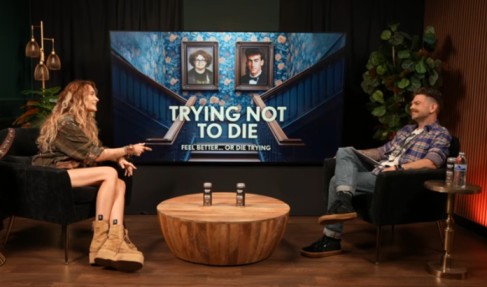
Read the full transcript of actress, and singer Paris Jackson’s interview on Trying Not To Die Podcast, May 26, 2026.
Editor’s Note: In this episode of Trying Not to Die, host Jack Osbourne sits down with his close friend, singer-songwriter and actress Paris Jackson, for an open and grounding conversation. The two bond over their shared experiences growing up as the children of legendary music icons and navigate the unique realities of living life in the public eye. Together, they dive into deeper discussions about music, personal growth, spiritual practice, and celebrating milestones in their journeys through recovery.
Introduction
JACK OSBOURNE: We have a very special guest today, my friend Paris Jackson. Howdy.
PARIS JACKSON: Howdy.
JACK OSBOURNE: How we doing?
PARIS JACKSON: Great.
JACK OSBOURNE: Right on. Thanks for doing this.
PARIS JACKSON: Thanks for having me.
JACK OSBOURNE: I appreciate you coming all the way out here to do this.
PARIS JACKSON: This is not that far.
JACK OSBOURNE: I know. Some people, you say Van Nuys and they’re like, uh… Well, I’m going to Norman’s for guitars right after. Oh, okay.
PARIS JACKSON: So I have time.
JACK OSBOURNE: There you go. What are you getting at Norman’s? A rag guitar?
PARIS JACKSON: I don’t know. They have some really good vintage ones. I was thinking of getting a Martin.
Guitars and Music
JACK OSBOURNE: Okay. Do you collect guitars?
PARIS JACKSON: I have a few. I wouldn’t say I have a collection, but I have a few really, really good, like old Gibsons. And stuff. Yeah.
JACK OSBOURNE: Acoustic or like—
PARIS JACKSON: Acoustic. I got an acoustic one from the ’50s that I got from a guitar shop up in Malibu. And then I got another one that I got out in Denver that’s like ’64. That’s my girl. That’s the one I always write with.
JACK OSBOURNE: Very cool. How long have you been playing music?
PARIS JACKSON: I started learning guitar around like 13, 14. I learned mostly on YouTube and kind of plateaued for a while because I learned enough chords to be able to write. And then in the last few years started exploring more with bar chords, which I swore off for so long and now I’ll write with them.
JACK OSBOURNE: Why’d you swear them off?
PARIS JACKSON: Because they’re hard.
JACK OSBOURNE: Yeah.
PARIS JACKSON: Bar chords are a pain in the ass. And then, yeah, I think I started kind of actually pursuing music in my early 20s.
JACK OSBOURNE: Were you skeptical? Were you resistant to pursuing music in any way?
PARIS JACKSON: Yeah. I kind of suppressed it as a hobby because of some obvious reasons, and also because I just didn’t think I was good enough. And then I just loved it so much that I was like, who cares? I’m just going to do it.
Growing Up in the Spotlight
JACK OSBOURNE: Yeah. I was always terrified. I just didn’t want to even touch it. So, hats off — anytime I meet anyone whose family is in the music business and they go on to do it, I’m always just like, man. Hats off, because I was just terrified.
PARIS JACKSON: Yeah.
JACK OSBOURNE: I played drums for a little bit.
PARIS JACKSON: Mm-hmm.
JACK OSBOURNE: And I was like, oh, this is fun. And then I just was like, you know what? No. I was drawn to the other side of the entertainment industry in that capacity.
PARIS JACKSON: It is funny. We do tend to stick with entertainment though. My brothers are going into film. We tend to kind of stay in the arts regardless. And growing up, I don’t know if it’s nature versus nurture, but it’s definitely—
JACK OSBOURNE: Yeah. Well, I look at it like this — my best friend in England, his dad was a tiler and he took over his dad’s business and he’s a tiler. And I think it’s kind of just ignorant when people are like, “Oh, well, nepo this and that.” I’m just like, oh, f* off. It’s all I know.
PARIS JACKSON: My favorite word. Right?
JACK OSBOURNE: It’s just so narrow-minded at the end of the day. Because for me, it’s going back to like the early 1900s — on my mother’s side, her great-grandmother was like a vaudeville performer and her great-grandfather was a conductor. It’s family business, the way I look at it.
PARIS JACKSON: Yeah, same thing happens with attorneys and doctors.
JACK OSBOURNE: Yeah, it’s not a bad thing.
Musical Influences
JACK OSBOURNE: What’s been your biggest inspiration with music?
PARIS JACKSON: Oh man. In the last half a decade, my biggest favorites — Radiohead. And they were probably the biggest influence for my first record. As far as songwriting goes, I’m really, really just in love with Andy Hall and Conor Oberst’s writing. I really love Margo and the Nuclear So-and-Sos, Mimicking Birds, just lyrically and melodically. But for the new stuff that I’m working on sonically, it’s a lot more like Marcy Playground, Pixies, Smashing Pumpkins, Nirvana.
JACK OSBOURNE: Yeah, because your first album had kind of a — I don’t want to say folky, but it was a little more—
PARIS JACKSON: All of my stuff is going to have folk roots. It’s something that I’m never going to be able to get away from. The singer-songwriter folky thing is just — I write on acoustic guitar, so that is just like, it’s not going anywhere.
JACK OSBOURNE: But you’re turning it up a bit with this one.
PARIS JACKSON: Yeah. Just trying new things. I learned that I can scream. So I’m like, let’s just make this kind of stuff that I would have loved when I was 14, 15 years old. And then the next album after that, I’ll probably go back to folk.
JACK OSBOURNE: Why not? What’s your favorite Radiohead album?
PARIS JACKSON: Oh, The Bends.
JACK OSBOURNE: The Bends.
PARIS JACKSON: In Rainbows is a close second, but yeah.
JACK OSBOURNE: In Rainbows is my vibe. I love that album.
PARIS JACKSON: You seem like an In Rainbows fan.
JACK OSBOURNE: Yeah, I’m an In Rainbows guy. You’ve seen them play live, right?
PARIS JACKSON: Yeah, I actually just saw them for the first time at the end of last year.
JACK OSBOURNE: Yes.
PARIS JACKSON: I was afraid — they did that European announcement and there was no mention of US dates, so I’m like, this is my one chance.
JACK OSBOURNE: Yeah.
PARIS JACKSON: So I flew out. Landed the day of the show, drove out to Oxford and did the Radiohead exhibit in the morning. Then drove into town, visited my aunt during the day in between. And then that night went and saw them at O2.
JACK OSBOURNE: Nice.
PARIS JACKSON: Went by myself, weaseled my way to the front and I had maybe 2 rows of people in front of me, but I was right there — and left the next day.
The Live Music Experience
JACK OSBOURNE: Wow. You did the real deal. Wait, you went by yourself?
PARIS JACKSON: Yeah. I was going to stay a couple extra days because my best friend lives out there, but there was a Bright Eyes show in LA the next day. So I was like, I have to do both. So I flew back for that.
JACK OSBOURNE: Right on. By yourself? Talk about that for a second. Like, you just rolling by yourself to a—
PARIS JACKSON: Well, yeah, because the thing is, if I’m going to see a band that I love that much, I don’t want to go with someone that’s not as big of a fan. I would want to go with someone that is just as much of a fan. Otherwise, I just want to experience it.
JACK OSBOURNE: Well, I’m just kind of talking from — not from a safety perspective.
PARIS JACKSON: You don’t worry about that at a concert. Everyone’s looking at the stage. They’re not looking at—
JACK OSBOURNE: That’s a good point.
PARIS JACKSON: Sometimes there are some cool moments where I definitely have moments with other people at shows when we’re watching the band that we love. We’ll sing to each other. There was a beautiful moment at the Radiohead show where the woman next to me and I were both crying at the same time, and we gave each other a really big hug. I love the live music community so much.
JACK OSBOURNE: The right live music community. Like the ones — I don’t like the live music community that’s just like, “I just want to post this.” That’s the stuff where I’m like, no, put your phone down.
PARIS JACKSON: Yeah.
JACK OSBOURNE: You’re never going to watch that back.
PARIS JACKSON: If you really love live music, you learn to hold the phone in a way where you don’t have to watch it through the screen. You just hold it up and it’s like, well, I hope I’m getting it. I’m going to watch it for real.
JACK OSBOURNE: You don’t find filming live music is like filming fireworks?
PARIS JACKSON: It can be, yeah, at times. I like filming my friends at shows sometimes. And I’ve also recently gotten back into photography, so I bring my cameras with me everywhere and I’ll snap some. I got some good pictures of the Microwave show that I just went to. I don’t know if you know them, but they’re phenomenal.
New Music Recommendations
JACK OSBOURNE: Right on. I’m pretty admittedly pretty boomer when it comes to music, especially new stuff. I’m kind of stuck in my — I’ll dip into some of the 2000s, but—
PARIS JACKSON: Early 2000s are great.
JACK OSBOURNE: Yeah, early 2000s is good, but I’m kind of a heavy ’90s grunge guy. That’s my go-to.
PARIS JACKSON: Cool.
JACK OSBOURNE: And then I don’t know why, but I was on a road trip with my wife and kids recently and I found this Creedence Clearwater Revival playlist and I was like, okay, little CCR, why not?
PARIS JACKSON: Tight. Yeah. I’m going to send you some new bands that are really good.
JACK OSBOURNE: Okay. Yeah, I need that.
PARIS JACKSON: There are — it’s hard to find, but there are some really good bands. A lot of them are local, some of them are friends of mine. Really, really good. I think you’ll probably like Microwave. The Bobby Lees are phenomenal — they’re from Woodstock. Fourth Wanderers and Nothing — Nothing’s more like shoegazy, they’re both from New Jersey. Lily is fantastic. Teenage Wrist is fantastic. There are so many newer bands that are just—
JACK OSBOURNE: All right. I’m in. Send away. Because I’m full boomer, like I said.
PARIS JACKSON: You would like Sludge Mother, actually.
JACK OSBOURNE: Sludge Mother?
PARIS JACKSON: Sludge Mother. If you like the ’90s — she’s very like Alanis style, you’d like her a lot.
JACK OSBOURNE: I like the name. I’m hearing that and I’m like, oh, is that like a doom rock band? All right, I’m in.
Public Perception
JACK OSBOURNE: Okay. Let’s pull back the layers. Let’s pull back some layers of Paris.
PARIS JACKSON: Let’s peel.
JACK OSBOURNE: Obviously people have a conception of you, right? What do you think people get wrong? When you see stuff about you — I see stuff about me, whatever — and you’re like, “No, that’s not right.” Is there one thing that stands out for you where you’re like, nope, that’s not me?
PARIS JACKSON: I think probably most of it. I haven’t been looking as of recent, and that’s been really helpful. I’m just a lot happier these days and I’m like, I should just keep that going and not look at these things, because that does chip away at my happiness.
JACK OSBOURNE: Yeah. Don’t read the comments.
PARIS JACKSON: Don’t even look. But yeah, a lot of the stuff that I’d seen in the past — most of it isn’t really accurate. There’s nothing off the top of my head that I can think of.
JACK OSBOURNE: Yeah.
Work Ethic, Sobriety & Spiritual Growth
PARIS JACKSON: I’d say maybe I hate the term “spoiled brat.” Yeah, I hate that a lot. Because there was a lot about my upbringing that was silver spoon-esque, but there was so much of it that had to be earned. There was very much a focus on developing a work ethic. And so I did see something recently where it’s like, “You don’t have to work,” and it’s like, no, I do. I really do, because if I stop, I’m like a shark. If I stop moving, I’ll die. I need it. It makes me happy to move and work and be productive. I need it for my wellbeing.
JACK OSBOURNE: Yeah, no, I get that for sure. It’s funny you say work ethic, because everyone always asks me, especially since my dad passed, they’re like, “What’s the one thing your dad always taught you?” And I was like, work ethic. My dad was like a f*ing grinder. He was like, “If you’re not there 10 minutes early, you’re late. You do your job, you get in, you get out.” And that’s something I’ve always taken on as I’ve become a grown man. I think it’s important to have, because I think work ethic isn’t something you can really learn. I don’t know, you either have it or you don’t. You can try, but it’s not something you can necessarily always learn.
PARIS JACKSON: Yeah.
JACK OSBOURNE: Do you feel like you had to do a lot of explaining of yourself?
PARIS JACKSON: In the past, yes. Not so much anymore.
JACK OSBOURNE: What changed? What made you decide to say—
PARIS JACKSON: It’s tiring.
JACK OSBOURNE: Yeah.
PARIS JACKSON: It’s really tiring. And I went through a pretty gnarly depressive spell for a couple of years. And this last year I’ve just been so happy, and I’ve just been putting all my focus into maintaining that.
JACK OSBOURNE: Yeah.
PARIS JACKSON: And it’s just a drag to have to explain myself. So I’m just kind of, what you see is what you get. And if you interpret it a weird way, that’s kind of—
JACK OSBOURNE: Not your monkey, not your circus.
PARIS JACKSON: Pretty much. Yeah. Everyone’s entitled to their own experience and their own opinions, and what other people think of me is none of my business.
JACK OSBOURNE: Yeah. So my podcast is called Trying Not to Die, and a big thing about it is, we all have our ways we try not to die, right? I think without realizing it, it’s the backbone for a lot of the “why” in people, whether it’s exercise, mental health stuff, or whatever. What’s your number one way you try not to die?
Spirituality, Recovery & Finding the Right Tools
PARIS JACKSON: Enlarging my spiritual life. For sure. That has been like the most fulfilling aspect of my life.
JACK OSBOURNE: Yeah.
PARIS JACKSON: Just my spiritual practices, service, and music. Those are the things that make me the happiest. But I spend a lot of time with my friends. I’ve whittled down my friend group and I’m very picky about who I spend time with now. And I have to say, the people in my life are salt of the earth.
JACK OSBOURNE: Yeah.
PARIS JACKSON: Just high integrity, loyal, funny, funny f*ing people. Just the sweetest human beings. And I just spend time with them.
JACK OSBOURNE: Yeah. It’s good to have a good tribe.
PARIS JACKSON: I keep getting more animals.
JACK OSBOURNE: Yeah. You might end up with another one.
PARIS JACKSON: I know. I do want that dog. I really do want that dog.
JACK OSBOURNE: Yeah. That’s a really special bond you have.
PARIS JACKSON: Oh, I bonded. She’s special.
JACK OSBOURNE: It’s like Avatar. You touch tails.
PARIS JACKSON: Yeah.
JACK OSBOURNE: How does expanding your spiritual life — what does that look like for you? Are you a churchgoer? Is it just recovery stuff?
PARIS JACKSON: Yeah, a lot of it is rooted in sobriety. But just exploring more and more things. I definitely got into tarot cards for a few years, and I don’t really do that anymore unless a friend asks me to read for them. And I mean, I’m from LA, so I’m all about the crystals and the Reiki and all that. I’m—
JACK OSBOURNE: Squeegee that third eye real quick.
PARIS JACKSON: Oh, god, I know. Yeah, dude. I sage my house all the time. But I think they’re all just kind of tools, and I’m trying out new tools all the time.
Learning energy work has been a recent thing of mine. And reading some cool stuff. I recently started reading The Tao, as well as this one book called Living Buddha, Living Christ by Thích Nhất Hạnh, which explores the similarities between Nirvana and Christ consciousness, which is really cool. And another one that’s on my list that my friend Chet recommended is called The Mustard Seed by Osho, because it explores Jesus’s teachings through the eyes of a mystic or a shaman. It’s less about the Bible and the institution of a church, and it’s just about, “These are the things that were said. These are some double meanings, triple meanings.”
JACK OSBOURNE: Yeah.
PARIS JACKSON: So that’s what I’m going to read next. But these are all just kind of tools. I do believe that a spiritual life is between me and what I consider my higher power.
JACK OSBOURNE: Sure.
PARIS JACKSON: But I’m all about finding new tools. Yeah.
JACK OSBOURNE: I think the whole journey with faith and spirituality is just that — it’s a journey. And it can change and it can evolve. There have been times in my life where I was pretty agnostic, and then times where I’m not. But I very much relate to that kind of wanting that conscious contact. Can we talk a little bit about your journey to recovery?
PARIS JACKSON: Sure.
The Road to Sobriety
JACK OSBOURNE: So what happened? You went to treatment pretty young, right?
PARIS JACKSON: Yeah. Well, I’ve been to treatment several times. I’d gone a few times prior to getting sober off of drugs and alcohol, and I went to some institutions after getting sober as well, including the Hoffman Institute, which I just—
JACK OSBOURNE: I hear great things.
PARIS JACKSON: Oh my God, if you haven’t been—
JACK OSBOURNE: I have not been, but everyone I know that’s gone there has that exact same—
PARIS JACKSON: Such an expansive experience, like truly just incredible. I’ve been to several institutions like that that do intensive workshops for therapy. I’m a big therapy girly.
But I won’t get too much into what it was like and what happened, but I got off of some pretty heavy drugs and realized that I also had an issue with alcohol, which is typically how it goes for people like me. You put one thing down, you pick up another. And the behavior is really ugly.
JACK OSBOURNE: Yeah.
PARIS JACKSON: It’s really ugly behavior in a moral way, because I was raised to be kind.
JACK OSBOURNE: Yeah.
PARIS JACKSON: Not nice. I could give a shit about being nice, but being kind — like looking people in the eye, asking the waiter their name so you can write it down on the receipt later. Just little things, like how do you treat people? And I went through years and years of self-hatred. Like, I may have been a liar, a cheater, a piece of shit, a thief, whatever, but I do have a good moral compass. I was raised right in that way. And what happens when I drink is that goes away — that goes right out the window — and I become a very vindictive person.
JACK OSBOURNE: What do you think addiction is?
PARIS JACKSON: Well, if we’re just talking about substances, I think there is a physical aspect. I think there is some kind of allergic reaction where, once we start, we can’t stop.
JACK OSBOURNE: Sure.
PARIS JACKSON: But I think even people that don’t have substance abuse issues have addiction issues to some extent. And I think that is some kind of a void — a spiritual malady, if you will — that the only thing that can truly satiate it is some kind of spiritual something.
Recognizing the Signs Early
JACK OSBOURNE: Now, from my own experience being sober and doing the work, I could kind of pinpoint markers in my youth where my addiction was present without me realizing it. Like, I was a full-on pyromaniac when I was a kid.
PARIS JACKSON: Mm-hmm.
JACK OSBOURNE: I used to set everything on fire. This was growing up in the ’90s when everyone smoked still, so cigarettes and lighters and matches were always around. Did you have anything like that when you were younger?
PARIS JACKSON: I loved setting things on fire.
JACK OSBOURNE: Oh, f* yeah.
PARIS JACKSON: I loved setting things on fire. There were definitely a lot of telltale signs that there was something that kind of set me apart from my peers when I was younger. I struggled with self-harm for a really long time, before I ever had my first drink or drug. And I had weird relationships with overeating and food as a young kid. And just, there was this overall reachy, graspy energy that I only ever really see in other addicts. It’s just this graspiness and reaching for something outside of yourself — I’ve always had that.
JACK OSBOURNE: Yeah.
PARIS JACKSON: I’ve always had that with people too, like reaching for people. And that’s been a huge thing for me — learning how to be in right relationship with myself, learning how to not be in consuming relationships with anything, which is a day-to-day thing. But it’s been probably the most non-tangible rewarding thing.
JACK OSBOURNE: Yeah. And you just celebrated 6 years, is that correct?
PARIS JACKSON: January 7th.
Six Years Sober
JACK OSBOURNE: Congratulations. That’s awesome. Right on. It’s good stuff. It’s funny — I got sober very young as well. I went to treatment when I was 17. And I was talking to a friend of mine, actually one of my very oldest friends in recovery. It’s his 25 years today. We’re going to go hang out this evening.
But you know, I was talking with our group of friends and I’m like, the one thing they don’t tell you about when you get sober is, once you’re kind of in the rhythm of it, how quickly time goes. Like it just goes. For me anyway, I just feel like it’s all gone in a flash. And you’re like, okay, when I’m not resisting life all the time and trying to will my way into the world being the way I want it, it gets a whole lot easier.
PARIS JACKSON: Yeah.
JACK OSBOURNE: How are you with boundaries?
PARIS JACKSON: I’ve gotten a lot better.
JACK OSBOURNE: Boundaries are important.
PARIS JACKSON: I’ve gotten a lot better.
JACK OSBOURNE: Yeah. I have a hard time with boundaries with a lot of things and people. I think just part of my weirdness is the people-pleasing component of like, “Oh yeah, I’ll just say yes. Yeah, yeah, no problem. Yeah.”
People Pleasing and Honesty
PARIS JACKSON: People pleasing has gotten a lot easier for me once I had a perspective shift on it, which actually one of my teachers at the Hoffman Institute said that a miracle is a shift in perspective. And I do believe that is what happens with a lot of people that experience recovery and sobriety and working on themselves.
People pleasing for me, I was so resistant to be free of that kind of defective behavior because I looked at it through a lens of martyrdom. And once I learned that it’s inherently dishonest, then I was like, oh, well, I don’t want to be dishonest. I don’t want to be a liar. And so once I kind of shifted my thinking on that and was like, okay, well, if I’m people pleasing, I’m lying. Then I was like, okay, I’m going to kind of back off from that behavior.
JACK OSBOURNE: I had a friend who’s a coach and I asked him about my people pleasing. He’s like, “You know what I want you to do? I want you to say no to everything.” If someone calls you—
PARIS JACKSON: The opposite of Yes Man, Jim Carrey.
JACK OSBOURNE: He’s like, totally. Yeah. He literally said that. He goes, “Anytime someone calls you to go get coffee or, hey, will you do this? Just say no. And then you can call them back in 5 minutes after you think about it, and then say yes.”
I’m like, that’s a really good practice. Because I’m just like, yeah, sure. Yeah, sure. And then I look at my calendar and I’m like, oh f*, I can’t do any of this.
PARIS JACKSON: Yeah.
Addiction and Trauma
JACK OSBOURNE: Do you think that addiction is a trauma response?
PARIS JACKSON: I don’t know. I think there’s plenty of people that have addiction issues that also have complex trauma, myself being one of them. But I’ve also met some people that don’t have the craziest stories and they just still ended up pickled.
JACK OSBOURNE: That’s a funny one too. I’ve got to know some people like that and I’m like, how the hell did you end up here? I have a friend from recovery and his father was a very prominent megachurch pastor who in the ’80s did a huge amount of protesting against my father and would lead these marches in Congress and do all this stuff to basically be like, “Outlaw Ozzy, he’s a Satanist.”
And it’s funny because we met in recovery and I’m like, well, I guess both our dads had it wrong. We both ended up here. So I think it’s kind of funny just how that kind of opposite can still end up in the same place.
PARIS JACKSON: I think if someone’s meant to end up there, they’re meant to end up there. There’s nothing you can do. Kind of like when your family tries to get you sober, it’s like, if you’re not ready, it’s not going to happen.
Music, Acting, and Creative Life
JACK OSBOURNE: All right. I want to talk more about your music. Zombies in Love — that’s your new single you sent me. I like it. Is it out now?
PARIS JACKSON: So Zombies in Love came out and the next one, Teenage Drama, is the newest. Next one.
JACK OSBOURNE: And the album’s not out yet though, right? Are you just doing singles? Do you have a title to the album yet? Or are we keeping it secret?
PARIS JACKSON: It’s a secret. Still working out the kinks on all that.
JACK OSBOURNE: When’s it expected to come out?
PARIS JACKSON: Not allowed to say yet.
JACK OSBOURNE: Soon-ish?
PARIS JACKSON: Soon-ish.
JACK OSBOURNE: What’s the most uncomfortable part about putting out your own music?
PARIS JACKSON: The semantics, like the business side of it. I don’t like dealing with contracts and details. I just want to make art and put it out.
JACK OSBOURNE: Sign of a good artist. An artist is an artist. Business people are business people.
PARIS JACKSON: Yeah, the business side of it is a pain in the ass.
JACK OSBOURNE: And then the opposite of that — what is the most comfortable part about putting out music? What do you enjoy most about it?
PARIS JACKSON: Giving birth, setting it free. Start working on the next thing. Having the freedom to now work on the next stuff.
JACK OSBOURNE: So you don’t marinate in it. You just kind of go right onto the next.
PARIS JACKSON: Yeah. I mean, it’s going to do what it’s going to do. Baby bird’s got to go fly and then it’ll either crash and burn or it’ll fly. I’m like, cool. Either way, I’m just going to keep making art for the love of the game.
JACK OSBOURNE: And you’re in a movie that came out this month as well.
PARIS JACKSON: Yeah.
JACK OSBOURNE: We shot the RZA film.
PARIS JACKSON: Yeah, we shot that a hot minute ago.
JACK OSBOURNE: You’re busy. Music, acting, you do some modeling. What else? Photography.
PARIS JACKSON: Yeah, that’s a little hobby. I got locked out of my photography account for like 6 years. I just got it back like a month ago on Instagram.
JACK OSBOURNE: Oh, how’d you get locked out? What’d you do?
PARIS JACKSON: I forgot the password and then I also forgot the email that it was attached to. And so we were contacting Meta like, “Please.” And they were just like, “We need the information if you want this account back.”
JACK OSBOURNE: Can’t help you if you can’t help yourself.
PARIS JACKSON: Pretty much. Yeah. So that’s just a little hobby of mine. But yeah, rock climbing — isn’t that how you and I met?
JACK OSBOURNE: We briefly met. Yeah.
PARIS JACKSON: Yeah. That’s another hobby that I love to do.
Rock Climbing and Coming of Age
JACK OSBOURNE: And that’s a recent thing?
PARIS JACKSON: I started in 2022. Our mutual friend that we met at the gym with was the one that got me into it.
JACK OSBOURNE: Have you gone on any big climbing trips yet? I just had my friend Corey on the podcast last week — awesome guy. You should, I should actually connect you guys. I think you guys would get along very well. He’s a world-class climber, done Everest a bunch, survived crazy avalanches — real deal climber guy.
PARIS JACKSON: I am nothing like that at all. I’m like baby climber.
JACK OSBOURNE: That’s fine. But any big climbing trips that you’ve done or planning?
PARIS JACKSON: No, I’ve done some outdoor climbing. When I first started, I was all about getting good grip and finger strength. And a couple years into it, I discovered stemming — that style of climbing where you’re just kind of pushing yourself. And that became just my favorite style. And now I mainly just do that. So my grip is out the window. And if you don’t have grip, you can’t outdoor climb. At least the ones in California that I’ve been to. I have yet to go to like Red Rock and the easier ones, but California outdoor climbing is no joke. Because they just didn’t change any of the grades from back in the day, ’60s, ’70s and stuff.
JACK OSBOURNE: The grading in Yosemite is completely off. You’re like, that is not a—
PARIS JACKSON: It was so humbling going from a top rope climber to a lead climber. Because I dropped a few grades. Now I’m back up to where I was, but then going from lead indoor to lead outdoor.
JACK OSBOURNE: Very different.
PARIS JACKSON: Yeah. I went from being a 5.11b climber to like a 5.8. 5’7″. Yeah.
JACK OSBOURNE: But it’s okay though.
PARIS JACKSON: Very humbling. Yeah.
JACK OSBOURNE: I used to get really stuck in the whole grading of it and then I was like, f* it. Did I have fun? Yeah.
PARIS JACKSON: That’s most important. That’s all that really matters.
JACK OSBOURNE: It’s my favorite sport because it takes you to the greatest places. There’s no other sport like it where you can just look around and go, “Wait a minute, where am I now? This is amazing.”
I was really lucky — for about 2 and a half years, I was like a full climbing bum and just traveled the world and went to all these really amazing places. It was kind of a part of my coming of age, if you will. I got sober when I was 17. And after a couple of years, I was kind of like, all right, now what? What was the point of this? And I randomly just ended up on a climbing trip, having never climbed in my life. All my friends went to college and I just packed a backpack and grabbed a passport and just traveled. It was awesome.
PARIS JACKSON: That’s great.
JACK OSBOURNE: Best thing ever. What do you think — did you have a coming of age kind of process?
PARIS JACKSON: I’ve had many. I feel like — I don’t know if you’re into astrology, again from LA into the woo-woo stuff — my astrology chart is wild. There’s a lot of craziness in the first part of my life, so much so that the Saturn return kind of starts to look a bit unremarkable, which is not the case for a lot of people.
Usually the Saturn return between 27 and 30 is when it’s like sh hits the fan, right? People get divorced or they leave the church they’re in, or they become moms or whatever — your whole life changes. And my life has just been doing that for the last 20-something years. So I’ve had many births, many rebirths, and I feel like I’ve become completely different people at different stages of my life.
JACK OSBOURNE: I think that’s okay though. I’m all about it.
PARIS JACKSON: Get it all done real quick so I can kind of chill when I’m a little bit older.
JACK OSBOURNE: I kind of had this thing recently. I was talking about it on another podcast — in my 20s I was like, cool, I’m an adult now, I can navigate the world. And then in my 30s when I became a parent, I settled into it. I was like, I got this sh figured out. And then I turned 40 last year and I’m like, I have no f*ing idea what this is.
PARIS JACKSON: But I’ve been told that 40 is like the year. Like that’s the sweet spot.
Social Media, Acting, and Growing Up in the Spotlight
JACK OSBOURNE: Well, I maybe, I don’t know. I don’t know if I’m quite in that sweet spot yet. I’m like in a place of, I don’t know. I just feel, I don’t think lost is the term, but maybe humbled is the term of like, I really don’t think my journey is what I thought it was or is, in its entirety.
I mean, I would say there are aspects like being a father, like, I’m like, nope, I’m good at that. That’s what I’m, having a family and doing that thing is super important to me. And being that kind of caretaker vibe. But everything else, I’m just a bit— it’s been a total shake-up.
PARIS JACKSON: Yeah.
JACK OSBOURNE: And it— but I’m okay with it because for me, where I go is like, well, just if you don’t know what to do, don’t do anything. And then listen, just listen for the message, listen for the guidance because it’s there amongst the chaos. And yeah, I’m figuring it out because it’s, as they say, as Michael Scott in The Office said, “crazy world, a lot of smells.”
PARIS JACKSON: Yeah, a lot of smells.
JACK OSBOURNE: Tons of them. I got sidetracked though. One spoon of chocolate. How did that come about, especially with RZA directing? Did you know RZA?
PARIS JACKSON: No, not personally. Yeah. And he’s dope. He’s such a cool guy and he’s really fun to work with. That whole set was really, really fun to be a part of. I definitely made a lifelong friend on that film, like Imairee, who was the other love interest. We were both the love interests together and we just became really, really close and she lives not too far from me, so we hang out and stay in touch. And we laughed a lot on that set, which is just super important to me. Laughter’s a really big—
JACK OSBOURNE: Yeah.
PARIS JACKSON: Big, ’cause life’s too serious. When you’re an addict in recovery and you have CPTSD and what, like, life’s too serious. You gotta have fun. That was a really, really fun project to be a part of.
Working with RZA and Acting Plans
JACK OSBOURNE: And it just came about, like you went for the audition? Because the film, I watched the trailer and it’s not what I would have expected from a film directed by RZA. It seems a little—
PARIS JACKSON: You sure?
JACK OSBOURNE: Well, it feels a little kind of out there. But then again, it’s RZA.
PARIS JACKSON: I mean, he’s super— I mean, it’s Wu-Tang. It’s like, they really like kung fu and they really like fighting. And it’s, I think it’s pretty on brand.
JACK OSBOURNE: Yeah. But the way— so how did it come about? You just got a call?
PARIS JACKSON: And Grizz is also like a massive Tarantino fan.
JACK OSBOURNE: Yeah.
PARIS JACKSON: So there’s little things in there where it’s just like, for sure, like the red apple cigarettes or whatever. Like there’s certain things where it’s like, okay.
JACK OSBOURNE: Are you going to act more?
PARIS JACKSON: Maybe. It kind of depends on what the role is and depends on if I feel passionate enough about the project to set time aside. Yeah. Because right now music is really, I would like to fill up every second I can with music.
JACK OSBOURNE: Yeah. That’s great.
Social Media: Pros, Cons, and Taking Control of the Narrative
JACK OSBOURNE: You’re pretty active on social media.
PARIS JACKSON: On Instagram. Yeah. I don’t really touch the other platforms. Yeah.
JACK OSBOURNE: What do you like about social media? Do you like having your own platform?
PARIS JACKSON: Hmm. I think social media has some pros and I think one of those pros is self-expression. I think it can also teeter into constantly performing, which does not always feel honest. And I’m not a fan of that. There’s a lot about social media I’m not really stoked on.
But it is also really nice just having access to the people I want to have access to and my friends or people that want to know about my music or want to know about what I’m doing. I can speak to them directly and that’s nice. And it’s also really convenient if there’s ever any issues with other forms of media and tabloids and things like that. And there’s something that is just, I mean, most of it is just untrue, but if there’s something that’s overtly true that I feel like I really need to clarify, then I can just handle it myself. You have it from the horse’s mouth.
JACK OSBOURNE: Sure. It kind of takes the sting out of a lot of the bullshit. Actually, it’s so funny. I posted a video last night because there’s all these articles about like, oh, I’m sick and I’m dying. It’s because literally I shaved my beard and everyone’s like, “Oh, he’s emaciated.” I’m like, no, I just shaved my beard.
PARIS JACKSON: Yeah, that happens to quite a few people. My godfather and I joked about that because he’s like, “Oh yeah, apparently in the 2000s I died like 6 times. Like I was just dead 6 times. People were like, oh, he died.” Like it was a whole thing. And even when I was in high school, I had been pregnant like 4 times. I got secretly married.
JACK OSBOURNE: Who to?
PARIS JACKSON: Multiple times. Like literally anyone that I was hanging out with, even if it was a platonic guy friend, that was my mystery man. Like there’s all kinds of stuff there.
Media Scrutiny of Young Women and Children
And yeah, media’s nuts because there was one photo of me. I remember I was probably about 14. So I think I was in like 8th grade and I was leaving my best friend’s house and I was wearing this, like, it was probably like a marble t-shirt or something. And I had like my volleyball shorts on and my shirt was folded a little bit and I was like, I had a somewhat athletic 8th grade body, but my shirt was folded and tucked in a weird way and they drew a circle around it and was like, “She’s pregnant.” And it’s like, I’ll show you the photo later.
JACK OSBOURNE: Oh my God.
PARIS JACKSON: It is crazy. The things that I’m not going to get into — media and body stuff.
JACK OSBOURNE: But the irony is that was an adult that did that about a child. Like, I mean, what the f*? I don’t know if you remember this, but when Mary-Kate and Ashley Olsen, there was like media covering the countdown until they turned 18.
PARIS JACKSON: Dude, the stuff they did to them and Britney and a lot of these young women that were literally children.
JACK OSBOURNE: Yeah.
PARIS JACKSON: Children. Yeah.
JACK OSBOURNE: Not cool. Did you—
PARIS JACKSON: I have lots of feelings about all of that. Yeah.
JACK OSBOURNE: Yeah. It’s dark. It’s really backwards and it’s like, well, you’re in the public eye, you’re in the public eye. And it’s like, well, from my experience, it’s like, I was in the public eye, but it wasn’t like I actively was like waking up being like, “I want to be in the public eye.” It just kind of happened.
PARIS JACKSON: Yeah.
Growing Up in the Spotlight
JACK OSBOURNE: When you were younger, when you were a kid, did you ever have like an “oh wait, my life isn’t like my friends at school’s lives” moment?
PARIS JACKSON: Well, I didn’t have like friends at school until I was homeschooled. For the first like 6th grade, 7th grade is when I entered like an actual school system. Didn’t have a lot of social skills.
JACK OSBOURNE: Was that a shock going from homeschooling to sitting in a classroom?
PARIS JACKSON: Yeah. And like the worst time too, like 7th grade sucks. 7th grade sucks. And then when you don’t have any pre-experience of how to interact with peers, that integration process can be kind of rough.
Yeah, I think it was just so normalized to sometimes look out my hotel room and see 1,000 people just hanging out with signs and I don’t know that there was ever like a moment where it kind of clicked. I think it was kind of just a slow, it just is. A graduation into understanding what other people’s lives were like, but it wasn’t like this jarring, “Oh, I’m so insanely different.” It was kind of just, I think I was eased into it.
Homeschooling vs. Traditional School
JACK OSBOURNE: Yeah. Did you prefer homeschooling or going to school? Because I’m thinking about homeschooling some of my kids.
PARIS JACKSON: Yeah. I think there’s pros and cons to both. I think there’s definitely a way to do homeschooling that maybe doesn’t leave the kid as social skill inept as I was. I think there’s a way to kind of integrate them with other kids. But homeschooling was definitely beneficial as far as like my actual education goes. I definitely feel like I disagree with a lot of the curriculum in most schools and I disagree with a lot of that stuff. And so I’m very grateful for the education that I had and the kind of tones of the schooling.
JACK OSBOURNE: What do you mean?
PARIS JACKSON: It was very— so I’m just going to state a fact, not an opinion. Depending on which state and city you are in, your history books are going to tell you completely different things. A history book in Houma, Louisiana is going to be completely different from one that you get in Seattle, Washington. That’s just, if you look at the things that are, that’s completely different.
And so I was very grateful for some of the history lessons that I got that were maybe a little bit more focused around harder truths and not sugarcoating, I guess, the history of the country or whatever. And that was cool. And also like having one-on-one, like I struggled with math. I struggled with anything that was left brain. So having like one person, me and the teacher, to kind of explain it to me was really helpful.
But it definitely lacked— I only really knew how to interact with adults. I was friends with my dad’s friends. I didn’t have people my age.
JACK OSBOURNE: Are you a history buff?
PARIS JACKSON: Not really. No.
JACK OSBOURNE: Oh, I love history. It’s my favorite. Yeah, it’s like the only subject I was like— but speaking of hard truths about history, I was in Washington DC last week. A congresswoman entered my father’s biography into the Congressional Record, and they gave us a tour of the Capitol Building. So we’re walking around, it’s really cool, checking out all this cool stuff. And they show us like in the main rotunda, if you look up, there’s like this circle of the formative American history of America. And like the first thing is like Columbus. And I’m like, I’m pretty sure he didn’t— didn’t he land in Cuba? Like he didn’t actually come to like North America. Which I just find it so funny how, like you’re saying, some of the stuff that I’m talking about. It’s like revisionist history. It’s like if it makes a good story, it’s like, well, yeah, it’s a good story, but it’s, you know.
PARIS JACKSON: Yeah. I think a big reason why I’m not super into history, unless it’s like maybe the history of a building or the history when it comes to people and things that they did. I’m not entirely sure how honest it all is.
JACK OSBOURNE: So no, people are horrible. Like history is not pretty. It is mean and violent and yeah, a lot of death. It’s f*ed up.
Legacy and What It All Means
JACK OSBOURNE: Well, speaking of history, do you ever think about your own legacy? Like what, how you want to leave this world?
PARIS JACKSON: I hate that word.
JACK OSBOURNE: Okay.
Legacy, Privacy, and the “Dead Dad Club”
PARIS JACKSON: Do you ever think about how— let’s reframe it then.
JACK OSBOURNE: Do you ever think about what you want your life to be and what you’d like, how you’d like to leave it behind?
PARIS JACKSON: Yeah. I’ve reframed the word legacy in my brain. And I think what it really is, is the feeling you leave in people’s hearts.
JACK OSBOURNE: Yeah.
PARIS JACKSON: And I think what I want to leave behind is, I’d say, just like a reminder. I really like the word reminder lately. I like spending time with a lot of people that are— maybe it’s a case of “there but for the grace of God go I,” of like, if I didn’t get sobriety when I did, that’s where I would maybe end up. And spending time with people of like, “oh, this is what is possible when you take care of yourself.” And when you take care of other people, you’re of service, you focus on your recovery. I like reminders of what’s possible either way. And I like the reminder of what we are inherently.
There’s a few different things that I’ve been looking into, and it’s funny how they’re all— we’re about to get real woo-woo— they’re all kind of like attached. So Ram Dass talks about— which is funny, he was in my dream last night, oddly. I’ve never dreamed about Ram Dass before.
JACK OSBOURNE: I had a really weird dream last night, but you finish.
PARIS JACKSON: I want to hear about it. I also had another weird dream where I was playing Bottle Rock and KISS was playing at the same time that I was playing. I just remember being like, “oh, f*, because they took the whole audience,” whatever.
So Ram Dass talks about being in one of two places, of being in the victim or being in creator. And being in the victim is kind of identifying with any of the things that make you you, of like, “oh, well, this is a title that I maybe have,” or “this is a thing that I like.” I think the human parts of us, and then stripping ourselves of all of these things and getting to what our true essence is — that is when we are in creator.
And there’s also certain practices in Peru, specifically with the Q’ero tribe or the medicine wheel, where the idea of being in the north chapter and stripping yourself and burning all of these roles — like maybe it’s a more light one, or maybe it’s a heavier one, like a liar or an addict, or maybe it’s a sister or mother — all of these different roles and titles, and burning all of them and getting to what the true essence is.
I’ve seen this kind of — I think even Jesus talks about it too. I don’t know enough about it, I don’t want to get too into that because I just don’t know enough. I’ve never really read that kind of stuff. But just the idea of “I am.” Not saying one specific person is, but like, “I am,” which is the same thing as the namaste thing. “The light in me recognizes the light in you.” The “I am” is the same thing that you are of the “I am.” And so there’s these really cool congruencies and through lines between all of these things that I’ve read or seen. And I would like to be a reminder of that on a personal level with my friends — just a reminder of what we really are.
Recovery, Identity, and Reframing the “I Am” Statement
JACK OSBOURNE: Yeah. I was having an argument with someone about that and how in recovery you declare your ism, right?
PARIS JACKSON: Sure.
JACK OSBOURNE: “My name is whatever, and I am…” And my friend was pushing back saying, “Well, no, I don’t like that because it’s putting me in the negative.” And I kind of said to him, “Well, I choose to reframe it in a way of — I say it as a reminder of what I was and can be if I don’t do what’s required.” And he was like, “Oh, I never really thought of it like that.” And I’m like, “Well, yeah.” But that’s kind of the interesting thing about an “I am” statement, right? It can mean one statement can mean many different things.
PARIS JACKSON: In that scenario, I would say “I have this ism.” I have.
JACK OSBOURNE: Okay.
PARIS JACKSON: Slight rewording. Yeah, but it’s a similar sentiment of like, “this is just a reminder.” Yeah, this is something that— and also, I do believe that — I think I’ve maybe said this before on a podcast or something — I do see these trials and tribulations, whether it’s a title of like alcoholic or addict or whatever, victim of trauma, f*ing whatever, as a superpower. Because when we go through the process of healing it and we go through the process of alchemizing it, it can become medicine for other people. And our experience can benefit other people. So I’ve learned the more painful that piece of suffering is, the more potent that medicine can be for someone else. So it’s a superpower.
JACK OSBOURNE: Yeah, I agree. Absolutely. I mean, if you can transmit something to someone and help, and even just be any kind of example, that’s a superpower for sure. It’s helping.
Navigating Public Life and Privacy
As an adult, did you struggle with trying to figure out how public, how private do I want my life to be? Or did you ever feel like you just didn’t have an option?
PARIS JACKSON: Yeah, there’s definitely a certain element where I felt I had to share everything and I felt like I owed it to people, because I do believe that is the impression I was given — like, “you owe this to us.” And that has drastically changed in the last few years, because I don’t really feel like any of us owe anyone anything.
The way I express myself now, I don’t want it to feel performative. I won’t get too into it, but the one main example that’s coming to mind is this idea of like, “you need to go on social media on your dad’s birthday or his death day or Father’s Day and you need to post.”
JACK OSBOURNE: Mm-hmm.
PARIS JACKSON: And you need to basically mimic how a fan would express their love. But for me, I had a personal relationship, not a parasocial relationship. So I’m now learning, “oh, I can have my own personal relationship and I’m allowed to be private about it.” And now my relationship is the most beautiful relationship ever. I’m in a very beautiful spot with my dad and I love that. And it’s no one’s business. And I don’t have to share that with anybody. And there’s a lot of freedom in that, which is really cool. But yeah, I’m not going to express my love in a copycat way, copying someone that didn’t know him.
JACK OSBOURNE: Sure.
PARIS JACKSON: Because I did — that was my best friend.
The Unique Bond of Being a Famous Parent’s Child
JACK OSBOURNE: Yeah. When my dad passed, I had this realization that out of all the people that had met him, knew him, knew of him, whatever — the millions of people — there are only 5 people on the planet that had the relationship that I had with him. And it’s me and my siblings. And when that really hit me, I was like, “wow, that is really unique.” And people can’t understand that. Unless they reflect on their own relationship with their parent, which I think a lot of people don’t. They’re looking at someone who they admire or are a fan of, whatever — it’s a hard thing to separate. Like, “oh wait, I wonder what that relationship was like.” And I often get the, “oh, what was it like to have Ozzy as your dad?” And I’m like, I don’t know what it’s like not to.
PARIS JACKSON: Right.
JACK OSBOURNE: It’s just my dad.
PARIS JACKSON: I think that’s the silliest question in the world. Yeah. I think it’s the silliest question.
JACK OSBOURNE: I’m like, he was my dad. He took me to school, he f*ing taught me things and did what dads do. And I think, yeah, as I said, people have a hard time separating.
PARIS JACKSON: Yeah.
JACK OSBOURNE: Sometimes.
PARIS JACKSON: Yeah. I think it’s cool. I have a couple other friends that are in a similar position as us. They’re part of the Dead Dad Club, and their dads were also artists. And it is nice having this kind of, “yeah, I get it. I get it.”
JACK OSBOURNE: I get it. Yeah.
PARIS JACKSON: But there’s certain things that we can roll our eyes about, and there’s some things that it’s kind of like, I don’t know, it’s just nice.
JACK OSBOURNE: Yeah. And there’s a huge amount — for me, and obviously I’m relatively new in that club — of gratitude for it. And not in an elitist way, just like, he was something to so many people, but he was my dad to me. And I’m so grateful for that.
PARIS JACKSON: And that’s yours.
JACK OSBOURNE: Yeah.
PARIS JACKSON: And you don’t owe that to anybody. You get to just have that and hold it and keep it. And it’s like, “okay, this is mine.”
JACK OSBOURNE: That’s pretty cool.
PARIS JACKSON: Yeah.
JACK OSBOURNE: It is. It’s funny — before my dad died, I kept telling my kids, “talk to him, ask him anything. He’s not going to be here forever.”
PARIS JACKSON: Yeah.
JACK OSBOURNE: And I think one of them did. My daughter, Andy, she would always text him.
PARIS JACKSON: Yeah.
JACK OSBOURNE: You know, you got to have those moments of humanity. And I was really encouraging them to have that. Because for me, it’s like I could try and hide, deny, whatever, and push back on like, “no, it was normal dad, normal dad.” But I know, you know.
PARIS JACKSON: No one’s normal.
JACK OSBOURNE: No one’s normal. But also, as you said earlier, superpowers — I know my dad had some weird superpowers. I don’t understand it. I’m not a musician. I can’t do what he did. But I think there are certain people — your father clearly included — that bestowed these kinds of gifts. I mean, it is a spiritual thing. I think at the end of the day, when people make a sound that just moves people—
PARIS JACKSON: Yeah.
JACK OSBOURNE: I don’t get it. I never understood it. I enjoy it though. I like feeling that vibe.
No Regrets
What do you have any regrets?
PARIS JACKSON: No.
JACK OSBOURNE: No regrets?
PARIS JACKSON: No.
JACK OSBOURNE: No shoulda, coulda, wouldas? No. That’s awesome.
PARIS JACKSON: Yeah.
JACK OSBOURNE: That’s a good place to be.
PARIS JACKSON: Yeah. I realized that recently. It’s probably in the last year that I’ve actually spent time with that question. I know I answered it really fast — I’ve spent time with that question. And I’m like, I don’t think I regret anything.
JACK OSBOURNE: Great.
PARIS JACKSON: Were there things that, if I look back on it, I kind of maybe cringe a little bit — certain things I’ve said in interviews where I’m like, “oh my God, you idiot.” But there’s certain things that obviously make me feel weird looking back on. But I’m at a place now where I do understand a sort of divine timing, and everything happens as it should or as it’s supposed to. And being like, “wow, that experience must have happened for a reason. And if I don’t see it now, I will see it later.”
JACK OSBOURNE: Sure. Yeah. What do you think has been your most ick phase of your life?
Fears, Surrender, and Saying Goodbye
PARIS JACKSON: Oh my God. Yeah. Because I’m constantly learning and I have a lot of Aries placements. I’m always reinventing myself in a lot of ways. And I’m very loud about it when I do it. So I think there’s definitely a lot of, plenty of moments in like 5th and 6th grade, plenty of moments in 7th and 8th grade, plenty of moments in high school, plenty of moments straight outta high school, early sobriety. I think because I’ve changed who I am as a person so many different times, I feel like each time I’ve changed, I’ve gone through like an awkward phase.
JACK OSBOURNE: Mm-hmm.
PARIS JACKSON: So I’ve had many of them.
JACK OSBOURNE: Do you have any fears? And it can be as benign as like a spider.
PARIS JACKSON: I’ve recently developed a different relationship with spiders.
JACK OSBOURNE: Me too.
PARIS JACKSON: Than I used to. That’s so weird you say that. It’s fascinating. Because I’ve been afraid of them my whole life. And a lot of fears like that are learned. I learned that from my dad, because he was deathly afraid of spiders. And I struggled with them for so long. And then in the last year, my relationship with them has changed. I don’t even really bother as much taking them outside. I don’t want that. If one is crawling on me and it’s fast, I’ll freak out.
JACK OSBOURNE: Yeah.
PARIS JACKSON: Which happened the other day when I went to see Bright Eyes at Red Rocks. He was a fast little dude and I freaked out. But if they’re slow and they’re minding their own, they’re doing their own thing, I kind of — yeah, it was a jumping spider that changed it for me because they’re friendly, they’re cool, and they’re smart. And I feel like they’re sentient.
JACK OSBOURNE: Oh yeah.
PARIS JACKSON: No, I feel like there’s something about them. And so I let them — they’re in my house and I kind of leave them alone. If they look like they could be poisonous, I obviously do want to remove them because I have animals. But that’s different.
I don’t know. I think I’ve struggled with a lot of fears of like not being good enough and abandonment and not doing things right. And recently I’ve gotten into this new practice of like, let me just write about this fear. Okay, why do I have this fear? How do I make this fear true? Okay, if I invited my higher power into this situation and tapped into higher self, higher power, whatever, universe, any of the things, what would this turn into? And typically it turns into surrender.
JACK OSBOURNE: Yeah.
PARIS JACKSON: I think that might be the antidote for fear is just surrender.
JACK OSBOURNE: Just like, it’s going to be what it’s going to be. It’s so weird that you say that about spiders because I just got hypnotized about spiders.
PARIS JACKSON: Oh, did it work?
JACK OSBOURNE: It totally worked.
PARIS JACKSON: Huh.
JACK OSBOURNE: Like I’ve held like massive, crazy huntsman and big ass spiders since. My hypnotherapist, Jim Curtis, he’s a famous hypnotherapist and coach and really awesome guy.
PARIS JACKSON: Can I get his number from you?
JACK OSBOURNE: I absolutely will connect you. Jim is amazing. He came on the podcast and he hypnotized me on the podcast. Yeah, in like 10 minutes.
PARIS JACKSON: Is that episode out?
JACK OSBOURNE: Yeah.
PARIS JACKSON: Okay, cool.
JACK OSBOURNE: Yeah, I’ll send it to you. Jim’s the man and I’ll connect you guys.
PARIS JACKSON: That’s cool.
JACK OSBOURNE: I keep going, but I know we’re hitting up on time and I’ve got for my Patreon folks, I have some questions. So we’ll wrap this up here. Thank you, Paris. Thank you.
PARIS JACKSON: Thank you.
JACK OSBOURNE: I really appreciate the chat and I’m looking forward to the album and I’m loving the single and congratulations.
PARIS JACKSON: Thank you.
JACK OSBOURNE: And if you want to see the Patreon questions, head on over to Patreon.
Related Posts
- Transcript of Nara Smith Interview: Call Her Daddy Podcast
- Transcript of Pop Base Interview: w/ Cherien Dabis on All That’s Left Of You
- Transcript of Actor Tim Robbins Interview: Joe Rogan Experience #2532
- Transcript of Paul Wesley Interview: Call Her Daddy Podcast
- Transcript of Madonna Interview: Howard Stern Show