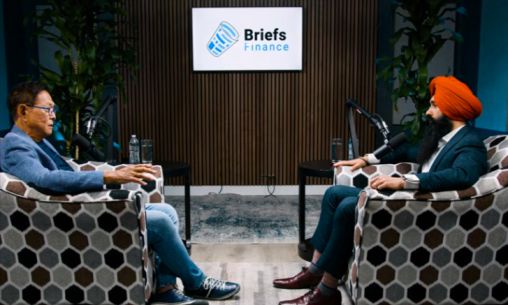
Editor’s Notes: In this provocative episode of Minority Mindset, Jaspreet Singh sits down with legendary author and entrepreneur Robert Kiyosaki to discuss the looming economic threats facing the American Empire. Kiyosaki shares his stark predictions for 2026, warning that massive national debt and geopolitical conflicts like a potential war in the Strait of Hormuz could trigger the biggest stock market crash in history. He challenges viewers to move beyond traditional 401ks and “fake money” to instead focus on acquiring “real” assets like gold, silver, and oil. Join us for a deep dive into financial history and learn why Kiyosaki believes proactive education is the only way to protect your future in these uncertain times. (April 24, 2026)
TRANSCRIPT:
The Coming Stock Market Crash and the Boomer Generation
JASPREET SINGH: Robert Kiyosaki, the economy is going through some of the biggest shifts that we’ve seen in the last century. People are concerned about AI taking jobs. People are concerned about the stock market and their 401(k)s. People are getting more concerned about where the housing market is going to go. They’re getting concerned about Bitcoin, even gold. So I wanted to get your opinion because we talked about 5 years ago. Do you think that the stock market is heading towards a downturn, or do you think that the economy is going to boom in the coming years?
ROBERT KIYOSAKI: Well, I hope I’m wrong, but I wrote a book, I think in 2012. It’s called “Rich Dad’s Prophecy.” And my rich dad says the stock market’s going to crash big time, biggest crash in history. So it hasn’t happened yet. And that’s my concern, because for my generation, I’m a boomer, I was born in 1947. And my birthday was yesterday, turned 79. And my generation, the boomer generation, is the first generation without a defined benefit pension plan. So that means if they don’t have anything by 65, they’re in trouble. And if the stock market crashes, if you get cleaned out, nobody’s going to save you. So that’s been my concern.
And then I’m a history buff. So in 1974, I was getting out of the Marine Corps. I flew for the Marine Corps in Vietnam, 2 tours. So 1974, I get out, but 1974 was ERISA in America, Employee Retirement Income Security Act, 401(k). So that was 1974. 1974, the dollar became the petrodollar. Today we have war in Hormuz. And you look at all of these, not really religious, but signs from God saying, “Hey, pay attention.” Because everything is changing at such high rates of speed.
And my message is, we know that it doesn’t make a difference what happens, but if your financial education is solid, you’ll still get rich. Like right now, the price of oil is going through the roof. I’m getting richer. Unfortunately, most people are getting poorer.
Owning Oil Wells vs. Oil Stocks
JASPREET SINGH: How are you getting richer because of high oil prices?
ROBERT KIYOSAKI: I own oil wells.
JASPREET SINGH: So you own—
ROBERT KIYOSAKI: I don’t own oil stock, I own oil wells.
JASPREET SINGH: What’s the difference between an oil stock and an oil well?
ROBERT KIYOSAKI: I own the production.
JASPREET SINGH: But if I buy stock in an oil company?
ROBERT KIYOSAKI: Well, the stock has to go up and down. I get paid for every gallon or barrel pumped. So the price of oil goes up, I get richer. Of course, I want to let you know that I did go to school for oil. So I am an oil man. I drove oil tankers, which are sitting in Hormuz right now, for a company called Standard Oil. And today I think it’s called Exxon or something. So I do understand oil and that’s what I went to school for. So somebody says, “What did you study in school? Liberal arts?” I said, “No, oil.” And my degree is in naval architecture, oil tankers. So I really do know oil.
And so I could see all of this strife coming with oil and all that. So I just bought another, I think, 20 oil wells. So they just keep pumping oil. I get paid, I pay no tax.
JASPREET SINGH: How much does an oil well cost?
ROBERT KIYOSAKI: Well, it depends on the— there’s a lot to it. I make it sound simple. But I have a whole team of people that do that, but I don’t own oil stocks.
Invest in What You Know: The Egg Story
JASPREET SINGH: Would you recommend somebody to get more involved in the oil stock market?
ROBERT KIYOSAKI: No, I don’t make recommendations. The whole thing, the reason I love what you do is we’re in the same business, it’s education. Don’t invest in oil unless you want to study oil. Like I have a really good friend, he’s a multi-multi-millionaire. And I said, “How’d you get so rich?” He says, “Eggs.” And what happened for him, ’cause we’re about the same age, when he was a kid, I think his grandmother bought him some chickens and the chickens laid eggs. And he goes, “That’s interesting.” So he used to collect the eggs and he’d go around the neighborhood selling his eggs. So this oil flow, cash flow, egg flow. So today that guy just kept reinvesting his eggs and I think he sells 1.8 million eggs a day or something.
JASPREET SINGH: Wow.
ROBERT KIYOSAKI: He has whole chicken coops. So you’re going to say, yeah, just start a chicken coop. Well, this guy just kept reinvesting his eggs. It’s capitalism. It’s not rocket science. Everybody could raise a chicken. Invest in what you know, but you’ve got to study what you want to be good at.
The Problem With 401(k)s
JASPREET SINGH: Study is more proactive and knowing assumes, and I think now a lot of people, like you mentioned, are getting to this conclusion that my job is not going to be enough. I’m earning a salary and I need to invest my money. And so what happens is your employer gives you a 401(k) and they say, this is your now retirement plan.
ROBERT KIYOSAKI: Yeah.
JASPREET SINGH: And so now it’s this 401(k), which is money invested into the stock market.
ROBERT KIYOSAKI: 1974 again. Yeah. ERISA, Employee Retirement Income Security Act, 401(k)s, IRAs.
JASPREET SINGH: And so now people are relying on their 401(k) and IRA to retire.
ROBERT KIYOSAKI: They’re counting on it.
JASPREET SINGH: They’re counting on it. And a lot of people are getting more and more anxious about the stock market, partially due to oil prices, partially due to AI, partially due to concerns about the economy and the debt and the national debt, global debt. Why are you not a fan of the 401(k)?
ROBERT KIYOSAKI: I have no control over it. I would never touch— I’m not saying you guys shouldn’t, don’t get me wrong. But I would rather raise chickens and produce eggs than have a 401(k).
JASPREET SINGH: Why?
ROBERT KIYOSAKI: ‘Cause I can control the egg flow.
JASPREET SINGH: But if I invested in the stock market, the S&P 500—
ROBERT KIYOSAKI: Do what you want to do. This is my prediction, okay? It’s not a good prediction, I hope I’m wrong. Somebody is setting up my generation, the boomer generation. What they’re going to do is the boomers have been saving all this money since ’74, 1974. 1970 was also the petrodollar, which we have a war in a place called Iran today. We’re being set up. I can see it coming. It’s happened before in history.
Thomas Jefferson’s Warning and the Petrodollar
JASPREET SINGH: See what coming?
ROBERT KIYOSAKI: They’re going to yank the stock market and they’re going to crash the stock market. My generation’s going to be homeless. It was predicted for years back in 1779 or something. A guy named Thomas Jefferson said, “If you allow a central bank to take over our monetary, our money supply,” the Fed basically, “your children will wind up homeless in the land your fathers fought for.” It’s history. Study effin’ history. 1974 was the petrodollar. We’re at war in Hormuz right now. I’m getting richer. 1974 was ERISA, Employee-Ranked Income Security, 401(k). We’re being set up.
JASPREET SINGH: Well, what is the petrodollar? Because I think a lot of people have heard that term.
ROBERT KIYOSAKI: Backed by oil. 1971, Nixon took the dollar off the gold standard and the dollar became debt. So when Nixon took the dollar off the gold, just check your history books. Everybody should know that stuff. He took the dollar off and they could print money as much as they liked. So today America is $39 trillion in debt because of what Nixon did in 1971. They should study that in school.
So they’re printing, printing, printing, printing. What goes up is the price of eggs go up and the price of oil goes up. It’s just common sense. You don’t have to go to school to understand that. So that’s what disturbs me — our education system’s Marxist. It’s criminal.
The Retirement Crisis and the Danger of Money Printing
JASPREET SINGH: But we’re in this system now. Money has been being printed and it’s been happening since 1971, and it really accelerated since 2020, the pandemic. That’s not going to stop. The money printing happens, the value of the dollar goes down, assets like real estate go up. But now for the person who’s thinking about retirement, because today we have the biggest retirement crisis in the history of time. Baby boomers are retiring with no money.
ROBERT KIYOSAKI: If what I sense they’re going to do, it’s going to be the biggest crisis of our times. I hope I’m wrong. Please, I hope I’m wrong, but I fought in Vietnam twice. I’m a US Marine gunship pilot. I killed a lot of people. And I learned to not trust my government.
So I’m fighting in Vietnam. And back then there was a guy named Walter Cronkite. Here at Arizona State University is the Cronkite School for Journalism. And I’d be on a carrier flying into Vietnam and Walter Cronkite would come on — this is Walter Cronkite and that’s CBS Evening News. And the pilots will be sitting in the room saying, “That never happened. What you’re saying never happened.”
So if you read “1984” by a guy named George Orwell, all this stuff’s easy reading. He says what government does, it takes the truth and puts it out as fake news.
JASPREET SINGH: So you think the government’s lying to us?
ROBERT KIYOSAKI: Oh God, geez. Wake up.
JASPREET SINGH: Well, if we have this now baby boomer generation retiring with very little money, let’s just assume the stock market doesn’t crash. They retire with $100,000, $200,000, $300,000, $400,000. The average 401(k) is under half a million dollars today. Not even that much, which is not enough to retire. Even if it was that much, not with inflation and debt. Inflation is going to keep happening. So these people that are now 60, 70 are not going to have enough money to continue living their life. The government—
ROBERT KIYOSAKI: If they don’t make changes.
JASPREET SINGH: And so what does that change? The government’s then going to print money and bail them out?
ROBERT KIYOSAKI: Probably.
JASPREET SINGH: And if that happens, you wipe out the generation below you, which is then the Gen X and then the Millennials and the Gen Z. But what happens then to our dollar? Because we’ve talked about how printing money devalues the dollar. There’s been concerns about inflation, but I don’t think people really understand what it means for the dollar to lose value. What does that mean and what could that mean if we continue printing money?
Oil, Eggs, and the Real Cost of Inflation
ROBERT KIYOSAKI: I met a friend of mine named James Rickards, Jim Rickards. He says, “You don’t need a PhD in economics to know that prices are going up.” And the reason it’s going up is because we print money. So prices go up because of that.
But also, again, let me say it, 1974 was a big year. ’74 was the year that came the petrodollar. So the petrodollar now affects diesel. Diesel is how they get the food from the farm to the supermarkets. So like it or not, you sit there filling up your tank of gas, you’re a soccer mom or dad, and you go to the supermarket and they’re hauling that food in. And not only that, that oil produces fertilizer and the price of fertilizer is going up. So my friend who’s selling eggs, he’s making a fortune because the price of oil, eggs are going up.
And the reason I use eggs as an example is just to be absurd. You don’t have to go to Harvard to raise chickens. But it’s that simple.
JASPREET SINGH: You don’t need to be smart to be rich.
ROBERT KIYOSAKI: No. My friend started his — his mother and grandmother gave him chickens and he just never stopped reinvesting. Now he has acres of chickens. And he sells the chicken manure as fertilizer.
Can the Government Afford the National Debt?
JASPREET SINGH: If we continue seeing inflation, oil prices go up, inflation becomes a bigger problem. The Federal Reserve Bank might be forced to raise interest rates like they did in the ’70s and ’80s. If they raise interest rates to save the dollar, how is the government then going to afford the national debt?
ROBERT KIYOSAKI: They can’t. That’s what I’m saying. You better wake up right now. They can’t save it. It’s impossible. This has happened throughout history.
There was a guy named Adolf Hitler who came to power after the Treaty of Versailles in 1918. That was end of World War I. And what France and England and America did was we told the Weimar Republic, you had to pay us back the money for World War I. So the Weimar Republic started printing dollars. They printed the Reichsmark and the Reichsmark went up. And so that’s why they had pictures of these people driving wheelbarrows full of Reichsmark.
And the woman went in — this is all in history books — she went into the store and she came back and he stole her wheelbarrow. They left the Reichsmark on the ground. That’s what’s going to happen to the dollar. History repeats.
JASPREET SINGH: Well, let’s hope you’re wrong.
ROBERT KIYOSAKI: Okay, I hope I’m wrong, but doesn’t make any difference. I’m still selling oil. My friend’s still selling chickens.
AI, Jobs, and the Future of Wealth
JASPREET SINGH: And this is where more people are hoping that technology, artificial intelligence, will come in and save the economy. Do you think the AI is going to be good for the economy?
ROBERT KIYOSAKI: It’s going to wipe out millions of jobs. It’s going to replace— what happened was, okay, there’s this guy named Bill Clinton, Tricky Dick, what was his name, Slippery Bill, whatever his name was. He opened the WTO and all this stuff. Our jobs were exported to China. So he allowed China to come into the system not that long ago. And then came Tricky Dicky Obama. Ooh. And then Biden. Ooh. You know, these bunch of rocket scientists. I mean, bunch of criminals. So they took the jobs to China. AI is going to now take away the doctors, lawyers, school teachers. You look at what’s happening right now on these streets here, is it that driver, that car without a driver in it?
JASPREET SINGH: Waymo.
ROBERT KIYOSAKI: Waymo. I mean, if I was an Uber driver, I’d say, hmm, maybe I’m out of work. But I was talking to this Uber driver yesterday, poor woman, young woman. She’s going for her third master’s degree and she’s driving for Uber. Uber and Waymo sits next to us. I don’t know if she can see it. She’s obsolete. She’s finished.
On top of that, it was Obama, not Republican or Democrat. What Obama did was he brought in the student loan program. So I’ll bet for her being a young woman going for her third master’s degree, let’s say she has $250,000 in student loan debt. It’s the worst type of debt possible. There is no more horrible debt than student loan debt. I borrow to buy a house, the banks are happy. If I screw up, bank just takes the house. But because she’s, this woman, any student is just a student, what can they do? So they make it so that if you’re a student loan person, in America, you’ll never pay it off. They’ll hound you for the rest of your life.
JASPREET SINGH: That’s where we are hearing two sides. The tech people are saying, no, AI is going to create more jobs. A lot of others are saying, what’s going to happen to my job? If I lose my job, what is my job going to be? We publish a newsletter every day called Market Briefs where we break down what’s happening in the economy. And the two biggest concerns of our readers, which are investors, are number one, the United States entering a recession, and then number two, AI.
ROBERT KIYOSAKI: That’s right. Depression.
JASPREET SINGH: Depression because of AI.
ROBERT KIYOSAKI: No, our debt. Our debt and oil and inflation. Just look at the facts. Don’t worry about AI, sports fans. That’s what I’m saying. AI is already going to replace that Uber driver. Waymo has already done that one.
Building Wealth at 25: Bitcoin, Gold, and Oil
JASPREET SINGH: So if you were 30 years old, 20 years old today, would you do something different with AI knowing what you know today?
ROBERT KIYOSAKI: Well, it depends on the person. I raise chickens right now. I’m being absurd, but people worry about things that they can’t do. We can all raise chickens. I mean, that’s how simple it is if you keep it simple stupid, K-I-S-S. I like oil, so I studied oil.
JASPREET SINGH: Do you think getting a degree is less valuable today?
ROBERT KIYOSAKI: Depends on the degree. That poor woman with her third master’s degree, she is an EMT — Emergency Medical Technician. She can’t find a job. Her third master’s in EMT. She’s looking for a job. So she thinks having a higher degree will get her a job. Well, she’s driving for Uber and Waymo sits next to her. She can’t even see it. I can see it. And, you know, well, I’d buy a Waymo car.
JASPREET SINGH: How does somebody then today, if I’m 25 years old, build wealth in this economy? Because if the stock market now is of concern due to a big crash, maybe I have a few thousand dollars saved up, maybe $10,000 saved up. What should somebody think about doing? Or I know you understand what you’re interested in, what you’re learning, but is there an industry that you think is set up to succeed over the next generation?
ROBERT KIYOSAKI: You know, that’s going on.
JASPREET SINGH: What about Bitcoin?
ROBERT KIYOSAKI: I want lots of Bitcoin or gold.
JASPREET SINGH: I mean, would you recommend gold?
ROBERT KIYOSAKI: I own gold mines. I’ve taken two gold mines public, New York Stock Exchange. I’m a capitalist.
JASPREET SINGH: Do you think that Bitcoin still has a future despite the—
ROBERT KIYOSAKI: Absolutely. And Ethereum.
JASPREET SINGH: Bitcoin, Ethereum, gold.
ROBERT KIYOSAKI: But I bought it when it was cheap. Your price is made, your profit is made when you buy, not when you sell. So right now, if Bitcoin goes to $1 million, I was rich already. I only paid $6,000 a coin. So I’m going to wait for it to get back to $6,000? No, I already bought that one. I’m buying oil now.
Tax Breaks, Capitalism, and the Wealth Divide
JASPREET SINGH: In the beginning of our podcast, you were talking about how you’re not paying taxes because of oil. How do oil and taxes work together?
ROBERT KIYOSAKI: Because it’s called— it’s a pretty sophisticated question, but they want you to drill for oil. So they incentivize you by giving you a tax break if you drill for oil. They want me to build apartment houses. So I get a tax break for apartment houses. So what I do is, let’s say I make $1 million. I borrow $10 million. I put up $10 million apartment house. I just buy one, you know. And I depreciate $10 million of the apartment house. It’s appreciation, depreciation, amortization. They teach you that in kindergarten. The 3 tax breaks are appreciation, depreciation, amortization. That’s what my rich dad taught me.
JASPREET SINGH: And you get that same tax break with oil.
ROBERT KIYOSAKI: I don’t pay tax legally because they want me to put up apartment houses. They don’t want me to own my own home. But they want me to build apartment houses. They want me to drill for oil, so the government gives me tax breaks for oil. If I have employees, I get tax break for employees. I don’t get a tax break for being an employee. I get taxed.
JASPREET SINGH: But do you think that’s where maybe the system is broken? If we have all these people set to retire with no money, the government’s not making taxes off of people that are using this depreciation tax break with real estate or oil, should they raise taxes on the financially savvy, the investors, to then pay for people to retire?
ROBERT KIYOSAKI: You must be a communist. I’m not sh*ing you. That’s what Gavin Newsom just did in California. He called it a wealth tax. Guess who left? All the billionaires left for Florida. Bezos and all those guys hauled ass out of California just 6 months ago. When you tax the rich, the rich move.
JASPREET SINGH: We’ve seen Elon Musk move his facility from California into Texas. And I think that’s where there becomes more of this animosity between the rich and the poor, the haves and the have-nots, because the rich say, I don’t want to pay taxes, I’m financially educated, I know how to use the IRS. Now, I’m an attorney and I’ve studied the tax law, and the IRS rule book is a rule book, and it tells you what you pay taxes on and what you don’t pay taxes on. And the rich, like you’ve talked about, have the teachers, the accountants, the attorneys to say, here’s what you can do to not pay taxes. Well, on the other—
ROBERT KIYOSAKI: It’s from the government that says, please do this. It’s not a loophole. It’s the government saying, we want you to build apartment houses. We want you to drill for oil. We want you to produce food. So we’ll give you tax breaks. It’s called capitalism.
JASPREET SINGH: And now this is where I think there’s a lot of need for education, because on the other side, a number of people are struggling more than really ever.
ROBERT KIYOSAKI: That’s going to increase.
JASPREET SINGH: The cost of living is going up. The cost to buy a house is going up. Incomes are not keeping up with inflation. And so the solution that many people run to is tax the rich, take those taxes, give it to everybody else. And now we will even the playing field.
ROBERT KIYOSAKI: It’s called Marxism.
JASPREET SINGH: And you’re saying that, that—
ROBERT KIYOSAKI: That’s Marxism. It’s Marxism. It’s communism.
JASPREET SINGH: But would it work?
ROBERT KIYOSAKI: No. Rich will run.
JASPREET SINGH: So then the solution you’re saying is—
ROBERT KIYOSAKI: They’re already— please, just a few months ago, Gavin Newsom imposed a wealth tax and Bezos and company hauled ass out of California. It’s costing California so much money now because they took the jobs with them.
JASPREET SINGH: At which point do you think people will realize that? Because we’ve seen this story play out many times where businesses leave and certain states will be happy. For example, when Amazon was looking to build their next facility, New York was in the running. And when there was the discussion about taxes, Amazon decided not to open the facility in New York.
ROBERT KIYOSAKI: They decided to move those jobs because they want to raise the taxes on them.
JASPREET SINGH: And so I guess I think the question that I have is, will— from history, is there a point where people flip, or is there always going to be this growing divide? And when is that breaking point?
The Coming Collapse and the Stock Market Setup
ROBERT KIYOSAKI: There’s going to be some trigger event that brings the whole thing down. That’s why I wrote a book called “Rich Dad’s Prophecy.” I think it’s going to happen in the stock market. And when that happens, but it was designed back in ’74, ERISA, Employee Retirement Income Security Act, 401(k). I think it sets out ’74, the same year Kissinger backed the dollar with oil, petrodollar. Now we have a war in Hormuz. The stock market’s all-time high and baby boomers now are 75 years old. When the S&P crashes, they’re homeless. I don’t think it’s a mistake. I think it’s a setup.
JASPREET SINGH: Really?
ROBERT KIYOSAKI: I was a Marine in Vietnam. I think I told you this before. I watched the news and we’d be on this carrier. They’re called MEUs, Marine Expeditionary Unit, carrier base. That’s what’s going on in Hormuz right now. We used to watch Walter Cronkite and he says, “And that’s the way it is in America,” the CBS Nightly News. And we on the ship screaming, “That did not happen.”
JASPREET SINGH: “That did not happen.” But why would they do that?
ROBERT KIYOSAKI: Keep people stupid?
JASPREET SINGH: Do you think that’s why they don’t teach financial education in school?
Financial Education vs. the Academic Establishment
ROBERT KIYOSAKI: I ask you that question ’cause that’s what you do. That’s why you and I are brothers. You want to teach, I want to teach. We have compassion for a fellow human being. All a schoolteacher wants is their retirement.
Those are professors. Arizona State Legislature, you can just look at all history, all in the records. So Arizona State Legislature called a meeting, calling those professors in to find out how they could shut us down, Charlie Kirk and myself. And how they could get away with it. So the day of the hearing for the Arizona State Legislature, guess how many professors? They subpoenaed 49 of them. Guess how many showed up?
JASPREET SINGH: How many?
ROBERT KIYOSAKI: My poor dad was a PhD from Stanford. I’m smarter than everybody else. I’m above everybody else.
JASPREET SINGH: And so this is where the financial education becomes important to understand history.
ROBERT KIYOSAKI: They won’t teach that history though. History is what is, story. So you choose the story.
JASPREET SINGH: Well, I think you are right that history, while it doesn’t exactly repeat itself, it does rhyme.
ROBERT KIYOSAKI: It does rhyme.
The Importance of Financial Education and Real Estate
JASPREET SINGH: And to study history, because we’ve seen a lot about how the economy can play out throughout history. We’ve seen currencies rise and fall throughout centuries. We’ve seen markets go up and down. But I think the question then on the average investor’s mind is, I feel stuck, right?
ROBERT KIYOSAKI: I mean, yeah, because that’s why they should tune in to you.
JASPREET SINGH: Well, I appreciate that, because one of the things we were talking about before we started this podcast was, if somebody is 30 years old and they’re not rich, you said that they should question.
ROBERT KIYOSAKI: Yes.
JASPREET SINGH: But 30 is so young. I mean, I feel like 30 years old, you’re still trying to figure out—
ROBERT KIYOSAKI: I was already rich.
JASPREET SINGH: What is rich?
ROBERT KIYOSAKI: I didn’t have to work anymore. I already had so much money coming in. I waited till I was 40 to retire. But I could have stopped at 30.
JASPREET SINGH: Now that concept, what you just said, is so difficult for the average person to comprehend because now the average person is thinking, I’m going to work until I’m 65, 85, but now it’s becoming 75 or even 85 with retirement. When you say if you’re not rich by 30, meaning you have the ability to retire, you need to question yourself. I would say that’s the vast majority of people.
ROBERT KIYOSAKI: Yeah, that’s a really good checkpoint. You know what I mean? You go, it’s like you’re a pilot and you’re flying halfway to Hawaii and you go, gee, how much gas have I got? And so 30 is a good checkpoint to say, how am I doing? Am I flat broke? I got 16,000 kids and whatever, what am I doing with my life? So that’s why I say 30 is a good checkpoint. You go, okay, check in with yourself.
The Paradigm Matrix: Breaking Free from Poor Mindsets
ROBERT KIYOSAKI: In psychology, there’s a thing called a paradigm matrix. It’s an interesting term — it’s like “like father, like son” is a paradigm matrix. So if I grew up in Alabama, I’d probably have a Southern accent. That make sense to you?
JASPREET SINGH: Yeah.
ROBERT KIYOSAKI: That’s a paradigm matrix. You become your culture. So in a family, if you have poor parents, you become your parents. You absorb their culture in your head. I was fortunate because I had a rich dad and I had a poor dad. And my poor dad was the PhD from Stanford, Northwestern. “I don’t have to worry, I have a PhD.” And my rich dad never went to school, but he owned tons of real estate. I said, which one do I want to be like?
So I had what I call an intervention. My poor dad, while I was coming out of the Marine Corps, said, “Why don’t you fly for the airlines?” I said, “Dad, I’m tired of flying.” “Well then go back to school, get your PhD.” “And what will I do with that?” He goes, “I don’t know.”
And my rich dad said to me, I said, “I want to be an entrepreneur.” He says, “You have to have the skills of an entrepreneur then.” Just like I had the skills of a pilot. The gunship pilot had to have the skill of shooting on top of it. I killed a lot of people, but that’s the skill set to stay alive. I also crashed 3 times. So I had the skill set of crashing. That’s what keeps you alive — you have skills.
So my rich dad said to me, “You don’t have the skills of an entrepreneur because you’re like my poor dad.” I said, “What do you mean?” He says, “Well, you can fly, but you’re not an entrepreneur.” So I said, what skills does an entrepreneur need? He says, number one, they have to be able to sell. If you can’t sell, you’ll never be an entrepreneur. Number two, you have to be able to raise capital. Number three, handle employees.
So I bitched and moaned. I said, I don’t want to learn how to sell because in my poor dad family, salesmen were scum. “Oh, salesmen — scum.” So I said to my rich dad, I don’t want to learn how to sell because of my family, because of the culture — that’s the paradigm matrix. In poor families, if you’re a salesman, you’re scum. You’re a crook, you’re a shyster.
And so I kept saying, please, I don’t want to learn how to sell. And my rich dad — I was like 28 years old, prime of life, still a Marine — said you have to learn how to handle rejection. And people hate rejection.
Some of my most successful friends are Mormons. They have to go knocking on doors, “Hi, I’m from the Church of Jesus Christ of Latter-day Saints.” I went, “Holy mackerel.” But they learned how to handle rejection. And that’s why the Mormon Church is the richest per capita church in the nation. Because their young people go on missions and they have to knock on doors. See, that’s skill sets.
JASPREET SINGH: So you have to be able to sell, handle rejection, raise capital, and manage employees.
ROBERT KIYOSAKI: And raise capital by using debt.
The Power of Good Debt vs. Bad Debt
JASPREET SINGH: So how much debt do you have now?
ROBERT KIYOSAKI: $1.2 billion.
JASPREET SINGH: Wow. Do you get scared when you think about—
ROBERT KIYOSAKI: That’s what I’m saying. Student loan debt is the worst possible debt. I can’t BK out. I can’t bankrupt out of that. If I have $1.2 billion in real estate debt, the bank says, “Thank you, bye-bye, gone.” So if things were to go bad, they’ll take it. It’s the bank’s problem. They’re happy. They have a valuable asset — they have apartment houses. They want it back. They can sell it again. But no bank wants to sell your job back again if you have a student loan.
JASPREET SINGH: Well, with a real estate deal, if you were to foreclose, the bank doesn’t want to foreclose.
ROBERT KIYOSAKI: Come on, give me a break.
JASPREET SINGH: They want to foreclose.
ROBERT KIYOSAKI: They want it back.
JASPREET SINGH: They don’t want you to make—
ROBERT KIYOSAKI: They want it back. They have something they can resell again. But they’re not worried about it. Everybody else is worried about it. They’re not worried about it because they’ve got the debt-to-equity ratios in there.
JASPREET SINGH: But if housing prices fall, apartment prices fall—
ROBERT KIYOSAKI: Those are houses, not commercial properties. I own retirement homes. It’s not pretty when you kick old retirees out of their homes, you know what I mean? But you have to choose your real estate carefully. You don’t just buy a piece of crap. Banks will lend you money, but you don’t want to admit you went bankrupt on a duplex. You want to take the bank with you if you’re going to go down. So when 2008 hit, I went to the bank and borrowed $30 million.
JASPREET SINGH: Really?
ROBERT KIYOSAKI: Yeah. Because they were giving real estate away.
JASPREET SINGH: Were you buying single-family houses? Multi-family?
ROBERT KIYOSAKI: No, please, please.
JASPREET SINGH: No single-family house?
ROBERT KIYOSAKI: Please, I’m not small. You think this big. I was taking down huge apartment houses. The banks loved me. I said, “Here, I’m here to save you. I’ll buy that thing for pennies on a dollar.” I made so much money in that crash. Because the banks were grateful they could have somebody step up to the plate, take it from them, put tenants back in, make it profitable again. Most people think, “Oh, single family, I have to — I’m renting out my bedroom.”
JASPREET SINGH: But it’s a great place to start.
ROBERT KIYOSAKI: That’s the one I want to talk to you about.
JASPREET SINGH: But if someone’s starting off, they’re 22 years old, 30 years old, this is—
ROBERT KIYOSAKI: That’s how I started. I took classes on real estate. I had to learn how to buy real estate for zero. It’s really easy. It’s called deal flow. For every property I bought, I had to look at 100 deals. The average person won’t do that.
JASPREET SINGH: That takes a lot of time.
ROBERT KIYOSAKI: Yeah, but every deal I looked at, I analyzed it. I got smarter and smarter and smarter and smarter. It’s called deal flow. You’d be surprised. I talk to people who are going, “Oh, I don’t have time.” I said, “Okay.” I don’t have time. Yeah, not going to be rich.
JASPREET SINGH: You have time for what you prioritize.
ROBERT KIYOSAKI: What are you doing all day long? I’m making money. What are you guys doing all day long?
Your House Is Not an Asset
JASPREET SINGH: One of the things that I think earlier on you were called out a lot for was saying that your house is a liability.
ROBERT KIYOSAKI: Your house is not an asset.
JASPREET SINGH: Yeah, the house is not an asset. And I think that’s what you’re alluding to here, that you’re saying that when somebody thinks about buying an asset, their single-family house or the duplex or whatever they’re buying, this is a liability.
ROBERT KIYOSAKI: Assets put money in your pocket, right? So I had a retirement home down the street here. It puts $180,000 a quarter in my pocket. $180,000 is not a lot of money. A lot of them though. Would you work for $180,000 a month, a year, half, a quarter? Most people don’t make that much money, but the apartment house does. The old age home does. So I bought this old age home. I put old guys like me in there. They don’t move too often. You have to know what you’re doing. Like my friend rents chickens — he sells chicken eggs. He’s an expert at chicken eggs.
JASPREET SINGH: So the asset is something that’s cash flowing.
ROBERT KIYOSAKI: Yes.
JASPREET SINGH: Putting money in your pocket.
ROBERT KIYOSAKI: Every month. Guess what? Oil. They pump out oil, plus tax breaks.
JASPREET SINGH: Plus tax breaks.
The Hormuz Threat and the Fall of the American Empire
ROBERT KIYOSAKI: Back in 1956, this is history again. There was a thing called the Suez Incident, 1956. It trapped the English government. And I think, was it Eisenhower? One of those guys said to the English, “Pay off your debt,” or something like that. That Suez Incident killed the British Empire — it went down. My concern is, you have Suez and you have Hormuz in Iran. I’m afraid it might kill the US empire. It’s because we’re so deeply in debt. We’re $260 trillion in debt.
JASPREET SINGH: $260 trillion.
ROBERT KIYOSAKI: With all the Social Security, Medicare, pensions, the debt, debt, debt. It is $39 trillion today. But the long-term off-balance sheet debt is another $100 trillion.
JASPREET SINGH: Wow.
The Debt Crisis and America’s Future
ROBERT KIYOSAKI: So America’s the biggest debtor nation in history. That’s what keeps me up at night and going, wow. So if we can’t pay Social Security and pensions and all that, then we have anarchy in the streets. That’s what concerns me. I’m concerned that my fellow human beings won’t have money.
But that’s why I suspect what might happen is they’re going to crash the stock market. And my generation, because of the 401(k)s, homeless. Jefferson, Thomas President Jefferson warned us of this. Says the central bank takes over, which is the Fed, the children of the fathers who fought for this country will wind up homeless. Homelessness is exploding right now. That’s what concerns me. How do you help the homeless? I don’t know. In New York, they’re putting them in hotels. So it’s a very big problem, this lack of money, but it’s more the lack of financial education. And our schools are not teaching us that.
JASPREET SINGH: Now, when you say that there’s this debt that will explode, essentially a dollar crisis, dollar collapse, you’re not the only one to talk about that. Ray Dalio has also been concerning.
ROBERT KIYOSAKI: He’s a smart boy.
JASPREET SINGH: Well, Dalio, boy, he’s a smart guy, warning about it because he’s kind of laid it out in different phases, right? And one of the last steps in his phases is that the country itself, people start to fight each other, and then the country starts to fight another country, which then weakens the country. And so once we started to see the conflict in the Middle East—
ROBERT KIYOSAKI: They take you to war when they can’t solve the problems here.
JASPREET SINGH: But a lot of people say that war is big business, that it can help save the economy.
ROBERT KIYOSAKI: It is. It’s the debt.
JASPREET SINGH: The debt is the concern.
ROBERT KIYOSAKI: Yeah. How do you pay for all that stuff?
JASPREET SINGH: Borrowing money.
ROBERT KIYOSAKI: Yeah.
JASPREET SINGH: Which we don’t have.
ROBERT KIYOSAKI: Right.
JASPREET SINGH: And if we keep borrowing money, more money has to be printed.
ROBERT KIYOSAKI: We’re very close to something tragic is going to happen. It’s going to take that one, you know, Dalio talks about just that one trigger and it goes off. That’s why I’m concerned. That’s why what you do is essential. You educate, warn people. And I like to scare people so maybe they’ll take action.
But a lot of people have what I call false gods. “Oh, I don’t have to worry, I have a master’s degree. I don’t have to worry, I have a job. I don’t have to worry, I have a real estate license.” You have no idea how many times I hear stuff like that. I go, okay, got it.
AI, Jobs, and the Changing Economy
JASPREET SINGH: Yeah, I can tell you with AI from our company specifically, because we changed our entire company once we saw how fast AI was getting smarter in 2025 and we changed how we hire. I mean, we don’t need entry-level people. I mean, that role has essentially been automated because of AI and we don’t need to hire as many people as we would have before.
ROBERT KIYOSAKI: Because you’re doing the world a favor right now saying what you’re saying. People need to hear what you’re saying right now.
JASPREET SINGH: Well, I started talking about AI in 2025 because I couldn’t sleep at night.
ROBERT KIYOSAKI: Yeah, you can see it coming, can’t you?
JASPREET SINGH: It— no, it really scared the crap out of me because I saw our company is going to go bankrupt if we don’t make a change. So we went from Briefs Media to Briefs Finance. We went from a media company to a financial technology company. We started investing so much money in technology to see—
ROBERT KIYOSAKI: And you’re making more money now, right?
JASPREET SINGH: We are.
ROBERT KIYOSAKI: Brilliant. That’s what— that’s the way you do it.
JASPREET SINGH: Well, I— but the scary part is thinking a lot of people are not seeing this.
ROBERT KIYOSAKI: Yes, that’s the problem.
JASPREET SINGH: And that’s why I mean, in 2025, if you look at my videos about AI, they just— I was just pumping out videos and content about AI because I was going— and I still am. Going through it. And this is one of those things where this is either very scary or a great opportunity depending on which side of this coin that you’re on. You say that there’s 3 sides to every coin: heads, tails, and edge. And so I’m looking at this saying, we need to use this tool because, as a media company, we’re pumping out content. We’re publishing our market briefs, newsletter articles on our website. Journalists hated the idea of AI because AI means instead of having a salaried journalist paid to write an article, we can just put in a prompt into an AI and they can put out an article in 15 seconds.
ROBERT KIYOSAKI: Yeah.
JASPREET SINGH: So what we did, we were very fortunate that we were able to train our journalists on AI and to learn how do we use AI to now, instead of you writing one article a day, you can now write 50 articles a day or 100 articles a day because now you are employing the AI agents.
But I think still today a lot of people are hesitant to believe that AI is actually going to impact their job or impact the economy because— or they don’t want to know, or we don’t want to know because we say AI is still stupid today. And I look at that and I say, today is the stupidest AI will ever be. It’s only going to get better. And then we want to stop it from moving forward.
And we’ve seen that play out in history because if you look at any industrial revolution, whether it was with factories or it was mass manufacturing or it was the internet or Uber taking taxi jobs, there was always some level of unrest. And now with AI, it’s happening again. But the difference today to me is it’s happening so fast.
And that’s what concerns me is 5 years from today, we’re going to see a very different economy. And on one hand, we hear people saying the economy is going to be better, things are going to be cheaper, things are going to be more efficient because of AI. On the other hand, I worry what’s going to happen with unemployment. What’s going to happen with jobs? Because if more and more companies are saying we don’t need as many employees, how are they going to pay their mortgage? How are they going to pay into the 401(k)?
Because the— for— I mean, the stock market is ultimately supported by people investing into the 401(k), people investing money into the stock market. The more dollars that flow in, the higher the stock market goes. And so I wonder now, when you take a look at all of that, you take a look at the national debt that we have, plus all the other debt. We can’t raise interest rates the way we did in the ’70s and ’80s, because if we did, that would save the dollar, but it would crash and bankrupt the government because we don’t have enough tax dollars to pay all that interest. And so I really just— it’s just all this information that I don’t know what to do with it.
Investing in the Future: Seeing What Others Can’t
ROBERT KIYOSAKI: Well, that’s why I say if you’re 30 years old and you’re not rich, you better do a self-examination because it’s in your head that’s stopping you. See, what you’re doing, I’ll just give you exactly what you’re doing. You can see the future and you invested into the future. That’s how people get rich. You have to see the future and you invest into the future. Most people, you know, all the future is what they’re going to have for lunch. You know what I mean?
JASPREET SINGH: Yeah.
ROBERT KIYOSAKI: That’s as far as they can see. So your skillset is you can see the future in technology, but most important thing is you’re already taking action. That’s your biggest skillset. And yes, mine could be real estate. Yours is seeing the future in technology.
JASPREET SINGH: And so I’ve pressed you on this before and I think that’s why you don’t say I don’t give recommendations because real estate made sense for you. Oil made sense for you. And many people ask for a blueprint. “Mr. Kiyosaki, just tell me what I should do. I’m 25 years old. Tell me where I should invest my money.” And you’re saying what’s right for you is right for you because of your knowledge, right? You understand oil, right? You understand real estate.
ROBERT KIYOSAKI: And I’m absolutely horrible at technology. It’s not— my brain doesn’t click around it.
JASPREET SINGH: And so somebody who’s 25 today, do what you know.
ROBERT KIYOSAKI: What you’re interested in.
JASPREET SINGH: What you’re interested in, really.
ROBERT KIYOSAKI: Yeah.
JASPREET SINGH: Even if it—
ROBERT KIYOSAKI: You have to have interest because the study, look, just because you’re interested in AI, you still have to do a lot of research. And if you don’t do that, you’re finished anyway. So I’m not interested in AI. I know it’s there and all this, but I hire guys who can do that for me. Otherwise, I can go make my money in oil.
Let me give you one more number. I think that’s interesting for people. So they’re printing $1 trillion every 100 days. Every 100— this is the US government. Yeah. So if I spent $1 a minute, how long would it take me to spend $1 trillion?
JASPREET SINGH: A long time.
ROBERT KIYOSAKI: 32,500 years.
JASPREET SINGH: Holy moly.
ROBERT KIYOSAKI: And they’re printing it every 100 days. Now, as a smart guy, that’s exponential. You know what I mean? That’s a lot faster than a chicken can lay an egg.
JASPREET SINGH: And that’s why saving money, working to earn those dollars and saving that money is losing.
ROBERT KIYOSAKI: Yeah.
JASPREET SINGH: Because as that money gets printed, the value of the dollar goes down, cost of living goes up.
ROBERT KIYOSAKI: Because they can’t get ahead of this debt. You see, if we had no debt, there was maybe a possibility of it.
JASPREET SINGH: But if we had no debt, the economy wouldn’t be as big as it is today.
ROBERT KIYOSAKI: Correct, I’m not arguing with that. But it went past the point of no return. I think it’s either $32 or $39 trillion in debt. We’re the biggest debtor nation in history on balance sheet, off balance sheet, Social Security, Medicare, and hope or retirements are on that list, not counted in the debt.
Will War Save the American Empire?
JASPREET SINGH: Well, do you think there’s anything that the United States government could do to prevent this type of collapse?
ROBERT KIYOSAKI: They go to war.
JASPREET SINGH: How would it prevent a collapse?
ROBERT KIYOSAKI: They don’t, they go to war. It distracts you.
JASPREET SINGH: But money still has to be printed to fund it.
ROBERT KIYOSAKI: I know, but we’ll print money. We gotta fight the war. So it provides jobs. It’s historic. It always happens. They go to war. It’s sad. I went to Vietnam twice. Killed a lot of people. Got lied to.
JASPREET SINGH: Said, “No, I’m not going to be that silly again.” But if that happens, who’s going to take the United States’ spot?
ROBERT KIYOSAKI: China.
JASPREET SINGH: The Chinese yuan.
ROBERT KIYOSAKI: It’s always happened. It happened to the English. That’s why I’m talking about the Suez incident, 1956, ended the British Empire. Today we have Hormuz, Suez, Hormuz. Kinda rhymes, you know, 2026. And then when that goes, China takes over. So it’s the end of the American empire, could be, I hope I’m wrong, could be 2026. In fact, Nostradamus was 1500, predicted 2026. Edgar Cayce, predicted 1950, 1950 predicted 2026.
JASPREET SINGH: 2026 as the end of the American empire.
ROBERT KIYOSAKI: Both men, yeah. No, no, something’s going to happen. So this was Nostradamus back in 150-something. And I think it was Edgar Cayce, another seer. He also said 2026. So we’re sitting on it right now. And that’s why I said you can look at Suez brought down the British Empire. Will Hormuz bring down the American Empire? I don’t know, but we’re shaky right now, really shaky.
And that’s where the simplest thing you can do is the problem is the dollar. So that’s why I say buy real silver. I’ve been buying silver since it was $3. Silver eagle. I have silver eagles and gold eagles hidden in a vault because the problem is the dollar. The problem is our money. So go back to what I call God’s money, gold and silver. I like Bitcoin and I like Ethereum.
Could the U.S. Return to the Gold Standard?
JASPREET SINGH: Do you think that the United States could ever go back to the gold standard?
ROBERT KIYOSAKI: No.
JASPREET SINGH: Why?
Final Thoughts and Advice
ROBERT KIYOSAKI: Too much. It’s finished. We’re finished. I said, I try to tell you something. It’s like, I think, numbers could be wrong, $39 trillion on balance sheet, $250 trillion off balance sheet. It’s not possible. They would have to print so— they couldn’t print that much stuff. But as long as it’s paper, they can do it. As long as it’s fake money, they can do it. They go back to real money, there’s not enough gold, they could do it, but gold would probably go to $100,000 an ounce. You know what I mean? I don’t know, I’m just guessing.
But the problem is 1971, Nixon took the dollar off the gold standard. We started printing. And that’s why all the financial planners said buy US bonds because a US bond is debt. Paid for by the US government. Oh, it’s safe as a US bond. Well, that was true back in 1950. May not be true today. Japan is dumping our bonds. China’s dumping our bonds.
JASPREET SINGH: Are you investing internationally in China?
ROBERT KIYOSAKI: Well, I have income from the world because I have books all over the world. I wrote one book, it goes to 50 different languages, goes out. I have my Cashflow game. You know, as we talk right now, Cashflow is being played in the Philippines. I teach all over the world, but my games teach for me because I’m a dedicated teacher, but I make money off of all of it.
JASPREET SINGH: So if you have one message then for somebody listening, they might be 25 or 55 years old. They hear the concerns about the dollar. They hear the concerns about the economy. What would your last piece of advice to them be?
ROBERT KIYOSAKI: Well, ’71, the dollar became fake money. You know, everybody thinks it’s real, it’s fake. So 1971, I shifted to gold. So I’m a rich man because as I was saying to you, the rich can see the future and you invest into the future. So that’s what you’re doing with AI. I’m not able to do that because I’m not an AI guy, but I do know gold and silver and Bitcoin. I know money.
So because I know the US dollar is toast, then I’m going to buy gold and silver and Bitcoin. Real money, not fake money. I don’t trust bonds, but everybody else does. You know, okay, well, you trust them. That’s up to you. I could be wrong, but Japan is dumping our bonds right now.
Where to Learn More
JASPREET SINGH: Well, Mr. Robert Kiyosaki, this was a very insightful interview. Learned a lot. If somebody wanted to learn more, follow you, where would you send them?
ROBERT KIYOSAKI: Well, this Rich Dad, but I created this Cashflow board game, if I could give a plug for that. The reason I created the board game is I learned everything playing Monopoly, you know, 4 green houses, red hotel. That’s all I do today, 4 green houses, red hotel. My friend has chicken eggs, you know, he raises chicken eggs. I have oil wells. It’s not that hard, but figure out what you’re interested in.
So get the Cashflow Board Game. One game, you can teach 10 people, 20 people, 30 people. But the reason the Cashflow Board Game works is because your hands are— you’re learning accounting for your hands, but you’re helping other people. The more you help other people, the more it comes back to you. That’s the rule of the, rule of the universe. As you know, it’s universal. “Give and you shall receive.”
JASPREET SINGH: Well, I will put a link to that Cashflow board game down in the description for anybody who wants that. Thank you again for your time, for the insight, and looking forward to doing this again soon.
ROBERT KIYOSAKI: Well, thank you for being a fellow teacher, my friend. Thank you. These are the most interesting times. There’s no answers anymore.
JASPREET SINGH: There’s more questions.
ROBERT KIYOSAKI: Yeah. And just keep learning.
The Federal Reserve Reset of 2026
JASPREET SINGH: Just keep learning. On May 15th, 2026, the Federal Reserve Bank is going to reset, and most people are not going to hear about it until they feel it in their wallet. What’s happening on May 15th? The chairman at the Federal Reserve Bank is going to change, and he has a new plan on how to shrink the debt crisis here in the United States. The only problem is you cannot fix the debt problem without causing…
Related Posts
- PBD Podcast #797: w/ Binance Founder Changpeng Zhao (Transcript)
- Howard Marks: AI, Debt vs Equity & The Next 40 Years Of Investing @People by WTF (Transcript)
- SRS #302: Joe Lonsdale on Strait of Hormuz, China’s Secret Move on Cuba (Transcript)
- Transcript: ‘Heading For A Global DEPRESSION!’ Professor Jiang on Piers Morgan Uncensored
- Transcript: Will the Iran War Cause a Global Depression? w/ Prof. Richard Wolff