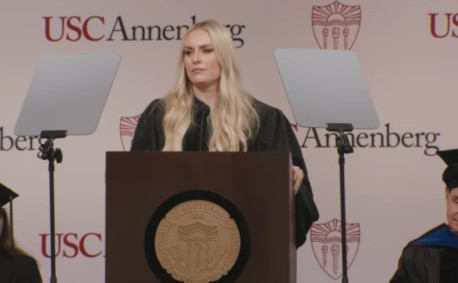
Editor’s Note: In this powerful commencement address to the USC Annenberg class of 2026, Olympic alpine skiing champion Lindsey Vonn delivers an inspiring meditation on resilience, adapting to a shifting landscape, and finding true strength in the face of failure. Drawing from her own career of extreme physical setbacks, including an Olympic crash just months prior at age 41, she reminds graduates that a perfect record is an illusion and that real growth happens when picking oneself up after a fall. Vonn encourages the new alumni to navigate the rapidly changing professional world by trusting their hard work, tuning out external doubt, and embracing the unexpected twists of their journey. Ultimately, she calls on the class to approach their upcoming challenges with courage, asserting that the act of daring to try when the outcome is uncertain is where true victory lies. (May 16, 2026)
TRANSCRIPT:
LINDSEY VONN: Whoa, I think this is the first time that the accomplishment is just walking up to the podium instead of stepping onto one. USC Annenberg class of 2026, congratulations. And thank you, Sophie, for that kind introduction, and also the Dean Willow for inviting me here today.
You know, I asked a lot of my friends if they remember who their commencement speaker was, and literally none of them said they remembered. So I really hope I leave you with at least a few tidbits on life after this incredible milestone. And tell people that you heard me too.
I should be honest though, I never went to college. So in many ways, I’m living vicariously through all of you right now, witnessing what hard work and dedication look like from a different perspective.
Lessons From Winning and Losing
Some of you may recognize me as an Olympic champion. Most of you probably know me from my Olympic crash on live TV a few months ago. But there are lessons for life in both.
You’re probably thinking I’m going to tell you about winning, about working hard, about talent and pushing past your limits. But after all is said and done, I’ve come to realize the most profound wins I have achieved in my life are actually my failures.
Your Degree Is Proof of What You Can Do
Think back on your last four years here. This degree is an accumulation of the many events you didn’t let break you. The all-nighters, the classes where you thought you could never reach the grades you sought, the hours you sacrificed going to the library instead of going with your friends to the 9-0.
What you have achieved is no small feat. It’s a milestone in your life. You showed up, you put in the work, and today you stand at the top of your first real summit. That degree is proof of what you’re capable of when you commit to something hard. Remember this feeling as you confront the challenges in your career and in life.
The exciting part is that you are standing at the base of a brand new mountain. And when you reach the top, I promise, the view will be worth the climb.
Standing at the Starting Gate
Some of you sit here today thinking you know exactly what comes next. And some of you — and this is completely okay — have no idea what comes next. Whether you can see the top of your next mountain or not, it’s there. Neither your confidence nor your fear is going to tell you what the climb is actually going to require.
A few months ago, I stood at an Olympic starting gate with the world watching. Despite having been retired for six years, getting a knee replacement on my right knee, absolutely no ACL in my left knee — which I actually still don’t have right now — and every reason to listen to those who told me to stay home, I was back. At 41 years old, racing against women half my age, and yet I had crawled my way back to number one in the world. And I knew I had a legitimate chance to win. The happy ending to finish my career was just two minutes away down the mountain.
But then, I crashed. My right arm caught a gate, I was five inches off my line, and just like that, I was cartwheeling through the air, landing with my leg fractured into pieces, staring up at the sky knowing it was all over.
How to Keep Going When You Fall
I’ll come back to that moment, because what I kept thinking about, lying in my hospital bed, is exactly what I want to leave you with today. As I said earlier, I’m not up here to tell you how to win. I’m up here to tell you how to keep going when you fall. And why, if you do, the winning will come.
In my career, I started in over 400 World Cup races. I won 84 times, and stood on 145 podiums. Everyone focuses on the wins, but if you think about it, that means there were over 250 times I went home empty-handed. With only the belief in myself and my work ethic that kept driving me.
Belief and Hard Work: The Only Foundation That Matters
Because no one has a perfect record. No one escapes life unscathed. The path to success is not a straight line. Success is not possible without a foundation built on two things, belief and hard work. Not talent, definitely not luck. Belief and work.
Throughout my career, I was told more than once by many people who were supposed to know that I would never make it. That my style was wrong. That I was too aggressive. That I didn’t have the right body type. That I simply didn’t have what it took. Maybe I should have listened, but I didn’t. Not because I was arrogant, but because I knew something about myself that they didn’t.
I knew how hard I was working, and I believed I was capable of more. Because I trained longer. I recovered faster. I showed up every single day with everything I had. And I knew that if I stopped believing in myself every time someone told me I couldn’t, I would never achieve my true potential.
When I won my first World Cup race at 19, some of those same people called it a fluke. When I won my first overall World Cup title, they said, “It’ll never happen again.” When I used men’s skis, they told me I wasn’t strong enough. When I broke records, they said I wore too much makeup. When I got onto the cover of magazines, they told me I was just using my looks and never acknowledged my wins. And on and on. That’s how my entire career went. Every milestone came with a new round of doubt or criticism from somewhere.
Because that’s how it works. The doubters don’t disappear when you succeed. They just find a new angle. People will underestimate you, challenge you, and question you for most of your life. Which means the belief has to come from you. Because it will never come consistently from the outside.
I’m not telling you to ignore feedback. Be honest with yourself. Work hard on your weaknesses. There is a big difference between someone helping you get better and a voice telling you that you don’t belong. You need to know the difference. And when it’s the latter, tune it out completely.
Every single person in this room has been underestimated by someone. What you do with that is your choice. Instead of letting it slow you down, choose to use it as fuel. You have the opportunity to choose every single day to believe you are capable of something extraordinary.
Falling From the Top: Crashes, Injuries, and the Darkest Years
In 2010, I won my first Olympic gold medal and my life changed forever. I went from being relatively unknown to being interviewed by Oprah in the course of a day. That was pretty cool, actually. I was literally on top of the world. And then for the next several years, I fell. Not metaphorically. I actually crashed. I know that’s really hard to believe. But I crashed repeatedly and hard.
I tore my ACL. Then I tore it again eight months later. I fractured my arm. My ankle. Injury after surgery. There are moments lying on a mountain in emergency rescue helicopters and hospital beds. Moments when defeat nearly consumed me. And I want to be honest, there were also injuries that weren’t just physical. My personal life fell apart during some of those years, too. I got divorced. I struggled with depression, body image, anxiety. Those are some of the hardest years of my life.
But here’s what I want you to understand. No matter how low you get, no matter how dark the world may seem around you, you have to keep going. Because your greatest achievements are right around the corner. And after every injury and every surgery, I had to pick myself back up. I reset my mind with a new goal. And I got back to work. I started over. I trained. I believed. And somehow, I found a way to win again.
Because the crashes didn’t break me. They taught me about fortitude, patience, and how to evolve. They taught me about my body in ways that made me a smarter, better athlete.
The Crashes Taught Me Who I Was
The personal losses taught me what I actually valued, what I was willing to fight for, and what I needed to let go. The wins were incredible, and I cherish every single one of them. But the wins didn’t teach me who I was. The crashes did.
And the records? The records aren’t impressive because they were easy. They’re meaningful because they were hard.
One of the few guarantees in life is that you’re going to fall, and it’s going to hurt. And in that moment, how you respond will matter more than anything else. That is your opportunity. Don’t waste it.
When you struggle in your career, in a relationship, in something you worked incredibly hard for, ask yourself, what can this teach me? Then get back up, apply what you learned, and go again. Because in my experience, the falls that felt like endings were usually the beginning of something I could have never seen coming.
Because you don’t always win, but if you’re paying attention, you will always learn. And those lessons are what will eventually help you succeed.
Graduating Into a World That Is Changing Fast
You’re graduating today into a world that is changing faster than any generation before you. The fields you studied, communication, journalism, PR, and public diplomacy, are being remade in real time. Artificial intelligence isn’t coming, it’s already here. The tools are evolving week to week. The job titles that exist today may look completely different in five years. Some may not exist at all. And new ones, ones that no one’s named yet, will take their place.
I know that can feel like standing at the base of a mountain and watching the terrain shift beneath your feet before you’ve even taken your first step. But that has always been the mountain. The terrain in life will always shift. And the people who reach the summit are never the ones who waited for it to stop moving. They’re the ones who learn to read the mountain, adapt to it, and when necessary, carve a new path through it entirely.
You are communicators, storytellers, the people who will shape how this next era is understood, explained, and navigated. That’s a role that doesn’t get replaced. It’s a role that becomes more essential as the noise gets louder. Your job is to find the path through the new terrain, to create it, to pave it. No one is going to hand you a map. But that’s the point.
The people I know who are the most fulfilled, the ones who seem like they’re exactly where they’re supposed to be, none of them are where they thought they’d be. They followed something unexpected. They said yes to something that didn’t make sense on paper. They let the mountain evolve. And they kept climbing anyway.
So keep your head up. Stay curious. Work hard wherever you land. Don’t be so attached to your plan that you miss the opportunities standing right in front of you.
The Trying Is the Whole Point
So, as I promised, I want to come back to that moment I told you about, that night after my Olympic crash, lying in a hospital bed where I had a lot of time to think. And what I kept coming back to was this. My Olympic dream didn’t finish the way I dreamt it would. It wasn’t a storybook ending. It was just life.
But here’s what I know about life, and about ski racing, and about anything worth doing. We take risks. We dream. We love. We jump. And sometimes we fall. Sometimes our hearts break. Sometimes we don’t achieve the things we know we could have. But we can try. And that, the trying, is the whole point.
I have no regrets. Literally, not one. Because standing in that starting gate, knowing I had earned the right to be there, knowing I had a real chance to win, that was already a victory. That crash didn’t take that from me. Nothing could.
And you are about to walk out of here into a world that’s going to ask you to dare. To step into your own starting gate. Maybe it’s your first job and you’re not sure you’re ready.
Dare to Step Into the Gate
Maybe it’s the company you want to build and everyone thinks the odds are stacked against you. Maybe it’s a seat at the table no one handed to people like you without a fight. Step into that gate anyway. Because the daring, the act of trying when the outcome isn’t guaranteed, that’s where the next phase of your education really begins. Out there. In the risk. In the attempt. In the willingness to stand at the top of something terrifying and try anyways.
Who I Am at My Core
I have stood at the top of some of the most beautiful mountains in the world. But when I think about who I am, really, at my core, I don’t think about the wins or the records. I think about the little girl from Minnesota who was told she’d never make it. I think about every starting gate I stood in afraid. I think about every time I climb back up after a crash, with broken bones, with nobody watching. That’s who I am. I’m the person who refused to give up.
Class of 2026: Your Mountain Awaits
So dare to dream. Even when it’s hard. Even when the outcome is uncertain. Even when people think you’re crazy for trying. Jump. Because the only real failure in life is not trying. Class of 2026, I believe in you. And I cannot wait to see what your future holds. Now go. Fight on. Your mountain awaits.
Related Posts