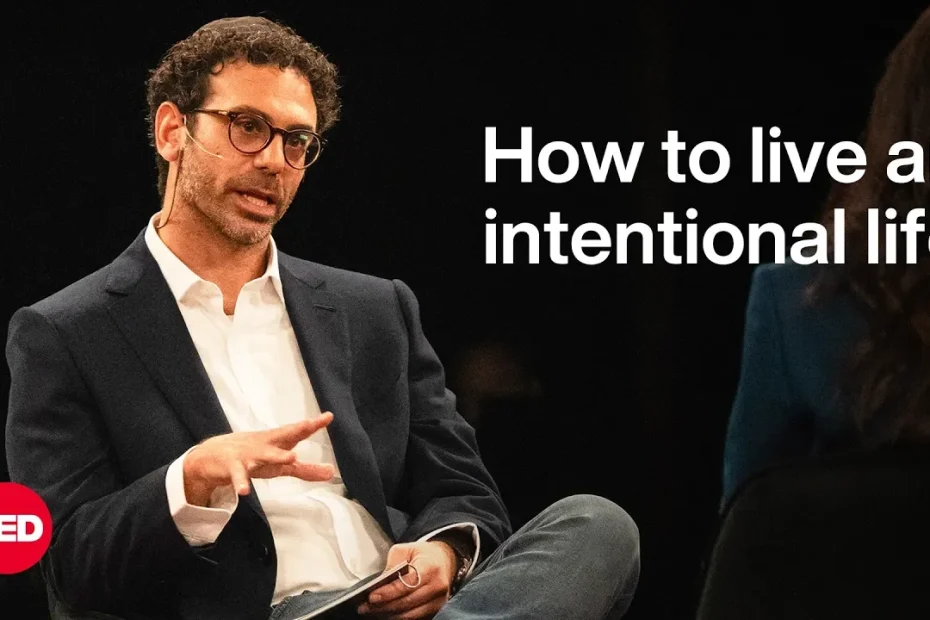
Here is the full transcript of Ethicist and rabbi Ira Bedzow in conversation with Shoshana Ungerleider, physician and host of the “TED Health” podcast on “An Ethicist’s Guide to Living a Good Life”, recorded at TEDNext 2024 on October 23, 2024.
Listen to the audio version here:
The interview starts here:
SHOSHANA UNGERLEIDER: Hi, Ira.
IRA BEDZOW: Hi. Nice to see you.
SHOSHANA UNGERLEIDER: Good to see you. Ira is a professor, an ethicist, and a rabbi. And he’s really all about helping people and organizations navigate ethical challenges and turn their values into action. So, Ira, the bio on the TED website, it says ethicist. So how do you describe yourself?
IRA BEDZOW: First off, Shoshana. Thank you. That’s a great question to start with. I would say whenever people hear that I’m an ethicist, the first thing that they think is, well, I don’t need that guy either I’m a good person, so I don’t need someone to tell me what to do, or they don’t know me. So I don’t want someone to come and impose their thoughts, their beliefs, their values onto me. So usually I don’t get any work when people think that.
What I like to say that I do as an ethicist is I try to help people think more creatively and make decisions based on who they want to be and what they care about. For me, it’s not simply just a matter of is this act good or bad or is this act right or wrong? It’s are you making the decisions that speak to the goals that you have? Are your goals worth having? The values that you embody in terms of what you care about and the applicability or the strategic implementation that you could truly achieve.
So in the professional realm, that looks like organizational ethics, professional identity formation, bias driven leadership. In the personal realm, it’s really about developing habits for behavior change.
Finding Your Purpose
SHOSHANA UNGERLEIDER: Yeah, so we’re going to get into a lot of that. But you’re helping people do something that feels really elusive and can be intimidating. Can you start by sharing what one or maybe two strategies that people can use to help them get more clarity on what their purpose is?
IRA BEDZOW: Great. So first I think we need to define our terms on purpose. Purpose is a really scary word. And I think that when we talk about purpose, oftentimes people think that there’s one thing in life that the universe wants them to do and if they don’t find it, then they haven’t succeeded. That scares me in a way of making people think that like there’s only one shot and if you don’t hit that shot, then your life doesn’t have the meaning that it’s supposed to have. And it’s not only not true, but it’s unhelpful.
When I think of purpose, I think about it as a self defined, long term intention that is meaningful to you and impactful for your world. I think if you have that type of intention, it’ll guide your decisions, it’ll guide your behavior, it’ll guide your goals, it’ll provide you a sense of direction, and it’ll provide that sense of meaningfulness as opposed to just thinking about the meaning of life.
So, strategies. So when I think about how to achieve this type of purpose, and truth be told, when you know it’s an intention, you know it’s not a goal. It’s like what you’re interested in, what you care about, what you want to do. I start asking myself a number of different questions.
So the first question I’ll say is, what do I want to do in this situation? The second question I’ll ask is, do I want to want what I want? Now, that sounds nuts. You’re like, I don’t understand. Does that mean, like, okay, you just really, really want it as opposed to want it?
So I will give you an example. Let’s say you and I were going out for dinner, and there’s this dessert cart, and there is cheesecake on the dessert cart. Now, I want that cheesecake. I think it’s delicious, and it’s like, just right there for me. But I also know that I’m incredibly lactose intolerant. So the question I’m asking myself is, do I want the cheesecake but I’m going to resist it, or do I not want. I want to not want that cheesecake because I know that there’s other things that I value, there’s other things that I care about, like not being sick for the rest of the night, living in a way that allows me to live my best life as opposed to a life of constraint or restraint.
So once I think about, do I really want the things that I say that I want? Well, what does this tell me about myself? Does it mean that I’m the type of person who has to organize my environment to achieve my wants or my urges? Am I someone who has to build resilience because I know that I can’t change my environment or I can’t nudge myself to do things? What do I need to know to make good decisions not about the world yet, but about myself?
The next question I’ll ask is, well, is that the type of person that I want to be? Do I want to be the type of person that has to manipulate my environment versus work on myself? Do I want to be the type of person that wants to work on myself and not have so much concern about the environment around me? Those entail very different decisions in what I’ll end up doing.
And then the last question is, well, how do I achieve my wants effectively? Now as an ethicist, you might be saying, well, you never said ought or should in any of that.
Like what should you do or what ought you do? And the reason is if I start talking about what people should do or if the world says what you ought to do, either you’re going to say no, right? Or you’re going to say, well, now I have to do what other people are telling me or what the world tells me to do, but I want for people to do what they feel empowered to do. Your values should entail choices, not something that you aspire but never reach. So that’s the strategy that I usually use.
Redefining Success
SHOSHANA UNGERLEIDER: Yeah, I can sort of see how this method would lead to more confident and values driven decisions. So, Ira, our metrics for success often can be tied to external validation, whether it’s promotions, awards, whatever. Should we rethink how we measure and define success for ourselves?
IRA BEDZOW: Yes. Next question. No, no. So I mean, look, I’ll tell you how I define success. You can tell me if it’s a good definition or if it’s one, we should use something else.
So I’ll define success as achieving your goals through and not at the expense of your beliefs and values. And the reason why I do that is because if you’re trying to run someone else’s race or play someone else’s game of life, you’re not going to win. You don’t know the rules, you don’t know the skills, you don’t know the challenges. And there’s too much uncertainty to think about what do I need to accommodate? And I don’t even know who I’m playing with.
But if you play the game of life according to your skill set, your desires, the team that you want to have and the game that you want to play, I mean, that’s a great life to have. I mean, there’s always risks and costs. We’re never going to say that, well, if I do whatever I want, I’ll be successful based on other people’s metrics. But what we should be saying is, well, what do I actually really want? And let me see if I can get those metrics.
So when someone asks me like, okay, how can I be successful? Like what does success mean for me? I’ll say, okay, well what metrics are you using? And oftentimes they’ll give me like either big picture things or like roles or like positions and stuff like that. And then the first thing I’ll say to them is, okay, let’s work with what you’re going with here. And I’ll say, paint me a picture of what your life looks like when you achieve those things, or even while you’re pursuing those things.
And they’ll say, what do you mean? I have this job. It’s great. What time do you wake up in the morning? Who do you talk to? How many emails do you send? Do you have friends in time for your friends? Do you care about having friends or time with your friends when you start painting that picture?
What I try to do is not focus on the possessions or the status, but focus on the activities that you’re engaged in. Because when you think about what you’re actually doing as opposed to what you’re having, like, two things are going to happen. One, you’re going to stop thinking about success as possession, such that once you have it, you then say, okay, well, now what? Or you have the fear of saying, well, I thought it was going to be much more exciting, but the pursuit was actually more exciting than the possession. Like, I don’t. This was a race that I don’t know if it was worth running.
The second thing when you start thinking about the activities as opposed to the possessions is the pleasure of the pursuit and the pleasure of the activity now are aligned. So your success is not simply that, like, momentary, I got it. But it’s that continual. I’m doing it. And that’s a real different perception of success.
Addressing Burnout
SHOSHANA UNGERLEIDER: Okay, I want to talk about a topic that comes up a lot, certainly in medicine, but otherwise, and that is burnout. It’s a really big issue in a culture that’s frankly obsessed with productivity. Some call this urgency culture. From your perspective, what are some of the habits and practical steps that people can take to resist the pressure that leads them to maybe overwork in the first place and can help them reconnect with their core values and their sense of purpose.
IRA BEDZOW: Yeah. So burnout’s a really tough thing to talk about because in one respect, you don’t want to say that an individual is responsible for their own burnout, because there’s a lot of environmental or situational factors. And if you don’t recognize the environmental or situational factors, you’re setting people up to fail. So that I don’t want to do. At the same time, if you say the only way to alleviate burnout is to rely on the system to change, you may be waiting a really long time. So I just want to put that out there and then let’s talk about some of the things that you mentioned.
So with regards to urgency culture, I think one of the things that we really have to recognize is the difference between urgency and importance. Urgency requires immediate attention, but that doesn’t mean it’s important. Like if you get an email saying, well, in the next five minutes you might have an opportunity to meet someone that could be a potential intern. That’s urgent. And it may be important to the potential intern, but it may not be important to you. It’s something to think about in terms of is the necessity to respond right away based on how much weight it carries or the time pressure that’s being imposed on you.
Something that’s important is a decision that’s really significant to how you’re going to live your life, but it doesn’t mean it has to be urgent. Living a healthy lifestyle, eating well, having regular medical checkups may not be urgent. I mean, I guess it depends how much you procrastinate in terms of making your calls for those appointments. But they don’t have to be urgent, but that doesn’t mean that they’re not important.
So in thinking about what we need to do, it’s easy to do the urgent thing and check the box of completion and we all get the satisfaction of we’ve done it. But if we don’t balance what we need to do quickly versus what we need to do for the sake of our lives, we’re never going to end up making the time for those decisions of importance.
Now let’s go to overwork. Right. So overworking has a lot of different factors to it. You could overwork because you feel a self pressure. Another way of saying that is you could overwork because you really like what you’re doing. Right. So for example, I think I might overwork.
SHOSHANA UNGERLEIDER: Yeah, I think you do.
Living with Intentionality
IRA BEDZOW: Yeah. Okay, good. But it’s because the stuff that I do every day at quote unquote work and when I say quote unquote work is because, like I have a bunch of different things that I do, some of which I work and some of which are volunteer. That’s the stuff that I want to do anyway. Like, I love helping people think through hard challenges, whether it’s my neighbor or whether it’s a colleague or whether it’s a student. So the opportunity to do it in the office versus out of the office, like one might be considered work and one is just like what I love.
You may feel overworked because not of self pressure, because of pressure from a boss or colleagues or friends or social aspects. That’s a very different type of pressure. That’s not about desire. And that’s a question of like who’s impacting the decisions you make or whose opinions do you value more? Yours or others. That also speaks to metrics of success.
You may think that you’re overworking because you just don’t value what you do. So you’re working too hard because you just don’t care about it or you don’t see impact or it’s not meaningful or there’s no room for growth. So of course you’re overworking. You’re having diminishing marginal utility every hour that you spend. Like, who cares?
You may, and this is, I think, the real crux of it. You may think you’re overworking because you’re actually not making room for the other things that you value. So just as an interesting story, in one of my moral leadership classes, the students went around after introducing themselves because I make them introduce themselves all the time. And they asked themselves the question, if you had an extra hour in the day, what would you spend it doing? And they all talked about what they’d spend it doing on and so forth.
And I said, do you know what that question really represents? And they’re like, yeah, if I have an extra hour in the day, what would I do? And I said, no, what it really represents is what do you think you’re not spending enough time on that you wish you were? Because wanting that extra hour isn’t just to say, well, I would do the exact same thing I’m doing now, but more of it. It’s what do I feel like I’m missing? So we can’t give ourselves an extra hour, but what we can do is reprioritize really thoughtfully.
SHOSHANA UNGERLEIDER: Yeah, you really highlight the need for intentional living in everything you’ve said. And this leads me to my next question, which is in my work with EndWell and as a doctor who’s cared for dying people, I’ve really had the privilege of learning from those nearing the end of their lives. And their experiences have really profoundly shaped my perspective on what truly matters. I’ve witnessed how reflecting on our own mortality can allow us to be more present, reminding us to prioritize meaningful connections and live with purpose rather than letting fear or maybe busyness dictate our lives. I know this is something that I struggle with. What kinds of tools do you give people to help them live with greater intentionality and purpose in their day to day lives? Given that we all have limited time.
Living with Purpose
IRA BEDZOW: You can use all the tools that I’ve already mentioned in terms of asking those types of questions, thinking about importance and urgency, learning how to prioritize, having clarity, or clarifying, like, what exactly the issue is. You can’t give a medical intervention unless you know what the diagnosis is. Otherwise you’re just, you know, throwing darts without a dartboard.
But there is one maxim that I really love. Like, I just. I love this maxim because it hits everything for me. So there’s this story in the Babylonian Talmud, which is like a Jewish religious text, where Rabbi Eliezer says that you should repent one day before you die. And that’s not the maxim, because that’s crazy. I mean, in a good way.
What is amazing to me about it is his students then come to him and say, well, how do you know when you’re going to die? Like, I need to time this right. So if I’m going to know when I’m going to die, then I can plan my day. But if I never know when I’m going to die, like, your statement means nothing to me.
And then this is what I imagine. It’s not. There’s no, like, description of it. But when I close my eyes, I imagine him having that smirk or that smile of like, oh, students, I have you now. And he says, no, of course, all the more so. You should repent today lest you die tomorrow.
What I love about that is it totally changes what we think about in terms of repentance. Like, when we think about repentance, we usually think about, we did something wrong and we have to return to a status quo ante. Like, we’ve lost something and we need to say, I’m sorry, but you don’t live every day thinking you’re going to die tomorrow, saying, what did I do wrong today so I can fix it. That’s not what he means, because that would be inapplicable.
What he means about repentance is returning to the aspirational and ideal self that you have in terms of your own self picture. Like, it’s asking yourself, is this the life I should be living? Is there something more? Am I taking life for granted or am I giving it everything that I have? It’s a very different view of repentance. It’s a return to what you want to be and who you want to become, as opposed to a return to what you were simply because you used to be.
The Role of Community
SHOSHANA UNGERLEIDER: That I love that I want to touch on community. Because we often think of success as an individual achievement what role, from your perspective, do community and relationships play in understanding of what it means to live a truly fulfilling life?
IRA BEDZOW: That’s a really good question. Cause it’s a really hard question. I mean, I think a lot of times when we think about community, whether that’s society, neighborhoods, definitely organizations and companies, we tend to reify culture and community, meaning that we think that it’s something over and above or outside who we are as individuals.
But oftentimes when you think about community, you think about culture. Culture is the set of expectations that we have given the interactions that we’ve had, like all of us. Meaning culture is made up of the behaviors of individuals. So you can change culture by changing the behaviors of the individuals around you.
So when you think about, like the role of community, I want to start really small first. Like, when you have an achievement or a success, who do you call? Who do you share with? Now, you don’t have to tell me, but I can imagine everyone in this room knows someone or has that person that they call. Which means that if you want to share your successes, then you realize how social of a being you are. There’s a big difference between having a success and having someone to share that success with.
Once you also realize that that whole aspect of sharing and sociality goes into the final product, you know, that it goes all the way through. So the problem that we really have is not necessarily the sharing of the experience. We always want to share the experience. It’s thinking about if we share the success or the credit of it, it somehow takes away from our credit of it. Almost as if success and achievement is a zero sum game.
Like if I say I did this and someone else did this also, well, then I did a 50%, 75%. I didn’t do it wholly. Right? But if success and recognition of success is a positive sum game, like sharing success and credit with someone doesn’t take away because it’s not a matter of a fixed or a finite amount, then community is all the more important because you’re not against the community. The community not only supports you and you support it, but you’re deeply embedded within the other people’s lives with whom you live.
Connecting Through Values
SHOSHANA UNGERLEIDER: We have an experiential activity, right? Ira, you have a really great way of helping us reframe how to connect to each other in a value led way. And I want you to share this exercise with our audience and lead us through it. So everybody get ready.
IRA BEDZOW: Sure. So oftentimes when we think about who we are and what we do and how we present ourselves to the world. We typically introduce ourselves through our job or through our family roles or through our community involvement. Mike will say, hi, I’m Ira. I’m an ethicist. What is an ethicist? I have no idea. Or, hi, hi, Ira. Shoshana, I’m a doctor. Oh, I know what that is. So I don’t have to say more.
But oftentimes, when we think about identifying ourselves by the roles that we have, whether they’re social and communal, whether they’re family roles, whether they’re job roles, you both rely on assumptions of, okay, everyone knows what that is. But you also hide so much. Like, if I say, hi, I’m Ira, I’m a dad, you’re like, great, I know you have kids, but do I know if you like them? Are you good with them? Do you spend time with them? Like, do they know who you are? All of that is hidden, right where.
If I told you that, hi, I’m a dad. But what that means for me is I love spending time with my children. But most importantly, what I love is showing them how to love the things that they do love so that they’re fully invested in how they live their life. You know so much more about how I teach my children, probably the activities we do together. You might think about, like, what our relationship is and so forth. Like, it just tells more when you think about the activities than you do about simply the roles. So. Well, it also does one more thing. It reminds me of what I do and what I care about. So it’s not simply just a projection outward. It’s a reminder inward.
So we’re going to do this as an activity. Instead of introducing yourselves to the people who you sit next to based on your roles, take a minute and think about what activities or interests light you up or how would you describe your character and the way you show up in the world or what beliefs or values guide you in facing challenges and opportunities. And then introduce yourself and see how that goes.
All right, so now that we all introduce ourselves, we’re going to just do a real quick show of hands. So I’ll ask. Let me ask a quick question. In introducing yourself this way, how much more open were you to not only share with somebody else, but to allow that other person to share back with you? Raise your hand. How many of you were like, nope, I’m not doing this? Okay, cool.
So I will tell you, there was. I did this exercise with, like, a bunch of senior leaders and executives, and one executive told me afterwards that he had Like a board meeting, and it’s a new board, and, like, a little nervous and figured, you know what? I’m going to not do my regular spiel. I’m going to do what you said, even though it sounds crazy, and let’s just see what happens.
And he said that the feeling in the room before he introduced himself was very stiff and in a way that almost put him on the defensive. Right. It was just super closed off because it expected the formality of the scripts that we’re always used to. And when he broke the script, people became human again. So one thing that I suggest is scripts are good. They set expectations. Scripts are also really good to break because you can see what lies underneath.
Finding Meaning
SHOSHANA UNGERLEIDER: Last question. Ira, if you could change one thing about the way that we think about living a meaningful life, what would that be?
IRA BEDZOW: Meaning. And finding meaning is an active rather than a passive endeavor. Like, let’s not wait and think about how meaning can come to us. Let’s search it out. Let’s find it in a way that’s exploratory and creative.
There’s one thing that I really like to tell people, partly because it’s funny, but mostly because it’s true. I like to tell people to think about new ways of being or new ideas or new actions as clothes that you’re trying on, just to see how they fit. Oftentimes, when we’re thinking about, what can I change? The very notion of the idea of change makes us feel like we have to commit to it before we even try it. Like buying clothes from Amazon with no return policy.
But if you can try things on and see how they fit, then you can see if you’re comfortable in it, if you like it. And then you’ll be able to see better options because you’ll have more choices available to you. That’s how you can squeeze meaning out of your life.
SHOSHANA UNGERLEIDER: Okay. I always learn so much from you, Ira. Thank you so much for this conversation.