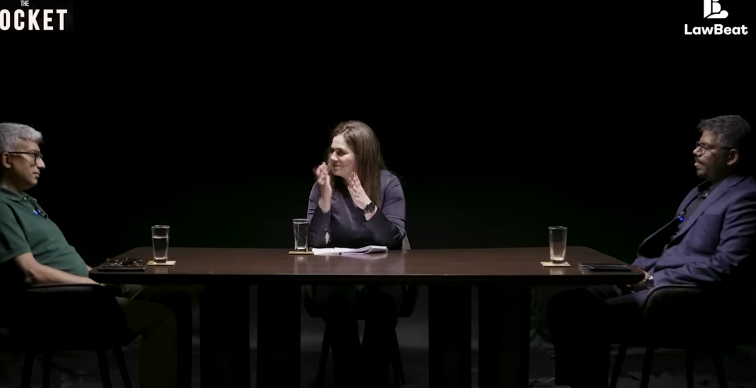
Here is the full transcript of Gopal Sankaranarayanan & J Sai Deepak Debate moderated by host Sanya Talwar, August 15, 2026.
EDITOR’S NOTE: In this Independence Day special from LawBeat, senior advocates Gopal Sankaranarayanan and J. Sai Deepak sit down with host Sanya Talwar to debate a provocative question: Has India’s Constitution gone too far? The discussion ranges across transformative constitutionalism, reservations, the Sabarimala verdict, the collegium system, feminism, individual autonomy, the role of the state, and the idea of Swadeshi jurisprudence—challenging familiar ideological binaries without easy winners or labels.
Opening
SANYA TALWAR: Thank you for being here with me today, Mr. Sankaranarayanan and Mr. Sai Deepak.
J SAI DEEPAK: Thank you.
GOPAL SANKARANARAYANAN: Thank you.
SANYA TALWAR: The reason why I wanted to have this conversation today, and specifically in a structured debate format, because personally I have seen you both in courts over the years. I’ve seen your advocacy. I have engaged with it. I have admired it. And enjoyed watching your arguments in courts also. Even outside of the courts, your views, sometimes distinct on various issues, have generated a lot of discourse with the wider audience also.
And I feel like the reason why that happens is because the articulation is very clear and it connects with the audience to a large extent. That’s not just because you are great lawyers, we all know that you are, but that’s also because of that connect with that audience.
And I think that is exactly what is required in today’s topic, which is Constitution Interpretation and Reflections. Because it’s a very broad, generic topic, what I thought was I’ll put out some propositions in the form of statements, and I will seek out your positions on them, whether you agree, disagree, or you agree with qualifications. And once both of you have committed to a position, we can move to the constitutional reasoning.
J SAI DEEPAK: Yeah, right, perfect.
Is the Constitution Evolving or Transformative?
SANYA TALWAR: All right, great. So, the first proposition is the Constitution is an evolving document and not a transformative one. So Mr. Sankaranarayanan, what do you think about it? Do you agree, disagree, or do you agree with qualifications?
GOPAL SANKARANARAYANAN: I agree, somewhat. What I would say is it’s evolving, therefore it’s transformative.
SANYA TALWAR: All right, Mr. Sai Deepak.
J SAI DEEPAK: So I would say it’s a question of which part of the Constitution you’re looking at. Like most documents, there are certain parts which are immutable, which preserve the character of the document, and there are certain parts which have been imbued with malleability so that it keeps pace with time.
So as a document, I would typically approach it as a document which has two parts, immutable and mutable. The immutable part is meant to evolve, and therefore, as Mr. Sankaranarayanan rightly points out, has to have a transformative character. But there are certain immutable parts which preserve the atma and the saharansh. That would be my take.
SANYA TALWAR: So you’re trying to say that there is a basic structure to it. And because there is a basic structure to it, it can’t go beyond transforming that, but it can transform other parts of the Constitution.
J SAI DEEPAK: I wouldn’t fully throw my weight behind the basic structure doctrine of the Supreme Court. I may have some disagreements with the methodology adopted and the outcome as well. In my view, it’s still out in the open, the jury, as to whether or not there is a cohesive judgment that has emerged out of that entire episode — which is the basic structure of the Kesavananda Bharati case. I think it’s a book in itself, it’s not a judgment.
As far as the approach is concerned, to answer your question, I’m saying in some portions, or with respect to certain portions, you preserve allegiance or fealty to the originality of the text and the intent of the authors. And in certain other instances, words themselves are subjective, broadly used with a lot of scope for subjectivity to keep pace both with time, intent, and policy. Those are different parts.
SANYA TALWAR: So to some extent, Mr. Sankaranarayanan, you also said that it is evolving and therefore it is transformative.
GOPAL SANKARANARAYANAN: Yes.
SANYA TALWAR: Would you explain that a little bit?
GOPAL SANKARANARAYANAN: Yeah, but if I can just react to what Sai said, I think if you accept that there are parts of the Constitution which are immutable, then you are accepting to some degree — and I think he admits that — that there are immutable basic features of the Constitution to that extent.
J SAI DEEPAK: True.
GOPAL SANKARANARAYANAN: But maybe Sai is not going the whole hog to accept the Kesavananda Bharati doctrine, which was expansive. And because so many judges wrote judgments in that case, it was only when Indira Gandhi was decided two years later that people started trying to call out the ratio of that.
Correct. So I think one thing that we will perhaps agree on is judicial review — of action being a common minimum which has repeatedly been asserted as part of the basic features.
J SAI DEEPAK: Correct.
GOPAL SANKARANARAYANAN: Right. One part which I’m not sure, but I’m presuming that Sai may not wholeheartedly back, is about secularism being a basic feature of the Constitution.
J SAI DEEPAK: True. Right?
GOPAL SANKARANARAYANAN: So I think that’s where the debates come and they fall for discussion, because there are substantial case laws which have tried to interpret this judgment. So things like equality — it’s too wide to say equality is a basic feature, because equality has so many nuances to it regarding communities, regarding sexual orientation, regarding types of genders, regarding how you will employ them, maybe in armed forces, maybe elsewhere.
So I can imagine that’s what keeps constitutional courts so busy. So I think we are on the same plane to the extent that we say there are certain basic features which are immutable.
You don’t know what the future will bring, right? So I would not like to arrogate to myself, 75 years on, the thought that I can comprehend what the future will bring. The future may bring us a kind of milieu and an environment where the Constitution as we knew it and understood it in 1950 may be completely different from the one in 2050.
SANYA TALWAR: Right. Any thoughts on that?
J SAI DEEPAK: Yes. So I think let’s split the document into three or four parts. Parts which basically define the country in terms of what it is, what are its constituent components — those portions, let’s say from Articles 5 to 11, which deal with the aspect of who are its citizens. Then there are certain portions which deal with what kind of rights they have, and a broader framework that discusses the administrative aspects or the federal aspects.
The federal aspects, while having seen significant contestation, it’s typically the first few chapters which over and over again go through a lot of contestation, because that’s where there’s a lot of room for ideology, vision, worldview. So, if you ask, let’s say, ten members in a room, would they disagree with the concept of some basic features? Most of them may not, but the fundamental difference would be on what each of them sees as a basic feature — and that will be driven by where you come from in terms of your ideology, or vichardhara in a broad sense.
For instance, secularism — fundamentally, I would say constitutionally or ideologically speaking, I can’t align myself to get to a position where I say it is a basic feature. That’s a function of who I am, and I will try and find justifications from the four corners of the constitutional debates to say this is why, this is where I stand, this is where I ground and anchor my position.
On the integrity of Bharat as a sovereign country, there must be some red line where we say “thus far and no further.” And those portions of the Constitution which preserve that integrity, which give primacy to integrity, they will remain immutable in my view.
Let’s say you look at something like Article 17, where you’re looking at untouchability. If you do justice to the mandate of the Constitution as it stands and the original social context of it, I think those portions, while remaining immutable, continue to do justice to the mandate. But if you expand it to a point where it enters kitchens, homes, bedrooms, puja rooms of individual spaces, then I would say you’ve gone far beyond the original intent.
So, on aspects of integrity, on aspects that deal with the relationship between the state, the red lines that the state is supposed to observe, that preserve institutional boundaries — there I would say there is room for immutability to a significant extent. Because if you were to go back to jurisprudence, the fundamental question would be that the existence of the document is contingent on the existence of the state. And if that Grundnorm is fundamentally shaken, and if that foundation is undone, then everything else that you wish to build over and above that will not survive.
So to that extent, those portions that deal with sovereignty and integrity would be significantly immutable in my view. Anything else over and above that would be the subject of an evolving republic. So I would certainly agree with Mr. Sankaranarayanan to the extent that I have been and will continue to be one of the strongest votaries of a “Republic 2.0,” where you hit reset on certain important aspects where legacy issues have not been addressed or have been worsened because of the inherited myths with respect to who we are as a people, where we come from, what kind of social justice assumptions this Constitution has been baked with, where there is some kind of foregrounding.
Have those social justice assumptions helped us, or have they made us worse? Have they Balkanized us as a society while preserving the facade of a constitutional democracy? Those are questions that I’d seriously ask. So from my perspective, I would 100% agree with Mr. Sankaranarayanan to the extent that the identity of the Republic is open to question, but the existence of the Republic may not be open to question.
SANYA TALWAR: So at least the both of you do agree on the fact that the doctrine of transformative Constitution cannot be applied across the board, at least throughout the Constitution. Is that correct?
GOPAL SANKARANARAYANAN: I am saying that because the Constitution keeps evolving, it is transforming incrementally, in little baby steps, but it’s happening. I would presume your question meant, was there an overnight transformative change? Constitutions don’t change in isolation. They are dependent on people, on institutions, on effective measurable impact that takes place.
A large number of the debates we’ve seen in recent years about the judiciary, and why it’s important to have an independent judiciary, arises out of that, because it’s the judiciary that can not only protect and preserve the Constitution but also implement it in areas where its implementation is demanded. And that is why there’s such an outcry that we find the judiciary, in moments when it should be more active, being passive.
So I don’t say that it is not transformative at all. In fact, I say the opposite. I say it is transforming, and it’s taking steps in transforming. What Sai, as I understand, is saying — and I completely agree with him to a large extent — is that relooks are necessary in a mature democracy where you’re implementing a republic. You have to relook at aspects of the Constitution.
Now, I know the ethos that Sai comes from and mine — we come from slightly differing ethos. But one thing that I think both of us largely agree on is how far reservations, for example, have worked in this country. Seventy-five years on — and I’m not talking about SC/ST reservations, because that is slightly different, based on historical backwardness and a lot of history that went into untouchability, etc. So measures have been taken there. But the OBC reservations, which have come in a big way both in the services and in education in the public sector, have been an issue of large debate.
And this is what Sai was talking about when he said “Balkanization” of society. You find the electorates and our political leaders using reservations, quotas, caste groups as purposes for them to move their own agendas forward. What they don’t see is the fact that within those caste groups, even among the OBCs themselves, there are a handful of them who are cornering all the government jobs and all the admissions. The large, vast number of those caste groups within the OBCs themselves are not getting the full measure of reservation.
People who should never be getting the benefits of reservations — like those who are in important political posts and important civil services, etc. — are continuing to have their children, grandchildren, etc. get the benefits of this, right? So when we test, like he says, different parts of the Constitution, we must always be questioning and seeing on implementation: how is it working? Are we a better nation for A or B or C? Because of reservations, are we a better nation? Because of, say, a judiciary with now 34, 38 judges, are we a better nation for that? Are we a better nation for having women’s representation in Parliament? We’ll find out.
But we need to understand, are we a better nation for many of these things? Our answers may fall either way. But the examination must never stop.
The Sabarimala Judgment and Article 17
SANYA TALWAR: Correct. I want to go back a little bit to what Mr. Sai Deepak had said also, and seek both of your views on that position. Article 17 specifically was reinterpreted from a transformative point of view in the Sabarimala judgment. I hope I’m correct there.
GOPAL SANKARANARAYANAN: Correct.
J SAI DEEPAK: 28th of September, 2018.
SANYA TALWAR: And the argument that was given was the purity argument.
GOPAL SANKARANARAYANAN: Right.
SANYA TALWAR: Do you think — and I seek both of your views — do you think that was the right interpretation from a transformative Constitution lens? And if it was or wasn’t, could we throw across Article 17 across religions from a purity and discrimination angle, and not just from a specific religious angle of Article 25? So far as Sabarimala was concerned, could we make it like a blanket, established rule for every religion, from the purity-centric argument, for transformative change?
J SAI DEEPAK: It’s a wonderful question. I’m used to being controversial, so let me take it on. So, one — on the question, let me just respond to something that Mr. Sankaranarayanan pointed out, and I think it was wonderful. The issue of reservation — there’s one thing that you need to seriously consider.
SANYA TALWAR: Right.
J SAI DEEPAK: Even the strongest anti-reservation proponent stops short of touching the SC/ST question. There’s a reason for it — because it has become such a hot potato to touch that nobody wants to revisit the question whatsoever. Because you have to realize, SC/ST as a subject is not a jati in itself. It is — jati is included in a particular schedule, under a certain presidential order, and so on and so forth.
Now, the question that you need to ask is, when some jatis were included there — especially those which suffered the brunt of untouchability — 100%, they made sense when they were included in that. Second is, having written on the subject of colonial mischief, I am unable to convince myself that that was the sole reason for inclusion of certain jatis into the schedule.
One of the terms that has entered the Bharatiya lexicon when it comes to our language, social discourse, political and constitutional discourse, is “Adivasi” and “Mulnivasi,” and those words have had a serious impact in the way you have formulated your own version of your affirmative action. It’s not even affirmative action the way we see it — serious social justice initiatives that have extreme, let’s say, consequences from the perspective of public employment, representation, and whatnot. And I use the word “extreme” not in a negative sense, but to say that they have serious consequences.
“Mulnivasi” and “Adivasi” make sense in the context of Australia, where you have the Aborigines, or you have the Maoris in New Zealand, or you’re looking at the Indian tribes or the original Native American tribes. How do you apply the concept of Mulnivasi and Adivasi in the context of Bharat? That effectively makes all the non-Mulnivasis and Adivasis colonizers. That is the assumption — that was the historical assumption on the basis of which this entire policy was created.
If you ask anyone where these terms come from, you will realize that the undertones of the Aryan Invasion Theory significantly informed the use of the way we have used it. Nobody’s ever dislodged that. No government has actually had the courage of its conviction to ask this fundamental question: why do we continue using these terms?
SANYA TALWAR: So you’re saying the schedule should be redone?
J SAI DEEPAK: I’m saying, first of all, change the language. The words that we have used are janajatis. Janajatis and panchamas are words that are recognized in Indian philosophy for a good reason, which is — those who have been kept out, not kept out, who have stayed consciously outside the rules of civilization, meaning the grama or the nagara, which is the village or the city, because they have chosen to be closer to nature, and therefore they have a certain different set of rules.
GOPAL SANKARANARAYANAN: They exercise the choice.
J SAI DEEPAK: They exercise the choice. One of the reasons that you will find serious transgenerational trauma in tribals especially is that when you move them away from nature, you’re not just moving them away from a place where they live — it is their entire way of life. Their religion, the way they operate in terms of their use of nature — everything changes. You’ve literally taken away the only thing that they’ve known for hundreds and thousands of years in terms of living with nature.
And the reason why you look at it that way is that you’re applying the modern template of poverty and development to those communities, which may not want it. And you’ve never asked those questions at all, because your assumption is: if you’re poor, you don’t have the ability to make a choice with respect to what you want. That’s the argument that’s always been made. So there is a legitimate concern there as well.
Therefore, what I’m trying to say is the assumptions that inform the existence of the SC/ST schedule may need to be revisited, without doing away with the concept. I’m not saying let’s do away with the concept. That’s one.
SANYA TALWAR: Second, let’s not do away with the reservation concept. 100%.
J SAI DEEPAK: No, no, I’m saying let’s not do away with the concept of SC/STs. You may want to have an alternative approach to actually reservations. I’ve said this in other places, which is that when the state does it, it becomes a race for access to state resources.
Therefore, I have been one of the vocal votaries of asking Hindu religious institutions to step up and take that responsibility, where a portion of the temple’s resources are mandatorily and, let’s say, statutorily earmarked and allocated for their education — without taking away their connection with nature. You can do that. According to me, if you take them away from that ecosystem, it’s as good or as bad as proselytization in one way or another. Even if they have not changed their faith, you have taken away the object of faith from their hands altogether.
Point number two, coming to the question of this Article 17 issue: if you don’t use the concept of purity in a temple, where will you use it? Why is purity such a bad word? Where else do you use it? The word for purity in Sanskrit that is used for the purposes of these religious spaces is shuchi. That’s where the word comes from. Therefore, shuchi, shuddha, ashuddha — these are the terms.
Why? Because you believe that consecration of a particular image or a murti has certain attendant requirements in terms of its upkeep. You want to be an Advaita Vedantin, you can say I don’t need the murti, I will even offer the pippal leaf to the deity and that’s the end of the matter. But if you choose to consecrate it in accordance with the Agama Shastras, then you have a certain set of rules that you have to follow.
The problem with the assumption is that you have decided to bake in the concept of patriarchy into that, and you’re therefore saying all these rules in this entire setup are patriarchal, therefore only one set of rules apply only to one gender. That is not true.
When the Sabarimala argument was being actually ventilated in court and canvassed in court in 2018, in July to August 2018, one of the things that we specifically pointed out to the court which found no mention whatsoever was — have you asked yourself, on the basis of this document called Tantra Samuchaya, which is a 14th- or 15th-century document codifying all the tantric practices which Sabarimala conforms to, about the kind of restrictions on men as well as babies?
It’s a sixty-two kilometer trek, barefoot. I’ve done this in my ninth standard. I’m sure others have. Jaate-jaate kahin na kahin toh khoon toh bahega, kahin na kahin toh cut hoga — walking that far, somewhere or the other, there’s bound to be bleeding, a cut somewhere. You’re not supposed to enter the temple with a bleeding, open wound. If you do that, the temple undergoes a complete parihara [purification ritual]. Let’s say you take a toddler, or a baby, or a youngster, and they suffer from incontinence — you have to close the temple and clean up the whole place, because their restrictions are based on blood, semen, and urine, regardless of what the source is.
SANYA TALWAR: Right!
J SAI DEEPAK: Okay, that’s one. Second, if it is an energy space which has a certain manner of worship and it has certain restrictions, purity will be applied. Therefore, I am less concerned about whether Article 17 is applied to mosques or churches, because fundamentally a mosque is different from a church, from a temple. They are not the same in the way they operate. The theology is different, the ontology is different, the practical application is different.
So for somebody to say, “mere kaan pe ek thappad pada hai, uske kaan pe bhi ek laga do” — because I got slapped, go slap him too — that’s not justice. “Agar mujhe padhna hi nahi chahiye tha” — if I shouldn’t have been made to suffer that in the first place — that’s what I’ll be fighting for, as opposed to saying “tab usko bhi jaake maar ke aao” — then go and hit him too. No, I’m just making an assumption here hypothetically speaking.
SANYA TALWAR: Could we place the same purity argument, which was interpreted from the point of view of discrimination —
J SAI DEEPAK: Right.
SANYA TALWAR: — in this particular judgment, to other religions?
J SAI DEEPAK: If they choose to apply, they should apply across the board. But my fundamental question is, I go back to the basics. Purity in a theological sense cannot be — it is not amenable to secular logic. And therefore, try not to apply the rational secularist lens to a theological space or a religious space, because the entire prism is different. And therefore, it’s as good or as bad as saying what works outside a religious space in terms of what is rational and what is not, cannot be applied in a place that survives and functions on faith.
SANYA TALWAR: Correct.
J SAI DEEPAK: Vahan kahan se aap reason lagaenge? — where will you even apply reason there?
SANYA TALWAR: Fair enough.
J SAI DEEPAK: Us faith ka apna hi ek tarkik logic hai, ek internal logic hai. Lekin woh aapke reason se toh mel nahin khaayega. — that faith has its own internal logic, but it won’t match your [secular] reason. It’s different. So secular, modern, scientific reason and rationality has no business or place there whatsoever. You’ll have to respect that.
So, in your view, this particular interpretation of Article 17 so far as the transformative Constitution is concerned was a serious overreach, a complete misapplication, had no basis whatsoever in the facts of the case either. In principle and on facts, I completely disagree [with the judgment].
SANYA TALWAR: Right, so to some extent we are coming to a point where we think that it should not be applied across the board. What is your take, sir, on this specific issue?
GOPAL SANKARANARAYANAN: Two aspects of it, both with reference to historical fact. You know, there was a huge furor when, through the 44th Amendment, they amended the Constitution’s preamble and brought in the words “sovereign,” “socialist,” and “secular.” Now, firstly, the preamble says “we give to ourselves on this day” in November 1949. So it was a historical fact which was in the preamble.
Now, given that historical fact, for you to start inserting stuff later, at whatever time, retrospective application, is in my view doing violence to what the Constitution said — what the American founding fathers said at the end of the 18th century, which went into their Declaration. You can’t sit and tweak it in 2025 because Donald Trump feels so, right?
So I feel that that kind of tweaking is a grave misunderstanding. You may have meant well — you may have meant that, look, we don’t want cleavages among communities, etc. But the fact is — and I know people who know me will find it difficult to understand why I’m saying this — the fact is, a constitution which deals with religions and faiths and communities in detail can’t ever be a secular constitution.
J SAI DEEPAK: Exactly.
GOPAL SANKARANARAYANAN: It may be an equitable constitution, it may provide for equality, etc., but the Constitution provides that for the Travancore Devaswom specifically, an amount should be paid every year.
J SAI DEEPAK: Correct.
GOPAL SANKARANARAYANAN: Can’t a Muslim, or a Christian, or a Sikh, or a Jew, or a Parsi come and say, what is this? Why is it in the Constitution? You have a commentary, an explanation, under Article 25 which says Sikhs are allowed to carry kirpans. Why not Hindus?
J SAI DEEPAK: Why not Muslims?
GOPAL SANKARANARAYANAN: We may all want to carry some kind of weaponry which we believe is part [of our faith], but the fact is your Constitution recognizes these. And it’s not worse for it. I think it’s great. I think it’s great that you’ve understood the kind of communities you’re dealing with, the society you’re dealing with, and you’ve taken that into consideration.
Which is why, when this question comes from Article 17, we have to look at it as a historical fact that Article 17 is abolishing. What does 17 do? 17 only abolishes the existing practice of untouchability. So you understand, we have this abhorrent, ridiculous, disgusting practice, and we are dumping it in the garbage bin. We are criminalizing it, right? So you make a law subsequently, by Parliament, to criminalize it, and then again another law later.
Now, in 2018, when we argued this, the argument suddenly came — because it was a novel argument born from some advocate’s mind — that in Article 25, when you talk about entry to Hindu places of worship — again, the word “Hindu,” not other places of worship, because again, societally, Muslims and Christians and other faiths did not really exclude people from their places of worship. Hindus did. We did exclude many groups from our places of worship.
J SAI DEEPAK: So, you had to deal with us.
GOPAL SANKARANARAYANAN: You had to say “Hindu places of worship,” and you say that you will not exclude classes or groups from those Hindu places of worship. Now, who are they talking about? Again, looking historically, you are obviously talking about the untouchables who you were excluding. So, you bring in Article 17 abolishing it, and with the same hand, in Article 15 you say you will not bar them from bathing ghats, common places, etc. And in Article 25 you say they will enter your places of worship — no problem with that.
To extend that to women in one temple who are menstruating, or of the menstruating age, right, and taking it up in a private PIL based on a letter that is sent to you, and across jatis — that was the biggest distortion I personally felt to the fact that Article 17 was meant for a community to finally — Ambedkar’s community — to finally come to the table and say, we are sitting here equally. I don’t think they ever conceived of the prospect that at some point in the future we are going to bring women into it.
Surely, either it is a religious practice that you have had for years for one temple, and, like Sai says, maybe the purity-impurity argument is one of them. I’m not accepting it, I’m saying maybe it is. Eventually, all this that we’re discussing now is sub judice again. The Supreme Court is deciding it. Maybe it is, but I feel that argument was doing a distortion to a constitutional provision, which was Article 17, which was meant for a specific group of people who were identified as such.
The British, in the late 1880s, embarked by sending out their individuals and doing surveys to find out who these people were who stay on the fringes of communities, who are excluded, therefore without a choice — not like the Adivasis, but without a choice. The untouchables were then identified by community names. Long lists were drawn up in 1883, or 1893, or something. Those lists came to become part of the schedules to the Government of India Act, 1935. That’s why they’re called the Scheduled Castes and the Scheduled Tribes — not because of schedules in our Constitution, but because of what we took from the previous constitution effectively.
Now, those identified groups were found — Scheduled Castes, I’m not on Tribes — Scheduled Castes were found, without, I think, any further application of mind at that point of time by the Constituent Assembly. They said, we’ll take them whole hog, and we’ll give them the protections that we are giving under the Constitution. When the Constitution came in, the only protection these people had was about reservations in Parliament and the legislatures. There was no other reservation or measure for them. It was only these two, and those two for ten years. That has been extended — now we’re at 80 years, or 90 years as we speak.
But I feel the Sabarimala five-judge approach was a distortion of Article 17. Article 17 was meant for specific people. Article 18, which forms part of that equality code — from 14 all the way to 18 — apart from certain aspects of 25, 24, 23, all these together form part of our equality code. So Article 18 talks about doing away with titles. So before that, you had all these titles that either the princely states would give you, or the British Empire would give you — lords, sirs, etc., diwan bahadurs, and so on. You did away with all of that in Article 18.
Now suppose somebody came with a distorted argument about those titles — and so that applies to the captain of the cricket team? Yeah, there’s a historical background behind this. Yes, yes. If you say, “I’m not going to call the Chief Justice ‘Chief Justice,’ because this abolition of titles, we’ll use his name for him” — this is not what it was meant for. You can come up with these kinds of arguments which may be good in a moot court, but the fact that they took it to the Supreme Court, and the fact that it was accepted in the Supreme Court, still surprises me.
J SAI DEEPAK: I’ll give an Article 17 argument which actually ties into what he says, and think about it differently. Across Goa, Tamil Nadu, Karnataka — specifically in the Bangalore region — coastal Andhra, and even Kerala for that matter, churches are now split on caste lines. Will the very same Supreme Court extend the Article 17 argument and say that this should no more be limited to just Hindus, that it should also apply to other places of worship where jati-based exclusion is actively observed as of 2026? That’s a question that you should ask.
Will the Supreme Court do it? Because the colonial assumption was that, despite their own biases of the 1700s, only Hindus suffer from jatis and exclusion. The concept of pak castes and napak castes based on professions — close to 80 jatis — were specifically recognized in perhaps the second census undertaken in Bengal by the colonial establishment. Which is why I say the entire skew toward — on the question of jati exclusively belonging to one particular community — also needs to be revisited. If that is an active part of the social life of other communities, whether Muslims or Christians, that’s a question they must ask too.
Similarly, when it comes to institutions which, let’s say, are in Amritsar — is there jati-based exclusion anywhere? Is that a question we are allowed to ask? Will the Supreme Court take up that issue? I am coming from the perspective of reinforcing colonial stereotypes through judicial approach to specific institutions, in ways that ignore existing realities of other institutions. As Gopal pointed out, the existence of any temple-control legislation with respect to Hindus gives the distinct impression that misappropriation, malfeasance, misfeasance is the sole property of Hindu institutions. It’s almost as if that is a paitrik sampatti [inherited property] for Hindu institutions, and nobody else suffers from it.
How do you deal with these assumptions? So the larger point that I’m perhaps making is, as a document, although it is legal in nature, it has certain social underpinnings and assumptions which have been treated as axiomatic. When you’re revisiting history at a larger level, without resorting to revisionism — why wouldn’t you want to revisit history that specifically applies to your constitutional policies, which has a tangible and direct impact on the policies that you frame, affects electoral arithmetic, and the manner in which you’re crafting public discourse today? That discussion has not happened.
So one of the things that I’m actively saying, and I say this with no disrespect, is that document is still a man-made document, so don’t deify it. It needs to be revisited in several parts. Preserve the value of the document to the extent that it keeps this country together, respecting its diversity. But within that, all the problematic assumptions which continue to push us against each other, where we are in a rat race for state resources — which is a race to the bottom — you may want to revisit those assumptions, no matter how problematic they are.
And again, tying into what Mr. Sankaranarayanan pointed out — no politician is going to do this. You need an independent judiciary to ask these questions. I’m not saying, therefore, let the judiciary transgress into the legislative mold. I’m not making that statement. But aap sawaal toh uthao, kahin na kahin toh iski goonj hogi — you must at least raise the question, its echo will be heard somewhere. Agar aapne sawaal uthaya, then it will start a conversation. When the Supreme Court of the country, or the highest constitutional court of the country, sets the ball rolling on at least initiating a conversation — without getting into the legislative mold — it will 100% have an impact.
And that’s one of the single biggest reasons I believe judiciary and its independence are hugely important. While it has resulted in certain, let’s say, overreach, there are self-correcting mechanisms, as the reference itself is proof of. You have a review, you have multiple shots at it, a dissenting opinion then translating into reconsideration of a bench.
GOPAL SANKARANARAYANAN: You can do all of that. Presidential opinion.
SANYA TALWAR: But, I would like to quickly ask one question there. You are saying that the judiciary —
GOPAL SANKARANARAYANAN: Sorry, I just wanted to say one thing. When you said that we need to have the ball rolling from the judiciary, I think we both agree that it has to be in their judgments and their orders. Agreed — not verbal statements that they make from the bench which get reported, right? Because I’ve seen this happen for way too long.
J SAI DEEPAK: Yeah.
GOPAL SANKARANARAYANAN: For us now, just to keep accepting this — we don’t want to have their observations and their headlines carry no weight, result in nothing. That, I think, makes them feel better about themselves individually, not about the institution. The institution speaks through its judgments and its orders. So let’s have some of that, right? Then we will see how much of an impact they’re actually having.
J SAI DEEPAK: You know, otherwise what will happen is this daily reportage that keeps going on, of every day’s “observation” — that gives an impression that it has some force of law. It’s creating that impression. Some statement made in court saying that we are not in support of temple control by the state — but if that doesn’t follow up with any kind of action whatsoever, or if, let’s say, there is an observation that comes from any quarter, let it show. The proof of any kind of statement ultimately is in policy implementation. Jab tak woh neeti ke dharatal pe aata nahin hai, uska koi maayna nahin — until it lands on the ground as policy, it means nothing. That’s an interesting point that you raised.
Should the Transformative Doctrine Apply to the Judiciary Itself?
SANYA TALWAR: Now that both of you are talking about the judiciary and the action of the judiciary — should the transformative Constitution doctrine apply to the judiciary also? Why should it go to the state and then to the society? Why shouldn’t it apply to themselves also? In what way — it’s a broad statement that I’m making. Are you talking about judicial appointments?
GOPAL SANKARANARAYANAN: Are you talking about judgments?
SANYA TALWAR: Maybe, maybe appointments, yes. Judgments, yes. Like you rightly pointed out, their observations at the bench are not as important as their jurisprudence — in fact, they don’t have the force of law. So to some extent, judicial restraint should be like a principle which should be broadly applied. I think that’s my personal view. Appointments, collegium systems — it opens a whole Pandora’s box. The main argument I’m trying to make here is the transformative Constitution doctrine should apply to all institutions, not just to the state.
GOPAL SANKARANARAYANAN: Of course, the minute it applies to the Constitution, it applies to all institutions, everything.
J SAI DEEPAK: Agreed, without exception.
SANYA TALWAR: But how do we apply it to the judiciary is what I’m asking?
GOPAL SANKARANARAYANAN: Well, I think it starts with appointments itself. And clearly, I think most of us have agreed that the collegium system is far from — even good. It’s very far from perfect, and it’s very far from good. We definitely need to have something. It’s only because we look for examples from elsewhere — at least in the UK, in the Appointments Commission, they have, I think, 28 or 29 members, drawn from different aspects of community, etc. How feasible that is with how disparate and fissiparous our communities are, is difficult — but it is at least something that we should be talking about and moving towards.
We talk about transparency, accountability in judicial, in collegium decisions, etc., but again, there’s the flip side — if you make it transparent, then you’re going to know about sitting judges and their foibles, and questions that the IB may have raised or other people may have raised, about how those appointments go through.
What I fail to see right now is: the judiciary has laid down a system which they have to follow, which everybody has to follow. The Collegium in the Supreme Court forwards certain names to the Union government — a list of seven. The Union government picks four people and appoints them. The Supreme Court doesn’t seem to be asking the question, what happened to the other three? They should be hauling up the Cabinet Secretary to stand there and give an answer to the court. And this has happened for ten years now that we have all accepted this as part of the system.
So when they keep saying again and again and again, ad nauseam — your friend Anand Ranganathan keeps saying this — that “the judges appoint the judges” — the judges don’t appoint the judges. Let’s not fool ourselves anymore that the judges are appointing the judges. The judges are suggesting names, and because that operating procedure hasn’t come in, because somebody comes with some bit of gossip that this guy is — one judge was called a “boozer.” Famous story I heard — one judge was known in the community as “Boozer.” That was his nickname. He was a teetotaler, so for a joke people named him Boozer. So the rumor went around that he’s a boozer, he’s a drunkard. So they didn’t recommend his name. Can you believe it?
This kind of bizarre notion creeps in, and people who deserve to become judges don’t become judges. But collegium members’ nephews, nieces, uncles, etc. — suddenly all rules are thrown to the winds. At 42, 43, they are made judges. So, I’m sorry — definitely this has to start with the judiciary. Let’s see where it goes, because in the last 10 years, I have completely and utterly lost hope in the judiciary pushing back against the way the government is going ahead, just appointing judges.
SANYA TALWAR: So, but to some extent, you do agree that the judges are appointing the judges, because you did say that nephews are coming in at 42, at 43.
GOPAL SANKARANARAYANAN: So my question is, when eight names go, four get appointed, right? Those four include the nephew of the judge. The other four don’t get appointed, right? What does it say about the credibility of the institutions — of all the institutions? What does it say? And this has not happened once; this has happened multiple times.
J SAI DEEPAK: Sai — Gopal being Gopal has burnt the candle on both sides.
SANYA TALWAR: That’s always the best, isn’t it?
J SAI DEEPAK: So here’s what I would suggest: the concept of a Judicial Appointments Commission sounds great. And I’m not saying this to add a qualifier later, but there is a “but,” unfortunately — which is, when I’m faced with a situation where the broader political establishment is looking at social justice as the primary consideration for every kind of decision, that means, as opposed to competence being the primary yardstick on the basis of which appointments are made, identity becomes the basis. And in the process, we are no more a meritocracy — we become a “courtocracy.” That is my primary concern.
If whatever, let’s say, exists of judicial independence as of date — even on paper — even if that were to be legislated out, then I can understand and I can say, fine, this consideration is based on nepotism, so on and so forth. I understand that. But a consideration where identity becomes the reason, as well as the shield, in the event of incompetence or worse, is a seriously problematic situation. Because in one instance, I have to deal with the incompetence of an individual. In another instance, I’m fighting with the identity, and then an entire ecosystem will stand up.
Assume for a moment X is bad because X’s appointment was based on other considerations other than competence, but let’s say it had no social justice considerations there. Then I can say, sorry, this person is bad. I can openly say, please reconsider this. There can be arguments to that effect. But if there is an argument which says that X is here because X hails from so-and-so in terms of a larger identity, and then you have 5,000 years of history or literature being quoted, which may or may not be entirely true, with significant contribution from the white man who has infested this country with a lot of assumptions and axioms — what do I do? How do I make that argument? Nobody can make that argument, because at the outset there is a chilling effect. Nobody can speak up against it.
So, I acknowledge that there are real problems within the system as it exists. But if the alternative is this, then I really don’t know — we are literally caught between the devil and the deep blue sea. If you ask me what the solutions are, I’ll at least say bringing greater transparency to the appointment process, so that it has a clear marker from the point of view of judgments delivered, accomplishments, pro bono services, academic publications. And the last consideration being, okay, there is no one from this community that is represented at the highest court of the land — that should be a consideration, but perhaps not the primary consideration.
Whether it is gender or anything else, I would go with that. I’d say the institution here is meant to inspire confidence in the people that when they go there, efficiency will not be compromised. And you’re looking at a time when this country is looking at massive investments. It needs to inspire confidence from a commercial perspective, ease-of-business perspective, and the fact that the system is relatively clean, and that it will move like an institution with its own set of principles, and it will keep moving — that continuity is expected of it.
If those are your primary considerations — I am not saying representation of any particular community has no place. I am saying it can’t be the top priority, regardless of who it is and regardless of what community it may be. That shouldn’t be the primary consideration, because if you do that, then the efficiency of the system and its competitiveness at a global level — which is what you should be thinking about — goes for a toss. It’s a primary casualty. You can’t hope to compete with China by creating a “kotocracy” out of everything. You can’t compete with any other emerging economy of the world by hoping to accommodate all sorts of social justice assumptions into every important institution, without focusing on what it is meant to do — dispense justice with speed, expedition, clarity, and conviction.
GOPAL SANKARANARAYANAN: But okay, can I put a question to Sai?
J SAI DEEPAK: Yes, yes.
GOPAL SANKARANARAYANAN: In your experience, with all the lawyers you’ve seen growing up around you, etc., and you’ve found many meritorious names and faces around there — has it surprised you that many of these people, forget about the community, social background, gender, etc. — many of the really efficient, good people, who would make good judges, don’t get appointed?
J SAI DEEPAK: Is that your perception as well? So I’ll answer this question straight without deviating. At two levels, in fact, I was surprised. A wonderful senior advocate — or rather, wonderful arguing counsel, who in my eyes should have been a senior advocate long ago — has been passed up by the highest Constitutional Court once, and by another High Court once. And it made me wonder that if this is happening at the level of designation, then what happens at the next stage?
So, I do agree that there are inequities in the system. I am not saying let’s just treat it as a part of life and move on — we must address it. I’m just saying, let’s try the internal mechanisms first, push them as hard as possible, as opposed to opening the door for institutional compromise through a statutory or legislative route. That’s all I’m trying to say, because the alternative, at the pace at which we are going, is seriously problematic.
Because you’ll be looking at somebody floating a paper on private-sector reservation, somebody saying internships need reservation, somebody saying scholarships need reservation — and right now it has become a “reservation republic.” And what is the guarantee this won’t influence or impact an institution such as the judiciary next? That’s a question you must ask. This is not a question that’s beyond the pale of reason or reasonableness. If appointments to PG diplomas, or let’s say PG programs in super-specialty subjects of medicine, can suffer from reservation, what remains? Seriously, what remains?
SANYA TALWAR: Like, I mean, doctors are getting —
J SAI DEEPAK: This is at a time when people are sick and tired of the medical system and the insurance system, and that linkage, in countries like America. This is at a time when you should be opening your doors to medical tourism from across the developing world, because they have seen through the system — through evergreening of drugs and whatnot. They can’t trust their own pharmaceutical companies, thanks to what happened during COVID. They would want to come to Bharat. And what do you want to present them with? A compromised system which focuses more on reservation than on efficiency? Look at the kind of opportunity loss here.
Reservation is meant to pull people up, not everybody down. In mathematics, there’s a fundamental concept called the datum — that’s the baseline. The purpose of reservation is to preserve the datum and pull everybody up, but not make everybody equal by pulling the baseline down. That is a conversation we have not had. We need to have that conversation, because, in my view, civilization, culture, history, politics — everything in sociology falls into this mix the moment you touch this topic. And we need to have serious conversations on this, which are informed not by allegations, not by rhetoric, but by asking ourselves: how did this policy come about? What led to it? What is the assumption? Does the presumption hold valid still?
Feminism and Western Constructs
SANYA TALWAR: Interesting, and lots of conversation we’ve had on one proposition. So I want to quickly move to the next, because I really want to discuss this also with you — in fact, all of them, but depending on the time, of course. The next proposition that I want to put to the both of you is: feminism cannot be interpreted as per Western constructs and jurisprudence in India. Mr. Sankaranarayanan, what do you think?
GOPAL SANKARANARAYANAN: Since I am not very familiar with either the Western constructs of feminism or the jurisprudence attending feminism in India, and I must plead ignorance on both, it’s not something I can take a hard position on.
For me, I think it’s simply about providing a level playing field for women, keeping in mind everything that comes with being a woman biologically and socially. A woman in India, perhaps, who is a working woman with expectations of her family and society and everything else, needs a lot of family support. I mean, it’s not necessarily a married woman, but even if you’re not married, if you’re single, if you’re in a relationship, whatever else — you need support through times when you go through bodily changes, when you have pregnancy.
Perhaps we have to understand the dangers of working late, and the insecurity that comes with it, because our country unfortunately is not able to give us sufficient law and order and protection. Keeping all those vagaries in mind, I believe, is what true feminism is about. And feminism, in my mind, is not something for women — it’s equally for men. I think it’s our job to step up to the plate and be encouraging and helpful. In my personal experience — I’ve spoken about this before — I think women need to do way more about projecting, helping, and assisting women than they do at the moment.
J SAI DEEPAK: Can I throw a googly at Mr. Sankaranarayanan?
SANYA TALWAR: Yes, please.
J SAI DEEPAK: Are you not being patriarchal in assuming that women need your help? That is the feminist version of how you see it.
GOPAL SANKARANARAYANAN: No, I’ll tell you why I don’t think I’m being patriarchal. Because I think men need help as well, from each other and from women. I think — because the proposition was framed with feminism in mind — I wanted to make it clear feminism is something that applies to both men and women equally. It’s just that we don’t have feminism applied to men to the extent — and this is where I think I depart from the usual Western constructs of what it is — I think there is a moral and ethical responsibility that we have as men to bear the burdens of what has gone before.
If we are citizens of a state and of a society, we have seen unequal burdens being placed on women historically. The same way that I carry the burden historically of wrongdoings being done to the untouchables, the SCs and STs, the same way I carry this burden as well. So, as a man discharging my obligations in society and in life generally, I feel it is my obligation to wear that cloak of feminism to the degree that it’s possible, to infuse my daily habits — and to instruct my children as well, to understand the fact that we are absolutely equal and there’s no difference that we should have with reference to our abilities. And this is regardless of whether you are a woman, a man, a transgender person, an SC, a Brahmin, a Muslim — it doesn’t matter to me. I believe that it’s important for me to wear that.
Now, the cloak that I wear — you may have a different label for it. You may not want to call it feminism. I just take it because that’s the only proposition we’re discussing right now.
J SAI DEEPAK: Would you apply the concept, or the assumption, of collective historical guilt in a religious context?
GOPAL SANKARANARAYANAN: If I felt that I was in a community which had perpetrated that kind of violence on some minority religions, that principle would hold good. I think in any kind of society where that kind of unequal infliction had taken place, I would think that would bring to bear — that’s, I think, why Tarun writes his book saying that reparations are owed, apologies are owed from colonizing Brits, because the Brits —
J SAI DEEPAK: He limits the scope of his depredations to economic.
GOPAL SANKARANARAYANAN: He does, he does. But I’m saying the fact that it would be nice to have that acknowledgment. It’s nice that you have a German chancellor coming along and mentioning that, look, genocide shouldn’t have happened. So I’m saying it’s nice to have that in polite society. We do take upon ourselves the guilt of things we have not done, right? And I think it’s something that would infuse a feminism debate. I’m happy to use any other phrase, and not call it feminism.
J SAI DEEPAK: So I’m grateful for his extension of this logic to a religious context as well. So, let me now not beat around the bush and address your question right now. See, it’s like this — I believe that societies have moved through phases which have been significantly influenced by the economic model and technological advancement.
So, when you’re looking at a pastoral society, there has been a significant division of labor. Read up on Bharat’s history, and you would know that all our water systems were actually in the hands of women.
SANYA TALWAR: In fact, ancient India, they say —
J SAI DEEPAK: You don’t need to go to ancient India, because even medieval — we’ll have contestation of who’s right on history — I’ll go to actual recorded history, in terms of medieval history or even colonial history. When the white man, the British, stepped into this country, they realized that water administration was significantly in the hands of women.
SANYA TALWAR: Which was a great big thing, because water —
J SAI DEEPAK: That was rarely the situation in other parts of the world, even those parts of the world where they come from — you’re talking about the 1700s and 1800s. We actually don’t know, as a society, how much importance has been placed — not just lip service, but in terms of actual delegation of tasks and distribution of power, actual power, to genders. That’s a conversation you have yet to have.
Now we have moved to a hyper-technology society. And if you look at the evolution of the DINK model since the ’60s — double income, no kids — it’s significantly been pushed by industrialists in America, who basically wanted to create greater supply on the workforce front to reduce the bargaining power of the existing workforce, which was significantly male until then. They pushed heavily, hoping that this would shoot up the supply to such an extent that the negotiating power is in the hands of the person running that institution, not in the hands of the person actually working on the shop floor. This is how this evolution starts.
But now it’s a reality. There’s nothing you can do about it, unless society decides to revisit it. Now, what do you do? Necessity is what I would focus on, and distribution based on who can handle what. Some are in the realm of the personal, some are in the realm of collective stereotypes. And I would say that right now, practically most of these stereotypes don’t survive — whether for good or bad, we still don’t know.
If I had to assign specific roles, I would still say protection falls primarily within the domain of the male, primarily for biological reasons and otherwise. And nothing should take this responsibility away from them, because if they step back and abandon this responsibility, then they are ceding space to the worse specimens from their own species and their own gender.
SANYA TALWAR: No, I’m sorry, I —
J SAI DEEPAK: So you’re trying to say that protection, physically or otherwise, you should take responsibility for — there is a line that you have to draw between chivalry and patriarchy. This is both chivalrous and it is not toxic. It is mandated. It is important. You should take up that responsibility, because if you choose to cede that space, then the ones who depend on you for protection are vulnerable to predators.
SANYA TALWAR: So you’re saying that fluidity now should be dismantled?
J SAI DEEPAK: It shouldn’t exist? No, no, no. I’m not saying fluidity must be dismantled. In the employment space, there is no question of any apportionment on the basis of gender. But if, let’s say, someone said, “boss, you have to take into account certain biological needs, and therefore please be accommodative of it” — at what point is it chivalrous, and at what point does it become patriarchy, where I’m assuming and taking decisions on your behalf? I’m in that fix, in the sense most people are in that fix. You say something which you believe is sensitive — it could be chivalrous, or it could be patriarchy. It depends on how you’re willing to look at it.
GOPAL SANKARANARAYANAN: Interestingly, yes, I mean, suppose we say, right, that it’s meant —
J SAI DEEPAK: If I pull up a chair for a woman, what is it? Chivalrous? No, it’s patriarchy, because you believe she needs special treatment. This is what we are being told. No, no.
GOPAL SANKARANARAYANAN: So here’s the thing, right? Let’s take it at an institutional level. Suppose you have the army or the police, and you say, like, you feel biologically they require protection, etc. Would this be consistent with saying that ideally our army should be entirely men?
J SAI DEEPAK: No, not at all. The primary consideration when it comes to employment of, let’s say, women in the army has come from the history of what kind of war crimes are actually perpetrated, and how they rush towards treating women as war booty. That is the primary consideration there. If somebody says this is exclusively the role of the male, then there’s a problem there. I’m not making that assumption. I’m saying the male can never cede that space in terms of his role — he can’t abdicate or abandon his responsibility. I am not saying they are incapable of taking up the responsibility. There’s a difference.
GOPAL SANKARANARAYANAN: No, but wouldn’t that institutionally — wouldn’t the argument then be, because we don’t want the men to abdicate, and the men say, yeah, we don’t want to abdicate, give us the responsibility of manning the infantry — fair enough, let the women be within the circle.
J SAI DEEPAK: I’ll answer the question. So are we batting for reservation in the armed forces?
GOPAL SANKARANARAYANAN: No reservation. I’m not saying reservation. I’m just saying the qualification is you have to be male. That’s it.
J SAI DEEPAK: No, no, the qualification cannot be male. I’m not making that submission whatsoever. I’m making the submission that men should not be told it’s okay for them to abandon this responsibility. If that’s different from saying that if a woman satisfies all these criteria, which is set, which is gender-neutral in any sense, then there is no problem.
GOPAL SANKARANARAYANAN: You’re saying that therefore the chivalrous are being attacked as being patriarchal?
J SAI DEEPAK: Correct. I do not want a situation where a man, or any male typically, feels that they will take care of it — they can, they should, they are capable of, is a different point, but you shouldn’t abdicate it, because there is a larger prospect there.
GOPAL SANKARANARAYANAN: But do you think feminism does that?
J SAI DEEPAK: There are shades of it. Unfortunately, there is a militant version that basically tells you that this is not done — pulling up a chair is bad. If you offer to pay for something, that’s bad. At the same time, if you choose not to offer, then you’re stingy.
Domestic Labor, Homemakers, and the Law
SANYA TALWAR: Let me draw us back to the military argument once, that the courts have also looked at, right? And secondly, the domestic labor argument, which was recently put up by the Supreme Court, where they said that the domestic labor which is put out by women in the household is equivalent to ₹30,000 per month. It was an MACT case. Of course, there was a specific fact to it, but that’s what the ideal compensation should be for women who take care of homes, and there should be a periodic revision to this.
GOPAL SANKARANARAYANAN: And then they went on to say that you’re talking about homemakers, not employees.
SANYA TALWAR: Homemakers. They said that this should be like their ballpark figure — it’s way more than that, but anyway, we’ll go with this. But then the judge says that they are “nation builders,” the women, and “Grihaswaminis.” So they have basically gone back to the texts, where Grihini, Grihaswamini — those words are used as “queens of the household.” I think that’s what it means to some extent. And then they are reducing the workload to an economic value. I think you did touch upon that when you said “level playing field.” So when we are talking about a level playing field, are we talking about visibility and recognition in terms of economic restoration always, or is the judgment going to be different when we are looking at —
GOPAL SANKARANARAYANAN: No, I am not limiting it to any one department. I’m saying across the board. We can’t have mothers-in-law and fathers-in-law having historical expectations that this was always what the woman’s role was, so this is what it should be now. I know it may be difficult for them to come to terms with it, but I don’t think that’s what the baby girl signed up for when she entered the world.
So I feel that socially we have to pull back from expectations we have about traditional women’s roles. I think freedom is important. Freedom of choice among children growing up is important. And when you educate them, and you teach them, and you guide them, and you give them independence, I think it’s stifling to pretty much destroy and limit that by telling them, no, here, at this line — suddenly when you get married, or suddenly when you get a job, or suddenly when you get pregnant — things are going to be fundamentally different for you as against your brother.
So I believe that everything has to accommodate itself, which includes institutions. You need to have creches, you may need to — I don’t even know the finer details about it, but if you have your time of the month and you need some accommodation for that institutionally, maybe you could consider that. I know there are companies which do that. But I’m saying at every level we need to ideologically move towards that. About 70 years ago, environment and pollution were not a big thing.
J SAI DEEPAK: People never talked about it in our country.
GOPAL SANKARANARAYANAN: It slowly became a thing. It was only in the late ’70s and mid-’80s that we even made legislation on it. We have now come around to actually demanding it as a right. And why did this happen? This happened because of a fundamental change across the board. It didn’t only happen at a legislative level — it happened in the way of infusing these thoughts in children, in schools, in colleges, in methodologies and institutions — in segregating waste, in having dustbins and garbage bags. Everywhere, you started thinking about recycling.
I’m saying we need the same kind of approach when you are dealing with anybody who has been discriminated against historically. We need that fundamental change, and it’s not just economic — it’s across the board.
SANYA TALWAR: So would it be fair to say that women’s rights should be viewed from a human rights perspective, from a broader lens — and women’s rights per se should not always talk about discrimination or exploitation, but they can be viewed from a human rights perspective also, from a broad sense, and from a responsibility perspective?
GOPAL SANKARANARAYANAN: Sure, but I feel very often we make the wrong choices. Like our Domestic Violence Act — under that, the victim can only be a woman. Why can’t husbands be beaten up? Where is the law for that? But that’s where you get short-sighted. See, there are some things where there are clear women-oriented issues — you need to address that. When it’s spousal, it can be both ways, correct? Then it doesn’t become a woman’s issue.
So when you look at it legislatively, I was hoping that one parliamentarian would stand up and say, can we say “man or woman” depending on the case? But no — it’s the same thing with marital rape. We are on opposite sides of the marital rape argument, right? There is fear on the other side that if you do away with the marital rape exception in our penal laws — you’ll possibly put it better — if you do away with that, you will have, just like with 498A being abused, you will have a whole bunch of cases being filed as yet another weapon in the woman’s armory when she takes it to divorce court. She will also file a marital rape case against the husband.
But I’m saying approaches require debate and discussion. We don’t have that in Parliament. We haven’t had a debate and discussion in years on any one of these topics, especially gender neutrality. And when we do have it, on this Women’s Bill, you’ll postpone it, and then you’ll look at excuses. You’ll hinge it to delimitation or something else, so that you don’t actually have to implement it.
Marital Rape and the Question of Western Jurisprudence
SANYA TALWAR: Any thoughts, sir?
J SAI DEEPAK: The thing about social media is, if this 20 seconds or 30 seconds is edited and put out, people will assume that Sai Deepak endorsed marital rape. So I’ll be very clear about what I’m saying.
SANYA TALWAR: We’ll be careful there, don’t worry.
J SAI DEEPAK: The position, at least which is still sub judice, is basically this: that courts cannot legislate on marital rape is the first argument. Second, it requires safeguards, is the second argument. Third is — never say do not ever recognize the possibility or the concept of the reality of marital rape. That’s not even the argument. 100% recognize it — let it come through the legislative route, with enough safeguards built in, because we have always operated with the assumption that the state has taken an actual interest in preserving the institution of the family as the fundamental building block of society.
In such a situation, nobody is saying that dignity and consent must be casualties at the altar of family. We are not making that statement at all. We’re only saying, argue this issue with the clear understanding that you’re dealing with the core building block of society, and therefore ensure that there are safeguards to prevent abuse. That’s the only thing, one way or another.
Second, the feminist movement in the West has a very different theo-political backdrop. If you import it lock, stock, and barrel here, then you are being completely the “Macaulay Putra” or “Putri,” in saying that the very same history informs this as well. And if someone makes the statement that the oppression of one particular gender, and systematic institutional oppression of one particular gender, that holds good for America equally holds good for India — that is an assumption that I may not be able to align myself with. Our situations are different. The way we have treated the genders in general is different. And in different parts of the country, it’s actually been different. Kerala should be different. The Northeast is different.
One of the fundamental assumptions that you will actually meet in all your reading of the Itihasas and Puranas, if you go back, is that women seem to have a higher position in the hills compared to the plains. There is some relationship there. I don’t know what the reason is — I honestly must plead ignorance on the basis for it, but that seems to be emanating from the literature. So therefore, you may want to be aware of the fact that you’re dealing not with a country, but with a civilization and a subcontinent that passes off as a country. And keep those diversities in mind. Do you want to actually use a sledgehammer across the board?
Now, going back to the central question of compensating homemakers — I do believe that there needs to be greater internal discussion. But if the state chooses to legislate this and gets into the picture, you’ll have one more weapon that is being wielded. Maybe some issues are best left for society to evolve its own solutions with time, as opposed to legislating everything.
Because this goes back to my fundamental argument that law is seen as the solution to every problem in the West. We have societal institutions and other mechanisms to deal with it. When it comes to a point where it truly creates and avalanches into some kind of law-and-order problem, along with a serious offense-related issue, then you choose to penalize it. Until then, if you want to interfere in every particular instance, the state will enter the bedroom, the state will enter the kitchen, the state will enter the puja room. What remains? Where is the sanctity of the family? Where is the sanctity of society? We must observe the state’s intrusion into each of these institutions with a certain degree of vigilance and paranoia, if I may say so. I do not trust the state blindly, regardless of who wields the reins of power, because whatever the state does, the state does to perpetuate its own power, by and large. And I would want to preserve the independence and the insularity of the family from the state to a significant extent — without necessarily saying that let everything be justified in the name of preserving the family, let every kind of injustice be defended in the name of the family.
SANYA TALWAR: But may I ask, why would you want to push that? I mean, a lot of jurisprudence is also emanating from individual autonomy, right — which is now Indian.
J SAI DEEPAK: Okay, it has become Indian. Yeah, it has become Indian, but it is now Indian jurisprudence, because they are reinforcing individual autonomy over, say, familial autonomy. The judgment of 28th September 2018, if I paraphrase it correctly, takes the position that individual rights is “the star in the constellation of fundamental rights” in Part III. That’s the position it takes.
Martha Nussbaum cannot dictate the course of Indian darshan and philosophy. It should not. I don’t recognize her authority as far as Indian sociology is concerned. I don’t recognize her standing one bit. I do not accept her assumptions. We cannot be guided by this — and that’s the problem when foreign sociology is then incorporated into Indian jurisprudence.
I’m not saying the individual has no value, but we have our own position. Don’t we have the conviction or the confidence, as a civilization which constantly speaks of “Vishwaguru” aspirations, to dig deep and find out what our own position is with respect to individual rights and family rights or society’s rights? We don’t ask those questions at all. Do we have no contribution whatsoever to offer, as far as that global pool of thought is concerned on that subject? Is that an assumption? Why are these questions not asked?
Intervention petitions are filed randomly in court saying, “we would like to quote Martha Nussbaum.” Who is she? What is she? Even if it were somebody else, a male, from that particular jurisdiction, I would ask the very same question — who is he, what is he, what is his standing to pronounce on our family issues and our societal issues? What do you know about my society to make this statement? Which society accepts this kind of interference? This is interference from the outside, through a judicially sanctioned route, which is problematic, because I can veto and vote against legislative interference that brings in Western philosophy. What do I do when it happens through the judicial route? I have only the option of a review. God knows how long it will languish — and then comes the reference, from 2018 to 2026, eight years. In the meantime, Martha Nussbaum has run riot across the place — not in one judgment, in multiple judgments. Intervention petitions were filed and mentioned in court saying, “we would like to cite this person.” I would have had an equal problem with anybody else, whether a Schulz or a Silverman or whoever it may be.
There is a problem, and the problem is: what is it about our philosophy that you choose not to touch even with a hundred-foot barge pole? What do you know, or not know, about it? Ask that question. Most people will draw a blank. What is the position of Indian philosophy? Which philosophy, on individual autonomy? Ask that question. There are six philosophies. There are hundreds of philosophies across the board. Choose, pick, talk, debate, discuss. Their entire argument is, the Upanishads say, wherever a good idea comes from, take it. Sure, but your “wherever” seems to exclude the home. Pehle andar jhaank ke dekhiye, agar yahaan pe aapko khaalipan mile, tab baahar dekhiye. Agar yahaan pe kisi problem ka solution nahin hai, tab aap baahar dekhiye. Yeh seedha har baar aap baahar kyun jhaank rahe hain bhai? — first look within, and only if you find emptiness there, look outside. Why is it that every single time you’re looking outward? There’s a problem there. That is where decoloniality comes into the picture.
Swadeshi Jurisprudence and the Marketplace of Ideas
GOPAL SANKARANARAYANAN: But I have a question on that.
J SAI DEEPAK: Yes.
GOPAL SANKARANARAYANAN: Because I have a little bit of reservation about many of our judges nowadays also, apart from people in politics, talking about “Swadeshi jurisprudence.” Now I take your point — I think it’s a very valid point that, sociology-wise, if you start importing — and your problem is not the importing, your problem is the fact that you’re not looking inside, correct? You’re not looking at our societal literature on this. You’re not looking at historical literature — you’re just importing. Now that is seriously problematic. That clearly shows your own colonial mindset, that you are only looking there — you’re obviously just Googling Harvard reports or whatever to get this.
But my question is somewhat different. It’s not on the sociological aspect, but on legal and jurisprudence. I firmly believe we have enriched ourselves in borrowing — not by ignoring what we have, but occasionally filling up little gaps. Agreed, right?
J SAI DEEPAK: Agreed.
GOPAL SANKARANARAYANAN: Why is there now such an allergy — or it’s made to seem that if you start citing a foreign judgment, or an international convention, or a foreign journal article on law — I’m not on society here, I’m on law — and look at the approach. He’s an IP expert, so this is an area where IP is born out of international conventions and all that. Why do you agree with this “Swadeshi jurisprudence” thing? I’ll answer.
J SAI DEEPAK: Swadeshi jurisprudence, at this point, is fighting back against an established assumption of a coterie, or a clique, or a cabal, for the last at least 30, 40 years. Several collectives have an issue with any kind of Swadeshi jurisprudence right now. What is happening is a pushback. I don’t agree with all aspects of it. I think it is rough — it has rough edges. It’s not as polished as it is supposed to be, but this is a response. It will and it should evolve. I agree with you.
So, for instance, we are discussing — I’m just coming from a conference at the Delhi High Court, organized by the Delhi High Court, on the question of alternative dispute resolution mechanisms and the role of artificial intelligence and technology in furthering this. Would I be shut and completely insular to best practices on AI from abroad? Absolutely not, because I’m saying there’s a difference between technology and sociology. Of course, technology also impacts sociology — that’s a different issue altogether.
But if, let’s say, I’m discussing questions of religious practices and how they must receive treatment under the Constitution, or I’m looking at the institution of marriage, or I’m looking at the institution of lowering the age of consent, or whatever it is — here I’m not going to accept foreign jurisprudence. I will not. Our considerations are seriously different. The institution of family is perhaps the most endangered institution in the West today — which is to say, it’s all but dead in several places. And they are fighting back against this themselves, saying this kind of liberal nihilism has led the institution of the family to look at a precipice of extinction. And when they are fighting back, and they’ve gone through the trial-and-error process — should we start from their trial and end at their error? That’s a bad thing, for the simple reason that what you have that is good, you don’t want to predict, and from outside you are literally importing stuff here.
I’m not saying that in the name of decoloniality and Swadeshi, you sit and differ with everything. If that happens, then one day you’ll differ with even the abolition of untouchability, won’t you? So I’m not making that point at all. I am making the point that please do your own research, ask your own questions about the Indian assumption. In my view, this has got little to do with, let’s say, mentality — maybe that’s about 30 or 40 percent of it. The rest of it is lazy research, because any other question would require you to do the work, to actually earn the right to have an opinion on the subject after having seen the ground reality. What is the reality here? What is the truth of the matter here? You have to extract that first. Has there been a baseline study of what actually happens in India? This is what it reflects. Until you do that, first you define the problem on the basis of the reality on the ground. Then you ask, what is the solution? Do we have internal solutions? Have we encountered this problem in the past? Is there a way to push the solution without encountering too much pushback? If not — if we don’t have an answer to it — then look outside. A hundred percent, you look at it.
He knows this better than I do, because he’s practiced more as well. In interpretation, you first look within. If you don’t find an answer there, then you go for external aids of interpretation — foreign judgments, even external aids of interpretation outside the legislation, outside the provision itself, you start looking for it. I am applying the very same logic to the issue of addressing a sociological problem and bringing a jurisprudence around it. I am not an isolationist. I don’t believe that we have the answers to all problems, but I certainly also believe that we can’t be told we have no solution to any problem that has come from us. Take a mixture of both. Applying something in contract law, in IP, in technology, in artificial intelligence, in innovation, is a different matter altogether. But when it comes to India’s fundamental institutions, where we have our own different assumptions, you’ll have to be slightly more sensitive when dealing with them.
There is no point speaking of strategic autonomy in the realm of foreign affairs, but giving up that autonomy when it comes to your society altogether, at the most fundamental level. Then what is the difference between you and them? How will you preserve your originality? How will you preserve your individuality? Otherwise you too become a “Brown Sahib” — what will be left?
Second, to answer his question: as long as Swadeshi jurisprudence remains just lip service, and it doesn’t translate into creating scholarship — it doesn’t translate into creating rigorous scholarship with a basis, and saying, this is the position, how do I apply it to a contemporary problem, and why is it better in the marketplace of ideas — that’s how you will fight. You don’t get to say I am better because I am from India. You get to say you’re better when you say, I’m not just from India, I’m better than the solution that they offer. That’s the solution.
GOPAL SANKARANARAYANAN: No, but for your marketplace of ideas, I think the fundamental thing you need is openness.
J SAI DEEPAK: Is openness. Exactly.
GOPAL SANKARANARAYANAN: On your university campuses — agreed, you need the free exchange of ideas. You need the communist being an absolute communist. You need a right-wing ideology being a right-wing ideology. The minute the state starts stepping in, you’re stifling that openness.
J SAI DEEPAK: Allow me to say this. In the last 12 years — since we’re discussing the state — both ways, the state has been stepping in for the last 60 years. And, you know, they have no business — they still haven’t opened up themselves. You know which institutions I’m talking about — you’ve encountered that exact institution, so I won’t name it. Multiple institutions believe that they are protecting free speech by stifling the opinion of one person. If you have so much conviction in your speech and your idea, then open it up for debate. Let people come and talk. Have a civil debate. Talk. Let’s see what happens. You don’t get to say “I won a debate” by closing the doors of debate altogether.
SANYA TALWAR: You’re talking about that specific institution.
J SAI DEEPAK: No, no, but this has happened across the world.
GOPAL SANKARANARAYANAN: It’s happened. Sai will be fair, informed — except, it’s happened both ways, right. My problem is the state needs to stay clear of certain things, certain places. Where, if Sai and I were in college, we would be hammer and tongs against each other, right? But we have to maintain the respectful dialogue that — that’s what makes really good lawyers good lawyers, because every single day they’re disagreeing on things. But you have to keep the debate alive, regardless of your differences, because you know you’re coming from the right place.
The problem is, in our universities, our school campuses, in most places where ideas flourish, there is now fear. Frankly, I’ll tell you — there is no fear. And it’s not the first time. It’s not that I’m not a student of history — we had fear in the ’70s, going the other way.
J SAI DEEPAK: The problem is that —
GOPAL SANKARANARAYANAN: The problem is the state being allowed to get away with it. Whether it’s BJP, whether it’s Congress, they both do it. And my problem is, every time a government comes with a new playbook, the opposition, who will cry hoarse now, when they are in power, will use that same playbook. It’s just a thicker playbook now, and they will use the same thing. That’s why we have to stand up against them and say, sorry, this is not the place you will come and interfere — which is the marketplace of ideas, because that is what makes this nation flourish.
Closing Reflections
J SAI DEEPAK: Can I just respond to what he’s saying? And as a meeting ground — Gopal and I have known each other for over a decade.
GOPAL SANKARANARAYANAN: Yeah, yeah, 15 years.
J SAI DEEPAK: We know where we disagree and where we agree. I can’t think of a single instance where it has been rancid or acrimonious. Disagreements stand, and they’ll be expressed. And at the same time, I know for a fact, when certain institutions chose to block me out, he stood up. I’ll certainly place this on record.
On the question of the state — here’s one thing that I’d like Gopal to consider, and the broader audience as well. Just consider this: somebody who has had the benefit of a 70-year institutional control, and has entrenched himself to such an extent that generations of academics feel beholden to pay obeisance to that ideology and that power structure — do you think it’ll be easy for somebody like me to just open up that institution and go in and say, sorry, I have a point of view, hear me out? I stand here on the strength of my achievements. I stand here on the strength of my opinions and my ability to articulate my position without the need for a mob to support it. Do you think I get an opportunity there? No.
And if that is the case, then you have to start accepting the existence of an entrenched ecosystem which refuses to cede space, to give space. “Cede space” means you step outside. “Give space” means you also give me a place there. That’s not happening. So what do we do? The answer is, you used power to capture that institution. Now, when your time is up and you’re losing it, you can’t cry about it. Then you open up, you change, you provide platforms, and you make sure that you’re not creating echo chambers. Create an echo chamber, I don’t have a problem. Don’t make an institution your echo chamber when it belongs to everyone. That’s where the problem is. The day this stops, the answer will come from a different place altogether.
Until that happens, I will have no other option but to say, I will pry the door open and ask you to come to a debate — because once the door is open, what am I saying? Come debate. Come and talk to me. Let’s see where this goes. We will fight on the strength of our ideas. Let’s see where you go. Argument for argument, citation for citation. Let’s see where this goes. The problem is, the door isn’t opening. We have to break it down to go inside. That’s what is happening. And it seems like some believe that power comes from the battle of the gun. So the answer has to be given in the same way.
I don’t know if we have more time — I have a hard stop.
SANYA TALWAR: So, I guess we will wrap up now. The point of this conversation was that we sit down — and you put it very well — and actually discuss ideas, even though they come from different, distinctive ethos. Sit down, have a chat, have a debate, or whatever you may want to call it, and actually let people judge what they want to believe in.
J SAI DEEPAK: You have no idea, this format has been a breath of fresh air. Yeah, and that’s one of the reasons four years ago I said no to television debates at all. I said, not done, I am not participating in any. You talk to me, you do it one-on-one, otherwise I have no interest in being visible for the sake of it. This experience I thoroughly enjoyed, especially with Gopal on the other side.
GOPAL SANKARANARAYANAN: Absolutely the same. I think I like the fact that we can have a conversation with a facilitator, because it’s not often that you get these occasions outside of a legal setting — and there’s so much more, I know the two of us still have to chat with each other about, but we’ll definitely find another opportunity for that. But thank you, thank you.
J SAI DEEPAK: I enjoy having space with Gopal on the side, or on the opposite side.
SANYA TALWAR: We’ve been both. Well, it was a pleasure to have you both separately and together. So, I mean, I had a lot of fun, learnt a lot. Lots more questions, so maybe another time.
J SAI DEEPAK: Yes, both ways, both ways.
GOPAL SANKARANARAYANAN: Thank you so much.
Related Posts
- Godmother of AI Fei-Fei Li Speaks with Stephen Kotkin on AI (Transcript)
- Transcript: Democracy in the Age of AI – 30th Forum 2000 Conference
- Transcript: FO574 Raj Shamani w/ Career Counsellor Dr. Karan Gupta
- How Blizzard Reshaped the Venomous Abyss After the World First Race
- The First 20 Hours – How To Learn Anything – Josh Kaufman (Transcript)