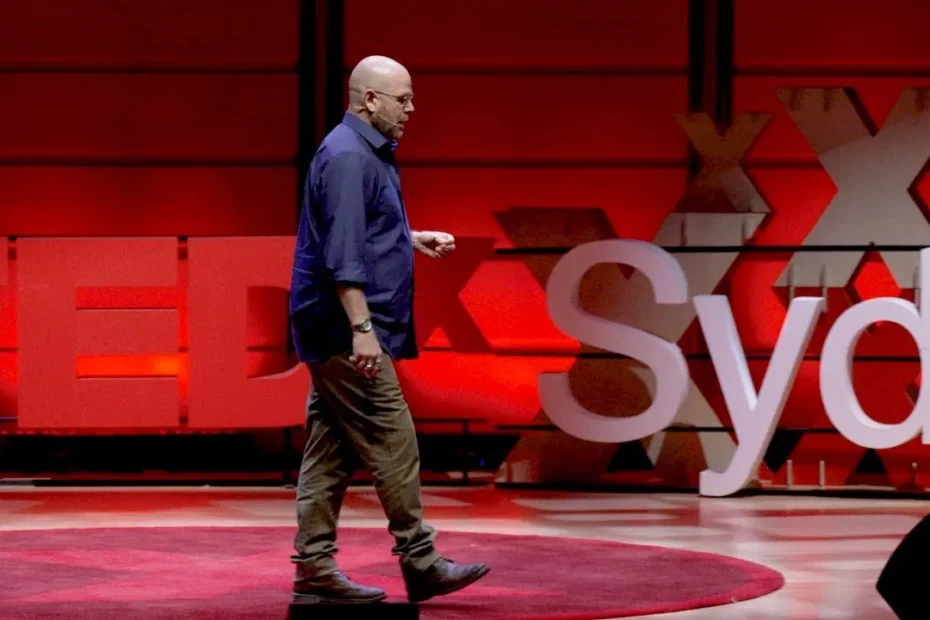
Read the full transcript of Professor of Global Ecology Corey Bradshaw’s talk titled “How Many Humans The Earth Can Support” at TEDxSydney (June 3, 2025).
Listen to the audio version here:
A Mathematical Warning About Population Growth
COREY BRADSHAW: So my talk comes with a warning. If you’re triggered by this, I recommend seeking remedial mathematical training immediately after the event. This is the global population trend going back about 12,000 years. Now I want to put this into some context for you, so I’ll put up a few events with which you might be familiar.
It’s about 10,000 years ago, Bass Strait flooded and Tasmania separated from the mainland. Then about 5,000 years ago, there was this big uptick in population size as well as technological innovation in Indigenous Australia. About 500 years later, the oldest pyramids in Egypt were built. The oldest fossil dingo dates to about 3,500 years ago, but they were probably here much longer than that. Thylacines and devils went extinct about the same time on the mainland. And then very shortly after, the Romans sacked Carthage in 146 BCE. Carthaginians arrived permanently in 1788, and Indigenous Australians were included for the first time in the national census in 1971.
So if you take all the people that have ever been born ever on the planet, it works out to about 130 billion, meaning that today, 7% of all people that have ever lived are still alive.
Biomass Distribution on Earth
But despite these massive numbers, we’re by no means the dominant biomass. Now biomass is just the average weight of an individual times all the individuals in a population. Most biological material is in fact in plants, followed by bacteria, fungi, the Archeans. Now we outweigh viruses only because viruses are very tiny.
Now let’s move to the animals. Most animals on the planet are in fact marine arthropods, followed by fish. Then we have the segmented worms, terrestrial arthropods, mostly insects, then the mollusks and the cnidarians, that would be your sponges and jellies. Note these are all invertebrates. The dominant biomass for vertebrates is livestock, then humans. The invertebrates make another brief appearance here, the non-segmented worms, the nematodes. And then we have all wild mammals and birds here.
Hasn’t been this way always. We go back about 12,000 years ago to the onset of the agricultural revolution. We took all the living biomass of vertebrates on the planet, this is what it would look like. This is what it looks like today. Most vertebrates on the planet are in fact cows. Then we come in second, pigs, chickens, all of the livestock, and this is what’s happened to wild vertebrates. The difference between the total biomass then and now, we call that agriculture. That’s the process of sucking productivity out of the ground and turning it into this case meat.
It’s not just vertebrates though. Every single biodiversity metric we look at around the planet is painting the same story. So you can look at live coral cover, total wetland area. You can look at the extent of free-flowing rivers. You can look at the number of large predatory fish. It’s the cost of our growth.
Recent Population Trajectory and Major Mortality Events
Now, coming back to our human population trajectory, this time only the last few hundred years. Unfortunately, we’ve only really started collecting human demographic data at scale globally since 1950. In the early 1950s, we can see here, based on the number of children born, these are surviving births, that baby boom post-World War II. But the actual highest rate of increase was in the 60s.
Now, against this backdrop, I’m going to put up the 17 largest human mortality events ever. Going from the Napoleonic Wars through the World Wars and even up to COVID-19 which killed about 15 million people. These don’t make a dent in the trajectory. Arguably, World War II had a little bit of a dent with 50 million people dead, but we have not changed this trajectory at all.
Basic Demography and Carrying Capacity
To put this into some more context about what it means for the planet, I have to give you a bit of a primer on basic demography, so bear with me. Here’s where the math starts. We have time along the X-axis going forward. We have population size on the Y-axis. Let’s say you do a census at some regular interval, like for example in Australia we do it every five years, like most countries we count everyone in Australia. For each interval, we can take the natural logarithm of the ratio of the population sizes between the two times, are you still with me? And that value we call R, that’s the rate of population change. In this case it’s declined, population has gone down. In this one interval.
Let’s plot this population rate of change now against population size. For most populations of most species on the planet, you see a negative relationship. Now the point at which R equals zero, that’s stability. So everything above the line is a growing population, and everything below the line is declining. Mathematicians, all of you.
Now, mathematically speaking, the definition of carrying capacity is the point at which this negative relationship crosses the stability line. We denote that K. So you think about it like this, if you have a large population, you tend to have more competition among individuals, so the average fitness goes down, and your population rate of change goes down, and so you track back towards carrying capacity. A small population has less competition, so you have higher per capita fitness, and higher growth rates, so you track towards K. Fantastic, you guys are better than my first years.
Human Carrying Capacity Complexities
Okay, but the concept of carrying capacity in humans is complicated. So we are the ultimate ecosystem engineers. We grow food here, and we place it over here where we can’t grow food.
We have transport systems, we have clothing, and housing technology allows us to live through extreme temperatures. So it’s very difficult to say what that would be, but there are signs.
So using the concept of the ecological footprint, measured here as the ecological assets required to replace the resources we consume and process our waste per unit time. This is measured by the number of earths, essentially, that we consume per year, and we crossed the line of one in 1970. We are using 1.7 earths per annum now, globally. If everyone consumed like an Australian, it would be more like four, right?
How can this be, Corey? You can’t use more than one earth, there’s only one. Think of it like this, let’s say you have a bank account, and I’m sure most of you do, and you live off of that balance, right? You can live quite comfortably, in fact, but if you end up taking out more than you put in every fortnight, you’re eventually going to be bankrupt, and that’s the trajectory we’re on now.
Three Phases of Human Population Growth
Okay, back to some math. Let’s take that population rate of change on the Y axis, and population size on the X, and we’ll apply it to the human population trajectory since the 1800s, so every one of those dots is a transition between one year and the next. Three distinct phases emerge.
The first is what we’ll call facilitation, because we actually see a positive, not a negative, relationship between growth rate and population size, and there was this abrupt transition in 1950, where there was nothing really going on, and then we slid in 1962 into this, what we’ll call a negative phase, because there was a very strong correlation, negative in the direction expected for most other species. Incidentally, that’s probably, that’s roughly when we crossed the one earth line in ecological footprint.
Okay, this is where it gets a bit interesting now, if you weren’t fascinated already, of course. If we extend that relationship through to R equals zero, which means stability, right, we can predict carrying capacity, but in this case, maximum carrying capacity. That puts us at about 11.5, 12.5 billion by as early as 2065, okay? Now that’s maximum carrying capacity, so that’s birth to perfectly offset by death. Not a nice place to live, right? This is environment kicking back on us hard.
Sustainable Population Estimates
So what could a sustainable population size be, or carrying capacity? Well, if we take the relationship that we see during the facilitation phase, and go right to the end, the highest growth rate, in other words, when society was doing the best, there was, for every increment in human size, there was an increasing growth rate, it would be about 2.5 billion.
Now let’s say we also wanted to use the ecological footprint data, and we said, let’s not use 1.7 Earths per year, let’s try to use half an Earth per year, right? That means that if you were using 1.7, we’re about 3.4 times too high, 3.4, so 8.2 billion today divided by 3.4 is 2.4 billion. Remarkable agreement between those two numbers. There’s also completely independent analyses, estimating with an equal distribution of wealth on the planet, about 3.3 billion people could live in economic comfort.
How does this maximum carrying capacity fit with current projections? Well, we’re smack dab on the UN, United Nations, high growth trajectory. Again, when we actually reach that is a bit uncertain, but we’re certainly on the right track, and we’ve been on this track at least since the early 90s.
Regional Growth Patterns and Climate Vulnerability
But growth isn’t equal everywhere, of course. This is the world split up into major regions, and the number of children that will be born per year by the end of the century, over a third of all children on the planet will be in sub-Saharan Africa. Using the United Nations own Climate Vulnerability Index for children, you’ll see here that Africa falls out not only as having the most children, but the most vulnerable children.
Population, Consumption, and Climate Change
Now climate change. Let’s look at that, and this is just the temperature anomaly, so this is the additional temperature beyond the baseline normal. We can see here if we place this into our three different phases, the tightest correlation is during the negative phase, when we cross the line into more than one Earth. So every increment in human population size means we get more climate change.
Yes, but, you know, climate change is just a product of the number of people, right? No, wrong, because also our per capita consumption is increasing. Since the late 1960s, we’ve been increasing our average globally per capita rate of consumption by 0.41 gigajoules per person per year. When you use machine learning models to determine what is contributing most to that climate change signal, it turns out that human population size drives most of that relationship, and of course, to a lesser extent, the consumption increase.
Displacement, Refugees, and Global Consequences
Now in 2024 there were about 120 million people forcibly displaced from their homes, of which about 43 million became refugees. Now in Africa, there’s a relationship between refugees and population growth such that a 1% increase in population growth increases the refugees by three to five times, such that in the absence of climate change, warfare, famine, by the end of the century there is between 80 and 120 million refugees coming out of Africa alone every year. If you think we have a refugee crisis now, it’s the tip of a very large iceberg.
I argue that the rise of the right-wing populist movement around the world is at least partly a result of increasing xenophobia from the displacement of people that will only get worse with climate change.
The Path Forward
We cannot ignore the population issue because it’s affecting the most vulnerable people first. We have to start thinking about empowering women globally to give them the choice to choose their family size by providing free, non-coercive, culturally sensitive family planning, because if we don’t have family planning, we don’t have family planning that we want, the environment’s going to do it for us. Thank you very much.