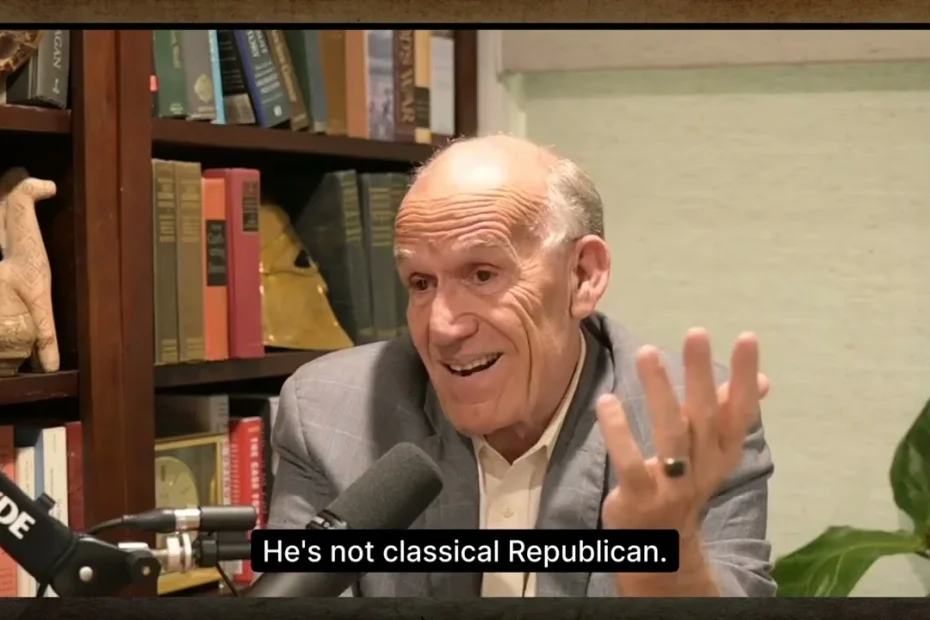
Read the full transcript of a conversation between Victor Davis Hanson and cohost Sami Winc on “Trump’s Tariffs and the Great Depression”, April 4, 2025.
The interview starts here:
Understanding Tariffs in Context
SAMI WINC: Hello, and welcome to the Victor Davis Hanson Show. This is our Saturday edition where we do something a little bit different in the middle segment. And today Victor is going to be talking about the Great Depression. And I think that kind of works well with the top news stories, which are over Donald Trump’s Liberation Day speech and the topic of tariffs.
Welcome back to the Victor Davis Hanson Show. Victor is the Martin and Neely Anderson Senior Fellow in Military History and Classics at the Hoover Institution and the Wayne and Marsha Busky Distinguished Fellow in History at Hillsdale College. Please come join him at his website, The Blade of Perseus. The web address is victorhanson.com, and we would love to see everybody there. There’s lots of things to read, and I think that you will enjoy the website, especially if you like Victor’s work.
So Victor, Donald Trump gave his Liberation Day speech, which seemed to be centered around tariffs and the process of the United States giving what Donald Trump called general reciprocity for tariffs.
We’ve had some reaction in the meantime to that Liberation Day speech, with the stock markets dropping a little bit – sixteen hundred points today on Thursday. Europe and China have sent out the signal that they are going to retaliate possibly. So this looks like it’s going to turn into a very big part of Donald Trump’s administration. I was wondering your thoughts on this.
Challenging Conventional Wisdom on Tariffs
VICTOR DAVIS HANSON: I have some questions about this. Number one, if tariffs are so bad, then why isn’t the economy of China, Vietnam, India, and Europe crashing? Because they have tariffs up to two hundred, three hundred percent in some aspects like Canada, but twenty, thirty percent in others. So why aren’t they having a discussion in China or Europe about how this is bad, like the Smoot-Hawley Act? Classical libertarian economics say tariffs are terrible. Why aren’t they having that internal discussion? But they’re not. Apparently they think tariffs are very good. It’s only our tariffs that are bad.
The second is they keep saying “Great Depression, Great Depression, Great Depression.” Well, we’re going to talk about the Great Depression. But my former colleague, deceased, but a brilliant man, Milton Friedman pointed out in print and in lectures – I must have heard him say this four or five times in person – that tariffs were a minor factor in the Great Depression. Most of it was monetary policy, too few dollars. There wasn’t enough money, and people were hoarding money.
But his other point was it was wild speculation in Wall Street. So my point is that the more Wall Street lectures us about depressions and tariffs causing depression, I want to say to them, no, you did. You caused depressions because you had wild stock swings. Does anybody believe some of these stocks that are being offered to the public are actually worth that? If you look at the actual earnings of companies and you look at their stock valuation, they’re way off.
Why is the world not angry at the people who started the tariffs and have asymmetrical policies, but they’re angry at the target that is finally replying?
SAMI WINC: The United States is the strongest country in the world and expected to be paternal to the rest of the nations.
Redefining the Tariff Conversation
VICTOR DAVIS HANSON: Okay, so we’re going to be a patsy for long because we think it’s 1947 forever and we’re right after World War II flush with cash and we’re the colossus astride the entire world and that’s in perpetuity? No.
The other thing is, is the word tariff even appropriate? If Europe has a ten percent, eight percent tariff on cars and we say we’re going to do the same thing, is it a tariff or is it just, are we just doing what you do?
What I’m getting at is tariffs classically as defined, going back to the Smoot-Hawley Act, were forty and fifty percent, and they were unilaterally imposed by the United States to protect industry after the 1930 stock market crash. These aren’t unilateral preemptive provocative tariffs. They are a reaction, and they’re reciprocal.
It’s like we’re on autopilot. We just say, we don’t believe in tariffs, but all we’re going to do is whatever tariffs you have, we’re going to mirror image you. So it’s your tariff. So Canada, if you have a 258 percent tariff on American butter, it’s autopilot. We’ll do the same to you. And if you don’t, we won’t. But we’re going to be completely on autopilot reactive.
I don’t even think tariff is the right word for it. They keep talking about the Smoot-Hawley Act in 1930, but if you look at those tariffs like I just said, they were astronomical. They weren’t ten percent. They weren’t even twenty-five. They were forty and fifty percent. And this is a whole different world right now.
The Real Economic Concerns
I’m more worried about the stock market being overvalued. And a whole generation of young people between the two coasts that are not getting married, they’re not having children, they can’t buy a home, they have not had a rise in real wages.
From 2005 to 2017 until Trump came in, there was no rise in middle-class wages adjusted for inflation. What good does it do to dump all this free trade stuff from China and Vietnam, for example, and Mexico in the United States and say that keeps consumer prices down if wages haven’t risen commensurately? We don’t get any break by cheaper prices if the wages are flat. And I don’t mean California artificially raising the minimum wage and driving everybody out.
There are cultural, economic, and social considerations. There’s a reason why we’re losing not just to the cartels’ machinations, but there’s a reason why a person takes a drug. There’s a reason why the suicide rate is at record levels. There’s a reason why males of the working classes between eighteen and thirty are completely a lost generation.
And it’s because they don’t get up in the morning and think “I’m going to build a plant, I’m going to build a natural gas generator, and I’m going to get an adequate wage, and I can buy a house.” That’s gone.
Trump’s Economic Populism
So what this is a class thing. It really is. What Donald Trump did was he said, this Republican is going to side with the working man. It’s not going to choose Wall Street. Wall Street hates Donald Trump.
Has anybody ever in their wildest imagination thought that Democrats would be on the floor of Congress blasting Donald Trump and worried that Wall Street’s going to be hurt and not talking one word about the working classes that are all for this because they think finally somebody’s listening?
And the final thing is, has it had any effects? Donald Trump says $4 trillion in foreign investment. The figures I’ve seen are commitments – they’re not actualizations yet, but $3.1 trillion. If that comes in, there’ll be millions of jobs that come in here for people to avoid these tariffs, because he’s just saying if you come to the United States and you want to help us, you can keep the profits. You just have to have the jobs here.
If you’re Mercedes Benz and you get a three percent to eight percent profit on your sales, fine. But the cost and the services and the labor is going to be here. You’re going to pay for things here. And so it’s going to be a boon to the interior of America.
And the Democrats, because they have no other alternative agenda, they are taking the side of the uber rich, even while they blast oligarchs and aristocrats and plutocrats. No, you’re on the side of plutocrats and aristocrats. You guys were the party of globalization under Bill Clinton that started it all off. You were the people who thought globalization was neat because you could wean the billionaire class over to your side, which is about seventy percent of them are on their side. So they are speaking in their interest. They’re not speaking for the people of Pennsylvania or Michigan or Wisconsin, the working people.
Tariff Exemptions and Sanctions
SAMI WINC: Just a few more things about the tariffs that are being applied to countries. Donald Trump has chosen not to apply those tariffs to Russia, Cuba, Belarus and North Korea. And I was wondering why.
VICTOR DAVIS HANSON: Well, ostensibly, we don’t have trade with them because they’re under the Biden administration’s trade sanctions. Once Russia invaded Ukraine, we leveled trade sanctions against them. And Trump has said that he would even go beyond that and put sanctions on anybody who does trade with Russia, i.e., buys their oil.
So it would be redundant. In North Korea, we don’t let things from North Korea come in. And of course, the left says, “This is Putin’s puppet. He’s not putting things on Russia.” He’s putting things on Great Britain because Russia is already sanctioned. And Trump, to get them back into the negotiations, he’s going to sanction them even harder.
Impact on American Farmers
SAMI WINC: Victor, I was wondering if you thought that there would be special impact on farmers. How is this going to impact farmers? Are they for or against these tariffs?
VICTOR DAVIS HANSON: I would say most of them are probably against them because it’s in the media. But if you look at the entire economic plan that people are proposing about the extension of the tax cuts, there are elements within that package of immediate depreciation for the purchase of tractors and things that will be, in the long run, favorable to them.
But right now, if you have a Massey Ferguson that’s assembled in Canada, or you’ve got a Kubota tractor and you need parts and they come in here, they’re going to be more expensive. I don’t know how much people are talking about, but in the case of a house, it might be ten thousand dollars more to pay the extra price on bolts and nuts and nails until domestic production either increases or those companies decide to put those factories here.
That can be done very quickly because there’s so much unused manufacturing capacity in the Rust Belt. You could have a Japanese company go into Michigan or Wisconsin or any of those places. They’ll probably go into Tennessee or the South because of the unions. But they can find all of these abandoned places, fix them up or build new ones. They could do it immediately. Within a year they could do it if they wanted to.
I have forty acres of almonds and it produces, on an excellent year, almost three tons. We’re talking about one hundred and twenty tons. It’s not very much, but we have maybe 1.2 million acres of almonds. Tariffs did not make the almond price collapse, overproduction did.
So what happens is if you have almonds or walnuts or pistachios or raisins and they go down to the port of LA, the Koreans, the Indians, the Chinese just go along with clipboards and they look at all of the cargo ships. They look at the cargos, the big crates, and they count them and they think, “What is the shelf life of a pistachio? How long has it been sitting here? Oh, in about six months we’ll offer them seventy-five cents on the dollar.” That’s what they’re doing because of overproduction.
Trump’s Tariffs and Global Trade Imbalances
VICTOR DAVIS HANSON: And they have tariffs too. Anything that competes with their agriculture, they have tariffs. And one final thing, this idea, that postwar idea is so ossified that we take the hit and we allow these countries to create these production assembly manufacturing centers, and then we take American capital out of the United States and develop them over there in these centers. And then they send it back here cheap. And this process then is going to make these countries like Vietnam more affluent or China more affluent.
I’m parodying George H. W. Bush and Bill Clinton. In that affluence, they naturally appreciate the beauties of Western style free market capitalism and more importantly democracy. I have seen zero proof of that.
The more we gave concessions to China, the more they rigged their markets and dumped product here below the cost of production. They manipulated the money markets, they stole copyrights, they stole patents, they ran up deliberate surpluses. They didn’t believe in capitalism free market economics. They believed in Napoleonic mercantilism. And did they ever liberalize?
Oh, Tiananmen Square was because I remember this, Tiananmen Square, That was because of the new affluent growing awareness. No. It just made the Chinese all globalization did to the Chinese is make its military almost the equal of ours, and Vietnam is still run by communists. I haven’t seen any of that. You think Mexico, all of a sudden, they’ve got one hundred and seventy-seven billion dollars surplus and there’s no cartels, there’s no corrupt judges?
No. There’s no proven demonstrable connection between greater affluence based on mercantilism and then an automatic or predestined transition to democracy. That’s what we were told. You guys out there in Pennsylvania, Wisconsin, Michigan, we’re going to have to put you up on the altar of globalism, and you can just go to 7-Eleven and be a clerk or work on the internet, you know, on sales or something because your jobs were overpriced. You were getting too much, so we outsourced.
And now everything’s more efficient because capital always goes to the more sufficient thing. But the people who say that are never the victims of their own ideology. It’s always somebody else in the Midwest or the San Joaquin Valley. And I saw that as a farmer. I saw raisins go fourteen hundred and twenty dollars to four hundred and forty in twelve months.
And I was a smart kid with an irrelevant PhD in classical languages farming on a massive Ferguson, and everybody around me, my Mexican American friends, would say, “Victor, where did you get a PhD? Are you a better pruner than I am? I can prune two hundred vines. I don’t think you can do that. What did they teach you over there at Stanford?”
That’s what they would say to me, and I’d say, “You got a point.” And they’d say, “Who is the fool, you or me?” I said, “I am.” The point is, I think I mentioned that I went up to the Raisin Administrative Committee and we had this economist come out and he was going to lecture us all about how wonderful it is that the free market was going to, and I said, Greece and Turkey are now in the EU and they’re dumping product below. They’re getting about, you’re a baker and you want to pay fourteen hundred for American ton of raisins or you want to pay eight hundred?
But they had actually, the real costs were triple ours because of the regulated economies, but the EU was subsidizing it, so they were dumped here. And I said to them, they have no defense. We’re paying for their NATO budget big time in the eighties. And I said, we just bombed Libya, Qaddafi, and you know what? All of these people that are dumping these EU countries that are dumping product here through subsidies below the cost of production to ruin our industry, they wouldn’t let American planes fly over Europe from England.
They had to go around the European continent—they were siding with Qaddafi while we were protecting them from Russia. So we’re paying their defense. They’re subsidizing product. And this guy says to me, as I said earlier, and you know what’s so weird? I heard it on the radio and driving today and on television.
Free Market Arguments and Reality
I try to listen to all these different stations. They get these free market people. Now they’re Democrats, but they usually are Republicans. They always say that it’s going to hurt the consumer because you’re going to get cheaper prices. And we’re going to get lackadaisical domestic suppliers because they think that they can just raise prices.
They’re not going to be competitive. And, you know, we talk about China and Vietnam and Europe, but, you know, they’re not—this is not sustainable for their countries to have protectionism because they’re not facing market realities. The buffets, the winds, the tornadoes of the market, we are, so we’re flexible. How’d that work out the last fifty years? Go tell somebody who was a boilermaker or steel worker and tell them that he was lazy or that he’s better off at seven bucks an hour or ten bucks an hour.
I’m so sick of that. It’s a class thing, and I have this unique or unfortunate experience of being in the Bay Area and on the Stanford campus listening to this, and then coming back to southwestern Fresno County and seeing the reality of stark poverty and no jobs that pay well, except for government, state of California. Fifty-seven billion dollars in debt, but it is still printing money on account, printing money, borrowing money for everything, Medicaid, everything.
SAMI WINC: Victor, before we go to a break and then to your middle segment on the Great Depression, the last question I had was, you notice I was skimming over the tariffs to be applied in all the countries and their tariffs? And it seemed to me that the countries that had the highest tariffs against the United States, and you kind of touched on this, were Cambodia, Laos, Vietnam, but and somebody could argue, they’re communist states, of course, but then Taiwan as well, which is not.
And it’s all these Asian states. Is there any, there are some that were not Asian, but it was predominantly with the highest ones, those Asian states. I know that they would make it interesting. Not all communist. Taiwan’s not communist.
VICTOR DAVIS HANSON: But their attitude was, their attitude, what was their model? Their model was China and their attitude was this, well, if China is a belligerent to the United States and a rival and the United States doesn’t trust it and China gets away with ten percent, twenty percent, thirty percent tariffs on certain things, then why wouldn’t our friends or neutrals like us get the same break? See, that’s what people don’t understand. Once you start to do it and you work at a disadvantage, and some of the people that you’re working at a disadvantage of are your hostiles or belligerents or enemy or opposition. Then your friends say, “Well, why would you treat your enemy better than us?”
So we’re going to do it too. So they got on. And then the second thing was, when we started to have frostier relations, some people started to relocate to Southeast Asia for cheaper wages. And they thought, wow, this is really good. We’ve got a lot of money coming in.
Maybe we’ll put barriers because we’re kind of insulated now. First of all, the United States doesn’t believe in retaliatory tariffs. And number two, we’ve got all this foreign investment coming in. So we can afford to be a little bit of protectionist of our small scale agriculture because they are not going to retaliate against us and we have got all this infusion for relocation from China and assembly. Same thing with Mexico.
Reciprocity in Trade Relations
I just don’t understand the logic. This is why I’m so confused. The world is angry at the people who say no mas. Carolyn Levitt’s been very good at that. I don’t know if it’s the press secretary.
I really like her. She just kept saying reciprocity, reciprocity, reciprocity. With her little chart, she puts them up, why are you mad at us? We’re just doing what you do. And, you know, even the only country that I have ambiguous about somewhat is Australia.
I did last night Sky News of Australia. I love Australia. The Pew Polls show that of all countries in the world we have the fondest, most favorable feelings, reverence for Australia. Okay, they run a sixteen billion dollar deficit with us. And so why did we have a tariff on them?
Because one of their biggest industries, of course, is beef. And in 2003, there was a case of mad cow disease from a Canadian imported cow. And so they went, and I don’t blame them, they went ballistic, they said no more beef. But then Donald Trump said, if you look at the Chinese and if you look at the Europeans and if you look at everybody, they go into little weird things like, “Oh, you can’t have a chicken in a cage this size,” or “This environmental can’t leave this much carbon footprint,” or you can’t have, you might have a swine flu or bird flu outbreak and they find little things like that. You think that 345 million Americans that eat meat all the time are going to get mad cow disease?
No, But Australia used that, and so for the next twenty-two years they haven’t allowed our beef to go in at all. So Trump said the other day, I like Australia, but they’re using an archaic, calcified idea as an excuse to keep out competition from American beef. I live eight miles from the Harris Beef Corporation, which is the largest beef corporation west of the Mississippi in terms of actual tonnage of beef produced. It’s right here on McCall Avenue, not very far from my house. John Harris sold it about four years ago to a local company.
But if you talk to the people who ran it, I won’t mention their names, they’re wonderful people. John Harris is known as a cattle baron agribusiness person, but he’s known foremost as a man of integrity. Just a sui generis. He’s a different type of person. He’s always had a high moral code.
We’ve mentioned Carol Harris, the recently deceased. She did too. Very generous people. The idea that they were producing beef there that might have mad cow disease, that is insane. That is one of the most up to date, clean, automated, and they even had PhDs in animal science to see that the way that the animals were dispatched was humane.
I think they even had an animal psychologist that come in and make sure that the animals weren’t too apprehensive as they were led to their next life. But my point of it is, so Australia would say that you can’t have any American beef, no Harris beef. That’s insane. And so that’s why there’s all these things that Trump is saying, I got four years. I’m gonna be reciprocal.
Trump’s Approach to Economic Policy
They’re just—it’s madness. And think one last thing. Everybody take a deep breath. He could have been like Ronald Reagan. Ronald Reagan did a lot of good things, but he didn’t cut the budget.
He didn’t try to balance the budget, and he didn’t try to shock the world into treating us the way that we treat them. George W. Bush came in. He did a lot of good things, deregulate a little but the deficits went up, just like they did during Trump’s first term, partly or mostly due to COVID. And we got into optional ground wars, which I supported in Iraq after 9/11 and Afghanistan.
So my point is this, this is the first, and George H. W. Bush, he kept talking about capital gains tax, capital gains tax, capital gains tax, but not offshoring or offshoring. This is the first Republican that said, We’ve all been playing musical chairs and this music is going to go off. And when it goes off, there’s no seat for the United States with thirty-seven trillion dollars in debt and one point one trillion dollars or somewhere between nine hundred billion dollars versus one point five trillion dollars that undulates in trade deficits.
So he’s the first person who said, I am going to, common sense wise, or comprehensively take a look at everything that is plaguing the United States. The border, no more cheap labor under the Bushes and Reagan. I looked at them as, I have debated. My friend Alan Simpson, he was one of my close friends, I debated him on the Simpson-Mazzoli bill in front of a group. I really loved him.
He was a wonderful person, but I think that bill was wrong. But he’s the first person that said there’s going to be no illegal immigration. We’re going to follow the law. He’s the first person that said we just want to be treated the way they treat us on trade. He’s the first person who said the federal government’s three million employees is out of control, and we can’t run these deficits.
None of the other Republicans did it. And yet, he’s—you pick up the Wall Street Journal, you think he’d be public enemy number one. I don’t understand it at all. I don’t understand why people are saying, yes, he tweets too much or he says this or that. I can understand that.
But why don’t they see what he’s trying to do? And why don’t they compare what he’s trying to do with past presidents? Why doesn’t the Wall Street Journal like the Democrats? Why don’t they just say, this is the Wall Street Journal’s alternate plan? We believe either they have to do one of two things.
We don’t think trade deficits are a problem at all. We don’t mind at all. It’s like we said, it lowers consumer prices and makes us more efficient. Then just say that. Or we don’t think budget deficits are that bad.
You can always borrow. You don’t need to cut like this and this and that because they’re always criticizing his cuts and stuff. Or why don’t they say we can manage three billion dollars or the defense budget, you know, it’s the same as the annual interest payout. That’s no big problem, but they don’t. All they do is attack, attack, attack, attack.
We’ll come up with a constructive alternative. Or if you can’t, say the status quo was fine. It was all Trump’s imagination. Trade was great. Deficits were no problem.
Trump’s Tariffs and Economic Policy
VICTOR DAVIS HANSON: Interest borrowing, no problem. The border was fine. We got a lot of cheap labor. Great demographics. Just say that, but they don’t.
That’s what drives me nuts. Going to be one last thing. There’s going to be, is it twelve Democratic representatives as we speak are going to visit the border to inspect the status of immigration. What are they going to do? Well, where are they?
Vinnie Thompson, remember him, the chairman of the January sixth committee, before that known as an election denialist who tried to overthrow the 2004 election by trying not to certify, I think along with thirty other House members, because they said, does this sound familiar? The voting machines were crooked, and George W. Bush didn’t really win Ohio. It was really John Kerry, and John Kerry, if he won Ohio, he’d be the president, so we’re not going to certify it. We’re going to delay.
Then they put him the head of the January sixth committee, and he’s going down to the border. He didn’t set foot there, did he? Not for four years. Guess his attitude is the border is wonderful when it’s wide open and there’s twelve million illegal aliens and there’s five hundred thousand felons so I don’t have to visit. But if Donald Trump is president and there’s nobody coming across and there’s no more illegal aliens, then there’s something wrong.
I’ve got to go find out and attack him. There might be something unsafe there, Victor. He’s saying there’s too many people not working. I went there and they’re just were driving around, waving at each other. They’re not getting killed or shot at or trying to deport people with who knows what.
And I think that Donald Trump has got a massive project trying to clean up the border problem that the Democrats left him, and he’s got a massive project doing these tariffs. They are going to be somewhat of a long term, much longer than he had to do this. He could have just sat back and said, “I’m Donald Trump,” and he could tweak things at the edges. He could have, like he did the first term, could have done some good things, good GDP, low inflation, deregulated, cut taxes, tried to jawbone the Cultural Revolution.
Instead he said, Woke, ESG, DEI, uh-uh. I’m going to have a counter revolution, cultural, social, economic, political, military, diplomatic. That’s what he’s doing. And I think only a businessman with his businessman’s attitude, we’ve got a problem, let’s get it fixed, this is how we do it. That’s the only way it gets done.
If you had a swamp creature in there, they would be doing what you just suggested, sitting back, letting things ride. Well, their wife would have come to them or their spouse or whatever and said, you know, I went to a cocktail party in Georgetown and I just can’t take it. What they’re saying. Or one of the senators would call up and say, My wife works for CBS, she’s going ballistic. Or somebody else would say, My husband, he’s working for PBS, you can’t do this.
And then they would be susceptible to that. But as I wrote in The Case for Trump, I’m writing a sequel, Trump Comeback or whatever we call it. I’m getting close to a rough draft, but he is like Sophocles’ Ajax or Ethan Edwards in The Searchers. He’s the outsider, tragic hero, everybody said we’re in the stasis. We can’t deal with the debt.
We can’t deal with trade. We can’t deal with the border. Had Joe Biden. Oh, who’s that weirdo riding in from the Mount from the Grand Tetons? Oh, it’s Shane.
Oh, he was a gunslinger. Yeah, but we don’t care if he’s a gunslinger. He’s faster than the cattle baron. So Shane, do your thing. And then when he does his thing and we’re safe, they said, Oh my God, he has a gun.
I don’t approve of that. Remember that great line when he says, “There’s no living with a killing, and there’s no place for me here, and I’ve got to leave.” And the point was, it’s just like John Wayne at the end of The Searchers when he walks out that famous John Ford scene where he opens the door and there’s light coming out and it’s dark and everybody’s celebrating that Natalie Wood came back and everybody’s happy. And you think they’re going to crown him with flowers or an olive wreath or something? No, they don’t want him.
He kind of does that jelling, “Well, you know, I am done and I am going home.” He has got that kind of confederate double breasted thing and it is like, “Thank you and we loved you for doing that, and I don’t think we want you to stay for dinner, not the mechanisms you used. You were a little bit too violent for my taste.” It’s kind of like Curtis LeMay, He’s going to take the B-29s down to seven thousand feet. He’s going to drop napalm.
He’s going to come in on the jet stream four hundred miles an hour. He’s going to target the industrial centers of all the major Japanese cities. He’s gonna shorten the war by two years? No invasion of Japan, probably? He’s going to mine all the harbors?
Oh my gosh. If he could do that, we wouldn’t have to invade Japan. And that was why we didn’t invade Japan, by the way. It wasn’t just the atomic bomb. Japanese said that after the war, that the B-29s did far more damage than the so then after it’s over, peace.
Oh my god. We invented napalm at Harvard University, and that Curtis LeMay guy did it. He dropped napalm. He dropped eleven million leaflets. That wasn’t enough.
And then we started trashing him, and he pops up in Dr. Strangelove, you know, as a composite character of these nefarious, odious generals, and then we make fun of him, and then he dies. And it’s like but when you’re in an existential war and you don’t know how to use the B-29 and it’s a bigger loss than the Manhattan Project, two billion down the drain, and General Hansel was a good a nice guy, a really nice guy, and he’s flying at thirty thousand feet and they’re missing the target. And the engines are burning out, then I think you need Shane. You need Shane or John Wayne.
And that’s what we do everything. Same thing with George Patton. Oh my God, he slapped a soldier. Yeah, he slapped a soldier after he saved North Africa and he won the Sicilian campaign, and then they put him back in. Oh, we need him.
Where is he? Well, isolate him for a year because he slapped two soldiers. Well, bring him back. We were stuck at D-day. We can’t get out of the Bocage.
He’s on the way to the Rhine. And then after the war, it’s, oh my gosh. He said that one day we might have to fight the Russians. Oh my gosh. He said that we fought to liberate Eastern Europe in 1941 from the Nazis, and now it’s controlled by the people just as bad.
Those are our allies, friends, the Ruskies. I know what we’ll do. Will we leave him off command? Then we’ll say he’s a nut, and that’s what they did. Same thing with General Sherman.
SAMI WINC: Sad tales, Victor.
VICTOR DAVIS HANSON: It is. It’s a tragic hero. That was the brilliance of the seven plays of Sophocles. Read them.
Philip Tides, Ajax, Antigone. It’s some brilliant person that comes out of nowhere to be the moral problem solver, and then as the problems get solved, the people who are the beneficiaries think, “Wow, that was amazing, but now we don’t need them. And now I hate myself for ever calling in such extremist.” And that’s how it works.
SAMI WINC: Well, Victor, we have to go to a break and then come back to talk a little bit about the Great Depression.
So stay with us everyone, and we’ll be right back for the Great Depression. Welcome back to the Victor Davis Hanson Show. So Victor, you can find Victor at X. His handle is @VDHansen and on Facebook at Hansen’s Morning Cup. And we’ve started video production of these podcasts, which can be found on YouTube, Rumble and Spotify.
So whatever your outlet is, come join us there. So Victor, the Great Depression, perfect week for it since Donald Trump rolled out all his tariffs. So I’m looking forward to your assessment of the insignificance of the Great Depression to our history. So go.
The Great Depression
VICTOR DAVIS HANSON: It’s still debated. The Great Depression was that period, from Black Tuesday, the collapse of the American stock market in 1929, all the way through 1939, where you finally had steady increase in GDP and lower unemployment.
It really didn’t happen though until 1941, and just remember that we had about eighteen percent unemployment with the second mini depression of 1938 and 1939. So the question is why did this booming economy in the post World War I era, the roaring 20s that we call it, why did it suddenly collapse? It’s very interesting that’s relevant now because we’re talking about tariffs. And there was a huge tariff, the Smoot-Hawley Act of 1930. But we noticed something.
The stock market collapsed in 1929, not 1930, and that didn’t get really going until 1931. As I said earlier to Sami, Milton Friedman never thought, as most economists don’t think, that the tariffs were the main contribution. So what caused this panic? One of the problems was that the stock market was not regulated and there was this boom and the actual productive capacity and profits in real dollars of companies that were highly valued through speculation. They were not earning the types of returns that justified the market and people started to see that.
Now, were there structural things that were happening? In the 1920s, horses, I think my grandfather told me that he stopped using horses in the early 20s on this ranch, but his point was half of his one hundred and thirty five acres was devoted to pasture to feed the so called Newman tractors. Once he got, I think his first tractor was a Fordson, I think they called him, and he went to heaven when they made the model nine, eight. It was called a 9N. It didn’t have overhead valves, but it did have a PTO shaft.
My point is that once that happened, he brought all of his land into production, And that happened all over the United States. So and it happened in industry too with electrification. So when you started to get mass electrification in the twenties at the end of World War One, you started to get enormous increases in assembly line production, and you started to get enormous increases in food production because you almost got a forty percent increase in irrigable land because it wasn’t being used to create the power to cultivate. That was now replaced by the internal combustion engine. So you were creating a lot of product.
At the same time, there was this Ponzi scheme where the Versailles Treaty said that Germans had to pay reparations. The Weimar government was under pressure, so it was almost the equivalent of about a half a trillion dollars today, and they were supposed to be paid in gold, or at least marks that were backed by sufficient gold reserve. And they quickly started to inflate the currencies to pay back France and Britain, but primarily France. So the German economy then suffered hyperinflation, started to tank. The allies who had borrowed billions of dollars from us in 1914, 1915, 1916 were not able to pay us back.
So what we did partly rectified and exacerbated under the Dawes plan. We started loaning massive billions of dollars of outflows to Germany so Germany could pay France and Britain so they could pay us back our reparations. And what we were doing is we were putting investment into the German economy that wasn’t creating goods and services or new factories or new jobs, and we were doing the same thing. They were paying Britain reparations, and they were not really using that to rectify the losses they had or convert their factories into productive peace. They were paying us.
So this money was coming in and the stock market was going crazy. And they looked at increased I mean, wouldn’t you want to have a booming stock market and start speculating when all of a sudden there’s billions of dollars coming in on borrowed money from the French and the British to pay us what they had borrowed at the early years. And then all of a sudden you look at agriculture and manufacturing and they’re producing all these goods and services. Once the stock market started to collapse, big time, and then people’s banks started to fail, people started to hoard money. I mean, one out of every five banks failed.
And so they took money out of circulation. And then people, at the moment they had this enormous productive increase in the 20s, there was no purchasing power because everybody was freaked out. They started taking their money out of the bank. The stocks were wiped out because of the dramatic thing. The British couldn’t pay us back.
The French couldn’t pay us back. And it was a monetary problem. And we were on the gold standard. And the gold standard’s fine if you’re in prosperity, but when you have no money, you need to increase the supply of money. And that was contrary to classical economics.
Keynes was right for a brief period that you needed to increase the money supply because there were billions of US dollars that were in people’s socks under their mattress. They were just terrified to spend it because they didn’t know if they’d have a job and they didn’t want to put it in the stock market and they didn’t trust the bank. So what do you do? You take it out of circulation and you pile it. Not that they had that much money.
And then the debts were called in. The more the debts were called in, the more you put you reload you took people twenty five percent unemployment. It was just a circular. And then in 1933, after the third year of this, getting into the fourth, we get the New Deal. And what did the New Deal do?
Trump’s Tariffs and the Great Depression
VICTOR DAVIS HANSON: It started to regulate the economy. And it’s the National Recovery Act, which was declared unconstitutional, the Agricultural Adjustment Act. They started to make work. Some of it was good, but it wasn’t market based. The government is not as wise as the market, and they started restricting profit making and controlling the economy.
At this time, by 1935 and 1936, we had some increases in GDP, but when you look at the other countries, and this is the irony about it, the totalitarian fascist horrific countries like Japan, like Germany, like Italy were command economies. And one of the things that—and remember, they had the word socialism, national socialism. Italian fascism was a socialist concept. Same thing with the Japanese militarists. So what they started to do were massive public works program, trains, train stations, public buildings in Germany and Italy, autobahns.
And then Japan started building huge port facilities, and they started to rearm. And they started to expand their market economies by expanding their monetary base. It had to be paid back, but for that period it was stimulus. We didn’t do that. And that cycle of too much production, too little money in circulation, twenty-five percent, it just kept going and going.
And no matter what Roosevelt did, he made it worse because he kept trying to control the natural yin and yang of the market, which would have adjusted. And so by 1938, we had about seventeen percent unemployment, eighteen percent. Think in some states it was up to twenty percent. And then he said something quite unique. He said, “We’re going to have Doctor War and not Doctor New Deal get us out of this.”
So then we went up, suddenly printed money up to one hundred and twenty-three percent, one hundred and thirty percent, bigger than now, one hundred and forty percent of GDP. So a country that could not afford an army the size of Portugal in four years was equipping people, twelve point two million people in uniform. And when they went overseas, people could not believe it.
The Australians or the British would say, “My gosh, those Americans have the most beautiful uniforms. They have chocolate bars. They have Lucky Strikes. They have Camel cigarettes. They have condoms. They have everything. And we don’t have anything.”
So it was massive and then everybody said when the war was over, the music would cut out and we’d be back in the Depression. It didn’t happen because we kept expanding production and we changed over from war production and then the Cold War, and we stayed in them. But it was preventable had the Federal Reserve loosened up on the money supply.
I don’t know if it would have been wise to suddenly get off the gold standard. We did eventually, but to start to nurse ourselves off it and allow money not to be all money connected with the amount of gold we had. I mean, it’s an inflationary process we have today. But the main problem was coming out of World War I with these payments that were just circulating between the defeated Germans and Austrians, the reparations that were not going to them, they were being paid off in funny money, and then our desire, I think Coolidge said “they hired the money, didn’t they?” Meaning France and especially France, but also Britain, especially Britain and also had to pay us back.
But nobody was using that money to invest is what I’m saying. And that fueled the stock market price. And then the stock market looked at things and they looked at, “Oh my gosh, look at cotton now. We went from a half a bale an acre to three barrels with machinery and nitrogen fertilizers and oh my gosh, everything.” And they looked at the arable and these farmers were buying machinery and they were taking huge debt.
I know my grandfather said to me, “I never borrowed a dime in my life, but I had no choice. If I could get it to nine in tractors, you know, for eight hundred dollars each and go to the bank and borrow it, then I could get double my production.” And but if the price of raisins went from World War I, dollars one hundred and seventy-five to thirty-two dollars and they used it, finally the government went in and bought it from them. And they laced it with brandy and sold it for cattle feed. And then the government came in and controlled it.
You couldn’t take your raisins and sell them yourself. The government owned it, commodities. And those were these allotments. You couldn’t plant this much of cotton or this much of wheat. They had allotments on everything.
So it strangled the free market as a reaction. So the strangulation of the free market and the constriction of the money supply and then the methods to address that made it worse. And then the international scene and it was tragic because one of the results of the Great Depression besides that ruined lives and people died and starvation and horrible things happened was the rise of Italy, Japan, and Germany. They said to us, the democracies, “We saw the Great Depression before you did. And we did public works and we borrowed and we rearmed.”
And so in the salons of New York, Mussolini was a cult hero. All these very wealthy New Yorkers said, “Wow, Duce, he’s got the trains run on time. He’s got sophisticated telecommunication stations. He’s got air service between cities in Italy.” They looked at Germany and they said “there’s not a freeway in the United States like the autobahn.”
So they started to not look at what those fascist countries were really like. They just saw that they had somehow survived the depression greater than and that made us unaware of what they were like and what our rendezvous would be like. They got ahead of us, way ahead of us, especially Japan.
The United States and International Economic Relations
SAMI WINC: This discussion has raised one observation and then one question, which might be too big for right now. It looks like the United States has expected to take an imbalance in their economic relationship with other nations in the world from post World War I, we tend to just always put it as post World War II, the US becomes the big economic power. Therefore, it had to take the hit when it came to trade imbalances, for example. But it seems to me that from the discussion of the Great Depression in the United States or what you said earlier, the United States has really done that even post World War I.
VICTOR DAVIS HANSON: They did. Number one. They stepped in with the Dawes plan and they said to the Germans, “Stop printing money to pay the Allies because the Allies can’t pay us. So we will loan you money and then you should invest that money in productive and create real wealth and pay the allies and they can pay us.” It didn’t quite work out that way. But we were trying to intervene and solve these problems.
Finally, said, “We’re so wealthy now with the roaring 20s and we’re so sick of World War I.” And by 1933 and 1934, the mood in America was, “Hey, we got one hundred and seventeen thousand of our kids killed over there. We sent two million people over there, and they’re at it again. Hitler, Mussolini, now the Japanese, we’re sick of them.” And that delayed our rearmament, and that was tragic.
SAMI WINC: And the second one is a question. So when you said that government is not as wise as the free market, you sound like a Milton Friedman free market advocate. Yet in our earlier segment we talked about tariffs and you’re defending Donald Trump’s tariffs. Make sense of that for me.
Free Markets and Government Intervention
VICTOR DAVIS HANSON: Well, the fallacy with all due respect is yours. Apparently you have to remember the adjectives I used. I said wise, not ethical, or nice. There’s an iron law out there. It has nothing to do with us. It’s kind of like the political science theory of the iron law of oligarchy. No matter what kind of democracy you create or constitution, there’s going to be a select group of people who are more talented or more money and they’re going to rise and run the thing. I don’t know if you believe that or but it’s kind of an iron law.
The hidden hand is what they use. And you can’t pick there’s millions of variables that make a business succeed or failure. So when Pete Buttigieg thinks he’s going to spend ten billion dollars to make charging stations, he thinks he’s smarter than all of these local people who build charging stations. They know the traffic patterns, the type of charging station. He thinks he can just mandate that.
Well, didn’t bill any, and we just blew that ten billion dollars Because he didn’t just say, “Here is a grant for the state of California to disperse and it’s going to be competitive building and we’re going to monitor it and see which particular contractor can build so many stations in such a time for such a cost.” It wasn’t it was overly controlled and even that is not efficient.
So what I’m saying is there is a hidden hand and it’s very efficient. Don’t get me wrong. It’s very efficient for the whole world to have something die in Vietnam produce something we want and somebody will produce something they want. But the problem is that efficiency is not necessarily equated to fairness. I’m not a socialist. I’m just saying that I’ll take an example.
We have the seventh highest per capita income in the world, But we’ve got massive numbers of people that can’t buy homes because that per capita reflects the total wealth of the country divided by the number of people in it. But it’s not a good indicator of the general welfare of everybody. It’s a good indicator of how dynamic the US economy is as is GDP, but when you have vast numbers of the people of the population who can’t do certain things in a sophisticated society, like get married at an earlier age, have children, buy a home, not take drugs, not commit crime, all that. Not that you can, that’s part of human nature, but you can mitigate that by having affordable housing.
I’ll give you an example of what in 1971, I graduated from this town, and I mentioned this before, but almost everybody in my class did not go to a four year college. They were electricians, they were insurance salesmen, they were assemblers, they were manufacturers. There was about ten of those plants in this little tiny town.
If I went down the main drag of Reedley, California, they were packing house after packing house after they’re all shut down now. Everybody was working there, and these people were buying homes for eighteen thousand dollars twenty thousand dollars FHA homes, and they were getting married in their 20s. When I came back from graduate school at twenty-five, everybody called me the old man, and “You’re not married? You’re not married and you’re twenty-five years old?” And I thought, well, I got a PhD. I don’t have any money. What would I do? You know, I can’t. So that was a very healthy thing in that country, and that reflects things about the country on crime, on safety, on tradition, on values. It was a very public spirited time, I can tell you that.
And I would make some progress. If I was walking in San Francisco, I don’t know, in 1955, and I lost my wallet, I would have a much better chance of somebody turning into police than I would today. I’m sorry, I would. If I was in Selma, California, and I was driving in a parking lot, there would be very little chance that somebody would intentionally try to hit my car and then file a fraudulent insurance claim, because there was a shame culture. It was a close knit. People were roughly pretty prosperous. I’m not saying they were as I mean, didn’t have cheap Chinese things and the Internet and all that. I’m not talking about technology, but it was very different.
It was the idea that we’re building homes and we’re going to build in 2014, we voted in California 7.5. It was kind of an ossified idea, an old fashioned idea to build dams and make water like our grandparents did. We built we authorized seven point five billion dollars to make three big reservoirs, and Gavin Newsom didn’t even do it. Nobody would have ever got away with that in the fifties or sixties. Instead, he took the money. He took a quarter billion dollars of the money and blew up down. For what?
Well, that was this new postmodern but what I’m getting at is you have to have a moral economy and an efficient capitalist economy, and they’re not antithetical. You can channel it. You restrict it too much like Europe does, you get socialism and inefficiency. So there’s five hundred million people in the EU and they produce about twenty dollars of goods and services per year. That’s our GDP.
There’s 340 million in the United States. We produce about thirty trillion, thirty-three percent more than the EU. And we have sixty percent of the population. And that’s because we’re far more efficient, far more efficient. But we might do a little bit more of ensuring that people have an up that we can encourage home builders to build homes.
We don’t have to be socialists like they are. But if we just said we’re not going to regulate the thing that’s really destroyed this country is this bicoastal elite who is very, very wealthy through globalization when they had their seven billion person markets. If you were a lawyer, a media person, an academic, an investor, a financial analyst, you name it, a high-tech person, you got a whole new seven billion people buying your products. But the muscular people, we just wrote them off. They were losers.
Trump’s Tariffs and the Great Depression
VICTOR DAVIS HANSON: You can’t do that. And so I’m not trying to romanticize the middle class. I grew up with the middle classes and I think if you look at a map of California, Tulare County, Kings County, and Southwest Fresno County, and I live at the intersection of all three, is the poorest area in California and about where Appalachia is. I think this community has about a sixteen thousand dollars per capita income. So I’m not trying to, but I can tell you that the morality of the people that I see here, in many ways it’s superior to the people that I see who are very affluent in Silicon Valley.
And so you have to try to invest in the working classes, always the majority. So the government should play a role but a necessarily smaller role for particular somewhat more deregulatory war. It can be an incentive capitalist role. It can say to this, if Gavin Newsom said this, any developer who creates one thousand homes, two thousand five hundred square feet per year, I will waive the requirement that he has to have a solar panel and this and this. Not things that involve the structure.
I will promise you that you can get a permit in a year and a half. That’s it. Or if you could give incentives, or I will not charge. If you build a new, for the first ten years, you will have a fifty percent reduction in your property tax. Anything like that, you can work with the market to incentivize.
But they’re doing the opposite. They’re de-incentivizing the market. They’re saying if you build a house, you better take a camera guy and pay him twenty thousand dollars aspect of your billing because under our judicial system, some guy is going to sue you and say you missed three studs and then we’re going to hold you liable. You know what I’m saying? And so we’re so over regulated.
And California is a huge state. If you look at the population per square mile, it’s not compared to other countries, it’s huge. I mean, it’s about the size and total area of Japan, and we don’t have 130 million people. We have 41 million and shrinking. So we have a lot of space.
We could really create more dams and reservoirs and fix our freeways and get better airports and more housing. And we don’t have to build European style high rises with a little green grass circle around it and everybody gets on the high speed rail to work. We can give people you know, five or six homes per acre and give them a backyard and stuff. And the government’s role is to play the role of making that an easier process to the extent it is and not taking over as the capitalists or the company. Have regulations or otherwise.
SAMI WINC: A housing tract that was built in the late 50s, early in this town. And if you go look at those houses, and I know people who’ve lived there, so I’ve been in them, they have like one quarter inch glass still. There were no regulations. And they’re slums. We called it Splinter Village when I was in high school.
VICTOR DAVIS HANSON: Splinter Village. It was kind of fake Lloyd, Frank Lloyd Wright style, and they all collapsed. You have to have regulations, but you have to be reasonable. And the problem is that our regulations are boutique regulation. They come out of the mind of very affluent people on the coast who have everything they need.
They’re very wealthy, and they think, I like to live to a hundred years. I want beautiful air. I don’t want any… I want to look out at California as perfectly scenic and pristine. I have to because they have that laxity to do that. And then they start charging electricity rates and gas rates and taxes that nobody could afford except them.
And that’s what’s destroying the Democratic Party, that it’s the party of the professional class and the billionaire class, and they want this idealistic top down vision, the vision of what Tom Sole called the vision of the anointed. And it has nothing to do with getting up in the morning in Fowler, California and saying, can I fill my gas tank at four seventy? I just got back from Michigan when I got the census flu a month ago. Gas was three zero five. We have more gas in California, natural gas and oil, than Michigan does.
I just went by, it was four seventy. There’s no reason for that. There’s no reason that a guy named Joe Gomez, who’s a lineman for the power company, should have to pay forty cents per kilowatt. It’s just ridiculous.
SAMI WINC: Well Victor, let’s take a break and then we’ll come back and talk a little bit about Gavin Newsom and the Democratic Party.
VICTOR DAVIS HANSON: Yeah, speaking of California. I know you went into it, but we’ll talk.
Gavin Newsom and the Democratic Party
SAMI WINC: Welcome back to the Victor Davis Hanson show. So, Victor, I know that you wanted to say about a little bit about Gavin Newsom who’s been in the news in an effort to look like he’s moving to the center so that he could potentially run for a presidential race. And also just the Democrats, are they offering any viable agenda?
VICTOR DAVIS HANSON: I mean, he said he was going to have what were the edgiest podcasts around. He was going to engage people, confront people. So we’ve had let’s see. We’ve had Michael Savage, Savage Nation. We had Charlie Hurt. We’ve had Bill Maher, and we had another conservative too. And it’s been going on about sixty days. Has he had any new initiative that says we’re going to build a reservoir with the seven point five? No.
Has he said we’re not going to blow up those two dams in Northern California after I did four already? No. Has he said I have a plan to raise the eight billion dollars that I gave to Medi-Cal? No.
He canceled the Reparations Commission that he created. Four percent of the population of California is African American. It was a free state. Never had a slave in its mind. Twenty seven percent of the population were not born here, and he’s creating a reparations when his seventy six billion dollars started the fiscal year in debt. No.
As he said, “Oh my gosh, California has one of the lowest home ownership rates is fifty five percent. The average nationwide is sixty two percent. I’ve got to start getting initiative to incentivize developers billing.” No. As he said, “Oh my gosh, I’ve blown twenty billion on high speed rail and the ninety nine doesn’t have six lanes, three in each direction, nor does the I-five and Federal Highway, nor does one hundred one, and people are being killed.”
Per miles driven, the one hundred one and the ninety nine are among the most dangerous places in the United States to drive. I better fix them. I better get six lanes before I build one more inch of high speed rail boondoggle. No.
He hasn’t done anything. We passed this repeal of the nine fifty dollars theft. He hasn’t even enforced it. They enforce it. You can go to San Francisco and walk through and shoplift. They’re not going to do anything to you. There’s not a new team that is going to indict you, convict you, and put you in jail for grand theft. He hasn’t done anything because he just looked around and he said this.
This is what he is doing. Okay, twenty nine percent Democratic rating, twenty seven percent. CNN says twenty nine percent, then NBC said twenty seven percent. Now it is twenty three percent. Then he said, “I better talk tough. We have a toxic brand.” That’s what he said, remember?
So then he thought, okay, but I created all this mess, but I’ll just reinvent myself, but I won’t ever reinvent myself and go back and do things to correct the disasters that I caused. But what are how are we doing this? Is the party following the lead of Fetterman? No. Oh, it’s called street art.
AOC and Bernie Sanders, she does her little jiggle leg and then Bernie gets that awful accent and starts, “Yes, we got it.” You know what I mean? And then we look at, “Oh, we can say SHIT if we’re senators. We are going to stop this SH. We are going to do this to Trump.”
Then we can have the kickback. Or we can get Al Greene, I can take my cane. “You are not going to do that, Donald Trump,” and get escorted out. Then we can have Cory Booker. Twenty five hours. “I hate Donald Trump. I despise Donald Trump. He’s a monster. No, he’s addicted.” No, he’s a twenty five… The only thing that was impressive about that, he didn’t urinate or defecate.
I don’t know how he did it. He must have taken some type of constipatory drug or something. I don’t know how he did it. Not drink water, maybe he didn’t get a kidney stone. I don’t know. But that was a complete waste of time. It was just a buffoon.
So then Gavin looks around and says, “Well, Cory, these people all have their theater art. We’ve got the House of Representatives inspecting the border to see if any illegal alien is being clubbed or whipped so we can say Donald Trump has put… Where are those cages that Obama built?” And they say, “Well, they’re empty now.” “There’s no… Well, show me a cage. I’ve got to say that Donald Trump is worse than Auschwitz,” like Michael Hayden tweeted, remember?
So that’s what they’re doing, and Gavin feels out. So now I’m going to have a hard hitting Joe Rogan type of podcast. No, you’re not. And then he’s going to do this. If you watched him, it’s really weird, his mannerism. He kind of goes like this. You know, like this?
SAMI WINC: Yeah, he has a lot of mannerisms. He has a lot of hand movements when he talks.
VICTOR DAVIS HANSON: Reminds me of… I was in the mountains of Greece, buying a rug for my mother, you know what I mean? Handmade rug up in Andrzejna or maybe a Rakkova, and the guy would do this and this and point it out like this very figuratively with their hands.
SAMI WINC: Dramatic. It tries to add drama.
VICTOR DAVIS HANSON: Yeah, difference was they were genuine and he’s artificial. So it’s a joke and Donald Trump is like the proverbial D9 cat. I mean, just, there’s all these obstacles. He’s going boom, boom, boom, boom, and they throw mud at him, and they throw stuff at him, and boom, boom, boom, boom, boom, boom, boom. And then he adds insult to injury when he’s… he doesn’t say like this, which I would do and I’d fail, because I don’t have his political skills. But I’d say, “I didn’t ask to do this, but if I don’t do it, who’s going to do it?” In other words, you know, the tragic sense.
He says, “It’s liberation day. It’s a day that will be the most famous day in American history. We’re liberating. You’re going to love it. It’s going be a little tough, but it’s like a showman.”
Their heads even explode what’s left of them, The D-nine just goes, and he doesn’t care. He thinks, “I’m only here one term. How do I get back at those people for all the things they did to me? Fannie Wills, I know what I’ll do this week. I’ll say I’m gonna invade Panama.”
“Oh my god. He’s a nineteenth century Teddy.” Well, that didn’t last long. “Maybe I’ll say that I’ll make Canada the fifty first state.” “Oh my god.” “How about invading Greenland?” “I got a better idea. I’m gonna run for a third term and violate the constitution.”
He’s not gonna do any of that, but he wants to to make them go insane. Yeah. And that’s what they’re doing. And you know what? I wouldn’t do that. And if I was president right now, the Democrats would probably have a forty percent. He’s president, he’s got them down to twenty three.
Because he understands their mentality and what makes them go nuts. And when they go nuts, they show who they are and they’re absolutely crazy. And they have no agenda. Have nothing to offer the American people. They’re like the Wall Street Journal, and they’re like the libertarian. I just want to hear what they want to say.
I mean, was surprised by Rand Paul. I know he’s libertarian, but he voted against Trump on the tariff. So I would just like him and then I would like Chuck Schumer and Nancy Pelosi to say, look, this is the… to be fair to Rand Paul, he’s good on the budget. But let’s just say Nancy and Hakim Jeffries and all of them just say contract for America debt thirty seven. Here is how we reduce the debt to thirty over the next decade then twenty and then two thousand and fifty were balanced.
Here’s how we get the deficit from one point seven down. Besides, and we already have almost forty percent in some states like California, it’s over fifty percent. So the idea you’re going to raise taxes to sixty or seventy is not going to be a solution. So then this is where Social Security is not funded. This is our plan. This is our plan to close the border. This is our plan to deal with the five hundred thousand criminals. They don’t do it. You know why?
This is because their solutions pull twenty percent, because they’re ideologue revolutionaries, they’re Jacobins, French revolutionaries. And they say, “you know what? If I say that I’m delighted that we let in twelve million new constituents, yeah, we have a few bad apples. There are always a few bad. Just a half a million. There’s gonna be some people killed, raped, maimed for life, but that’s you know, make an omelet, you break an egg.”
That’s their attitude. “You know what? Afghanistan, that was humiliation, but it’s over. Fifty billion, sixty billion, million, who cares? It’s Taliban. They’re terrorists anyway. They needed a new rifle, a new helicopter.” That’s their attitude. They don’t care, and they can’t say that. “Fracking? I don’t want fracking. I don’t want fossil fuels.” Well, the Americans do. “Well, I can’t say anything. I can’t say that I’d like to make mandatory EVs.”
Trump’s Tariffs and the Great Depression
VICTOR DAVIS HANSON: That’s what they did. They made it they had all these rules until Elon. It’s pretty much that Elon’s kind of a sacrificial tragic hero. His Tesla’s on the altar of fossil fuels. By just trying to destroy the brand of Tesla, they’re empowering the fossil fuel industry.
SAMI WINC: Maybe Ram fifteen hundred trucks are going to say, “Oh my God, we got rid of that beautiful Hemi V-eight just when it was getting nineteen or twenty miles per gallon? Let’s bring it back because they destroyed Elon and nobody wants a Tesla so we’re all going to buy Hemis.” Or maybe Tahoe and Suburbans will come back with a V-eight.
VICTOR DAVIS HANSON: I think you’re dreaming, Victor. I think that the idea is we’ll get rid of Tesla and they’ll go to the EVs that Ford and others have about eight percent of the market.
Nobody wants those things. They’re no good. Tesla was a work of genius. That’s the funny thing. The best thing he ever said was when they asked him how he did it and he said something to the effect, “And I did it with Asperger’s too. I’m the first guy to do it with Asperger’s.”
He is a little communicatively distant. Everything he touches, I don’t know how he does it. His personal life is a mess. He’s got all these children. He’s got these girlfriends, wives. And he tweets some crazy things. But there is an authentic American quality about him – he’s kind of like Henry Ford who was kind of weird, you know, and so was Henry Kaiser, and so was Alexander Graham Bell. Edison was really weird.
And I think he’s just an authentic Renaissance genius. He knows how, not only as an engineer to have the idea, but he knows how to get the top people. When they did Prepare’s interview and he had those doge people, remember it was Big Balls, is that his name? B-A-L-S. I thought it was going to be a bunch of little nerds.
Then I looked at those guys and they were like forty-five, fifty, and they were head of this company and head of that. And they reminded me of a half courtroom lawyer, half sophisticated professor, half engineer. They were brilliant. And they weren’t like “chainsaw, we’re going to cut.” They were sober, judicious, methodical. And they gave a brilliant tutorial on what they’re doing. I wish that could be published. That’s the best thing that Elon ever did.
SAMI WINC: Yeah. It seemed like a room full of mathematicians, mathematical geniuses.
The Attack on Tesla
VICTOR DAVIS HANSON: It’s so sad. I mean, people say, well, why would you have any empathy for the richest man in the world? But I do when I see him talking and he seems bewildered when he talks about what they’re doing to Tesla. It’s kind of like they’re destroying – I used to be – I provided – they all love me. They’re destroying this product, this brand that they all want.
It’s the best car of any EV in the world. It has no emissions. You can argue about the power generation and where it comes from, but why are they doing this? Well, they hate you, Elon. Why do they hate you? Because you are trying to balance the budget and cutting, and you endorse Satan, Lucifer, the Prince of Darkness, Donald Trump. They are going to hate you for the rest of your life no matter what you do.
SAMI WINC: Why would they do that? It’s so bizarre. They’re terrorists.
VICTOR DAVIS HANSON: Nobody’s arresting them. No. They’re in on it. When Jasmine Crockett says, “We’re going to take Elon down,” she means it. That filters out to the talking points and the eight to five demonstration hours.
Somebody is paying them a lot of money in some cases, a lot, talking points, but the Democratic Party and the left is behind it all. They’re the orchestrators. Just like during the 2020 riots, you always get a fact checker. Have you noticed that? Kamala Harris can say, “and these riots are not going to stop, nor should they stop. They’re going to keep going. They’re going to go all the way until election day.” She didn’t say riots, but demonstrations. “They shouldn’t stop.”
And you see all the fire in the background destruction. All of Politifact, and all of these fact checkers say, “She didn’t mean this. She was calling for peaceful protest.” And then you have Donald Trump: “I want everybody to go to the Capitol and assemble patriotically and peacefully.” This was a code name for rioting. That’s what the fact checkers did. It’s crazy. It’s just the way it is.
Reader Comments
SAMI WINC: Alright. Victor, we’re at the end of the show. So I wanted to read a comment from Ashley Kraft who is responding on your website to your article, “What Trump Needs to Do.” And I have a feeling based on what she says, she’s responding to the suggestion that he have a compassionate voice. And she says, “Thank you for your wise comments. President Trump has shown this side of himself before. As I remember the disastrous debate with Biden last summer that ended that campaign, it wasn’t just that Biden’s condition was out there for all to see, but many times President Trump looked at him with sympathy, and it worked really well. That being said, one of Trump’s greatest assets in my opinion is his steady authenticity. If and when he authentically feels like expressing that tragic tone, he will.”
VICTOR DAVIS HANSON: That’s a very good letter. I don’t know if I would say it was quite sympathy. If you’re Biden and you say something, and then Trump goes like this, “I don’t know what to say. Does anybody know what he said?” I guess that’s sympathetic.
The most sympathetic thing – I keep going back to this, I know your listeners are going to get sick of it – but he said when that couple came up, “You’re not ordinary. No, no, you’re not ordinary.” And then when the wife, the spouse of the person who said that said, “You took a bullet for us, thank you.” And he says, “I guess I did. Yeah, I did.”
So I’m writing this book, and one the things I’m not doing is going to interview him or go – I just want to look dispassionately and read everything I can and watch everything, every video. But I’ve been learning that he’s much more complex than his enemies make him out to be. You know what I mean? And he’s very affable. And, anyway, the story’s not written. We’ll see what’s going to happen. He’s got four years. He’s got to get through the midterms.
SAMI WINC: Or they’re going to impeach him and subpoena everybody.
VICTOR DAVIS HANSON: And we’ve got everybody’s going to have to get – that’s going to make the Wisconsin race look like child’s play, the midterm. And the low propensity voters that have joined the Republicans, they’re going to have to get out and vote. And vote and vote. They’ve got to get out because it’s going to be – oh, I don’t even want to go through it. It’s going to be very important.
They’re going to change all of the vocabulary too about Donald Trump. The classical definition of a recession is one point five negative growth for two quarters. When Joe Biden had that, remember that? And they said, that’s not a recession. That was an archaic system of classification.
The reason I’m saying that, I just saw that on a left wing site that said, “Once we get to one point five, two consecutive quarters, he’s doomed us. It’ll be a full-fledged recession.” I thought, no, it won’t. You’ve told us it didn’t exist anymore. That was what Biden said. So the language will change, and we’ve got a lot to look forward to.
But, at least someone finally in God’s year 2025 said, what can’t go on won’t go on. And we were headed to the third tier of civilization if we were lucky in debt and disunity and no borders. And now we have a chance.
SAMI WINC: Well, thank you, Victor, for all your wisdom today, and thanks to our reader, Ashley Kraft, for her comment, and thanks to you, our audience, for choosing to join us this weekend.
VICTOR DAVIS HANSON: Thank you everybody for watching. Much appreciated and viewing too.
SAMI WINC: This is Sami Winc and Victor Davis Hanson and we’re signing off.
Related Posts
- Transcript: President Trump Remarks at Wheeler High School in Marietta, GA
- Transcript: What It’s Really Like Inside Trump’s World w/ Maggie Haberman & Jonathan Swan
- Transcript of Rolling Stone Interview: Zohran Mamdani
- Transcript of Tucker Carlson Interview: The Mishal Husain Show
- Transcript: President Trump Speaks at FIFA Reception in New York City