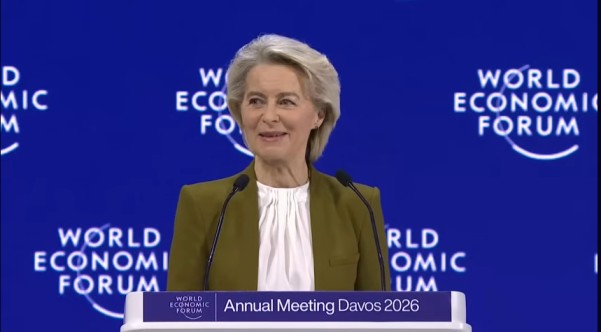
Brief Notes: At the World Economic Forum 2026 in Davos, European Commission President Ursula von der Leyen delivers a forceful speech on Europe’s economic independence, security, and global partnerships. She highlights new mega trade deals from Latin America to a potential EU–India pact, plans for an integrated EU capital and energy market, and a surge in European defense capabilities. In a direct message to President Donald Trump, she warns that proposed US tariffs are a serious mistake and insists that the sovereignty of Denmark and Greenland is non-negotiable.
TRANSCRIPT:
Opening Remarks at Davos
Ursula von der Leyen: President Brende, dear Volker, thank you very much for the warm welcome. Your Majesties, Excellencies, ladies and gentlemen, indeed, it is now 56 years since the first meeting here in Davos. And the idea of the founder, Klaus Schwab, was to create a platform to discuss the issues and the ideas of the day.
Of course, the world has transformed completely since 1971. But the original idea of Davos has remained, as we just have heard in the speeches. So I was delighted that you have gone back to your roots with this year’s theme, “A Spirit of Dialogue.” Because this spirit is all the more important in a world that is more fractured and more fractious than ever.
Historical Lessons: The Nixon Shock and European Independence
1971 was the year of the so-called Nixon shock and the decision to de-link the US dollar from gold. In an instant, the foundations of the Bretton Woods system and the entire global economic order set up after the war effectively collapsed. But it also had two major effects. It inadvertently created the conditions for what would become a truly global order. And it provided a sharp lesson for Europe and on the need to strengthen its economic and political power. It was a warning to reduce our dependencies, in this case on a foreign currency.
The world may be very different today, without any question. But I believe the lesson is very much the same. That geopolitical shocks can and must serve as an opportunity for Europe. And in my view, the seismic change we are going through today is an opportunity, in fact a necessity, to build a new form of European independence.
And this need is neither new nor a reaction to recent events. It has been a structural imperative for far longer. So when I used this term, “European independence,” around a year ago, I was surprised at the sceptical reactions. But less than one year on, there is now a real consensus around this. The sheer speed and almost unthinkable scale of the change have driven this, but the underlying imperative is still the same.
Building a Permanent New Europe
The good news is, we acted immediately. Whether on energy or raw materials, defence or digital, we are moving fast. But the truth is also that we will only be able to capitalise on this opportunity if we recognise that this change is permanent. Of course, nostalgia is part of our human story, but nostalgia will not bring back the old order. And playing for time and hoping for things to revert soon will not fix the structural dependencies we have.
So my point is, if this change is permanent, then Europe must change permanently too. It is time to seize this opportunity and build a new, independent Europe. And ladies and gentlemen, this new Europe is already emerging.
EU-Mercosur Trade Agreement: A Historic Breakthrough
On Saturday, I was in Asunción, in Paraguay, to sign the EU-Mercosur trade agreement. It was a breakthrough after 25 years of negotiations. And with it, the European Union and Latin America have created the largest free trade zone in the world, a market worth over 20% of global GDP, 31 countries with over 700 million consumers, aligned with the Paris Agreement.
So this agreement sends a powerful message to the world that we are choosing fair trade over tariffs, partnership over isolation, sustainability over exploitation, and that we are serious about de-risking our economies and diversifying our supply chains.
Expanding Global Trade Partnerships
And that will not stop in Latin America. Last year, we reached new agreements with Mexico, Indonesia, and Switzerland, our host country. We are working on a new free trade agreement with Australia. We are also advancing with the Philippines, Thailand, Malaysia, the United Arab Emirates, and more.
And right after Davos, the next weekend, I will travel to India. There’s still work to do, but we are on the cusp of a historic trade agreement, indeed some call it the mother of all deals. One that would create a market of 2 billion people, accounting for almost a quarter of global GDP. And crucially, that would provide a first mover advantage for Europe, with one of the world’s fastest growing and most dynamic continents.
Europe wants to do business with the growth centers of today, and the economic powerhouses of this century, from Latin America to the Indo-Pacific, and far beyond. Europe will always choose the world, and the world is ready to choose Europe.
Europe’s Assets and Investment Potential
And ladies and gentlemen, this reality also reflects the fact that Europe has all the assets it needs to attract investment. The savings, the skills, the innovation with our AI factories and gigafactories, and the applications that are necessary, AI first. What we need now is to mobilize collectively these assets to their full potential, and to focus on the essential.
Creating a Predictable Regulatory Environment
So focal point number one is to create a conducive and predictable regulatory environment. We live in an age where capital and data can cross Europe in a second. And business must be able to move just as freely. But as things stand, too many companies have to look abroad to grow and scale up, partly because they face the new set of rules every time they expand into a new member state.
So while on paper the market is of 450 million Europeans open to them, it is far more complicated in reality.
And that acts as a handbrake on the growth and profit potential of companies. So this is why we need a new approach.
We will soon put forward our 28th regime. The ultimate aim is to create a new, truly European company structure. We call it EU Inc., with a single and simple set of rules that will apply seamlessly over our union, so that businesses can operate across member states much more easily.
Our entrepreneurs, the innovative companies, will be able to register a company in any member state within 48 hours, fully online. They will enjoy the same capital regime all across the European Union. And ultimately we need a system where the companies can do business and raise financing seamlessly across Europe, just as easily as in uniform markets like the United States or China.
If we get this right, and if we move fast enough, this will not only help EU companies grow, but it will attract investment from across the world.
Building the Savings and Investment Union
Which brings me to the second focus, investment and capital. We are now building the Savings and Investment Union. We need a large-scale, deep and liquid capital market that attracts a wide range of investors. And this will allow businesses to find the funding they need, including equity, at lower costs here in Europe.
We have made proposals on market integration and supervision to ensure our financial market is more integrated. This covers trading, post-trading and asset management, as well as driving innovation and making our supervisory framework more efficient. This will help ensure that capital flows where it is needed, to scale-ups, to SMEs, to innovation, to industry.
Creating an Affordable Energy Union
And the third priority is to build an interconnected and affordable energy market, a true energy union. Energy is a choke point for both companies and households. And just look at the dispersion of prices across European electricity hubs. Europe needs an energy blueprint that pulls together all the parts. This is our Affordable Energy Action Plan.
We are, for example, massively investing in our energy security and independence with interconnectors and grids. This is for homegrown energies that we are trying to promote as much as possible, the nuclear and the renewables, to bring down prices and cut dependencies, to put an end to price volatility, manipulation and supply shocks.
But now we have to speed up this transition. Because homegrown, reliable, resilient and cheaper energy will drive our economic growth and deliver for Europeans and secure our independence.
Ladies and gentlemen, whether on trade or business, capital or energy, Europe needs an urgency mindset. Our starting point is good. We are home to global champions in fields ranging from wind power to next-generation batteries, from aerospace to the industrial machines that are essential to build the chips and advanced weapons. Our companies are taking up AI at the same pace as their US peers. Europe is in the race for the key technologies of tomorrow. But as global competition gets ruthless, we must show real ambition, especially in those sectors vital for our independence.
Europe’s Defence Surge
Take defence, for example. We have done more on defence in the last year than in decades before. We have started a surge in defence spending, up to 800 billion euros till 2030. Member states are stepping up their investment at record level. And this has helped to triple the market value of European defence industry companies since January 2022.
We now have three leading European defence tech start-ups that have reached unicorn valuation. They are working on AI-powered software and systems for battlefield intelligence, or on advanced dual-use and surveillance drones. So they are also driving innovation and investment in Europe’s defence tech industrial base. All of this would have been unthinkable even a few years ago. This now only shows how economy and national security are more linked than ever. But also what we can do when Europeans have the will to match the ambition.
Ukraine and Russia’s Ongoing Aggression
So ladies and gentlemen, this need for ambition is most important when it comes to the security of our continent. In just over a month, we will mark the fourth anniversary of Russia’s war of aggression against Ukraine. Four years on, Russia shows no sign of abating, no sign of remorse, no sign of seeking peace. On the contrary, Russia is intensifying its attacks, killing civilians every day as we speak. Just last week, its bombing of Ukraine’s energy infrastructure left millions facing darkness, cold and water shortages. This must end.
We all want peace for Ukraine. We recognise President Trump’s role in pushing the peace process forward. And we will work very closely with the United States. And we all agree that therefore Ukraine must be in a position of strength to go to the negotiation table. And this is why we Europeans have decided to provide Ukraine with a loan of 90 billion euros for 2026 and 2027.
With this support, we make sure that Ukraine can bolster its defence on the battlefield, strengthen its defence capabilities for a peace agreement, and keep basic services running. Above all, it reaffirms Europe’s unwavering commitment to the security, the defence and the European future of Ukraine. And in parallel, we decided to permanently immobilise the Russian assets and that we reserve the right to make use of them. This should serve as a stark reminder to Russia and as a message to the world. Europe will always stand with Ukraine until there is a just and lasting peace.
Greenland: A Non-Negotiable Issue
Ladies and gentlemen, I have spoken a lot today about European independence, on partnerships, on prosperity and security. So I would like to conclude with Greenland, an issue which cuts to the heart of all three of these imperatives. When it comes to the security of the Arctic region, Europe is fully committed. And we share the objectives of the United States in this regard.
For instance, our EU member, Finland, one of the newest NATO members, is selling its first icebreakers to the United States. And this shows that we have the capability right here, in the ice, so to speak. It shows that our northern NATO members have Arctic-ready forces right now. And above all, that Arctic security can only be achieved together.
And this is why the proposed additional tariffs are a mistake, especially between long-standing allies. The European Union and the United States have agreed to a trade deal last July. And in politics, as in business, a deal is a deal. And when friends shake hands, it must mean something. Ladies and gentlemen, we consider the people of the United States not just our allies, but our friends.
And plunging us into a downward spiral would only aid the very adversaries we are both so committed to keeping out of the strategic landscape. So our response will be unflinching, united and proportional.
But beyond this, we have to be strategic about how we approach this issue. And this is why we are working on a package to support Arctic security.
Four Principles on Arctic Security
First principle, full solidarity with Greenland and the Kingdom of Denmark. The sovereignty and integrity of their territory is non-negotiable.
Second, we are working on a massive European investment surge in Greenland. We will work with Greenland and Denmark hand-in-hand to see how we can further support the local economy and infrastructure.
Third, we will work with the United States and all partners on wider Arctic security. This is clearly in our shared interest and we will step up our investment. In particular, I believe we should use our defence spending surge on a European icebreaker capability and other equipment vital to the Arctic security.
And fourth, in the same spirit, we need to work with all our regional partners to strengthen our common security. And this is why we will look at how to strengthen our security partnerships with partners such as the UK, Canada, Norway, Iceland and others.
Europe’s New Security Strategy
Finally, I believe Europe needs to adjust to a new security architecture and realities that we are now facing. And this is why Europe is preparing its own security strategy, which we plan to publish later this year. And as part of this, we are upgrading our Arctic strategy too. And at the heart of this will be the fundamental principle, it is for sovereign people to decide their own future.
Ladies and gentlemen, when I started preparing for this year’s address, security in the High North was not the main theme. But in many ways it feeds into the wider point I started with today. That Europe must speed up its push for independence, from security to economy, from defence to democracy. Having the dialogue with our friends and partners, also if necessary with adversaries.
The point is that the world has changed permanently and we need to change with it. And therefore, thank you and long live Europe.
Related Posts