Editor’s Note: In this compelling address at ARC 2026, Paul Marshall explores how modern Western society has become adrift, shifting away from common sense and the foundational values that once anchored it. Drawing on his perspective as a classical liberal, he examines how “deconstructionist” ideologies have eroded cultural and moral order, leaving many feeling alienated from the current political landscape. Marshall argues that we are now at a critical juncture where we must move beyond these parasitic narratives to actively reconstruct a positive vision for the future. He emphasizes the urgent need to reclaim virtues centered on truth, beauty, and the good to inspire a new generation and restore human flourishing in an age of unprecedented technological change. (June 23, 2026)
TRANSCRIPT:
Opening: A Classical Liberal’s Perspective
PAUL MARSHALL: “My views are pretty much those of a Democrat circa 2010, but I have been demonized relentlessly.”
Those are the words of Elon Musk earlier this year. He didn’t leave the Democrat party, but the party left him. Bill Maher has said something similar. So have RFK and Tulsi Gabbard. So has Marc Andreessen, who we will be hearing from this week.
And the same is true for me. I describe myself as a classical liberal, admittedly more like 1908 than 2010, maybe even 1688, but a classical liberal is what I am. And just like those Democrats, I feel like politics has shifted around me.
I’m sure many of you in this hall feel the same thing. It even feels like politics has gone slightly mad, abandoned common sense, lost its way. That is certainly the case in Britain, where we’re heading for our seventh prime minister in 10 years. But it’s pretty much the case across the Western world. And this is not primarily about personalities or political parties.
Deconstruction: The Dominant Intellectual Path
It goes deeper. Indeed, one of the main contentions of ARC, as we’ve been hearing this morning, is that the fissures in our politics are downstream, downstream of much bigger fault lines in our culture and in the world of meaning and ideas. And that is why our conference spends most of the time upstream from politics. And that is a space I want to inhabit today. I want to talk about the overarching theme of this year’s conference, our strapline, from deconstruction to reconstruction.
We need to start quite a long way back. Over the last two centuries, the path of intellectual thought has been overwhelmingly one of deconstruction, or just plain destruction. There are precious few examples, and I challenge you to name them, of philosophers, whether of meaning, morals, or politics, who have offered us anything positive.
The word deconstruction is most commonly associated with Jacques Derrida, the man who took all the fun out of literature. But he was not the most important deconstructor. For me, two others stand out. In the 19th century, Nietzsche said there was no absolute truth, only perspectives. Then later, Michel Foucault said that in the absence of truth, everything should be interpreted through the lens of power. The world was divided into victims and oppressors. I guess this is what happens when you let the French and Germans take over.
Foucault is now the most cited source in all academic literature. The most cited source. He was an interesting guy, Mr. Foucault, one of the biggest public supporters of the Ayatollah Khomeini, and a big advocate of legalizing sex with minors on purely libertarian grounds, I’m sure.
In many ways, the West now lives in Foucault’s world, the world of oppressors and victims, the world of my truth and your truth. A world where Islamists and LGBTQ activists can happily coexist in the same political party, even though one tribe wants to throw the other off the roofs of buildings, simply because they share the same sense of victimhood.
The American University and Critical Theories
After World War II, the worst ideas from Europe were also smuggled across the Atlantic, where they were incubated and mutated in the American University to give us critical race theory, critical gender theory, intersectionality, and queer theory. There was also a side helping of post-colonial theory to make sure we deconstructed Western history and are properly ashamed of it.
I love all these theories equally. I can’t get through breakfast till I performed a land acknowledgement, checked my privilege, changed gender at least three times. This usually means I get to the office half an hour late, but I just explain that time is an oppressive white supremacist invention.
The Deconstruction of God, Markets, and Meritocracy
The process of deconstruction did not finish there. Richard Dawkins and the new atheists said there was no God, and blithely assumed that a godless society would come up with a nice humanist creed to provide meaning, mutual trust, and moral order. I understand he may now be having second thoughts.
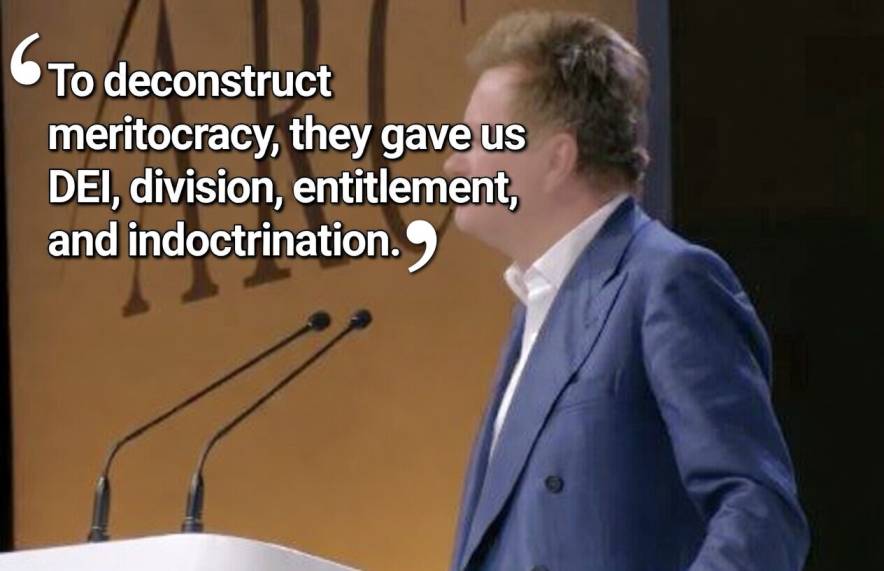
In the economic sphere, it was a bit harder to deconstruct because the evidence that property rights, free markets and innovation are the best mechanism for creating prosperity is so overwhelming that it is difficult to build a counter narrative, especially since 1990. But deconstructionists can be sly. So to deconstruct free market economics, they attacked from the flanks. They brought us net zero, an ideology of fear and destruction, giving a new excuse for state interference. And to deconstruct meritocracy, they gave us DEI, division, entitlement, and indoctrination.
Almost all of these ideas and narratives are parasitic. They feed off an historic body of good foundational ideas, but then pervert them and erode them. None come from a place of optimism. None of them bring unity. None of them set out a path to human flourishing.
Why Destructive Ideologies Gain Purchase
But why have these parasitic and destructive ideologies gained so much purchase? Well, I don’t want to be too marked just about this, but it is partly inevitably about economics. Free market economies always produce winners and losers, at least in material terms or at least in relative terms.
There will always be ideologies for winners and ideologies for losers. And in a democracy, these ideologies have a pretty much even chance of adoption.
If the losers cannot participate in prosperity, they will tear it down. So the winners need to make sure they look after the interests of everybody, of the wider society. But in the financial crisis of 2008, we privatised gains and socialised losses. In its aftermath, QE massively amplified inequality, ramping up the asset values of those who were already rich.
To use Scott Bessent’s phrase, we had gain-of-function monetary policy, with central banks around the world using quantitative easing to inflate asset prices. QE became an engine of inequality and the political class did nothing to offset it. In the era of globalization, we forgot to care about those who lose out from free trade, and in an era of innovation we forgot, and we are forgetting, to worry about those who lose out from creative destruction. And so bad ideas have found willing adherents.
The Paradox of Radical Progressivism
Bad ideas also need enablers. And this brings me to the paradox of radical progressivism. This is a body of ideas which takes some good fragments from the classical liberal tradition, but robs them of their moorings in faith, responsibility, and above all, common sense. As a result, a creed which sees itself as positive and constructive ends up being the engine of destruction.
Progressivism relies on a utopian theory of human nature. It argues for rights without responsibilities. It seeks to break down traditional structures like the family, the church, and the nation in the name of individualism. And it promises perpetual progress, not only in the economic sphere, which is defensible, but also in the moral sphere.
Now, I’m not an historian, but it seems to me that the idea that humanity can be infinitely perfected has been tried repeatedly and led to some highly questionable outcomes.
Most progressives have also forgotten God, or at the very least they don’t do God. The traditions of Christian socialism, working class Methodism, non-conformism, have all been lost. If you wanted to be fair, you could say they have imbibed too much Athens and not enough Jerusalem. Progressives don’t like Jerusalem. Perhaps ever since someone explained to them that it’s in Israel.
They don’t understand religion, they don’t understand the differences between religions, and they don’t understand the passions that religion can incite. So progressives embrace cultural relativism, open borders. They’re ashamed of their own history and are willing accomplices to the West’s civilizational self-erasure. Apart from that, they’re great.
Living by Lies
All these bad ideas have also been sustained by lies. Men have cervixes. Biology is fluid. William Shakespeare was a black woman. The English countryside is racist. America was founded in 1619. All cultures are equal. Winston Churchill and not Adolf Hitler was the main villain of World War II.
To borrow a phrase from Ignat’s father, we have lived by lies. Now, the further a society drifts from truth, the more it will hate those who speak it. Telling the truth, as someone once said, becomes a revolutionary act, but truth matters.
Truth and Kindness
A left-wing friend of mine, who is also an enemy of progressivism, has taken to reciting frequently a passage from the book of Proverbs about the importance of upholding both truth and kindness. Truth and kindness. Too often we sacrifice truth in the name of kindness. But as any parent of adolescent children knows, truth and kindness are not opposite virtues. Truth is an essential ingredient of kindness. Without truth, kindness is a placebo. We have to hold to both these virtues at once.
When a society stops telling the truth because it might be hurtful or because it might be unpopular, then that society will soon lose its North Star. It will lose its soul.
It was the defence of truth that first brought Jordan Peterson into public life. He refused to be compelled to lie about biological sex. It cost him a lot, but he stood up bravely for freedom of speech and for truth. He is our North Star and I salute him.
The Young: The Biggest Victims
Now the biggest victims of our lies have been the young. We encourage huge numbers of them to go to university, to earn useless degrees from resentful academics with no experience of the real world. They’ve been fed false narratives about our history and our culture. They have emerged from three years of purgatory with huge debts. They face uncertain economic futures.
We don’t know what AI will mean for their job prospects, but some will struggle for sure. There will be growth in GDP, but it will be growth in GDP for me and not for thee. And if you are the worst of things in today’s lottery of life, young, white, and male, you will face not only an uncertain economic future, but discrimination against you when you apply to university, and discrimination against you when you apply for a job.
We boomers, my generation, have made a right mess. We screwed up.
Reconstruction: Toward Human Flourishing
So how do we turn things around? How do we give hope to the next generation? How do we create or restore human flourishing?
The Greeks talked about this a lot, as Philippa was talking about earlier. They had a word for it, eudaimonia. And they summed it up in three ideals, the good, the beautiful, and the true.
The Americans understood it too. When the founding fathers set about building a new constitution for a new land, they also spent an inordinate amount of time debating the nature of values and virtue. For as Benjamin Franklin said, “Only a virtuous people are capable of freedom.” We need to have that conversation again.
What were the virtues that underpinned the flourishing of our societies? What was the golden thread of ideas from Athens to Jerusalem that produced such an extraordinary civilization? What was the combination of factors that led to such an explosion of prosperity in the West in the 18th and 19th centuries? And the task could not be more urgent.
A New Cambrian Age: The Challenge of Technological Change
Unfortunately, our civilizational and cultural deconstruction has taken place at a moment of unprecedented technological change that even a culture highly confident and stable in its moorings would struggle to contend with. Some are calling it a new Cambrian age, echoing the era some 530 million years ago when there was a sudden explosion of evolutionary biology and innovation.
It is no longer adequate to talk about the digital age or the information age. AI will usher in an age of abundant intelligence. It will massively multiply the paths of innovation. It will massively accelerate the pace of innovation. Space exploration will open up new worlds, maybe parallel economies of new minerals, new technologies, abundant resources.
Change is coming faster than any of us can imagine. Indeed, change is coming so fast that it is leaving thinking behind. The technologists don’t understand philosophy and the philosophers don’t understand technology.
The United States is forging ahead into this new era of prosperity and abundance. Sadly, Europe and the UK seem to be mired in bureaucracy and risk aversion. But the tide of change and innovation is coming and it will affect everyone.
The Path Forward
We will face many of the same questions on both sides of the Atlantic. How do we combine economic dynamism with human flourishing? In the era of AI, how do we combine the conditions for innovation, the key to productivity, growth and prosperity, with the care and support for those in society who lose out from creative destruction? How do we harness the earth’s and the sun’s abundant energy and turn it into wealth whilst remaining good stewards of the planet?
We need to recover the belief in free markets tempered by virtue and good governance, in energy abundance tempered by good stewardship of the planet. We need our schools to follow the example of Katharine Birbalsingh and teach our children to love their country and their culture. We need our universities to return to their roots in critical thinking, free speech, and love of learning. We need to recover confidence in our civilization and defend it from parasitic and progressive follies.
And we need to turn these ideas into a positive vision of the good, the beautiful, and the true, which can inspire a new generation and give them back a stake in their society and in the future. We need to create a world in which the majority and not just the minority can flourish.
We need reconstruction.
Thank you.
Related Posts