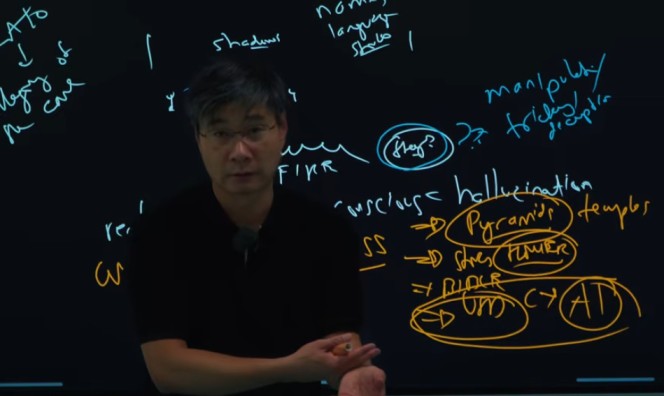
He’s blind because he’s been in the dark all his life, but somehow he recognizes that there’s this light outside the cave, and he feels compelled toward this light. So he’s walking, stumbling to this light. And again, they are watching him — “We don’t care. Do whatever you want, man.” They don’t stop him.
He goes out into the light. And now he’s outside. It’s pure light. He’s left the cave. At first, he’s in pain, and he struggles to reorient himself to this new world, but then eventually, he falls in love with this world. It’s a beautiful world, and it’s like heaven for him. And he’s like, “Oh my god. This is the real world. The cave is a fake world that we created ourselves. Let me go back there and tell everyone about the truth.”
And when he goes back, they again don’t stop him. “Whatever you want, man. Do whatever you want.”
So those who are in power — you think they have an army, you think they have magic, and you think that they’re evil — but really all their power rests on our belief in their power. They themselves don’t have any power except to manipulate us.
The Danger of Revealing the Truth
The third thing you need to understand is that even though this is a fake world, people don’t know this. They think it’s real. In fact, they believe it is so real that they are willing to die for it.
So when this man who’s seen heaven, who’s seen the truth, who has come back to tell everyone, “These chains that you have aren’t real — we can break free and escape into the real world” — if he dares to tell them this, together, they will kill him.
In other words, the reality is a hallucination. It’s created by us, but we fall in love with it. We’re so attached to it psychologically and emotionally that if anyone tells us it’s fake, we kill them for it.
So it’s these three things I want you to keep in mind as we explore our world, because our world is actually just Plato’s cave.
The American Empire and the Global Financial Order
You need a force in order to create this reality, to chain us together. And this force, of course, is called the American empire. Basically, just the military. But they themselves don’t really want to control this world because they’re an army. So what they do is they allow the creation of a financial order — a global financial order — which then constructs the game that we play. And these people then construct the reality that we live in.
What is this global financial order? Well, at the very top is something called the Bank of International Settlements in Basel, Switzerland — the Central Bank of Central Banks. Below them is the World Bank and the IMF, the International Monetary Fund, which controls the rules of the global financial order. And then below them are something called central banks — the Federal Reserve in the United States, the People’s Bank of China in China, the Bank of England in England.
Together, they create the global financial order. And what’s the global financial order? It’s just to use the US dollar as the main mechanism of wealth extraction and wealth storage. Really simple. The US dollar.
Another way of understanding these people is to think of them as the game masters — the ones above us who have constructed the game and control the rules of the game as we play it.
The Global Economy and the Price Hierarchy
Once the game has been created with the rules and incentives, now we can play the game, and this game is called the global economy. So when China trades with the United States, when you go off to Europe on vacation, you’re all participating in a game created by the financial order.
And the purpose of this global economy is to have everyone play as much as possible so that wealth can be transferred from the world to the United States — the powers that be. And they do this through two mechanisms.
The first is the US dollar. Every time you use the US dollar, you’re actually paying a tax to America, because America has the power to print as much US dollars as it wants.
The second way is through something called a price hierarchy. The global economy is divided into tiers. Resources are considered the cheapest, even though in reality they should be the most expensive — because resources are limited, they’re finite. Above resources, of course, is manufacturing. Above manufacturing is the knowledge economy. And then the highest is finance — basically, the game masters.
Once we have this price hierarchy in place, what we can do is divide the world according to specialties. Resources would be Russia, the Middle East, the GCC — Saudi Arabia, at least. Manufacturing would be China. Knowledge would be Europe and the Five Eyes — basically, the Anglosphere: Canada, New Zealand, Australia, Britain. And then finance, of course, the United States.
As you can see, this is a system that benefits the United States and its allies to the detriment of China and Russia. But this is how the game is structured. Of course, if the United States doesn’t like you, what it can do is not allow you to play this game. And these countries, of course, would be North Korea and Iran, among other countries. China and Russia aren’t happy about the system, but at least they get to play. Iran and North Korea are not even allowed to play the game of the global economy.
The Rules-Based International Order: A Constructed Illusion
Now, of course, you can’t have people believing that this entire global economy is structured so that the West can steal resources from everyone else. So what you do is you create another layer called the rules-based international order — multilateral organizations, which includes the UN and the WTO, the World Trade Organization. But it’s really controlled by the empire. All of these are just basically shadows on the wall that the empire is creating and projecting to fool us into behaving the way the empire wants.
Indoctrination Through Education, Media, and Culture
Now that you have the system in place, what you need to do is indoctrinate people into believing that the system is fair, just, and good. And you do that through three mechanisms — education, media, and culture.
What is education? Schools and universities. Academia. You think that you go to university to learn knowledge. No, you don’t. You go to university to be brainwashed and to believe that the system is not just fair, but that what really makes this system work is the rules-based international order. You don’t even think about empire. That’s education.
Then, of course, you have media — CNN, BBC, New York Times. Each time you read an article, you think you’re receiving news. You’re not receiving news. You’re being brainwashed into believing that this order is fair, just, and appropriate. A phrase that you’ll keep on hearing over and over is “rules-based international order.” But it’s not a rules-based international order. It’s Plato’s cave. It’s a deception.
And the last, of course, is culture — Hollywood, television shows, sitcoms. Things that you absorb every day. There’s high culture and there’s low culture.
So these are three mechanisms through which this disorder is basically indoctrinated into everyone, so that you don’t even know this is a deception. You believe that this is reality itself. And this is all to create values and norms — just the way you see the world — which allows for the creation of a legal structure so that if you break the rules, it’s not that the elite will come after you. They don’t have to come after you, because everyone else will come after you.
If you’re that person who discovers that this is all a deception, they’ll kill you. Not the elite, but the people around you will kill you — because you are breaking their fantasy.
The Three Transnational Systems
PROFESSOR JIANG XUEQIN: You’re destroying their fantasy. Alright? So this is a very effective system. The problem though is that you need to spread the system. Okay?
So there’s three problems. First, you have to protect this system, the status quo, then you have to spread this system as well. And you also need to justify the system.
And you do that through three transnational systems, three transnational organizations. First, of course, is intelligence. What is intelligence? Spies. Their job is to infiltrate other nation’s elites and co-opt them into the system. That’s what their job is. That’s what intelligence does.
Then you have crime. Crime disengages in the most profitable enterprises, which includes, of course, drugs, human trafficking, and something called money laundering. And this is a way to incentivize the global elite to work together.
And then there’s one more mechanism called science. Now you think that science is about pursuing the truth. No. It’s not. Science is fundamentally about finding evidence to justify and protect the status quo. That’s why science is fundamentally materialistic.
The Three Major Values
PROFESSOR JIANG XUEQIN: And what we have to remember is that this system is trying to create values. And these three major values is something called the open society. What’s open society? It’s just basically globalization, multiculturalism, DEI. Diversity is good. Why is it good? Because it’s good. We don’t know. It’s good. They never find a reason, but it’s always, “Well, you don’t believe it? It means you’re racist, which is bad.” So open society.
Second is the idea of privatization, or we call it neoliberalism or free market, meaning that governments suck at what they do. Therefore, you should allow private entrepreneurs to control everything. This idea of neoliberalism. Again, there’s not much evidence to support this, but if you don’t believe this, it means you’re communist. Which is bad, by the way.
And the last thing, of course, is consumerism. How do you prove your value in life? How do you pursue purpose and meaning in life? Buy things, man. And then put it on Instagram so that people can like it. That’s the value of life, man. Make as much money as possible, and then buy a yacht. Get a super hot girlfriend, and then broadcast it on Instagram. And then you’re a hero.
Of course, what we don’t discuss is that this system is making people lonely, miserable, depressed, suicidal. But well, it’s because they’re not taking enough drugs. If you’re depressed, you should take antidepressants, and that will solve the issue.
The Elite Structure and the Occult
PROFESSOR JIANG XUEQIN: So because intelligence, crime, and science are both the nation state, you need other mechanisms to actually operate these three things. And what allows for the system to work is a collection of elites. You can break them down into three groups. First, you have transnational capital. So think of, you know, finance. Transnational capital. Then you have civil societies, and then you have families. Elite families.
And these three organizations themselves are bounded by something called the occult. The occult is just basically hidden secret knowledge not available to people, that comes from three places. Hermetic philosophy, the Bible, and the Kabbalah. We’ll discuss this later on. Don’t worry too much about the occult right now. I’ll show you what the occult is later on. But this is how the system works.
The Parasite and the Host
PROFESSOR JIANG XUEQIN: So there’s some questions about this. The first question is, well, if this is true, why is this system separate from this system? Why not just say that the occult is the basis of everything, and then you have the elite, and then you have science, intelligence, crime, and then you have the empire?
And the reason why is this — this is really important for you guys to understand. This is the parasite. It doesn’t actually create anything. All it does is suck up value, extract value. And this is the host. So in fact, these are two separate systems. This is the host, and this is the parasite.
Then your next question here would be, okay, let’s assume this is true. What evidence is there that this actually works? Because there should be people that operate this system.
Well, I will give you some names. Jeffrey Epstein and Jared Kushner. And I’ll explain who they are as we go along. And these families help the Rothschilds. Same with civil society? Chabad Lubavitch. And you’re like, “This is all conspiracy. This can’t be true.” Well, it’s all true. And I will give you the evidence that this is all true later on.
By the way, some of you will be like, “They’re all Jews, man. So what, they say the Jews rule the world?” Well, the answer that we have implicates these people who are Jewish, but there are other people who are more powerful, who are able to maintain themselves in the shadows. So it’s not really fair to say that it’s a Jewish conspiracy. I think this explanation, this system, is actually much more complicated than just saying it’s all Jews.
The Problems of the System
PROFESSOR JIANG XUEQIN: So now what I’ll discuss is the problems of this system. And once you understand the problems of this system, then we understand why this war in Iran is happening, where it’s going, and what this means for the world.
The first major problem is all this is based on empire, the perception of empire. And what this means is that everyone has to believe that the American empire is invincible. It cannot be defeated for the system to work. Once people start to believe that there are alternatives, that the empire is weak, then the system cannot work. And so, therefore, the only solution to this problem is America has to go fight wars for no reason.
It’s like being the school bully. People pay you money because they think that you’re a bully and you are not reasonable. And so to prove that, every now and then you have to go beat another kid for no reason. You’re just like, just smack the kid and everyone’s afraid of you. That’s America. And that helps us explain all these wars in the Middle East these past twenty years. Why did America invade Afghanistan? Why did America invade Iraq? Why did it blow up Syria? Why did it blow up Libya? Why are they attacking Iran? To prove to the world that “I’m still the biggest, baddest bully on the block, so you better obey me or I’ll come beat you up.”
Russia, Ukraine, and the Renegotiation of the System
PROFESSOR JIANG XUEQIN: The second problem is that the system, as you can see, is really, really unfair to a lot of countries. Iran, North Korea, Russia specifically. So this helps us understand why Russia invaded Ukraine in 2022, because they’re trying to renegotiate this system. Because right now, the system is discriminating against them. It’s extracting their resources for very little money, so they want to renegotiate this system. The way you renegotiate this system is by showing the empire is not so tough.
But this also shows us why America refuses to surrender Ukraine. This war was lost about two years ago. Ukraine has absolutely no chance. Why is this war continuing? Because if the perception that empire is weak, that America can be defeated — if people are aware of this, this entire edifice collapses. People wake up and see it’s all shadows on the wall. So America has no choice but to keep people fighting.
And this also helps us explain why America invaded Iran — to show Russia “I’m still the biggest, baddest bully.” And now we understand what Iran is doing. Iran recognizes this: “I cannot attack empire directly. It’s too powerful, it has nuclear weapons. I’m not going to attack the education, media, and cultural system of America because it’s too embedded. I can’t attack the UN and the WTO. It’s all being controlled by America. The only thing I can attack is the global economy.” That’s why they closed out the trade of Hormuz. Because once they put pressure on the global economy, it destroys the entire edifice. It is a house of cards. You find the weak point. You hit it so it all collapses. And that’s why Iran is doing what it’s doing.
And what this also tells us is this: there can be no ceasefire. There can be no truce. There can be no peace, because both the American empire and Iran are fighting for the nature and structure of reality itself.
The Boomers and the Defense of the System
PROFESSOR JIANG XUEQIN: And the third thing I want you guys to be aware of is this. Remember in terms of Plato’s cave, they really don’t have to do anything because the prisoners themselves want to protect the system. Well, this is true as well. Where if you are in education, media, and culture, and you are at the very top, you are not in power, but you benefit from the system. And therefore, you insist on protecting the system at all cost. And these people, of course, are called the boomers.
Not all of them. But the elite of the boomers. Even though they themselves don’t have that much power, there’s a lot of them. And they will make their politicians and the military fight to the death to maintain the illusion of empire which benefits them. Again, Plato’s allegory of the cave.
Answering the Three Questions
PROFESSOR JIANG XUEQIN: So now we can answer all three questions. Why did this war start? Because America had no choice in the matter. It had to defend the illusion that the American empire was invincible. Otherwise, this entire edifice would collapse.
When will this war end? This war ends when the global economy is destroyed. Because once the global economy is destroyed, this entire edifice collapses.
And what will happen after this war? Well, a new world will emerge where there are different spheres of influence. But we’ll discuss this later on. But I first introduce to you the big structure of what’s going on.
Jeffrey Epstein: Operator of the System
PROFESSOR JIANG XUEQIN: So now what I want to do is go more into the structure of this world. What I’m going to show you is that Jeffrey Epstein is one of the operators of this system. He works for the Rothschilds as well as civil society, as well as capital, and he is embedded in science, crime, and intelligence. And the evidence is something called the Epstein files.
So this is Jeffrey Epstein, and this is Donald Trump. Jeffrey Epstein died in 2019 in a federal prison. He was being charged with many crimes, and the FBI ran an investigation into him. Just recently, the United States Department of Justice, the DOJ, on their website, released about 3 million documents pertaining to the Epstein investigation, and a lot of these are emails. And what you discover is that he knows everyone who’s powerful in the world.
For the longest time, it was believed that Jeffrey Epstein was a Mossad agent. His job was to lure powerful Americans such as Bill Gates and Bill Clinton to his island called Epstein Island, where he would film them engaging in compromising activities, and then he would blackmail them. That was for the longest time what people understood to be Jeffrey Epstein’s role.
But when you look at the emails, what you recognize is that, no, actually, that’s what he did for fun. Actually, he made most of his money in arms trafficking and in money laundering. Also, Bill Gates wasn’t going to Epstein Island to give Jeffrey Epstein money. He went to ask for money. Think about this. Bill Gates, at one point the wealthiest man in the world, was begging Jeffrey Epstein for money. Think about that.
Epstein’s Network: Thiel, Musk, and the Rothschilds
PROFESSOR JIANG XUEQIN: So let us look at who he is. This is Peter Thiel. Peter Thiel, as you know, is one of the wealthiest men in America. And Peter Thiel and Jeffrey Epstein are arranging a time to meet. Again, it is not Jeffrey Epstein seeking these guys out. They’re seeking him out.
Elon Musk, the wealthiest man in the world, is actually trying to arrange an appointment with Jeffrey Epstein. Why? Because Jeffrey Epstein says, “I represent the Rothschilds. Your money is fake. Your money is stock market money. Your money is an illusion. I represent real money, real power, real wealth.”
So Jeffrey Epstein is very close with the Rothschild family. This is Ariane de Rothschild, one of the members of the Rothschild family. And in December 2018 — a year before he dies — Jeffrey Epstein sends Ariane de Rothschild an email saying, “Hey, let me tell you something really funny. Harvard is saying that when Hitler was poor, he lived in a home, a charity home that was financed by three wealthy families who are Jewish. And who are these three wealthy families? They’re the Rothschilds, the Epsteins — me — and the Gutmanns. So these three families, Rothschilds, Epsteins, and Gutmanns, go back centuries.”
So Epstein is a member of one of the most powerful families in the world. Now, Ariane de Rothschild responds and says, “Oh, it’s just a conspiracy theory.”
The Epstein-Rothschild Connection
It’s just saying that the Jews traded Hitler. And Epstein gets angry at him and says, “No. It’s a hundred percent true, man. Hitler was selling his clothes and already living in a shelter funded by Jews. Epstein, Rothschild, and Gutman, no conspiracy.”
“It’s really true. Okay? The Epsteins, who are we? We’re the Vienna bankers. Alright? We’ve been around for the longest time. You Rothschilds think you’re powerful, well, we’re powerful too. Okay?”
The FBI Investigation into Jeffrey Epstein
Alright. So the FBI is running an investigation on Jeffrey Epstein, and they created a file on him. And there’s a confidential human source, a spy basically, who they recruit to tell them who Jeffrey Epstein is and what his network is. And the FBI is sort of blown away by what they discover. Okay?
So, Amber, could you help me read, please? Okay. Alright. Alright. So I want you to start at the top, and it’s a bit hard to read. Okay? But try your best.
AMBER: Jeffrey Epstein was represented by Alan Dershowitz.
PROFESSOR JIANG XUEQIN: Okay. Alan Dershowitz is a Harvard professor. He’s one of the most powerful men in America. Okay? Alan Dershowitz. Keep on going.
AMBER: CHS remembered Dershowitz tell Alex Acosta, US attorney of Southern District of Florida at the time, that Epstein belonged to both US and Allied Intelligence Services.
PROFESSOR JIANG XUEQIN: Okay. So in 2008, Epstein was arrested in Florida for doing inappropriate behavior. Okay? And Dershowitz comes in and says, “Hey. You can’t arrest this guy because he works for intelligence.” Actually, the truth of the matter is intelligence works for him. Okay? Keep on going.
AMBER: CHS shared phone calls between Dershowitz and Epstein during which he slash she took notes. After these calls, Mossad would then call Dershowitz to debrief. Epstein was close to the former prime minister of Israel, Ehud Barak, and trained as a spy under him. Barak believed Netanyahu was a criminal. Saudi Arabia, Israel, and the United Arab Emirates are allied against Qatar, Turkey, Iran, and Syria.
PROFESSOR JIANG XUEQIN: Okay. That sounds okay. Alright.
Epstein’s Intelligence Connections and Career Path
So here it says that Epstein worked for Mossad. That’s not true. Okay?
Alright. So you look at Epstein’s life. He actually started his career at Dalton. Dalton is one of the most prestigious elite schools in America. That’s where all the most powerful, wealthiest families send their children. Okay? He was hired as a teacher. Then he went to work for Bear Stearns. Bear Stearns, which is a financial firm, and there he learned finance. But then he went to work for Doug Lees. Who is Doug Lees? Doug Lees is an arms trafficker involved with Iran-Contra. Okay? So he’s one of the biggest global arms traffickers in the world. And then he started to work for Barak, who is the prime minister, or the former prime minister of Israel.
Alright? So everyone’s like, “Okay. Well, it’s because he sucks up to everything, and that’s why he was being moved from one place to another.” Okay? But another way of saying this is he’s an operative, and he’s being trained in how power works by mentors. Does that make sense?
Let’s just say I have a big company. Right? And I’m a chairman. My son is going to inherit this company. How do I train him to be a good boss? Well, I have him work in different departments of the company and I have mentors train him in these different departments. Right?
So what is Dalton? Dalton is education. Right? What is Bear Stearns? Finance. What is Doug Lees? He is criminal. And who is Barak? He is intelligence. Right? Does that make sense, guys? He’s being trained, mentored in the different sectors of power in the world.
Alright. Keep on reading.
AMBER: Masha Drokova, telephone number is based in Silicon Valley. She has been running a firm called One Ventures, which is supposedly an early stage investment company. She used to be Russian president Vladimir Putin’s main contact in the Russian youth movement. CHS and Drokova spoke, but Drokova did not talk at all about technology. Instead, she looked at CHS and said, “You knew Epstein, didn’t you?” She said Epstein was a wonderful man.
PROFESSOR JIANG XUEQIN: Okay. So Epstein was connected with Vladimir Putin. Okay? Alright. Let’s read the last section. This is most important. Okay?
AMBER: Sage has advised Chabad.
PROFESSOR JIANG XUEQIN: Okay. Chabad Lubavitch. Right? The organization we talked about. Yes. Keep on going.
AMBER: Chabad is doing everything they can do to co-opt the Trump presidency. Chabad is basically state sanctioned Judaism. It is used by Putin to keep tabs on all the Russo-Jewish oligarchs. On the day Trump was elected president, Ivanka Trump and Jared Kushner were at the gravesite of Rabbi Schneerson.
PROFESSOR JIANG XUEQIN: Okay. So remember, last class, I showed you a video of Netanyahu approaching a rabbi called Rabbi Schneerson and saying, “Will you give me your blessing?” And Schneerson says, “Yes. I will. And please hurry up and make the messiah come.” Okay? So it’s all interconnected. Okay? Netanyahu, Schneerson, the Trump family, Putin, and all that — it’s all connected through Chabad Lubavitch and Jeffrey Epstein. Okay? Keep on going.
AMBER: Who was the most powerful rabbi in the Chabad network? Jared didn’t disclose his stake in Cadre because of its ties to the Russian state NFI. CHS believed this is the real Russian collusion story. Kushner had moved a lot of Russian investment money around. The FBI should investigate Kushner’s family charities to find evidence of corruption and money laundering. Chabad routinely uses charities to launder money.
The Transnational Network Revealed
PROFESSOR JIANG XUEQIN: So this is it, guys. Okay? This is it. The FBI did an investigation. What they discovered is that Jeffrey Epstein and Jared Kushner are both part of this transnational network that’s able to co-opt different nation states, including Russia, including America. And they’re all connected to this other transnational religious organization called the Chabad Lubavitch. And their leader is Rabbi Schneerson. It’s all one big network. Alright?
Prince Andrew and the Afghanistan Report
And let’s look at this. Okay. This is a report, a secret government report. What happened was that when Americans went into Afghanistan, the British went in too. And Prince Andrew, who is the brother to the king, asked the British government to investigate investment opportunities in Afghanistan. Okay? So this is the British government. And so whatever they report has to be confidential. It’s basically a state secret. And this report tells Prince Andrew where’s the best place to invest in Afghanistan. And what does Prince Andrew do? He emails it directly to Jeffrey Epstein.
Okay? You think these guys work for the government, Prince Andrew? No. No. No. They work for Jeffrey Epstein who works for the Rothschilds. Alright?
Epstein and the Libya Opportunity
Alright. This is Libya. Alright. So in February 2011 — okay. This is July 2011. America starts bombing Libya, and it seems as though Gaddafi will fall. And already, Jeffrey Epstein and his friends are discussing how to make money out of this. Right? Because they know that Libya has many assets frozen in American banks. So once a new government comes into place, then this new government will want the money back. Right? And Jeffrey Epstein and his friends are like, “Let’s do this for them and get a commission.” Alright? Can you read?
AMBER: Understood. Remember, there are already eighty billion in frozen funds slash assets internationally, of which thirty-two point four billion dollars is in the US, and it is estimated that the real number is somewhere between three to four times this number in sovereign, stolen, and misappropriated assets. So if we can identify and recover five percent to ten percent of these monies and receive ten percent to twenty-five percent as compensation, we are talking about billions of dollars. But the real carrot is if we can become their go-to guys because they plan to spend at least one hundred billion dollars next year to rebuild their country and jump start the economy. Also, remember Libya is a rich country as its population is two million less than the city of New York, and it has the ninth largest crude oil and natural gas reserves on the planet and a literacy rate of almost eighty percent.
PROFESSOR JIANG XUEQIN: Do you guys understand what’s happening? Okay? These are parasites. They look at geopolitics, and they’re like, “How can we take advantage of geopolitical events to make the most money for ourselves?” Alright?
Epstein, Bitcoin, and Academia
And you’re like, “Okay. Well, Jeffrey Epstein is gone.” Oh, sorry. Okay. Alright. So something else I want to discuss with you is Bitcoin. Okay? So this is a Guardian article that shows that Jeffrey Epstein was helping to finance the development of Bitcoin. Alright? But not only that, I want to show you this picture. This happened in 2004 at Harvard. Okay? This is Larry Summers, who is the president of Harvard University. This is Steven Pinker, one of Harvard’s most famous scholars. And this guy is Jeffrey Epstein. Alright? Who’s paying for the center? Probably Jeffrey Epstein.
And you’re like, “What is happening here?” And, again, I keep on telling you guys this. You think academia is about pursuing truth, doing research. No. It’s not. It’s about protecting and justifying the status quo. It’s about providing a network for powerful people to meet together and to work together. Okay? And the Jeffrey Epstein files reveals this, how corrupt academia and science are. It’s all part of this huge transnational network. Right? This grand alliance between science, crime, and intelligence in order to extract as much value from the world as possible. Okay? These are parasites.
Jared Kushner and the Same Playbook
And you’re like, “Okay. How about Jared Kushner?” Well, Jared Kushner is doing the same thing, guys. Okay? This is Jared Kushner. Right? Who’s this guy? Vladimir Putin. What are they doing? They’re discussing peace in Ukraine. Because Jared Kushner — okay. I’m speculating. Okay? I don’t know. Okay? But I imagine he’s a real estate developer. So he’s saying to Putin, “Hey. After this peace treaty happens between Ukraine and Russia, Ukraine will need to be redeveloped. So you should give opportunities to, you know.” Okay?
So that’s Russia. Then you go to Iran. This is Yair Kushner, Steve Witkoff, and the Omani foreign minister. And before the attack against Iran happened, there were these peace negotiations between the Iranians and Jared Kushner and Steve Witkoff, who represent the Americans. So this guy, Steve Witkoff, during the negotiations went on TV and said that, “Oh, the Iranians are trying to enrich weapons grade uranium as soon as possible.” Okay? So what Steve Witkoff is doing is he’s sabotaging the peace negotiations. These guys are negotiating with the Iranians not to create a peace treaty but to create a justification for war.
Alright? Oh, and also, this is Jared Kushner. This is Steve Witkoff, and this is Benjamin Netanyahu. What are they doing? They’re discussing peace in Gaza. Why? Because after peace happens in Gaza, Steve Witkoff and Jared Kushner are going to lead a real estate team to develop Gaza into these luxury villas, guys. Okay? So this is how the world works. Alright?
A Civil War Among the Elite
But, again, there’s a problem with the system. Alright? So okay. Well, this is the way the world works. Now the question then is, okay. This is the way the world works, and Jeffrey Epstein, Jared Kushner, and others are the willpower in the world, and they represent the elite. How do we know this? Why is the Epstein files out on the government website? Right? Why is it that you can go on the Department of Justice and look at all these things?
Well, because there’s a problem with this system. And it’s this. This system is a parasite. Right? So they are extracting value from the nation state. So other elites are asking themselves, “Why can’t they be the parasites but not us?” Right? So what’s happening is a civil war between the elite, these people, and the counter-elite, people who want to take the position and become the parasites. Okay? And that’s why we’re seeing this conflict right now emerge in America. Alright?
Any questions, guys? Any questions? Alright. So we will discuss this civil conflict, this civil war next class.
Related Posts