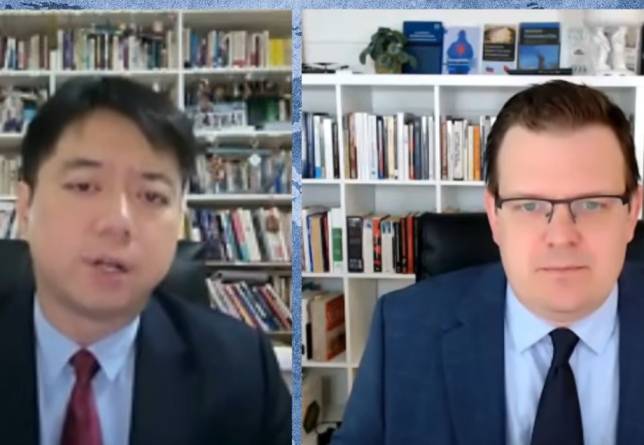
Editor’s Notes: In this insightful discussion, Professor Wang Wen joins Glenn Diesen to explore China’s strategic perspective on the war in Iran and its broader implications for the global order. They examine how the conflict accelerates the transition from a unipolar to a multipolar world, emphasizing China’s role as a mediator and advocate for peace amid regional instability. The conversation also highlights the potential shifts in energy security and infrastructure as Beijing navigates the risks and opportunities presented by current geopolitical tensions. (April 20, 2026)
TRANSCRIPT:
Introduction
GLENN DIESEN: Welcome back. We are joined today by none other than Wang Wen, a professor and dean of Chongyang Institute of Financial Studies and dean of the School of Global Leadership at Renmin University of China. So thank you for taking the time. I know you’re a big voice in Beijing, so I appreciate taking the time to speak with us.
WANG WEN: Thank you. Thank you, Professor Diesen. Every time when I conversation with you, I really enjoy.
GLENN DIESEN: Likewise.
China’s Stance on the Iran War
GLENN DIESEN: Today though, I wanted to focus a bit on how China is affected by the war in Iran because it does impact China in many ways. I guess the very first wide question would be how Beijing interprets this war against Iran. Is it seen then mainly as a regional conflict between the US and Iran, or do you see it in the context of a much wider systemic rivalry that also includes China?
WANG WEN: Well, I think the Chinese government’s stance regarding the current conflict involving the US, Israel, and Iran is very, very clear. China emphasizes a resolution of the dispute through political negotiation and opposes any unilateral military action not authorized by the UN. The Chinese side has repeatedly called for a ceasefire and an end to hostility and advocating for respect for Iran’s sovereignty and legitimate development rights, while opposing the maximum pressure campaign and long-term jurisdiction.
And I think the position adopted by the Chinese government is not only grounded in the principle of international law, but also reflects China’s own strategic interest, specifically its standards as a major energy importer and staunch advocates of multilateralism, and more importantly, I think, originally from the ultimate imperative to safeguard global peace.
Because as a scholar, I must say, in today’s world, there are too many wars. It has been only 37 years since the end of the Cold War. Yet within these 37 years, the world has witnessed the outbreak of at least 150 military conflicts, including the Gulf War, the Yugoslav War, the war in Afghanistan, Iraq, Libya, Syria, Ukraine, as well as now in the Middle East. And the vast majority of these military conflicts have involved the US, whether initiative directed by the US, involving US participation, or backed by the US support. The example set by the world’s biggest superpower is quite frankly terrible.
So now you ask how Beijing is thinking? I think consequently, the Chinese strategic community now is focused on the issue that this particular war further disrupted the international order, destabilized the global economy. Furthermore, our focus lies on deeper and more long-term questions. For example, what the international order looks like following the end of the US-Germany peace mechanism, what mechanism be established within the multipolar world, what long-term regional dialogue framework be fostered, how crisis and dispute be truly and foundationally resolved, and what specifically responsibility and contribution must China undertake in this regard? So we think about so many long-term perspectives after the war. So I think this war, yes, maybe it produced a lot of huge influence.
The Shift from Unipolarity to Multipolarity
GLENN DIESEN: Yeah, that’s interesting. Well, let’s call it a contradiction because often in the West, the last 30-plus years have been referred to as an era of stability, a time of peace when there was order and the rule of law. Yet if you look over the past 30-plus years, we’ve seen the Yugoslav Wars, the 20-year occupation of Afghanistan, the illegal invasion of Iraq, Libya, Syria, Yemen, and I would even put the Ukraine and Iran also in the category of Western wars. But also you can put the genocide in Gaza. I mean, it’s quite a long, long list for an era which we consider to be a period of peace.
But even when this comes to an end, we now see that all the rules seem to be thrown away. That is, from the American side now, they’re shutting down access to international waterways with Cuba, Venezuela, Iran. We’re talking about the destruction of entire civilizations, and it’s quite a brutal language. If this war in Iran is part of the shift from the unipolar to the multipolar world, do you see this war then being an important turning point in the global order?
WANG WEN: Well, first, I cannot speak on behalf of Chinese policymakers, but I can share some popular views on Chinese strategic academy. Now, more and more Chinese scholars believe that the US hegemony has reached its end, that the so-called post-Cold War order is drawn to a close, and that the world is entering a new era of, as you mentioned, multipolar meeting.
And the multipolar era is characterized by at least 2 points. One feature is that the US has totally lost the strategic capacity to dominate the world. It is maybe in the future the US will decline to a regional power, an ordinary regional power, possessing strategic leadership only in some specific region and specific fields rather than on a global or comprehensive level.
You know, now the US is like a decrepit old boss. Look at their alliance. Japan is humiliated. The European country, to be honest, is distorting it, and Canada is pushing back against it, and Israel now is kidnapping it. In a sense, the US is quite a very pity figure, and it is being manipulated by all its former allies.
So what is even more pitiable is that President Trump still believes he is constantly winning. And so it’s very pity. So I sometimes feel quite sympathetic towards the American people. They ought to be spending the money currently used to wage wars on improving their domestic livelihood and infrastructure instead.
So the second feature is the successful rise of emerging economies such as China, Russia, India, Brazil, as well as other regional powers — Vietnam, Indonesia, even Nigeria, South Africa, Ethiopia, Tanzania — a lot, a lot of emerging economies. And the US no longer possesses the strength to contain the continued rise of any of these emerging economies. Iran, the same applies. Over the coming decade, or perhaps even longer, provided that Iran adopts wise domestic and foreign policy, I believe it will ultimately break free from the shackles of nearly half a century of US sanctions and achieve a new rise. So in short, we are currently in the transition phase, one in which an old hegemonic order is giving way to a new multipolar landscape.
China’s Restrained Response and the Threat of Sanctions
GLENN DIESEN: But I guess overall, many people get the impression of China as always being a bit cautious in international affairs. This has especially been the case, I guess, since 1978 — the peaceful rise, don’t create too many waves in the international system in terms of negative reactions from other great powers. And it seems to have been — well, some would argue that it might have changed a bit over the past few years, the willingness to stand up a bit tougher against the United States.
But that being said, in the Iran War, it looked like China kind of kept this traditional profile — a very somewhat cautious and low-profile stance. How are you assessing this? Is this just restraint in order not to globalize a regional conflict, or is it the limited influence? And given now that it’s not just about Iran, it also appears to affect China in a big way. That is, when the Americans put a blockade on Iranian ports, they’re very open that this is also intended to deny China oil from an important source. Meanwhile, they’re also now talking about sanctioning Chinese banks that trade with Iran. So how are you seeing this? Do you expect this to continue — the restrained response from China?
WANG WEN: I think it’s, as you mentioned, the so-called relative restraint culture. And a lot predefined, not only in Iran issues today, but also maybe in the past you mentioned, even in the Russia and Ukraine conflict. I think that these serve precisely to demonstrate the underlying political philosophy of China’s foreign policy — advocating for ceasefire and an end to hostility while emphasizing the resolution of dispute through political negotiation.
And simultaneously, China will not cease its normal trade relationship with both warring parties. During the Russia and Ukraine conflict, for example, China maintained normal trade ties with both Russia and Ukraine. Similarly, in the current war, China continues to conduct normal trade with the US, Israel, and Iran.
So nowadays, the US threat to sanction Chinese banks engaged in trade with Iran — I think this is very unreasonable. Of course, some threats from the US are often like the paper tiger. China’s response to US sanctions often undoubtedly goes like this: “Come on, go ahead, try to sanction me. If you intend to impose sanctions, we will certainly take countermeasures.” So this is China’s very clear signal. In the coming months, I think the US will not dare to take such action. Of course, they are keen to ensure the success of President Trump’s upcoming visit to China — provoking China with this gesture would result in yet another political setback for Trump. And viewed from this perspective, China has long seen through the true nature of the US as a paper tiger.
Impact on the Belt and Road Initiative
GLENN DIESEN: But I guess a key concern for China would be that over the past many years, it has been financing this expensive Belt and Road Initiative, which — well, a large part of it is connecting this Eurasian landmass through different roads, railways, ports, digital connections, and the Middle East has been an important area where it has invested. I also can’t help but notice that when the US and Israel are bombing in Iran, they’re going after a lot of the transportation infrastructure. Overall, this is also an attack on the Chinese investments. Do you think this — well, how does this affect China? Will it reduce focus on the Middle East, or will China change its trade routes, or what can we expect to see from Beijing?
WANG WEN: Actually, China’s investment in Iran now is about $5 billion. Since the outbreak of war, of course, projects have ground to a halt across the war zone. Personnel have been urgently evacuated, investment prospects have become uncertain, and the progress of subsequent investments has been severely impeded. Over the past month or so, China’s capital markets have experienced fluctuations approaching 10%, resulting in losses for a lot of investors. Furthermore, as about 35% of China’s oil imports pass through the Strait of Hormuz, the nation’s energy security has also become impacted.
So while these shocks are certainly not severe enough to fundamentally destabilize China’s overall economy, I have to say these shocks have sent a very strong — and much stronger — strategic signal to Beijing that it is imperative to advance the Belt and Road Initiative in a sustainable and high-quality manner. Because as we all know, the BRI seeks to foster connectivity. More importantly, the core objective of BRI is to construct a great number of overland oil pipelines across the Eurasian continent, thereby reducing excessive reliance on energy importation on maritime shipping routes.
Viewed from this perspective, the importance of overland corridors such as the expanded North-South China-Europe Railway Express, the Trans-Caspian Transport Corridor, and the Central Asia Land Corridor has risen significantly. And there is also a growing emphasis on increasing the allocation of energy resources from non-Middle Eastern sources, including Russia, Central Asia, Africa, and South America, in order to mitigate dependence on any single maritime shipping lane. So in short, the strategic change boils down to two key terms — the diversification of transport corridors and the diversification of energy sources.
Implications for Taiwan
GLENN DIESEN: Yeah, seems like a good response. But many people also, when they look to assess how China will react or be impacted from this war, they also look towards Taiwan. What kind of lessons do you think Chinese strategists draw if they look towards a potential conflict or at least a Taiwan scenario? I mean, for many in the West, they argue that this is a great opportunity or a window of opportunity for China to do something in Taiwan, given that the Americans are tied up in Ukraine and they’re tied up in the Middle East. Others are pointing that it’s also maybe a necessity for China to solve this issue now given that the US is becoming increasingly reckless. But beyond this though, do you see the war making a conflict over Taiwan more or less likely?
China’s Strategic Position and the Taiwan Question
WANG WEN: Well, I understand the subtext of your question is like that, given the current conflict with Iran, which could potentially diminish U.S. military capability or tie down its strategic assets for a long time period? Will China accelerate its timeline for unifying Taiwan by force? I was asked a very simple question a few years ago, when the Russia and Ukraine conflict broke out.
But my point is that if the Chinese mainland intended to resolve the Taiwan issue through military means, the United States would have long since lost the ability to stop it. The US simply lacks the capacity to defend Taiwan. Whether or not China mainland ultimately chooses to use force to unify Taiwan is not a decision contingent upon whether the United States has the ability to prevent that unification.
What I want to say is that there would be no military unification without the moves towards Taiwan independence. Any use of force would be directed at independence separatists, not at the general public people in Taiwan. In other words, even 30 years ago, when U.S. military power was arguably at its peak, had Taiwan declared independence, the Chinese military, Chinese mainland, would still have proceeded to unify Taiwan by force.
So my logic, my reasoning is that the Chinese mainland has consistently and patiently sought a peaceful resolution to this issue. In fact, anyone who truly understands the Taiwan issue will recognize that at this moment, the likelihood of the peaceful resolution is growing even stronger, and the prospect of such a resolution is drawing even closer and closer.
The US-China-Russia Triangle and Shifting Power Dynamics
GLENN DIESEN: Well, if this war though in Iran is intensifying a shift towards a multipolar world, how does it affect China’s relations with other great powers? With the United States, because on one hand the US seems to be getting more unhinged, if not aggressive, but also China might rely more on the United States. At least that seems to be part of the design of the US. Or with Russia, I was thinking if the energy supplies from the Middle East now are becoming less and less reliable, does this cement or deepen China’s dependence on Russia? Or I guess overall, how do you see China’s relations with the US and Russia being affected now, or what direction will it take after this war?
WANG WEN: Yes, I think that this conflict has significantly shaped the balance of the triangle relationship among the US, China, and Russia. Previously, the US acted as a relatively proactive party in this dynamic, while China and Russia occupied a comparatively positive position, in the past. But now the US finds itself heavily constrained by Iran. It has become increasingly erratic, even going so far as to make overtures towards China and Russia. And while Russia and China, the two nations, have gained the greatest strategic initiative.
Russia now, of course, has emerged as a beneficiary of the massive surge in oil prices, and even more so of the situation on the Ukraine battlefield. And China has experienced some repercussions regarding oil imports and its stock market. Yet, on the whole, the strategic pressure it faced from the US, its primary competition, has diminished.
So I think that, as I mentioned, conversely, as President Trump sought to successfully visit China in middle May, he found it necessary to make conciliatory gestures toward Beijing. Moreover, to avoid losing the Middle East election in November, Trump simply cannot afford to jeopardize U.S. and China relations. So viewed from this perspective, both China and Russia have seen their strategic maneuvering space impact in their respective contests with the US. And they now hold stronger cards in these geopolitical games. The US nowadays has permanently said goodbye to the era in which it could effectively contain both China and Russia.
So I think for those experts who truly grasp the nature of strategy, it appears that the United States may have won every battle yet, but the US lost the entire war. President Trump may be the master of every tactical maneuver, but when it comes to overall strategy, he proves to be a fool.
Risks and Opportunities for China
GLENN DIESEN: Yeah, fool seems to summarize it well. But also, you mentioned that Russia has benefited. Of course, it comes with both risks and opportunities because the war in Iran is seen with great concerns. It destabilizes the entire region, it threatens to burn down the whole Middle East. Iran is a key strategic partner, a key transportation node in the Eurasian system. Partner in SCO, BRICS. So it’s not a good war in this sense. But if you look at the economics, the oil price and all, of course this adds a good chunk of money into the Russian economy and also makes it very difficult to keep unity in the West on the sanctions against Russia. But again, it comes both with pluses and minuses. But if this war continues, what do you think would be the main risks or opportunities for China, or is it mainly risks, I guess?
WANG WEN: Yeah, as I said, if the war continues or escalates, risks to China are very evident. China’s energy lifelines would remain vulnerable to disruption. The cost of imported oil would rise, potentially triggering inflation, and China’s foreign trade order in the Middle East would contract. Furthermore, the Belt and Road Initiative, as you mentioned, the projects would face risks ranging from asset freeze to default, among other complications. There are a lot of risks.
So that’s why I think I often tell my foreign friends that China is a major economy least inclined to see the war break out anywhere in the world. That’s why over the past 40 years, China has never launched a war or joined a war or been involved in a war. Because we know only through peace can China achieve better development.
So that’s why I want to borrow your important platform to recommend my new book this month. This book ranks high on China’s bestseller lists. The book’s name is New Strategic Opportunity: China and the World Towards 2035. This new book is top 3 in China’s bestsellers. I’m talking about the new strategic opportunity. My essential message in my new book is that no matter how adverse the international environment may become, China assesses the capacity to burst seas and create a new strategic opportunity. The more wars that occur and the more turbulent the world becomes, the more the world will come to recognize just how important China’s peace, stability and prosperity truly are.
So China’s new strategic opportunity is that whatever happens in the world, China focuses on itself, domestic solution. Then we can find and seize more and more new strategic opportunities. You, Professor Dingxin, you visit China many times. You can see nowadays in China, 1.4 billion people enjoying a secure urban governance free from gun violence, universal access to 5G network, streets filled with new energy vehicles, a society that has completely eradicated absolute poverty, cashless payment ecosystem by everyone, reliable power grid free of blackout, high-speed railway network, low consumer prices, and also a food delivery service capable of bringing any food to one nowadays. Even in the foreign social media, these festivities of China’s national governance are increasingly becoming the envy of more and more developing countries’ people, and not maybe more and more developed countries’ people.
So as I often said, in my new book, the more the United States seeks to instigate war, the more China strives to uphold peace. For the United States, every war serves as another step down the ladder of decline. Conversely, for China, the longer it succeeds in maintaining peace, the more sustained its rise will be. So this is China’s greatest opportunity.
Peace as Strategic Opportunity
GLENN DIESEN: Well, I like to hear peace framed as opportunity. It’s not so common anymore, but it does make a lot of sense, and I wish more countries did so. It is funny, I spoke a few days ago with Chas Freeman. He was the former U.S. Assistant Secretary of Defense, and he was making the point — well, he was a translator, also diplomat with Kissinger when he went to China in the late ’70s. He was making the point that today China represents the international system the way the United States pretended it was in the past. So it does appear that China is taking over that mantle, which is well, good news if China handles it in a very responsible way, which it appears to do. Anyways, thank you very much for taking the time, and I look forward to seeing you in Beijing soon. Thank you.
WANG WEN: Yes, thank you, thank you, thank you.
Related Posts