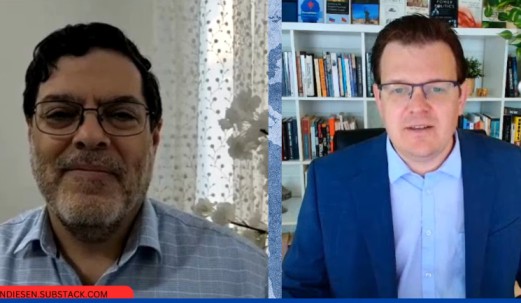
Read the full transcript of Prof. Seyed Mohammad Marandi’s interview on Greater Eurasia Podcast, June 14, 2026.
Editor’s Note: In this episode, professor Seyed M. Marandi joins the program to discuss how the recent Israeli attack on Beirut has likely sabotaged or at least delayed a potential memorandum of understanding between the United States and Iran. He examines the geopolitical motivations behind the strike, the ongoing regional tensions, and why he believes this move represents a significant setback for diplomatic efforts.
Introduction
GLENN DIESEN: Welcome back to the program. We are joined today by Seyed Mohammad Marandi, a professor at Tehran University and also a former advisor to Iran’s nuclear negotiation team. So thank you for coming back on.
I think most of the world now is looking at what is happening in this deal, or what looks like a deal between Iran and the United States. Well, we’re told from the American side, the Iranian side, as well as the Pakistani, that a memorandum of understanding would likely be signed today. Well, with possible delays, but I would like to be somewhat optimistic because from what I understand, the deal will start with the US releasing some Iranian funds, which is an important buy-in.
However, this is still far away from an actual deal if I understand it correctly, and I also have a hard time envisioning that these deals will actually be signed and also followed by both sides. So how are you seeing this? You know, many people would like to be optimistic after these months of war.
Israel’s Attack on Beirut and Its Impact on Negotiations
SEYED M. MARANDI: Well, we should always be optimistic, but I think that it’s pretty clear that because of the Israeli regime attack on Beirut, things will change. The attack obviously was to prevent a deal from happening, to prevent the two sides to agree upon an MOU. And I think that will have, it will have an effect because the Iranians are saying that either the Americans are not serious, or that they are incapable of controlling the situation.
If the Americans are incapable of controlling the situation, then there’s no reason to negotiate with them. If they’re not serious, then again, there’s no reason to negotiate with them. If they’re playing good cop, bad cop, again, there’s no reason to negotiate with them.
We were close to an agreement. We haven’t achieved the final text, contrary to what Trump says or what the mediators are saying, the deal isn’t, we haven’t reached a final text, but the framework is pretty clear. And the differences are and have been under discussion, although right now I think that for now the Iranians are not going to negotiate.
And they’re going to focus on the Israeli regime after what it did in Dahye, murdering at least 3 people today in the capital of Lebanon, because that was a red line that they were not supposed to cross. And they carried out that attack just to say that they will not be abiding by any agreement. And if that’s the case, and again, as I said earlier, there will be no agreement.
And of course, this, I think, ultimately hurts the Israeli regime more than anyone else because the entire world is waiting for a deal. And the entire world is thirsty for energy supplies and all the other products that are stuck in the Persian Gulf or that are produced in Persian Gulf countries, in the Persian Gulf.
But it seems that it will be — it’s just like with the previous ceasefire that took place after the 39 days of battle. The Israelis back then carpet bombed Beirut to crash the deal. And that led to where we are now, where the Strait of Hormuz was partially closed and now fully closed ever since the US assault a couple of days ago.
So this is a repeat of that. In other words, just like the Israeli regime wrecked the ceasefire agreement after the 39 days of fighting, right now the objective is to wreck the agreement. The big question is, what did the Americans know? When did they know it? And what their position was on this. But in any case, for now, I think we’re going to have to see a different course of action.
The Framework of the Deal
GLENN DIESEN: Well, you say that the framework seems somewhat clear. What do we know about the framework? Because I’ve been told there, you know, there should be, the media should be careful about speculating, but of course, we do know some things. What is it that we know so far?
SEYED M. MARANDI: Well, what happened was that 2, 3 weeks ago, we were close to a deal and then the Americans tried to impose some new conditions and that just stopped the negotiations. And then they tried to put pressure on Iran, the Israelis attacked Beirut back then, of course, where Iran retaliated. And then the Americans began to attack Iran.
And then it was on, I think, Wednesday that they sent the Qatari delegation to Iran, basically saying that the U.S. withdrew those conditions. So the negotiations went back to normal. Of course, Wednesday night, the United States carried out that attack. And it’s believed here that that attack was basically to hide the fact that the United States had withdrawn those conditions. In other words, they didn’t want to be seen as weak. So they carried out that attack so that if there’s an agreement in the following days, it would look as if they were doing it from a position of strength. But in reality, the Americans retreated from their excessive demands.
So in general, the terms of the agreement are what you already know, what has been discussed for weeks: lifting, waiving the sanctions for Iran’s energy exports, releasing Iranian assets through a particular mechanism, ending the genocide in Gaza and forcing the Israeli regime to retreat, and of course ending the siege.
And Iran would promise not to develop nuclear weapons, which Iran has been saying for decades. And also Iran would normalize the civilian trade that goes through the Strait of Hormuz.
But of course, Iran has said publicly that it will continue to control the strait and it will receive fees from ships that go through the strait, and they will not allow ships that belong to Iran’s enemies to pass through. So that’s more or less where we are.
The Debate Within Iran: Supporters vs. Opponents of the Deal
There is a big difference. There’s an ongoing debate in Iran, which became pretty harsh yesterday, between supporters of the deal and opponents of the deal. But the arguments are basically about implementation.
The critics of the deal say that there aren’t adequate assurances and that the United States, in the JCPOA, the nuclear deal of 2015, they cheated Iran under Obama and harmed Iran and burnt Iran badly because Iran carried out its side of the bargain. Iran implemented its obligations and the United States didn’t. And since it was a very one-sided deal as a result. And now the concern is among those who are opposed to the deal that we have a similar situation where, for example, what if the United States does not hand over the money? Iran, the stolen money. What if, especially in Lebanon, the Israeli regime continues to kill and slaughter across Lebanon? What if it continues to occupy Lebanon? These are all key questions that are being discussed. And there were even some protests last night against the deal.
Personally, I think that both sides have a case. Both sides have some strong arguments, hence both sides I think have some weaknesses in their arguments. But we don’t have a final deal yet. And I think in a sense what the Israeli regime has done is it has created more unity among both sides that we have to be more careful about Lebanon. And of course, all the other issues.
So for now, I think that debate that was very intense last night has been pushed to the side because of Netanyahu.
Netanyahu’s Role and the Consequences for Israel and the US
Netanyahu, what he’s basically doing, and I think he’s definitely damaging the Israeli regime badly, because what he’s done is undermining Trump. Now, of course, some may say that Trump may be being deceptive and that he’s fully in cooperation with Israelis. Of course, I have no way of knowing if that is true or not, but I do think at least among ordinary Americans, it would be seen as if an American attempt to bring an end to the war or to bring at least a more normal economic situation has been deeply hampered or blocked by Netanyahu and the Israelis.
I think that this is not a good move by the Israeli machine. Bombing Beirut, which is a red line that they’ve crossed. Because Iran is going to have to punish the regime, but it is also going to set back any potential deal. And the Israelis will be seen by ordinary Americans as impeding U.S. government attempts to bring an end to this situation and thus worsening the economic crisis or the energy crisis.
So, you know, Trump either is opposed to what the Israeli regime is doing, and that weakens him, it shows him as weak, or this is a good cop, bad cop game, and still Iran is going to retaliate and it’s going to be more skeptical of US intentions and more sensitive about Lebanon, or Trump has been persuaded to change his opinion by the Israelis. And again, that destroys any belief in Tehran that the United States may be serious about carrying out its side of the bargain.
But I think across the globe, this will be seen as a continuation of the Israeli regime and Zionist attempts to disrupt and wreck the global economy because this war was carried out by the Israeli regime and Trump and Netanyahu. And the energy crisis began as a result. Then after the 39 days of fighting, when they had a ceasefire agreement, Israelis carpet bombed Beirut, thus wrecking that agreement and causing the energy crisis to continue. And now that the two sides are close to an agreement, although there are differences, by carrying out this assault on Beirut and crossing that red line, the Israeli regime is extending this crisis even further.
I think that people across the world will be increasingly angered that this regime that is genocidal is also wrecking the lives of people across the world. And I think that’s something that’s not going to be lost among ordinary Americans either.
Too Many Actors Sabotaging the Deal?
GLENN DIESEN: Yeah, well, I’m watching footage now of the destruction in Beirut. This is an interesting time for the Israelis to strike the capital of Lebanon on the same day as the US and Iran are supposed to sign this memorandum of understanding, but it always begs the question of who’s influencing whom there. I often hear that it’s the US controlling Israel. Others are pointing out that Israel has this excessive influence over the United States.
But is it possible to get a deal through if there’s so many actors who would like to see or who’d like to sabotage this? Because from what I understand, there’s significant hawks in, well, not just the US, but also in Iran. But I think Israel would be the definite, most problematic one here because there they all seem to be hawks. So do you think it’s too many, too big of a minefield in order to navigate towards an actual agreement?
SEYED M. MARANDI: I don’t think we can compare Iran and Israel and the United States. In Iran, those who are critical of the deal are worried about implementation, not about the framework of the deal itself. If Iran’s assets are released and the Israeli regime is forced to end the genocidal attacks on Lebanon and so on, everyone here would be satisfied. At least the main political factions and parties and the general public. The divide is whether this text has enough assurances built within it to make sure that the United States carries out its side of the bargain.
In the case of the Israeli regime, I think what it wants to do is wreck the agreement in any way possible. And in the United States, it’s the Zionist lobby that accompanies them, that is aligned to them and that they want to wreck the agreement. They don’t want an agreement. They want war. They want crisis. And for Netanyahu, for him, this is all about political survival.
The Israeli Regime’s Path of Self-Destruction
But as I said, I think this hurts the regime. I think it hurts Trump. It hurts the United States, the US government, because it shows them to be subordinate to the Israelis. It makes ordinary Americans more angry. I don’t think this does the regime any good.
But in general, I think that the Israeli regime has been very foolish since October 7th. They’ve been going down the road of self-destruction. They’ve destroyed their image. We know that it is the most despised entity in the world, according to global public opinion. And people across the world see them as responsible for the economic woes that we are seeing across the world.
And we are inching towards the cliff. We’ve seen experts come on different programs say that the tipping point will be in late June, early July, late July, sometime in this period. And the more this agreement is delayed, the worse the economic crisis will be, the deeper it will become, and the longer lasting it will become. So I don’t see this as a smart move by the Israeli regime, but they’ve been very foolish alongside genocidal since October 7th.
The Strait of Hormuz and the Terms of the Deal
GLENN DIESEN: But one of the parts of the deal will be, well, again, the Iranians will seemingly get a lot that is, well, they will have some of the limitations from what I understand on the US force of the region, that the US at least wouldn’t ramp up its forces. It would have to withdraw what it has there now. But it’s argued that Iran has to open the, what the Iran will open the Strait of Hormuz. But this is a very vague term because what exactly does that mean?
There’s no going back to the status, old status quo. I think this has been made very clear by the Iranian foreign minister. Yet at the same time, Iran is also making the point that it never actually closed the Strait of Hormuz. But of course, there are restrictions. So what is baked into this memorandum of understanding in terms of what’s going to happen to the Strait of Hormuz? And I guess, are there ambiguities here? Because it’s very hard for the US, I think, to sign any deals where it can’t claim victory. So will all the texts be specific, especially on these issues like Hormuz?
SEYED M. MARANDI: Well, again, there’s no final text and things could change. And there may not be an agreement anytime soon because of the Israeli attack and because the signing of the deal, I mean, the signing of the agreement would probably not have happened today anyway, because there are a number of issues that the Iranians have, feel that need to be resolved. And as I said, these are the issues that are being debated in Iran right now. Issues regarding assurances. Will the United States truly release Iranian stolen assets? Will the United States pull back its forces? What assurances are there in the deal to make sure that happens?
Now, of course, the counterargument is that Iran controls the Strait of Hormuz, but even that’s open to debate. Although I think that the negotiators on this particular aspect have a stronger argument. The negotiators are saying that we will control the Strait of Hormuz. The critics of the deal are saying that’s not in the deal, but the negotiators are saying we don’t need it to be in the deal. This is our sovereign right and we will impose fees and we will control the strait, but allow ordinary shipping to go through normally, which is what we also want. Because we want trade and business to grow in the Persian Gulf region and for the region to thrive.
So the debate here is about control of the Strait of Hormuz. The critics are saying, what if the other side does not abide by its commitments? Once we’ve opened the Strait of Hormuz, it will be difficult to close it again. It will be politically problematic. What if the Israelis start bombing homes and killing people and provoking and slaughtering families? And then what does Iran do? Does it shut the strait or does it keep it open? And if it keeps it open, then the Israelis will kill more and more families and slaughter more people and destroy more towns and villages. That’s the argument. But the negotiators are saying we will, whenever necessary, we will be able to do what we need to do with regards to the Strait, because if the other side implements the deal, then everything will move forward normally. If it does not implement the deal, then restrictions can be made again.
Apprehensions After the JCPOA and What a Deal Means for the Region
GLENN DIESEN: Yeah, well, I would imagine in Iran there would be a lot of apprehensions after the JCPOA and other deals where Iran made these deals and implemented, well, its conditions, but then saw the United States essentially ignore it. And well, if this had happened only one time, it’ll be something, but it seems to be a recurring theme. So I guess that’s why I’m a little bit optimistic if it’s correct that the US will release these Iranian funds. Essentially as a buy-in to show that if the deal falls apart, then at least it’s the US that will have made the mistake. So it’s a, well, reason for cautious optimism at least.
But let’s say it does move forward, or that is, they agree on the final text and no one’s able to sabotage the deal. What does this mean for the wider region? Because over the past 47 years, the whole region has been very much defined by the United States building up these alliance systems with the Gulf states, with Israel to contain Iran, ideally over time weaken it and collapse it. How is this going to, again, change this region? Because it looks as if this deal goes through, it’s hard not to interpret it as an Iranian victory. What does this all mean?
SEYED M. MARANDI: Well, assuming that, let’s say, Iran retaliates, and then after a period of time, the two sides, meaning the United States and Iran, agree to a deal, and they start implementing it, let’s say, in a week from now, two weeks from now, whenever, I think that that will be a turning point in the region. But even without a deal, I still think this is a turning point. But I think that will be a symbolic turning point in itself, in that the United States will be formally having to accept defeat. Any deal with Iran that is not capitulation on the Iranian side is a defeat for the United States. I think it will be remembered as such.
What the Iranians are trying to do right now is to see if they can change the relationship between itself and the countries in the Persian Gulf. They were obviously complicit in the war and Iranians are very angry. Many people died as a result. But the Iran-Oman model and the Iran-Iraq model is something that Iran wants to expand. And so Iran is in one-on-one negotiations. And I think these countries, some of them more so, some of them less so, are coming to the understanding that the United States is not protecting them. The United States has wrecked their countries in many ways over the past few months by using their territory. Of course, they were complicit. They were all for it. It was only when things went south and the Americans didn’t protect them or couldn’t protect them, that they began to recognize that this is not the way forward.
So what the Iranians want to do is to convince these countries to tilt away from the United States and to become more fearful of the Greater Israel project. So I think that an agreement would contribute to that because the United States has shown that it’s not able to sustain its hegemony over the region like before. This is a major turning point. But again, even if there is no deal, I think we’re still going in that direction.
Trump’s Nuclear Threats and the Collapse of the Liberal Narrative in Iran
GLENN DIESEN: Yeah, well, I’ve seen some news pops up on the feed here where they say, well, in American media such as CNN arguing that a deal will not be signed today after all, despite what Trump is saying. Again, I’m not using CNN as evidence of reality, but as you suggest, everything seems to be still up in the air. The final text isn’t agreed. And early this morning, I saw Trump tweet something. I forgot what the last sentence of his tweet was. He promised “the ultimate solution” or answer if Iran doesn’t sign the deal. So it sounded like a nuclear threat, essentially. I’m not sure if he’s, yeah, he tweeted also yesterday.
SEYED M. MARANDI: I don’t know if he tweeted something right now, but yesterday he tweeted, he had a very long tweet and basically it was a nuclear threat, which is now becoming normal. And it just shows how abnormal the West has become because Trump has been saying on many occasions he’s applied using nuclear weapons before. He’s talked about obliterating Iran, sending it back to the Stone Age and wiping out the civilization. He said it many times, but you don’t see any parliaments in Europe condemning this. You don’t see any governments condemning it. You don’t see the media condemning it. You don don’t see important journalists condemning it. You don’t see American journalists, Canadian journalists, Australian journalists, New Zealanders. You don’t see any condemnation, even though he’s threatening to carry out the greatest, the biggest holocaust in human history. And you don’t see the European Parliament or the British Parliament saying anything.
So that for Iran is a sign of where the West stands. And it intensifies, it’s really wrecked the liberal narrative in Iran. Because as you know, you’ve been to Iran, there’s always been this counter-narrative that existed among elites, many elites in Iran, and liberals in particular, about Iran’s relationship with the West and strengthening the relationship with the West, and not prioritizing Russia and China and BRICS countries and the Shanghai Cooperation Organization and so on over the West.
But what we’re seeing, both through Trump’s actions, the war, the West’s support for the war, two wars, last year’s war, which started yesterday last year, and how the West supported both wars and how they refused to condemn the attacks on Iran’s peaceful nuclear program. All of these things combined and the threats made by Trump where no one in the West, not the left, the right, the liberals in the mainstream, none of them will condemn him. All of that has convinced Iran that we should look elsewhere. And the liberals, even though they were always a minority, but they were a substantial minority in Iran, an influential minority anyway, a disproportionately influential minority in Iran because they are often from the more wealthy class as well. Many wealthy people in Iran support that particular mode of thought. But all of these events and the language used and the lack of any outrage in the West among elites with regards to this language has really changed the way many people in Iran think about the West.
The West’s Abandonment of Its Liberal Veil
GLENN DIESEN: Well, the problem is it’s beyond Iran as well. Again, during the June war, that’s when the German chancellor came out and said that “Israel is doing our dirty work for us.” And yeah, I see the tweet here, by the way, which Trump sent out last night. He wrote, “Hopefully this process,” referring to the negotiations, “will work out quickly, easily, and smoothly. If it doesn’t, we have the ultimate alternative, hopefully never to be used again.” I mean, yes, some plausible deniability, but I think it can’t be read as anything else than a threat of a nuclear war on Iran for not essentially capitulating to US demands. It’s quite extraordinary.
If you also see the kind of things that have been done during the Ukraine war as well, I think the political West has lost something. I mean, I’m not pretending it was a beacon of morality before this, but it’s too overt now. I mean, there was always this, everything was covered in a liberal veil. At least we pretended to, you know, be fighting leaders of countries, only going after Gaddafi, Saddam Hussein, and they would never fight the countries anymore, just their leaders apparently. And also under this, you know, allegedly higher goal of serving some goals in humanity, always some human rights or democracy. But now, as you said, when there are talks about destroying entire civilizations, and there’s no pretense anymore. I’m not sure if I should be happy that the honesty at least is out there, or just be a bit fearful that the pretense has been given up.
But that being said, just a final question. How do you see, what do you expect? I mean, you’ve been following Iranian politics, the United States, all of this for a very long time. You’re there in Tehran as well. You seem to have the finger on the pulse. Where’s this headed, you think? Are you somewhat optimistic or do you think there will be a return to war?
Will Iran Respond? The Road Ahead
SEYED M. MARANDI: I think there will quite possibly be a, at least limited war because Iran will probably respond to the Israeli regime.
GLENN DIESEN: You’re referring to Beirut, isn’t it?
SEYED M. MARANDI: Yes, yes. And I think because the genocide is just too much. People are seeing families being massacred across Lebanon every day and tens of people being murdered every day by the Israelis. And the West has no problem with it. Western media is looking away as usual. And so the Iranians are saying that we can’t just let this go on. So I think there will be a response by Iran. Again, I don’t have any idea. I haven’t spoken to anyone. I’m not in the know. And I think that there won’t be an agreement in the coming days. And as you pointed out, apparently something has come out to indicate that that’s going to be the case.
I’m not a pessimist. I’m not a pessimistic person by nature, I think. But the real question is who calls the shots? Is it Trump or Netanyahu? And of course, Netanyahu, the individual is not that important. It is the people behind Netanyahu who allow him to make these decisions. And again, if Trump is against it, then he seems powerless. If he supports it, then he’s being dishonest. If he’s shifting his position, again, he’s useless. So none of this is going to do any good for a deal. It’s going to delay it and it’s going to make the situation more difficult. And if I was an Iranian negotiator, I would be making new demands with regards to the text to ensure that the Israeli regime can’t just continue doing this sort of thing.
GLENN DIESEN: But in short, you think the Israel attack on Beirut can have derailed the entire US-Iranian deal for now?
Potential Derailment of the US-Iran Deal
SEYED M. MARANDI: I think it will. I think it has already set it back, and I think it could be set back further depending on the events in the coming hours and days. And it could be totally derailed. I’m not ruling that out, but at least for now, what I can say is that it’ll be delayed in my opinion for a while. And which is a big thing actually, because with the economic crisis growing, I think each day and literally each hour counts. But that’s what I think.
GLENN DIESEN: Well, you’re probably right. Well, I guess we’ll find out by the end of the day. Anyways, thank you for accommodating my schedule on a Sunday afternoon. I appreciate it.
SEYED M. MARANDI: So that’s my pleasure, Glenn. Thank you for having me.
Related Posts