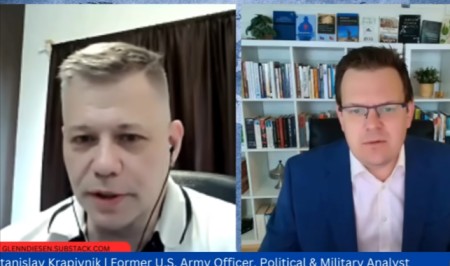
Editor’s Note: In this episode, host Glenn Diesen is joined by former U.S. Army officer Stanislav Krapivnik to discuss the escalating conflict in Ukraine and shifting frontlines. The conversation delves into the strategic implications of increased missile strikes, the internal political dynamics within Russia and Ukraine, and the growing concern over the potential for the war to expand into neighboring countries like Belarus. (June 2, 2026)
TRANSCRIPT:
GLENN DIESEN: Welcome back. Today is June 2nd, 2026, and we have the great privilege of being joined by Stanislav Krapivnik, a former US Army officer who since returned to his native Donbas. So thank you for coming back on the program.
STANISLAV KRAPIVNIK: Thank you. And it’s always a pleasure to be on. Well, I’ve returned to the Donbas a bunch of times, but I’m living up in Moscow.
GLENN DIESEN: Moscow now, yes.
STANISLAV KRAPIVNIK: But yeah, we travel quite a bit. I just had a couple of friends, they’re former military, so they’re a little more stable in these situations than civilians. They did a run down to Zaporizhzhia and on their way back up and down the highway that the Ukrainians are trying to turn into the highway of death and they’re saying that they’re hitting.
This is the Rostov-Taganrog-Mariupol highway that then branches off, goes on to Kherson, which when you’re kind of, isn’t quite been liberated yet, Kherson Oblast, and then branches off into Crimea. And the Ukrainians are talking about they’re using drones to hit fuel trucks. Well, really what they’re doing is, and they have hit a few fuel trucks, military ones, but the majority of what they’re hitting is civilian trucking, killing civilians.
But what they’ve started doing is using drones to drop mines in the middle of night and leave. And as they were coming back, a civilian car ahead of them drove over one of those mines and blew up. So this is the situation. It’s basically just more terror bombing. Dropping mines all over the roads, and the vast, vast, vast majority of traffic is civilian traffic. So they’re out to kill more civilians. Nothing new.
Russia’s Escalation and the Strikes on Kiev
GLENN DIESEN: Yeah, I wanted to get to that later on as well, the front lines, because there are different developments on different parts of the fronts. But yeah, I wanted to first ask, though, about how you see Russia going up this escalation ladder now, because when I woke up this morning, we saw again another massive strike on Kiev. And in the past, we knew that there were limited strikes at least on Kiev. And you had the Western leaders being essentially free to catch the train in and out as they pleased. But something appears to have changed in Moscow in terms of the decision-making. Now we see that Kiev, I guess, is no longer off-limits. It’s being hit much harder.
And also the rhetoric against, well, especially the European countries is also intensifying. What is your sense of what has shifted in mood in Moscow?
STANISLAV KRAPIVNIK: Well, the mood in Moscow — I guess better to say the mood in the Kremlin, because the mood in Moscow is Kiev should be a crater, Estonia should be a crater, and maybe a few European cities, or non-Russian, non-Ukrainian European cities should be a crater. The mood in Moscow is extremely militant, but the vast majority, and the vast majority of Russia.
The Gamification of Drone Warfare
As I was saying, civilians being killed, this is nothing new. The Ukrainians are murdering between 5 to 10 civilians every single day. Have we talked about the gamification of drone warfare? No. Okay. I haven’t talked to you about that. Okay. So the gamification of drone warfare.
Why are Ukrainians, as a last resort, killing civilians? So these guys — and by the way, this is also a reason why drone operators, Ukrainian drone operators, don’t ever seem to make it to becoming POWs, if you get my point — the Ukrainians have an incentive program.
So if they blow up military, expensive military equipment, they get a certain amount of points. They take out military personnel, they get a certain other amount of points. If that’s not part of the target area or targets in the area, they’ll go after civilian engineering equipment or telecommunication equipment. If that’s not in the area, they go after civilian trucking. If that’s not in the area, they go after civilian cars. If that’s not in the area, they’ll go after a grandma walking a baby in a pram. They have to kill something to get some amount of points.
The points go down as you go down the target categories. If their batteries are starting to run out as they’re waiting or trying to find something to kill, oh look, there’s a kid in a playground. Well, it’s still a kid in a playground. I’ve got to kill Russians. So they will go after that.
The unit, be it a section, a platoon, the company, they collect these points at the end of the month and they use them to buy equipment. They get better equipment, they get better pay, get better provisions, swag, what have you. So this is the gamification of warfare. Another NATO creation handed over to the Ukrainian lab dog.
So yeah, that takes the incentive — the KPI there is to kill something. That takes whatever little humanity is left in these bastards and deletes it permanently. So they have to kill something. Otherwise, if they lose the drones and don’t do anything, they get penalized. And when you consider the vast majority of drones don’t kill anything — I mean, all the kills you’re seeing with drones is about only about 15 to 20% of the drones. The rest of the drones are stopped, shot down, catch on trees, and so on and so on.
So this is the reality of it.
This is the reality that we’re dealing with. And they will definitely go after a school — killed 21. And when the West says, “Oh, there was just a missile went off course.” What missile? There were 16 drones. And they’re reconning that school in Starobilsk for half a day with recon drones. So no, this is very, very specific targeting of civilians as the backup plan for not finding something military.
The Dormitory Strike and Russia Shedding Its Restraints
GLENN DIESEN: Yeah, I was also wondering what is changing the calculus in Moscow. Because on one hand, one heard a lot about, of course, NATO allowing its territory to be used to strike Russia. We hear about the Europeans obviously making a big noise in terms of not just expressing their intention to develop more capabilities, that is the long-range missiles, but also the intent — that this should be used to strike deep inside Russia. So we have this going up the escalation ladder.
But of course the dormitory appears to have been struck in Lugansk, and that appears to have also made it very difficult to have any more restraint. And I agree with how it was being covered, because once this was covered — the dormitory — across BBC and other European media especially, the headlines, the only coverage was “Putin accuses,” you know, “Russia, Ukraine of targeting this.” And then you have some stories that it could have been used by drone operators, even though you have these Ukrainian websites setting up these death lists, putting essentially the teachers and the staff on this list. So they didn’t pretend as if they were drone operators.
Anyways, it’s quite a dramatic development. But do you see the dormitory having more emotional value, or do you see all of these issues coming together to explain why Russia might be shedding its restraints now?
STANISLAV KRAPIVNIK: All of those issues, and it’s still a limited shedding, in my opinion. Unfortunately, it’s a very limited shedding. I don’t quite go into the “let’s use nukes” portion, but I think we have the conventional means to get the message across and not through hitting Ukraine.
The problem is, first of all, by the way, that murder, death, kill list — the Militvoryts — you know where it’s registered at? You know which servers are at?
GLENN DIESEN: Yeah, next to the Pentagon. CIA. CIA, sorry.
NATO as a Direct Combatant
STANISLAV KRAPIVNIK: Yeah, Maryland. Langley, Virginia. That’s right. By the way, just for the Americans listening, just so you understand, your government has the proxy servers right next to the CIA headquarters, and on that list is a whole lot of American citizens. So your government, be it Biden or Trump, has no problems with your proxy targeting and murdering Americans, your citizens, your fellow citizens. For exercising their free speech. Just let that sink in. I’m not even going to talk about places like England that arrest 15,000 people in a year for thought crimes.
So, you know, that’s us really. You know, Andrey Kartapolov, who is a former general, he’s a member of parliament, he’s the head of the Armed Forces Committee. He came out and said, “Yeah, we’re going to target decision-making centers, but we’re not going after the Rada or Zelensky or the politicians. We’re only the decision-making centers. We’re fighting with the military.”
I said, “Well, you know what? I disagree with that because the military is just a tool. You’re fighting with the government. And the government of Ukraine is a psychopath.”
Well, the thing about targeting the government in Ukraine, if you fight Russia, you fight Iran, you fight China, you’re fighting civilizational states. You kill one guy, the next guy steps up. You kill the next guy, the next guy steps up. You don’t have that in Ukraine. It’s a kleptocracy. The people around Zelensky are there because they’re stealing everything dry, and they will continue this war because sending Ukrainian people, sending little boys and girls off to war makes them money.
But they’re not in it to die for Ukraine. None of them are planning on dying of old age in Ukraine. They’re there to feed off the trough like a bunch of pigs. And what they’re feeding off of is the meat and bones of their own people. So the moment they start getting killed, liquidated, brought to justice, having their come-to-Jesus moment, the rest will run because they have nothing in this. They’re not here ideologically. They’re here to feed.
They’re going to take, okay, so now it’s gotten dangerous enough of me getting killed. How much money have I stolen? That’s enough. I’m getting the hell out. That’s what’s going to happen with the Zelensky government. It’s going to collapse. You don’t have to go after Zelensky himself. You have to just take out enough of them. Budanov might be one of the only ones that’ll stick around because he is a dedicated terrorist. The rest of them, these people, they’ll scatter. They’ll scatter in every direction, just like some of them already scattered.
Yulia Mendel, prime example. She was in the government how long? So you’re telling me she didn’t know about all the corruption? Or did she not get her portion, so she decided to jump ship? Somebody that’s been that close to Zelensky for that long suddenly leaves the 5th year in the conflict, the 7th year in with Zelensky. Of course she knew what was going on. You have to be absolutely blind, deaf, and dumb not to see the corruption. It’s absolutely blatant.
So people like that, they get upset, they’ll run. If their lives are in danger, they’ll run. Because that’s, they’re living for themselves and their pocketbook.
The Hardline Faction Rising Within Russia
Now from the Russian side, like I said, unfortunately Zelensky’s inner circle is not on the target list. It should be, but I’ll tell you the problem with NATO is NATO is very comfortable. The EU is very comfortable. No matter what they do, it’s the dumb Ukrainians are going to get smacked. They’re just biomaterial anyways, who cares? And that’s the problem. NATO has to be made an example of, or an example has to be made in NATO and not in Kyiv, not in Lviv. Maybe Tallinn, maybe Riga. That should be the example. Here’s what’s going to happen to the rest of NATO. You forgot what war is? Here, start feeling a little bit of war on your own skin. Or maybe Helsinki. These cities should be made to suffer. Switch them off. Take out their life-critical infrastructure, your water, sanitation systems.
By the way, what the Americans do constantly, the Americans would have exterminated Europe by now if the Europeans were doing this. And that’s the point that gets done to Russia. Why the hell are we not doing the same? Look, the Iranians blew up 13 American bases. Is there a nuclear war? No. The Israelis go in and murder the leadership of a different country. Is there a nuclear war? And that’s quite literally the examples that are being used on the Russian government.
Well, first of all, the Russian government, that’s also not correct to say. The Kremlin is not a uniform entity, just like any major government is not a uniform entity. It has factions. And one of the bigger factions that’s now coming to fore is start beating the crap out of NATO. Make an example, take out NATO bases. I mean, take them out. That’s the message NATO needs. It’s the militant wing that’s now rising up.
You’ve got, of course, a liberal wing that wants to bring everything back to 2012. Unrealistically, yes, but that’s what they believe in. You’ve got different other wings with different factions like in any major government. You have multiple factions that you don’t necessarily see the bickering or the maneuvering. It’s just well hidden. And the American government, you see that it’s all on display because they all like to pump themselves up. And other governments, it’s under the covers. Russia happens to be under the covers.
But you see, for example, Shoigu, the generals, to a smaller degree, the Ministry of Foreign Affairs, Lavrov, they want a hard response. There’s Medvedev, he’s in that category too. Other people like Dmitry, they want to make a deal. Dmitry’s not there by himself. So you have different factions within the government, and the hardline faction, especially with these outrages that the Ukrainians, that NATO is producing with Italian-made drones.
Shay Bowes was showing the drone pieces and the other journalists down there. I was supposed to go down there, but I have a foot injury, old military injury, and my foot was swollen up. So I was on crutches, couldn’t go down there. But yeah, this has just raised the public anger that much higher and they’re backing hard attacks. And what Kyiv is getting is not the hard attacks that the majority want. It’s enough to calm the anger down a little, but the majority of people want Kyiv to be a very big hole in the ground right now. We can rebuild it later. That’s the attitude now.
The Ukrainians have done something that only the Germans were able to do in ’41. They taught Russians how to hate again. And the hatred is growing exponentially with all the crimes against civilians.
Targeting NATO Infrastructure
So, I mean, that’s the reality right now. And I think that until NATO countries are hit, take one or two, make an example of it and make a very direct message. Today it’s Riga, tomorrow it’s Warsaw, the day after it’s Paris or London. We don’t have to blow up the civilians. Nobody needs to do it with nuclear weapons. The Russian technology is unstoppable. It’s big enough. It’s hard enough that you can switch the city off, destroy the internal communications.
When those arresters hit in, for example, in Dnipropetrovsk, that side of Dnipropetrovsk hit, all the pipes, sewage pipes, water pipes, they all burst because it’s a 4.6 earthquake on the edge of the city. Close to ground zero, it’s about a 5, 5.5 on the Richter scale earthquake. And those pipings, they’re not made for being earthquake-proof. That’s how much kinetic energy is being dumped. So yeah, you can do a lot of damage and make the people very, very uncomfortable in their lives as the final note. And then after this, it gets very serious.
But until NATO feels this themselves, they’re not going to stop. First of all, when they’re allowing their airspace to be used, let’s understand what that means. They are now a direct participant of this war. It’s not they allowed their airspace to be used. By allowing their airspace, their ground space, anything to be used without trying to shoot down these drones as they’re passing through their territory, they are no longer neutral. They’re no longer a proxy or working as a proxy. They are direct combatant. NATO countries are direct combatants.
And if you listen to, at a minimum, that’s Lithuania, that’s Latvia, Estonia, and Finland. And if you listen to what the Russian intelligence services have put out, Latvia has gone the next step. It’s allowing, it’s a process of allowing 5 of its bases to be used as launching platforms for Ukrainian drones. I mean, they are a direct participant in war. They are a party, a direct party. They can’t even say they’re just supporting and defending Ukraine. They are direct combatant, at which point they should be destroyed as a direct combatant.
That’s it. You’ve made the decision. You are now a direct combatant in this war. Now the question is, are the Germans ready to start receiving presents? Are the British ready to start receiving presents? How far are we going to go with this?
Growing Anger in Russia and the Shifting Front Lines
GLENN DIESEN: Yeah, I think this is something that’s missed in the West, that is what is happening in Russia. Every time they see a missile striking deep inside Russia, which European leaders more or less, not just celebrate, but also take credit for in terms of how they are producing these missiles and everyone knows they’re directing them, I think it gets lost in all of this, what’s happening on the other side. That is, as you said, the anger which is growing now in Russia, and while you used the word hatred as well, in Moscow, which wants powerful retaliation.
And even if you put the emotional aspect aside, you can see the pragmatic argument for also why Russia is probably shifting now to a much more hardline position because, as I often make the point, over the past 4 years you had this growing slow incrementalism where longer-range weapons, more powerful weapons are being sent. In the beginning, it was controversial. I remember Baerbock said, “Oh, this is, you know, we’re in war with Russia.” This was a controversial thing. Now they’re all saying it essentially. So the language has shifted, the direct involvement has become more obvious, and at every step the Russians kind of had this dilemma.
Do you either retaliate but then risk a wider war with NATO, or look the other way but then send the signal that they won’t retaliate, which would then embolden the other side. And I always make the point, anyone reading Western newspapers now, you can’t help but to, you can’t disagree with this, that the NATO countries are not emboldened because every day you see articles about, “Well, we can do what we want, the Russians aren’t going to do anything, they’re going to be afraid of war.”
But deterrence works if, say, Russia attacks NATO, but if deterrence means, “Oh, Russia can’t retaliate against NATO,” and then we escalate and escalate, at some point you’re going to reach a breaking point. And this is my sentiment as well, that is, we kind of crossed that line now, and the delusion of escalation control is going to be, well, our undoing essentially.
But I did want to get to the front lines though, because there’s a lot of, it’s a bag of mixed nuts there in the Zaporizhzhia region, as you said. Well, the Ukrainians have taken territories, especially along the Dnieper, while also of course targeting the roads leading towards Kherson. But while Konstantinovka, we see that the city appears to be falling. Again, I don’t want to put a timeline, it can be from days to possibly hold on for a few weeks. While the Russians are also opening up a much wider front line across Kharkov and Sumy, where a lot of different front lines appear to be merging as they’re expanding as well.
STANISLAV KRAPIVNIK: You know, how do you—
GLENN DIESEN: —do you see a— how do you interpret the wider developments here? Because a lot of things appear to be changing. That is not just the escalation of the missile and drone strikes, but also the front lines appear to be going through some changes as well.
The Frontlines: A Comprehensive Overview
STANISLAV KRAPIVNIK: You know, I’ll start from Zaporizhzhia and work my way in the semicircle. Western Zaporizhzhia, the Ukrainians have thrown in everything and the kitchen sink, and they have taken, they have rolled the Russian forces back to a degree. They’ve done it, this is their third counteroffensive in the Zaporizhzhia region since February.
The problem with the Ukrainians, with the two previous ones, one was an attempted counteroffensive near Gulyai-Polye, which was stopped almost instantly and crushed and rolled back. Well, there wasn’t even much to roll back because they hadn’t made any progress. The other one was northeast or mostly east of Dobropolye, Zaporizhzhia, that is now basically being encircled. So they were able to push through the front lines. They got up to the second lines, they were stopped, and now they are being encircled from the east and the west. And to their back is a river with all the bridges blown. So there’s a very large pocket of Ukrainians surrounded.
Ukrainian Tactics and the Use of Suicide Infantry
What the Ukrainians, the reason the Ukrainians are able to break through faster than Russian forces is they don’t give a damn about losses. There’s the key point. They don’t give a damn about how many losses they take. They will throw in suicide infantry.
Just to understand how this works, when these guys, you see these guys getting press-ganged off the streets. So they get separated into two categories, 35 and under and healthy, and 35 and older or not healthy. So what happens is the younger guys, they get picked up by these assault infantry brigades where they’ll actually get training and they’ll get decent equipment because they’re used as storm infantry. And then everybody else goes to a suicide squad. They’re good for one hurrah, one charge, or they put them out to hold some sector that storm infantry can’t hold.
The storm infantry are used to doing assault, but they also take a lot of casualties in the process, when then they pull out because they can’t hold, and then they’ll pump in the second grade infantry, but before the third grade infantry, but before they do an assault, Heidikamp is a prime example.
I have a friend of mine, I’m not sure if I told you this before on the show. A friend of mine is telling me, you know, they crossed the Kharkiv border over in Vovchansk. They took some high ground, they dug in. He said, in front of our fighting positions are 2 kilometers of open fields. So what the Ukrainians would do is when they can, they’ll launch 3 or 4 waves of suicide infantry to try to soften up the Russian positions before they move in with the assault infantry that’s actually trained.
He said, “You know,” and we were talking about how they were moving, the infantry was moving. It was obvious that these guys had zero training. Basically told, shown which end of the rifle was the business end and sent off. And he said, “We hardly ever fired on them.” 2 kilometers of fields. The artillery chewed them up halfway through. None of them survived. They bring the next wave and the next wave and the next wave. And they had such a position with 2 kilometers of open fields in front of them that there was no point in bringing the storm infantry because they couldn’t get softened up. Because every time they brought in these suicide squads, suicide platoons, they just get wiped out by artillery halfway through.
2 kilometers is a long, long distance to run across, especially if you’re out of shape on top of that. But even if you’re in shape, 2 kilometers of open field against artillery is a suicide mission. You normally try to, the job of any infantryman is to initiate combat within a 50-meter range. That’s the average firefight since World War II was initiated at 50 meters or closer. That’s why infantry crawls, climbs, or just tries to charge across in vehicles to get as close as possible before you initiate direct kinetic engagement.
Anything else just means you’re going to get killed between long-range artillery, medium-range artillery, mortars, especially aviation and everything else. If I see you at 200, 300 meters or 500 meters, you’ll never make it to 50 meters if I’m in a prepared position and I have enough resources behind me. It’s just impossible.
So these guys are just being thrown away. They make these movements forward, they grab something, they put up a bunch of photos. It’s PR again, but they can’t hold because they lose so much of their resources to grab that. And then they get rolled back. So I’m not exactly worried on the Western Zaporizhzhia. At best, you call it a spoiling attack to try to delay the Russian offensive there. But that’s western Zaporizhzhia at this point, along the Dnieper.
Ariokhov and the Zaporizhzhia Sector
Then you have Ariokhov. Ariokhov runs along two parallel highways. It’s a long settlement. It’s a long, thin settlement. And it’s got satellite settlements to the south of it. Ariokhov is the last fortress in this area. And it’s a hastily built-up fortress because it wasn’t like the Donbas they built up for 8 years.
Ariokhov, at this point, the southwestern 2 settlements from Ariokhov, neighboring settlements have been invested. There’s close combat that’s been going on for a while. There’s some movement on Ariokhov from the west. So Russian forces are about 9 kilometers away. And on the east, Gulyai-Polye, Russian forces are breaking through and are about 9 kilometers away. They were over 20 kilometers away at the beginning of the year. So they’re closing in and they’re starting to close in relatively quickly because the Ukrainian defenses in those areas have collapsed. And it’s just mostly open areas.
So Ariokhov is about to be taken from 3 directions. And the northwestern 2 roads, parallel roads, are under drone control. So getting resources in is pretty difficult. Once that’s done, there are no defensive positions in Zaporizhzhia up to the estuaries that come in into the Dnieper that Russia just got rolled back from. It’ll roll back again. That’s the situation there.
The Donetsk Republic: Konstantinovka and Kramatorsk
In the Donetsk Republic, it’s pretty much quiet on the southern portion of the Donetsk Republic. There’s been a breakthrough around, or a break-in, I won’t say breakthrough, it’s a break into the enemy lines in the Dobropolye Donetsk direction. The names of some of these cities get repeated, but everything in that area has been concentrated first and foremost on Konstantinovka. And Konstantinovka is about 70% in Russian hands.
There’s a big pocket of Ukrainians that have been surrounded in the south-central portion of the city. The city itself is split along the river. The bridges have been blown, the bridges from the north have been blown, so they can’t support each other. And the Russian forces just went around, started going around the city from either side in a long envelopment. And they’ve come together and they’ve cut out the pinchers, come together and cut off about 70% of the city. It’s either directly in Russian hands or in a pocket, with Ukrainians trapped in it.
So what’s left in Konstantinovka looks like it’s about to fall. And Russian forces are moving closer. They’re within about 6-7 kilometers of the edges of Kramatorsk from the east. Konstantinovka would be right here. Then Kramatorsk and Slavyansk right here. So it makes like a triangle shape. A C or an inverted L or a gefer in Russian, in Cyrillic, of Type 4.
And really what’s left is Konstantinovka, Slavyansk, and there’s one other small town to the south of — I mean, Konstantinovka, I’m sorry, Kramatorsk and Slavyansk, and there’s one other small town south of Kramatorsk, cannot remember its name at the moment, that just is this wall. And that’s it. Those are your final big fortified positions. And if you look on any of these tactical maps or theater maps and you see the fortifications, they’re usually drawn in like yellow lines. You see this cluster of fortifications up and down those areas and there’s almost nothing past those areas. It’s open fields.
Northern Fronts: Slavyansk, Kupiansk, and Kharkiv
And in the north toward the Slavyansk direction in the north, it’s continued siege of Krasnoye Mon. The Russian forces surrounded, they’ve cut off logistics. They’re not very anxious to go in house-to-house fighting. They’re doing constant probing attacks to wear the Ukrainians out. And the Ukrainians are out of food and running out of ammo. So just a matter of time till you break morale or they just run out of ammo and you just clean up. Well, that opens the way up into Slavyansk from the north.
Kupiansk is in Russian hands. It’s a cleanup operation on the edges of Kupiansk, a reorganization. And in that pocket up to the Serebryanka River, there’s a big water reserve east of Kharkiv. The Russian forces up north have been cutting logistic lines, they’ve been moving into that pocket all up and down the borders. And whenever they decide to launch the offensive out of Kupiansk toward the city of Bryansk, that’ll cut off that pocket fully. That’s about a fourth of Kharkiv Oblast that’s going to get cut off. It’s basically already logistically cut off. Logistics are very difficult in that pocket. So, a couple thousand more, maybe 5,000, 10,000 more Ukrainian soldiers in that area.
And Russia’s steadily moving toward Kharkiv out of Volchansk. They’ve finished off the Ukrainian forces. They’re using the forests to move down because the forests give a lot of, everything’s green. So it gives you a lot of protection against drones. So they’re moving through the forested areas.
The Sumy Front and the Belarus Question
Same thing in Sumy while we’re at it. The Russian forces are about 7 kilometers, 8 kilometers away from Sumy in the north, which is a light day’s walk, a very light day’s walk. They’re also using the forest to infiltrate through and to get around the drones to get to the edge of the city. And there’s movement in eastern Sumy, but that’s still about 30 kilometers outside of the city of Sumy, as opposed to 8 kilometers in the north. So there’s pressure up and down the line.
And Zelensky keeps talking about Kyiv, the Russian forces might be moving out of Belarus, what have you. But there were like 160 overflights of Belarus by Ukrainian drones. Which at this point is a casus belli for Belarus to actually get into this war.
Ukraine’s Cities as Fortified Ghettos
But there’s an interesting point that started, and I brought this up, I was on Solovyov, Evening with Solovyov last week, and people started talking about the Ukrainians started fortifying the cities of Kyiv, Nikopol, Mykolaiv, Odessa, all these other cities. By barbed wire, anti-tank trenches, dragon’s teeth, minefields. They must be ready because we’re about to break through. No, this is not the reason, gentlemen. You’re missing the point here.
Ukraine is a big concentration camp. Let’s begin with that. The borders are barbed wired. The guards shoot to kill anybody trying to get out of Ukraine. But Ukraine is still a big place. Now, the Zelensky regime has started mass mobilization, or as we call it, morganization of the population, of the male population in Kyiv. Here’s the problem. They could still run away in the middle of the night out of the city. So what do you do? We fortify the city.
Guess what? Not only does it work to keep Russian forces out, but it doesn’t work too well because unless you have oversight of that portion of the mined dragon teeth and barbed wired area, those obstacles can be removed relatively quickly with heavy equipment, particularly tanks. You throw a chain around that dragon tooth, tank starts backing up and just drags out of the way. You’re talking about a temporary halt to movement, but it’s a very different — the reason you put up obstacles like that in a battlefield is you have to overwatch them with artillery, with direct fire weapon systems. So when the enemy’s trying to get through them, you’re shooting up the enemy because they’re not in maneuver warfare. But other than that, it’s just a temporary handicap.
It works great for civilians. You cannot get civilian cars across a field anymore, even if it’s dry, because, oh, there’s Konstantinov wire, there’s dragon teeth, there’s minefields. Civilians running across the field to get the hell out of Kharkiv or get the hell out of Odessa, run for the hills. Yeah, or some small villages out there they can hide in. Yeah, there’s that barbed wire, there’s the minefields. There are checkpoints on all the roads going in and out with bunkers and overwatch. So now you control what comes into that city and what comes out of the city.
So in other words, Kyiv is a big ghetto, like the Warsaw ghetto. It’s a big ghetto. Odessa is a big ghetto. All these cities have now become big ghettos. Now you can start, it’s a sheep pen if you want to look at it that way, a sheep pen for humanity. And now you can start harvesting them a lot easier. They’re not going to run anywhere. They can’t run anywhere, or it makes it much more difficult for them to run anywhere. That’s the reality of Ukraine. It’s a concentration camp with many concentration camps inside of it. And that’s what it is.
Mobilizing Women and the Endgame for Ukraine
In the Kharkiv Oblast, they’re now press-ganging women because they’re out of men. And these are all Russian areas. Now they’ve started press-ganging women all over Ukraine. You’ve got billboards. They’re not press-ganging women in the rest of Ukraine, but they’re doing everything psychologically to get them to go fight. They’ve got billboards all over the place. You’re a woman in Ukraine, your duty is to fight on the battlefield. This is to the last Ukrainian.
Just for the Western audience to understand. All the meat must be gone to the grinder. That’s it. When the last Ukrainian baby has a grenade strapped to its hand with a pin pulled and told, go run toward the Russian soldiers, is when Zelensky and the rest of the parasites get off the dead corpse and leave for Israel, for the US, for the UK. And the majority of them will leave for Israel because they’re all mostly Israeli citizens, dual citizenship, if we’re going to be honest about it.
Zelensky’s parents live in a $7 million mansion in Eshkolon. Just to be honest about this, you know, instead of beating around the bush, everyone wants to avoid that, that the Israelis are absolutely neck deep in all of this too, and all this mass murder. And by the way, there’s Israeli colonies, they’re now popping up in southwestern Ukraine, have been for the last year and a half, and they have their own armed security off limits to the Untermensch that actually live in those areas. So that’s the reality of it.
Belarus and the Risk of Wider War
GLENN DIESEN: I’m glad you mentioned Belarus because that’s another area where it appears, well, it would be a possibility for an escalation indeed. Ukraine has made— well, Zelensky especially has made the point that Belarus could enter the fight at any time, either Russia through Belarus or Belarus joining the fight. And they say that they’ve picked 500 targets already in Belarus. Ready to strike. You have a lot of Ukrainian drone overflight into, or incursions into Belarus.
So again, the claims by Zelensky are either real or false. If they are real, that is that Belarus will enter the fight, that would be again a big escalation on the Russian side, possibly part of a knockout blow against Ukraine. I’m not sure. If it’s false, then it could signal Ukrainian escalation. I guess another frontline now would be a disaster. Possibly it would be easier for the European countries to enter the war more directly if they were attacking Belarus, as opposed to Russia directly. I’m not quite sure what the calculation would be.
But how are you seeing this? Or is this just something to keep Ukraine in the media, because this is something that Zelensky has been worried about in the past, that is that whenever the cameras are pointing to the Middle East, the weapons are drying up, the money is drying up. So I always made the point in defence of Zelensky, if you will, people often argue that he’s fighting a lot of PR wars, but you have to fight some PR wars when you’re backed by foreign governments who need their public to have a certain interest in order to continue to pump the weapons in. So again, I’m not sure, how are you assessing these reports now about the war expanding into Belarus?
Zelensky’s Strategy: Dragging Europe Into the War
STANISLAV KRAPIVNIK: Zelensky’s only hope for long-term survival and continuing to feed like a parasite that he is, is to involve the European Union fully in this war. I don’t even have to say NATO. It’s the European Union. The Americans aren’t going to fight for the Europeans. They’re going to make money off the European meat that they’re going to help send to the front, but they’re not going to fight. Why would they?
Europe is more than happy to exterminate its own population. Non-Russian Europe is more than happy to exterminate its own peasant population for American profits and their own profits. And most of the European leadership, if they don’t have dual citizenship, they definitely have landing strips somewhere in the US or such to get the hell out when their term is done or when the civilians are ready to go lynch them. And we’ve seen this obviously over and over again. The people screaming loudest for war, like the Balkans, the Baltics, they all have dual citizenship. Most of them with America or England. So yeah, they’re not going to stick around. The peasants can go die off. When it gets too hot, we’ll get the hell out. Their families are already out. So that’s the reality of it. These people are not going to die for their nations. They’re going to get rich off their nations.
So the point of Zelensky has always been to drag the Europeans, the rest of the Europeans into this war. That’s his modus operandi for survival. And up until about a year ago, the European Union has more or less been good at dodging that bullet. But something in their mentality changed, and not only are they not dodging that bullet, they’re getting out of their trenches, standing up full straight, full height and going, “Yes, shoot us, get us into this war. We want to die en masse.”
The Ukrainization of Europe
STANISLAV KRAPIVNIK: And the European population for the most part does too. And I’ll tell you why. Because they vote for these people. They continue to contribute to these people. They continue to buy their bullshit. They don’t listen to our shows, the majority of them. They listen to what makes them feel calm. “We’re going to win. We’re the winners.” Oh, you mean my son has to now go? Oh, I have to go?
Because something that all those Europeans need to understand, it’s called the Ukrainization of Europe. Your leadership is paying very close attention to how to put you into the grave. They are taking the Ukrainian model. They’re experimenting in Ukraine. That’s going to be in Germany. That’s going to be in France. That’s going to be in every one of these idiot nations that really, really wants to go to war. And if you vote for anybody but the parties that go against that, you want to die in a war. You may not understand that, but that’s exactly what you’re voting for.
Look at Germany. It’s a prime example. It’s got a bunch of different parties. Really? It’s only got two parties. It’s got the AfD, the Alternative für Deutschland, and it’s got the Uniparty. Because the entire Uniparty, all the other parties are voting for the exact same thing. Escalation, escalation, escalation. They may have some differences in internal affairs, and even that’s not that big of a difference. But they all vote for exactly the same thing. So it’s basically a Uniparty. The entire German elite is a Uniparty except for the AfD.
And it’s the same thing in most of these countries. In England, you have Reform that people still have hope for, maybe as an alternative. And then everybody else is the same. The Greens are more rabid than Labour and the Tories, but they’re basically all the same thing. They’re the Uniparty. Every single European country has a Uniparty. They make you think you have a choice. You have no choice. You have a controlled choice. That’s the epitome of controlling the peasants. Give them the illusion of a choice. In reality, you have no choice.
You vote for any of these parties, you’re going to get the same result. Maybe the wrapping is going to be a little bit different. Maybe the bow tie will have a little different design on it. But in the end, you get the same present. And the present is, the men are going to get to go die, and your elites are going to get rich, and all those migrants they brought in are going to be taking care of your women. They’ll breed you a new race of people, more docile, so ruthless, they can be controlled more easily. But you’ve got to get the men out of the way. And that’s what this is — this is the meat grinder to get the men out of the way.
Narrowing the Scope of Acceptable Discourse
GLENN DIESEN: Noam Chomsky once— well, he wrote that the way you often control discussions in liberal democratic societies is that you just narrow the scope of acceptable discourse, and then you encourage vibrant debate within that. So if you can have a society where you can discuss whether or not Putin is more like Hitler or Stalin, then you could have a debate.
STANISLAV KRAPIVNIK: Or maybe he’s Genghis Khan. Here’s the outlying concept: he’s Genghis Khan.
GLENN DIESEN: Yeah, so for example, in many countries you would have a debate to what extent should we help Ukraine? Because on one hand, one should avoid nuclear war, perhaps. On the other hand, we shouldn’t embolden the Russians to allow them to use nuclear blackmail. But the premise which narrows the debate is the fact that this was helping Ukraine. That is, we toppled their government without the consent of the majority of Ukrainians, against their will and against their constitution. And then of course sabotaged the Minsk agreement, sabotaged the 2019 election result, and then of course undermined the Istanbul agreement and boycotted diplomacy for 4 years. And just pumping weapons to the elites and bribing them to make sure that they continue the war. And all of this goes under the great banner of “helping Ukraine.”
And no one ever goes back to ask, well, imagine what the country would look like today if we hadn’t done this, if we had allowed the country to be a bridge instead of a bastion against the Russians. They would have had all their territory, including Crimea. All the men would still be there, the territory. The future would be intact. But no one questions whether or not this has anything to do with helping.
So we narrow it like this, and this is what we can discuss. This is the premise of civilized discourse. If you challenge somehow the virtue and the altruism of NATO, then you fall outside. So it has to be based on the premise that our leaders are doing what they think is right. We are good, the Russians are evil. As long as you agree to this, then we can have a debate. That’s why before any discussion about Iran or what’s happening in Palestine, the opening question will be, “Do you condemn Hamas?” We have to first establish this. Also, “Do you condemn Putin?” And once everyone has identified the good guy and the bad guy, then we can have a debate, and a vigorous one as well. And then people feel like, “Yeah, this is an open democratic society.”
But I look at my own country and I see every single member of parliament is for sending weapons. Not a single member of parliament is saying perhaps we should talk to Russia.
STANISLAV KRAPIVNIK: No.
GLENN DIESEN: Diplomacy is controversial, and none of the media suggests otherwise. All the newspapers in the world write the exact same thing. This doesn’t happen by accident. And again, I think Chomsky has done a lot of good work on this. Anyways, do you have any final thoughts?
The Illusion of Choice in Leadership and Decision-Making
STANISLAV KRAPIVNIK: Yeah, I’ll tell you this. In the corporate and in the military world, this is called the decision-making matrix. So the commander goes, okay, what’s my courses of action? And the staff goes off to create a list of course of actions.
Okay, so what you’re doing is, especially if you’re staff with an agenda, so you want a particular course of action. So you take that course of action that you want to get the commander or the CEO or the vice president to agree on. You add a couple other courses of action that are not that far or very, very bad. Any other course of action may be good, but against your will, you just drop off and don’t add in there as others. So you get your 5 or 6 course of actions. You have your weighted averages on what each action will do or what needs to be done. And you just weighed in favor of your option and you present that.
“Here’s 6 different options, sir, of what we could do. There’s only one good option. That’s the one we want, right?” That we want him to go, “okay, that’s the good option.” We’ve already weighted everything to make sure that’s the option that gets chosen. And we have the solution for the leadership.
It works the same way for, as it works for the peasant, it works for the king. You give the king that option. He feels like he has options. He has maneuver, but really he has no maneuver. You’ve already weighted that field. You’ve gotten rid of the more radical options, or they’re maybe not radical, they may be the only sensible ones, but the ones you don’t want, you’ve gotten out, taken them off the table, or you made them look so bad that it’s suicide. And you’ve given them an illusion of choice.
“Here’s your 5 or 6 options, your courses of actions that we can take. There’s only one right course of action, but even if he doesn’t take that one, he takes that second best one. It’s pretty close to the first one.” So we’re still going in that direction, then we’ll modify it for the next one and next one to get you back on course that we wanted.
How Governments Are Controlled
This is how governments are also run, especially when you have ignorant people running governments that have no concept of what the hell’s going on. They have no education worth anything, that are just morons. So it describes a very large chunk of the Western leadership also.
The special interests that are behind them, they give them an illusion of choice. “Sure, you’re the one in charge. Absolutely. You’re the Prime Minister. Of course you’re in charge, sir. Yes, you’re the big guy. Hey, can we perform some more fellatio on you as you choose the option we want you to choose?” And he feels like, comes out there, “yes, it was a horrible choice, but we made the right choice because I knew the choices we had to make and we had to make this choice.” And he’s now convinced that that’s the right choice that he’s always been pushed toward and to get on the road that his backers or the great Cardinals want.
And that’s the illusion of choice. It works just as well for the leadership. And believe you me, most of those leaders are getting manipulated just as easily.
And the worst part is, especially in any so-called democratic society, is when the leadership starts to believe their own BS. They start believing their own propaganda. That’s when it really gets dangerous.
Europe’s Runaway Train
And for the European Union, we’re in that dangerous zone. This is it. The last big brake on Europe going to die was Orbán, and Orbán’s been removed. Neither Fico nor the new prime minister of Czech — I’m sorry, it’s not Czechoslovakia anymore — neither of those two are heavy enough weights to really put a brake on this runaway train.
Orbán was doing a good job of it. Not because he was pro-Russian, because he was pro-Hungary, as it should be. Everybody should be taking care of their own country and their own country’s interests. That’s how you can negotiate with people, because you figure out what their country’s interests are. Okay, he’s taking care of his country’s interests. We can negotiate. We can find common ground.
You can’t find common ground with ideologues unless you submit to them. That’s the problem. And Russia’s not about to submit to a cage full of hamsters. Sorry, but that’s what the European Union is for the most part. Very vicious hamsters biting each other as often as trying to bite somebody else.
So this is the reality of it. And these people have bought into their own BS. They believe their own propaganda. They’ve been manipulated. Some of them very well knew the direction they were supposed to be going from the very beginning. But either way, this is how you control the leadership. Just as well as you control the peasant, you can control the king. It all depends who’s standing in the background. That’s what you really need to look at.
Who’s behind these people? BlackRock is behind Merz. We know that. The Americans are also. But BlackRock has lost a lot of investment in Ukraine. They’re not very happy. A lot of these other companies aren’t very happy. You just start looking at the bigger interests standing behind any of these figureheads.
GLENN DIESEN: That’s the logic behind the NGO industry as well, I guess. But no, I agree. I think people like Fico and Orbán, they’re able to pull the countries back a little bit, but they’re not able to stop the EU from rolling forward towards war. So, yeah. Anyways, thank you very much for taking time so early on a Tuesday morning. I appreciate it. And yeah, have a great day.
STANISLAV KRAPIVNIK: You too. You too. Thank you.
Related Posts
- Transcript of Jiang Xueqin Interview: Gleb Solomin Podcast
- Sean Foo: Iran War Is Destroying the U.S. Dollar & AI Buildout (Transcript)
- Transcript of Commodore Steve Jermy Interview: Tucker Carlson Show
- Jeffrey Sachs: U.S. Eurasian Strategy – Destroy Russia, Iran & China (Transcript)
- John Mearsheimer: All-Out War in the Middle East & Trump’s War on Russia (Transcript)