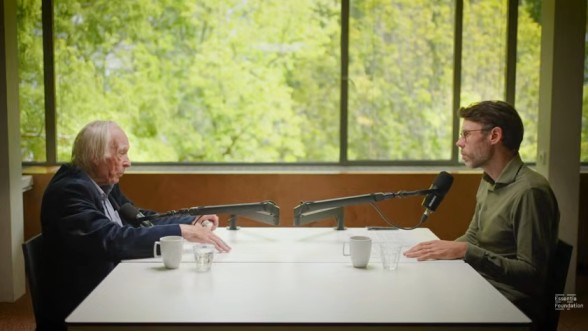
Editor’s Notes: Is life really ruled by our DNA, or have we been telling the wrong story about evolution all along? In this in-depth conversation, Oxford physiologist Denis Noble explains why he believes neo-Darwinism is dead and how his theory of “biological relativity” changes everything we think we know about genes, cells, and organisms. From self-exciting heart cells to the surprising intelligence of cancers and immune systems, he shows how causation flows both upward and downward in living systems, not just from DNA up. Stay tuned if you want a richer, more meaningful picture of life—one that reconnects biology with philosophy, agency, and even our deepest search for purpose. (Nov 29, 2025)
TRANSCRIPT:
HANS BUSSTRA: A very warm welcome to the Essentia Foundation YouTube channel. I have the honor of sitting down in Leiden with Professor Denis Noble. A very warm welcome.
DENIS NOBLE: Great pleasure to come and talk about whatever you want me to talk about.
HANS BUSSTRA: That’s amazing. I just heard you present here at a conference about biosemiotics. We will touch upon that.
DENIS NOBLE: Yes.
HANS BUSSTRA: But maybe good for our audience. For people who do not know you, you’re a pioneering physiologist and emeritus professor at Oxford. And in the 1960s, you built the first computational model of a living heart cell. And you’ve spent basically a lifetime showing how organisms aren’t just driven by genes, but by dynamic networks across different scales. And in your latest book that you wrote with your brother, Raymond Noble, “Living System,” that I really enjoyed reading, you summarize all your arguments against the popular reductionist idea of the selfish gene. So nice to touch upon all of that. Good to know that our audience watching is interested in philosophy and metaphysics. But I think your work, in a brilliant way, will bring us to those topics.
DENIS NOBLE: I think it will, yes. I understand where you’re going.
The First Heartbeat
HANS BUSSTRA: Yes, maybe good to start with the beginning of life. How does our life really start? What causes our very first heartbeat?
DENIS NOBLE: The first heartbeat in an animal as complicated as us occurs after about 28 days of an embryo. The embryo at that time is no more than perhaps a third of a centimeter in size, embedded in the mother’s womb. It has to start that early, because oxygen and CO2 can diffuse over relatively tiny distances, a few microns. So as soon as the multicellular organism has become that size at which it becomes impossible for oxygen to diffuse to the center, CO2 to diffuse out without a circulation, that’s when the heart is needed.
Now, at that time, the embryo is nothing more than a ball of cells. That’s remarkable. A tube forms which pumps peristaltically—is the word we use. But it means the tube itself has a wave of contraction forcing the fluid around that tiny ball of cells. But at that time, there is no nervous system. And that’s important because each of our muscles in our body, like our arms, legs, head, and so on, is moved by instructions from the nervous system to do what I’m now doing.
Where does the instruction come from that the heart receives to do its beating? There’s none. And I was faced in 1958, when I started graduate study at University College London, with that extraordinary fact. Nobody knew how it could be that a muscle could excite itself to be rhythmic.
Now, nowadays we talk about autocatalytic reactions. It’s a long word, but it just means that something self-propels itself. But we didn’t have that idea way back in 1958. So they stopped me with one absolutely fundamental question. They looked at my equations and they said, “Where, Mr. Noble, in your equations is the oscillator?” You see, their mindset was, if he’s going to produce this, there must be something that forces the system to do this. Whereas actually the question was nothing does. So how does it happen? How could a system excite itself?
And they were not really persuaded, but they did say, “Okay, you’ve convinced us you’ve got a problem. We don’t know how you’re going to solve it, but we will give you some time on the computer.” And well, it worked. I got a paper in Nature, one of the top science journals, showing that indeed it self-excites. There is in a biological system always the possibility that it might generate an automatic cycling process. In another sense, what I was showing was a fundamental process that must have been operating at the very origin of life, the ability to self-excite and to continue doing so indefinitely.
The Question of Agency
HANS BUSSTRA: Yeah, and there’s a lot in here for people who are new to these terms. Self-excitation—already the word “self,” it implies that there’s some form of agency, which when I say that, of course, is already a bit sinful, I think, in evolutionary biology.
DENIS NOBLE: Well, you were not allowed to think that way in 1958.
HANS BUSSTRA: You call that also in your book, or it’s known as the teleological sin. Maybe?
DENIS NOBLE: Indeed it is. That’s right. You are not allowed to think like that. I was taught as a student by people at University College London who were very much part of the reductionist, as we call it, strategy in biology. Because just previously, two years before, Francis Crick had formulated what he called the central dogma of molecular biology, which is a very simple idea that from a sequence in our genes you can generate a protein. The protein then forms a structure which is determined by the sequence and finally that produces the function of the body. So everything could be predicted from what happens at the level of DNA.
That is impossible. I’ve come to realize that after another 40 years of work, before I actually retired from my position at Oxford University and became what’s called an emeritus professor.
Francis Crick is one of the greatest molecular biologists ever, together with Jim Watson and Wilkins in London, and we have to remember also Rosalind Franklin, who actually did the experiment to get that X-ray picture of DNA as a double helix and to show that that’s exactly what it is. And that was brilliant. And I don’t challenge any of that. I think all of that is brilliant molecular level discovery. But he then went on to formulate it as a dogma. He called it the central dogma of biology.
HANS BUSSTRA: Which is that we can relate everything back to genes, everything back to DNA that codes.
DENIS NOBLE: Exactly. So you need nothing more than that.
HANS BUSSTRA: Now, which is what Schrödinger had predicted, right?
Schrödinger’s Crystal Metaphor
DENIS NOBLE: It was actually Schrödinger who formulated that idea way back in 1942 when he wrote a book called “What Is Life?” And as a physicist, he was, after all, one of the formulators of the wave equation in quantum mechanics. He realized that the only thing that we knew in those days that could replicate itself was a crystal. Students in school often take a saturated salt solution, let it evaporate slowly, and you watch the crystals forming at the bottom of the solution. It’s fascinating.
HANS BUSSTRA: It looks like magic.
DENIS NOBLE: Yeah, it looks like magic. The crystals—lovely. Children love crystals anyway. Caves and goblins and goodness knows what. Yes. So it’s all to us as children very exciting to see that. But what Schrödinger said in his book, well, maybe life does that. It just replicates like a crystal. And that has continued all the way down the 70 years or so since as a kind of dogma, reinforced by what Crick did in his central dogma, but made into a popularization by Richard Dawkins and his extraordinary book, “The Selfish Gene.” It’s a fabulous story. It’s just completely different from what actually happens in biology.
HANS BUSSTRA: You’re now even being polite.
The Problem with Self-Replication
DENIS NOBLE: I’ve spent the last 20 years of my work working out precisely what I’ve just said is true. First of all, the idea that something replicates itself—true, crystals do that. You don’t need a telecrystal to do it. As soon as the amount of water has evaporated off, that makes it impossible to hold those molecules in solution. They will enter into the right place within the crystal. That happens. And of course, it’s automatic.
And when you think of the genetic material DNA, it is a little bit like a crystal in the sense that each of our nucleotides will attract its pair. They’re linked together, A, T, C, G, in pairs. And they like to be together. That’s a chemical fact. We don’t need to—we use the word “like,” but it doesn’t mean quite what we’re saying when we like somebody. But it is a bit like that because they pair together. Okay. That’s pure chemistry.
And about a dozen years ago, chemists actually checked: if you unravel the DNA in a dish without a cell, how does it replicate? And it does. And the titles of their papers are interesting. One of them refers to the efficiency of self-replication chemically and the other, with a very similar title for RNA. One did DNA, the other RNA, and they measured the accuracy. And that’s the key. It’s about one error in something like 10,000 pairs of these C, G, A, and Ts.
HANS BUSSTRA: Yeah, which sounds pretty accurate to me.
DENIS NOBLE: It’s pretty good. And that’s why the title of the paper is “Efficient Replication.” Yeah. The problem is that our genomes are 3 billion base pairs long. Divide by 10,000, you’ll have 300,000 errors approximately. Any cell that reproduced with that degree of error would not live. It would be in effect fated to die. And of course the rest of the population of cells would use the energy and the components. So it can’t be how it’s done.
But what actually happens would have utterly surprised Schrödinger, who formulated this idea in the first place. What actually happens is that under the guidance of a living cell, around seven enzymes—these are proteins that cause a reaction to occur—in this case, the reactions are to cut the DNA and to paste a new nucleotide in. So they’re called cut-and-paste enzymes. And they literally creep along this extraordinarily long thread, which is the DNA, locate where the errors are, take out the nucleotide that’s wrong and put the right one in. It’s utterly extraordinary.
Even more extraordinary, the living cell does not allow itself to divide and distribute the DNA to the two daughter cells until that has happened.
The Mystery of Cellular Knowledge
HANS BUSSTRA: How does it know that?
DENIS NOBLE: I don’t think we know yet.
HANS BUSSTRA: We don’t know. How do those enzymes know when they encounter an error?
DENIS NOBLE: Ah, well, no, they can. That we do know. You see, you’re back to the double helix formation. You can check what is in the other thread that’s now unraveled, but it’s still there. Okay, so you get the information that there’s an error from that, and you know then that you’ve got to replace that nucleotide.
HANS BUSSTRA: The moment the cell knows there are no errors anymore, we can now divide. How does the cell know that moment?
DENIS NOBLE: That’s the bit we don’t know. See, I don’t think anybody at the moment—I’m not an immunologist, so may not be able to know everything. But let’s make a guess. Somehow the cell as a whole has got to be ready to start the division process. That’s when the membranes actually fold in on each other and two cells appear. And the DNA has also got to be separated, sometimes mixed together. If it’s sperm and egg, exactly what happens.
But I don’t think at the molecular level we know exactly how a cell can be said to know the time has come to divide, but it won’t do so until that is the case. If it does do so, the two daughter cells will be fated to die, so they will never be used.
HANS BUSSTRA: But biochemically speaking, we do not know of a way where it could be coded.
DENIS NOBLE: I don’t think we do. No, I’m talking from my knowledge. Whether somebody else already knows that, I don’t know that they do. I think they would have won a Nobel Prize if they had found out.
The Gene-Centric View Challenged
HANS BUSSTRA: For people watching who are more interested in genes and have always been taught this more classical story that most of us think of when we hear about it—that it is all in our genes. Just to provoke you a little bit, we have Dolly the sheep. I mean, a clone from a single cell. We can insert certain—I found this example of a green fluorescent protein from a jellyfish into a mouse that then starts glowing.
DENIS NOBLE: Yeah.
HANS BUSSTRA: There are also these wonderful examples of how it does seem like genes are the code of life. And okay, the cell might be the computer, we need to compute it, but the genes—it surely looks like the genes are the code of life. Professor Noble.
The Genome Cannot Self-Replicate
DENIS NOBLE: So, yes, sorry, I know that’s what people tell me. You see, I say, well, wait a minute. If the genome cannot self-replicate, which I’ve just demonstrated, you’re in trouble because you need life in order to make that happen. So already you’re in a situation in which a very important function of genes, which is to replicate, to go to the next generation, depends upon the living cell. Think that through. First of all.
Second, another problem which we’ve not yet discussed. It codes for the protein sequence, the amino acid sequence in the protein. 70% of the proteins formed that way can be folded in many different ways. This has been brought out quite recently, the degree to which protein folding, which is how it works chemically, because that’s how it—for example, the protein that grabs a virus formed by the immune system has a particular shape which is designed. I use that word advisedly because I think it is. It’s designed to fit that virus.
And that is not determined solely by the genome, partially by it, because that’s how the immune system generates a new grabbing protein that enables that particular virus to be grabbed. That’s why it takes us about a week to become naturally immune to, for example, the COVID virus during the COVID pandemic.
But if you ask the question, are proteins automatically folding according to their structure? The answer is no. They fold according to their environment. You can even show that the same protein can be present in the fluid of the cell and act as a simple enzyme, meaning something that speeds a reaction up, that’s necessary for our generating energy. And at the same time, if it happens to find itself within a lipid membrane, one of the membranes of the cells, it can be a transporter. It can be both, either, just depending on the circumstances.
Now, why can it do that? One of the great successes of the Human Genome Project, when it was first announced in 2001 with a big paper in Nature—there’s a figure in that paper which shows the evolution, according to the species in which they were investigating, of the way in which proteins have generated additional functions by adding a new functional bit of amino acid sequence to their structure. That’s gone on over the billions of years of evolution.
Proteins have evolved to have multiple functions, but which they serve is dependent on the living cell. So what I’m saying is that both replication is dependent on the living cell and the function of the proteins is dependent on the living cell. Neither automatically follow from the DNA alone. So I’m very happy to have that question and be told that surely is just automatic, that the genome specifies. I now lecture worldwide on genes are not the blueprint for life. I was asked, in fact, to write an article for Nature last year, 2024.
The Question of Cellular Agency
HANS BUSSTRA: I think also the point in your conversation, to relate back what you told earlier, that it needs error correction on a cell level. That’s—to me, that is very—is pretty convincing. What puzzles me is this question of agency that I’m just thinking, okay, so the cell wants something. The cell has purpose. The cell—would you go along with terms like that, terminology like that?
DENIS NOBLE: Yes, I think you have to, because in the end you have to use terms that mean what we say. In this case, what we are saying is we do not know how the cell generates the intelligence it clearly has, but that it has it is obvious. It doesn’t divide until it knows that the genome has been accurately replicated.
HANS BUSSTRA: And the current microbiology, physics even cannot give us a mechanism here.
DENIS NOBLE: Not at the detail of the molecular biology, no. But what we can say is that that process clearly exists. So without working out exactly in detail how it happens, we can be certain that it is there.
Now, we do get some parts of the pathways. Physiologists now do the following kind of experiment. How can a cell that, on a molecular scale is enormous—if I represent a single nucleotide in one of my genes as the size of my fist, and this here in Leiden was the center of it, the nucleus, then the cell surface for that single cell would be over there in Paris, quite a distance, hundreds of miles and kilometers away. And yet within seconds, a signal comes from way over there in Paris to the nucleus here in Leiden and tells the genome, “Please do the following.”
Now, how do we know that? We know that because physiologists are being able to follow what happens when calcium enters another kind of protein channel at its cell surface way back there in Paris. And underneath the membrane, the calcium rises to a higher concentration that triggers a biochemical reaction. We don’t need to go through the fine molecular details of that. But that puts a messenger on a motor, believe it or not. There are motors that walk along tubes in a cell. There are tube trains.
HANS BUSSTRA: I’ve seen those images. It’s crazy. It’s literally a motor on these two wheels.
DENIS NOBLE: They literally walk. Yeah.
HANS BUSSTRA: Messaging.
DENIS NOBLE: If somebody had told this to Schrödinger way back in 1940, could he have even—oh, come on. No, this is not possible. But it is. When I exercise, I’m telling my muscle cells, “Please make more protein.” How do they do that? They send a message along those tube lines to tell the DNA in the right place in the nucleus to make more myosin, which is a muscle protein, and more actin, which is another muscle protein. That’s how they do it.
Bidirectional Causation
HANS BUSSTRA: And so that dogma, or what’s it called—the whole idea that it’s only one chain of causation from genome to RNA to proteins, and then the organism or the organ, you say it works both ways. So these passengers—
DENIS NOBLE: It has to. Okay, it has to. That’s right. There has to be feedback from the higher level of—now, wait for it. I’m going to use the word—
HANS BUSSTRA: But this has been established, right?
DENIS NOBLE: It’s been established. That is necessarily true. Yes. Because that’s how the immune system works. But if you ask the question, do we know the full molecular details? No. We know about those tram lines going all the way from Paris to Leiden in our metaphor for a moment. But if you ask the question, what exactly is the structure that is the messenger, in that case for, let’s say, telling the muscle proteins to make more protein—well, the muscle gene coding for those proteins to make more of those proteins—well, we probably know that the messenger is probably an RNA.
That is another kind of nucleotide sequence possibly existed before DNA. But let’s not worry about that technical detail. We can probably guess it would be one of those. There are many RNAs. The genome in fact produces more RNAs than it produces proteins. Yeah, that’s difficult too. Those should be called genes too. But we don’t because that’s not the way our discoveries occurred.
Anyway, however one puts all of that. Yes, you can make good guesses as to what would be going down as messengers on that little tubulin going from the cell service to the nucleus to tell it what to do. But in every single case, we won’t know the precise molecular details. That’s for people to work out in the future.
The Questions We Permit Ourselves
HANS BUSSTRA: Yeah, but your work, what I find astonishing is that—or just very nice to see how science operates, that science operates on the questions we permit ourselves, right?
DENIS NOBLE: Yes, indeed.
HANS BUSSTRA: And that of course relates back to metaphysics, what our foundation is about. It was the work of Michael Levin, who’s been inspired by your work to think, “Hey, wait a minute, if it’s not all coded in the genome”—and interested in bioelectric fields, who has now been able in the lab to show by influencing bioelectric fields, that basically influencing the message in Paris, “I want this.” And what he wants is like a different organ even.
DENIS NOBLE: Indeed so. Yes.
HANS BUSSTRA: And which is crazy, right? I’m just curious what your thoughts here on his work, how it relates to your thinking.
Michael Levin’s Xenobots and Cancer
DENIS NOBLE: Well, first of all, it’s absolutely phenomenal what he’s shown. You can take cells from the skin of a frog, isolate them from their environment, which is the frog skin, which is a very complex organ. Incidentally, we ought to often think of skin as, well, just what makes us look beautiful if we are, or handsome if we’re not, you hope. But anyway, it’s not. It’s an extraordinary sensitive—I’m just doing this at the moment to feel what I’m feeling—extraordinarily sensitive structure to heat, sound. That’s the way our ears work.
All the various receptor processes occur at the surface. And cell surfaces too have got ways of detecting what is happening. And so they’re able to detect, for example, in Michael Levin’s work, “We’re no longer connected. There’s just a little bunch of us, maybe five cells, but we’ve got to feed.” What do they start doing? They start using their little wavy cilia on the surface of the cell to swim in the environment to see whether they can find food. They’re already an organism. Together, together, together.
Now that brings me to cancer. So I think one of the big implications of Mike Levin’s work is the insight cancer is an organism within the organism. It’s a group of cells that have done what his xenobots, as he calls them, his frog skin robots are doing. It looks for its own way of surviving. And actually the more we invade it with radiation or with chemotherapy, the more it will find ways of escaping all of that, which is why we manage to push cancer back for a few years. But very often, not always, thank goodness, not. But very often, it just starts to come back again.
And the reason for that is exactly what happens in those xenobots of Mike Levin. They start radiating their way of changing their genes to look for ways of surviving even better. That’s what a cancer does. That’s why it’s so difficult to control.
HANS BUSSTRA: But doesn’t his work sort of point to a paradigm shift in treating cancer, namely that we can tell those cells, tell those cells to stop by influencing bioelectric fields if we can?
DENIS NOBLE: That’s what the immune system tries to do. Of course, the immune system has a huge role to play. My concept of cancer is that there are potentially cancerous cells all the time because—come back to that cell division—occasionally it does go wrong and it starts to divide before the accurate replication has been completed. When that happens, you get a defective cell. Often that will just die of its own accord. But sometimes it will survive. That will be happening all the time in the sense that a cancer is a rogue cell. Rogue cells exist all the time in our bodies.
But what does it normally experience? The immune system comes and kills it. Now you’ve got a problem. How does it know what to kill and what not to kill? If it’s ramped up too much, you get autoimmune disease. There’s a fine balance between giving the immune system too much power, in which case it will kill the body itself, and giving it enough power to detect all of those defective cells and kill them. That’s very characteristic of living systems that they have to make those very difficult decisions. A balance of what degree of power do you give?
Cells Forgetting Themselves
HANS BUSSTRA: Yeah, philosophically it really interests me that when talking about Michael Levin, thinking about his work—
DENIS NOBLE: Yes.
HANS BUSSTRA: I also at a moment thought—cells have to forget, forgive, sorry, forget—cells have to forget themselves in a sense.
DENIS NOBLE: Right.
HANS BUSSTRA: They function in sort of in favor of the whole organism.
DENIS NOBLE: Yes.
HANS BUSSTRA: And a cancer cell stops doing that.
DENIS NOBLE: Indeed. That’s right. It no longer is part of the organism.
HANS BUSSTRA: Yeah.
DENIS NOBLE: And we know how cells communicate to tell themselves that they’re part of the same tissue. These are called the microsomes or the exosomes or the extracellular vesicles. These are tiny packets of cell information, and cells are exchanging these all the time.
The curious thing is that idea goes back to Charles Darwin, 1868. He didn’t see and couldn’t with the microscopes of the day, the particles that he postulated, but he knew that cells had to communicate to each other because he thought that we could communicate body characteristics to the germ cells, the future egg and sperm. That’s a Lamarckian idea. But the point I’m making is that the idea that cells tell each other, “I’m part of this tissue,” I think they’re doing that all the time. And that’s what produces the integrity that’s normally there. But when it goes wrong, of course, it produces a cancer.
Neo-Darwinism Is Dead
HANS BUSSTRA: You seem to be wanting to rehabilitate the true Darwin. I mean, I just heard you say in a presentation that you said neo-Darwinism is dead.
DENIS NOBLE: Yes. True Darwinism is far from dead. Exactly.
HANS BUSSTRA: So tell me about what is true Darwinism.
# Neo-Darwinism and the Missing Pieces
DENIS NOBLE: True Darwinism includes natural selection, which of course is his original great contribution, together with Alfred Russel Wallace. They did that together in 1858. And then 1859, Darwin published his famous book, The Origin of Species.
But nearly 10 years later, he knew that there was something missing, because even in the Origin of Species, he explains that the body communicates change to the future egg and sperm. That’s the Lamarckian idea, which is that characteristics developed in us can be transmitted down to future generations. Physiologists have found that for at least 20 years now. So we’ve been in conflict, in a sense, with standard neo-Darwinism for that period of time.
Now I come to what Darwin did. He not only thought there may be communication between cells in the body, but he also thought, well, wait a minute. What is that magnificent peacock doing when it opens up its wings and the peahen sees, what is it, 40 or 50 eyes staring at it with great translucent fluorescent coloring? He thought, well, it’s trying to tell that peahen, I want to mate with you.
But then he realized, but wait a minute. That means the peacock intends to do. He writes that. He says in his book in 1871, the peacock consciously tries to convince the peahen. And then a bit later in the same book he writes, the peahen can do it too, of course, in a different way. She’s not spreading enormous beauty as the male does. It depends. Some species have it that way round. The males carry the beauty and the females don’t. In us, it’s the other way around.
HANS BUSSTRA: And people watching will just think, I mean, like, just like a surface understanding of evolution that has been just like the trial and error of nature ending up with a beautiful—
DENIS NOBLE: Exactly so. Well, if you give evolution as natural selection enough time, but that may be 30 billion years longer than the existence of the universe. Something has to have speeded evolution up. That’s what Darwin realized. There has to be other processes that short circuit the extremely slow process of random change in the genome.
The Mathematics of Evolution
HANS BUSSTRA: Can we sort of account for that mathematically, for this point? That the mathematics of it all tells us that something needs to influence it?
DENIS NOBLE: To move faster, otherwise it would take far too long. Let me give an example back to the human genome sequencing in 2001. What that showed was a comparison between human genome, the genome of a yeast cell as a single cell organism, fly, worm, through to the mouse and then human. At that time, 2001, we at last had the genomes of all of those.
They did a very simple thing. In Figure 42 of that paper, they represented the proteins that arose. Well, they were particular proteins. They’re called transcription factors. But don’t just worry about the details. They took particular types of protein and showed that they had evolved by transferring whole domains of sequence from one gene to another. It’s forbidden by the central dogma.
Now, that had actually been discovered nearly a hundred years ago by a very famous American geneticist called Barbara McClintock. She showed, looking at corn growing in conditions of drought and any other factors that influenced its environment, putting it under stress, that suddenly the corn starts to do exactly that. It juggles its genes. It actually moves genes from one chromosome to another.
She could see all of that under a microscope, watching the chromosomes. She didn’t know about DNA in those days. This is way back in the 1930s, 1940s, 1950s is when we got to know about DNA. And she was eventually awarded the Nobel Prize in 1983 and she published a paper saying, you know, this gives a totally different picture of life. The genome is an organ of the cell.
What she meant was the cell controls the genome. What was I describing earlier in this discussion? Precisely how it does that. The body as a whole can tell the genome what to do now. We don’t necessarily do it consciously, but to come back to Darwin, we’re now back to the peacock displaying its beautiful feathers for the peahen to appreciate, convince it to mate.
He wrote that peacock was intending to do that. He had the concept of agency. He didn’t use the word agency. But what is intention? It’s precisely that. I think that a very big mistake has been made since the central dogma was formulated way back in 1956. And that’s the idea that purposiveness, agency, as we would like to call it today, is central to understanding any living system.
Those xenobots of Michael Levin have got agency which they have generated from that situation, which they suddenly find they’re no longer part of the frog skin.
HANS BUSSTRA: Yeah.
Agency in Living Systems
DENIS NOBLE: And they create the agency to look around with their cilia swimming away to try and find food. I think, therefore, agency is something that is fundamental to any living system. How do we explain it? Good question. I don’t think we have the evidence yet to say in detail how that happens.
But that it happens we can’t doubt any more than we can doubt whether the immune system knew, in inverted commas, for the moment anyway, the immune system, during the COVID pandemic knew that it had to find new immunoglobulins and told its cells, mutate, please make new immunoglobulins. And then selected out of those, the few that succeeded, asked them to reproduce.
How did it know to do that? I don’t think we fully know the answer to that yet. But do we need to know in order to know that it did it? No, we know already. Just as I know that you are an agent and I’m an agent, and he over there is an agent.
So there’s a difference. This gets onto philosophy, doesn’t it? Because there is a difference between admitting that something exists and that something has been explained. It’s the purpose of science to try and explain.
HANS BUSSTRA: Indeed, if you assume that our physical universe, matter, just the chemistry of life is all there is, you would need a mechanism. Whereas if you say there might be immaterial processes or whatever, you do not necessarily have to account for everything in a material way.
DENIS NOBLE: Right. Well, I’m not sure it’s quite so simple as that, but it’s getting there. Yes. There’s a difference between knowing that something happens because you see the evidence for it in the intentionality of the peacock, for example, or the whatever it is you’re investigating, those xenobots going shooting off and trying to live, the difference between that and having explained how exactly it does it.
Because once you get onto the question of how exactly it does it, you’re into the question of levels of organization. Because at what level is all of that integrated? That’s what led me to the idea that we have to see systems all the way up and down, all the way up to the body as a whole, and even to the social context in which the body exists, and down to the molecular level.
But interestingly, the most constrained level is the molecular level. That’s the level at which no choice can be made. You can say in a sense that a nucleotide chooses to be associated with T rather than G if it’s an A. But in fact, it’s determined chemically. Once you’ve got the energy of interaction between those nucleotides, there’s nothing they can do other than to do what they do. So that is inevitably the most constrained level.
Biological Relativity
As you go up the levels, you get to increasing openness to forms of structure that are open to what the environment is doing. And once you do that, it becomes no longer a matter of chemistry, it becomes a matter of the organization at higher levels of organization.
I formulated that as a principle of biological relativity. It sounds like a long word, but all the word relativity means, and even in Einstein this is what it means, is two-way causation. It’s that nothing exists in and of its own. It’s already always relative to what it can interact with.
Matter doesn’t exist without a space that it deforms in general relativity to be the space within which the matter moves in the first place. I mean, it’s two ways all the time. So relativity just means that it’s always a relational situation between two parts of a system. And, well, you can give it all sorts of names. You can say it’s special. That’s part of Einstein. It’s what leads to his ideas about the speed of light, movement through the universe.
You can say it’s general, which is his ideas about the general properties of the universe. And you can say it’s biological because it’s the structure of the way in which there’s organization within biology to do exactly the same thing. The molecular level being constrained by the next level up, micro things within cells, and then cells constraining those, and then tissues constraining cells, organs constraining the tissues. Finally the organism as a whole constraining itself, and then the social level constraining the organism. It’s all constraints all the way up.
HANS BUSSTRA: Yeah, I printed out this one for me.
DENIS NOBLE: Oh, that’s it. Yes, exactly. In fact, if you can no longer arrange it. Quite right. Because it’s no longer correct to arrange it as levels like that up and down, it’s better to think of it as radiating circles of interaction because I think once you move to the social level, which is the level where you’ve got to have meaning making, you are outside the standard causation between the levels of physical processes.
HANS BUSSTRA: Yeah. And of course the big question in thinking about, we have such a strong tendency on, we want to plot agency somewhere.
DENIS NOBLE: Exactly.
HANS BUSSTRA: And your image makes that difficult. Right?
DENIS NOBLE: Because it’s impossible.
HANS BUSSTRA: It’s everywhere and it’s nowhere.
Agency: Everywhere and Nowhere
DENIS NOBLE: It’s everywhere and nowhere. And you know, this is an insight of oriental philosophy for a long time. What is the yin and yang? It is actually the same idea that each molecular element interacts with other molecular elements in a two-way interaction.
The way we detect some of the most invisible particles in the universe, the neutrinos, is to look for the very rare event when a neutrino interacts with another particle. That’s how the physicists do it. They build huge underwater caverns or underground, I mean caverns of water in which to watch this happen. It’s so rare.
There’s dark matter postulated to exist. We’re getting into metaphysics now. There’s dark matter postulated to exist that we can’t see. Physicists are already having to at least consider there might be things we can never detect. There might be matter that we can never detect. But that depends upon first having the concept that all that we can detect is always two-way.
Because what do we mean by detect it? We mean we can see it. How do we see it? Because our photoreceptors enable us to see something happening that says that exists. And of course dark matter won’t do that because it doesn’t enable our receptors to be excited.
But look, there are many things like that. There are wavelengths we can’t see, but many of those wavelengths are seen by a fish or by the squid or the octopus. We can’t say with certainty that what we see is all there is. There’s a thought.
HANS BUSSTRA: We’re trapped in our own, our images, our cognition, our models of the world. Hearing you talk also, I’ve mentioned that maybe too often on this channel, but I’m just fascinated by the work of John Wheeler, the physicist. That’s the image of relating back to how we started our conversation, that self-excitation as the universe as a self-excited circuit.
The Improbability of Life Being Unique to Earth
DENIS NOBLE: Indeed, I think that must be true. It seems to me very improbable that it’s just in this part of the universe that something quite phenomenal has happened which is leading to, and has led to the existence of you and me and all the rest of humanity and the octopus and the squid and so on and so forth. That seems to me to be exceedingly implausible.
But what else has happened elsewhere in the universe is very difficult, of course, to know. We can speculate, but that’s where we pass across the boundary to metaphysics rather than physics.
And what my dear friends within the reductionist camp in biology—I’ve been friendly with Richard Dawkins for over 50 years now. Examined his thesis back in 1966. That’s true. Yes, exactly. So when we debated three years ago in the big festival in England organized by the Institute of Art and Ideas, he started the whole debate, or discussion, as we called it, with, “You know, that man over there, he was my thesis examiner.” Absolute hilarity amongst the audience at this idea that these two people on opposite sides of the debate were one student and examiner.
Anyway, that’s all true, but to come back to the point, what people like Richard will do, and others also in the camp of thinking that things can be represented extremely simply without any philosophy at all. Science has not to do with philosophy, nothing. That’s what Richard says.
Now, my reply to that is very simple. If you think that, you won’t even know how to distinguish between association—between one thing happening, another thing happening—and the causation that enables that to happen.
Association vs. Causation: Lessons from the Heart
Now, why do I say that? It comes out of my own work on the heart. Thirty years after presenting my work for the first time internationally, actually here in Leiden at a big Congress in 1962. So we’re fast forwarding to 1992. By then, I’d found that not just five protein mechanisms involved in heart rhythm, but at least 55 or maybe 555. They’re huge. I mean, these are vast networks of gene products, the proteins, RNAs and so on.
And what we found was that you can knock a key one out that was known by our experiments to contribute to 80% of the electric current, causing that pacemaker potential to develop and therefore causing the heart rhythm. You can block that and only a 10% change in frequency occurs. What that tells you is there’s a difference between association—10%—and causation—80%.
Now, unfortunately, nearly all the associations in genomics, 90-odd percent of them, have been shown to be very small. If you understand what I’ve just said about the heartbeat and you extend that to all the other functions in the body, we know why that is: the body has many ways of making the same function happen. If it didn’t, it wouldn’t survive. It’s robust.
HANS BUSSTRA: Yeah. It’s redundant also.
DENIS NOBLE: Right, exactly. So would we trust flying in aircraft if they didn’t have backup systems to get kicked in if the control mechanism has been compromised?
HANS BUSSTRA: No.
DENIS NOBLE: And in the end, of course, the pilot is the key backup, but before that, there is backup in the system to ensure that it will continue to fly, land safely and so on. So we’re used actually in our ordinary living day, every time we fly, every time we drive a car for that matter, because cars are modern computers now.
HANS BUSSTRA: Yeah, they are, they are.
DENIS NOBLE: So you’re no longer struggling to turn this, you’re getting help from the system that enables this to occur relatively easily. So that difference between association and causation is absolutely universal across biology.
The Failure of Genomic Prediction
Now I come to the important experiment that was done at University College London two years ago, published in 2023 in the British medical journal Medicine. And what they did was to take all the genomic information being stored in the National Health Service in England in what is called the polygenic repository. That’s a long name for what is actually very simple. All your genome sequences are there and all the diseases you later suffered from are also there, because the life histories of those people—you can’t identify them. So nobody is identifiable from all of this, but you can do statistics on it.
And that’s precisely what the University College London team did. It’s quite a large team that did it, led by a man called Hind Gharani. And what they did was to say, okay, all the association scores are fairly small, but if we add them all together, we get what might possibly be the cause. That’s the hypothesis: it’s the cause. Together they function to create a situation in which somebody at some time has a heart attack or develops a cancer, both of them, possibly fatal.
So they pushed those scores into a computation. Do they predict the diseases those people suffered from? Very simple question. And the answer in the conclusion of their paper: the correlation is very weak.
In effect, what they were saying is, by the same standards that determine whether we accept, regulatory-wise, a new drug proposed by a pharmaceutical company—accept it or not, that is, does it work without too many side effects? There are too many side effects. What you find is that occasionally you predict correctly. But equally, there are a number of occasions where you predict the wrong way from those scores. That’s tragic.
We were led to believe in 1999, when the whole thing was about to be announced as the first sequencing of the human genome, that within 10 years—that was the prediction by the leaders in the United States of the Human Genome Project—within 10 years we’d be able to cure your cancer. Has not happened.
And you see what my kind of physiology has done is to explain why that’s the case. That’s why I want to get this across publicly, that there’s a big problem here. I think that means that it’s going to be necessary to change tack in the way in which biology is conceived and the way in which it is done.
The Problem with Denying Agency
And that is going to include accepting the existence of quite a lot of things that the usually reductionist analysis denies even exists. What the biggest textbook of evolutionary biology in the United Kingdom and in America for that matter, because it’s both—Futuyma’s textbook called just Evolution—omits, which is anything to do with agency. Nothing must be accepted as having a purpose.
Well, I don’t understand that. I used to understand it about 40, 50 years ago, but in the last 20, 30 years I’ve come to the view: No, look, you have to at some stage or another admit when you’ve got the wrong metaphysics. And believe me, the central dogma is a central dogma, which is one of the problems in what I’m describing in standard biology. That is a form of metaphysics. It’s an assumption that everything flows according to DNA self-replicating and simple selection by “does the organism die or not” being the only process by which evolution occurs.
And I think we have to come to the conclusion that that simplistic analysis has failed to explain what we need to explain. Worse still, it’s failed to deliver the health care that we thought genomics alone would be able to deliver. That’s serious.
HANS BUSSTRA: That indeed is very serious. And also I’d say on a cultural level it also has implications on how people live their lives, right?
DENIS NOBLE: I think so. For very good reason. Which has been demonstrated too. If you really believe that, you can’t help it. “My genes made me do this.” That is actually the defense that somebody once produced in an American court.
HANS BUSSTRA: Yeah. It’s according to what science tells us.
DENIS NOBLE: Right. “I pulled the trigger, but I was not responsible.” Yeah. At that time people thought they’d identified, believe it or not, genes that cause criminality. There are no such genes.
HANS BUSSTRA: There’s a Skinner or Ulcer behaviorism.
DENIS NOBLE: I’m afraid so. It is all of that. But worse than that, if you ask the question, what motivated the killing of six million people during the Second World War? Six million Gypsies, Jews and other “strange”—in the view then of the ruling organization, the Nazi organization within Germany—what was the justification for killing them? It was that their genomes were bad.
There are no criteria that can be usefully used from the genome alone to identify criminality. Just as there are no genes within your gene sequence or mine or anybody else’s that will determine whether or not we’re going to be schizophrenic.
To take another example, what does explain that kind of problem? Schizophrenia is a very good example, actually, because what we found is that it’s much more to do with poverty within communities, which is why it’s familial, why it goes down through the generations.
HANS BUSSTRA: Like this biggest circle in your image.
DENIS NOBLE: It’s the biggest circle there in that diagram. Exactly. And that is vastly more important than the gene sequence, the correlation. But remember the difference between correlation or association and causation. The association is there, it’s in the families. But the reason for that is a social reason, and we have to admit that.
Restoring Agency and Purpose
I think now to tackle that problem, you’re going to have to give rise to treatment that recognizes agency. Because I think the person who thinks like a criminal might—”I can’t help it, it’s my genes”—has got the wrong mindset to survive in society. The mindset is “I can lay back because there’s nothing I can do about it.” That is the very opposite of what somebody should be trying to do.
The best way of bringing up somebody who feels like that is to encourage them. “Well, actually, you do have agency. You can.” And Richard Dawkins says this too. “We can frustrate our selfish genes,” he writes. I have to ask myself the question, how does that work?
Well, he said, “So we can educate our children. Let us educate our children, because we’re the only species that can do this.” Where does that idea come from? Can you believe it is Descartes? It’s the philosopher back there three or 400 years ago, who said animals are automata. But then he realized, “Well, remedy, I’m not.” So there must be something, the self, that causes me. The soul. He used as the word, of course, the soul, the self, whatever, that enables me to control this body, which otherwise would be a mechanical automaton.
Of course he was impressed, as many were amongst educated people at the time, with extraordinary things. Constructions that had been made in the gardens of the rich, effectively robots had been created from tiny tubes that were making them move in particular ways. I didn’t know that the fluidics, they were using early water computers, if you like, causing mechanical toys to behave like robots, even making sounds. I mean, it’s quite extraordinary what happened during that period in the mid-1660 area.
HANS BUSSTRA: I think artists now doing that with—there’s a Dutch artifact.
DENIS NOBLE: Yes, exactly. So I think it is actually terribly important socially, culturally, to let people realize that agency is real. Without that, you can very easily sink into what I would call an almost depressive view of life. “I can’t help it.”
HANS BUSSTRA: Yeah. And what we see now, I guess if you want to do that within that still, that materialist, reductionist framework, you have to close your eyes, because then a doctor would have to say, “We cannot account for the placebo effect because I basically deny the existence of your free will or mind.”
DENIS NOBLE: Indeed.
HANS BUSSTRA: But we know from studies that it does work. “Sorry, I cannot give you—but just do it.” Because—but the moment you open up and are scientific about it, you have to sort of question your metaphysics.
DENIS NOBLE: Well, indeed, yes. Well, any good doctor knows the placebo effect is important. Yeah.
Philosophical Foundations: From Descartes to Spinoza
HANS BUSSTRA: And as you just said, you critique Descartes. Many, many philosophers do. To what philosopher do you feel more aligned? I think you mentioned Spinoza’s thinking, for instance, actually.
DENIS NOBLE: So Spinoza is extraordinary. He was, incidentally, Jewish in origin and must originally have come from the Spanish environment, Toledo or wherever it was in Spain. He was in Amsterdam eventually, as Benedict Espinosa, and he entered into correspondence with the early secretary of the Royal Society in England, which is the National Academy of Science, and he wrote in Latin. I can even reproduce part of it.
HANS BUSSTRA: Seriously.
DENIS NOBLE: “Conceive, if you wish, a tiny worm living in the blood, and it will perceive how the individual particles of blood move around within the blood, but it would have no idea what the purpose of the circulation is.”
It was a beautiful statement of the difficulty of proceeding from one level of organization—the particulate. In this case, we didn’t know about molecules, but the particulate to the general form. But that’s a distinction that goes way back to Aristotle. He was the first, as far as we know, to distinguish between causation by form, which is the constraint by the boundary conditions of any system, and constrained by the physical interaction—knocking into each other, sliding over each other, or whatever it might be that molecules take part in. You need both. Without both, you can’t even begin to get solutions to any of the equations of life.
HANS BUSSTRA: And he would say, wouldn’t Spinoza say that this cut that they carved, made to him, was a unity that the whole of nature is an expression of the divine?
DENIS NOBLE: Indeed he did, yes. His theology, which has got him expelled from the synagogue in Amsterdam, just down the road from here in life. Yeah, yeah, yeah, it is. I mean, it’s extraordinary, isn’t it? There was a man over there in Amsterdam who thought very deeply about science, philosophy. The two in those days were not thought of to be a separate set of activity.
But there he was, excommunicated from his own community and thinking still about what on earth is it divine? Just extraordinary. It was a sad fact that the Royal Society never accepted to publish what he sent because, well, to come to the point there, the then secretary, Henry Oldenburg, who himself was from the Netherlands, incidentally, he was suspicious of Spinoza’s theology and couldn’t feel that he could take the decision to publish his ethics, which is one of his greatest philosophical achievements.
But that’s what would have happened had Oldenburg agreed to take Spinoza’s work and publish it in—what are they called?—the Philosophical Transactions of the Royal Society. That’s a scientific journal. It’s still called a Philosophical transaction, because nobody in those days distinguished between a philosopher and a scientist. People understood you have to do both.
HANS BUSSTRA: It’s just interesting how this dualism, our mind-matter divide, way of thinking, still influences us.
DENIS NOBLE: It does. That’s right.
HANS BUSSTRA: So hard for us to conceive of that as being one. I think models like these start helping that we say we cannot locate it somewhere. It’s everywhere, nowhere. As we tried your biological relativity, as you call it. But you do write stuff. For instance, in your latest book, there’s a sentence where you say, between brackets, “the watchmaker may be blind.” So you’re talking about the universe as a whole, I suppose. But she, like, it’s a—she feels her way in the process of change and intention does not come from anywhere. It’s definitively what living things do.
DENIS NOBLE: Yes.
HANS BUSSTRA: Could you explain a bit on this sort of metaphysics which you are proposing?
The Self as Process, Not Thing
DENIS NOBLE: Yes. Actually, that’s not the first book in which I elaborated this particular metaphysics. That was in fact the Music of Life way back in 2006. And it’s worth going back to that, because I was trying to ask myself the question, was Crick—back to Francis Crick, I’m afraid—was he correct in thinking that if he took the claustrum out of my brain… The claustrum is a tiny part of the brain which has the property that is connected with almost every other part, which is why he chose the claustrum. Have something that connects with everything else. And perhaps there you’ve got the neurological form of the self, me.
So Dennis Noble is there. So I thought, wait a minute, if I’ve got a pot here and I take that bit of my brain out, forget all the technical difficulties in doing this, and I keep the bit of tissue that I’ve taken out beautifully perfused, is it going to be me? You keep it alive. That is easily done because even slices of brain tissue can be made to continue living. So is it me?
Well, first of all, I can’t even talk to it. That’s a big difficulty. I can’t even communicate with it. Now we come to another aspect of the self, which is it depends upon that communication. We define who we are by interacting with other beings. The little bit of evidence we have on feral children, there aren’t many, but of the few authenticated cases one can take, they don’t behave like a human.
HANS BUSSTRA: These are children who grew up—these are children exactly amongst animals or…
DENIS NOBLE: Amongst dogs, whatever it might be, monkeys that have adopted them. Very rare that this happens. But what you find is that they don’t behave human-like anymore. They have not acquired the cultural environment in which we as babies grow up within our families. And I think you have to say there isn’t a human there. There’s the form of a human, but it hasn’t got the mind of a human.
But that tells us a lot about the nature of the self. Again, the Oriental philosophers have a word for this. They call it Anatman. Atman is Sanskrit for the self. An is no. So it’s no self. There isn’t one. Now, I think that’s strictly true. If I take my body alone and it never had any communication with other humans, I would not have a human self. I would develop whatever self was appropriate to the being that I had become within the community in which I had grown up, if I had the luck to have grown up at all.
But that means, I think, that the self is a process rather than a thing. I state that in the Music of Life, long before writing Understanding Living Systems. So what Ray and I are stating there in Understanding Living Systems is a simpler explanation of the same point. Because we don’t need to put it in the form of an Oriental system of thought. Even within our own system of philosophy, it doesn’t make sense to ascribe a self to the brain alone. And there I lay my case. That is my metaphysics in relation to the nature of the self.
HANS BUSSTRA: Yeah, I can follow you. And that it is a process. It reminds me of what Alan Watts would say, that we shouldn’t talk about a tree, but about treeing. The process of…
DENIS NOBLE: Indeed. Which is a process of being a tree. Yes, exactly. So…
HANS BUSSTRA: And…
DENIS NOBLE: And that knows a community because his roots do that.
Life at the Boundary Between Order and Chaos
HANS BUSSTRA: What fascinates me though, but this is like purely speculation. I’ll ask you to speculate here is if we see it all as a self-excited thing, the universe, that that sort of gets itself into this process. You write that it’s that interface between order and chaos.
DENIS NOBLE: Yes, indeed.
HANS BUSSTRA: You write interesting things like nature creates problems. If there wouldn’t be—well, how do you put it? If there wouldn’t be life, there wouldn’t be problems. So it is nature that creates this dichotomy. Then starts playing with it and somehow at this boundary. Utterly fascinating.
DENIS NOBLE: Absolutely. I think life lives on that boundary between order and chaos. Between—yes, between order and disorder. That’s the way I put it in a book called the Language of Symmetry. Yeah, there is a book, hasn’t sold many copies because most people find it terribly difficult to understand.
HANS BUSSTRA: We’ll put it down in the descriptions for people. They can so give it a boost.
DENIS NOBLE: It exists. The Language of Symmetry is a book. I’m not the sole author. It was done with a philosopher called Benedict Ratigan and also a popular science writer. But our idea comes from the harnessing, as I call it, the control of disorder at lower levels of organization in our bodies to produce the order that we see. That is us. If we are ordered. And most of us are, thank goodness.
So we do that all the time, using stochasticity to produce the order that enables us to live. So I don’t buy the idea that we’re just the random variation in our genes giving us a phenotype. That’s a long word for being us. The properties we have that we’re just that we are in control of what the genes do in our bodies. If we understand the ways in which we can exercise that control.
HANS BUSSTRA: And for people to understand that notion of harvesting stochasticity, it would be that through, for instance, errors being made in the genome, an antibody can be presented that the cell knows, I need this one. Right. So it is out of these errors that you see, this is what I need.
DENIS NOBLE: Indeed.
HANS BUSSTRA: And that error becomes the solution.
DENIS NOBLE: Indeed. So an error becomes the solution. And you cannot describe that as anything other than the order arising out of disorder. Without the disorder, you wouldn’t be able to have learning. The AI people know that too. Alan Turing, the first person to write about artificial intelligence in 1950, said it very clearly. You need to have an element of randomness to have any learning at all. He said that way back in 1950. Yeah.
HANS BUSSTRA: And now the machines, AIs rely for a great part, I think, on our randomness input on these machines.
DENIS NOBLE: They’re harnessing all of that information.
HANS BUSSTRA: But of course, and you write, you have a very interesting story, a love story in your latest book about that, that we could of course conceive of machines that have random number generators in them. So we did then have sort of that stochasticity you’re talking about.
The Water-Based Computer Problem
DENIS NOBLE: Yes. Our story of the poor girl who is not really a human. Her brain is a silicon chip system. It imagines her saying eventually, “Oh, dear, I don’t understand. My boyfriend, he asked me, what’s my purpose in life? Well, I think my purpose in life is to make him happy. And I do. But he doesn’t seem to think that’s enough. And a few days ago we had an argument about it. He even hit me across the face just to stop me smiling, because I used to just smile every time he got upset with me. It worked beautifully until that day yesterday.”
And so I asked myself, what is the difference between me, a robot inside a human body and a girl? Am I like a doll to him? Oh, dear. I go back to my maker and I say, “Look, I’ve risen and encountered a major problem. Could I not be made of water like him?” And my creator says to me, “Well, honey”—he calls me that. He seems to think I’m rather pretty and nice—”Well, honey, the problem is I don’t know how to make computers out of water. Nature did that. It took 3 billion years to do it, and I had no idea how to copy that. So you better just go away and put up with being as you are.”
Oh, dear. Poor Julie. She has just to put up with being as she is. And she can’t find a purpose in life. Now, that’s the story, of course, it’s made up. It’s just imagining a situation. But I think it’s an interesting challenge to the artificial intelligence people working away as they are now and producing exceedingly impressive responses of AI to all kinds of questions that we may ask it.
But I find it difficult to imagine that that alone will—without harnessing the stochasticity in an ordered way—I find it difficult to imagine how that will produce behavior like a human. But it will be increasingly difficult to tell the difference because ultimately, if people asked, what is my purpose? I would say it is to acquire understanding of living systems. That’s my subject. But do I know what I’m going to end up with in say, two years time? No, I don’t, otherwise I would already know it.
Now the AI can only work on the basis of what’s written about me or what I’ve written. So if even I can’t say with any certainty what I shall be saying in two years time, how on earth can an AI system determine that I will do X? It won’t. But you see, as organisms we have that, I would like to say knowledge that we can actually do that. I can say I don’t know what I’m going to do in two years time and live with that and know that it’s up to me to find out. And I don’t know yet.
HANS BUSSTRA: I love that sort of thinking of water-based AI and water computers. I think it’s just very interesting.
DENIS NOBLE: Well, it’s not impossible, but it did take nature 3 billion years to do it.
Quantum Effects in Microtubules
HANS BUSSTRA: We haven’t discussed quantum mechanics yet. I know. Now, coming just back from filming at a conference where a lot was presented about microtubules and quantum effects in microtubules. So we’re talking about the highway we discussed earlier from Paris to Leiden, commuting, communicating stuff to our genome. And it now seems very likely, and we are on the brink of experimentally establishing it, that quantum effects play a role there. I’m just super curious what you think this would imply and how it informs your work and thinking.
DENIS NOBLE: I’ve actually discussed this with Roger Penrose who is said to be the origin of this idea.
HANS BUSSTRA: Together with…
DENIS NOBLE: By Stuart Hameroff.
HANS BUSSTRA: Exactly. Yeah.
DENIS NOBLE: Now Roger’s answer was very simple. It’s not just that I have a five minute recording of my discussion with him and what he said in that discussion because I put to him the question directly. Do you think that quantum mechanical processes, like the collapse of a wave function and all the various terms that people use to try to describe quantum mechanical behavior, do you think that’s the basis of consciousness? No, no, it’s worse than that.
I looked at him, okay, how is it even worse? He said, we don’t even understand quantum mechanics. That explains why we can’t compute it. If we can’t even compute quantum mechanics, how can we use quantum mechanics to compute us?
Now looks to me as though there is a disagreement there between Hameroff and Penrose, even though they’ve published together. But I think we should ask at the very source. In each case, Stuart will have his reasons as a neurologist and knowing about microtubules and those tram lines all the way from Paris to here, that I think also one needs to ask Roger himself and he says quite clearly, no, I think it’s not quite like that. It is worse than that because we don’t even understand quantum mechanics.
Now that is a sort of statement that I like. I think part of the problem in science is that we too readily think we must understand it all. It may be we have to live with the fact that we can’t. Actually, the discussion today in our meeting here in Leiden led to discussion of that particular point between order and disorder in the universe. Can we have a good resolution? Or in the case of quantum mechanics and its quantum gravity and general relativity as developed by Einstein, can we find a way of bringing the two together?
Well, it’s worth asking the question, do we need to or should we just simply live with the fact that there are limits to what we can understand? I actually come to that view myself that the best, for the time being, at least way to think about it, is that this is beyond what we can know. So let’s live with that and get on with it.
HANS BUSSTRA: I like that approach. I think what’s happening with quantum is that culturally people have so long lived, had difficulty with what science tells us.
DENIS NOBLE: Yes.
HANS BUSSTRA: Seemingly tells us that there’s no meaning in life, no purpose.
DENIS NOBLE: Indeed. Yes.
HANS BUSSTRA: And then we grasp onto this new science that tells us things like nonlocality and entanglement, which seem to be compatible with religious ideas. So we want to grasp it as a mechanism, but still forget that it’s still a model of reality. And indeed, as Roger Penrose said, there’s a fundamental debate about what it all means to me. It points to sort of this, that society at large is just so dearly wants meaning back, which science seems to be put sort of aside.
Reconciling Science and the Humanities
DENIS NOBLE: And I think this is a resolution then that we can make with the great cultural traditions of humanity in the stories we write, in the poetry we write, the music we write. With all of those forms of the humanities, I think we can come to a well deserved mutual understanding that yes, there are processes beyond what science can analyze in the way in which it is traditionally used. I happen to be a musician as well.
HANS BUSSTRA: What instrument do you play?
DENIS NOBLE: I play guitar, but more importantly I sing the troubadour poetry. The medieval poetry of the troubadours, including Arnaut Daniel, Jaufre Rudel. It’s fantastic poetry. He invented the sestina, which is the way of arranging the rhyming words in a six line stanza to have a different order in each of the six verses according to a mathematical formula. And this system all makes sense, but only in his language, which is not French, it’s Occitan.
And he makes a stick, “Verjo,” become the tool with which eventually he unites with his lover. When they can ascend to paradise, because only in paradise can they actually have that joy. That’s what his song says. And that is the beginning of Dante writing the Purgatorio, the Inferno, in the Paradiso of the Divine Comedy.
Look, I think there’s a need for a laying down of the weapons with which science has quarreled with the humanities. We need to bring a resolution to that. And I think that kind of resolution is perfectly possible. Because once science accepts that there’s a concept of agency which doesn’t depend on some ghostly thing, determining what we do does not depend on supposing that there’s something inside us that is the essence of us and that the essence of us is out there in our social relationships. We’re back into culture. What is that? It’s the culture and therefore the poetry, the drama and the music and all the other. The dance. I forgot about dance.
HANS BUSSTRA: That would be my…
DENIS NOBLE: It’s very nice to think there could be a resolution of that because it’s been a standoff for absolutely enormous number of decades between the obvious fact to the humanities that we can be creative and the science is giving the impression that all of that is a bit ephemeral and doesn’t have any real existence. It’s time to resolve that. And I think that is resolvable. We may not be able to resolve our concepts of the universe, but I think we can resolve this argument.
HANS BUSSTRA: I couldn’t agree more.
DENIS NOBLE: No longer an argument.
HANS BUSSTRA: I couldn’t agree more. And we’re trying to do our best by making this plea for different metaphysics. And you do it in a different approach in systems thinking and biology.
DENIS NOBLE: And…
HANS BUSSTRA: And as a final question. But you already sang to us, so that already to me was… My question would be like on a personal level. If you speak to young people who find it difficult to find their way in life or people in distress. And you write “Dancing to the Tune of Life.” What is your advice on how to dance to the tune of life on a personal level?
Mentoring the Next Generation
DENIS NOBLE: Well, I do this all the time. I have a small group of young people working with me. Not working in my team in Oxford. I’m not creating a team anymore. No, there are people dotted around the world and I’ve accumulated who are looking for precisely that. How given that they are also thinking very similarly to me. And that’s why they’ve come to me for advice. What can we do to swim within this environment in which you can’t even get funding if you want to do that? Tragic.
HANS BUSSTRA: Yeah.
DENIS NOBLE: And I’ve examined theses where people have been clearly knocking against the dogma of the times. I’ve tried therefore, to give encouragement to those people by forming a group and they meet from time to time. I just… What do I do? I animate the group to some degree, but they do so too because in the end they enjoy doing what they’re doing.
I also accumulate people. When I went to Santiago de Chile earlier this year in January, to take part in their Congresso Futuro, the Congress of the Future, I gave a talk on “Genes Are Not the Blueprint for Life,” which is exactly the Nature paper that I published last year, very short paper, so anybody can read it very quickly. I was given around five young people who’ve been selected for the congress to help with shepherding people around and so on.
But I discovered, of course, they were well selected people from within the school systems in Santiago, with tremendous inspirational to me, sense of their wanting to find their purpose in life. I’ve continued to mentor two or three of those to help them negotiate what to them are huge hurdles. How do we, in a tiny part of the world, in Chile, for example, manage to have opportunity to go to major universities, for example. But that requires that people get encouragement to think you might be able to do it. If you really want to try and do it, why not have a go?
So my way of doing it is to try and inspire young people to think, well, what is being opened up here? And breaking out from a paradigm which has had its day in science and for many years now, is to encourage them to think that actually the world is their oyster. The world is the place where they can achieve something. It gives them purpose. There are people looking for what they can possibly do. I love it.
So give me somebody aged about 16 or 17, and I enjoy mentoring them. But you know who else used to say that? The Jesuits used to always say, give me a child, I’ll bring it up and it will remain in my religion for the rest of life. It’s cultural transference, isn’t it? From generation to generation.
I’m trying to create an environment in which certainly I don’t tell people what religion they should have. I’ve no interest in that at all. But at the same time, for them to respect all the traditions of mankind and think that somehow we can manage to negotiate through all of those controversies that have fueled war after war after war and come to a better resolution in the future. That’s what I’d love to see.
HANS BUSSTRA: I think that’s a beautiful way to end this discussion. Our conversation, I should say.
DENIS NOBLE: Thank you very much.
HANS BUSSTRA: Thank you very much. Thank you very much.
DENIS NOBLE: Very enjoyable discussion too.
HANS BUSSTRA: I enjoyed it very much.
DENIS NOBLE: Thank you.
HANS BUSSTRA: Thank you very much for watching our conversation. If you have any questions, you can leave them below and we will make sure to put links to all we reference to and work of Denis Noble in the description below. Thank you for watching.
Related Posts
- How to Stand Out in an AI World by Thinking Better, Not Faster: Sol Rashidi (Transcript)
- Modern Wisdom: w/ Alex Petkas on True Story Of The Odyssey (Transcript)
- Reconstruction: Malcolm Gladwell Interviews Barack Obama (Transcript)
- Transcript: “How to Win Without Crushing Your Soul” – Graham Weaver
- Why Early Legal Action Matters After a Cryptocurrency Investment Scam