Read the full transcript of investigative journalist Dave Troy’s talk titled “Is Democracy Dying?” at TEDxBerlin, August 4, 2025.
Listen to the audio version here:
The Failed Promise of Post-Cold War Democracy
DAVE TROY: So after the fall of the Berlin Wall and the subsequent end of the Cold War, many experts predicted that democracy would flourish and spread, and that Soviet authoritarianism was an aberration. Well, we’ve had 35 years now to run this natural experiment and to ask whether or not that was actually true, and we’re now in a position where we can ask the question, is democracy spreading?
And unfortunately, the answer to this question is not really. Over the last several decades, democracy has faced many, many headwinds, and in fact, today, there are fewer democracies, and the quality of the democracies that exist is lower, and 39% of the Earth’s population lives under authoritarian rule, and many countries, including the United States and several countries in Europe, are now rated as flawed democracies.
So I’ve been spending the last 10 years of my life trying to figure out the answer to why this is happening, why didn’t democracy spread, and what can we do to help it to spread?
The Historical Roots of Anti-Democratic Movements
So it turns out, if you look under the surface, there are a lot of anti-democratic movements that are very old, some of which go back a century or more, and there’s a lot of individual people that have been behind these movements. In Russia, there’s a guy named Ivan Ilyin, who was at the turn of the century and described a kind of a monarchist approach to government, Oswald Spengler, who wrote the book “The Decline of the West,” was a German mathematician, and really called for an alliance between the extreme left and the extreme right to take over any kind of flourishing of democracy that might take place.
These movements, these two men specifically, had adherence later in the 20th century to people like Francis Parker Yockey, who wrote a book called “Imperium” about this, Julius Evola, an Italian theorist, and then they had acolytes like Willis Cardo in the United States, and then subsequently other folks like Alexander Dugin, who was a prominent Russian geopolitical theorist, and Steve Bannon, an American political theorist, who have been both really networking together these very illiberal movements around the globe.
In addition to that, there’s also another strain of kind of what you might call neo-reactionary monarchist, network state. Sometimes people call this libertarian exit. This was started largely by a guy named Nick Land, who provided kind of a theoretical framework. He was a philosopher out of the UK. This work was picked up by Curtis Yarvin. Another guy named Balaji Sreenivasan, who launched the network state movement out of Silicon Valley, picked up on their works and kind of operationalized it, along with another guy named Patrick Friedman, and then, of course, you’re familiar probably with Peter Thiel and Elon Musk, who have applied money and other resources to help operationalize and fund these activities.
The Noosphere: An Esoteric Theory Shaping Policy
Now there’s also some more esoteric ideas that many Westerners are just not familiar with at all, and this stuff was stuff that I had to learn from scratch and was a bit of a surprise to me. How many of you have ever heard of the noosphere? Okay. You’re my friend, though, so almost nobody’s heard of the noosphere, but a few of you have.
This was kind of an obscure theory that was dreamed up by two scientists, one Vladimir Vernadsky, who was a Russian-Ukrainian scientist, and then also Pierre Teilhard de Chardin, who was a French-American theologian and scientist. What they theorized was that the Earth would go through three phases, the first phase being the geosphere, which is just rocks and water and the elements, and then the biosphere, which would mark the emergence of life, so plants and animals, and then a third phase called the noosphere, which would mark the emergence of a collective consciousness or intelligence that would actually envelop the Earth physically, and it would be perhaps tumultuous change, but it would be a signal point for a complete transition and transformation of the Earth and our inhabitants on Earth.
So this idea became very influential in both the United States and in Russia, but particularly in Russia and has become a big part of Russian culture, and in fact, today, Vladimir Putin’s chief of staff is a guy named Anton Vaino, and his claim to fame is that he invented a nooscope to monitor our transition into the noosphere, which is a little crazy. Okay.
Russian Mystical Traditions and Modern Policy
So there’s another esoteric tradition that underlies a lot of Russian policy right now, and you can trace this back to a Russian mystic and artist named Nicholas Roerich, and he basically took elements of theosophy and Gnosticism to develop a prophecy about the future organization of the world that was very similar to the noosphere concept. The only thing is that it would require anybody that doesn’t go along with this plan to either be marginalized or eliminated, so it’s kind of not great.
But Mikhail Gorbachev, right around the same time that the Berlin Wall fell, was using the Roerich idea, he called it, as the basis for perestroika and glasnost, and a lot of people don’t know that, but these ideas very much underlie a lot of what’s happening now with Vladimir Putin and Russia and Russia’s policy towards the West.
Reflexive Control: Russia’s Information Warfare Strategy
You see this also reflected in this doctrine called reflexive control. This is a sample of a paper from 1986 talking about the Russian idea of reflexive control, and don’t worry about trying to make too much sense of the specifics there, but the main idea here is that it’s Hegelian dialectics, Marxian dialectics, and the idea of Hegelian synthesis that we actually heard somebody talk about earlier today, taking a thesis and an antithesis to try to drive towards some evolution point, some synthesis that would move things forward.
And this has been adopted as official policy by Russia towards the West for the last several decades, and what they kind of try to do is to pit an artificially constructed idea of the left against an artificially constructed idea of the right, and then drive towards some synthesis that produces a controlled output that gets them what they want out of the West.
So a lot of the information warfare that we’re seeing deployed against the West is being driven by this kind of a framework, and we see this displayed in a variety of different books and other materials that are out in the information environment.
Anti-Democratic Literature and Financial Warfare
So on the left there you see a book series called “Project Russia,” which was released in Russia between 2005 and 2010, and in it they describe democracy as fundamentally decadent and that it is not worthy of our support, and that voters don’t have enough information or domain expertise to make decisions, so therefore decisions should be made by strong leaders and an elite that is informed properly. This is clearly a way to try to undermine the West.
It also calls for a complete financial crisis and meltdown so as to remove the hegemony of the U.S. dollar, and we see this reflected in other works like Sergei Glazyev’s book “The Last World War, The U.S. to Move and Lose,” and he’s really the architect of this whole BRICS currency idea that you probably heard about, trying to take on the dollar and dollar hegemony, and then these folks have in turn also found allies in Washington with people like Kevin Roberts, who was one of the principal authors of Project 2025, the big U.S. policy package that is being followed by the Republicans, and they all call for a financial collapse and the end of dollar hegemony.
Here in Germany you see this in the strange alliance between the far left and the far right, you know, Alice Weidel with AfD, and Sarah Wagenknecht with Bündnis, formerly Die Linke, and you see them working together towards common cause a lot of time, and it’s this sort of Hegelian synthesis trying to move things forward, but mostly to try to undermine democracy, and of course we’ve seen just in the last few days that the German government has not been thrilled with the activities of AfD.
Learning from History: The League of Nations Example
So the question that remains when you look at all of these anti-democratic movements is how can we actually nucleate or otherwise cause to exist a future where democracy actually prevails over these illiberal anti-democratic movements, and it turns out that we’re not the first ones to ask this question. Others have been looking at this for some time, but in particular I want to call out Clarence Streit, who was a reporter for the New York Times, who was assigned to cover the League of Nations in Geneva in 1929, and what he observed in studying the League of Nations was that it was doomed to failure, and the reason that he felt like the League of Nations was doomed to failure was because the
unit of membership of the League of Nations was the nation rather than the individuals in those nations. So people don’t have any stake in the activities of the League of Nations, and it did in fact fail. What Streit called for instead was the creation of a federal union of democracies that would pull together the world’s largest democracies and give people a stake directly in that larger union.
Let’s take a listen to what Clarence Streit had to say about this. “What we are trying to do is to unite the people of the North Atlantic democracies who are now in the coalition, we’re trying to unite them on the same principles that we followed in our early history when we united the 13 states in our present federal government.”
And the reason why Streit recognized that this was the time to do this in 1939 was because the machinery of governance and communication and trade was at that point global. And of course if it was global in 1939, we’re way past that point now. Obviously it’s very global now. So if this was a good idea then, it’s a good idea now.
Post-War Applications and Limitations
And a lot of Clarence Streit’s ideas were actually applied in the post-war era. Of course Streit was trying to prevent the outbreak of World War II. That did not happen. Obviously World War II did occur. But the ideas that he was championing ended up in places like NATO. But that’s primarily a defensive alliance, you know, it’s not a political union.
Likewise the European Union pulled together a similar kind of set of ideas for the European continent but is not a global union and is not designed to pull together democracies. The United Nations, unfortunately, repeated many of the same mistakes that were present in the League of Nations, once again making the unit of membership be the nation instead of individuals. And there’s also no incentive for a country to actually want to become a democracy because you don’t have to be a democracy to join the UN. And in fact we see now that the UN is being very much, you know, controlled and influenced by many anti-democratic kinds of countries.
The Challenge of Global Coordination
So the challenge that we’re left with now is that we have all of these global challenges like climate that need real attention and real coordination amongst many countries. And we have no way to effectively do that. We’re relying on these individual countries following the Westphalian nation-state model from the 1850s to try to execute on this. And we just simply don’t have a way to do it. We don’t have a way to deal with collective action problems like this.
So we have to fix this. And Streit’s model, which, you know, there might be other ways that we could go about approaching this as well, offers one pathway forward.
A Personal Call to Action
And I have to say, you know, this is personal for me. I’ve been spending the last decade of my life with great sacrifice and upending of all kinds of other priorities to look into this and to try to come up with a pathway forward and to report on it. And quite frankly, people don’t understand the degree to which these anti-democratic movements run deep through our history right now. And we need to start to get a handle on this.
My grandfather landed on Normandy in 1944 to try to ensure a democratic future for Europe and the world. And, you know, we need to honor that sacrifice, and we need to sacrifice ourselves in order to try to find a solution here.
The Global Infrastructure Reality
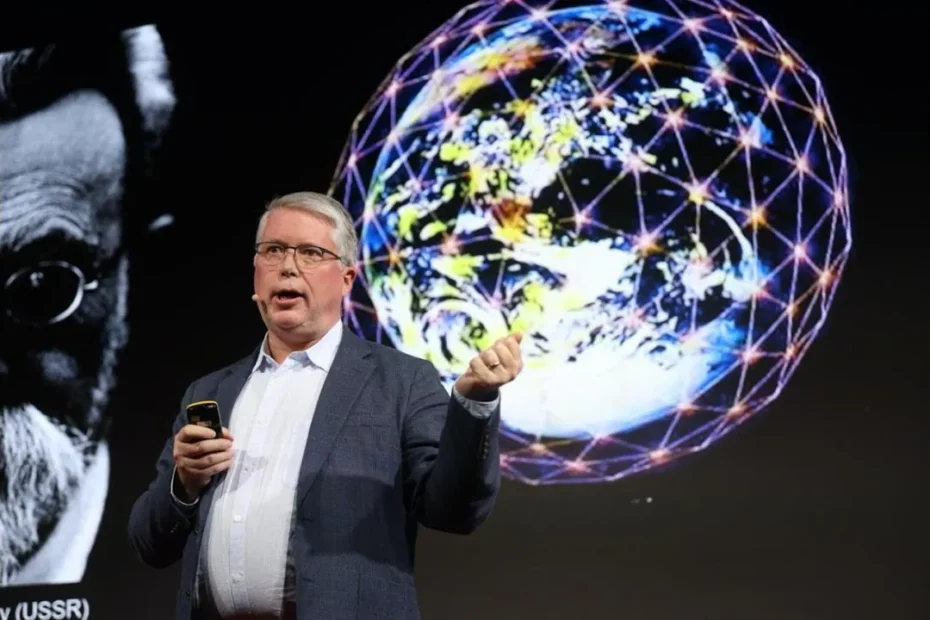
So if you look at this map of Starlink satellites, the machinery of our global communication right now is clearly global in scale. And it’s being controlled by a man-child troll, Vladimir Putin collaborator, and Hitler. And so we have to ask ourselves, what are we going to do about that?
Conclusion: The Conversation We Must Have
What are we going to do to bring our machinery of governance in line with our priorities and carry our democratic values into the 22nd century? Because if we don’t start having this conversation now, and really it’s a conversation that we last had seriously in 1945, then we aren’t going to see democracy survive into the future. But we can start this conversation today, and we must.