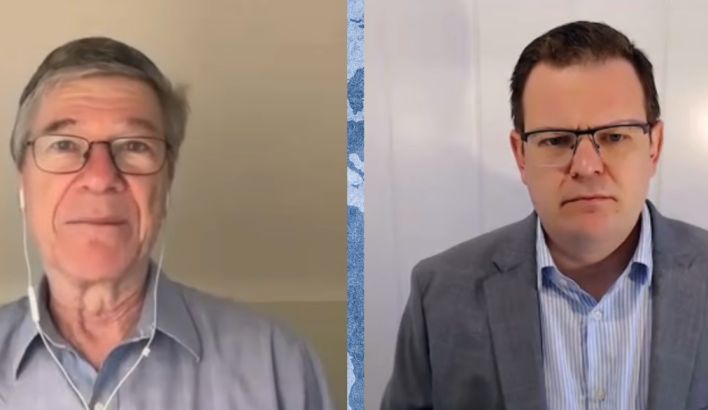
Editor’s Notes: In this episode, Glenn Diesen is joined by Professor Jeffrey Sachs to examine the profound impact of the conflict with Iran on the U.S. empire and its global alliance systems. They discuss the rapid unraveling of American hegemony and the dangerous consequences of erratic leadership and “shock and awe” tactics in an increasingly multipolar world. Sachs offers a sharp critique of the “fatal” nature of U.S. alliances, urging nations in Europe and the Gulf to seek security through regional diplomacy rather than military dependency. This timely discussion highlights the urgent need for a return to reason in international relations to navigate the shifting global order and prevent further escalation. (April 4, 2026)
TRANSCRIPT:
GLENN DIESEN: Welcome back. We are joined today by Professor Jeffrey Sachs to discuss what is happening in Iran, but also in the wider world order. So thank you very much for coming back on the program.
JEFFREY SACHS: Great to be with you.
The Unraveling of U.S. Hegemony and the Iran War
GLENN DIESEN: So we see that the consequences of this war against Iran, it’s, well, it’s difficult to measure. We see it on the global economy, the world order, but also the alliance systems. That is, over the past decades, or you can say even 80 years, many countries from the Gulf States to Europe, East Asia, they essentially bet their entire security on US protection, that is, linking themselves to the US hegemony.
This now, as the US hegemony is in decline and Trump appears to be becoming more and more erratic, we see that the whole order is unraveling very quickly. Of course, a lot of this came. The last speech by Trump, of course, is something that also puts some shocks through the international system. I was wondering, how do you assess this?
JEFFREY SACHS: I think two things are going on simultaneously here and in Ukraine and in other crises. One is the extraordinarily erratic behaviour of the United States government and personalised in Mr. Trump. He shocks the world. He shocks most Americans. Nobody can really rationalize the brazenness, the lawlessness, the viciousness of U.S. actions and of Trump’s rhetoric.
His line about sending Iran back to the Stone Age shocked everybody in the world, I think. We can add that his partner in this crime, Benjamin Netanyahu, gave a similarly shocking speech that fewer people saw the day before and the start of the Jewish Passover holiday. And in the Passover holiday, which is the story of the Israelite exodus from Egypt, God visits 10 plagues on the Egyptian people. And in Netanyahu’s speech, he visited 10 plagues on the Iranian people.
It’s again a speech of shocking brutality and also a geopolitics, I would say, of maybe the 9th century BC, the mindset. The biblical framing, Netanyahu casting himself as God is all so stark, so sharp that anyone that is watching what is happening right now sees that we have an extraordinarily violent war that seems to have justifications coming out of 9th century BC mindsets, or simply psychopathic ideas of sending other nations to the Stone Age.
We heard Trump chortle about the destruction of a bridge in which 9 people were killed crossing the bridge, which was a non-military target. And reportedly 95 people injured at the attack on the bridge, and the president was delighted by that.
The Battlefield Reality vs. American Claims of Dominance
So this is one thing that’s happening is all over the world and inside the United States, there is a sense of an absolutely violent and lawless regime in the United States. The second is the battlefield. American hegemony ultimately tests on the belief, rests on the belief that America dominates the battlefield. And all of the rhetoric of Trump and Netanyahu has been since the start of this operation, but it’s true in every US operation, that shock and awe will overcome the foe, and that the inevitability of U.S. victory is so overwhelming that everyone will bow down to the United States. And more and more, that idea is unraveling.
One could say that it unraveled decades ago in Vietnam. One could say that the same failure was shown in Central America in the Contra Wars. One could argue that the same has been seen throughout the Middle East and Afghanistan, that this overwhelming force doesn’t prevail. But each time the same proposition is put forward. That the might of the United States, the unprecedented ability to project power and force is overwhelming.
And Trump made that claim a couple of days ago, and then the next day, two American fighter jets were downed, and counterattacks came in Israel and in the Gulf region again. So to many observers, many people you are meeting with and discussing, the battlefield evidence is quite the contrary of what’s being claimed by the United States.
Iran seems to have continuing massive retaliatory force, the depletion of anti-missile systems seems to be real, the breakdowns of morale in the US even reportedly forcing an aircraft carrier to return to base because of some kind of insurrection or insubordination or collapse of morale among the sailors. As reported, seems to show the opposite.
So there’s a fundamental question. What is America’s power? And ultimately that turns on its military and economic power. And second, what is America’s intention? And that turns on the statements, the goals, the behavior of the U.S. government. And on both counts, this is a shocking period.
On the question of aims and goals, this is shocking. We can’t even piece together as hard as we try exactly why we’re in this war. This seems really to be a war of whim. That’s the best description that I’ve heard of it.
And when it comes to American power, the debate is open and the days will tell what the real situation is, but at least to this moment, the American and Israeli claim of shock and awe overwhelming the Iranian government is not true.
And quite the contrary, it seems that there’s a lot of worry, in fact, beneath the surface, that the ability to defend against, especially the Iranian missile attacks, is waning and in the Gulf region almost nonexistent.
The Risk of Escalation and the Ideological Roots of Violence
So this is why the whole world is watching this in amazement. We are seeing fundamental things play out, and they’re also extremely dangerous. They can escalate to nuclear war without question.
On the side of Israel, the level of violence, dehumanization of Israel’s foes, the biblical language, which in this case of the Bible, the Old Testament story of the Israelite capture of their promised land is so ruthless, so violent, so genocidal that the rhetoric and mindset coming from Israel suggests no limits. That seems to be not just tactical, that seems to be actually ideological. The hatred for the other in Israel seems to be unbounded.
And a difference of the US and Israel is that in the United States, the public opposes the war quite overwhelmingly. And nothing that Trump has done has changed that. And this unease and opposition is very widespread. In Israel, I’m sorry to say, it seems that most of the public backs the war and backs the violence, and backs the idea behind the war of the hatred of the other side and the belief that the other side is an implacable foe that must be totally annihilated, which again is a maybe 9th century BC mentality, but it seems to be infused in this society.
Can This War End? The Problem of Existential Demands
GLENN DIESEN: Well, a common friend of ours, John Mearsheimer, he keeps making the point that no one has told him any story of how this could end in a positive way, that is in a US victory. And it’s a good point. I just find it difficult to see what the best possible outcome is. The whole idea that if there’s just enough death, destruction, and carnage, then somehow the Iranians would simply capitulate.
It seems like part of the problem with this strategy though is that what the US demands of Iran is their capitulation would then become an existential threat. If they would have to give up even their conventional deterrent, what would stop the destruction of Iran. And there seems to be some parallels to the war, or the proxy war against Russia. That is, if we just escalate enough, then we’ll get a deal. But when your adversary considers this to be an existential threat, there is no bowing down, it’s only escalation.
So do you see any possible end to this war? Or how can this be ended? Because at the moment, it doesn’t seem that Trump is willing to pack up and go home.
JEFFREY SACHS: Well, I think that this is the point, the difference of can and will. Of course, Donald Trump can and should pack up and go home, but it’s very unlikely to happen.
And the backdrop of all of this is the continued American assertion of hegemony. That’s not only Trump. That is the dominant American foreign policy idea that America must be and is the most powerful country in the world in every region and must constantly prove that or demonstrate that if there are any doubts. So a war in Iran is not about Iranian issues. A war in Iran is about demonstrating America’s full and unconstrained power. And it must be proved to the whole world that it is full and unconstrained.
The Role of the Military-Industrial Complex and Personal Corruption
That’s the backdrop that goes beyond the question of Trump. But on top of that problem, which is the assertion of hegemony, which is a claim that the U.S. believes in and makes but cannot fulfill because the U.S. doesn’t have the predominant power to do that other than in utter destruction, there is the personality of Donald Trump. And personalities make a difference in wars. Wartime leaders make a difference.
And the more we understand the situation in the US, the more the personality factor plays in. We can give structural reasons for the American demands on hegemony. This is something that goes back decades. We can also talk about financial motivations and the pressures, or not even pressures, I should say, the lobbying and the money-making from the war profiteers. And there’s no doubt that a lot of Silicon Valley, Palantir being case number one, is a great proponent of these wars.
By the way, just parenthetically, they want to test their new AI-driven weapon systems. So this is also for them experimentation. It’s lab work. The fact that people are killed and there’s a war, all the better. It’s very realistic. We can see how these weapons work. There’s a certain madness, greed, tens, hundreds of billions of dollars driving this. Same is true in Israel.
So there’s a side of this that is very direct. But I was saying that even with all of those structural features, the claims of hegemony, the size of the military-industrial complex, the huge money-making and grift that goes into this, the personal grift of Donald Trump and his family, who are the most corrupt officials in U.S. history, I mean, corrupt family and president in U.S. history.
Trump and Netanyahu: Psychological Instability at the Helm
There’s a personal element of psychological instability here that I believe is at work, which is that Donald Trump is a psychopathic. This is a clinical judgment that is made by forensic psychologists and psychiatrists since he came on the public scene and made repeatedly, and I think very cogently. This is not a man who gathers information and rationally processes it and maybe vicious but is highly tactical, closes the deal and so forth. This is an unhinged man who is impulsive, paranoid, psychopathic, and a megalomaniac.
This is not the kind of person one wants in the presidency of the United States. I would say that Netanyahu has similar psychological traits. These are very violent, unhinged people. And it means that stepping back is not easy. Everything is a test for them of their own world, as well as more broadly, a test of the American political class mindset of hegemony, which, despite all the evidence to the contrary of the fact base of hegemony, is still believed in Washington.
A Path Forward: Can Putin, Xi, and Modi Convince Trump to Stop?
So we have a very big structural and individual problem of getting any kind of de-escalation or any kind of resolution. I have one and only one thought about this, frankly, it’s not a very persuasive one, perhaps, but it is the one that I’ve been holding, which is that Donald Trump listens — to the extent that he listens at all, he listens to those he regards as his peers.
And he does regard President Putin, President Xi, Prime Minister Modi as peers that he wants to be part of and live up to. These are leaders of superpowers. He inevitably, almost without exception, expresses respect for them, for the power that they hold, for their lead of superpower nations. They need to tell him to stop.
I think it’s extremely important. They need to tell him, “Donald, this is not going anywhere. This is not going anywhere good. This is not helping you. It’s not putting the United States in a better position. It is not helping any country in the world. It’s dangerous. It needs to stop.”
I don’t know if that is even remotely sufficient under these circumstances, but I think it is important to try. This is not the bluster, we’re going to enter the war against you. Quite the contrary. It is to try to explain this has to stop because if it continues on the path that it’s continuing, it’s going to bring us all to disaster.
The Folly of Hegemonic Peace: Advice to U.S. Allies
GLENN DIESEN: Well, certainly having some coordination and more cooperation by the great powers, certainly something we need. If Putin and Xi are able to do this, it would be great. But what do you say though, you have advised many governments around the world over the years, and what would you tell the allies of the United States?
Because it appears that the Gulf states very much have also embraced this principle of hegemonic peace. Also the Europeans. I mean, if we looked to Venezuela, for example, their main concern was that Trump talked about the oil rather than human rights, but the actual actions weren’t really against. And I assume as well, if he would have included them from the beginning, they would’ve been much more supportive of the attack on Iran as well. Instead, he let them wait until the war had failed before inviting them in, in which they now do not want to partake.
But they also, especially the Europeans, have very much embraced the idea of peace through strength, which is a nice way of saying militarism instead of real diplomacy. That is, we’ll be so powerful that our opponents will have to do what they’re told, yet they shouldn’t arm themselves to balance our might. So this kind of hegemonic idea of peace, this is something not just the Gulf states have benefited from, but also the Europeans still don’t want to give up on, as we see in the conflict with the Russians. So how would you advise them today if they still pick up the phone and call and ask, given the US losing its position in the world, where do they go now?
The Illusion of U.S. Protection
JEFFREY SACHS: Of course, I’ve been saying exactly for the last decade at least, be careful of the United States. It’s got a delusional foreign policy. It believes that it runs the show, but it gets you into deep trouble. I have repeated dozens, if not hundreds of times, my favorite adage of Henry Kissinger, that to be an enemy of the United States is dangerous, but to be a friend is fatal.
How many times have I said that to governments or in the European Parliament or to the Gulf leaders personally in recent years? Not just because of this war, but because of all of the circumstances that go back a very long time. I do not believe, for example, that countries gain any security whatsoever in hosting U.S. military bases. I’ve argued for years and suggested for years that these countries invite the United States to go home. You don’t get security. These bases are a magnet for conflict, but more than that, they suborn your own sovereignty.
European countries remain 80 years after the end of World War II semi-occupied by the United States, and the United States meddles deeply in European politics to a shocking extent, actually. And so my own recommendation has been repeatedly, this idea that you are finding security in the United States is wrong. The United States has its own rather bizarre ideas about the world, which is hegemonic control. If you subscribe to that, you’re subscribing to an unreality.
And moreover, if you host the United States military and CIA on your soil, then you are also basically relinquishing your sovereignty. You cannot speak straight. You will find that if you are in politics and you oppose the United States, you will be knocked out of your politics within your own country. And so generations of politicians arise that can’t even find the words to express opposition to even crazy American ideas. And there are so many crazy American ideas because hegemonic dominance is an unreality. And if everything is built on the foundation of an unreality, there’s a lot of craziness that goes along with this.
Warnings to the Gulf Region
So Glenn, I was in the Gulf region last year speaking with leaders exactly expressing this sentiment. This is before the war. This is not an ex post idea that these bases will not protect you. I said to friends in the Emirates, you know, why are you joining this coalition with Israel and the United States? You think that this is really prudent, that this is correct, that this is accurate? Together with Israel that has committed a genocide before the world’s eyes in Gaza, you’re part of the so-called Abraham Accord. This makes no sense for you. This is no security. This is no realism, whichever your favorite foreign policy position is.
Well, I think realism, if it’s done right, means that you are taking a realistic view of the situation. And the idea that the United States is going to protect you is not exactly realistic. You know what I heard? “Oh, but Mr. Sachs, we’re getting Nvidia chips. We’re getting data centers. This is key for us.” That actually was the currency of foreign policy, I would say, in the last couple of years. “We turn on or turn off the data centers in your country, the high-end chips.”
Well, these are now all being blown up. By the day, by Iran, a data center does not have anti-missile defense systems around it. So governments need to take a much more realistic understanding. We’re in a multipolar world. That’s the foundation.
The U.S. Mindset and Its Failures
The United States political leadership, and by that I mean the White House, the National Security Council, the CIA, the armed services committees, the military contractors, they don’t accept that. They don’t get that. They don’t believe in it. They think, well, AI and Nvidia chips in our weapons systems, in our Palantir-based target identification systems, in our AI-empowered killing systems — this is still dominance.
They wanted to show in Gaza, we can kill everybody. We can level Gaza. By the way, after a genocide, Hamas is still there and still operating. Israel couldn’t achieve its gains even in a small neighborhood that was bombed and leveled over 2 years. Now we’re talking about Iran with almost 100 million people, and a formidable technological base and military base.
This is also something that the mindset of the United States cannot understand, which is that there are technologically sophisticated people everywhere. Iran is one of them. They view Iran again as medieval, if not Stone Age, but they don’t understand that Iran has highly sophisticated technological capacities. And those have been also put at the service of the military.
Advice for a Multipolar World: Know Your Neighbors
So I think the advice was right, but not heeded. And today I say all the time to any government, look at your neighborhood, be friends with your neighbors. Don’t let the American empire divide you because your safety and well-being depends on your neighbors.
And don’t build or think you’re going to build the wall — whether it’s the Berlin Wall or a new wall to hem in Russia — or don’t think in the Gulf that you can be on the western side of the Persian Gulf, but on the eastern side, Iran, that’s the enemy. Don’t think in those terms. Look at your neighbors. Make peace with your neighbors, cooperate with your neighbors, trade with your neighbors, and then on a regional basis, understand that your safety and well-being depends on good relations with all of the major powers.
China is not your enemy. Russia is not your enemy. India is not your enemy. The United States should not be your enemy. But we also need the United States to get beyond the mindset that it displays now, which is either you’re for us or you’re against us. That’s the American mindset borrowed from the Athenians in the Peloponnesian Wars when they told the Melians, “If you’re not with us, we kill you.” Unfortunately, that is part of the American playbook as well.
But countries cannot succumb to that without giving up their own sovereignty and their own future. And now in a multipolar world, they don’t have to succumb to it. So this is my basic advice in general, which is don’t let the American empire divide your own neighborhood.
I say it in Japan and Korea, “China is not your enemy. It’s your neighbor.” I say it in the Gulf region, “Iran and the GCC should be the first ones talking with each other.” Not only do they share the Persian Gulf and the Strait of Hormuz, but they share a lot of other things as well. They share culture, history, transit points, ecological risks in a very dry part of the world beset by major water crises.
And I say it to the Europeans, “Russia is not your inveterate enemy.” This Russophobia is a historical fiction. It’s a complete misreading of history, but it’s also a complete misjudgment about European security, which can only be achieved collectively with Russia, not in opposition to Russia.
How Empires Divide and Conquer
So this is the same everywhere. Empires divide and conquer. The United States has used division as a way to extend hegemony. It’s always saying the one on the other side is the enemy. It’s always trying to extend to the other side.
The U.S. position ideologically in the Middle East is, “We already run the Gulf. Now all we have to do is bring Iran back into the fold, which we happened to succeed in doing in 1953, but then lost in the 1979 revolution. We need to bring them back into the American empire.”
So every region faces a divide that the US stokes. The US tells ASEAN, “Oh, China’s your enemy.” It tells Japan and Korea, “China’s your enemy.” It’s stoking these divisions. And of course it has stoked the division with Russia because the whole point of the end of the Cold War — and I was present personally, watching at the highest levels — was that peace had come to a common European home. But the US wouldn’t have it.
It needed to expand NATO. It needed to keep an alliance against a country that no longer existed, for a threat that absolutely didn’t exist. But it needed, for American hegemonic purposes, to expand NATO — and not just to expand it, but right up to Russia’s borders — and to put in anti-ballistic missile systems and all the rest, and to abandon treaties that had been signed with the Soviet Union in which Russia was the continuation state. So that was the mindset. Europe fell into it, so dutifully, privately uneasy, publicly without a murmur.
Europe’s Own Imperial Mindset
And by the way, as crazy as this mindset is, let me just add two points. Europe has its own hegemonic mindset that remains even 80 years after the end of the European empires. So Europe ran the world in a rather vicious way for a long time in Asia and in Africa. That mindset’s not gone.
So that’s why the subservience to the US imperial mindset is not so hard, because it’s also seen to an important extent as keeping the West dominant. And so the Europeans, yes, they’re subordinated to the United States, but in a way it continues to be a projection of Western dominance in the world. And they view the United States as therefore in a way helping their empires that no longer exist to continue their international control.
So that’s really part of what’s happening right now. Europe goes along because the idea of controlling the Middle East — that’s a totally European idea. That’s not just an American idea. That has deep roots. The worst of this is the British. The British absolutely still maintain the trappings and mindset of empire that has gone for almost 80 years, but it’s still there.
And so we hear the most remarkable rhetoric coming from Britain vis-à-vis Russia or other showdowns where Britain has no power to deliver on any of this, but to make a lot of rhetorical and political mischief.
What’s interesting is even in the Iran War, there’s been a little bit of hesitation by the British. This shows how completely outrageous this war is, because the British almost never hesitate to support an imperial venture, and have always said America is basically our successor empire. But in this one, it’s so outrageous that the British have tried a little bit — “Don’t bring us in.” This is almost unprecedented. The British jump into every American war, but not this one, because it’s so completely outrageous what’s happening right now.
The Inherent Contradiction of Hegemonic Peace
GLENN DIESEN: Yeah, I think that’s the inherent contradiction of the hegemonic peace though. If you want to be a hegemon, you have to be very dependent on the alliance system because you divide regions into dependent allies versus just balanced or contained adversaries. And I don’t think often European leaders appreciate this, that once you are in a conflict with your opponent, be it Russia, then this is what makes them so dependent on the US. This is why they have to sign all these horrible trade deals. This is why they end up in this situation.
Same with the Gulf states. I mean, their conflict with Iran is the reason why they’ve become hostage to the US. And I think it was acceptable when the US was more of a comfortable hegemon, but now that it’s declining — and as Mark Rutte said, NATO is also not just for protection, it’s for power projection — if this is for power projection for the US, and so they’re being used to go after rising powers, and then the US isn’t in the position to defend them anymore, then it looks like a disaster. It’s just shocking to me that there’s not more efforts to readjust to current realities.
The Political Cost of U.S. Subservience
JEFFREY SACHS: What’s so interesting about it is that it does not deliver. It delivers insecurity, it delivers economic crisis, and the publics know it. So the politicians that continue their subservience to the US in Europe are profoundly unpopular. They’re running strongly against public opinion.
The leaders in the Gulf region that continue their subservience to the United States and Israel, because this is a US-Israel war, are very much facing opposition from what’s called the street there, but just is public opinion. The public in the Gulf region does not want to be an ally of Israel in this, but this is the position that their governments have put themselves into by saying our security is an F-35, or our security is an F-16, or our security is a military base of the United States.
Unfortunately, it’s a very naive idea, but it is the idea that got them into this, and it traps them not only in their national interests, but it puts them in direct opposition with their own publics.
And you can watch step by step as Trump is reviled in Europe right now. His net approval rating is something like minus 70%, and that was before the Iran War. In other words, maybe 15% approval rating, 85% disapproval rating. The man’s despised for very good reason. He’s a despicable person. But the governments have continued to try to appease him, try to support him, try to say that we’re onside, and they lose support.
We’re seeing this in Italy right now, where Prime Minister Meloni basically made her politics as Trump’s best buddy in Europe. And that was a calling card for a while. And it no doubt made some people in Italy feel that, well, at least we have the United States on the inside track. But now it’s completely turning because young people are saying, what is this? We’re siding with this? This is madness. Madness.
And so you see everywhere in Europe, if you side with Donald Trump, you lose your own political base. That doesn’t necessarily mean you lose power immediately, given the constitutional order. Maybe you have a parliamentary majority that can last 2 or 3 years, but you don’t have a political base within the country.
GLENN DIESEN: Well, thank you for taking the time, and let’s hope that governments begin to embrace reason again and adjust to new realities.
JEFFREY SACHS: Very good. Glenn, great to be with you. Talk to you soon.
Related Posts