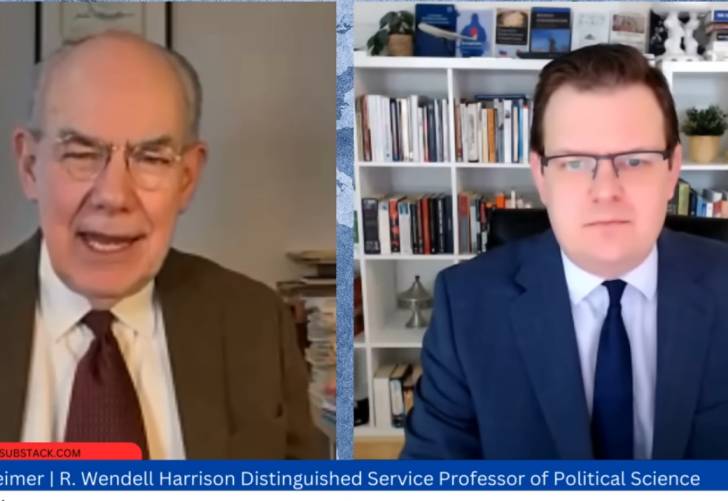
Editor’s Notes: In this compelling discussion, Professor John Mearsheimer joins Glenn Diesen to examine the escalating conflict between the United States, Israel, and Iran, arguing that the U.S. has already effectively lost the war. Mearsheimer highlights the lack of a plausible “off-ramp” for the Trump administration and challenges the assumption of “escalation dominance,” noting that Iran possesses a formidable ability to retaliate against critical infrastructure in the Gulf States. The conversation also delves into the historical limitations of strategic air power, the role of intelligence support from Russia and China, and the catastrophic economic implications for Europe as the conflict intensifies. Ultimately, Mearsheimer provides a sobering critique of current U.S. strategy, suggesting that the refusal to acknowledge the reality of the situation on the ground is leading toward a humiliating strategic defeat. (Mar 11, 2026)
TRANSCRIPT:
Introduction
GLENN DIESEN: Welcome back. We are joined by Professor John Mearsheimer to discuss the war against Iran, which is definitely not going as planned. So thank you very much for coming back on.
PROFESSOR JOHN MEARSHEIMER: My pleasure, Glenn.
The War Is Not Going as Planned
GLENN DIESEN: Well, as I said, the war definitely not going as Trump had hoped, but it seems to be going as many would have predicted. Indeed, Trump himself had been met with a lot of warnings before he went down this road, and now, of course, it’s unclear what direction he should take.
We also see reports from the American media that even Israel is now growing concerned. They don’t think that Iran is going to collapse. They don’t think it’s going to surrender. So what exactly, if time is on Iran’s side, why go down this road? And the Wall Street Journal said something similar, that Trump’s advisors would like to find a quick exit from this war. So what do you make of this? Is this reaching the end of the war, or will Iran not permit this?
PROFESSOR JOHN MEARSHEIMER: Well, it’s quite clear that the war is not going well for the United States and that President Trump, I think, would like to put an end to it. And the problem that he faces is he can’t find an off-ramp. I think nobody can tell a plausible story about how this war ends.
If we had decisively defeated Iran the way we decisively defeated both Nazi Germany and Imperial Japan in World War II, then you can say the war is over with. We are the winner, and we’re going to impose terms on the loser. But that’s not what’s happened here. They haven’t won anything approximating a decisive victory. And in a very important way, the Iranians have an incentive to continue the war, to turn it into a protracted war of attrition, and they have the means to do that.
So the question then is, how does President Trump get Iran to agree to settle this war? When you listen to people in the administration talk, they sometimes talk as if we’re the only player in the game. Of course, the Israelis as well, but the Americans and the Israelis are in the driver’s seat. We determined when the war started, we determined when it ends, we determine the conditions that the Iranians have to accept. This is the sort of view you get from inside the administration, but this is not the way the real world works. The Iranians have a say in this. And the question is, how do you get the Iranians to agree to stop fighting?
Now, some people might say that we are inflicting so much punishment on the Iranians that they would be happy to quit. Pete Hegseth has been saying that today is going to be the day of the heaviest bombardment that Israel and the United States inflict on Iran. Okay, let’s assume they inflict more punishment today than they have in any of the previous 11 days of the war. Does that mean that the Iranians are going to throw up their hands and quit? I hardly think that’s the case. I think that Iran has prepared itself to accept massive punishment by the United States and Israel. So we can dish it out, but the Iranians are not going to throw their hands up.
And in fact, what the Iranians are going to do is they’re going to up the ante from their side as we go up the escalation ladder. They’ll go up the escalation ladder. If you start destroying critical infrastructure inside of Iran, they’ll destroy critical infrastructure inside the Gulf States and inside of Israel. And they can do it. They have lots of ballistic missiles, they have lots of drones. Almost all of them are highly accurate. And they’re operating in a target-rich environment. It’s not like they can’t find targets to hit. They can hit vulnerable and important economic and strategic targets with relative ease.
So they have a strong hand to play. When I say they, I mean the Iranians have a strong hand to play. And they have no incentive to settle this one on America’s terms. They have a deep-seated interest in making sure they get something out of a settlement — sanctions relief, reparations, who knows? But they’re going to drive a hard bargain, because the more time goes by, the more desperate we are going to be to settle this one.
So all of this is to say I don’t see what the off-ramp is at this point in time for President Trump. I hope I’m wrong. I hope I’m missing something and the war can just be shut down. But nobody’s been able to tell me a plausible story as to how you bring this thing to an end anytime soon.
I would just say one final point, Glenn. I think if the effects on the international economy are significant, it looks like we’re heading off a cliff. And that is possible. I think at that point the Americans will bring the war to an end, but that will not be a victory.
Escalation Dominance and Iran’s Strategic Position
GLENN DIESEN: What you described, or what the United States hoped or thought the war would be like, it’s what we refer to then as escalation dominance — this assumption that one can decide the pace of moving up or down the escalation ladder. This seems to be something that is reasonable once one is in a comfortable hegemonic position, that is, one can dominate, that is, to dictate when the war starts, who should be involved, what are acceptable targets, when do we put an end to it.
But it just seems that Iran can’t end this war, because if they end it now and accept some ceasefire, then I guess the main fear — not unlike what the Russians are fearing — is that the US would just be back again in a few months.
But if there is no deal — I mean, if you look at the Russian conflict, if they can’t get a deal which gives them security, they will take territory to make sure. But on the Iranian side, if they can’t get any deal which gives them proper security to make sure this doesn’t happen again, they’re not going for territory. It looks as if, well, kicking the US out of the region by eliminating these Gulf states could be a reasonable pathway. I use the word “reasonable” — well, probably not correct here. But what do you think is the consequence for the Gulf states here? How vulnerable are they?
The Vulnerability of Gulf States
PROFESSOR JOHN MEARSHEIMER: Well, the Gulf states are remarkably vulnerable. First of all, they have only a handful of petroleum sites where they process the petroleum and the liquid natural gas and so forth and so on. The petroleum infrastructure is just very vulnerable. These are big fat targets. And there’s no question that the Iranians can take out the petroleum infrastructure in all the Gulf states with relative ease. They have the short-range ballistic missiles and the drones to do it.
But the other set of targets that really matters are the desalination plants. These countries in the Gulf states are heavily dependent on fresh water that comes out of the desalination plants. I was reading the other day that there’s one desalination plant that services Riyadh, the capital of Saudi Arabia. And if you take that desalination plant out, you’re taking away 90% of the water that Riyadh depends on. And overall it appears that the country of Saudi Arabia depends on 70% of its water from desalination plants. Kuwait, the number is 90%. Oman, the number is 76%. I mean, these countries are just massively dependent on desalination plants and water. You can’t live without water. Just think about that.
So you have this vulnerable set of targets — these desalination plants that the Iranians can easily take out. And then you have the petroleum sites that I talked about earlier that are few in number, easily targeted, and can be taken out. You can wreck these states. You could take Abu Dhabi and just wreck it. So the Iranians have really serious options here.
And then if you turn to Israel, I don’t think that Iran could do that to Israel. But as time goes by and as the Israelis run out of defensive interceptors — interceptors that can knock down these incoming ballistic missiles — the amount of damage that Iran can do to Israel will be very great. And you already see evidence that the Iranians are pounding Israel, and that pounding will get greater with the passage of time.
So this is why it’s so obvious that the Iranians have real options. The idea that we have escalation dominance and that we can beat the Iranians as we go up the escalation ladder, I think, is a fallacious argument. They have, in a way, an assured destruction capability. They can destroy the Gulf states, and that would have a profound effect on the world economy. And surely President Trump and his advisors have begun to realize that. And that’s one of the reasons I think they’re interested in looking for an off-ramp now.
But then the question is, how do you find the off-ramp? And I don’t think there is an off-ramp at this point. And I think what they’ll do is they’ll escalate and they’ll think that escalation will solve the problem. This gets back to my point about what Pete Hegseth is saying about today, Tuesday, being the day when we will inflict the most punishment on the Iranians that we have inflicted so far.
Okay, we start walking up the escalation ladder. But then this brings me back to my point about what the Iranians can do if they go up the escalation ladder with us. And the point is they could do massive damage to the Gulf states, so they have options here, and they can do massive damage to the international economy. So I think going up the escalation ladder is not going to produce a satisfactory outcome for us — for the United States and for Israel.
The Energy Dimension and the Strait of Hormuz
GLENN DIESEN: Yeah. Given that they’re so vulnerable with the desalination plants, it’s a bit strange that the United States would have chosen to escalate by attacking the desalination plant within Iran, because now Iran can almost — well, can — retaliate by the same means without being seen as the main aggressor, essentially having an alibi to do so.
But how significant is the attack on, or the suspension of, the trade in energy? Because many people make the point it’s also linked into the entire international financial system with the petrodollar. But this seems to be one of the areas where the Trump administration is worried. Again, they make the point now that if Iran tries to block the Strait of Hormuz, then, well, according to Trump’s tweet, they will hit Iran 20 times harder. And now we hear Macron also say, well, we’re going to come and help defensively somehow to open up the Strait of Hormuz. How significant is the energy aspect here, and what kind of dimensions are there to it?
The Limits of Air Power: Historical Lessons
PROFESSOR JOHN MEARSHEIMER: Well, the energy dimension is of enormous importance. 20% of the world’s oil and gas comes out of the Persian Gulf. It just matters enormously. And everybody understands that if this turns into a long war, it will have disastrous consequences for the world economy.
Again, this is one of the principal reasons that President Trump is looking for an off-ramp. He likes to talk about opening the Straits of Hormuz. All I can say is, good luck on that one. If that was easy, we would have done it earlier. I don’t think we can open the Straits of Hormuz. You remember not too long ago, President Trump was talking about escorting tankers in the Persian Gulf, and the Navy basically told them that was not possible. Those naval ships, American naval ships, would be too vulnerable.
So I don’t think that they can open the Straits. The other thing you want to remember is if they actually destroy the petroleum infrastructure in the Gulf states, it doesn’t matter whether the Straits of Hormuz is open or not, because there’s going to be no oil coming out of the Straits of Hormuz. And if they destroy the desalination plants and the petroleum installations in the Gulf states, there are effectively not going to be any Gulf states left.
The Iranians have options here. They can play hardball, and the consequences would be devastating for the Gulf states. And as I say, then it wouldn’t matter whether the Straits are open or not. But I don’t think we’re going to open the Straits anyway. I don’t think we’re going to put naval ships in the Persian Gulf either. So I think in a very important way, the Iranians are in the driver’s seat.
Strategic Bombing and Its Historical Limits
If I can just make a historical point that gets back to an issue that you were raising before, having to do with escalation dominance and air power, and even decapitation. If you go back to the period before World War I, as we all know, wars before World War I had no air dimension. Wars were fought between armies and navies. And it was in World War I where we first saw air forces employed by the fighting forces in Europe.
Then after the war, in the 1920s and the 1930s, before World War II, you developed independent air forces. And those air forces became very interested in strategic bombing. Strategic bombing is another way of saying long-range bombing. And the idea was — and this was, of course, popular in the air forces of the world and among air force thinkers — that an air force by itself could independently win a war. In other words, you would no longer have to win that war on the ground or at sea. You could just take your air force and you could hit the other country’s homeland, you could hit its economy, you could hit its population, you could hit its military forces, whatever, and you could bring that country to its knees with air power alone.
And in a very important way, we tested this in World War II, and we have tested this theory many times since. Now, there are still some people who believe you can do magical things with strategic air power, which again is another way of saying with air power alone. But the fact is, there are real limits to what you can do. There’s no question that you want to have a powerful air force if you go to war. And there’s no question that in some cases, strategic bombing helps win a war. But strategic air power by itself cannot win a war. It just can’t. The historical record is unequivocally clear on this.
So when you go to war against a country like Iraq in 2003, you definitely use air power. You remember “shock and awe,” Glenn. That was the American Air Force pounding Iraq before we sent the ground forces in. Strategic bombing came before the ground forces went in. But the fact is, to create regime change and win a decisive victory in Iraq, we had to use land power. We had to send in ground forces. We couldn’t do it with air power alone.
No Boots on the Ground: The Fatal Flaw
Fast forward to the present. This is a campaign where we have no boots on the ground, there’s no land power. And we’re talking about doing it with air power alone. We’re talking about doing it with strategic bombing. This is what the decapitation strategy in the opening stages of the war was all about. And when people now talk about going up the escalation ladder, when you talk about Pete Hegseth announcing that we’re going to punish Iran more today than we have in any of the previous 11 days, what they’re saying is that we’re going to win this war with strategic air power, with air power alone — we don’t need ground forces.
Well, the historical record, again, is unequivocally clear on this. You can’t win wars, especially against formidable adversaries, with air power alone. It just doesn’t work.
So here we are in a world where we have no boots on the ground, and President Trump does not want to put boots on the ground. Are we going to conquer Iran the way we conquered Iraq? I don’t think so. So, of course, the end result is that we’re relying on strategic air power alone. And what are we going to do? We’re going to punish. We’re going to punish Iran like it’s never been punished before. There’s no question about that. You turn the American and Israeli air forces loose on Iran, they’re going to inflict an enormous amount of punishment, do an enormous amount of damage to Iran. No question about that.
But again, the historical record is clear that countries can absorb that punishment. Look at what we did in World War II. Look at what we did in Korea. Look at what we did in Vietnam. You can inflict massive punishment on civilian populations and the countries fight on. And in terms of military targets, we’re not going to get all those ballistic missiles and drones. They’re going to continue to fire ballistic missiles and drones at Israel, at the Gulf states, and at American military assets.
So strategic bombing is not going to produce a decisive victory here in all likelihood, unless there’s a miracle. And I don’t believe in miracles. I hope I’m wrong. I hope this war comes to an end, but I don’t think that’s going to happen. And I think the historical record is on my side.
So when Pete Hegseth and President Trump talk about escalation dominance and pounding Iran more than ever, don’t believe that that’s going to work. It hasn’t worked in the past, and there’s no reason to think it’s going to work now.
Iran’s Deterrence and the Regime Change Illusion
GLENN DIESEN: Yeah, this is a problem. How to put an end to the war on one’s terms. I think it was Otto von Bismarck who made the point — something along the line — that it was easy to lure the Russian bear out of his lair, but difficult to get him back in. You can say the same about the Iranians here, because they didn’t want this war. But now that it’s here, it’s very dangerous for them, I think, if it ends on terms which would allow the whole thing to play out yet again.
So now, not to draw too many parallels with the Russians again, but I also think that for them now, restoring their deterrent to make sure that no one goes down this path again is a key objective.
But this comparison to Iraq — even if one would introduce ground troops, Iran is almost four times the territory of Iraq and it has almost twice the population. This is a massive country. I don’t know, I thought it was strange that the idea of introducing a few Kurdish troops was somehow going to overrun this country. As you said, it will contribute probably significantly to disrupt and destroy things. But in terms of if there’s an objective besides just causing death and mayhem, then it is unclear.
Is this the source of the miscalculation though? Because the idea that you could regime-change a country only with an air force — because there had to be a plan — it appears to have been regime change. And again, in Norway, we actually had a political leader of one of the political parties who went out on Facebook or Twitter and actually wrote that, “Well, now the Iranian regime has fallen,” because they saw that Khamenei had been assassinated. So that’s it. Now the government is over.
Is this the kind of thinking that, you know, you have one bad man, if you just kill the bad man, then the regime is gone? It’s so remarkably stupid if this is the case. The fact that you have political leaders who think in this way, communicate in this way — it makes you think no one’s behind the wheel, I guess.
Ignored Warnings and the Road to Miscalculation
PROFESSOR JOHN MEARSHEIMER: Well, a couple of points. I think that the initial strategy — and we have gotten at this issue in our previous comments — but the initial strategy was decapitation. And then if the decapitation didn’t work, I believe that we felt that we could punish them in ways that would force them to throw up their hands and surrender. We would have escalation dominance. And this is another way of saying we thought we could do it with air power alone.
Now, very importantly, the administration was told by insiders — two sets of insiders — before the war, that this was unlikely to work. You remember that General Caine, who was the chairman of the Joint Chiefs of Staff and was handpicked by President Trump to be the chairman — he brought him out of retirement. He was only a three-star general. President Trump brought him out of retirement, made him a four-star general, and made him chairman of the Joint Chiefs. So he was, in a very important way, Trump’s general.
Much to his credit, General Caine told President Trump that we did not have a viable military option. This is before February 28th. Furthermore, the National Intelligence Council, which is separate from General Caine, did a study before the war that said you’re unlikely to get regime change and bring this war to a quick end. This was careful analysis done by the National Intelligence Council, done by insiders. So there were two flashing orange lights, if not red lights, that were in the president’s face that he just ignored.
And as I said to you before, we have a huge body of literature on air wars and sanctions and regime change that anyone can easily access and easily figure out what the bottom lines are. It’s not a complex literature in the sense that almost everybody agrees that air power alone or strategic bombing doesn’t win wars, that sanctions have real limits, that regime change is wickedly difficult. First of all, it’s almost impossible without ground forces. But even with ground forces, the whole process is wickedly difficult. The literature is unequivocally clear on this.
So when you marry what we know from previous analysis by scholars and policy analysts with the fact that you had General Caine and the National Intelligence Council warning the president not to do this — and when only 20% of the American people approved it, but the rest didn’t — you want to think about that? Only 20% of the American people were enthusiastic about this war. The other 80% either opposed it or weren’t too sure. To go to war in those circumstances is quite remarkable.
And you just sort of wonder, what was Trump thinking? How could he have possibly done this? And when you look at where we are today, given everything I just said, it’s hardly surprising that we’re in a real mess and there’s no apparent way to get out of it. It’s just not surprising. What is happening now is consistent with the historical record.
Lessons Unlearned from the 12-Day War
And just to add one more dimension to this — go back to the 12-Day War last June, the 12-Day War between Israel and the United States on one side and Iran on the other side. It was the Israelis and the Americans, not the Iranians, who wanted to end that war after 12 days. Decapitation didn’t work in that war. We didn’t have escalation dominance in that war. I mean, what more evidence do you need before February 28th to tell you that this is a bad idea? But nevertheless, Trump jumped in along with Netanyahu, who, of course, was pushing him and promising him that we would have a quick victory. And here we are.
GLENN DIESEN: See, that’s a great point that makes this even more extraordinary. The fact that we already had this war back in June for 12 days. And it was the same problems. The weapons shortage — that was a key problem. That’s why they had to put an end to it. And of course, because it was only with Israel, Iran was more willing to put an end to it.
But how does it surprise you that the US didn’t pack a bigger bag for this war, that they didn’t have more weapons? Because I heard they only prepared for a few weeks at most. Was it just the assumption that if it didn’t work, then we can just put it to a halt again after 12 days like last time?
Trump’s Distorted Worldview and the Road to War
PROFESSOR JOHN MEARSHEIMER: Well, you’re assuming that President Trump is a rational, legal thinker, right? You’re assuming that he does the careful analysis that you would do or I would do if we were taking our countries into war. But that’s just not the way he operates. And it’s clear from listening to him talk that he has all these pictures in his head that bear no resemblance to reality. He’s constantly saying things that are just simply untrue. And if he believes them, you can see why he just does foolish things.
He’s recently been saying that, first of all, Iran has weapons that are not accurate at all. These are all inaccurate weapons. Nothing could be further from the truth. They have ballistic missiles and drones that are highly accurate. Not all of the ballistic missiles for sure, but many of them, and certainly almost all the drones. But to say that they have an inventory of weapons that are all inaccurate is a foolish thing to say.
Furthermore, he made the outlandish comment that Iran has Tomahawk missiles. There’s no way Iran would have Tomahawk missiles. How could he say that? And then he tells all these stories about how we decimated last year Iran’s nuclear capability. We basically erased it from the map. But now we find out that that wasn’t true. That 60% enriched uranium that Iran had before the 12-day war started, before the United States bombed those critically important Iranian nuclear sites on June 22nd of 1965, that despite all that, the Iranians’ 60% enriched nuclear material is still there. We didn’t destroy it, but he said we did.
So you never know exactly what he’s thinking. But it does seem quite clear that many of the pictures that he has in his head don’t square with reality. And in that circumstance, you can understand how he could be bamboozled by someone like Prime Minister Netanyahu into thinking he could win a quick and decisive victory.
Netanyahu’s Role in Drawing the U.S. Into War
PROFESSOR JOHN MEARSHEIMER: And by the way, if there’s one person who was telling him that this was all going to work out in a magical way and we were going to live happily ever after after a quick military victory against Iran, it was Prime Minister Netanyahu. He’s been arguing for a long time that the regime in Iran was vulnerable. And all we had to do was hit it hard and it would collapse, and apparently more moderate leaders would take over in Iran who would be willing to be subservient to the United States and Israel. But we just had to show that we had the courage. This is Prime Minister Netanyahu speaking. We just had to show that we had the courage to really hit Iran hard, to pursue a regime change strategy.
And Netanyahu, for God knows how long, had been trying to get the United States to do that. He had been trying to drag us into a war against Iran by promising us that it would produce a great victory. But every president before Trump, including President Biden, avoided falling into that trap because they all understood that it was a trap and that we would not win a quick and decisive victory. But anyway, it appears that Prime Minister Netanyahu bamboozled President Trump, convinced him that we would win a quick and decisive victory, and we have not won that quick and decisive victory.
Unhinged Rhetoric and Credibility at Stake
GLENN DIESEN: I guess that’s another great irony here. That is the whole argument that the Iranians are an irrational actor. While we see now this kind of a bit unhinged rhetoric coming from the White House, because only over the past 24 hours, I’ve seen Trump’s claim that the Iranians told Witkoff that they would insist on developing nuclear weapons no matter what, that Iran was going to take over the whole Middle East if we hadn’t attacked first, that we had maybe three days before Iranians would have attacked the United States.
And again, there was the attack on the girls’ school killing 160 girls, very young ones as well. Many of them were between 8 and 10. I went with the assumption that this was, I think, a safe assumption that it was a mistake. No one hopefully doesn’t target and kill 160 young girls on purpose. But I don’t understand — first the claim that it was an Iranian missile, then finding out it’s a Tomahawk. His whole administration then goes on, moving away from, okay, Iran didn’t kill these girls on their own. But then moving on to the Tomahawk, that, yeah, Iran could have it. Nobody else in the administration would go out with such an absurd statement.
It just seems that governments always lie, all governments. But this really takes it to a new level, to the extent that the credibility, not just of Trump, but of the United States, could be at risk. And that’s a non-material asset, you can call it, but it’s still very vital, it would seem.
Rational Actors: Iran, Russia, and the West
PROFESSOR JOHN MEARSHEIMER: Well, I think if you look at both Iran and Russia, whether you like the regimes in those two countries or not, I think the leaders — and here we’re talking about Putin in the case of Russia and of course Ayatollah Khamenei and now his son — all the evidence is that these regimes are rational and legal, that they’re thinking strategically.
I mean, just to segue to Putin for a second. Putin is a first-rate strategic thinker. I don’t know how anybody could disagree with that. The idea that he’s some sort of fool who’s detached from reality makes no sense. You don’t have to like what he’s doing. You can think that he was wrong to invade Ukraine, I understand that. But he thinks in a very logical way. I think he has a powerful strategic mind.
And I think if you look at the Iranians, you listen to the foreign minister talk, he is an impressive individual. Again, you don’t have to like the Iranian regime and you can view Iran as an adversary. But I think it’s very important when you’re in a war and you’re trying to assess the other side, that you do it in a rational, legal way. And if the other side is smart and clever, that you appreciate that fact and take it into account as you put your plans together for dealing with the adversary.
All I would say is that the United States, when it comes to dealing with Russia, when it comes to dealing with China as well, and when it comes to dealing with Iran, you’re dealing with leaders in those countries who are smart and who know how to think strategically. But then when you look at the Europeans and you look at the Americans, especially President Trump and Secretary of Defense Pete Hegseth, and you listen to them talk, you say to yourself, it’s not clear that these people understand strategy 101. It’s not clear that they’re operating in a rational, legal way.
Sometimes I think it’s quite frightening to hear President Trump talk about a particular issue because the things he’s saying are just simply not true. Again, the point about Iran having Tomahawk missiles — this is just not a plausible argument, aside from the fact that it’s not true. It’s just not plausible. And he tells stories like that all the time. So I think that when you look at our side of the equation, it’s not a pretty picture.
Why Leaders Lie — and Why Trump Is Different
GLENN DIESEN: Well, you have written a book on this topic that is titled Why Leaders Lie: The Truth About Lying in International Politics. How do you make sense of this then? Because I remember from your book that one of the key arguments was that often we find more lying from liberal democracies. I remember I cited that once in political propaganda, because we often portray propaganda as simply coming from authoritarian states. But if you go back to Walter Lippmann, Edward Bernays, all the original scholars on propaganda, they all made the point that if you’re a liberal democracy, then essentially sovereignty has been transferred to the people. There’s more need to manage the masses. So there was more demand for propaganda. But we propagandized the concept of propaganda to only mean what other people would do.
Do you have any conclusions on how it came to this? Because as I said, the stories in the media are just beyond belief. They’re not credible in any way.
PROFESSOR JOHN MEARSHEIMER: Let me make a couple of points. First of all, in the book that I wrote about lying, one thing you discover is that there are not many lies told by states to other states. And one of the reasons is that if you lie all the time, then lying becomes an ineffective tool. In other words, lying only works when the other side suspects that you’re telling the truth. So if you’re a habitual liar, lying is just a waste of time.
So I was actually shocked to discover when I wrote the book — and many of my audiences refused to believe the argument — that states don’t lie to each other very much. And the argument I made was that you see more lying by state leaders to their own publics than you see cases of state leaders lying to other leaders. This is counterintuitive, and I found it hard to swallow at first, but I just gave you the logic.
Now, as you point out, I also found that in democracies, leaders are more likely to lie than they are in autocracies, for the reasons that you laid out. So you see quite a few instances of presidents lying to the public. And of course, this book was written before President Trump.
So how does President Trump fit with this book? First of all, President Trump doesn’t lie on a lot of occasions because he actually believes what he is saying. Which is scarier than him lying. I think he actually believes a lot of these statements that he makes that bear little resemblance to reality. I wouldn’t be surprised, for example, if he believes that Iran has Tomahawk missiles. He has a lot of false beliefs firmly embedded in his brain. So that’s point one.
Point two is I do think that he tells lots of lies. One could argue he lies almost all the time. He’s constantly telling lies, but the fact is that they’re ineffective because everybody understands that he’s lying. He just says whatever he thinks. As I said before, he may believe some of those things, and if he believes them, then they’re not lies. But then there are other occasions where he says things that he has to know are not true.
The fact that he tells so many lies means that lying is not an effective instrument for him. Lying is only effective when people think that you’re a truth-teller or that you’re not going to lie. If you and I have had a personal relationship spanning 25 years and I’ve always been truthful to you, it’s easy for me to lie to you because you trust me and you let your guard down. But if you’ve dealt with me for 25 years and you know that I lie all the time, I really can’t get away with a meaningful lie because you just don’t trust me. You see the logic.
So I think with regard to President Trump, the fact that he lies just doesn’t make that much difference. It doesn’t buy him anything. And if anything, because some people think some of the time that he really believes what he says, you think that he’s not playing with the full deck.
Russia’s Role and the Ukraine Connection
GLENN DIESEN: Well, I’m glad you pivoted a bit towards Russia because that seems to be a possible, well, an important component now, for two reasons, I guess. One would be, how do you see Russia’s involvement here? There’s been a lot of noise in the media that the Russians are providing intelligence to Iran to hit American targets. I kind of assumed that this was happening. I assumed the Chinese were doing the same, as they have a concern, of course, that Iran could be defeated, but also because the United States is doing the exact same thing in Ukraine. But how do you think this war is affecting our war in Ukraine at the moment?
Russia and China’s Strategic Gains from the Iran War
PROFESSOR JOHN MEARSHEIMER: I think to start with the latter part of your questioning, that this war is wonderful news for the Russians. First of all, it means that the United States is wasting precious assets in this fight that it might otherwise give to the Europeans or allow the Europeans to buy, to give to the Ukrainians. I think that there’s no question that this is hurting Ukraine’s efforts on the battlefield because we’re expending huge amounts of munitions in this fight. Patriots, THAADs, things like that are being used. And by the way, you notice that we’re bringing THAADs and Patriots from East Asia to the Middle East. And this means that we’re weakening our deterrent against China, we’re weakening our containment policy vis-à-vis China.
But going back to the Russians, the Russians fully understand that this is going to have deleterious effects for the Ukrainians. Furthermore, as you know, the United States has been working overtime, the West has been working overtime to inflict pain on the Russian economy. And this war is going to have the opposite effect. If the flow of oil and gas out of the Persian Gulf is greatly reduced, that means the demand for Russian oil and gas is going to go up. And we already see evidence that the United States is willing to allow India now to buy more oil from the Russians because India is hurting as a result of the cutoff in the Gulf. So economically, this is wonderful news for Russia. And again, in terms of the battlefield, it’s wonderful news. So I think this is a net positive for the Russians from that point of view.
With regard to what the Russians are doing to help the Iranians, as you know, that’s hard to tell. I think that it is quite clear that the Russians are providing intelligence for the Iranians, and that intelligence is helping the Iranians wage the war and it’s limiting what the Americans and the Israelis can do to defend against Iranian ballistic missiles. So I think that is almost certainly being done. And I wouldn’t be surprised if at some point, if Iran needs oil, that the Russians provide oil or gas to the Iranians. It’s hard to say for sure what’s going on there, but that’s another possibility. And I wouldn’t be surprised if they provided some weaponry before the war and they’ll provide weaponry during the war. What exactly they’ll provide in terms of numbers and quality, who knows?
But I wouldn’t be surprised if the Russians and the Chinese as well are helping the Iranians. Both of those countries obviously have a deep-seated interest in seeing Iran defeat the United States and Israel in this war. I mean, if you or I were playing China’s hand or playing Russia’s hand, we would want to see the United States suffer a humiliating defeat in its fight with Iran. So the incentives here for Russia and China to help Iran are great. And exactly what they’re doing is hard to say, but it does look like they’re helping out, especially with regard to intelligence. And that’s complicating our problem.
Europe’s Strange Position and the Cost of Subservience
GLENN DIESEN: It seems. Another benefit for the Russians, though, would be to improve their image within Iran because, if you take a step back and stretch out your viewpoint over the past centuries, the Iranians and the Russians have had quite a few wars behind them, and there’s every reason in the world for the Iranians to distrust the Russians as well. This is a good opportunity for the Russians, though, to be seen as a savior instead of a nemesis, or someone who will stab them in the back at the most critical hour.
But my last question was really about Europe, though, because it also has responded in some very strange ways. The EU, of course, is giving its full support, at least rhetorically. Merz positions himself now as the number one Trump man to support whatever Trump wants to do. The British are also, of course, supportive, but they didn’t want to send any weapons then. Now they do want to send weapons, but Trump doesn’t want it because according to Trump, they already won. How do you make sense of the European position on this? And how much relevance does French participation have, and how is Europe impacted by this war? Because Europe, we just cut ourselves off, or we like to say liberated ourselves from Russian energy. And now the Iranians are liberating us from Middle Eastern energy. It’s not much more coming our way, it seems.
PROFESSOR JOHN MEARSHEIMER: I think the economic consequences for Europe if this war escalates and some of the scenarios we described at the start of the program play out, the consequences of that for Europe would be catastrophic. And I think the European elites understand that. I think they wish very much that this war had never started. This is a war that is not good for Europe. But as is almost always the case, the Europeans do pretty much what the Americans want them to do. And they’re kissing up to the Americans and supporting the American war effort, failing to condemn the United States and Israel for this brazen war of aggression, for assassinating the leader of a foreign country. The Europeans are not condemning this, safe for the Spanish. And it’s really what you would expect from the Europeans.
And what drives this, as we’ve talked about many times before, Glenn, is the European fear that the United States will leave Europe or at least markedly reduce its military footprint. The Europeans don’t want that. They want to keep NATO intact. They want to keep the Americans fully committed to Europe. And the European elites believe that the only way you can do that is to lick America’s boots. And in this case, that means lick President Trump’s boots. And so, as you would expect, the Europeans are following the Pied Piper.
The question is, do the Europeans matter in terms of winning this war? And the answer is no. I mean, who cares whether the Europeans get involved or not? Maybe they’ll help on the margins, but that just doesn’t matter at this point. There’s nothing the Europeans can do to fundamentally affect the balance of power between Iran on one side and the United States and Israel on the other side. I mean, President Macron talks like this is 1799 or 1805, where France is under Napoleon and by far the most powerful state in Europe. It’s Europe’s Godzilla. And France can do X, Y, and Z. Those days are long gone. France has very little military capability, and it certainly has little capability to affect events in the Middle East. So it just doesn’t matter very much.
This war is going to be settled between the Iranians on one side and the Americans and the Israelis on the other side. And what’s in the interests of those three actors is what really matters here. And from Europe’s point of view, the sad truth is that their interests are going to be largely ignored because the Americans are just not going to pay Europe’s interests much attention. We don’t care that much about Europe. President Trump views the Europeans with contempt. The idea that he’s going to go out of his way to help Europe is not a serious argument. In fact, if the Europeans get hurt in the process, I would imagine that President Trump will think that’s a good thing. He has contempt for the European elites. So Europe is in real trouble. It started with the Ukraine war, and this war just makes a bad situation much worse.
Should Europe Stand Up to the United States?
GLENN DIESEN: That seems like, again, I always agreed with the idea that the United States is the pacifier. And we in Europe are going to have a lot of problems fragmenting, if not more than when the United States departs. But it looks as if the efforts now to keep the US there will only fragment Europe faster because wanting to keep the US there by prolonging the Ukraine war means we turn on the Slovakians, the Hungarians, ignore them. Or now that Merz was sitting next to Trump and Trump could just hammer away threatening Spain, and Merz has to sit there obediently, not say anything critical because he has to show loyalty to Trump. And now, of course, they’re alienating the Spanish. So it just seems, always the worst of both worlds is what the Europeans are going for. It’s quite extraordinary to watch. It doesn’t give one a lot of optimism.
PROFESSOR JOHN MEARSHEIMER: Yes, let me make a radical statement, Glenn. I think that one could make an argument that it’s in the Europeans’ interest to, in effect, pursue the Spanish model vis-à-vis the United States, to play hardball with the United States, to tell the United States that you’re going to greatly improve your relations with China. You’re going to trade with China and you’re going to trade sophisticated technologies with the Chinese. And if the Americans don’t like that, well, we’ll cut a deal then. But in the meantime, we’re going to fundamentally change our relationship with China.
And furthermore, with regard to the Middle East, we’re going to condemn what you’re doing in the most powerful terms, and we’re even going to look for ways to punish you. We’re going to condemn you for starting a war of aggression. We’re going to condemn you for collaborating with the Israelis and waging a genocide. We’re going to condemn you for assassinating Ayatollah Khamenei, pursuing a really hardball strategy with the United States. And given that the United States needs Europe in all sorts of ways, that will provide the Europeans with some leverage so that they can protect their own interests.
What we’re saying here is that by constantly kowtowing to the Americans, by licking President Trump’s boots, you put yourself in a situation where your interests are not protected, and if anything, your interests are hurt and you’re getting yourself into more and more trouble as the years go by. That’s the way I’d look at it if I were a European.
But again, this is a radical argument. And the Europeans’ brains have been grooved to think that this is heresy. The arguments I’m making are wrong. They’re just simply wrong. We don’t have to analyze them. We just dismiss them out of hand. We’ve learned all along that the only way to deal with the United States is to be nice and to be subservient. That might have been true at one point, but I don’t think that’s true with President Trump. And I’m surprised they haven’t figured that out.
I think the Spanish leader has figured that out. President Trump is a classic bully in many ways. The United States is a country that is a bully and long has been a bully. But President Trump is a classic bully. And the only way you deal with a bully is you stand up to that bully, and if you show weakness, the bully will walk all over you. And of course, this is what President Trump is doing with the Europeans. He walks all over them. He doesn’t pay attention to their interests. He does what he thinks is in America’s interest. And if that hurts the Europeans, tough luck for them. That’s his approach. And you would think that the Europeans would have learned this by now and would have altered their policies towards the United States in fundamental ways, but apparently that’s not the case.
GLENN DIESEN: No, I don’t think it’s radical at all. I always make the point as well that the most important partner for Europe should be the United States. But if you want to keep this relationship, then Europe should do exactly the opposite of what its instincts tell it. That is, not to put all its eggs in that one basket. What you want to do is diversify, work with the Russians, the Chinese, the Indians and all others. Because if you have this asymmetrical interdependence where all of Europe’s relations depend on the US, but Europe is not really that important to the US, with this asymmetry, the US can walk all over Europe and the relationship isn’t any more sustainable. So if you want to save the relationship, you need a balance of dependence, diversify as well.
I mean, this is the logic of the Russians. For them, the Chinese relationship is the most important they have. But they also realize there’s asymmetry there, that they would become much too dependent on China compared to China’s dependence on Russia. So they recognize if they want the Chinese relationship to work, you diversify as well. You also deal with the Indians and all others.
But I think the mindset in Europe is just, well, America’s our liberal democratic partner, so let’s just show our loyalty. Let’s cut ourselves off from the Russians, cut ourselves off from the Chinese, threaten the Indians a little bit. Now the Americans will reward us for our loyalty and, sit in front of his desk, call him daddy, and somehow everything will be fine. It’s very strange. I don’t understand where the thinking is.
India, Europe, and Leveraging the United States
PROFESSOR JOHN MEARSHEIMER: With regard to India, I’ve given a number of talks in India recently, and I was recently in Mumbai. And my advice to the Indians, I hate to say this as an American, but if I were an Indian, I would not get too close to the United States. As I like to say, the United States is a rogue elephant. And if India gets close, it will pay a certain price. It discovered this last year when we put, when President Trump put 50% tariffs on India.
And I think that that basic logic which applies to India applies to the Europeans as well. You just do not want to get too close to the United States because when you do that, you give the United States all the leverage, and the United States will use that leverage. That’s certainly true of President Trump. So you want to give the United States as little leverage over you as possible, and you want to maximize the amount of leverage that you have over the United States.
This is my point about trading with China. The United States has a vested interest in making sure that European states don’t trade sophisticated technologies with the Chinese. Okay. But that tells me that the Europeans therefore have leverage. They can threaten to trade sophisticated technologies with the Chinese. The Americans will not want that. And the Europeans can exact the quid pro quo from the Americans if they cut off the flow of cutting edge technologies to China.
GLENN DIESEN: Well, thank you very much, John, for taking the time, as always. I always learn a lot listening to you. So thank you, and I hope you come back on soon.
PROFESSOR JOHN MEARSHEIMER: Thank you for having me, Glenn. I enjoyed the conversation. I just wish the subject wasn’t so depressing that.
Related Posts
- Transcript: Aimen Dean Interview on Osama Bin Laden & 9/11 – FO550 Raj Shamani
- Transcript: Joe Rogan Interviews Chris Williamson #2544
- Transcript: Tucker Carlson Interviews Clayton Morris on AI Data Centers
- Transcript: Annie Jacobsen Interview on Biological War – Modern Wisdom
- Transcript: Diary Of A CEO Interview w/ Konstantin Kisin and Steve Keen