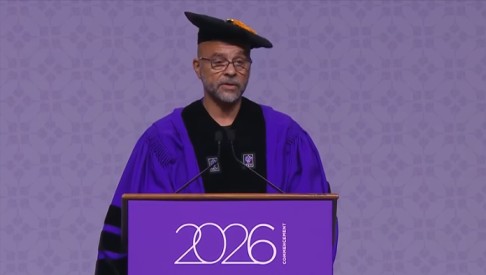
Read the full transcript of Google X’s former Chief Business Officer Mo Gawdat’s speech at NYU Abu Dhabi Commencement 2026, June 13, 2026.
Editor’s Note: In this speech, Mo Gawdat argues that success in the age of AI requires agility, suggesting that life should be navigated like a game of squash rather than a rigid chess match. He encourages graduates to embrace failure as a learning tool, leverage technology to solve meaningful problems, and ultimately lead with love to create a lasting, positive impact.
Introduction
MO GAWDAT: Thank you so much. What a privilege. Everyone that I met so far shook my hands and said, “Thank you for being here.” I was like, what are you talking about? I’m the one that is so grateful for the opportunity. It’s such a privilege, because you realize that quite a few of you are going to walk out of here and go out to change the world. And if I have a tiny chance of being part of that, then what a privilege. Genuinely, what a privilege.
And of course, you too have that privilege, because I’ll tell you very openly, when I look back at the times when I graduated, how do I say that nicely? I didn’t have as many challenges as you guys have ahead of you. You know, geopolitical, economic, AI. The world has a lot of uncertainties as we venture into it in the next few years. But I also didn’t have many opportunities, believe it or not.
From Civil Engineering to the World of Tech
When I graduated, I graduated at Ain Shams University in Egypt as a civil engineer. I studied civil engineering because that’s what my dad wanted me to study. I wanted to please him. He was a beautiful gentleman. But I was a very serious geek. Like, don’t be fooled by the fact that I can put sentences together. Inside, I’m all math. That’s it. Algorithms.
And in a very interesting way, when I graduated, there were genuinely two or three major IT companies. We called it IT tech at the time in my hometown, Egypt. There was IBM, ICL, which I’m sure you never heard of, and NCR, which probably you haven’t either.
When I graduated, I graduated with a project that basically was entirely a piece of very complex code that was designed to solve the problem rather than just me solving it. And so I submitted a long sheet of paper that basically said, “This is your numbers and here’s the solution.” And within four hours, genuinely from discussing my project, I started to get job offers from the top civil engineering companies in the world — or at least in the region.
And I simply said, no, that’s not what I want. I’ve done what my dad wants. I want to be a geek. And so I’m going to hunt for one of those geek companies. And I kept saying no until the offers dried out. And then for a very interesting few months, nobody was talking to me.
A Fender Bender That Changed Everything
Until I had an accident. Interestingly, I was driving and I had a tiny little fender bender with a friend of mine. He opens the door and he walks out. You know, in Egypt, when we hit each other, we go out to fight. And so he was about to shout at me and he goes, “No.” And he hugs me and he was like, “Man, I’ve been looking for you. We’re looking for a civil engineer who knows computer science at IBM.”
You could call that luck if you want. I call it life preparing you for something. But either way, I think it gives you a very interesting sign that there will be parts of your life where you’re going to think that opportunities are drying out. There will be parts of your life where you’re going to think that things are challenging. And if you just stay with what you believe in, stay with what you’re good at, I can guarantee you that you’re going to get a break.
I’ll tell you a little bit more about why I believe life behaves that way. But let’s keep that for later.
Your world today is very different than mine. I was a geek that coded mainframes. I don’t even know what those are today. AI is changing everything every two and a half days, every three days.
From Chess to Squash: Embracing Agility in an Uncertain World
As I progressed in my life in that company, IBM, and then I joined Microsoft and I joined Google at the time when those companies were changing the world. And somehow success for a successful entrepreneur or businessman or geek was to forecast the future four to five years ahead and choose to plot a plan that primarily gets you where you need to be within that future and then execute really diligently until you win that plan.
Winning, in my world, was quite a bit like a game of chess. You plan ahead and you execute. You’re not going to have that. The game of chess is just out of the window. The board is gone.
I’d like you to imagine the world you’re going into more like a game of squash. You’re on your tiptoes. You don’t know where the next ball is going to be. And when you see that it’s going to the right, you take two steps to the right, hit that ball and go back to the center of the court and wait to see what’s going to happen next.
Now, there’s nothing better in a game of squash or worse than a game of chess. The question is, how good is the player? And the question is, how can you accept the fact that this is your new game board and that you’re going to have to play as per the game board?
I can guarantee you, if you insist to play chess in the middle of a squash court, you’re not going to do very well.
And so that agility in my mind is really where success, I believe, is going to come from in the next few years.
Turning Disruption Into Opportunity: The Story of Emma
I have a wonderful startup that’s an AI that’s aiming to build human connection, to assist us humans with deep connections. And we were planning to launch after seven months of very serious geekiness on March 1st. And you know what happened on February 28th. And instead of crumbling, we decided to build another side of the product that actually brought people even closer together. And today, Emma is valued at 100 million dollars. Eight months later.
I can guarantee you, I’m not saying that to brag. I can guarantee you every single one of you has the exact same opportunity to do something that changes the world within the next month, few months or years.
The Power of Failure: Lessons From Google X
When you’re doing that, I’m going to double click on the importance of failure. It’s quite interesting that any good squash player realizes that to lose a point or two or even a game or two or even a tournament doesn’t really matter. What matters is an ability to make mistakes, make them quickly, cheaply, and then move forward in a way that makes you better than the minute you walked in and made that mistake.
And I learned that in Google X when I was the chief business officer. I was assigned with contributing heavily to what we now call the moonshot factory and an approach that allows innovation to happen freely, while at the same time not getting us stuck in investments that would drown the company.
And so we built an investment community that was simply empowered to invest in any project that walks in. We’d meet every Tuesday and we’d approve almost every single idea that came into the door, every single one of them, as long as they didn’t contradict the laws of physics.
And it’s quite interesting. We had one condition, which was come back in two weeks and try to prove yourself wrong. That was the objective. We gave them the resources and we told them we will be as pleased if you actually create something as we will be if you fail. And sometimes people walked out of the room and came back before the end of the day, returned the funds and said, “No, no, we did the math and it’s not going to work.”
Fail Fast, Fail Cheap, and Keep Moving
And that ability to fail quickly and to fail cheaply and learn and move forward, I believe, is the ultimate form of agility. Now, failure is the character of an adventure, because imagine if you’re in a quest where there is fog around you. You don’t always walk straight forward. You don’t always walk to the target. You may take two steps forward and then stop and take a step back and a step to the left and then two steps forward again. And that ability to do that, in my mind, is what differentiates the great adventurers from the ones that stick to their path.
Your Homework: Master the A.I. Tools You Need
But those great adventurers also use incredible tools. And I think one of the things that — I know you’re graduating and you’ve done so much study, but I’d like to give you another homework. When you get home today, sit in front of one of the language models, a good one. I use Claude or Gemini. And describe yourself, your background, your ambitions, your dreams, and ask it to tell you what A.I.s you need to learn. And when it tells you those A.I.s, wake up tomorrow and be the master of them. And then repeat that exercise every few weeks because there will be new A.I.s.
That tool, the ability to create something within six weeks or six months, if you want — I don’t know how to describe it any other way — we’ve commoditized intelligence. Like there is a plug in the wall where you can plug in and get electricity. Now there is a plug in your phone or in your computer where you can plug in and get more insight, more mathematics, more knowledge and so on. So use that. Use that to your advantage. Be faster than the challenges that are facing you.
The Earthquake, the Deal, and a Lesson in Integrity
I want to go back to that accident. I told you, you may think of that as lucky, but it was genuinely life preparing me for something. And perhaps the biggest learning of my life was that this company, IBM, that I joined — three years later I was the account manager, or the sales manager, if you want, of the education sector. And that year, my country, Egypt, had a massive earthquake that destroyed a majority of the schools of Egypt. And so Egypt was given a lot of funds and a lot of resources to rebuild the schools, but they asked that those redesigns be done on CAD systems, GIS systems and so on.
And so I was a very good salesman. I walked in and I convinced the Ministry of Education to buy $4 million worth of IBM equipment. It was the second largest deal of the year. Six weeks later, I realized that around two-thirds of that is not going to work. And accordingly, around two-thirds of Egyptian students are not going to go to school. And I couldn’t sleep at night. I genuinely couldn’t.
I went back at 7 a.m., sat in front of the Ministry of Education’s office, and I wanted a meeting. By 8 p.m., when he finally was walking out, I said, “Your Excellency, I really have something to tell you. You need to cancel my order.” He thought I was mad, right? But he did. The next day, we had a committee. We cancelled two-thirds of the order. I went back to my boss expecting to be fired. He supported me. And then three weeks later, the minister called me and said, “I have another technology request. What of this can IBM offer?” And I said, “this, this, this, and that.” The next morning, I kid you not, I had a $16 million order, direct order.
When You Try to Benefit Life, Life Has Your Back
And I realized something incredible, that when you try to benefit yourself in this world, life goes like, “Yeah, game on. Fight me.” When you try to benefit life, life goes like, “I have your back. I’m going to do the work for you.” And I promise you, that was the story of my career. Anytime I tried to make a difference in life, I didn’t have to fight at all.
Ethics as a Compass
The right people showed up at the right time, with the right funds, with the right ideas, and it worked. Every single time. It’s hard to think because sometimes you think that everything has to be difficult. But it has to be difficult if you’re against the mainstream of life, and life wants benefit for all beings.
So please, do the test of ethics on everything that you built. If you don’t want your loved ones to be at the receiving end of something you’re building or investing in or thinking about or promoting, please don’t do that. And the opposite is also true. Invest in what makes a difference. Because when you look back at life from where I stand now, trust me, one more car doesn’t make any difference at all. What makes the difference is what you actually did for life, for others, and so on.
Life Is a Video Game
One last thing, and then I leave this beautiful place. Have fun while you’re doing it. I know many of you younger ones will understand. Life is a video game. I can guarantee you that with physics. And when life is a video game, you know what the objective is? Most serious video gamers are not trying to win the level or collect more coins. Most serious video gamers in the world have one objective, which is to become the absolute gamer they have the potential to become. And the only way you can become a better gamer is if you play.
You have to love the game, even with the challenges. Because of course, if a video game is easy, it’s boring. You wouldn’t want to play. When it’s challenging, that’s when you engage. So I beg you to have a life where you’re not only successful at the end of it, but where you look back and say, “Man, that was fun. I loved it. I loved every minute of it.”
The Cheat Code
There is a cheat in this video game, like all video games have cheats. One door on the right that if you open and walk through, you’ll win. And I promise you, I’m an old man with a beard and a deep voice. That cheat is love.
If you manage to love others as much as you love yourself, or sometimes a little more, and you decide to dedicate the incredible gifts you’ve been given to act on that love, I promise you life will help you and you’ll make a massive difference.
I wish you all the success. I wish you impact. I wish you a life that makes a difference. And I wish you a lot of love. And I hope that you’re going to, in my place, look back at that life and say, “Man, that was fun.” Thank you very much. Congratulations.
Related Posts