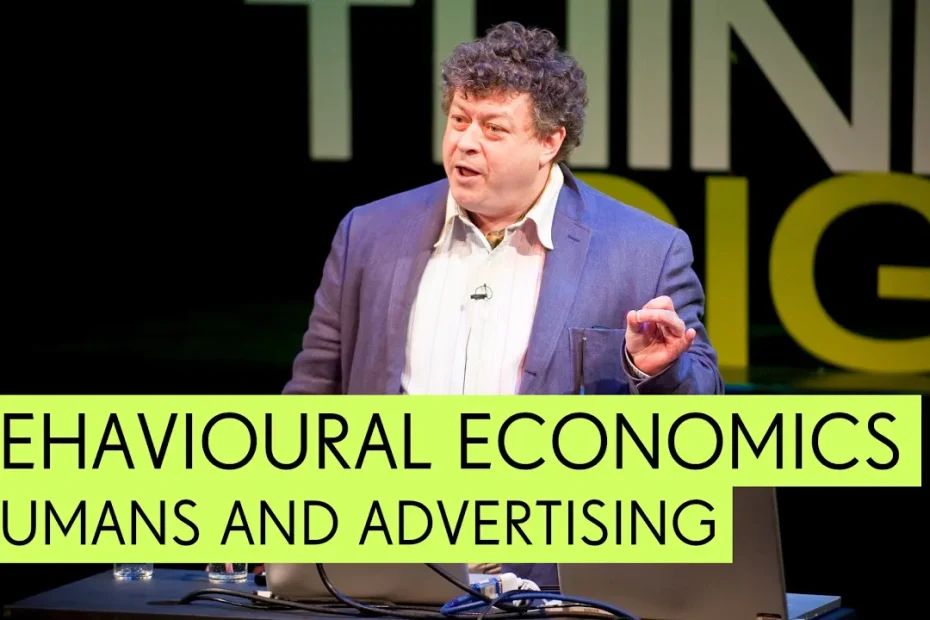
TRANSCRIPT:
Introduction
LAUREN LAVERNE: Thank you very much Andy. Okay time for our final speaker before lunch who’s been described to me by Herb as the Boris Johnson of the advertising world. You can imagine my excitement. I am agog so I’m going to move on and welcome Rory Sutherland.
So listen let’s examine the evidence. Boris born in 1964, Rory 1965 it says here. Both had short early careers in proper jobs before they fell into writing. I know how that goes. Boris became the editor of The Spectator and Rory continues to write them a column entitled The Wiki Man and his day job is officially the vice chairman of Ogilvy UK but he’s perhaps becoming better known as the hugely witty and insightful communicator of counter-intuitive thinking. Please give him a very warm welcome Rory Sutherland.
RORY SUTHERLAND: Thank you very much. In some ways it’s a marvellous introduction and a wonderful analogy in fact because if I sort of cock up or ramble or just go off topic it can be considered perfectly on brand so thank you very much for that one.
Cognitive Biases and Problem-Solving
I describe myself as an advertarian simply because one of the things that fascinates me in life is I suppose from behavioural economics is what you might call cognitive biases. That when actually solving problems we are very very strongly biased towards certain solutions and against other ones. One of the things that strikes me as interesting is that the way society seems to be structured is we are massively biased in favour of solving problems with stuff and of course has quite a bit of bearing on what Andy was saying earlier.
We seem to have a massive bias both as individuals and as institutions towards solving problems with stuff, with engineering, with technology, with gadgetry or possibly with legislation, with compulsion and almost the last resort we seem to adopt is actually psychological solutions. Now what I’m not saying and I make this point absolutely clearly at the beginning is I’m not one of those people who claims that actually you know you don’t actually need medical research all we need to do is feel better about being ill. Although actually it is interesting that this is one of the few countries where placebos are actually illegal. Now I think placebos are actually pretty good, they’re extremely cheap, they’re effective, proven to work and they don’t really have any side effects or if they do they’re imaginary so you can satisfactorily ignore them.
But I would like to say that I’m not one of those people who emphatically is sort of anti-scientific and believes all we need to do is actually reframe everything and the world’s problems will go away. What I do think is interesting is how slow we are to actually look at psychological questions of happiness and what people really value in what we do and how comfortable we are always to come up with solutions that either involve you know using in some ways scarce materials or large amounts of energy messing with reality or indeed something I also don’t like which is sort of legislation and compulsion. But actually one of the things the government does is it actually attempts compulsory solutions, solutions involving coercion before it actually tries persuasion.
The Advertarian Perspective
So this is just a subject that interests me widely and so I occasionally call myself an advertarian which is that I believe that actually where possible you should involve interfering with people’s behaviour and actually persuasion is a vastly preferable thing. Why is it that people are so uncomfortable? I think it is that particularly institutions and far more so than individuals who thrive on a rational justification of actions to each other. So every single committee or organisation within a body has to explain itself rationally rather than emotionally. Therefore biasing the actions of that organisation towards what you might call the obvious, the direct, the first level solution and what I also call really a kind of what I can only call physics envy. That actually people love to think that organisations and people work the same way that machinery does.
If you look at people in management consultancy the overwhelming majority of them will actually have a background in something like engineering and they’ll have spent their time dealing with systems where input A, increasing input A probably increases in output B and those things happen in some sort of vague proportion one to the other. Absolutely fine if you’re running a steam engine within reason. Pretty good if you’re dealing with machinery of some kind. Essential if you’re dealing with some form of complex machinery. The only problem is it’s a pretty hopeless measure for dealing with people. One of the things you mentioned is that wonderful incentive scheme where of course by increasing the number of page views the bonus goes up. What that’s known as actually is a perverse incentive. It’s an incentive which to management consultants seems completely logical and sensible.
Perverse Incentives
The only problem is that the effect it probably has is absolutely the opposite of that which is intended. A great example of perverse incentives came about in I think it was 18th century France when they were badly overrun with squirrels. So they set up a bounty, a perfectly logical sort of incentive scheme for squirrel’s tails and you got paid a certain number of sous for every squirrel’s tail you presented to the authorities and they thought well in you know just a few years the whole problem of squirrels will have gone completely. “What seems strange is the amount they paid out every year kept going up but the squirrel problem didn’t go away at all. In fact if anything it was getting worse and it was only then that they discovered that people had actually started intensive squirrel farming in order to make money out of the tails.” That’s what’s actually called a perverse incentive.
Now what you’ve got to realise is that most human behaviour doesn’t follow physical laws.
Quite a lot of human behaviour is actually first of all it’s disproportionate unlike physics. You know input A and output B bear very little sort of linear relationship one to the other. The other thing is they can actually be opposite. That actually the very output is actually the opposite of that you would expect under those circumstances. Now this does not mean that changing human behaviour does not involve science. What it means is it’s a different kind of science. In this case less like physics it’s more like climatology. Small butterflies wings effects have enormous effects on human behaviour. Utterly trivial little things transform the way in which people take decisions and the way they act. “At the same time fairly massive interventions often have either no effect or indeed a perverse effect where people end up doing the opposite. It doesn’t mean you shouldn’t actually use the rather wonderful mechanisms of science and you know the belief in actually new disprovability and so forth in your activities. Merely that it’s not the sort of science that people who are actually by and large quite bad scientists think science is. So that’s the vital point.”
Changes in Advertising
What interests me about the advertising world is that I think three things have happened in the last 15 years that make this all the more important. The first thing is obviously digital media. That’s the most obvious thing and actually that has transformed the way in which we can actually create interventions in human behaviour. Does this mean we can be extremely evil and manipulate people into doing bad things? I think generally yes that’s true it does.
What we’ve simply got to do is actually realise that you can equally use the same interventions as a powerful good. A very good guy I recommend called BJ Fogg who’s a professor at Stanford describes himself as the professor of persuasive technology. What he effectively focuses on is the extent to which interface design and the creation of various technologies can actually without the need for compulsion change people’s behaviour for the better in many an exciting ways. That to me is very interesting. The second interesting thing is that the task that faces advertising is less and less about selling packaged goods which is very much an attitudinal job where we believe that what people thought about a brand translated fairly perfectly into how they acted. More and more of the challenges we face have a very strong behaviourist component.
You would argue patently anything to do with the environment. Most people already have the intent to do the right thing. What they patently fail to do is to back that up with action. The second area of interest is the extent to which we can actually now digitally intervene both by changing the actual nature of the product itself, those shoes being a perfect example, or actually by intervening very very contextually close to the moment where decisions are made. Now let me give you an example of this technological intervention for the good.
Asymmetric Decision-Making
If you look at the decision to take a car versus to take the train, one of the worst things that happens that encourages everybody to go by car is in many cases, unless you live right next door to a railway station, you take the decision do I drive or do I take the train when you’re already in a car on your way possibly to the station or to your destination. That is an asymmetric decision. Now try this little thought experiment. Imagine for some perverse reason you live right next door to a railway station where a train takes you to work but there’s no parking there so you’ve got to park your car three stations down the line. It is then a different decision to get off the train which is taking you to your office and actually start the car and drive to work.
Most of the time you go well I’m on the train now I might as well stay there. The problem is that most train journeys start with a car journey therefore the symmetry of decision making is imperfect. If by the way you have kids and you’ve already packed the car up with seven tons of shit the decision is already made for you because there’s no possible way you’re getting to the train. You’re also uncertain about for example is there room to park at the station, I’ve got to get out of the car, will my car be safe, I now have to buy a ticket, what time is the train, are the trains running. It’s an asymmetric decision.
If you can use technology or pricing to get people to book train journeys a day in advance and possibly reserve a car parking space, if you can simply move that decision one day earlier the asymmetry doesn’t quite apply and therefore you will get people making a weighed up intelligent decision about the relative overall benefits of train versus car. “Car may still win by the way but it is a fundamentally different decision when you look at it from a distance versus a decision which is do I stay in this car where some nice music is already playing on the radio or do I haul my arse out, park the car, endure a bit of rain, go through some barriers and pay money for tickets. Therefore by using technology to change the place that decision gets made you will fundamentally change the decisions that people make and that brings me to the third aspect which excites me about marketing persuasion and general what I’d call persuasive technology which is the development of behavioural economics and if you want behavioural economics the work of absolutely tremendous scientists mostly in the United States but increasingly a few in the UK as well.”
Behavioural Economics
Daniel Kahneman being the founding father, if you read nothing else read his Nobel Prize acceptance speech, the interesting thing being he won a Nobel Prize for economics when he’s not actually an economist, he’s a psychologist.
Then what’s so interesting about that behavioural economics within a sentence simply says to you that the context, the medium and the interface within which a decision is taken may have a far greater effect on the decision we make than the long term consequences of a decision even when we know those consequences. So actually you can actually get more people to sign up for a credit card, this is if you’re Dr Evil, by redesigning the application form to make it very attractive than you can by dropping the APR. Now true, regrettable, worrying maybe but nonetheless true. The actual interface you present people with to make a decision from the menu if you like or the situation or the context in which they decide will often have a greater decision on the course of action they adopt than actually the consequences of that course of action.
I jokingly occasionally say if you take immediacy bias into account, in other words people are disproportionately biased in their lizard brain with what does this decision feel like right now up front, I’ve actually asked the question, it’s always assumed that actually men are more reluctant to get married than women okay and it’s assumed that men somehow have a great aversion to the institution of marriage. I don’t think this is necessarily true, actually men who are married live considerably longer, seem to have happier lives. What it might be is that men have a disproportionate aversion to the actual business of a goddamn wedding. “Now I’d like you to imagine for a second if you think about it, a wedding is the most feminine possible goddamn thing you could possibly conceive in the history of the world. In fact it could practically be a test of devotion on the part of a man to spend several days discussing floral arrangements and coloured sashes for crying out loud okay. Now I’d like you to imagine just for a second what a wedding consisted of is basically a three or four day period of adventurous sex and travel where you were bought really high-end electrical goods by all your friends.” You actually have a world where loads of men were desperate to get married and deploring their girlfriend’s lack of commitment okay. That’s what I mean by the upfront business in which you decide may have a far greater great effect on your decision than the long-term consequences of the decision.
Marriage and Gender Differences
By the way I half believe that, I’m making that half as a humorous point but if you look at the by the way once you get married as a bloke no one ever buys the bloke a present ever again. Once you’re married no one will ever buy you a Scalextric set okay I guarantee it. Instead something they’ll come back and they say I’ve got you a tablecloth well whoops chucking do you know now anyway but I mean you know it is it is if you think about it is an institution which does not have huge upfront incentives to being a bloke so I just thought I’d make that point.
Context in Decision Making
So that’s behavioural economics that the understanding that actually now another great example of the context of decision making is simply that a glorious example of a waiter going up to someone in a restaurant saying we have two specials today we have fish or chicken. In which case I think I’ll have the fish. About three minutes later the waiter comes back and says I’m terribly sorry I forgot we also have beef and the person pauses and goes ah well in that case I’ll have the chicken. Now the reason for that it does actually happen the reason for that is that actually if you only have fish or chicken fish seems like the healthy option but the presence of beef on a menu serves to make chicken seem acceptably healthy.
So if you’re a fast food chain just bring out a McLeod burger and actually everything else on the menu practically seems like rocket and parmesan. Okay but actually there are huge huge comparative forces in how we actually exercise judgment. Now you could say well there’s an advertising man I can use this for evil and it’s absolutely true I have to admit that possibility exists. What we have to do however is also just be aware of these forces because it’s almost impossible to understand human behavior unless you take that into account. This by the way is my first book recommendation of the day John Kay’s Obliquity.
“Going back to my little analogy with climatology one of the things you understand is that many many things in life particularly those things involving human psychology are not very well solved by the most direct and obvious solution. I mentioned that earlier actually if you employ the most direct and obvious solution you may have opposite results. In many cases an example of this is the businesses which seek to make the most profit are not the most profitable. By and large the most successful businesses are those which pursue an oblique end. They have some vision or big ideal that drives them and motivates them and if you look at the world’s great brands they are almost all the creation of someone who is slightly mad. Jobs, Knights, Kellogg, Ford they’re all barking basically but the fact is because they were barking they actually pursued something which was actually a bigger meta ideal than the simple pursuit of short-term profit. As a result interestingly and Kay makes this point their businesses were more profitable for it. That the shareholder value movement is actually something which is a very very direct approach to how a business should be run and as a result it’s arguably completely inimicable to the business of creating business value.”
Partly because of course it purely looks at the interests of the shareholders whereas a great business actually is great because it actually manages to create some unifying appeal that actually motivates not only the shareholders but also the organisation’s customers and its employees and that what’s interesting about a business with a higher big ideal and the entertainment industry would be a very good example of this at its best is that actually it manages to enthuse everybody.
The second you become a shareholder focused organisation arguably you may actually be completely unless you’re a bank in which your employees are just as greedy as everybody else you’re actually creating an entity where actually the motivations suddenly become dissonant or actually fighting against each other. So that’s my point there this is a great great book. The other thing you have to understand unless any Marxist in the room surviving unless you hold to the Marxist labour theory of value that the value of any good is proportionate to the work that goes into it. The other thing you have to accept is just that value is subjective.
Subjective Value and Advertising
“You also have to accept that our perception of value as human beings is coloured by two million years of evolution which in some ways makes us very wonky indeed. One justification for advertising which I will give it’s a contentious one is that in some cases the human perception of value is so badly wacko that actually to meddle with it is a healthy thing. For example the human tendency disproportionately to value things that are scarce. Rhinoceros horn, tiger’s claw, you know rare hardwoods for furniture. The fact that we are all biased and we can’t it’s almost impossible for us to overcome this bias to think that because something is rare and expensive it must be valuable and packed with you know wonderful things. That is a huge human bias which actually we need to overcome. A second thing we need to need to overcome is the human bias to view things that are inexpensive as less valuable. Because one of the great problems of capitalism is that when you actually produce things at an increasingly low price because they are efficient to produce or indeed because you can produce them very sustainably because they don’t involve any rare commodities in their production or indeed they involve very little labour in their production. What you interestingly do is you bring the price down and with it the value in which people attach to something goes down.”
To give you an example of this subjectivity of value by the way hugo de naranja is the Spanish for orange. This is from Buenos Aires. The dollar sign is not the dollar it’s the peso and it’s the Spanish for orange juice. This is someone who’s actually very cleverly adopting price discrimination. But the point about that subjectivity thing is that our whole value system is very very subjectively driven.
We tend to view rare things very highly. We tend to view scarce things as valuable. We tend to see things as getting cheaper in mass markets and we value them less. I’m so sorry about this. We tend to value them then less and less. So coach travel or frozen food two extraordinarily efficient forms in environmental terms of transportation and of food preservation because they produce Iceland and National Express therefore become mass market therefore become down market and therefore become inferior goods. Televisions which frankly you know Louis XIV if he looked at your house he’d say it was shit but he’d give you half of burgundy for your television and yet because you can produce one for a thousand pounds we value them less and less.
So the better the job capitalism does the less appreciative we get because of this perverse way of valuing things according to how expensive they are. Emphatically it’s a causality that operates in both directions. We pay more for things we value but we also value things more highly that we have to pay for. Now there’s a vital question to me which is to some extent the job of advertising maybe to actually not to do added value but actually retrieved value. In economic terms what’s interesting is the consumer surplus which is the difference between what you would pay for something and what you have to pay for it generates no human pleasure or appreciation whatsoever.
Now looked at that way there are many of you in this room who would happily pay three thousand pounds for a flat screen tv if you had to you could buy one for eight hundred. Do you view it with the joy as if well I’ve just paid three thousand for the television and someone’s giving me a two thousand pound two hundred pound rebate? No you don’t. You simply pay for things whatever you can get away with paying for them. As a result there is a huge loss in human happiness because actually as prices get lower our appreciation of things actually diminishes. So much of the effort of capitalism in producing things that are lower cost and greater efficiency it actually fails to translate into human happiness.
Advertising as Complementary Goods
“This seems to me a really vital point and it seems actually to me to be quite worrying. Now one solution to this is to look at advertising and particularly if you want to do digital advertising look at it in a completely new way and two economists in this case Gary Becker and a chap called Kevin Murphy did this for us. Their definition of advertising they refused to accept that advertising was necessarily persuasion and they defined advertising as basically the creation of complementary goods. That you create advertising when just as the best way if you want to sell a burger you can get a fairly crappy price for a burger selling it as an uncooked patty. As a cooked patty on its own you can get a tolerable price for it. Add chips and a bun and some lettuce and you can get a very good price indeed. Their argument is that advertising is purely the creation of sometimes through entertainment or through media or through communication or sometimes through other things the creation of the addition of the lettuce, the bun, the fries.” It’s actually the creation of complementary goods that actually surround the core good itself and enable it to be better appreciated and to command a higher price.
Now what’s interesting about this definition of advertising another British definition would be free peanuts at a bar which add value to the consumption of beer. They probably increase your consumption of beer but actually to some extent advertising works like those free peanuts. It’s a complementarity. Popcorn and movies would be complementarity. The two things have become linked together such that the two in combination create far more pleasure than individually. Actually movies on their own are okay.
Popcorn without a movie is complete crap when you think about it. It only works. It’s the Pernod of the food world. Pernod only works if you’re in France. If you’re in France the most sophisticated delicious drink in the world so you buy a litre bottle you take it home and the second you get back to Britain you pour yourself a glass. What the hell did I buy this piss for? Pernod and France complementary goods. That’s the way to look at it. Now interestingly if you’re particularly in digital this new definition of what advertising is and can be is hugely liberating. This is probably almost as close as advertising has ever got to art which is the early Shell county guides to the UK produced by Shell as a complementary good to petrol consumption.
People would enjoy motoring more and therefore motor a bit more if they know what they’ve got to see. And so John Betjeman was one of the people who actually wrote the early Shell county guides. That was perfect. Now conventionally we’d say oh that’s strange that’s like branded content it’s really weird. Actually if you use the definition of complementarity that is a very very pure form of advertising. So I suppose it’s package tracking. It’s an informational component that actually adds huge perceptual value to distribution.
But if you think about it like this that effectively where you go instead of thinking how can I persuade people to buy my product? How can I bludgeon them with argument and rationality and reason to buy what I have to sell? If you sit down and go I have a burger what’s the equivalent of ketchup, a bun or some fries or a bit of lettuce? In other words how can I create complementarity for this thing? You will come up with much more interesting digital advertising solutions than you will if your first port of call is persuasion. Apart from anything else it’s not altogether clear that persuasion is actually very persuasive.
Creative Advertising Solutions
I’m a bit of a fan of Bob Dylan who in his song Brownsville Girl makes the point or rather he or one of his characters makes the point people don’t do what they say they believe they do what’s convenient and then they repent. A simple question is what might you do actually to make your product easier or pleasanter to buy? You know you do not you should not sit there and think my first job as an advertiser is to persuade people of things. Here’s another complementary good a Lufthansa idea which works whichever airline you fly on called My Sky Status and you sign up for this thing tell it where you’re flying which means of course Lufthansa know how many other airlines you might be using and it tweaks or posts your Facebook page both when you take off and when you’re in mid-flight.
It’s kind of sweet it also has a little live globe which shows lots and lots of Twitterers in mid-flight all over the world. That’s a lovely little creation of complementarity in other words we’ve actually improved the travel experience. I tried in an example of complementarity to get British Airways to give all their best passengers these things I’m wearing which are buzz knot airport friendly non-metallic braces which if you’re the sort of person who’s sick of taking a belt or braces off when you go through the x-ray machine makes more difference to your enjoyment of travel than practically anything else. Now I’ll skip very very quickly the brilliance I’ll skip that as well because we only have so much time. One of the brilliant things to look for in marketing is disproportionality how very very small things have a huge effect.
This is from a hotel in Sweden in Stockholm where that those are the lift buttons nothing remarkable in that except those aren’t the buttons that’s another row of buttons another bank of buttons that say ground first second mezzanine garage this row of buttons in the left in a pretty cool hotel in Stockholm says garage funk rhythm and blues country rock and roll you choose your lift music. Now at the expense of maybe a thousand pounds or not much more they have done more to brand that hotel and differentiate it from other hotels than those many big hotel chains that tell you you know this hotel has recently undergone a program of refurbishment of 25 million dollars so that your hotel room can resemble every other goddamn hotel room you’ve ever seen in your life.
Creative Branding Examples
This is Virgin Atlantic where the little salt and pepper things on upper class you think oh I might steal those they’re quite cute and you pick them up and embossed on the underside it says pinched from Virgin Atlantic upper class. They’ve actually anticipated your very move. Now this is you will you will remember that years after you remember whether you’re in a 777 or an Airbus. Now that’s the glorious thing about marketing is you can create huge amounts of delight and memorability and distinction with utterly trivial levels of expenditure.
This is the member since date in the American Express card. If you ever send someone a new it doesn’t mean anything and it doesn’t actually make any difference to the service you receive. If ever you send someone by mistake a new replacement card which says member since 10 rather than member since 95 about a third to a half of people complain and demand you reinstate them. Now the effect that’s had on card member loyalty we think must have been worth a few hundred million dollars since American Express first started and yet the cost of that those two digits is practically nil.
Rethinking Transportation Improvements
This is the Eurostar you probably know this example. Why on earth do a lot of engineers think it reasonable spend six billion pounds making the journey 40 minutes faster? That is a typical engineer’s definition which is numerical, journey time, duration. We can improve this by 17.4 percent. The trouble is there are not numerical measures for how nice the journey is.
So everybody when given some money spends the money making the journey faster rather than better. I put a brief out to some creative teams. Okay you’ve got a marketing budget of six billion. What do you do with the Eurostar? One lot said put Wi-Fi on the trains. There is still no Wi-Fi on the train. They said it doesn’t really matter how if your journey is three hours or two and a half if it’s useful time. I think perfectly fair point to be honest. The more interesting creative team said I employ all of the world’s top male and female supermodels. I get them to walk the length of the train handing out free Chateau Petrus. You’ll still have five billion pounds left in change and people will ask for the trains to be slowed down.
If the Conservative government is interested I also have a plan for cross rail which actually is to scrap cross rail but to have New Orleans style paddle boats going up and down the Thames. People say well it’s much much slower. I said yes but they solved that problem in Louisiana in the 19th century. If you have nudity and gambling nobody cares how long the journey lasts.
Small Interventions, Big Impact
Now at a smaller and more high-minded level Esther Duflo the economist is actually showing how the way to eradicate poverty is with tiny little strange interventions. Tiny little disproportionate things.
The incentive of a kilo of lentils when you inoculate your child combined with the fact that you make inoculation of children a social event where five mums turn up with seven kids rather than one mum turning up at a time with one kid massively increases the confidence of actual inoculation which in turn then has the greatest effect on the eradication of poverty. But where Esther Duflo is interesting is if you’re a guy at the UN with a budget of 200 million it is beneath your dignity. It’s simply infriding. It doesn’t satisfy your own self-love to say solution to poverty, free lentils. You always look for a big grandstanding heroic thing and this is the fundamental organisational problem.
“All organisations like businesses and governments look for huge grandstanding solutions to problems whereas human behaviour is just as receptive, arguably more receptive, to the small thing. These things at 10% of the cost of a speed camera but prevent twice as many accidents.” Or some of the clever ones show a smiley face when you’re going under the speed limit and a frowny face if you’re going too fast. You don’t need to fine people. You don’t need to give them three penalty points. This thing has appealing to people’s better judgment actually has more effect than the threat of punishment. That is a case which is completely in opposition to the assumptions of conventional economic thinking.
This is the single way in which the underground was best improved. Most train journeys are more improved by the installation of dot matrix boards than by anything to do with the trains themselves. Why? Psychologically a 12 minute wait when you know it’s 12 minutes is actually less stressful than a six minute wait when you’re uncertain.
That’s a beautiful cycle. The dot matrix display is a brilliant psychological solution to a problem. Don’t necessarily double the number of trains. Just tell people how long you’ve got to wait.
The Importance of Detail
And this is my big debate here which is you have in the world stuff that has a big effect, stuff that costs a lot of money. We call that strategy. And that’s good. It’s worthwhile. Companies have to have a strategy. But the trouble is that everybody because of their own urge for self-advancement is looking in that top right hand corner. Of course there’s some people on the top left that’s called consultancy. There’s stuff at the bottom left that’s trivia. I don’t mind that. It just doesn’t cost anything, doesn’t do any harm, doesn’t have much effect.
But what do we call this? And what I think we need is every business needs a director of detail and government needs a ministry of detail. For the people who are saying actually and what the minister of detail and the director of detail should have an absolutely tiny budget but utterly immense power. And the job is to sort out all the small irritating stuff that everybody else is too grand to actually look at. It’s what I call terminal five syndrome where the building is magnificent but the signage is atrocious. Has anybody flown into terminal five? How many of you when heading for the Heathrow Express ended up facing a brick wall at the end of that? Okay because the thing is there’s a yellow sign saying trains and then the next sign is actually a blue sign to your left that says Heathrow Express.
So about one in three people ends up facing a completely blank wall at the end of something that’s about the length of Coventry Cathedral or something. Now that’s the case where the building is brilliant, the expensive stuff is fantastic, the detail is atrocious.
Behavioral Economics and Nudge Theory
This is my second book recommendation Nudge by Thaler and Sunstein. Absolutely tremendous book on what he calls paternalistic libertarianism and it’s very much the origin of much of this thinking that small things have huge effects.
This is my suggestion for the saving crisis. We have tons and tons of ways of impulse buying. They’re called shoe shops and clothes shops and goodness knows what else. “My small suggestion that women’s fashion should have a VAT rate of 80%. Doesn’t go down well with my female friends but my point is that actually you know why is it that women actually need 20 times more shops to clothe themselves than we do? I just thought it’s just worth asking.” If we’re going to start with environmentalism I think there’s a place you could start. But actually what happens if you have a red button at home? It’s entirely malicious by the way, female fashion, because men don’t notice and women don’t like it. But anyway if you had a button at home what about impulse saving? A little red button at home every time you press it it puts £50 into your pension scheme.
Saylor and Sunstein invented a beautiful pension scheme called the Save More Tomorrow pension. All they did was they changed the interface, the context in which you actually took out a pension. Instead of going oh my god I’m 25, this is to get people under 35 getting a pension. Instead of going oh my god I’m 25 I’m going to have to put £100 a month away which means I won’t be able to go to Dave’s party on Wednesday. They said you sign up now, you can cancel at any time but you sign up and you choose a percentage, let’s say 20 and 20% of all your future pay rises goes into the pension scheme. So you never see your salary, your disposable income at the end of the month actually go down.
“It’s merely that when you get a pay rise and a bit of good news your salary goes up a little bit less. The net effect of changing this format was that actually among the 25 to I think it might have been 35 year old age group, pension saving over the whole period went up by over 200%.” The only change was a simple change to the format in which people signed up.
I’ll skip a few of these, I’ve mentioned the coach travel one, I’ve mentioned frozen food, things that because they’re ecologically efficient and because they don’t involve much waste actually become cheap and because they become cheap they then become devalued. I think that’s a vital role that advertising has to play. What could you do to make coach travel really cool? It’s cool if you’re a rock star after all, there must be something that can be done.
Contextual Communication in Digital Media
And the final joy of digital media is the ability to communicate contextually. Google realises that a target audience is quite often not a target audience at all, it’s a target moment, it’s a target when not a target who. This is a beautiful example of advertising, when you’re in a traffic jam you advertise trains. On Friday that poster talks about Virgin’s offers so you can get home to your mum’s Sunday roast this Sunday for only sort of £30. According to climate, traffic conditions, time of the week, time of year, that message actually changes and gives you a different incentive to go and take the train according to the actual context in which you find yourself in. I think that’s a wonderful, wonderful potential for all digital communication.
Another lovely case of what I might call context, a creative team briefed to advertise their aunt’s florists in a town I think in Gloucestershire and they said the thing is nobody notices flowers in a five-star hotel, you expect to see them there. They said do you have flowers left over at the end of the week? She said yes. Okay, take the flowers, make up a nice bunch, four or five bunches and put them in the phone box, the men’s public loos, the women’s public loos, it might have been the bus shelter and the police station. Places where you don’t expect flowers and underneath was just a beautiful little line which just said surprise someone with flowers and the telephone number and the address of the florists.
The brilliant understanding of context that if you, you know when you go into a five-star hotel you go yeah big big deal, flowers. When you go into a public lavatory where the most interesting thing you’re expecting to see is a large drawn penis on the back of the door or whatever it is that women draw. And actually there’s a big bunch of flowers there, that really really works. So a beautiful, beautiful use of creative use of context which is to a great extent what the digital revolution is all about. We can now actually engage in a kind of conversation rather than monologue simply because we can actually say things that are sensitive to circumstances but we can also design choices very very quickly. I mean we can design choices that are actually sensitive to context.
The Power of Perception
So whoops one more, that’s my last book recommendation Dan Ariely, Predictably Irrational, tremendous book on behavioural economics by one of the best people and this is my last example of how actually two things, we’re not perishing for want of wonders, we’re perishing for want of wonder. The great problem we have in life I think is not actually that we’re failing to provide for ourselves enough interesting things, it’s simply that our appreciation of those things needs to be heightened. You know we’ve you know literally as you know the amount of wonder and amazement we actually express that the world we live in is too little.
The second thing I think to understand is that the great definition of poetry is to make new things familiar and familiar things new and one fascinating thing that advertising can do is actually get people to look at old things in a new way. Rather than making people want more of something else, the complementarity definition of advertising, the fries with the burger definition of advertising, the peanuts definition of advertising is to actually add appreciation to what already is. So not added value actually but extracted value in many ways. Here I think is the most perfect case if you can roll the film of actually creating value through perception while doing absolutely nothing to the product at all. Here we go.
“Shreddies are supposed to be square. Have any of these diamond shapes gone out? New diamond shreddy cereal.”
The Power of Perception in Marketing
Same 100% whole grain wheat in a delicious diamond shape. Now Ogilvy actually ran this in Canada and it caused a major sales uplift in Shreddies. Now what’s wrong with that? If it suddenly caused you to see boring old square Shreddies in a new light what possible harm has been done? It’s a point made by the philosopher Jamie White who said you have a car, you sell it for £5,000 or £10,000. You want to sell it for £11,000. There are two things you could do. You could spend £500 per car putting in leather seats and charge an extra £1,000 or you could spend £500 per car on advertising persuading people that cloth seats are cooler than leather seats. He says in terms of the creation of value, if you accept that value is subjective, the two are absolutely equivalent. I would argue actually they’re not equivalent.
That the second option is decidedly preferable if you’re a cow. And finally the Canadians being very conservative people, some of them weren’t very keen on the withdrawal of their old traditional square Shreddies and really it was a bit of a new coat moment for Canadians and so in a gloriously Canadian way they actually eventually arrived at a compromise.
The Peacock’s Tail Theory of Advertising
My final final point is one way you add value is simply indulgently producing advertising which is indulgent and beautiful. This is the peacock’s tail theory which is that the peacock’s tail has meaning to female peacocks because it’s useless. It’s what Darwinians call self-handicapping. The fact that actually you can still function as a bird while carrying around this completely impractical thing on your back means you must be pretty damn fit genetically.
Now actually to some extent some advertising does that by proving that you actually invest a huge amount of attention and expense in your reputation. It gives you a reputation to lose and having a reputation to lose gives people much more confidence buying from you than they do if you have no reputation at all. It’s rather like you’re much more comfortable I hope buying a second-hand car from the Archbishop of York than from a bloke you just met in the pub. The fact that someone has a reputation to lose is one of the many many things that gives you confidence to do business with them.
It’s the feeling that actually whereas normally a single transaction it’s in their interest simply to rip you off as much as you can, someone with a reputation is by definition not only interested in your transaction, they’re interested in your subsequent transactions, your friend’s transactions and your friend’s friend’s transactions. The fact that they care about reputation and advertising is simply a visible means of demonstrating that is actually what gives people the confidence to buy from you.
The Importance of Reputation in Business
I’ll give you a perfect example of this. If you want to have a bad meal, I can guarantee you a bad meal, go to a tourist city and eat in a tourist restaurant. They know you’re never coming back and that is effectively a business which has no reputational component whatsoever because every single person is a customer of that restaurant only once.
So it’s in their economic interest to give you as bad a meal that doesn’t actually kill you before you get your credit card out. When you have a reputation and patently they’re interested in actually your 10 meals, your 15 meals, your lifetime value, then you can actually have a confidence in eating in a place which an unknown tourist restaurant doesn’t give. So the vital thing is sometimes the role of advertising in terms of complementarity is simply to be gorgeous and I always say that because in an economic climate where we try and measure the value of every penny, this argument sits very uncomfortably. Nonetheless, no one’s actually told peacocks about accountancy and they continue to do what they do.
Lessons from Behavioral Economics
So that’s a final thing, a very interesting thing in behavioural economics, the peacock’s tail is one of them.
Two final little lessons, one perfect lesson, the reason women love being bought jewellery and flowers by men is actually because of a kind of sacrifice. It’s precisely because men aren’t interested in jewellery and flowers. So it’s actual evidence that he loves you, that he’s prepared to buy you something that he doesn’t like. If you buy your girlfriend the complete first season of Battlestar Galactica on DVD, there exists the small suspicion that self-interest may be involved. That’s the one tragedy of behavioural economics, you’ll never look at the world in that same unblemished way again, for which I apologise. But thank you very much indeed.
Related Posts
- Transcript: Maya Angelou’s Greatest Life Lessons on Oprah Podcast
- Transcript: The Next 50 Years: Humanity, AI, Power w/ Yuval Noah Harari
- How to Stand Out in an AI World by Thinking Better, Not Faster: Sol Rashidi (Transcript)
- Modern Wisdom: w/ Alex Petkas on True Story Of The Odyssey (Transcript)
- Reconstruction: Malcolm Gladwell Interviews Barack Obama (Transcript)