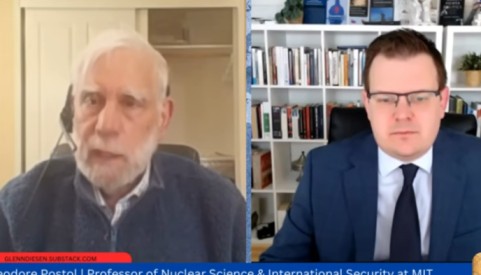
Editor’s Notes: In this detailed analysis, MIT Professor Theodore Postol examines the nuclear capabilities of Iran and the potential consequences of a nuclear conflict with Israel. He argues that Iran has already crossed the “nuclear threshold,” possessing the materials and technical expertise to rapidly assemble a deterrent without the need for prior testing. Postol provides a harrowing technical breakdown of how nuclear weapons function, illustrating the devastating impact of firestorms and radiation that would result from such an exchange. The interview serves as a stark warning about the current geopolitical trajectory, urging for a shift toward diplomacy to avoid a catastrophic loss of life. (March 30, 2026)
TRANSCRIPT:
Introduction
GLENN DIESEN: Welcome back. We are joined today by Theodore Postol, a professor of science, technology and national security policy at MIT. He’s an expert in nuclear weapons delivery systems, missiles, missile defense, and has worked as an advisor at the Pentagon. So thank you again for coming back on.
So we spoke after the US and Israel had launched its first surprise attack on Iran back in June of 2025. And at that point you mentioned that the Iranians have probably nuclear material to build at least…
THEODORE POSTOL: Yes, they do.
GLENN DIESEN: Ten nuclear weapons and they’re already a nuclear threshold state. So it almost seems foolish as you argue then not to develop a nuclear deterrent, given that the US and Israel will be back.
Iran’s Nuclear Deterrent Capability
THEODORE POSTOL: They tried to. They don’t even need to develop a nuclear deterrent. All they have these materials. Let me just explain a bit, if it’s okay, what they have. Let’s talk about what they have, how they can use it, and then what it would look like if they retaliated after an attack by Israel, a nuclear attack on Tehran.
I think given what we have so far seen with regard to Israeli and Iranian behavior, it’s my guess that the first one to use nuclear weapons, if they are going to be used, will be the Israelis. They are far more reckless and aggressive than the Iranians have been. That’s my guess.
But the point that I think is important for all of your audience to understand, and I pray that there are many Israelis listening to this, is that an Israeli nuclear attack on Iran can be retaliated against. The Iranians will be able to do it even if they have not yet built nuclear weapons, because the time between going ahead and building those nuclear weapons in those — remember, I just showed you those tunnels which are everywhere — and I’ll show you equipment that could easily fit in those tunnels and be used.
It’s my guess that there’s a lot of equipment of this kind already in tunnels that may or may not have been used already to build a final nuclear weapon. But they don’t have to have taken the final step. They could be following the edict of the Ayatollah Khomeini that they should not build nuclear weapons and just have this equipment sitting there. Because the edict also says that if Iran is attacked and its existence is under threat, then it would be justified, according to this edict, to use nuclear weapons.
So they are in a position, if they have this equipment — and they do have it. Shall I just take a minute or two and then I’ll tell you what they can do, what the consequences of this would be? That’s important as well.
Iran’s Enriched Uranium Stockpile
All right, so why should anyone understand that the Iranians almost certainly have the ability to build nuclear weapons? This is because they have this 60% enriched uranium hexafluoride. I’ll show you where uranium hexafluoride is in these canisters.
So here’s a canister of uranium hexafluoride. It’s got about 50 kg of uranium hexafluoride and it’s very rugged. It’s maybe a meter in length. The total weight is about 50 kilograms, 100 pounds. And it’s got 25, 30 kilograms of uranium hexafluoride in it. That’s enough to give you a nuclear weapon when you take the uranium hexafluoride and you convert it to uranium metal.
All right, so how do we do that? Well, just to show you how large these containers are, here’s 10 atomic bombs worth of uranium — 60% enriched uranium hexafluoride. That’s about, not quite 400 kilograms. They have 408 kilograms. So really they have 11. If you do a more careful arithmetic, they can make 11 atomic bombs with this material.
The Enrichment and Conversion Process
Okay, this is for 90% enriched. These containers have 60% enriched. So you want to convert the 60% enriched uranium hexafluoride to 90%. Well, the reason it’s uranium hexafluoride, which is a chemical substance, is because it’s kind of a crystal. If this glass container contained a very small amount of uranium hexafluoride only, and its temperature was maybe 100 degrees Fahrenheit, 40 or 50 degrees Celsius, you would not see the crystal there — you would only see a clear container because it would be a gas. Uranium hexafluoride would be a dilute gas, a very thin gas.
And the reason you want it as a thin gas is you’re going to put it into what are called centrifuges. We’re not going to worry about exactly how these centrifuges work. All we need to know is that the Iranians have these centrifuges and they know how to use them. They have cascades of these. This is a particular cascade of 174 centrifuges where the enriched uranium is put out, which could be 90% enriched. You would need a few weeks of time with one of these cascades to enrich the 60% gaseous uranium hexafluoride to 90% enriched uranium. But it’s still uranium hexafluoride, so I need to convert that to metal.
So what I would do is blow — I have a device the size of a large closet that would be blowing very toxic, high temperature gas, hydrogen fluoride through a gas of uranium hexafluoride.
This is very high temperature, very toxic materials. But you can build something that’s feet in size to do this. You have a reaction chamber, high temperature hydrogen fluoride, high temperature uranium hexafluoride. What comes out are small particles of a green material called uranium tetrafluoride. And that green material can be easily separated out with what’s called a cyclone separator. All the particles precipitate out.
I take those particles, I put them into a container with lithium or calcium and I heat the container up. It’s a high pressure container. The chemical reaction occurs at some point. The metallic uranium precipitates out. It’s heavier than the magnesium chloride or calcium chloride. And you have this ingot of uranium — 90% enriched uranium. That’s all doable in a tunnel. A few hundreds of square meters of floor space is all you need. This is not a big operation.
Building a Nuclear Weapon Without Testing
And then you machine it. Now to build a nuclear weapon, all you need to do is assemble. In this cartoon design, you have a sphere of uranium 235 and you have two plugs of uranium and a little bit of conventional explosives — very easy to build. The conventional explosives drive these two sections into this sphere, creating a critical mass. I have some material like beryllium and plutonium, which is going to generate neutrons. And this thing will go nuclear and give me a 15 kiloton yield.
I don’t need to test this. Let me repeat that. I do not need to test this weapon. This weapon never needs to be tested before I use it. So I can have 10 or 11 weapons without testing them that I can deliver with total confidence that they will work. I can test this device with depleted uranium to make sure that the assembly process works. Once I have the device, I just assemble it with 90% enriched uranium — no problem at all.
The United States did this for Hiroshima. We never tested the Hiroshima bomb. We didn’t bother. The bomb that was tested was the Nagasaki bomb, which was made of plutonium. The reasons you need to test a plutonium bomb is another story. I don’t need to go into that now.
Timeline for Weapons Production
All right, so let’s step back and say, okay, I have 10 or 11 of these weapons. I can build them within weeks. In fact, I can potentially build them in a shorter time than a week because I may have multiple centrifuge cascades. One of these cascades could take four or five weeks to enrich the necessary amount of 60% enriched uranium hexafluoride to get to 90%. But if I have two or three of these cascades, I could do it in a few weeks.
There’s no reason that they don’t have several of these cascades. They’ve been building thousands of these centrifuges. We don’t know how many of them they have stashed away. Everything wasn’t necessarily in Isfahan and Fordow. We didn’t have any numbers toward the end when the Americans broke the treaty. When we broke that agreement, we lost the ability to monitor their construction of centrifuges.
The Broken Nuclear Agreement and Political Failures
They let us for a long time watch the 60% enriched uranium which they started to enrich after Donald Trump broke the agreement. And incidentally, Joe Biden shouldn’t get off on this either, because Donald Trump broke the agreement, Biden became the president and he didn’t immediately reinstate the agreement.
He was surrounded by these idiot Democrats. We talk about idiot Republicans — there’s plenty of idiots and stupidity to go around in the US national security community. And what these idiots were saying was, “Oh, we’re now in a position to extract further concessions from the Iranians, so let’s not give them back the treaty.”
You reach an agreement, you meet the terms of the agreement, you don’t start re-bargaining again. And Biden deserves a large amount of the negative credit for this disaster having occurred. It’s not simply Trump. And I think all these interviews where you see Jake Sullivan saying, “Oh, Trump did this” — well, Jake Sullivan was part of that. These guys should not be allowed to get away with what they did. The Biden people are just as responsible for this disaster we’re now facing.
Anyways, sorry about that. Let me get off my soapbox.
Nuclear Targeting Strategy: An Informed Analysis
Okay, so let me show you what a targeteer might do. I’m speaking from some significant experience here. I was involved in monitoring US nuclear planning. I studied the plans. I had oversight responsibilities while I was working for the Chief of Naval Operations as an advisor. So I knew how we were using our nuclear weapons. It wasn’t some briefing that Jake Sullivan gets where he sees all these little pictures. I know where the ground zeros go. Unlike these idiots who claim to be experts, I know how you place the ground zeros. I saw the way we did it.
Anyway, let me show you what a well-informed, studied Iranian targeteer could do. First of all, you would want to do maximum damage since the Israelis would have certainly killed a very large number of Iranian civilians. You are now totally justified in attacking Israeli civilians as well. They started it. They set the standard. You are retaliating. So that’s my assumption here.
What I’ve done is shown the fireballs of these nuclear detonations. They’re only hundreds of meters in diameter. This is a couple of kilometers, one and a half or two kilometers in radius. Inside this fireball, when the nuclear weapon detonates — these are low yield weapons, they’re not thermonuclear weapons, they’re simple weapons — within a hundredth millionth of a second, an enormous amount of energy is released at a very small interval of time.
This little ball of uranium that has been assembled will just become a hot mass of material. It’ll be confined, a few meters in size for a few hundredths of millionths of seconds, and it’ll be tens of millions of degrees in temperature. If it’s a thermonuclear weapon, it would be hotter, but tens of millions of degrees is hot enough.
The Physics of a Nuclear Detonation
What’s going to happen is it’s going to emit X-rays which get absorbed by the surrounding air, and the surrounding air becomes superheated to maybe a million degrees. So it cools rapidly from 10 million degrees to a million degrees, and it’s maybe 30 or 40 or 50 or 100 feet in diameter because it’s propagating out at the speed of light initially.
Now you have this superheated mass of air that violently starts to expand because its density is that of normal air, but its temperature is a million degrees. So this thing is going to violently expand outward and it’s going to act like a fast-moving piston on the surrounding air, which has no chance to move. So the air gets piled up as a shockwave at the edge of this fireball.
When the fireball reaches its maximum size at 1 second, its average temperature has dropped to about 8,000 degrees Kelvin — about 2,000 degrees Kelvin hotter than the surface of the sun. But this is not 150 million kilometers away. This is kilometers away, fractions of kilometers away. So the light and heat radiated by this ball of light is tremendous. And because of that, it sets fires.
What these little yellow lines show is roughly the range at which fires will be set. Notice there are areas in between that I have intentionally allowed where the fire zone is not initiated, because I’m going to depend on the fires to do extreme damage and killing. My objective here is to maximize death and destruction with these three weapons. Remember, I have eight others I could be using elsewhere in Israel.
The Firestorm Effect
So here is what happens when the nuclear weapon detonates. This is the cloud from Nagasaki. What you see is a rising cloud — this is white because this is condensing water vapor from the lower altitude. You had a fireball created at lower altitude. It buoyantly rises. As it rises, it expands and cools. When it expands and cools, droplets of water are generated. So it becomes like a cloud. Of course it’s very radioactive — tremendously radioactive.
And look below — you see the column of buoyantly rising hot air. This is just buoyancy, just Archimedes’ principle, setting up an airflow. You can see that violently burning area below which is creating soot, following up this stem. There are fiercely burning fires below on the ground.
The same is true of the Hiroshima bomb. This is not unique — the idea that firestorms are unique to Nagasaki or Hiroshima. That’s nonsense. The reality is these create firestorms.
So what happens? Well, let’s look at a kilometer or so distance — maybe a little bit over a kilometer, a kilometer and a quarter. Within a tenth of a second, if you have a structure — this is a wood frame structure, different structures respond differently — you would see the bright light of the fireball growing. That’s 0.1 second because the fireball is very hot but hasn’t grown to its maximum size.
When it’s brightest, it’s brightest one second after the detonation. The shockwave breaks away, but the shockwave is not yet reaching out to a kilometer or so range. So what happens is the front of this building is burning off. And of course through the windows, ignitions are occurring — the interior of the building is also being set on fire.
About 10 or 11 seconds later, the shockwave reaches the building and you can see the top of the building being crushed. Most people focus on the shockwave. The shockwave envelops the building, crushes it, and causes tremendous damage. But it’s wrong to focus on the shockwave in terms of the greatest danger, in terms of the killing from this nuclear detonation. It’s the fire that kills people. And that fire is generated from combusting material.
Historical Precedent: The Hamburg Firestorm
So here’s a fire generated in Hamburg. This is 1943, and this fire is burning. This picture was probably taken about 40 or 45 minutes into the attack. These fires were generated by incendiary weapons, not a nuclear weapon. But it doesn’t matter. The fire I’ll be talking about hereafter is initiated by the nuclear weapon, but the fire burns like any other vast area fire.
A vast area fire is different in character from the small fires you’re used to seeing. The phenomenology is the same, but on a different scale. The way this place was set on fire is they dropped munitions. Unlike what people mistakenly believe, this was intentionally done. There were elaborate studies done on what density of incendiaries you were going to drop, because you wanted the incendiaries to drop between natural firebreaks.
The Allies did statistical studies. This was not an accident. And also, they were not simply incendiary munitions dropped — some of them were booby-trapped. Because if the incendiary came through your roof, which they were designed to do — they were designed to penetrate through the roofs to start fires in the interiors where they would burn and spread more rapidly — there were sometimes little bombs on them. So if someone in a room tried to pick up the incendiary and throw it out on the street, it would detonate and kill them.
So this was very deeply and carefully thought out, just like this nuclear attack I’m talking about is deeply and carefully thought out. Spread the detonations out large enough so that not every part of the area is set on fire initially. This is death by careful analysis.
How a Firestorm Develops
So what happens then is the fires are most intense nearest where the fireball was illuminating. The fires are much less intense at the periphery, but they’re initiated — your curtains are on fire. Everything in your apartment is not on fire, but the curtains are on fire. Maybe parts of the rugs are on fire. If there are books, or particularly if you have a desktop with paper on it, the paper’s on fire.
You’re not involved in trying to knock out those fires. There’s a blast wave that just came through that caused enough interior damage — shattering windows, knocking interior walls down, knocking exterior walls down — that you’re badly shaken up. Family members are possibly injured. Some are burnt because the fireball’s bright enough to burn their skin. You’re not worried about putting out those fires. You’re worried about trying to get out into the street, away from this horrifying level of damage inside your home.
So this is a general area with uncountably large numbers of fires — like someone went around lighting matches and dropping them everywhere. The fires are not tremendously intense, but they’re in numerous locations and nobody’s dealing with them. So very quickly,
Final Thoughts and the Path Forward
GLENN DIESEN: Yeah, it’s quite of a grim possibility, but it is also scary that we’re actually heading in that direction.
THEODORE POSTOL: I think people need to know this, Glenn. People need to know this. It can’t be abstract. I put this together because I did not want it to be abstract. “Oh, a few million people dead.” That’s an abstraction. I want them to see what a body on the street looks like of someone who’s tried to escape, what the desiccated corpse of a person who’s inside a shelter looks like. I want them to see this because that’s the only way it becomes real.
And I think the only way you’re going to decrease the chances of something catastrophic like this happening is if people have an intestinal understanding, a real understanding of what would happen. And that’s why I put together this talk, and anybody else who wants to hear it, let me know. I’ll be giving it anywhere.
GLENN DIESEN: Well, thank you very much for putting together the material, and I couldn’t agree more with you. The casualness of the whole thing, of how we’re sleepwalking into such a disaster. It’s quite shocking after all these years of carefully avoiding nuclear war, and this is where we’re heading. Do you have any final thoughts before we wrap up?
Israel Must Accept a New Reality
THEODORE POSTOL: Well, I think the situation is serious. I think the war, from the point of view of the Israelis and the Americans, has already been lost. And that doesn’t mean that Israel has to cease as a state. Israel can survive as a state, but it has to adopt a different attitude toward Iran.
Israelis have to say, “We have to live and let live.” We don’t have to agree with the Iranian system of government. We don’t have to like them, we don’t have to love them, but we need to respect their right to exist as a great nation. And unless we reach that understanding, and we let them, help them understand that we mean it, we’re not going to turn against them. We’re not going to try another sneak attack. We’re not going to make believe we’re negotiating and attack them like we did to Hezbollah in Qatar, or like we did on February 28.
We cannot continue this way. We need to establish credibility as a negotiating state who acts according to the diplomatic rules that have been established since Ivan the Terrible was eventually overtaken by civilization and diplomacy. You cannot continue operating this way.
A Message to Israel
You are not the chosen people that you think you are. You are a people who have a great culture. You have great accomplishments. You have every reason to be proud of those accomplishments. But you have no right to be murderous in this way. And you have no right to disrespect the rights of other countries who also want to survive on their own.
And you need to accept that, and you need to transmit that to the world, and in particular to Iranians. Because right now, if I were Iranian, I would not believe a thing you’re saying diplomatically. And if I don’t believe it, I’m going to stay at the wheel and I’m going to continue these attacks. And it will eventually result in terrible damage to Israel, beyond the terrible damage that has already occurred.
And anyone who thinks that terrible damage has not occurred to Israel has been smoking banana peels. It’s just not understanding what this reality is. The economy of Israel is a shambles.
Americans Are Rethinking Their Support for Israel
And incidentally, I should say as an American — and I don’t think of myself as an American Jew, but I do come from a Jewish background. I think of myself as an American, not as an American Jew — but I can tell you as an American, Americans are fed up with Israel. Israel does not have this relationship with the American population that it used to have.
I talk to Americans all the time who say, “I’m not going to war to defend those Israelis, and I’m not going to be sucked into a war to defend those Israelis.” So Israelis who think that they’re going to be on the gravy train after this thing happens better think twice. Because the American population is rethinking. And I mean the population. And I’m not only talking about Americans who are non-Jews, I’m talking about Americans who are Jews.
And like I say, I do not think of myself as an American Jew. My wife is Catholic. I don’t think of myself in these terms. But I can tell you that I know a lot of American Jews, and I’m not alone in the view that these guys in Israel have taken advantage of the United States. And I’m finished with them, and a lot of other Americans are too.
And they better think about that, because they have an economy that they have to rebuild. And the amount of help that they may be expecting to get is very unlikely to be what they’ve been getting in the past. That’s my expectation.
Related Posts