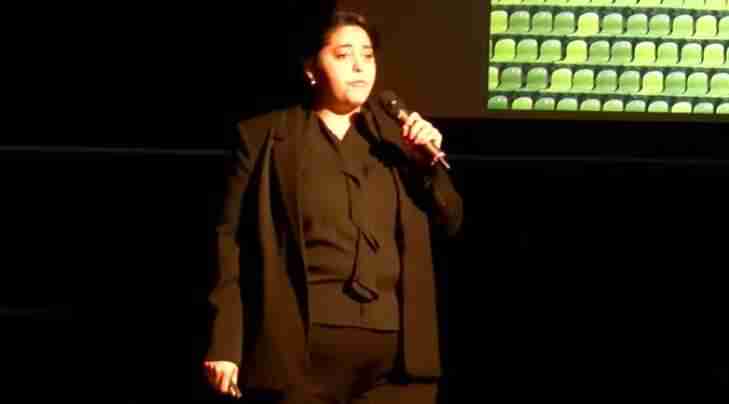
Read the full transcript of Dr. Laura Valadez-Martinez’s talk titled “Things About A PhD Nobody Told You About” at TEDxLoughboroughU 2026 conference.
Listen to the audio version here:
TRANSCRIPT:
The Prevalence of PhD Students in Europe
LAURA VALADEZ-MARTINEZ: Right now, there are 740,000 students enrolling in a PhD in Europe. That is to every 1,000 of the adult population enrolling in a doctorate degree. A doctor of philosophy, known as PhD or DPhil, comes from the Latin “to teach” and the Greek “love of wisdom.” It is a process where you’re meant to master the ins and outs of a topic that really is of your interest. It is a process where you can learn and expand your knowledge and really get to know what something is about.
A PhD usually starts with some proposal that contains research questions, some methodology, and some justification about why this is important. You’re supposed to write a thesis of about 100,000 words or so, so it’s a long piece of work. You work under the guidance of a supervisor, and then you defend your work before an examiner panel. You are encouraged to publish in academic journals. And in some countries, there may be some teaching and some coursework involved.
The Standard PhD Process
So this is how the process usually looks like. That’s the formal standard definition of what happens in a PhD. Nevertheless, there are many things on how to do a PhD well. A simple Google search for the phrase “how to write a PhD” throws about 2 and a half million results. So there are books, magazines, blogs, articles, you name it.
There’s a lot of information on how to do well in a PhD. Universities tell you, this is what you have to do, this is what you have to fulfill to finish your degree and to be called a doctor. Fine enough. Nevertheless, there are a few things nobody talks about. There are a few things that you discover while doing that journey.
So today, I will focus on 7 of those. I will take you through my experience when I did my PhD on these issues that I found and some ideas on how to overcome them.
Challenge 1: Feeling Stuck
The first one is, “I’m stuck. I don’t know what is next.” Probably we have heard of the term writer’s block, when somebody is not being able to make progress in their thesis, or make any progress in their writing.
In a PhD, however, being stuck could be much more. It could be stuck with ideas, stuck with methodology, not knowing how to do it, how to run a model, stuck with not knowing where to find the literature, stuck with not knowing how to analyze the results. So there are many mental processes taking place while you’re doing a PhD. They go from vocabulary to memory, analysis, synthesis. So it is only normal to feel stuck at a certain point and not knowing what is next.
But hey, nobody told me about the need to think. So it is important to have some thinking time. Reading takes time. Knowing how to do something takes time. Learning a new method takes time.
So it is important to, yes, read a lot, but to pause yourself and think and really make sense of the things you’re reading. And this thinking time is really important.
Challenge 2: Dealing with Information Overload
The second challenge is, well, there is more. And yes, a lot more. There are more books to read, more authors to find, more methods to try, more questions to address, there’s always something more.
I usually say that doing a PhD is like opening doors. So each of these knowledge stores you open leads to a whole new world of research. And each of these doors that you open, they go to another world of research. So new books, new authors, new things. So do you really want to go there?
Do you really want to keep going and lose the original starting point? So while nobody told me about the importance of leaving things out, actually, it is important to leave. Make sure that you really focus on what you’re doing. Yes. It is important to read new things, but also concentrate on what you actually want to do.
Many of the readings that you will read will have to stay in the drawer, and many of the calculations that you will do will have to go to the trash bin. That could be very frustrating. And it doesn’t look like progress, but that is progress. So leaving things out is actually making progress in your thesis. Sometimes you have to read a lot to really understand what is important for your own work, or to actually say, no, this is not important, I’ll have to leave it out.
Challenge 3: Maintaining Motivation
A third challenge that I have found is “I have no motivation.” Doing a PhD is meant to be difficult. It is not meant to be something easy. We have heard, oh it’s a marathon. Yes, a PhD is a marathon with a few sprints as well, but mainly a marathon where the work is constant and it’s long and the end result is over there very far, and yes, it is very easy to find lack of motivation.
A recent study in the UK showed that 3 out of 10 doctoral students will not finish their degree within 7 years. And obviously many things take place, and many things play a role in attrition rates, or why someone is not finishing their doctorate degree. Nevertheless, lack of motivation is certainly one of those. But nobody told me, hey, cheer up, and you can do it. So I will not either.
Instead, I will say, work. Work really hard, and then keep working. As painter Pablo Picasso said, “Inspiration does exist, but it has to find you working.” So yes, a PhD, it is a constant process where you’re working.
But nobody told me about the importance of tiny progress.
So all these readings that you’re reading, and all these calculations that you’re doing, all the paragraphs that you’re writing, that is progress. You may not feel like that, but that is progress, and that is important. So these tiny achievements are really important. They give you this sense of accomplishment that you’re really doing something. Because while writing a PhD thesis, there’s always something you could be doing.
So if you’re struggling really with writing a paragraph, then try something else. Try sketching maybe your methodology chapter. Or if you’re tired of running calculations, then go and find your graphs and try to make them pretty. So there’s some way something you could be doing, even though it’s small and tiny, that is progress, and that’s how a PhD is done.
On the other hand, you can also find tiny progress somewhere else.
So it doesn’t have to be in your thesis. I would say, actually, find something else you could be doing, where you can find that sense of accomplishment and that you’re making progress that is important in your life. It could be something like baking a cake. It could be joining a class, doing a painting, even though you’re not good at painting, but just try it out. And having that sense that something is finished is really important.
If a PhD is a long process where you’re working constantly and the work is there and there’s always something there that you have to do, having this tiny progress elsewhere really keeps you going, and that gives you the motivation to keep going through the PhD process.
Challenge 4: Keeping Track of Your Work
Now, a 4th challenge that I found is, “I forgot what I did.” It may sound crazy, but yes, you may forget what you did. Sometimes, you may forget what you just did a minute ago. Because a PhD requires working long hours, maybe you haven’t slept, maybe you’ve been reading a lot and you forget, you have stress, you have deadlines, something is approaching.
So it is very easy to get confused and to forget what you did. So nobody told me about the importance of having a research diary. Well, actually, somebody did. And that is one of the best pieces of advice I have been given. So write a research diary.
And I mean, write the decisions you make and why you made them. While I was working on my PhD, I had to run some calculations to model the effect of poverty on children. I had a data set with more than 3,000 variables and more than 25,000 cases. Some information was at the individual level, some information was at the household level, some information was at the macroeconomic level. And I had to put everything together to model how the effects of poverty would affect children, obviously with all these theories going around it.
So yes, our PhD is a constant process of going between detail and generality, so it’s easy to forget why you were doing something. And if you’re tired and you haven’t slept, it’s like, why did I do that? So this is how the space under my desk looked like. There are a lot of notes, hundreds of them, just tracking every decision, how I changed every variable. If this variable meant this, then I wrote it down.
If I then decided to change it, I would say, why? Because then it’s very easy to forget, and then why did I change that? So it’s important to keep this research diary, and as I said, it’s an advice that I was passed on to, so I’m sharing it with you. Related to that, if you’re working in quantitative research, write up syntax. It is kind of a research diary, but in the program you’re working with.
So it’s a way to keep track of the variables, what you’re doing. But not only that, it will allow you to find mistakes and to replicate the analysis. So if you want to do again this type of research with another dataset or with something else, you could use that syntax to write it down. And also related to that, well, never ever (this may sound easy and simple) save changes on the original dataset. We are working with datasets.
My models ended up looking like multi poverty, multi poverty 2 1,003, multi poverty 2,003 new, multi poverty 2,003 new without housing, multi poverty final. I can see some people are laughing and probably that sounds familiar. I don’t know. I don’t know if that’s the best way or not, but at least it helped me to keep track of what I was doing or what was going on. And then when something said, final, final, this is a good one.
Well, that was a good one. So do not delete that dataset.
Challenge 5: Questioning Your Research’s Relevance
Moving on to the 5th challenge. Well, “I’m not sure this is relevant.” Suddenly one of the biggest questions invades your mind, is this actually relevant?
Is this important? Is it adding anything to the world? Is it adding anything to the knowledge? Is anybody going to read this? Well, according to the OECD, doctoral holders are expected to play a key role in society because they drive forward the advances in knowledge, science, and technology.
That is one big statement, and that reveals great expectations. So yes, no wonder why it’s easy to feel fear and to be afraid of not knowing what to do, of being afraid that this is relevant or not. So my idea is this, well, nobody told me about self-assurance. It’s important to be self-assured, and I have a couple of those. One way to be self-assured is to read the originals, to read the original documents.
Social policy scholar, Este Anderson, said, “Adam Smith is often cited, but rarely read.” So if you’re going to use Adam Smith in your thesis, go find Adam Smith. Don’t rely on someone else, he said that. This is part of good scholarship anyway. But if you’re using some author, go and find the original source because not only you will find new ideas and new approaches, but it will help you to find how it connects to your research.
A second way is well, get in touch and be updated. Read journals, go to conferences, find out who else is working on your topic. That is important because not only you will learn from each other, but also you will know that you’re on the right track.
Challenge 6: Dealing with Loneliness
The 6th challenge is, “I feel lonely.” A PhD could be a lonely process, and I mean, a very lonely process.
So yes, a PhD is done in solitude, but it doesn’t have to be a lonely process. A study of the University of California, Berkeley, recently found that around half of postgraduate students suffer from some kind of depression. And obviously, many things play a role in depression, but feeling lonely in a process that is already long and difficult does not help. So nobody told me about the importance of being connected. One way of being connected is get involved in your department, talk to your colleagues.
But not only about academic things, but also saying, well, I don’t know, I feel lost, I don’t know what to do, I don’t know how this is done. Find a way to be connected to others that are there. Another way to be connected is talk to your supervisor. Well, you are the only person in the world who knows exactly that topic the best way. But that second person should be your supervisor.
So talk to them. Find a way to connect to them and say, I don’t know what is next. I don’t know how to do this. So it’s being honest. I’m being humble in knowing that research is difficult, and this is a process that is long.
A third way to connect to the world is find something simple, for example, buying a plant. Well, you don’t have to, but I did. And I saw mine growing during 4 years, and it was rewarding, so it was nice. It was a way to connect to the world. But another one is also connect to your family and friends, people who are outside academia.
So it’s a reminder that there are problems out there that are not related to not knowing how to write a paragraph, that are not related to models not converging, not finding the right information. So find ways to connect with other people. And also, by the way, be prepared. Be prepared to explain how your 4-year thesis, your 100,000-word work summarizes into phrases because they will ask. And not only they will ask, but that is a sense of accomplishment.
You know, when you’re able to say, this is my thesis, in a sentence or 2, you have made progress because you know what you’re talking about.
Challenge 7: Finding Your Own Way
And well, finally, what is the right way? But nobody told me that either. I don’t know. Some people work office hours, 9 to 1, 2 to 5.
Some people work during the night. Some people work during the weekend, and then nothing during the day. I don’t know. It’s up to you. There is no single correct approach.
It is a process where you can find really what interests you and find your own way. I have said many things now, but this is just my journey, this is my experience. So it is up to you. If you’re starting a PhD or you’re thinking about it, there are no secret recipes on how to succeed. You have to find your own ways.
So live it, enjoy it, shape it. Now, you’ve been taught. Thank you very much.