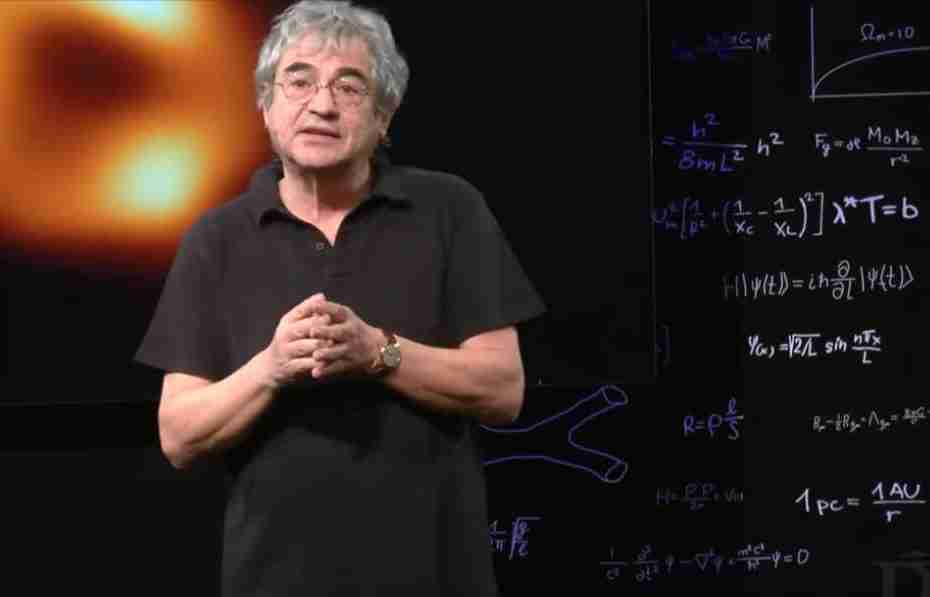
Transcript: Come With Me Inside a Black Hole – Carlo Rovelli Public Lecture at Perimeter Institute (February 7, 2025).
TRANSCRIPT:
# Introduction
CARLO ROVELLI: Wow, full house. I can’t see a single empty seat.
Well, thank you all for being here and thank you for this wonderful, too kind introduction. I’m particularly thankful to PI because being invited here in the 25th year, quarter of a century of PI, I’ve been here back and forth for all these 25 years. I was here at the very beginning. In fact, I was even here before the beginning because I participated in the early discussions of how to create a new institute.
It was a great experience, it was fantastic. I remember these first years, not in this beautiful building—it didn’t exist at the time—but in the red brick tower on King Street in Waterloo. There was Rob Myers, of course, who’s been later director. Lee Smolin, who’s one of the inspiration forces of the birth of PI. This fantastic spirit to create a completely new research place where imagination, intelligence, freedom of research could run free. And 25 years later, here we are in this great, fantastic place, which is PI.
So, thank you for existing PI. I’m told the scientists are allowed to do what they want. Take advantage of it.
# The Scientific Revolution: Past and Present
I’m going to talk about black holes. But let me start by putting this into the big picture.
From Copernicus to Newton, late Renaissance, all the way to the beginning of the Enlightenment, there’s been this major event, which is the great scientific revolution. The revolution of thinking that has given rise to modern science. Science existed before, but the change that happened at that time has profoundly influenced Europe, and then the rest of the world equally profoundly.
It was long—it was a century and a half from Copernicus’ book to Newton’s book. And during that long revolution, humanity’s way of thinking about what is reality, what is matter, what is space, what is time, what are things, how things happen, changed very profoundly. From us being in the center of the universe, earth and heavens being completely separated, things happening because of magical influence, angels pushing, whatever, to what we call modern science.
I believe that the revolution in physics of the 20th century—quantum mechanics on the one hand, and everything we tie to the name of Albert Einstein and his revolutionary understanding of space and time on the other, the theory of general relativity—is an equally radical modification of our understanding of the world. It is already changing, but hasn’t yet completely changed our civilization probably as much as the great scientific revolution of the Renaissance. That revolution evolved into Enlightenment, into the industrial revolution, into modernity in all its complexity. What this revolution is going to bring us to, we don’t know. It’s going on, but these things move slowly.
Sometimes we think that science happens very rapidly, discovery after discovery. No, science I think is slow, and ways of thinking about the world, ways of conceptualizing the world evolve slowly through discussion. The current revolution isn’t finished yet.
That one took a century and a half, as I said. This one started in the early 20th century—quantum mechanics in the 1920s, 100 years ago. We’re celebrating also the 100 years of quantum mechanics this year. And these two theories haven’t yet been combined, so we’re really halfway through this change of rethinking the universe. General relativity by itself without quantum mechanics doesn’t make any sense, and quantum mechanics by itself without general relativity doesn’t make any sense.
They’re clearly both wrong in some sense, which is not clear, and the effort of completing the revolution is ongoing. It’s one of the things which is motivating a lot of research in fundamental physics, bringing together these two partial steps in understanding the world.
# Galileo’s Role in Scientific Revolution
Now, halfway through the Renaissance revolution, Galileo Galilei, who was several generations after Copernicus, but died when Newton was born, was a towering figure, perhaps one of the greatest, maybe the greatest with Newton, of the characters of that revolution. He contributed in all sorts of ways—invented experimental physics, mathematical physics, invented all sorts of things.
But one of the most impressive things he did—if you have been to the exhibition, the Galileo exhibition, a couple of rooms that way—was to use the telescope, which was recently invented, to improve it and start a campaign of observation of the sky, which opened up marvels: the satellites of Jupiter, the rings of Saturn, the phases of Venus, the craters of the moon, the spots of the sun. He just saw things out there that nobody had seen before, and that had a huge impact.
In fact, it very rapidly had a huge impact, because a lot of people looked through the telescope and could see what he was saying. Some people tried but couldn’t see anything. But many people could see, and his books, his impact was enormous. Why? Because humankind opened a window and looked out and found new things. And these new things, on the one hand, were a major element of support for Copernicus’ view of the world—the Earth spinning and going around the sun, rather than the Earth being the center of everything.
Somehow they were fitting much, much better with Copernicus’ view than the Ptolemaic view, the previous view that was in place for two millennia around the Mediterranean. On the other hand, these discoveries, these new things in the sky they were seeing, were also crucial for going ahead and trying to complete the Copernican revolution, making a coherent picture of reality, which Copernicus didn’t have, because the physics at the time was still Aristotelian physics.
Not because Aristotelian physics was a dogma, but because it was the best available at the time. And Copernicus changed everything. Aristotelian physics wouldn’t fit with the Copernican revolution.
So Galileo gave, at the same time, a confirmation of Copernicus and tools with which Newton could bring everything together with this marvelous synthesis that is in his book, the Principia, and which is the ground on which so much modern science is based.
# Black Holes: Today’s Galilean Discovery
Now why am I saying that?
I studied black holes at school when I was at university, except the book was saying these probably don’t exist. My teacher said, never believe in books that you study at school. Study them, because there was a very good description of black holes, but then there was a conclusion that was completely wrong.
It was not a bad book! It was a fantastic book, written by one of the greatest scientists, Steven Weinberg, Nobel Prize genius, and yet he had it wrong. So don’t believe in books.
What I was saying is that these incredible things, which are black holes, which the astronomers like Galileo three centuries ago, have seen with this picture and with other evidence—it is not the only evidence we have about black holes. We have a large amount of gravitational waves, radio signals, all sorts of astronomical things. Now we know these things are there, and we know that these kinds of things are best understood as what my book was calling black holes, and was saying they don’t exist. Namely, as a special solution of Einstein’s theory.
And the beautiful thing is that Einstein wrote this equation in 1915. He couldn’t understand what his own equation meant. Well, it took a long time to figure out what the equation predicted, but through many people—Schwarzschild, Finkelstein, and so on, Roger Penrose—it became more and more clear that the theory predicts this funny object, which are black holes, and these black holes would show themselves in some phenomena.
One of these is this ring, funny shape here, and now we have found all these phenomena, these rings and all sorts of other phenomena. So black holes are a confirmation of Einstein’s theory, and at the same time, they are a tool and possibly our best door for going beyond general relativity, and for telling something about this open problem, which is general relativity and quantum mechanics together.
Because inside this black hole, or in the future of this black hole, there are precisely situations which cannot be accounted for, described with general relativity alone, or with quantum mechanics alone—we need the two of them.
# The Journey Ahead
So I want to tell you now two things. First, what we know about black holes, the solid part, the reliable part of our knowledge, up to the way where we go into the part we don’t know, but that’s the most interesting one, which is the one where quantum mechanics and general relativity come together.
I spent my life trying to build a theory of quantum mechanics and general relativity together, a theory of quantum gravity, so I will tell you about this theory and how it plays a role in black holes.
Just before jumping toward the black holes in this explanation, one thing: bringing together quantum mechanics and general relativity, completing the revolution, has nothing to do with the problem of writing the theory of everything, the final theory of physics, the unified theory of everything. These are two independent problems.
The final theory of everything, well, who knows, my great-great-great-grandchildren, maybe. I think the universe is still too mysterious for hoping for a final theory of everything. We don’t have a theory of everything. The attempt to write it down has found very bad “no” from nature.
I think we’re very far. There are so many things in the universe we don’t understand, but the effort of putting together what we have understood about quantum mechanics, what we have understood about general relativity, that’s a well-posed problem that we have to solve.
# Understanding Black Holes
So, let’s go toward this object and let me tell you what we know and what we suspect about black holes. That’s going to be my black hole, because I needed something round.
A black hole is something round, essentially, whose size—most black holes around us that we have evidence for are much bigger than this, but not too big. They’re sort of a few kilometers in size, like London, where I spend most of my time, or Waterloo. But very, very massive.
But there are black holes much bigger than this. Sagittarius A* in the center of our galaxy is a million times bigger in mass, which is probably the size of the orbit of the Earth, something like that. But there are black holes which are a billion times bigger. So, colossal things, immense things.
These are black holes we have evidence of. Maybe there are smaller ones. Maybe there are black holes of this size, or maybe teeny ones. We don’t know. There’s no reason for believing that they don’t exist. If somebody says they don’t exist, remember my book that said no black holes exist.
They have the size, and they’re very massive. A black hole of this size would be more massive than the Earth. So, to make a black hole, you have to squeeze a mass into a very, very small region.
# Journey Into a Black Hole
Imagine we go there, and that’s what I want to do. The title of this talk is “Come With Me Inside a Black Hole.” I need your attention, your imagination, because this is going to be a trip of imagination, and also your being ready to accept that reality is very different than what we usually see around us.
So, imagine that we’re in a starship together. This building is a starship. We’re flying toward a black hole, and say we’re flying toward this one, which is one of the ones we know better, because we have a picture of it. This is the center of the galaxy.
So, we fly there, go there, and what do we see? Well, basically, we see that, because that’s an image which is taken with a group of telescopes. Very complicated, but if you’re close, that’s what we are going to see. In fact, we’re going to see—the way to interpret this is that this is a ring, a red ring, badly out of focus.
When we go there, we’re going to see the same, but much more sharply in focus. It’s going to be a clearly defined red ring. Now, let me tell you why we’re going to see that.
First of all, it’s not that around the hole there is just a ring of things, because if there was a ring, we would see it like the rings of Saturn. We would see sometimes just like that, sometimes just a line. No, with black holes, you see the ring from whatever direction you look at it.
You always see a ring. Why? Because this ring is not a thing. This ring is an optical phenomenon. It’s like a rainbow. It’s completely an optical phenomenon, and it’s not the light of a black hole. It’s the light of a lot of stuff around it, which is all over around it.
The reason we see a ring is the following. One of the consequences of Einstein’s theory is that not only masses are attracted by gravity, but also energy. Einstein’s E=mc², so whatever energy does, mass does, whatever mass does, energy does.
Mass falls, energy also falls. Light has no mass, but has energy, so it also falls. It’s attracted by the black hole. It’s also attracted by the sun, but the sun is very big given its mass, so even if some light comes very close, it’s attracted a little bit, deviates a little bit. In fact, measuring that was one of the first pieces of evidence that Einstein was right.
But a black hole is very, very massive, so given the mass, it’s very small, so when the light comes very close, it’s attracted a lot, so much that you can do a simple calculation. It’s done in all classes of geometry, and light can be in orbit around a black hole, so you can flash some light and it just goes in orbit.
Inside the Black Hole: Space-Time Distortion
CARLO ROVELLI: This orbit is at some given distance from the black hole, fixed distance from the black hole, sort of one and a half times or three times its radius, and so this means that light can go around this way. Now, careful. Imagine this is a black hole and here there’s something shining, some hot matter shining.
Then you see it because light comes to you, but you also see it because light curves a lot and goes to you, but you also see it because light makes two turns and comes to you, or three turns and comes to you, so you see it multiple times. Once here, but all the other times you see it here, and the ones is here, you see it here, and the one is here, you see it here, so you see everything many times, and many times just from this distance, so you see a ring, a clear ring.
Of course if you look from another direction, the same, you see a ring like that. The beautiful part is that I studied that in my textbooks, in one that says, yes, but this doesn’t happen. Here it is, it happened.
Time Dilation Near Black Holes
CARLO ROVELLI: So we go there and we see this ring, fantastic, we’re very happy. Now we go closer. We go closer to a black hole, a starship, imagine this is a much bigger black hole, so this is a small starship, we go close, close.
If we let ourselves go, we fall into it, but let’s keep the rockets on, so let’s keep at the distance, and the second phenomenon I want to describe is time dilation, which is maybe the most spectacular of all.
The following happens: we stay at some distance from the black hole, like a little bit closer, we stay at some distance, closer, and so on, and imagine we had the news from Earth. Earth was, you know, your daily news, every 24 hours you listen to CNN, Fox News, Al Jazeera, whatever, TASS, China Daily, whatever.
Now, as we get closer, we get the news, not every 24 hours, but every 10 hours, 5 hours, 3 hours, and when we’re very close, we get one news very fast. So if we look back at Earth, we see everything happening very fast, and if we are on Earth and somebody gets messages from us, we send messages once a day, back on Earth, they receive it every two days, every five days, every week, every year, the more we get closer to it. That’s time dilation.
Time dilation is not something that we see here on the Starship. I mean, there’s the attraction, but time is normal. We just wake up in the morning and get breakfast, everything is normal.
Clocks go at the same time for us, but we see everything far away going fast and people see us going slower. So time goes slower near a Black Hole than far away. This is a phenomenon we measure in the laboratory, but near a Black Hole it becomes colossal.
The more close we get to the Black Hole, the more everything we are seeing from Earth is slowing down. When we cross the Black Hole, now we go in, from Earth, they don’t see us anymore. They see us just at the last moment before entering.
Crossing the Event Horizon
CARLO ROVELLI: Now we’re in, going in. Now when we cross it, you may say, now we’re crossing this boundary, what happened? Nothing. In our Starship, everything is completely normal.
Just cross, outside, inside. We cannot go out anymore, but once we are crossing, in the Starship, everything is normal. And that’s why it’s called Horizon, right? It’s called Horizon because it’s the same thing as the horizon of the sea.
If you go on a hill and look at the ocean, you see a line and the ship going behind the line disappears. But it’s not that there is a line on the ocean, so here is the horizon. When you are on the boat, nothing, the ocean is completely normal.
So the line is this surface, it’s the line we cannot see beyond, like the horizon. Why? Because space-time is curved, like the Earth is curved, so you cannot see behind. We are inside, now we’re in, inside the Black Hole.
We still see the stars around, we can still get messages from Earth. They cannot get our message, but we still see messages, assuming that Earth is not in the future for us, so assuming humankind still exists, but we’re still there. We’re going in, everything is locally normal, but if we look a little bit around us, funny things happen.
Space Deformation Inside the Black Hole
CARLO ROVELLI: And this is the third effect I want to describe, which is space deformation. Let me describe it this way. If I ask you to guess what is inside, it’s just air, compressed, because it’s full.
But if I ask you what is the volume, how much is the volume inside, well this is roughly a foot, roughly a cubic foot of volume inside, right? Because we have a clear understanding of the geometry. Inside something like that, there cannot be too much space, because we know geometry, Euclidean geometry.
Well except that Euclidean geometry doesn’t describe real space, because real space is described by this curved geometry, that’s the core of Einstein’s relativity, and gravity itself is this distortion of space and time.
So what’s the geometry inside the Black Hole? Basically, it’s enormously larger than what you expect. So when you go in, you find a huge space inside. You remember these fairy tales? You go in the forest, there’s a teeny hut, okay, small.
You go in, and then there’s a huge room, another huge room, and gardens, and so on – more space. And you go out, there’s a teeny hut, in fairy tales. Well, the universe is a fairy tale. It’s exactly like that. That fairy tale is more realistic than our Euclidean space.
And the shape of the space inside, I have another tool here, that’s my tool. This is a lower dimensional analogous. Imagine you have this circle here, and I say this circle bounds a surface. This is a few centimeters, what is a surface? Well, it’s just a few centimeters square.
No, look, the surface is much bigger. You can imagine this can be a very big surface. So that’s exactly what’s inside the Black Hole.
It’s like a long cube, which is very, very long in one direction, and small in sort of the radial direction. So once we go in, there’s a huge, huge thing inside, but small. Last reliable thing, everything I’ve said so far, every good relativist would agree.
I mean, there are a lot of relativists in the room, I hope I’m not saying anything wrong. For the specialists, I’m using maximum volume foliation inside the Black Hole, just in case, it’s a technical thing. So every good relativist would agree that what I’ve said is credible, reliable, and that’s what Einstein’s theory predicts.
And Einstein’s theory has been so good so far, there’s no reason, I believe, to doubt it.
The Shrinking Space Inside
CARLO ROVELLI: So last surprise given by Einstein, we are inside this long cube, okay? And we discover that this geometry in which we are is not static, it’s changing. And it’s changing how? It’s becoming longer and longer as time passes, which is okay, but worse, it’s shrinking.
So we are in, we cannot go out and it’s shrinking around us. And then we say, oh boy, okay. And in fact, I mean, if one wants to be realistic, even if we go inside a huge Black Hole like this one, one of the bigger ones, pretty fast, we find it shrinking.
And there’s this long direction in which we’re pulled long, spaghettified, right? We’re squeezed in one direction, two directions and elongated in another direction. Good. Now, we shrink, shrink, shrink, and then what? And here’s the point.
Beyond Einstein: Quantum Gravity
CARLO ROVELLI: Then we cannot rely on Einstein’s theory anymore. Because a simple calculation that every physicist could do is that if you want to know when quantum mechanics comes in into phenomena, you can do an estimate. And what you get is that as long as things are microscopic or are big, you can forget quantum mechanics, right? This big ball, just forget quantum mechanics.
But when things start becoming small or very high energy concentration or great curvature, quantum mechanics comes in. And the quantum effects on this dynamic of space-time are quantum gravity, is what we still don’t know. This is what I’ve been paid for doing all my life for decades and decades, right?
But I’ve worked with a theory, with people here at PI, a lot, Bianca Doran, a lot of postdoc and students, and Lee Smolin and many others. There is a theory, we have a very good theory, which I believe firmly, three days a week. And the theory tells us some prediction, which might be right, but the theory might be wrong.
So now I’m going to tell you what I consider the best possible gravity theory tells us which is going to happen next. But now I have to change gear, because so far I keep telling you, believe it, it’s reliable. Now I cannot say that anymore. Now I say that’s our attempt to look beyond current knowledge.
The Quantum Nature of Space-Time
CARLO ROVELLI: So what happens? Well, quantum mechanics, what does quantum mechanics tell us? That the world is granular, photons is just photons, light is not continuous, this is grain, there’s an atomic structure of things, quantum fields have quanta, which are particle-like.
So space-time itself should be granular, that’s one of the main predictions of loop quantum gravity. There’s a minimal size of things, that the dynamics is probabilistic.
So you cannot follow exactly the equation, tell you what happened, but you have probabilities. And you have probabilities of jumping, remember the quantum jumps, at the beginning of quantum mechanics. Electrons stay on orbits, but can jump from one orbit to the other.
And you can compute this jump, and you can jump from one classical story to another classical story. A typical example of a quantum jump is the tunnel effect. If you have a wall and a particle that can bounce on one side and can bounce on the other side, quantum mechanically you can bounce from one to the other. You tunnel through the wall.
The Bounce Theory
CARLO ROVELLI: So what can happen when this shrinks, this geometry shrinks? You might get to tunneling into some other solution of general relativity, some other classical solution. Which solution? And now I would like you to guess, and I’m going to help you.
A black hole is formed, most black holes we know are formed by collapsing stars, stars that fall into themselves. We, you know, with our starships have been falling through the black hole. The shrinking of the black hole is really a falling, it’s like the space-time falling over itself and closing into itself.
Now if when something falls and hits something that cannot go over, because you cannot squeeze too much, there’s a minimal size, what happens? When something falls and finds a barrier, what happens? It bounces.
The typical thing that happens when you fall and you hit something, you bounce. So that’s the idea. At the end of the shrinking of the black hole, there might be a bounce.
A bounce into what? Now if you look at the bounce of this ball, the coming up is very similar to the going down, except that if you make a movie of the going down and you project it backwards, you get the coming up. So a ball, a bounce, it’s like a movie reversed of what happened before, it’s a time reversal of what happens. So that’s what could happen, okay?
This dynamical squeezing, squeezing, I’m going to make it longer than that, could jump into reopening and coming back, coming back or whatever inside.
Black Holes and White Holes
CARLO ROVELLI: Now question, could that be again described by standard Einstein theory? Yes. In fact, Einstein theory has a solution which is a black hole, which is this shrinking, and there’s another solution, which by lack of imagination is called white hole, which is exactly the time reversal of that.
Now if you look in books today, they say, well, white holes don’t exist, this is a solution for Einstein equation, okay? Maybe.
Why do people don’t expect that white holes exist? Because how could they be born? You see, in a black hole, things fall inside. If you think the opposite, a white hole is something out of which things come out, right? If you make a movie of water going into a bottle and you do the movie backward, water comes out of a bottle. So people say, come on, white holes would be, you know, things coming out from a sphere.
Where do they come from? Well, they could come from a black hole, which has bounced quantum mechanically, has become a white hole and come out. So the suggestion that comes from quantum gravity and from the theory of quantum gravity is that this is a possible phenomenon. A black hole shrinks, becomes very long, jumps into a white hole, and then things come out.
But careful, that’s a first picture. Let me make the picture more precise. I let this go. Does it come out exactly like it went down? No, right? Why? I mean, let it go up to here and it only comes down here. It has lost energy. The dissipation is friction.
And careful, the bounce is time reversal. If I make a movie and show it reversal in time, it’s the same, but the actual phenomenon is not time reversal, right? If I show a movie that I let it go like there and then it bounce higher, you say, no, no, no, the movie, you’re cheating me. It’s the other way around.
Okay. So dissipative phenomena, friction, are not time reversal invariant. So I expect this to lose energy while it’s going down into heat in the air, to lose energy while it’s bouncing into heat in the ground and the ball itself, and to lose energy while it’s coming up.
So it doesn’t come up all the way up. So similarly, I expect the black hole to dissipate while it’s shrinking, dissipate all the time. So not coming up the same big black hole that it was before.
Inside the Black Hole: The Quantum Journey
CARLO ROVELLI: So how does it dissipate? Well, we know how it’s dissipating. Thanks to the best scientific result of Stephen Hawking, who was a visitor at PI more than once, who made a very convincing argument that if you leave a black hole there and you wait from the outside, it’s not staying forever, but it’s dissipating, it’s losing heat around and becoming smaller, smaller, smaller, smaller. So what is reasonable to expect is a black hole evolves into a white hole, but a white hole very teeny, because it’s lost a lot of energy.
Very teeny, the mouth, where is my black hole here, this becomes very teeny, but inside you have still this huge volume which has been bouncing and is coming out. How big? And here is again, loop quantum gravity is a hint, because you see, a black hole can jump, quantum jump into a white hole, but a white hole, this is something which is well known from classical general relativity, a white hole has a probability of falling back into a black hole. So a black hole can go to a white hole, a white hole can go to a black hole, what happens? They transform each other and they end up sitting on the minimal energy, on the stable solution, this is what quantum mechanics tells us. When you have two states that can transform into one another and you let them stabilize, they sit on the minimal solution, which is a quantum combination of the two.
So what the theory suggests is that after the black hole has become evaporated, become very small, what you get is a teeny, teeny thing with a big interior, which is a quantum superposition of black and white. You know, this is fantastic. So how big? Well, once again, loop quantum gravity comes in, because the main prediction of loop quantum gravity is that geometry is discrete.
So area can be zero, or can be one quantum of area, Planck area, nothing in between. Now, if you have this interior, it cannot be zero. But the area goes down up to its minimal area.
And minimal area, it’s one Planck area, but this black hole was a mass, the mass is given by the area. And the mass is going to be one Planck mass. Now one Planck mass is what, very big, very small?
Do you know how much is a Planck mass? It’s a microgram. It’s my hair. Okay, that’s exactly the mass, a centimeter of my hair, it’s a Planck mass.
Black Hole Remnants and Dark Matter
So here we have a prediction. Once again, to which I believe firmly, two days a week, that it’s possible that the universe is full of these little things, which are remnants of black holes, whose mass I know is a fraction of a microgram, 0.14, it can be computed, Planck mass. And I’m going toward the end.
Suppose this is true. I’m pretty confident this is true, especially on Monday and Tuesday. Could we detect these things? Could there be a lot of these things? Well, there is a fascinating possibility.
Suppose that in the early universe, or even in some early phase, before the Big Bang, a lot of black holes were produced, and had time to become remnants, remnants of a long, long life, not infinite, but long life. So suppose you have a lot of these little things, a microgram, a fraction of a microgram, very teeny, zooming around. Would we see them? Well, we would see like a powder, but we wouldn’t see it, because these have a mass, but not a charge, not a magnetic charge, nor electric charge.
So we don’t see them, they’re invisible, but they have weight, have mass. So there’s gravitational force. So it would be like some sort of matter, which is dark, but it’s all over the universe.
Sounds familiar. So quite astonishing, the astronomers have seen mysterious things, which is dark matter, they call it dark matter, which is something which only interacts gravitationally, and could very well be, as far as we see today, powder. And if you do a calculation of how many there could be, there could be now one that zooms here and goes through, because it interacts very, very weakly only gravitationally.
Of course, there’s a lot of “if” here, if loop quantum gravity is right, if the scenario of the bounce is right, if there’s enough black holes in the past that have become these things. There are other hypotheses about dark matter, many, none very convincing, in my opinion. This one has a characteristic that doesn’t require any other physics, except quantum mechanics and general relativity. No supersymmetry, many dimension modification, Einstein equation, you name it, okay?
Detecting Black Hole Remnants
Maybe. But if so, could we actually detect these things? Well, my last paper, I want to just take you all the way to the research I’m doing. Now, my last paper published in a few physical regulators come out in the fall.
It’s how to build a detector who actually would detect one of these very, very teeny hair that is flying by fast, because we’re moving through the dark matter. And we think that we have enough technology using quantum technology to actually build a detector of that. It’s big, complicated, who knows.
To see the gravitational waves of these things, somebody long ago said, let’s build a detector. It took 30 years, Kip Thorne and his friend got a Nobel Prize for detecting the gravitational waves. So maybe this is, but wait, we are still inside the black hole, right? I said, we jumped to a white hole, now we have to come out.
It’s going to be hard. Imagination has to be, because you have to come out for very teeny, Planck-sized things, transforming to radiation. So, okay, imagine we can, you know, our conscience somehow survive that, we’re out.
The Nature of Singularity
Last comment. We’re going in, I’ve taken you in, going through, so, you know, horizon, falling in, through these things, it’s called a singularity, but singularity is a stupid name. Singularity is what would happen if there’s no quantum mechanics.
And remember, singularity is not somewhere, it’s not in a place, it’s not down there at the center of black hole, it’s somewhere, it’s when these things surround you. So we jump through the singularity, through this quantum process, which is not strange, because we are a quantum process, jump all the time, we are jumping, quantum process jump, we are in the white hole, and we come out. Now, last comment.
Time Dilation and Black Holes as Time Machines
How long does it take, the entire process? Easy. If the black hole was very big, it has to evaporate. For a big black hole to evaporate, we know that from Hawking’s calculation, how long? It’s billions and billions and billions of years.
So, very, very long. But wait, time is different outside and inside. What about inside? Jumping, okay, black hole like this one takes less than half hour to, once we cross the horizon, to be squeezed to get the quantum jump, and then half an hour after to come out.
Okay, so the time of this lecture. We go in, we cross, we’re out, but one hour, that’s it. But in the meanwhile, the universe has evolved for billions and billions of years.
So, that’s possible last way of viewing this fabulous object here. A black hole is just a shortcut to the future. You jump in, it comes out a billion years later for the universe, and just half an hour for you.
The universe is absolutely fabulous. Thank you very much. Thank you.
Q&A Session
MODERATOR: Thank you so much, Carlo. What a wonderful talk. All right, so now we have time to take some questions from those in the theater and anyone joining online.
So, if you have questions for our speaker, please make your way to the microphone, as I mentioned before. If you’re joining online, you can type your questions into the chat, and I’ll have them up here. So, we would kindly ask if you have a question for Carlo, please limit to one question, so we have enough time to get to questions from everyone in the audience.
If you have more than one question, or you want to learn more about these things, never fear. We have many scientist volunteers that will be in the atrium to answer lots of physics questions afterwards, and we definitely encourage young members of the audience, if you have questions, to come and ask them at the atrium. As people are coming up, I’ll ask one that has already come in from online.
MODERATOR: So, one of the questions we got from online while you were giving your lecture was, what do you think is the likelihood that primordial black holes exist?
CARLO ROVELLI: Yeah, thank you. I take the question seriously, but I’m not an expert. So, there’s a lot of work on primordial black holes. People here are involved into this research. So, my understanding is that it’s considered a good possibility by people working in the area. Instinctively, I find it very probable.
It seems strange to me that from the hell that was the early universe, black holes wouldn’t be formed, but there’s a lot of technical heavy work on that, and I don’t think we have a definitive answer. The difficulty is not so much to believe they were formed. The difficulty is to believe if they were formed, how had they impacted the cosmological evolution.
So, do we have a scenario where they formed and it’s coherent with what we know about cosmology, that they would still be around? Thank you.
MODERATOR: All right, first question from the audience. Go for it.
AUDIENCE QUESTION: Hello. Thank you for your presentation. I have a question. I was encouraged by the people outside to ask this question to you. You were talking about time dilation a little earlier. Now, as a rocket gets closer, I’m watching a rocket go into the black hole.
I see that slow down. Now, as you get infinitely close to the black hole, doesn’t time get… Like, do I ever see the object… No, sorry. From my perspective, does the object ever go into the black hole? Because time is going to slow down completely for them.
Perhaps like a one over x limit, x goes to zero, something like that.
CARLO ROVELLI: You mean from your perspective, who’s observing from outside?
AUDIENCE QUESTION: Yeah, I’m observing from outside.
CARLO ROVELLI: Yeah. So, I don’t see what the problem with this information paradox. Is it a paradox? Because information hasn’t disappeared. And even what you were saying earlier about it goes in, turns into, gets squished, comes out as a possible dark matter particle.
Would I see that as well from my perspective? Because my time is different from the person who actually went in. So, from my perspective, I think… I don’t understand something. Please tell me if I’m wrong.
But has any of this happened? Has any… From my perspective, did the person go in? Did all those things that you talked about happen?
CARLO ROVELLI: Yeah. So, from your perspective, you don’t see anything entering. You don’t see anything entering the black hole, right? You see, as you say, you see things slowing down.
And in fact, what you actually see is that seeing is light. Light itself is slowing down, so it’s becoming more and more red, more and more weak. So, you see things fading away into nothingness.
You see people not moving, and then becoming more and more red, and then don’t see anything anymore. Okay. The problem of the black hole information is that we know much more, and in particular, we know also hole irradiation.
So, we know what is the full physics outside the black hole in the distant future. And from that, it’s not possible to reconstruct the past. One way of viewing this is thinking about Hawking’s intuition about black hole radiation, which is a virtual couple of particles created, one falling inside and one… The two now are one outside and one inside, but they are correlated.
They’re entangled, in fact. So, the state of one is not pure. It’s only the state of two is pure.
So, if you don’t know the other one, from the state of one, you cannot reconstruct the past. So, definitely, given the physics we have, without the information inside, we cannot reconstruct the past. But, you know, as far as we know, we expect that local physics is such that, probabilistically, from the present, you can reconstruct the future, and from the future, you can reconstruct the present and the past.
So, this is an information problem. Information problem is technical. It’s more complicated.
It’s page time. There are other aspects. But if the scenario I’ve given to you is correct, this all disappears, of course, because all the information comes out later on.
So, there’s no information problem. Thank you.
AUDIENCE QUESTION: And just from my perspective, I’m sorry if I didn’t understand, does the person actually go into the black hole? Never mind what I saw.
Does a person go into the black hole, from my perspective, ever, if I wait infinite amount of years? And that’s what I was trying to ask. If the person never goes in, and I’m missing something.
CARLO ROVELLI: If the person never goes in, and I’m missing something. If the person never goes in, then none of this happened. All the matter that went in the black hole is just sitting outside there. It hasn’t gone in yet.
That’s correct, but that’s not the source of what people call information problem. You’re right, but that’s not the source of what people call the information problem.
AUDIENCE QUESTION: So, if nothing’s gone in, then this question wouldn’t happen either, at least from my perspective.
CARLO ROVELLI: Yes, but that’s not the information problem. Information problem is not about something falling in. Nothing is falling in, and yet something else happened. Let me put it another way.
The information problem is, well, let me stop here, because we can talk about the information.
AUDIENCE QUESTION: Hi. So, we as observers, right, we see black holes slowly decaying over billions of years. And so, if you’re in a black hole, and you’re going through an hour-long period that, you know, billions of years do pass, is there any issue with the black hole, you know, collapsing? Is there any issue with the black hole collapsing while you’re in it, if time from an outside observer is going by, you know, for billions of years?
CARLO ROVELLI: No, if you’re in, the issue is not about what happened to the horizon, it’s what happened to you. You see, the inside is not stationary, it’s not static, it’s not stationary. The inside is dynamical.
Inside the Black Hole: Understanding the Physics
CARLO ROVELLI: In fact, many physicists are confused about that. Many physicists have the idea, especially people who haven’t worked with general relativity enough, that a black hole itself is something that stays there, okay, so it’s something static. That’s black hole.
But that’s from the outside. The outside is static, nothing changes. But once you’re in, nothing is static.
The picture you have, you’re in, you’re in a room, the room is squeezing over you. So the question is not, from the inside, the question is not what happened when the black hole outside shrinks or whatever, it’s what happens at the moment in which things shrink to you. Now, the subtlety is that we have two problems.
One is you’re inside and things, and the other is you’re outside and you see the horizon, you see the horizon becoming smaller and smaller. Now, I guess your question is, how do we know that the quantum jump is happening at the same time? The answer is that at the same time doesn’t mean anything in general relativity, okay. Things can be either in the future or in the past or in another or a space-like separation.
So these two things happen at space-like separation. They’re two events. You can always draw, call simultaneous two events that happen not in the future one another.
So the time in which the horizon jumps from black to white and the time in which the inside jumps from black to white are at space-like relative separation. So it’s convenient to use a time coordinate in which they happen at the same time, but it’s not one influencing the other. Okay, thank you very much.
It’s very tricky, the time, the space-time geometry of black holes is horrendously tricky. We spent a lot of time recently, even in the last 10 years. Wait, what exactly is going on? It’s not simply intuitive.
You have to build up the relativistic intuition.
On Causality and Scientific Explanation
AUDIENCE QUESTION: Do we know what causes the time dilation?
CARLO ROVELLI: This marvelous interview with Richard Feynman, who’s a genius and could be clear ideas about all that, in which somebody asked them, you know, if a magnetic force, a particle does that, what causes that? What we know is that these things cause the rest. We don’t know what causes these things.
When Newton wrote his fabulous book, he wrote a simple set of, you know, concepts, equations, ways of thinking. If you buy these, if you say, okay, let me think in this term, you can explain, you know, why things fall, why planets go around, why birds fly, I mean, how far project, you can explain it. But now you explain all that in terms of this.
And now you say, okay, what explains this? And Newton says at the end of the, what causes gravity? And says this super famous sentence, hypothesis non finger, in Latin, which is, I don’t make stories about that. That doesn’t mean that we cannot ask this question, right? Because now we know what causes Newtonian gravity, because we have another way of thinking, that space and time, the geometry of space is just measuring distances, right? And the thing we call measure distance determines the geometry, and that is affected by matter. So we have that way of thinking that explains why this ring, why everything including Newtonian.
Now you’re asking what explains that? We don’t know. Science is not about final explanations. I think if you think science is about final explanation, you get confused.
Science is about finding a way of thinking with a set of basic concepts and basic relations, you know, which express in equations, in terms of which we explain everything else. Now we can say, can we explain more? But I don’t think there’s a bottom line, a final, because whatever we do is explained in terms of something else. Okay.
Q&A Session
AUDIENCE QUESTION: When is our trip going to start to hurt?
CARLO ROVELLI: Ah, when it starts hurting. I thought you’re asking about the ticket where we live. Good question. Depends on the size of the black hole.
So it’s once we’re in, it starts hurting when, let me give a precise answer. If you’re sufficiently small in gravitational field, wherever you are, it’s like gravity doesn’t exist, because you’re free fall, whatever you are. But if you’re large, the different parts of you fall in different manners, so you’re going to push and pull.
So if you are a lake, you don’t feel gravity. But if you’re a big sea, you feel, you do tides, because gravity are different from one place to the other. So your head and your foot, we’re inside this spaceship.
We’re going down slowly the black hole. And at some point, your head and your foot are too large for being small in the gravitational field. So your head is being pulled up with respect to your foot, squeezed.
So the precise answer is when your size get comparable with the curvature of the interior. Okay, as long as you’re very small compared to the, fine. But when your size is comparable to the curvature, then you… So for a small black hole, that happens immediately as you go down.
For a very large black hole, you have to wait until this is shrunk around you. De facto, for a real black hole like that, it’s going to happen in a few minutes after you’re in.
AUDIENCE QUESTION: Hi, my name is Guillaume. Thanks to meet you, doctor. I was just curious to know if it is possible to estimate the age of a black hole? The ones we can see?
CARLO ROVELLI: Marvelous question. Do I know the answer? Not from the black hole itself. That’s a great question. In principle, in an empty universe, you go there and you see the black hole, a certain size, and imagine you know that it was formed by a collapsed star.
Can you know how old? No, you cannot. Now, of course, the universe is not just a black hole. We know what happened to galaxies. We know the cycle of when stars were… So we have an idea of how old they could be. But from the outside, a young black hole and an old black hole with the same mass are exactly the same. But if you go in, they’re not exactly the same.
And that’s another thing that gets you often confused. If you go in… Suppose you have two black holes, same mass, but one is very young and one is very old. So the young one ends here. The old one has this very, very long tail. So if you could look at the inside, we would see the age. But from the outside, we don’t see it.
AUDIENCE QUESTION: So one of the consequences of the quantum loop gravity theorem is this possible production of dark matter, right? But one of the things with dark matter is they’re saying that’s part of the reason why things like galaxies and stars were condensed in the first place. So how are we going to form black holes without the presence of dark matter? That’s the result of the black holes.
CARLO ROVELLI: Very nice. So you definitely should enroll in our research in cosmology. Yeah, that’s one of the questions. Now, in what you said, we’re talking about two different families of black hole. I said the black holes we see around us are a very different kind.
Very roughly three kinds, even if there are intermediate ones. The ones that we know there are many, which are stars. They have to be a little bit bigger than the sun when they stop burning because all the hydrogen has been burned. The heat doesn’t keep them up, and the weight squeezes them down, and they form a black hole. And these are black holes, the ones I said a few kilometers.
Then there’s these huge ones, which are typically the center of galaxies. Most galaxies have a huge black hole in the center. There’s a lot of research about that. I’m not sure I’m up to the last details about the research about that, but there’s also confusion where they come from.
These are huge, and somehow the idea is that they formed, and then they grew, they kept eating, eating, eating stuff. But they’re too big, and in fact, there’s a sort of tension. How did they come out? Probably they were primordial, because otherwise they wouldn’t have enough time to grow so big.
But I don’t think there is… I mean, there might be people expert more than me in this room, because I’m not an expert. I don’t think there’s clarity about the story about that. The black holes I’m talking about, we haven’t seen them.
There’s a small one. So the remnants have to be produced by black holes either before the bounce, if the big bang was a bounce, or early in the universe, but small enough to have time to… So a possible scenario is that a lot of small black holes become remnants, form dark matter, and then this dark matter, as you say, as was your question, create the potential wells where somehow galaxies of black hole come. So we’re kind of looking more on those very small scale ones, that could possibly come close after the big bang.
AUDIENCE QUESTION: Hello, I was just wondering, since you spoke about things entering the black hole and then it decaying and exiting as dark matter, I was wondering if it exiting as dark matter and the whole process could help us understand what dark matter is.
CARLO ROVELLI: Yes, entirely. Let me be clear here. Dark matter, there’s total evidence about it. So there’s something out there or some whatever that create this phenomenon which is dark matter, which is very well studied.
And there are at least, I don’t know, six or seven explanations which are being studied. This is one of the possible hypothesis of what it is. It could even be a mixture of these ones.
So we don’t know. But if this story, again, I’m insisting, this is an hypothetical story. If this story is correct, that’s exactly a possible explanation of dark matter.
Maybe it could be a partial explanation of component dark matter. Maybe the story is sort of like that, but not exactly that. But it would explain dark matter.
And I like this explanation of dark matter. I sort of hinted that during my talk, but let me repeat. All the other explanation of dark matter that I know require to guess some new physics.
Maybe it’s not general relativity. It’s relativity modified. Maybe there’s a new particle. Maybe there are some supersymmetric particle. That was a preferred explanation some time ago. It searched, not found. So now it’s out of fashion. Maybe there is some funny things totally different in the basic laws of physics. This possible explanation of dark matter, I like it.
This is a personal opinion. I’m not sure it’s a strong scientific argument, but to me, it sounds like a strong scientific argument. It wouldn’t require any modification of the basic laws. Just quantum mechanics and general relativity, if we have understood how they work together. And maybe I can close with that. If we look what has happened, and I close to getting back to the beginning.
If you look what has happened in the last decades, think about the Nobel Prize, gravitational waves, quantum mechanics and entanglement and all that, black holes, cosmology. I mean, all the heaps, fabulous physics, fabulous steps ahead in understanding the world. Nothing new at all with respect to what was in the physics book 50 years ago, 40, 50 years ago.
So 40, 50 years ago, after the standard model, quantum mechanics, general relativity, we had basic set of laws that explain everything we see, including the new phenomena. It’s just the greatest story about quantum mechanics. So yeah, look, the question that was written down by Heisenberg and so on, all right.
Look, the question that Einstein wrote down, we’re right. All the other attempt, supersymmetry, high dimension, just change it. Nature said, no, no, no, no, no.
So I think, I mean, my colleagues have a lot of passion to try to invent something, some new theory. Maybe we don’t need to invent a new theory. We have to understand the ones we have.
UNIDENTIFIED SPEAKER: Thank you, Carlo.
Related Posts
- How to Stand Out in an AI World by Thinking Better, Not Faster: Sol Rashidi (Transcript)
- Modern Wisdom: w/ Alex Petkas on True Story Of The Odyssey (Transcript)
- Reconstruction: Malcolm Gladwell Interviews Barack Obama (Transcript)
- Transcript: “How to Win Without Crushing Your Soul” – Graham Weaver
- Why Early Legal Action Matters After a Cryptocurrency Investment Scam