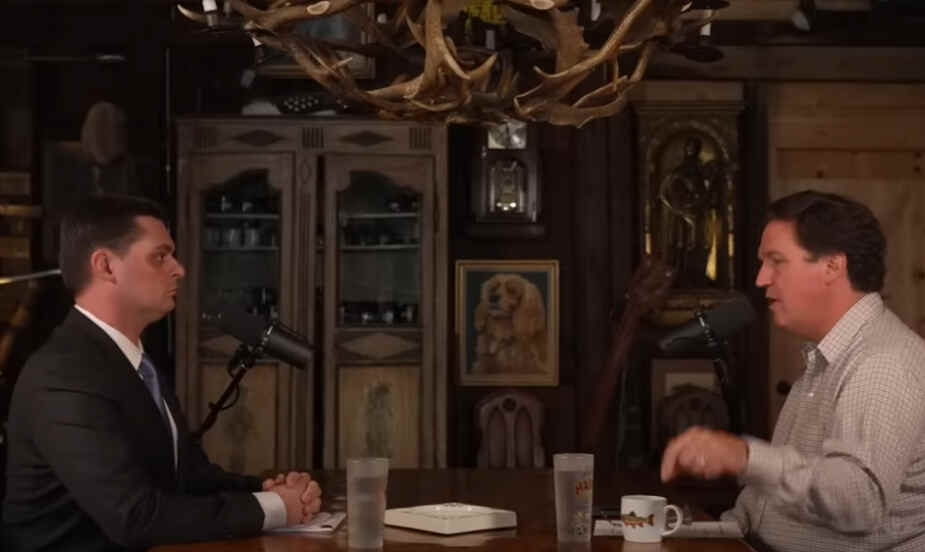
Read the full transcript of former Pentagon official Dan Caldwell’s interview on The Tucker Carlson Show episode titled “Military Expert Dan Caldwell Breaks Down What Will Happen Next in Israel’s War With Iran”, premiered June 20, 2025.
The Likelihood of US Strikes on Iran
TUCKER CARLSON: So it seems likely the US Government will participate in offensive strikes on Iran’s nuclear facilities. If that happens, what next? How does Iran respond? Can airstrikes alone end the nuclear program? And what happens to the rest of the countries in the region and Iran’s allies? Do they get involved?
There is no better person to talk this through with than former Pentagon official Dan Caldwell, who joins us now as we sit here right now. And I hope you’ll correct me if you think this is, this impression is wrong. But I think the general view among people who are watching what’s happening in Iran is that there will be some kind of US Strike.
I’m not, this is, I’m getting this from what I’m reading in the, in the popular press. There will be some kind of strike on Iran by the US Military against an enrichment site, the famous subterranean enrichment site with some kind of conventional, large, conventional bunker buster weapon. That has not happened. Of course, we don’t know that’s going to happen. We don’t know anything. But let’s just assume that does happen. What happens next?
DAN CALDWELL: Well, let me just say if it does happen, I hope all my predictions are dead wrong.
TUCKER CARLSON: Me, too. Thank you for saying that.
DAN CALDWELL: That means dead Americans. And you know, I won’t say who I was talking to somebody who I guess you could describe as a neoconservative. And you know, I said I hope if this happens, you’re making fun of me and calling me an idiot.
TUCKER CARLSON: Me too. I totally.
DAN CALDWELL: I really mean that because there’s guys who are just like me 15, 20 years ago that are going to be in the middle of this fight. Either they’re going to be on some of these bases that will likely come on or attack. They’re going to be part of air crews. You’re going to be on some of these ships. I really hope that all the confident predictions play out and I’d love to be wrong.
The Current State of Military Personnel
TUCKER CARLSON: Can I ask you to start? How are those guys, since you’ve been one of those guys, how are those guys feeling right now?
DAN CALDWELL: You know, are they getting news?
TUCKER CARLSON: Are they on social media? Are they aware of what people in the US Are saying about the likelihood of this?
DAN CALDWELL: I think that a lot of them are. I have spoken to a few that are still in the service. And the ones that I talk to are either senior listed or more senior officers. So they’ve been around for 15, 20, some, some cases, 25 years at the tail end of their careers. And honestly, a lot of those guys are tired.
And these were guys 20 years ago that the one thing they wanted was to get in the fight. They wanted to go to Iraq, they wanted to go Afghanistan. Some of them are on their seventh, eighth deployments, either to the region or to Europe or somewhere else, and they’re worn out.
And they also see that the military has really continued to be overstretched, despite the fact that the Iraq and Afghanistan wars have wound down. And remember, we still have thousands of troops in Iraq and Syria. Thankfully, the Trump administration, prior to this, appears to have started a retrograde, a withdrawal from Syria. Hopefully, we go to zero there.
So we solve a lot of troops there, and a lot of them just feel like we’ve been doing this for so long, and there’s so many things we have to do to fix the military, to fix the culture, something the DoD is really trying to prioritize. We need to reform. Our Army Secretary, Dan Driscoll, is starting this major army reform effort that I think is important, and another war will distract away from that. It’ll take resources away from that.
There’s a huge problem right now with standard of living within the United States military. A lot of barracks are falling apart. You had the Navy Secretary, John Phelan, and credit to him, he went out to Guam and saw the decrepit state of the barracks for, I believe, the Marines out there, and he ordered them shut down. And they were so bad.
So another war that not only puts more lives in danger and requires more deployments to that region, after 20 years of continuous deployment, sometimes the last minute, again, it takes resources away from things we need to do. And I think a lot of folks are really worried about that as well.
Life on Naval Vessels During Potential Conflict
TUCKER CARLSON: If you’re on a ship in the region right now and you think there could be, you know, offensive military action by the US Military, and you’re, you’re at some level of the chain, you’re part of it. Are you nervous?
DAN CALDWELL: I mean, being I. And when I was in the Marine Corps, even though we are an amphibious branch, I never served on a. On a ship before I flew over to Iraq. I didn’t go over on a. On a boat float. But, I mean, from what it’s been described me, you’re in a. A metal container.
I, you know, I used to talk a lot of trash about the Navy, but, but understanding what it’s like to live on a ship six months at a time, and especially when you get extended over and over again, I’d rather do multiple deployments to Iraq.
TUCKER CARLSON: So it’s nowhere to run, literally.
DAN CALDWELL: Yes. Yeah, it’s, it’s terrifying. And as been publicly reported, we had some very, very close calls in the recent fight against the Houthis is there was, you know, some anti ship missiles. We have a very effective ballistic missile defense and anti missile defense on these ships.
But one of the reasons why One of those F18s fell off the Harry S. Truman was because it had to do some aggressive maneuvers to potentially avoid a Houthi anti ship missile. And thankfully it didn’t hit. But imagine being One of the 6,000 sailors and marines on that ship and in that moment and it’s terrifying. It can be absolutely terrifying.
TUCKER CARLSON: It is terrifying. I’m sorry, I’m sorry I interrupt you. I just. No, I was thinking that this morning, what would it be like to be one of those guys just waiting for something to happen and knowing it could be nothing?
DAN CALDWELL: Nothing but respect for United States Navy.
TUCKER CARLSON: Totally agree. So you were saying. And I just wanted to add my voice and vehement agreement. I really hope to be wrong in every one of my predictions. I hope to laugh at myself and apologize to everyone for being hysterical. I really hope that I can do that and I know you feel the same way. So with that caveat, what do you think is likely to happen if a strike of the nature that I described happens?
Lessons from the Soleimani Strike
DAN CALDWELL: Well, I think the, the event to look back on the back to that could show us what could happen is what happened after the Soleimani strike. And it’s not a perfect comparison because it’s pretty clear the Iranians telegraphed to us that they were going to do that. We had some back channel communications most likely, and so we knew it was coming.
And so our troops on Al Asad Air base, where I served and actually interestingly where the vice president served as well, too many years ago, were able to get to shelters and to get out of places that were very exposed. And Iran launched a salvo of ballistic missiles at Al Asad Air Base. But even then, which is where Al Asad Air base is in western Iraq, it’s in Al Anbar Province.
TUCKER CARLSON: It’s an outright. I knew that.
DAN CALDWELL: And one thing to note about that base is, is that we do a lot of joint training with the Iraqi army and the Iraqi army is part of the Same government that has another security force called the Popular Mobilization Force, which is a group of militias that are loyal to Iran. They were funded, initially, supported and trained by Quds Force, led by Soleimani at the time.
And so we are at that base training allies of the people that are likely going to be trying to kill us in this war. So that’s important to remember. And that, I think can lead you to, to understand that is still the case. Absolutely. That’s our main mission in Iraq right now, is to support the Iraqi Security Forces, which includes the Popular Mobilization Forces, which consists of Iran allied militia groups.
The Contradictory Nature of Current Military Missions
TUCKER CARLSON: This is so bonkers.
DAN CALDWELL: It is the most convoluted mission, I think, on the face of the earth right now.
TUCKER CARLSON: Is that a mission that seems like a suicide pact? Kind of. Kind of. It seems like putting guys in jeopardy for what’s the purpose? Exactly.
DAN CALDWELL: We’re literally propping up an ally of Iran and we’re subsidizing an ally of Iran. And some will argue it’s like, well, we need these troops in Al Assad and we need them in parts of Baghdad still and other parts of the country to check Iran. But a small number of troops is not meaningfully influencing the Iraqi government and it’s not providing a meaningful check on Iranian influence. They’re just easy targets that allow us to, excuse me, allow the Iranians to bleed us cheaply.
TUCKER CARLSON: So without divulging anything, I mean, I know that you won’t, during the course of this conversation, say anything that is privileged or, you know, legally confidential, secret, but as far as you know, they’re, they’re there today. Those American troops are still in Iraq.
DAN CALDWELL: As far as I know, yes.
TUCKER CARLSON: Still surrounded by Iranian proxies.
DAN CALDWELL: Yes, yes. And so I would still have concerns about a strike, direct military intervention in Iran were those troops not there. But the risks would be substantially lower if we didn’t have troops in Iraq and Syria.
The Risk of Escalation Through Tripwire Forces
TUCKER CARLSON: Man, can I just say something really cynical? It’d be pretty easy to draw us in to a ground war against or a full scale regime change effort against Iran by attacking those troops.
DAN CALDWELL: No matter who you are, I’ve said it publicly prior to being at dod. In a lot of ways, those troops in Iraq and Syria were tripwire to a larger war and especially after the defeat of the ISIS caliphate. And you can argue whether or not they should have been put back into Iraq and Syria to begin with, but especially after the ISIS caliphate, they should not have been there.
And one of the. There were many crimes in the first Trump administration, but one of the greatest crimes in the first Trump administration was an active effort by President Trump’s own political appointees in some cases and elements of the military to undermine his stated preference to withdraw, particularly from Syria.
And let’s not forget you had the president’s special representative, I believe, for Syria, this guy, Jim Jeffrey, who after he left the administration, ran around Washington, D.C. bragging about lying to the president about the number of troops in Syria so that he would be less likely to withdraw them.
TUCKER CARLSON: That’s not a crime. I think that’s a crime.
DAN CALDWELL: It should be. It absolutely should be. And it’s disgraceful.
TUCKER CARLSON: And the fact subverting the civilian leadership of the military is not a crime.
DAN CALDWELL: I think it is, absolutely is. And it was completely outrageous. And as a result, I think there’s a direct line between that and last year when you had three army reservists killed at Tower 22 in Jordan by a drone. Tower 22 in Jordan is directly in support of. It exists to support a base in Syria. And had Jim Jeffrey and others not undermine President Trump, those three reservists would likely still be alive today.
TUCKER CARLSON: Why is it called Tower 22?
DAN CALDWELL: Honestly, I’m not entirely sure.
TUCKER CARLSON: But it is a US military installation of some kind in Jordan whose purpose is to support the US military installation that is in Syria, but shouldn’t be.
The Syrian Mission and Its Evolution
DAN CALDWELL: It’s literally right across the border. And that installation in Syria is called Tanf. And again, none of this, this has all been reported. Public info is that was originally established to train anti-Assad fighters to basically effectively retrain them to fight ISIS.
And so then that mission morphed into a counter Iran mission where it’s. They wanted to keep American troops there and the proxies there so Iran wouldn’t have a line of communication or basically, you know, an ability to move forces from Iran through Iraq to Syria. So that was a justification.
But then things changed in northern Syria. The Syrian army started collaborating more with the Kurds. So they got a line of communication and so then it ran out, another mission, and then it became airspace control.
And by the time it was, you got to January 2020, I believe it’s January, February 2024 when this incident happened, the Biden administration, it was reported when people asked about Syria policy, Biden admin officials would just laugh because we had none. So they were sitting there for no reason other than this belief is that you can never withdraw, retrench from anywhere because of surrender.
TUCKER CARLSON: Well, and the irony is, of course, that elements of ISIS now run Syria. And we’re cool with that for some reason. Yeah.
DAN CALDWELL: I mean, at the end of the day, Jelani was created in American prison. Now I will say I think it is good we’re trying to remove sanctions on Syria.
TUCKER CARLSON: I totally agree.
DAN CALDWELL: Because, you know, sanctions only hurt the, the average person in Syria. I’m glad we’re pursuing that. I’m glad we’re trying to pursue some type of diplomatic course there. But let’s be honest, who won that war? Al Qaeda won the war.
The Moral Bankruptcy of Current Policy
TUCKER CARLSON: Well, that’s the point. Look, I’m rooting for Jelani. I want him to become, you know, a wise leader who makes the region more stable and peaceful. And I want everyone to succeed. But as long as we’re framing everything in moral terms, this just shows the true bankruptcy of the program.
DAN CALDWELL: Yeah, that we replaced Assad with al Qaeda.
TUCKER CARLSON: Yeah.
DAN CALDWELL: You know, I guess the one thing they have in common is both begin with a first, but the one thing.
TUCKER CARLSON: They don’t have in common is only one of them is responsible for 9/11. So I think I’m pretty pro Assad, if that’s the choice.
DAN CALDWELL: I mean, I. Yeah, Assad definitely was incredibly nasty and awful.
TUCKER CARLSON: Yeah.
DAN CALDWELL: But essentially you bring up 9/11 who did we cooperate with after 9/11? We sent prisoners to Assad to help interrogate. And ultimately we had a shared interest in stopping Al Qaeda. So we cooperated with Assad early on.
TUCKER CARLSON: Terror, I know. So if you were to frame your foreign policy around your own interests or even around your own grievances, like fair to be mad about 9/11. All these people died. 3,000. Then you would definitely not be happy that the guy who helped you after 9/11 was overthrown in favor of the people who did 9/11. From an American perspective, that’s not a win.
The Cost of Syrian Involvement
DAN CALDWELL: And we spent tens of billions of dollars in Syria. We lost lives. We know Joe Kent, his story, his wife, absolute heroic woman. You know, other soldiers, Marines were wounded. We came close at several points to getting a combat with the actual Russian military. We had a major battle with Russian mercenaries, the Wagner Wagner group there.
You know, a lot of people focus on the risk of escalation in Ukraine and, and an incident where American and Russian forces that are operating the area could come into conflict and where that could go. That that almost happened in Syria on a weekly basis for several years because you had Russian and Syrian, or you had Russian and American aircraft operating the same place, you had American troops and Russian troops operating in the same area.
One misunderstanding could have kicked off a cycle where we’re in a major conflict with Russia and the focus has been on Ukraine. But the place for a longest time where Russian and American forces were brushing up against each other was in Syria. So especially after the destruction of ISIS caliphate, that mission should have ended. And it is again an absolute crime that it was undermined not once but twice in President Trump’s first term.
The Tripwire Strategy
TUCKER CARLSON: You described our true presence in Iraq as, quote, a tripwire. Can you flesh out what you mean by that and how it happened?
DAN CALDWELL: I would say both Iraq and Syria and probably more Syria is that kind of gets to ultimately why I think some people wanted to keep our troops there is that if there was a mass casualty incident where an Iranian aligned militia or some other actor attacked American troops and, you know, God forbid, killed or wounded a significant number of troops, that would have been justification to escalate either against Iran or to get more involved fighting other groups like, you know, Al Qaeda, ISIS.
And so just their mere presence was again, they weren’t effectively deterring Iran or other actors because they’re just too small. But their presence in and of itself was a risk that we could be sucked into a major war.
TUCKER CARLSON: So are you saying that you sincerely believe there are US Policymakers who Intentionally put American troops at risk.
DAN CALDWELL: I don’t think consciously there are us at least I don’t want to believe. No, there, there are US policymakers that believe that. But you know, I, I think subconsciously some folks did.
TUCKER CARLSON: I think Lyndon Johnson allowed the USS Liberty to be attacked. He knew those guys were going to die. I thought they’re all going to die. I mean that, I think that’s true. So, I mean that’s happened before. He’s the President, United States allowing, hoping for the death of US Troops for some other agenda. Like there are people that evil. Lyndon Johnson was that evil.
DAN CALDWELL: Yeah, I mean the, the, you know, when we know now about Gulf of Tonkin and all that other. I, I think so.
TUCKER CARLSON: Exactly. Yeah, exactly.
DAN CALDWELL: And I, you know my, my belief is, is that honestly a lot of it more had to do and we talked about this last interview, this kind of policy inertia like right, it’s easier just to say let’s keep doing the status quo as opposed to actually changing something because there’s less risk in a lot of people’s minds. Now again, I just laid out the risk of keeping troops there. But in some people’s minds there’s less risk to their career by preserving the status quo as opposed to changing something that’s not working.
TUCKER CARLSON: And regardless of motive, I think your point is demonstrably true. Whether or not the people who set it up intended it to be a tripwire. It is a tripwire.
DAN CALDWELL: Yes.
TUCKER CARLSON: That’s fair, right?
DAN CALDWELL: Yes, absolutely.
Escalation Scenarios with Iran
TUCKER CARLSON: So that’s the first thing that could happen if we strike, if the US Military strikes offensively against Iran in any way. Right. So, yeah. And okay, so then what else? What would happen then?
DAN CALDWELL: Well, that’s where there’s really, it all depends on the impact of the counterstrike on U.S. troops and on American facilities and how the United States responds if we continue. At that point, you’re on the escalation ladder.
So if our troops are attacked and we attack, we counterattack with a larger strike and a larger force. And if we use certain bases in the region, like say in places like Qatar, Kuwait, Bahrain, the Emirates, Saudi Arabia, if these countries allow us, and there’s a good chance this is something I think needs to be constantly reinforced, is that these Gulf Arab states are not where they were in 2019. So there’s not, it’s not a guarantee that they would allow us to use these bases in their country to attack Iran.
But if the Iranians perceive whether it’s true or not that we are using those bases and they’re looking to punish us, they will attack bases that are, you know, larger, more, maybe more hardened, but hosts a lot more troops and that could quickly lead to more casualties. They also attack ships in the Arabian Sea or Persian Gulf. And they could also, if we continue to get pushed up the escalation ladder, attack U.S. diplomatic facilities.
Now those are all worst case scenarios, but they’re risks that should be considered and can’t be ignored. So it gets back to this whole idea that I just, and again, I hope I’m wrong. I fundamentally don’t buy that you can just do one or two strikes and that’s it. And the Iranians aren’t going to respond. It’s going to have to be. You’re going to have to prepare and expect a much longer and much more.
TUCKER CARLSON: Bloody military campaign, obviously, without divulging the details of any kind of classified planning document. We know that the Pentagon has been thinking about how Iran would respond to a strike against its enrichment facilities for like a long time. A long, long time. This has been, I mean, people have, and I know that you’re one of them. Does anybody think that they just wouldn’t respond?
Iran’s Response Capabilities
DAN CALDWELL: I’m sure there are people right now who are trying to say is they won’t respond is like they’re weak, they’re on their back foot. They, they’re, they want to just save, save the regime. So therefore they’re just going to back off, that they’re not actually going to respond.
And if you look at the hours immediately after the Israeli initial Israeli set of airstrikes, there’s some people saying, watch, like Iran’s not going to really respond or it’s going to be weak. And, you know, over the next few days, they launched between four and 500 ballistic missiles. Again, thankfully, they weren’t as effective as originally advertised, but still they’ve, as we sit here today, I believe, killed around 25 Israelis, wounded nearly 600. They’ve been able to hit, you know.
TUCKER CARLSON: They’ve wounded 600 Israelis so far.
DAN CALDWELL: Yes. Yeah.
Information Control and Casualty Numbers
TUCKER CARLSON: Are we. There’s total military censorship in Israel. Israeli citizens are not allowed to leave. Most of them are not allowed to leave the country. They shut it down. So, like, they’re stuck there, poor people. And so, and there’s, you know, total control of the press in Israel. So do we know, like, are we confident we know the casualty numbers in Israel now?
DAN CALDWELL: Both sides, the numbers that have been released by both sides are in some cases maybe overstating things. I think it’s, it’s likely the Iranians are maybe overstating civilian casualties, understating military casualties, you would guess. And I think, I think it’s a lagging indicator. My understanding, and again, I’m not an expert on this, is that the way Israelis work is that they allow the information to come out at just a later point.
But look, I mean, in some ways I don’t blame them because somebody filming something from a balcony and how a missile hits, that is intelligence for their.
TUCKER CARLSON: Oh, I, oh, I’m not complaining about it. I’m just saying I, I always.
DAN CALDWELL: And you saw something. You see that very. In Ukraine as well.
TUCKER CARLSON: Yeah, I mean, you, that’s a whole different. I mean, the casualty numbers in Ukraine, you know, American lawmakers who funded this war extended this war for years at the expense of the Ukrainians, I think, have a moral obligation to know how many Ukrainians have died. They did this. Yeah, but they don’t care.
DAN CALDWELL: I actually think there’s an amendment and I could be wrong about this, put in one of the National Defense Authorization Acts or an attempt to force the disclosure of the two true casualty numbers. And I think it was defeated or it was added in and just it’s being ignored by DoD.
TUCKER CARLSON: Yeah, I really think that’s contemptible. I’ve asked a bunch of lawmakers who, who have, are really responsible for the war or the continuation of the war know like how many Ukrainians have died. They have no interest in knowing, you know.
The Strategic Race Between Iran and Israel
DAN CALDWELL: But anyway, the point of walking all that through is that Iran is really adjusting and changing their tactics as the war grinds on. And that’s in part because Israelis have been successful in destroying some of their mobile missile launchers and their missile stocks. So the barrages aren’t as intense, but you’re seeing them introduce new systems.
And here’s the most important thing: absent an American intervention, which as we’ve discussed could be imminent, right now the war is essentially a race between Iran and Israel. For the Israelis, they are trying to destroy as many Iranian ballistic missile launchers and ballistic missiles before they run out of anti-missile ballistic missile interceptors for their Arrow David Sling systems and then our THAAD Systems and our SM-3 SM-6s that we’re launching off of ships.
Likewise, Iranians are trying to preserve as many of their missile systems and survive as many Israeli airstrikes as possible while the Israelis wear down their store of precision munitions and missile interceptors. So each side is trying to get to a point where they’re either not threatened by certain offensive weapons systems or their offensive weapon systems can breach defensive systems more effectively and inflict more casualties.
And there’s smart people that say right now in that race, Israel has a slight advantage. Other smart people say Iran has a slight advantage because of the number of missiles they stockpiled. And that really right now is the game. So there’s a time pressure here on both sides and absent American military intervention, which will change the whole dynamic, that’s really what it’s going to come down to – which side can outlast the other with certain types of weapons and weapon systems.
The Potential for American Military Intervention
TUCKER CARLSON: Again with the caveat, I have no freaking idea what’s going to happen. Nobody does other than, well, I don’t know that anybody does right now. I mean there’s been reported repeatedly that there’s going to be American military intervention. Like that’s just reported as fact. And whether it is or not, so I just want to focus a little more intently on how does that change the dynamic and how much offensive intervention would qualify as like dragging America into the war officially?
DAN CALDWELL: Well, again, a lot of it goes back to the conversation we’re just having. If Iran doesn’t respond to just one or two strikes, they decide to take that blow and there’s evidence that most of the evidence shows they probably wouldn’t, then that would probably contain the size of the American offensive operation.
But if we were to go in, I think it is likely that we wouldn’t just hit a nuclear site for the sake of our own troops. So it would not just be a one-off strike or we’d coordinate with Israelis. And again, if there is an attack on American bases in response to this, that would pull the United States more into the war and push us into a spiral where we’re constantly escalating against the other side.
And then that brings us to a point where even though it’s pretty clear the Trump administration, even if they do decide to do the strike, doesn’t want a regime change war, ultimately gets pulled into a regime change war whether or not we want it.
The Three-Day Notice Dilemma
TUCKER CARLSON: So none of this was even on the table 10 days ago until the Prime Minister of Israel called the President of the United States and said I’m going in, I’m doing it, I don’t care what you say. Has all been reported in the New York Times, given three days notice. It’s just a little bit crazy that all of a sudden we’re talking about like how are we going to deal with this war against Iran, which wasn’t even a thing two weeks ago.
So I just want to say that if this were a war that the United States chose, this wasn’t a war that was chosen for us. We’re going along with it. But if we had chosen this, if we decided like depending on headquarters, we’re going to take out those enrichment facilities, you wouldn’t do it three days later. Right? There’s a lot of planning for these things.
DAN CALDWELL: Yes. And this is, I mean again, stuff has been publicly reported. These types of operations have been planned for years.
TUCKER CARLSON: Yeah.
DAN CALDWELL: And they’ve had different plans, they’ve adjusted, but have essentially been on the shelf for years now.
TUCKER CARLSON: Yeah. But does it make it harder to get just three days notice before the shooting starts?
DAN CALDWELL: This is where I’m a little unsure because I don’t know 100% for sure. There’s a lot of public reporting, but that’s not always…
TUCKER CARLSON: So that’s your… You’re absolutely right. And I shouldn’t pretend like I know.
DAN CALDWELL: And so I don’t know what was in the region or not, but to successfully accomplish something like this, you do need a lot of things that happen leading up into that. I think that is fair to say. And the United States military can move quickly when it needs to. I’ll say it can move quickly when you don’t have large number of ground troops, when you’re primarily relying on air and naval assets. So you can move stuff in quickly.
But leading up into that there normally would be a lot of planning. But again, I’m sorry if I’m going back and forth here. This has been a scenario that has been planned for a long time.
Russia’s Limited Involvement
TUCKER CARLSON: In thinking about this, non-classified of course, but given that Iran is part of BRICS and has all kinds of military and economic ties with Russia and China, how high is the concern that they might get involved?
DAN CALDWELL: So this is where it gets interesting is I think Russia in particular has a lot of reasons for them not to get involved.
TUCKER CARLSON: That’s my sense.
DAN CALDWELL: And the reason, there’s a few reasons. One, a lot of the things that Iran would need from Russia are actually things the Russians really need in Ukraine, right? So air defense assets, fighter jets and things like that. Russia’s military and industrial base is much more developed than the United States and NATO.
Interesting fact – and the NATO Secretary General says all the time – is Russia produces more weapons and munitions in three months than all of NATO combined produces in a year. But the Russian way of war in Ukraine relies on overwhelming firepower. So it’s very difficult for them to divert weapons to other partners. I’m not saying that couldn’t happen. Maybe there’s some intelligence sharing, but I don’t think that my gut would be, they would not support Iran in a very big way.
China’s Strategic Calculations
I think China is different. I don’t think that they would overtly support the Iranians, but I think if there’s one party that over the medium term at least, and they may face some short term challenges because of disruption and energy supplies, but over the medium term that would benefit from another major war in the Middle East that the United States is heavily involved in, it is China.
Because the weapons that we would be using to fight Iran are what we would need in a Pacific contingency. And God forbid we fight a war with China. It’s not even fighting war either. It’s weapons that we want to supply to some of our partners, whether it’s Japan or the Philippines or South Korea or Taiwan. Those are all systems that would be heavily used.
Whether it’s air defense, standoff munitions, other types of air-to-surface munitions, surface munitions. Those are the things that are going to lead the Iran fight because of just the size of Iran. Iran is a huge country, both in terms of population but geography. It’s not as small in terms of geography as Iraq and it’s just much longer distances to say, get from the Persian Gulf up to Tehran.
So you have to rely on certain types of weapons and certain types of aircraft. Again, all of which would be at the tip of a spear in a fight against China. So it is in their interest to see us expend more and more munitions and wear down more and more weapon systems in the Persian Gulf.
So again, China’s played it very smart in how they engage the Middle East. I think that they would be more willing to do things economically to help Iran and maybe provide some non-lethal systems like they have for Russia that could be beneficial for Iran in this fight. But again, you can’t…
TUCKER CARLSON: What do you mean by non-lethal systems?
DAN CALDWELL: So for example, China, there’s debate over this, but there’s not really clear evidence that China has provided lethal weapons systems like Iran and North Korea have to Russia. However, they have provided non-lethal weapon systems like counter-drone technology to Russia. They have provided, they’ve helped them get around some of the Western sanctions. They’ve helped provide them certain types of electronics that are maybe harder to get from the West. I think we can say that with confidence. They could do that with Iran.
TUCKER CARLSON: Massive investment in Russia.
DAN CALDWELL: Yes.
TUCKER CARLSON: Which by the way, keeps the Russian population prosperous and happy and not complaining about the war.
Natural Tensions vs. Forced Alliances
DAN CALDWELL: Yes. But again, as we talked about before, that’s not a natural alliance. And the Russian security services are still very suspicious of the Chinese, just like the Iranian security services are. They’re still suspicious of the Russians because there’s a long history of Russia invading…
TUCKER CARLSON: And these are countries that border each other.
DAN CALDWELL: Yes. Occupying Iran, I believe, twice in the 20th century. So getting back to a theme that we’ve talked about before is like, we’ve pushed these countries together because of our foreign policy. We should be able to pull them apart. They should have natural tension. But because of our foreign policy over the last 30 years, we’re creating these opportunities for cooperation. And that makes the situation in the Middle East worse, the situation in Ukraine worse, and the situation in the Pacific worse for us.
China’s Pacific Priorities
TUCKER CARLSON: Do you think there’s any chance that China becomes, if this does become a direct conflict between the United States and Iran, that China enters it in a way that’s like, that we can’t ignore, that’s just so provocative that we’re at war with them too?
DAN CALDWELL: I think it’s more likely that they would make a decision to do something in the Pacific because that is more important to them. I don’t buy this argument that if we were to pull out of the Middle East, that China would want to become a hegemon in the Middle East. They have been able to use smart power and minimal military power to maintain influence and reap economic benefits from the Middle East. And they don’t have the force projection capabilities that the United States has.
Some smart people that I’ve worked with have made pretty compelling arguments that they are not likely to try and dominate the Middle East. So I don’t think China would get directly involved in the Middle East. But if they see the United States worn down even more in the Middle East, that may change some of their calculus vis-à-vis Taiwan.
Understanding China’s Regional Perspective
TUCKER CARLSON: And I wonder, not just Taiwan. So we’ve been in Japan for 80 years. We’ve been in Korea since 1950, 75 years. Those are in their neighborhood. And I’m certainly not justifying anything, I’m not, but I’m just trying to understand their perspective because I think it’s meaningful.
If there were, if there was an 80-year-old Chinese military base in Belize, you’d be like a little close. We wouldn’t want that. Nobody wants that. And so maybe their expectation is that they can drive us out of the East, out of their direct sphere. Is that a concern? I mean, is that something that people who think this stuff through, think about?
The Pacific Theater vs. Middle East Priorities
DAN CALDWELL: Yeah, I think there have been people that have thought about that and I think there’s a lot of people. Honestly, I think one of the biggest issues the Pentagon is dealing with right now is since that has been identified as the main theater, the main threat, the pacing, to use military term, the pacing threat or pacing challenge, whatever term you want to use, that everything we’re doing in the Middle East trades off against the Pacific, which from an economic standpoint is much more important to us than the Middle East.
You know, what happens in the South China Sea is fundamentally more important than what happens in the Middle East. Middle East I think is, you know, 5% of the world’s population, 5% of the GDP. East Asia is like something like 60%, 40 or 60% of the world’s GDP. So just from a trade and the conditions of our economic prosperity standpoint, it is much more important to us.
And China is an actual, real existential threat to the United States, where Iran is a threat in so much that we have 40,000 troops spread across the Middle East, many of them who are in exposed positions, as we’ve talked about, that are vulnerable to Iranian attacks. That’s the biggest reason why they’re a threat.
TUCKER CARLSON: Wait, I don’t, I don’t think you watch Fox News. I heard Ted Cruz say that the Iranians are going to nuke LA.
DAN CALDWELL: Well, as of right now, they don’t have a nuclear bomb. One interesting thing is, is Iran has not developed missiles that go beyond a certain range. Doesn’t mean they can’t, but, but they have been hesitant to up until this point because they don’t want to be seen as threatening countries outside their region.
TUCKER CARLSON: So why is Ted Cruz saying they’re going to nuke LA?
DAN CALDWELL: I think, and again, I’ve been a big Ted Cruz fan over the years. I’ve come to, you know, respect him on many levels. I think he is repeating a talking point to help raise the level in people’s minds, the level of threat that Iran actually imposed in order to justify.
TUCKER CARLSON: American involvement in regime change.
Iran’s Actual Capabilities vs. Perceived Threats
DAN CALDWELL: Correct. Let’s be honest, Iran has been a bad actor in the Middle East. They have been a major sponsor of terrorism, indisputably. But I believe their economy is the size of Pennsylvania. Saudi Arabia alone spends four times what they do on defense. They’re bordered by Pakistan that has a nuclear weapon, and they have pretty decent relationship right now. But over the years, there’s been tension because Pakistan, Sunni, Iran, Shia.
You have Israel with a very capable nuclear triad and very capable army. So they’re surrounded by countries in the region that have historical antagonisms with them, and they simply, right now do not possess the capability to hit the United States with conventional weapons.
What they do, and this is something we’ve talked about, need to be concerned about, is they do have the ability to infiltrate terrorists in other countries. That is a risk that is something we need to take into account, but is not existential. Like the threat posed by China with the what is quickly emerging as the biggest navy in the world with hundreds of nuclear weapons, including intercontinental ballistic missiles, against the United States, China, that could shut off a significant amount of trade and economic activity to the United States and harm us in significant ways.
Iran is simply not an existential threat in the same way that China is and even Russia is with 6,000 nuclear weapons.
TUCKER CARLSON: So why are we so focused on Iran?
DAN CALDWELL: There are a lot of reasons they.
TUCKER CARLSON: Can’t be strictly limited to our national interest, given what you just said.
The Drive for Liberal Hegemony
DAN CALDWELL: Again, it goes back to first and foremost, and I know people want to talk about a whole host of other things, but really the thing that is driving this the most, and our focus on Iran and the Middle East as a whole, is that too many of our policymakers still believe in the idea that America needs to be not simply the most powerful country in the world, but the most dominant power in the world.
That we need to have dominance in a way that we are able to impose our values on other parts of the world that have rejected them, mainly liberalism, that we need to use our dominance to achieve liberal hegemony. And that leads us into conflict with countries in regions that really shouldn’t matter as much to us as they should. And we do have some interest in the Middle East, to be clear, and I can walk through those. But the countries that just don’t pose the type of threat that a lot of people in Washington hype them up.
TUCKER CARLSON: Wouldn’t it be easier if you’re the Iranian government, just like observe Pride Month in Tehran and just get this over with and then there’s no threat of an attack? Right.
DAN CALDWELL: Well, as Brett Stevens told my friend Saurabh Amari, he wants to ultimately see the 82nd Airborne in the streets of Tehran escorting a gay pride parade. And that kind of, that kind of sums that up.
TUCKER CARLSON: Brett Stevens said that? Yeah, man, I’ve known a lot of people in 56 years. I don’t know I’ve ever met anybody weirder and dumber than Brett Stevens. But that’s just me.
DAN CALDWELL: I, I actually, this is going to sound weird. Yeah, I respect him because he just says it out loud. He, he, he says, yeah, I want the United States to be the most dominant power in the world to spread liberal values. I want, I want the United States.
TUCKER CARLSON: To not even from this country. I mean, it’s like getting a lecture about America from Brett Stevens is like.
DAN CALDWELL: I, again, I just, I’m pretty sure.
TUCKER CARLSON: He’s from Mexico, but whatever he is, yeah, he’s from Mexico.
The New York Times Op-Ed Consensus
DAN CALDWELL: I didn’t know that. But again, I, in a weird way, I obviously find his views abhorrent. I mean, he’s, he’s said absolutely fundamentally racist things about, about, you know, Arabs and other people. He’s got a weird obsession with genetics. But he’s honest. He doesn’t try to like wrap it in the, in the, this cloak of American interests and American values. He just comes out and said, is it? And, and, and again, in a weird way, I kind of appreciate that.
TUCKER CARLSON: Yeah. No, I mean, there, there’s, I guess that’s where the being an idiot kind of plays into it. He just kind of says it out loud.
DAN CALDWELL: Isn’t it, isn’t it funny essentially that I think you have what, three or four New York Times op ed writers that believe exactly what he believes? I mean, David Brooks, David French, him. Tom Friedman’s kind of evolving. I don’t even know where Tom Friedman is these days.
But essentially they, they, they, they, yeah, they, they hold the same views, the supposed, you know, left wing paper. And there’s some, look, they’ve, you know, credit New York Times. Sometimes they do have some good stuff on their op ed pages. But you know that you have, you essentially have four op ed columnists that believe essentially the same thing. They just express it differently. Like, David French would never be that. David French would be the guy that, that masks it and like this is what’s good for America and America, they’re all violence worshipers.
TUCKER CARLSON: David French especially. And there is a kind of like weak man compensates through promoting killing in other parts of the world. You know, it’s like this sort of same weird cuck syndrome they all have. No, it, it is though. It is. I mean, you don’t have to be Sigmund Freud, to see like David French is like a psychosexual thing that’s going on here.
DAN CALDWELL: Yeah.
TUCKER CARLSON: So handsome.
DAN CALDWELL: I mean, I, I will say this with David is, you know, I’m, I’m.
TUCKER CARLSON: A much bigger dick than you are. And I’m sorry you’re such a nice.
David French and the Democratic Party’s Foreign Policy Shift
DAN CALDWELL: No, I, well, you bring up certain people. I will be a dick is. I, I think David, he’s so interesting because he, he brought away such a much different. And I know there’s people that, you know, mocked his military service. I’m not going to do that. But he brought way like a much different understanding of his service in Iraq than a lot of other people. And I’ve just kind of found that fascinating.
And I think in a lot of ways his views are really increasingly the way he talks about foreign policy. I think he’s more of a barometer of where the center of the Democrat Party is than the, the dying neoconservative fringe of the Republican Party is. He is representing increasingly where the Democrat Party is, not the Republican Party on foreign policy.
TUCKER CARLSON: Interesting.
DAN CALDWELL: And we, we brought this up last time. Remember the, the Democrat party platform in 2020 was more hawkish on Iran. They did a 180 from, from, excuse me, in 2024. They did a 180 from where they were in 2020 on Iran in 2024. And it was more hawkish. And there’s a world where you could add Liz Cheney as a national security advisor or as a secretary of defense.
TUCKER CARLSON: That’s just the darkest thing I can imagine. So you, I just want to go back to something you said a second ago. You said the dying Republican neocon fringe. Of course, I love the sound of that. But it’s hard to see you’re looking obviously in more broadly than I am because right now I see Fox News as just this pure crazed neocon war propaganda operation.
Mark Levin, the least credible person in broadcasting is like in charge of the government. I mean, I’m overstating, of course, but it’s like they seem very powerful right now, that part of the Republican Party. Mitch McConnell, Tom Cotton, Ted Cruz, Mark Levin. But you’re saying they’re a dying fringe.
The Lack of Popular Support for War with Iran
DAN CALDWELL: Again, it’s looking at it right now. It’s very easy to think that the neocons have once again taken over the foreign policy apparatus of the Republican Party. But I think we need to look at a couple things. There is no popular support for going to war directly with Iran. We have to acknowledge there is concern about Iran getting Nuclear weapon. But there’s not a constituency for going to war with Iran and there hasn’t really ever been one. But most of your Republican voters don’t want this.
TUCKER CARLSON: I looked up the numbers, the polling numbers, and I think the AIDS virus is more popular than the idea of going to war with Iran. I think it’s actually 16% national support.
DAN CALDWELL: Yeah. And that was from YouGov. Brookings has done polls, the University of Maryland. There was one joke of a poll that was clearly manipulated that’s being circulated by neocons. But there’s poll after poll from both liberal, nonpartisan conservative institutions show there’s not broad support for this.
In addition, you now have within the administration a lot of people that don’t look like the types of people that used to staff Republican administrations, mainly George W. Bush administration. But also you could argue that the first Trump term in terms of foreign policy, these are people like Bridge Colby, people like Joe Kent, people like Michael Anton who have different ideas about American foreign policy and are much different than say the types of people that a Paul Wolfowitz or John Bolton would hire into administration. So they don’t have a lot of people within the power structure right now, at least on the political side, within the career side and the military. Absolutely.
And then in addition, you have to acknowledge is that there’s now an institutional structure that didn’t exist in 2016 of organizations that are able to get a message out around foreign policy that the challenges are what, you know, Ben Rhodes called the Blob, even though he’s a card carrying member of the Blob, these traditional organizations that push for American primacy intervention.
So you have a lot of pieces coming together that show that, that neoconservatism on the right is, is in retreat. But that’s in a lot of cases when movements can be most dangerous, is that I really sense in a lot of ways why they have gone all out is because they’re desperate, is they see, particularly on the right, the younger cohort coming up and we talked about this. A lot of these people make you and me look like Paul Wolfowitz in terms of foreign policy beliefs.
TUCKER CARLSON: I feel very, I mean I always say this, but I feel very moderate. I am very moderate just by temperament and I don’t meet really any moderate young people on these questions at all.
DAN CALDWELL: Right. And they see that. So that’s why there’s such an all out effort right now to push this, because they think it’s their last chance.
Israel’s Goals vs. Trump’s Goals on Iran
TUCKER CARLSON: I think they’re right. I think they’re Right. So I think even now we’re sort of officially clinging to the idea that Israel’s goal here is a non nuclear Iran. That’s not true. Their goal is regime change, I think it’s fair to say. But I do think Donald Trump’s goal is not regime change. I don’t think he wants to be. I know he doesn’t want to be in a regime change where he doesn’t want Iran to have a bomb. He said that a million times. My question is a practical one. Is it possible to shut down a nuclear program with an air campaign?
Military Capabilities and Nuclear Deterrence
DAN CALDWELL: I think you can roll it back. I think you can severely damage it. But look, I’ll use an argument that the advocates of the Iraq war made, is that you can’t truly shut down a weapons of mass destruction campaign with certain people in charge of the country. You can’t truly shut it down because you can’t trust inspectors, you can’t truly trust intelligence. They were doing that in a very manipulative way. But there’s a sliver of truth in that.
So if you truly want to get rid of an Iranian nuclear weapon program and make sure it’s totally dismantled, it’s likely going to require a regime change or some type of occupation or, you know, invasion. That may sound extreme, but if you stop and think about it, that’s the truth. Now you can roll again.
TUCKER CARLSON: Well, so I have thought about it, but not as deeply as you have, I would bet. Can you flesh that out a little bit? Why would an air campaign not solve the nuclear problem?
DAN CALDWELL: Because you would need to verify that all the centrifuges are destroyed. You need to verify that all the knowledge, both, you know, scientists, you know, other engineers, that they are accounted for, in some cases killed, that there’s no files remaining, and that all the centrifuges, all the different pieces, all the nuclear material, the triggers, anything that could be part of this are destroyed. And then any development of the delivery systems, it is incredibly difficult to do that. It’s impossible to do that purely through error.
You’re going to need inspections, you’re going to need people on the ground verifying this. And again, what we’ve seen before is the argument that the inspectors aren’t going to find everything. So I think you can kind of see where this is going. And so the argument likely that you’re going to see, and it’s not totally incorrect, is that to truly get rid of the threat of a nuclear Iran, an Islamic republic with a nuclear bomb is you’re going to need regime change.
And so, as I said previously, that’s why, in my mind, this really isn’t about a nuclear bomb. And I think I want to be clear, for President Trump, it is. And for a lot of good people who rightly are concerned about nuclear, it is about that. But for a lot of others, it’s about regime change. And I think that the consequences of that for the United States, for the Middle East, even for Israel, have not been thought through. Because a lot of people, just like in Iraq, they aren’t thinking about what comes next if we get rid of Iran, but we just Islamic Republic.
Lessons from Recent Military Interventions
TUCKER CARLSON: We just had the Iraq war. I mean, that was. It only started 22 years ago, and we still have troops there. We just got out of Afghanistan a couple few years ago. After 20 years. Like, the memory is not just fresh. It’s not even a memory. It’s still a present reality. We still have troops there.
DAN CALDWELL: What are you talking about? I mean, Iraq is a thriving liberal democracy. Afghanistan just achieved 100% female literacy. I don’t. I like.
TUCKER CARLSON: Which was always. Which was always the goal.
DAN CALDWELL: You know, I don’t know what you’re talking about. But, you know, joking aside is there’s still a lot of people who think we can do this, that we can actually change a regime and instill liberalism through the barrel of a gun. There is still that thinking in Washington, D.C. that they have learned nothing from Iraq, from Syria, from Libya, from Afghanistan, from Yemen, from other places. It does not work.
The Contracting American Empire
TUCKER CARLSON: My problem is bigger, which is what happens to the American empire, which is obviously contracting. We don’t have the will or the money to sustain it at current levels. Obviously, we are challenged by China and maybe other countries for supremacy over shipping lanes and over the air and all this. Things are changing really, really fast.
So the empire is getting smaller, but there’s got to be a way to unwind it slowly, thoughtfully, with minimal damage. I think our adversaries, not even enemies, but just challengers to our position, would like to crumble in one day. So there’s this incentive to really kick the legs out from under America right now. Do you feel that?
DAN CALDWELL: I believe so. Yeah. I think so. And again, there’s a lot of people, I think, in China that would love us to see bogged down in the Middle East. You and I, you know, are. We don’t believe that we should be involved in the Ukrainian war. But if you’re somebody that thinks that, that, you know, Ukraine is the most important thing for liberal democracy, this war is going to make it harder, if not impossible to support Ukraine. You know it’s going to make it harder.
TUCKER CARLSON: Why is that? Why is that? Why would a war with Iran make it impossible to continue supporting Ukraine?
Resource Constraints and Military Logistics
DAN CALDWELL: It’s a good question. So after the October 7th attacks, you had Joe Biden go on 60 Minutes and say after he was asked by the host, I forget what host it was, but he was asked, are we going to be able to support both Israel and Ukraine? And his dying brain said, oh, come on man, of course we can. We’re the most powerful country ever. We won World War II, of course we can do both.
And a week later, the United States was forced to redirect a shipment of artillery shells from Ukraine to Israel to support them in their fight against Hamas. And that right there just shattered the illusion that we can do both of artillery shells.
TUCKER CARLSON: So pretty low tech stuff, right?
DAN CALDWELL: And we had about, I believe, six, seven months prior to October 7, when Netanyahu was out of power for a bit, I think Holly Bennett was in charge. He allowed the not allowed but signed off on the United States to pull all our artillery shells out of a pre positioned stockpile to give them to the Ukrainians to support them in their ultimately failed counteroffensive.
So when October 7th kicked off, they needed certain types of ammunition. The stockpile that we had staged to support Israel in times of crisis was drained and we could not refill it because we were giving the Ukrainians more artillery shells per month than we could produce. So we were drawing down our stockpiles to very low levels.
Now that’s just artillery. I don’t, at least right now, think there’s going to be a lot of artillery battles. At least I hope not. If that happens, it’s gotten really bad. But the most precious munition and asset, military asset in the world right now is air defense. So the Ukrainians need Patriot missiles. And there’s been a lot of discussion in the press. That’s Zelensky’s number one demand when he talks to the United States. You want Patriot missiles?
Well, the United States is going to need a lot of Patriot missiles to defend our troops in a war with Iran. So if a war with Iran kicks off and we’re firing through our supply of Patriot missiles, we just simply aren’t going to be able to give the Ukrainians anymore.
TUCKER CARLSON: Sounds like we’re undersupplied.
DAN CALDWELL: Absolutely, we are. And this, again, a lot of this, we can talk about ideology all day, but the end of the day, this is really a math problem. We Were talking about that earlier with the race that Iran and Iraq are in, or excuse me, Iran and Israel. Our ability to sustain fights like this for long periods of time is extremely limited. And you’re in a very precarious situation as a result of this.
Defense Spending and Production Issues
TUCKER CARLSON: And what do they do with a trillion dollars a year? Exactly.
DAN CALDWELL: It’s a good question.
TUCKER CARLSON: No, for real, I’m not being mean. I mean I respect. There are some people in the military officers I respect. Not a ton, but some I’ve met, some really smart ones. But like no one thought ahead. You can’t even produce enough artillery to supply Ukraine and Israel. Not huge countries like that. What is that?
DAN CALDWELL: So if you look at a system like the Iron Dome in Israel now everybody kind of talks about, they call Israel’s entire system the Iron Dome. It’s really, Iron Dome is designed to shoot down cheap rockets from Hamas and Hezbollah.
TUCKER CARLSON: Right.
DAN CALDWELL: The systems are being used now are David Sling and the Arrow system and then our THAAD system and some of our naval ships. Yeah, but the Iron Dome is designed to be a little more cheap and to shoot more in mass. We don’t have enough systems similar to that where we can produce a lot of things in mass and in quantity.
We focus on building these expensive systems with a lot of bells and whistles because we still haven’t adapted to the fact that these wars that are quick and cheap and easy or not necessarily cheap but are relatively quick where you don’t use a lot of expensive munitions, that those are few and going to be few and far between if non existent in the future.
So our defense industrial base still hasn’t adapted to the fact that we just need to produce more really cheaper and in some cases less advanced weapons in larger scale instead of building these highly advanced weapons with all these bells and whistles in smaller numbers like right now, again, this public knowledge we only produce about I’d say 100, 150 and I could, it could actually be lower interceptors. So ammunition for the THAAD system, which is our most advanced anti ballistic missile system, we have only produced nine of around 900 to 1,000 THAAD interceptors. Just 900 to a thousand.
TUCKER CARLSON: That’s total.
DAN CALDWELL: I’m not talking launchers, I’m talking the rounds for them.
TUCKER CARLSON: Yeah, yeah.
DAN CALDWELL: So Iran has about, depends on the estimate, about 2 to 3,000 ballistic missiles that can reach Israel and maybe it’s probably significantly less because Israelis. But you see how this quickly becomes a math problem. We’ve only built between 900,000. They have up to 2,000 types of missiles that the THAAD is designed to shoot down. And if you’re assuming 100% success rate, you don’t have enough interception.
TUCKER CARLSON: Again, I refer to the previous question. What do we spend a trillion dollars a year on?
DAN CALDWELL: We spend it on those hard to produce expensive systems. And some of them, you have to admit, are very capable. F35 has gotten a lot of criticism over the years, but I think we’ve adapted and turned into a fairly capable system. Some people may disagree with me on that, but I think it is a capable system, but we haven’t been able to build and that has a lot to do with how we funded it.
Enough of those or enough of certain types of ammunition to really fight a long extended war against an enemy that has either a lot of people or can produce a lot of things like cheap drones or cheap rockets or cheap indirect fire weapons. We just are not quite set up for that type of fight yet.
TUCKER CARLSON: Well, I mean, Russia still occupies Eastern Ukraine.
DAN CALDWELL: Exactly. And for that, I mean, that is where it should have become patently obvious to us that we have to change how we do this. And again, credit to some of my colleagues at DoD is they know it. We fortunately just confirmed for Undersecretary of Acquisition and Sustainment Mike Duffy. I think Steve Feinberg knows that they know, but they have a big fight. Going to be fighting a lot of entrenched interests to.
TUCKER CARLSON: It seems like the wrong time to start swaggering around trying to start new wars with people.
DAN CALDWELL: Yeah, exactly. We are trying to fix a lot of things and we’re going to have to put a lot of those things on the back burner if we get into a major regional fight.
The Reality of Military Solutions
TUCKER CARLSON: If we throw these. And again, I don’t know this is going to happen. But the President’s stated goal is to make sure that Iran doesn’t have nuclear weapons. I just want to restate. You don’t believe as a practical matter that’s achievable with a couple bunker buster strikes.
DAN CALDWELL: I do not. And again, I hope I’m wrong. I think the best, the least worst option is an imperfect diplomatic solution. That is the best, least risky option, probably the only option.
TUCKER CARLSON: I mean, you can’t force your wife to love you can’t, you know, beat her up till she loves you. You have to. In the end, everything is voluntary. You have to convince people. And someone who’s determined. Well, you’re the military guy, you tell me. I mean, if someone is determined to commit violence against you. It’s pretty hard to stop it if he’s still alive. Right.
DAN CALDWELL: You could deter it. And that’s where deterrence comes into effect here, is that there are different levers. And I’ve said this before, is, yes, you do need a credible military option.
TUCKER CARLSON: Yeah, yeah.
DAN CALDWELL: For diplomacy to work. But I think everyone agrees, even. Well, not everyone, but I think everyone who’s approaching this in a sane manner understands, just like with the Ukraine war, is that this is the least worst way for this to end is with a robust diplomatic agreement. Again, maybe it’s not so robust. It’s less than perfect. That does restrain Iranian nuclear ambitions.
Military Personnel and Foreign Policy Concerns
TUCKER CARLSON: I got to wonder about the troops who are at the barrel end of this thing. If they read the New York Times, they learn that the U.S. really had nothing to do with any of this. Just sort of Israel shows up and says, we’re doing this, and now we’re following along and participating to some extent, maybe now to a greater extent.
What do they think of that? It feels like it doesn’t feel like it’s true. We were pushed into this by another country. Is that if you’re serving in uniform, away from your family, risking death, is that like a good reason? Do you think that’s adequate, or do people not think like that when they’re deployed?
DAN CALDWELL: I think most folks are going to have those thoughts, but they’re going to put them down and they’re going to focus on the mission. I think that’s what they have to do.
TUCKER CARLSON: Yeah, of course. I totally agree.
DAN CALDWELL: You can’t. You know, when you’re in the middle of a. You know, when you’re about to drop bombs on Fordo and you’re a B2 pilot, you can’t in your head be wondering about, you know, the nature of American foreign policy and how we got here.
TUCKER CARLSON: No, I totally get it. But when you get home.
Regional Security Architecture and Unintended Consequences
DAN CALDWELL: Yeah, and look, I have to be honest here, and I’ve told people this. I’m somebody who does believe the United States should have a partnership and support Israel. I think that an ideal world is that we would have a security architecture where you would have Gulf Arabs cooperating with Israel. That would help prevent the rise of a regional hegemon and a global hegemon coming in, dominating the region. I see benefits to that.
But I am concerned that if this is perceived as a war for Israel, what impact is that going to have on support for us doing some of those things? And I’ve tried to communicate to people who are strong supporters of the state of Israel. That that’s one of these second and third order implications that you need to be aware of is what is going to happen in popular support for the state of Israel. I think you and Steve Bannon talked about this.
And there’s another aspect here too. Right now in the region, the Gulf Arab states are wanting to pursue better relations with Israel for a lot of reasons, business opportunities, other things. But one of the biggest things pushing them together is the threat of Iran. So if Iran collapses, it’s a failed state. If they’re not there, I think in a lot of ways, again, there’s still going to be Iran. And it’s not clear. A lot of the regime change advocates can’t articulate really what comes next.
The Shah’s fail son probably is going to go back to Tehran and take over. These nuts and the MEK aren’t going to come and take over. But whatever is there, if it’s less of a threat, if it’s not the same threat again, that’s probably good. But what’s the unintended consequence of that? Just like the unintended consequence of removing Saddam Hussein was empowering Iran, if you don’t have that threat posed by Iran anymore that in some ways balances against the Gulf Arabs, they’re going to look at Israel and they may have concerns and they may go back to where they were before and be hostile to Israel.
TUCKER CARLSON: Yeah.
Israel’s Historical Periphery Doctrine
DAN CALDWELL: It’s important to remember that for most of the Cold War, Israel pursued a foreign policy that was rooted in something called the Periphery doctrine. And it was very smart. It was driven by Ben Gurion, where they dealt with a hostile Arab world, particularly the states that were supported by the Soviets. So they prioritized building relations with non Arab countries on the periphery of the Middle East. So primarily Turkey, Iran and Ethiopia. And that was to balance against the Arabs.
And that’s why Israel, even after the Islamic Revolution, even though Khomeini was screaming death to Israel, that’s why initially after Iraq invaded Iran, Israel was their main arms supplier and other countries started selling them stuff. That’s why Israel was such an integral part of Iran Contra, why you had a lot of American neoconservatives who were supporters of Israel that were advocates in the 80s, people like Michael Ledeen, Elliot Abrams, of still trying to pursue good relations with Iran, even though you had Khomeini shouting death or America, Death to Israel.
And that’s why up until the end of the Cold War and the defeat of Iraq in the Gulf War, that Israel viewed Iraq as a bigger threat as opposed to Iran, and they were quietly supporting Iran, in some cases openly, even though you had this very anti Semitic, anti Israel regime. And honestly, it was incredibly. I believe that was a smart thing to do. But after the end of the Cold War, after Saddam, the country they viewed as more threatening was degraded. Iran became the bigger threat.
So I tell that story to say is what happens after you don’t have Iran? Does Turkey become more powerful? Do other countries start to band together out of fear of what Israel’s done in Iran? And so I’m really concerned that people aren’t thinking through what could happen here then, not to mention what could happen in Iran.
I’ve only listened to a small part of your interview with Ted Cruz, but he was saying something about how it’d be good if the Islamic regime was gone and through a popular uprising. Yeah. An ideal world, you’d have a bunch of Iranian liberals rise up and overthrow the Islamic regime and you’d have a popular democracy in Iran. But it’s more likely you could have something worse. Replace the mullahs. You could have Iran break into a civil war. You have a lot of ethnic minorities that are looking for independence. If Iraq hadn’t invaded Iran in 1980, there’s a chance there’s a world where Iran could have devolved into major civil war. Because all these ethnic minorities that were trying to break away, 40% of the country. Yes. So that’s a lot, lot of history there. But this is what is not being discussed about the risks around regime change that really worries me. And it’s a repeat of what happened in Iraq in 2000.
The Politics of Perpetual Conflict
TUCKER CARLSON: Well, I think the people pushing literally just don’t care at all. And in fact, chaos in neighboring states, I think is bad for the world. And including Israel, I think it’s bad for everybody. But there are some people who think it’s good. I mean, that is a world. That is a view.
DAN CALDWELL: Yeah.
TUCKER CARLSON: Abetting chaos on purpose.
DAN CALDWELL: Yes. It’s kind of like. So I was just in Europe and was meeting with European diplomats, was very interesting. And some of them were open. We saying we want the Ukrainian war to continue because it benefits us. And these were from countries. I won’t, you know, Chatham House rules. I won’t say who. But these are from countries that are supposedly the strongest supporters of Ukraine saying, we want the war to continue, not we want Ukraine to win, we want the war to continue.
TUCKER CARLSON: Why?
DAN CALDWELL: Well, for them, they perceive Russia as a threat and that if Russia stops fighting in Ukraine, then They’ll reorient against them, even though there’s really not. Putin has not expressed the intent as clearly as some people like to say.
Western Leadership and Misplaced Anger
TUCKER CARLSON: What’s so funny? I mean, if I would just. I know the Brits feel this way especially. Oh yeah, They’ve convinced themselves that Russia’s their greatest enemy. It’s bizarre. But, you know, if I were Putin, I would offer free first class trips to Moscow so they could see that, like Moscow was so much nicer than any place in Great Britain. It’s like, not even close. There’s no part of Great Britain that’s as nice as Moscow. It’s like probably an upgrade for them. I mean, their, their leadership is so bad, their country is so degraded.
DAN CALDWELL: I think, I think a lot of them, I think the Brits are starting, I will say, I think they’re starting to come around a bit.
TUCKER CARLSON: It’s some, it’s weird that they’re mad at Putin. Why aren’t they mad at Keir Starmer? Why aren’t they mad at the conserv fake conservative Rishi Sunak? And you know what I mean?
DAN CALDWELL: I think part of it is for, for them. And I’m not by no means an expert on British politics. I enjoyed working with some people. The British defense establishment was in the Pentagon. I have a lot of respect for them, but there’s still kind of this grasping at trying to be a global imperial power when they’re, you know, they don’t have the resources or the power.
TUCKER CARLSON: Of course, and I feel sorry for them. Unsort of. But, but on the other hand, it’s like every western country has the same syndrome where they’re well deserved frustrations about the decline of their own countries are channeled into hate at people thousands of miles away.
It’s like you’re in a country where people are just dropping dead at 25 of fentanyl ODs and no one can get a job after graduating college and you can’t afford a house and can’t get married or have kids and you’re like, I’m mad at Putin, I’m mad at the ayatollahs. It’s like, you know what I mean? It’s this weird kind of like unwillingness to face the truth, which is, no, you’ve been betrayed by your own leaders.
DAN CALDWELL: It’s easier to point, it’s easier to point abroad than look, you know, and you’ve seen that, you’ve seen that throughout history. You know, the British dealt with that in the Falklands War. Why did Argentina invade the Falklands when they did, because the Argentina junta was having severe problems.
TUCKER CARLSON: Exactly. And why did Thatcher respond the way that she did? Because she had also just come out of these strikes and that helped her tremendously. No, there’s all kinds of baked in incentives to war. You do wish some of these countries would take that hostility, which, again, is well earned. They have a right to be hostile and focus it against their own leaders and effect regime change in their own countries. These countries, they deserve regime change. A lot of these countries in the west.
Ukraine: Western Supporters vs. Ukrainian Reality
DAN CALDWELL: Yeah. And it’s. Again, for me, I. I’ve been to Ukraine and went to Ukraine last year during the war, and I came away with a lot of sympathy and respect for a lot of Ukrainians. I came away with a lot of immense. I’ll just use the word hatred, shouldn’t, you know, let it linger. But it was angry at some of the Western supporters of Ukraine and a lot of Ukraine’s leaders.
TUCKER CARLSON: Why? Tell me why you felt that way.
DAN CALDWELL: Because at the end of the day, a lot of these people’s strategy is to continue to send young Ukrainians in pursuit of a victory that they know they can’t win. And they’re doing it just so they can feel good about themselves, just so they can say, we’re standing up to Putin.
And, you know, I got to say, like, you know, we haven’t talked about the Ukrainian drone, you know, issue. But last month, the ambassador to Ukraine resigned. This woman named Bridget Brink, and she made a big show of it. She wrote a op ed for the Detroit Free Press. She’s probably going to run for Congress in Michigan. And it was a bunch of pablum. It was about, you know, how America needs to lead the free world, how she was essentially ashamed that President Trump’s administration has recognized that the only way Ukraine’s going to survive as a nation is through a diplomatic settlement. And she was. She’s saying that we were portraying our values and all this other nonsense.
TUCKER CARLSON: She’s a child.
DAN CALDWELL: It was childish. And she was the ambassador to Ukraine. I met her, actually.
TUCKER CARLSON: She’s a joke.
DAN CALDWELL: When I went to Odessa the first time, and I interact. I was never really directly, but on a lot of calls with her when I was in administration, and she could not articulate, how do you achieve some semblance of victory for the Ukrainians, considering the fact that they don’t have enough people and we don’t have enough weapons to give them?
The Crimea Delusion
TUCKER CARLSON: She told a friend of mine at an event, a cocktail event, that her baseline demand was that Putin give back Crimea. And it’s like she didn’t know what Crimea was. She didn’t understand. I mean, basically, like we’ll have a nuclear war over Crimea is what she. But she didn’t even understand. That was the implication. Like, she was like an idiot.
DAN CALDWELL: Most of the Ukrainian. Most. Most of the Ukrainian government, obviously, no government’s a unitary entity, but there’s an increasing number of people in the Ukrainian government, including some folks that I think a lot of. I’m not going to say who they are. Including some folks that I think would be surprising to people here who recognize reality. They know Crimea is not coming back.
And those, you know, those people in some ways are becoming the enemies themselves. And that’s why you see more and more crackdowns on dissent in Ukraine, why a lot of people are afraid to speak out, and why, honestly, that major drone attack was launched the day before a negotiating team was going to Istanbul to meet with the Russians.
TUCKER CARLSON: So what was. I mean, I don’t. The conventional view is there’s no chance the Ukrainians could have pulled that off without the help of NATO.
Pentagon Intelligence and Ukraine Operations
DAN CALDWELL: So can. I heard you and Steve Bannon talking about this. Here’s my view. I know Steve has been asking a lot about this. I actually don’t believe that the upper echelons of the Pentagon, the CIA, White House, State Department knew about this.
TUCKER CARLSON: Well, the White House didn’t know.
DAN CALDWELL: I think they’re 100% correct because they would have been incredibly uncomfortable with this happening the day before peace talks. And I do have to say I think the same applies to CIA leadership.
However, I do believe that there were elements of the military supporting Ukraine, particularly through training and some of their intelligence sharing, and probably elements of the intelligence community that’s supporting Ukraine that knew about this and didn’t run it up the chain because they were worried that they would be told no because they had started this plan under the previous administration and they knew the previous administration likely would have been comfortable with it, but ours wouldn’t. So they probably suppressed that information from getting up the chain.
And I want to be clear, I’m not casting aspersions on everybody in European Command. There’s a lot of great officers, great soldiers and Marines, sailors, airmen, serving European Command. There’s actually some really smart, realistic members, intelligence community that are serving on the Russia, Ukraine portfolio.
But there’s others that are still bought in, like Bridget Brink, to this idea that Ukraine can achieve a victory. And one way to do it is by these spectacular attacks that while may risk a little thing called nuclear war, because we’re attacking Russian strategic assets, not just missile launchers and stuff. And yeah, they have a role in the war in Ukraine, but remember, they also attacked a Russian nuclear submarine base in the north of the country. So that was done first and foremost to undermine the peace talks, I think, going into Istanbul the next day. And also, too, to invite some type of escalation.
America’s Imperial Challenges
TUCKER CARLSON: Well, they’ve tried to kill Putin at least twice, so. Yeah, yeah. And that leads to one of my last questions, second to last question, which is, why do we put up with that? I mean, if our job is to run the world, or at least the west, and I think most people in the US Government think that is our job, maintain the peace, act in our interests, et cetera, et cetera.
Zelensky and a few people around him are actively subverting that. He’s not elected. He rules by force. Ukraine is less free than Russia, from what I can tell. Like, why are we continuing to send him money? Why don’t we force him to leave? Why don’t we, I don’t know, render him somewhere? I don’t, I don’t get it.
DAN CALDWELL: I forget was it was you told me this or, or, you know, I have a. Some British commentator said we’re just really bad at being an empire. We don’t understand the patron client relationship.
TUCKER CARLSON: That was me. I thought that since December of 2003 in Baghdad. We’re not good at this. We should.
DAN CALDWELL: Yeah, yeah. We were not built to be an empire.
TUCKER CARLSON: No, the Brits were.
DAN CALDWELL: Yeah, the Brits definitely were. But we are not, you know, we were meant to be a republic, not empire.
TUCKER CARLSON: Yep.
DAN CALDWELL: And I think we. I will say this administration has started to change that. I can’t tell you how much the aid pause that we did really freaked out the establishment and sent an important message to Ukrainians, but also the Europeans. But there’s still a ways to go.
And I think we need to really change that mental model about how partners and allies. We work with partners and allies. It doesn’t mean that we are telling them what to, you know, we’re dominating them in certain ways. We’re always trying to throw them under the bus. That doesn’t work either. But this idea that we let certain clients do things constantly that are against our interest, it doesn’t benefit us in the long term. It doesn’t benefit these clients. I mean, look at what happened with Afghanistan. I think that’s a perfect example of that.
US Power to End the Iran Conflict
TUCKER CARLSON: Last question, if you had to bet. Do you think the US Government is capable of closing out this war in Iran, like saying to Israel, you know, we’ve done enough, like, stop. And if Donald Trump decides, you know, he wanted to go back to the negotiating table, send Steve Witkoff to Oman again to meet with the Iranians and try and hammer something out, do we have the power to do that?
DAN CALDWELL: I think it’s. This is an interesting question. Are we talking about capability or willingness?
TUCKER CARLSON: Both. Like, could that actually happen? Is that really.
DAN CALDWELL: Absolutely. I think that is. That is entirely possible. I say it’s likely. I don’t know.
TUCKER CARLSON: Yeah, we can’t know. But you think it’s possible?
DAN CALDWELL: Of course. I mean, we. We have done this before. I mean, I. I think, you know, with Israel specifically. You know, Ronald Reagan is considered a very pro Israel president.
TUCKER CARLSON: He was a very pro. Is a president, for sure.
DAN CALDWELL: But there were times where, where the feeling was, is that Israel was not doing things in our interest. And we made that clear. And we used our leverage to make sure that they were not harming American interests. And I think we perfectly have the capability to do that again. We don’t know how the next few days are going to play out, but it’s definitely there. We have tremendous amount of leverage over many parties in the Middle east, over many countries around the world, for sure. We just have used it incredibly poorly.
Syria and Foreign Policy Contradictions
TUCKER CARLSON: Dan Caldwell, I keep reading about what an extremist you are. I think you’re the most moderate person I’ve spoken to this month.
DAN CALDWELL: Who else are you interviewing?
TUCKER CARLSON: Thank you.
DAN CALDWELL: Is Jelani coming? Do you have. Are you going to love Jelani?
TUCKER CARLSON: We’re totally pro ISIS now. It’s totally cool as long going to.
DAN CALDWELL: Damascus, as long as Assad is gone.
TUCKER CARLSON: The funny thing is I was invited by. By Assad a couple times, and I didn’t go both because, you know, I didn’t have super strong feelings about it. I was like, that’s not worth it. You know, it’s just not. I’ve got other interests and I’m not. I don’t want to spend my thing with the Middle East. But if I’d gone, I think that would have been. I mean, it kind of wrecked Tulsi Gabbard’s life for a number of years. Got her kicked out of the Democratic Party. But if you were to go to Damascus to meet with the Jelani, the former DASH guy, the ISIS guy, Al Qaeda guy. True extremist. Totally cool.
DAN CALDWELL: Yeah. I mean, Al Nusra. I mean, Al Nusra and ISIS split, but yeah, he was a member of ISIS of.
TUCKER CARLSON: Yeah, whatever. I’m using the terms broadly, but like, yeah, like radical Sunni extremist, like nihilist.
Attacks on Administration Officials
DAN CALDWELL: We do have to say one thing, though, about you brought up Tulsi Gabbard, is there’s a lot of good staff right now in administration that are doing the Lord’s work. And I have to say, some of the things that are being said about them and how they’re being undermined in the press and being accused of awful things is absolutely disgusting.
There, candidly, is an effort to run somewhat of the same playbook against them they did me. It’s like you’re seeing these accusations of leaking and they’re on the outs, let’s be honest. That’s a trick that people who want a bigger war are playing to stifle dissent.
TUCKER CARLSON: Oh, I’m. I’m aware.
DAN CALDWELL: Because if you dissent, you know, look, as I said before, you dissent and they make a decision to do something, it’s your job to implement it. But they’re trying to snuff out any sort of process or debate right now by attacking and trying to accuse certain groups of people, whether it’s in the White House, the Pentagon, ODNI, State Department, of leaking. So they’re scaring them away from actually offering feedback and challenge.
And that’s utterly disgusting. And, you know, I know that there’s a lot of good people in the White House that aren’t going to tolerate it. They’re not going to be, you know, they’re not going to be bullied by it. But I think we acknowledge it’s happening, and it’s not surprising, but it still is, utterly.
TUCKER CARLSON: Can I say one thing? And you’re definitely in this category, but it’s the people who’ve been targeted in general are the most patriotic, the most pro American, the most people whose views are the most consistent with the ones Donald Trump ran on. I’ve noticed that. I think it’s true for you. It’s certainly true for Tulsi.
DAN CALDWELL: And they’re also the people that when the President says we’re doing this, they’re going to implement it. And if they don’t agree with it, if it goes against their core beliefs so much, then they’re going to resign. They’re not going to do what Jim Jeffrey, who we were talking about earlier, is going to do. They’re not going to do what people in the first term did and undermine it, is they’re going to say, roger that, and go forward. And that’s what makes this whole thing even worse.
TUCKER CARLSON: Yeah, they’re attacking the best people, because lying is not a crime. Telling the truth is. Yeah. Thank you, Dan.
DAN CALDWELL: Thank you again.
Related Posts
- Transcript: President Trump Remarks at Wheeler High School in Marietta, GA
- Transcript: What It’s Really Like Inside Trump’s World w/ Maggie Haberman & Jonathan Swan
- Transcript of Rolling Stone Interview: Zohran Mamdani
- Transcript of Tucker Carlson Interview: The Mishal Husain Show
- Transcript: President Trump Speaks at FIFA Reception in New York City