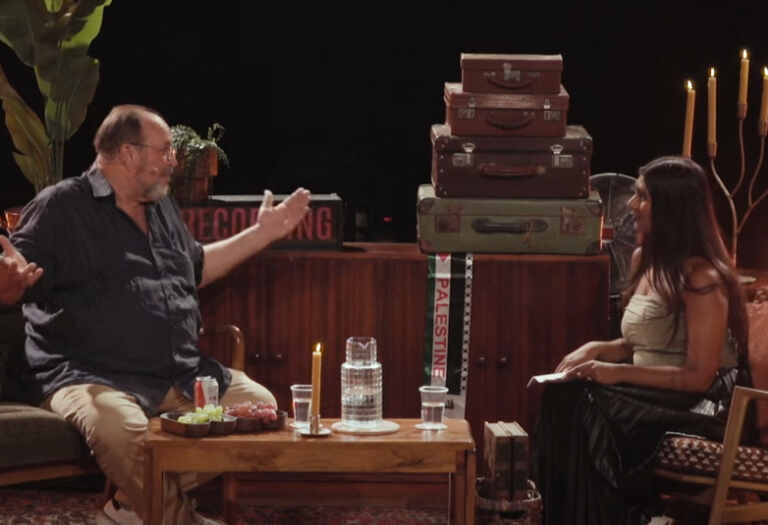
Read the full transcript of British journalist Ash Sarkar in conversation with Scottish historian William Dalrymple on “The Ancient Indian History Our Schools Don’t Teach”, on Downstream IRL, premiered on August 10, 2025.
Welcome to a Different Kind of History
ASH SARKAR: Hi! Welcome to Downstream IRL. As I’m sure you’re all aware, popular historians in this country can be a bit of a mixed bag. So on the one hand, you’ve got those who say the empire was great. “What are you whining about? You didn’t even deserve the fucking trains anyway.” And on the other, you’ve got many people who can tell fascinating stories about individuals, but don’t really want to challenge dominant narratives of cultural superiority or indeed, our sense of what’s normal and advantageous today.
William Dalrymple has, however, cut a very different path. Combining travel writing, art history, archaeology, architecture, cultural commentary, his books are both richly researched and also compellingly written. His works on the history of India, the British Empire, and the Islamic world have challenged dominant narratives around civilization, conquest and cultural exchange.
And in addition to his work as a historian, he co-founded the Jaipur Literary Festival, and his podcast with Anita Anand Empire has hit 80 million downloads. Those are Ariana Grande numbers, mate. That’s insane.
We’re here to talk primarily about his book The Golden Road: How Ancient India Transformed the World, which is, I think, a kind of friendly retort to the Silk Roads theory, which says that the land trading route from China through Central Asia and into Europe, that’s the central way for thinking about the kinds of exchanges between east and West.
Instead, Dalrymple looks at sea trading routes from India westwards into the Red Sea, eastwards into the Mekong Delta, and traces the spread of people, ideas, religion, philosophy, numbers, silk, and even the humble rhubarb. I’m sorry, my husband’s going to kill me for doing a Yorkshire accent, but what can I say?
William Dalrymple, welcome to Downstream. I love that you’re walking on with a can of lager.
WILLIAM DALRYMPLE: Not just any old lager.
ASH SARKAR: Hells, let’s just jump into it.
WILLIAM DALRYMPLE: Sure.
Alexander the Great: A Forgotten Encounter
ASH SARKAR: I’m Alexander the Great. Less of the skepticism, please. I’m Alexander the Great.
WILLIAM DALRYMPLE: I never doubted it, Ash.
ASH SARKAR: And I’ve done a load of conquering. I finally show up in India. What am I making of what I find in ancient India and what are they making of me?
WILLIAM DALRYMPLE: Well, the second question first. There’s not a single reference to Alexander the Great in any Indian source.
ASH SARKAR: What? Why do I have so many Indians in Alexander, then? What’s going on?
WILLIAM DALRYMPLE: So we think of it as this sort of extraordinary moment in Western history with this great conqueror. Indians shrug it off and no one records it. Nobody knows. Some Indian historians doubt that it happened. I think it did happen, but it’s so unimportant in the wider flow of things in India that it’s simply not recorded.
But what he comes to and what develops in the centuries to come is a civilization about which in the west, but astonishingly in this country, which had 300 years of relations with India and has this enormous Indian population here, it’s astonishing how little we know about ancient India in this country.
The Forgotten Giants of Ancient Indian Science
To give one example, I suspect everyone in this audience knew about Archimedes in his bath, shouting “Eureka” by the age of 6, 7 or something.
ASH SARKAR: I’m really overestimating the quality of my education for sure.
WILLIAM DALRYMPLE: But it’s a name which, you know, the idea of this Greek and his toga or whatever it is, shouting “Eureka.” It’s something kids learn about equally. By the age of 10, most people come across Pythagoras and his theorem.
Now that’s all very well and Joe will be very pleased that we’re studying all these wonderful Greek figures, but we should also know, and we don’t, names like Aryabhatta and Brahmagupta, who the South Asians in the audience will know this and have uncles that have sent them WhatsApps about it from their childhood. But all the white Brits have never heard of these people. You can go to universities, you can go to Oxford and Cambridge and simply these names will not register.
But they are crucially important. Aryabhatta, in about 350 AD comes up with the exact circumference of the Earth. The distance of the Earth to the moon, the distance of the Earth to the sun, the fact that we live in a heliocentric universe, that the Earth goes round the sun.
ASH SARKAR: Lucky guesses?
WILLIAM DALRYMPLE: No, because he gets the figures exactly right. And that’s a thousand years before Galileo.
Brahmagupta, who takes his ideas forward. Brahmagupta, sitting on a mountaintop in Rajasthan, a place called Mount Abu, and he’s meditating on this idea of Sunya, which is an idea in both Buddhist and Hindu civilization about the void. And he comes up with definitions of zero.
So zero is, for example, the number you get when you subtract a number from itself. And he realizes that zero is not just an absence or the space between positive and negative. He realizes it’s a number with its own qualities and therefore you can do, well, number one, place value, tens, hundreds, thousands, tens of thousands, hundreds of thousands. You can also do things like algorithms and algebra and all sorts of fancy mathematical tricks. And it’s basically Brahmagupta who take zero, adds it to the existing nine Indian number symbols and creates our numbers.
The Journey of Numbers and Ideas
ASH SARKAR: What’s the relationship between Indian numbers and what we call Arabic numbers?
WILLIAM DALRYMPLE: They’re the same. We call them Arabic numbers because we got them from the Arabs, but the Arabs get them from India and they still call them Hindi numbers.
And there’s this whole extraordinary history of how these Indian numbers, along with many other things, such as quite possibly the plan we all have of universities. When you go to Oxford and you see these courtyard after courtyard running down Oxford High street, you see exactly the same plan at the Indian University of Nalanda in about 600 AD.
Other ideas, like chess, when chess is an Indian game, originally comes through Persia to the west. When you say checkmate today, you’re speaking Farsi, though you don’t realize it’s Shah mat, “the king is dead.”
ASH SARKAR: Oh, yeah. And rukh comes from the Farsi word for a chariot, and it’s the same.
WILLIAM DALRYMPLE: Word as Shahrukh Khan. For the Bollywood fans in the audience.
ASH SARKAR: Our minds just exploded.
WILLIAM DALRYMPLE: So it’s through. There’s a. One of the early viziers of Baghdad. In fact, the family that create Baghdad for the Abbasid caliphs in the 8th century are a family originally known by the Sanskrit name Pramuk, which just means boss in Sanskrit. That’s arabicized to Barmakid.
And the Barmakids bring in the works of Aryabhata and Brahmagupta. It’s translated into Arabic by a guy called Al Khwarizmi. Al Khwarizmi comes from what’s nearly the Aral Sea, from modern Uzbekistan, comes down, translates it, and he produces a book which he calls. He brings in a bit of Euclid. He throws in some Western ancient Greek mathematics, too.
And he writes a wonderful book called, with the snappy title of “The Book of Completion and Balancing According to Hindu Calculation.” But that’s too long, even in Arabic. And so everyone just knows it by nickname, Al Jabar, Al Jabra. And his own name, Al Khwarizmi, becomes the basis of our word algorithm.
The Detective Work of History
ASH SARKAR: When you’re piecing this together, do you feel a little bit like a detective?
WILLIAM DALRYMPLE: It’s very exciting because this is stuff which we should know and which scholars do know, but it simply hasn’t made it out into, you know, in the same way that we know about Archimedes and his bath and all these things that are part of our Western curriculum.
There’s so much, and this is also the theme of Joe’s book that so much that we consider to be central to Western civilization, which comes in my book specifically from India, but in Joe’s book from the wider world. And both of us are very much working on the same. When we first met and compared ideas, we were very much finding the same sort of things and using the same sort of sources. It was very exciting.
The Power of Wind and Geography
ASH SARKAR: I mean, let’s talk about the sort of physical conditions which enable for this kind of spread of ideas. You know, how central is climate and geography when you’re thinking about why these ideas were able to spread the way that they did.
WILLIAM DALRYMPLE: So in the case of India, it’s completely central. And India has a great gift, which you certainly don’t have in, say, Scotland. In Scotland, winds blow in one direction in the morning and then a different direction in the afternoon and the third direction in the evening. In India, you have improbably very punctual and well organized wind systems.
ASH SARKAR: That is not something I’ve heard about Indians very often, but let’s go.
WILLIAM DALRYMPLE: And basically, because you have Tibet above India, which is this vast area, if you see it on the map, it’s an incredibly large landmass and that freezes over in winter and you have winds, cold winds raking in, and then it thaws in summer and warm winds blow out. But on a continental scale, on a massive scale.
Now, this creates the monsoon winds. And that means that if you’re an Indian sailor in the thousand BC or 500 BC or 500 AD, all you’ve got to do is put up a sail. And once you’ve learned how to ride these terrifying monsoon winds, just like a surfer learns to surf that big wave in Hawaii and have that incredible surfing experience as an Indian sailor, once you put up your sail, you get turbo driven at speed across the ocean.
And so it takes only six weeks to get from Kerala on the winds through Yemen to Roman Egypt.
Challenging the Silk Road Myth
And so we’ve been brought up, certainly my generation been brought up with this idea of the Silk Road, which you mentioned in your introduction. And I have a lot of fun arguing this with my friend Peter Frankopan. Joe, in fact, has kept us apart at one point for the only time that we nearly had a disagreement in Cheltenham. Thank you, Joe.
And the Silk Road, which is now such a dominant idea, and it works at every level. It’s very romantic idea. Everyone loves the idea of Bactrian camels swinging in saddlebags and coming down the Pamirs and through the sand dunes of Dunhuang. And it works with a Netflix series when Marco Polo is with those Mongol princesses. It works on the level of geopolitics, in that it’s the basis for the Belt and Road, which the Chinese have built on top of this idea.
In reality, that idea is not an ancient idea. There is not a single ancient mention of the Silk Road. You don’t get it. Marco Polo doesn’t talk about the Silk Road. There’s no. And also, Rome doesn’t know about China and China doesn’t know about Rome.
In fact, this idea is dreamt up in 1877 by a German geographer called Baron von Richthofen, whose grandson was the Red Baron. Some of you may remember those stories of this First World War fighting ace. That was the grandson of this guy. And it only enters the English language in 1936 with a guy called Sven Hedin, who was a Nazi sympathizing Swedish explorer. And it’s only when I’m at college in the 1980s that you get a show in the Metropolitan Museum in New York, which kicks off the whole thing. And from there it spreads.
ASH SARKAR: And at no point people are thinking, well, boats can carry more stuff than camels, so maybe they were more important.
WILLIAM DALRYMPLE: Obviously, you can fit 10 times, 100 times more into a boat, a big junk or a big Arabic dhow than you can in a few camel saddlebags. And so my book says that certainly for the ancient period, we’re not talking about the Middle Ages. There’s no question that Marco Polo, after the Mongols smash a hole through Europe and open up this motorway running from the Mediterranean to the South China Sea, at that point, there is a road going east to west which connects China and the West.
But in the ancient period, the same sort of period that Joe is writing about, Rome and China don’t know each other, but Rome and India are each other’s number one trading partners.
The Roman-Indian Connection
ASH SARKAR: And is that because of Egypt?
WILLIAM DALRYMPLE: Once they get Egypt, once. You think back to your literature classes, Anthony. Cleopatra, she puts the asp to her breast, commits suicide.
ASH SARKAR: You would not catch me dying for a man like that.
WILLIAM DALRYMPLE: No, I’m sure your lovely husband would not ever want you to apply any sort of asp to your breast. But he’s here in the audience, isn’t he, William?
ASH SARKAR: My mum is here.
WILLIAM DALRYMPLE: Your mum is here. We’ll keep off asps, then.
Anyway, but after they commit suicide, Augustus seizes Egypt and Egypt becomes part of the Roman Empire, giving India a front door to Rome because it takes only six weeks sailing on the monsoon winds to go from the Red Sea coast of Egypt through Aden to, well, three big ports, one near modern Karachi at the mouth of the Indus, called Barbaricum, another one in Gujarat, Bharuch. But the really big one is Muziris in what’s now Kerala.
And these are connected so closely to the Roman economy. Although again, this is something scholars know but is not in popular consciousness at all. That Pliny, a conservative sort of Spectator reading Roman naval commander, complains that because the metropolitan elite are importing all these fancy luxuries from India, by which he means silk, which he regards as sort of Victoria’s Secret pornoware.
ASH SARKAR: It’s too diaphanous.
The Roman-Indian Trade Connection
WILLIAM DALRYMPLE: It’s too diaphanous, exactly right. You can see everything through it. For your mom’s sake, I’m sure she’d never let you go out of that. And then there’s pepper, which he regards as a sort of woke spice, the kind of thing the young are putting on their food today. Why can’t they just put olive oil or garum and ivory?
And so he says that there is this massive drainage of the wealth of the Roman Empire into Indian pockets. And we have these figures now from a manuscript called the Muziris Papyrus, which actually gives figures that there’s one. It’s a container, it’s an invoice for a container. It happens to have survived in the dry Egyptian desert.
And it gives three things. It gives prices of all the goods, gives the goods themselves, which are ivory, pepper, cotton, silk and odd things for making perfume with nard and malabathrum. Then it gives the prices which are enormous. And your Indian ancestors were ripping off our poor Roman ancestors with outrageous prices.
ASH SARKAR: Don’t hate the play, I hate the game.
WILLIAM DALRYMPLE: And then finally, in a nice sort of Trumpian moment, the tariff that the Roman, the one-third tariff that the Romans were putting on Indian imports. And this is now very important because economic historians have been playing with these figures. They’re coming up with ideas that maybe as much as a quarter of the Roman imperial budget came from the customs take on the Red Sea.
And this one container described in the Muziris Papyrus, which talks about something like 250 tons of ivory in this container. So a lot of dead elephants and a lot of pepper, just 250 amphora full of black pepper. If that container actually made it to Alexandria and was sold for the prices declared on this declaration, the importer would have been the Elon Musk or the Larry Ellison of Roman Alexandria.
The Impact of Roman Gold on Indian Culture
ASH SARKAR: And so what’s the effect of all of this Roman gold flowing to India? What’s that doing in terms of the creation of, I mean, it’s not right to talk about an Indian ruling class. Of course, you’re talking about multiple kingdoms and principalities and all of that kind of thing. But what’s the effect of Roman money on Indian culture?
WILLIAM DALRYMPLE: So there’s two points, first of all about the existence of India as a notion. India is an ancient idea and you have people. The other name for India in the constitution is Bharat. Bharat is there in the Mahabharata, which is coming into final shape about 300 AD.
So there’s a very clear idea of a geographical and cultural space called India Bharat, which is defined by the Indus on the west, the Ganges on the east, the ocean to the south and the Himalayas to the north. But within that you have 70 or 80 different kingdoms. So it’s legitimate to talk about India, but it’s not. We shouldn’t conceive of it as one nation state. It’s a cultural world which was hugely divided, but which shares often a number of ideas from top to bottom. So India is a real space. What was the second question?
ASH SARKAR: What was the effect of Roman money on Indian culture?
WILLIAM DALRYMPLE: Becomes very rich. And India has already this very sophisticated guild system. There’s a guild called the 300, which is a bit like the Iron bank in Game of Thrones. They’re completely kick ass. And they are guilds which have assassins. We have inscriptions of a core of assassins. So if you assassinate or, sorry, if you kill, a brigand kills a member of this guild as he’s wandering through the Himalayas, they send these guys after them.
ASH SARKAR: Sick.
WILLIAM DALRYMPLE: Quite good. Then they also have their own soldiers and their own war fleets. So they’re a bit like the East India Company. I hate to break it. It’s the same idea. And they have their own foundation.
And what happens is that when Rome falls, which it does in mid 5th century, and those two big ports, Berenice and Myos Hormuz on the Red Sea coast of Egypt, which have been receiving this huge waves of Indian imports when they are abandoned. There’s a big problem in India because suddenly this gold which has been pouring, bucketing, draining in Pliny’s usage into Indian pockets, that ends. And it’s the guild the 300 which…
ASH SARKAR: Pivots and so instead goes, “We’re going to look to Southeast Asia instead.”
The Shift to Southeast Asia
WILLIAM DALRYMPLE: Exactly that. And that’s the moment around 500, exactly the moment as Rome is falling, those ports are being abandoned. Roman gold is no longer arriving. That’s the period that you get in the Jataka, stories of the Buddhists in the Ramayana, in the Mahabharata, references to Suvarnabhoomi, the lands of gold.
And what’s happening is they’re not getting gold turning up from the west anymore, so they have to look east. And at this period, you begin to see in the archaeological record these estuary ports in Southeast Asia, where at the edge of the Mekong, at the edge of all the different rivers, where they’re selling the forest products in the interior, people are bringing in boats and things down to the estuary.
And there you get Indian merchants arriving initially, seasonally, then setting up houses and staying. And the first temples. I went this autumn to the Bujang Peninsula in Malaysia, and there you can see the first temples built by Indians in about 500 AD very simple square base structures with a veranda dedicated with lingams showing the worship of Shiva, but also Buddhist temples.
And from about 500 A.D. you begin to get this massive infusion of Indian ideas into Southeast Asia. And this, over a period of a thousand years, culminates in the largest Hindu temple in the world. Even now is not in India. It’s Angkor Wat in Cambodia.
ASH SARKAR: I mean, how extraordinary is that? That there’s the, you know, also one of the largest religious monuments in the entire world, I think out of England.
WILLIAM DALRYMPLE: The largest religious monument in the medieval world.
ASH SARKAR: The fact that it’s so far away from the Ganges and from the sort of, you know, cultural and spiritual center of India. How does that happen?
WILLIAM DALRYMPLE: Well, it’s far away from the Indian Ganges, but it’s on the banks of another Ganges. Because when Indian ideas take over, there’s two Ganges.
ASH SARKAR: Because I’m about to call up my GCSE geography teacher and ask him, so you’ll know it.
WILLIAM DALRYMPLE: So what do Indians call the Ganges? Ma Ganga. How do the Khmer pronounce Ma Ganga? Me, Kong. The Mekong is the Ganges.
So just like the Brits take names like Perth to Australia and York to New York. So Indians take Ayodhya, the capital of Lord Ram, and they build a new one outside Bangkok. They build a new Kurukshetra, which is the great battle of the Mahabharata in Laos. And all the main Shaivite shrines of India have counterparts in Cambodia, those big pyramid temples that you see all over Cambodia.
What’s fascinating, though, is that this is not a conquest of the sword. This is not earlier. Indian nationalist historians of the 30s tried to turn this into a sort of, “We’ve got our colonies too.” And they were wrong in that these were not conquests.
ASH SARKAR: But was there some element of violence?
WILLIAM DALRYMPLE: No, not that we have any really clear evidence of at all. No. It’s much interesting. It is genuinely an empire of the spirit, not an empire of the sword.
Religious Conversion and Trade Networks
ASH SARKAR: And was there conversion? Because, you know, Islam, we make it very easy for people to convert. I could convert all of you right now like that. Very, very easy. Hinduism is sort of like, well, it’s your fate to be born a Hindu and if not, better luck next time.
WILLIAM DALRYMPLE: So what you get is that there is specific benefits for specific people at this period converting to Hinduism as opposed to Buddhism. So while you’ve got Indian ideas circulating at large in Southeast Asia from 500 AD on, the merchant class like Buddhism, because just like today, if you’re a business, you can greenwash with a bit of sustainability, talk your business and however much, you know, carbon footprint you’re generating with your data or whatever it is you can buy.
The same is true in Buddhist thought in that you just. The merchant who’s done hideous things to gather his fortune just donates half of it to the Buddhist temple and bing, or karma, it’s karma wash. So the merchants counterintuitively. We have this idea in the west of Buddhism being this very otherworldly religion. It isn’t. It’s actually a religion strongly linked to capitalism and to trade.
And the first inscriptions that we have, Buddhist inscriptions, we have in India, it’s the merchant classes who are not only subscribing to it, but carrying it around the trade routes. So it passes as quickly as it does because there’s this nexus between the merchants and the Buddhist monasteries.
So, for example, Andhra Pradesh is a very nice inscription of a man who calls himself a Mahanavika. Now, Mahanavika in Sanskrit means a great sailor. And he says he gives a little bit of his life story. And he says, “The monks lent me enough money to buy a boat and here I’m recording that I repaid their debt with interest as agreed.” So the monks had an interest rate and they had slaves too, we know from other inscriptions.
So this idea of this otherworldly religion, all religions are in the world and take on the world, and Buddhism is no exception to that. So anyway, the Buddhists are very much part of the trading world and Buddhism travels on the trade networks.
It’s the kings and the ruling classes like Hinduism, because Hinduism, although we have post Gandhi this idea of Hinduism associated with ahimsa and nonviolence. In reality, in the classical and early medieval period, Hindu kingship is all about being a successful warrior. You want to be like Lord Ram, you want to be like Arjuna in the Mahabharata, you want to be like Lord Krishna with his chariot.
And kings do not like Buddhism because it requires them to be non violent. And there’s no point being an early medieval king if you’re not a warrior. So when Hinduism goes to Southeast Asia, it’s very much part of the courts. And so the Brahmins come over from India with their literacy. They bring particularly not only Sanskrit, which becomes the lingua franca, all the way from Kandahar in Afghanistan to Bali in Southeast Asia, like French and Tolstoy’s Russia or Latin in medieval Europe. And they also bring a particular Indian script which is called Pallavagranta or Southern Brahmi.
The Development of Scripts
ASH SARKAR: This is the curly one.
WILLIAM DALRYMPLE: The curly one. So North Indian scripts, like you write in Hindi, you have the washing line with the letters coming down, but you can’t draw that straight line in the south because you’re writing on palms.
ASH SARKAR: Straight line on palms.
WILLIAM DALRYMPLE: So if you do the straight line on the palm leaf, it cuts the palm. So you have to do the curvilinear round letters, which is what Tamil and Malayalam…
ASH SARKAR: Is this why you have curly scripts in Southeast Asia?
WILLIAM DALRYMPLE: So it’s the same script. So the Palavagranta, which is the basis of Tamil and Malayalam is also the basis of Pyu Mon, Khmer, Thai, all the pre Islamic scripts of Southeast Asia. And if you are Tamil, you can have a pretty good guess at Thai words. When you go on holiday and arrive at where? Suvarnabhoomi Airport for your Christmas holidays. The land of gold.
The “Everything is Indian” Phenomenon
ASH SARKAR: Oh my God. I mean, we talked about this last time we met and I don’t know if people in the audience are familiar with Goodness Gracious Me. There was a particular Goodness Gracious Me sketch where you’ve got Sanjeev Bhaskar who is, you know, somebody’s dad and his son is trying to be like, “Look, dad, look at the Mona Lisa. Look at Shakespeare.” And he is like, “Shakespeare Indian.”
I mean, when you’re going through a book like this and you’re like algorithms in Indian algebra, also Indian, Southeast Asia Indian. All scripts seemingly. Rhubarb, pepper, silks, ancient Rome Indian, Indian, Indian, Indian. Is there ever a moment where you go, oh, am I doing, am I doing the bit?
WILLIAM DALRYMPLE: So there’s also, this is something that, you know, is very big with Mr. Modi. And I was very keen not to sort of, you know, play that whole Hindu nationalist game. But it is true, a lot of it can. And even one of the jokes that Sanjeev Bhaskar makes in one of those sketches is “Leonardo da Vinci Indian.” Now, in reality, this will take a couple of minutes. Give me time for this one.
ASH SARKAR: You’re pissing me off.
WILLIAM DALRYMPLE: So we got as far as Brahmagupta and Aryabhata’s ideas getting to Mesopotamia, to the Barmakids. It spreads throughout the whole of the Islamic world. And Al Khwarizmi’s book of Mask, the Al Jabr, becomes the basic textbook right into Islamic Spain.
So while everyone in the Islamic world is using Indian numbers in Italy still and Northern Europe, they’re still using the old Latin numbers. And, you know, try even in the audience tonight, giving your number to your next door neighbor in Latin numbers takes you half an hour. XVMC XVCC, XVM.
ASH SARKAR: Is that why he never texted me back?
The Fibonacci Connection: From India to Renaissance Art
WILLIAM DALRYMPLE: I know. And so just very quickly, as late as the 12th century, everyone in the Islamic world, even in Spain, is using these numbers, but no one in Western Europe is. And then Pisa founds a colony in Algeria, a little small trading colony. And a single guy goes over and he brings his kids and the boy learns the Arabic numbers, which are the Hindi numbers in Algeria.
And then he goes back to Italy and he finds his friends still trying to do long division with MCM XV divided by CCMX, CCXX112. And he realizes this isn’t the best way to do it, so he writes a book called the Liber Abaki, the Book of Numbers. And that guy is Fibonacci.
So Fibonacci has not finished yet. It gets better. We’re getting back to Fibonacci Indian, so we’re heading towards Leonardo. So it’s a good moment for Scotland, actually. I’ve got to bring Scotland in here too.
So Fibonacci is some. He is the boy wonder. Everyone’s heard about this extraordinary book and the single most brilliant king in medieval Europe called Frederick II Stupor Mundi, the wonder of the world, comes up from Palermo to Pisa to meet him. It’s like imagine Trump going to Pittsburgh to meet the guy that’s won Countdown or something.
And he realizes they have an open air competition and Fibonacci wipes the floor. So he takes him back to Puglia and introduces him to his head of his astronomy department, who is a Scotsman called Michael Scott from Melrose and Michael Scott from Melrose reads the Liber Abaci realizes it’s a work of genius, but being a pragmatic Scot, says, “Look, pal, it’s just a wee bit theoretical for me.”
And he says, “You’ve got to be a bit more, you know, practical. So we’ve got to have interest rates, money conversion, double accounting,” which is an Arab Indian invention, and interest rates. And so Fibonacci rewrites the Liberky, produces a second edition dedicated to Michael Scott from Melrose, which has all these things.
And that becomes the basis for the Italian banking revolution, the Medici, but it also becomes the basis for Renaissance art. And Piero della Francesca, the great Renaissance painter, reads this extraordinary book. And we think of Piero as being this great Renaissance artist in his own time, he was sort of a mathematician.
And Piero writes three treatises, one of which is all about perspective and the basis for the whole Renaissance revolution of perspective. But he also writes to others. And when he dies, these are taken by his friend Fra Luca Pacioli up to Milan, where he shares it with his flatmate, who’s painting a picture of the Last Supper, Leonardo da Vinci. Indian.
Buddhism’s Journey to China
ASH SARKAR: I’m interested in how very different political cultures would have understood one another. So Buddhism spreads eastwards from India to China. How would Chinese royal courts have thought about Indian culture, if they did at all?
WILLIAM DALRYMPLE: So again, in the Silk Road myth, there’s this idea that China is the terminus of the Silk Road. It’s where all ideas begin. Gunpowder, printing, books all go from there westwards. But what we forget is that one of the most important, arguably the most important religion in China is an Indian.
ASH SARKAR: Religion, Buddhism, China, Indian.
WILLIAM DALRYMPLE: And it’s carried this great university which I mentioned, Nalanda, which is the main center of the Buddhist world. This is this incredible monk called. He used to be pronounced Huan Sang in the old thing. Xuanzang is how he’s pronounced today.
And he comes over from China, copies out 500 manuscripts in the Landa, which he then takes back with him on a whole caravan back to China. And the Tang emperor Taizong sets up this whole translation bureau and allows Xuanzang to copy out all his manuscripts.
And at the same time, Taizong has taken into his bedroom a 15 year old concubine called Wu Zetiang. Now Wu, it turns out, is a bit of a piece of work. And she gets rid of the Empress. And when my girl, when Taizong dies, she manages to pivot from his bed into the bed of his son Gaizong.
ASH SARKAR: Again, don’t hate the player, hate the Game.
WILLIAM DALRYMPLE: She then first of all becomes chief concubine, then empress. Then when he has a stroke, she becomes the regent. And then when he dies, she becomes the only woman emperor in 3,000 years of Chinese dynastic history.
And she does this just like the Tories brought about Brexit with all those dodgy think tanks in Smith Square and Tufton Street. Wu Zetian has her own think tank called the Scholars of the Northern Gate, the Tufton street of early medieval China.
And they basically make Buddhism and Indian religion the state religion of China for her reign. And she relies on the Buddhists because in Confucian thought, women are inferior and cannot rule. But the Buddhists don’t have this rule.
And the monks come up with a whole lot of dodgy prophecies saying that she is the reincarnation of Maitreya, and she’s not only the just emperor, but she’s also the Buddha incarnate. So she has complete control of China for 50 years. And she imposes Buddhism on China and on the Chinese court.
The Taoists and the Confucians are reduced in status at court now, that’s only one generation. And the Buddhist Confucians, sorry, the Confucians of the Taoists come back next, but for that period. And Indian religion rules supreme in China and remains very important throughout the rest of Chinese history.
So you can argue that India, in a sense, is the most influential in this period of the seventh century, the most influential force in the whole of Asia. And it’s much more the center of things at that period than China.
The Rise of Persian Culture in India
ASH SARKAR: So how is it that, you know, Sanskrit, you know, goes from being the sort of, like, dominant script and, you know, dominant language for political culture, to it being replaced by Persian.
WILLIAM DALRYMPLE: So in the 11th and 12th centuries, you have a whole series of migrations, rather like Joe talking about the Bronze Age collapse. In this case, you have the Turks coming in the same cousin tribes. One lot goes smash through the Byzantines, Battle of Manzika, take over Anatolia and become the Turks of Turkey.
But their cousins smash through down into India, and by the early 13th century, early 14th century, there are Islamic Turkish sultanates as far south as Madurai and Tamil Nadu. So the first thing is the arrival of Islam, which brings with it Persianate culture and makes Persian the dominant language.
But the next thing that happens, which we often forget, and in modern India, there is this massive dislike of the Islamic eruption, and there’s a whole school of thought that says that the Muslims destroyed everything is the idea. But what is not remembered Is the next thing that happens is that the Mongols appear.
And that’s an important part of the story too, because the Mongols not only smash up all those empires in Afghanistan and Merv, Samarkand, Tashkent, all those sort of places, they cause waves of Persian speaking refugees down into India, bringing Persian with them. And so that’s the point at which Persian becomes the language of culture in India.
But it also means there’s a hostile border at the north of the Punjab where you have the Mongol Empire to the north and that now stretches to the Mediterranean. So it goes east, west, but it doesn’t go south of the, of the Himalayas. And so India is locked off at this period and no longer has this period, no longer are there the overland routes to China. They’re closed at this.
So it’s a double thing. India loses the geography, but it also, it becomes very much a junior part of this, of the Persianate world. And if you like India’s, you can look at it from a variety of ways. The BJP looks on this as loss and destruction and thinks this is the end of Indic civilization.
But you can have another view that the richness of India is that it is like a cake with three layers. You have at the bottom the Sanskrit layer, in the middle you have the Persianate layer and with that the Taj Mahal, Mughal miniatures, that whole world. And then on the top layer you have English language, the Indian love of Shakespeare.
Today, the Booker long list came out, half the authors were Indian because they’re writing some of the greatest works in English and have been since the time of Tagore. So English becomes an Indian language as well. And it’s that.
So you can look at it two ways. You can look at it as a thousand years of slavery as Modi looks at it, or you can look at it as I tend to do, as making India the richest and most sophisticated and complicated and culturally rich and mixed and diverse and pluralistic culture on earth with these different complicated layers all giving different things.
The Emergence of Hybrid Culture
ASH SARKAR: Do you see any kind of emergence of, you know, a third hybrid culture for from those Persian influences and you know, the older “Indian” ones that it’s layering on.
WILLIAM DALRYMPLE: Of course, Indo Islamic culture is hugely plural and mixed and cosmopolitan. So Urdu and Hindi are very much the same. You know, Hindustani, the old word for the vernacular of northern India. It has the two worlds, it has Sanskritic derived words, but it also has the Persianate and Arabic worlds.
And the whole of North Indian culture is about that hybridity, which is, you know, since Partition, that has been. You know, the Pakistanis emphasize the Persianate and the Arabic and the Indians emphasize the Sanskrit and the vernacular, but it’s a hugely mixed culture for most of the Middle Ages and the early Modern period, and that’s its richness, to my view.
Political Reactions to Historical Work
ASH SARKAR: How much does your work piss off BJP Die Hards?
WILLIAM DALRYMPLE: Well, different books piss them off different amounts. The ones that have the Moguls pissed them off a fair bit, but they quite like this book. And there’s a kind of division in the Indian right that sees this book either as a very sort of clever British attempt to muddle everybody and there’s a conspiracy somewhere around it.
ASH SARKAR: The old Fox of Europe.
WILLIAM DALRYMPLE: The Old Fox of Europe again. But no, it’s done very well in India. This book has been number one for six months.
ASH SARKAR: I mean, are there some people who think that you’ve undersold Indian achievements? Because I know that there is a vein of Hindu nationalists who think that there was an ancient India atomic bomb.
WILLIAM DALRYMPLE: So I think the reason this book has done well, I mean, there was some laughter in the audience at that point. There’s this whole world of WhatsApp uncles that put out ideas that India invented the Internet, that the Rishis had databases and nuclear weapons in the Mahabharata.
And I think that’s why no serious Indian scholar has ever actually written this book, because they’ve all got mad uncles and think this is a slightly embarrassing line of inquiry. And where why I think this book has been a success in India is that in a sense, it very soberly gives, without any nuclear weapons or Internet theories, what really can be shown to be the contribution of India to the world.
And because this is very contested, a quarter of the book is footnotes. It’s all very rigorously sourced. Because I knew that this is controversial territory. You had to go into battle fully armed, so to speak.
Pressure on Indian Historians
ASH SARKAR: I mean, thinking a bit more about your work on the Moguls, what kind of political pressure are Indian historians coming under in terms of doing this kind of work?
WILLIAM DALRYMPLE: There’s a lot and anyone that knows they’ve seen in India, the Moguls have just been removed from many of the school textbooks. In the 40 years I’ve been living in Delhi, the Mogul part of the National Museum has been shrinking and shrinking and shrinking until virtually nothing is left of the Moguls at all on display.
And they’ve just given a lot of the Mogul stuff to a new museum put up by the Aga Khan Trust outside Humayun’s tomb. So actually they’re now on display very nicely, rather more nicely than the National Museum.
So yes, the Moguls are very. The idea is that Nehru bigged up the Moguls and now everyone wants to know more about what Hindus did. And this is very interesting. Tracks of Indian history, which is true, were not taught before.
Also, I think there’s a very real feeling that all the history that was taught was Delhi history and that the history, for example, of the cholas, who are these extraordinary kings who rule in South India, is not part of the textbooks. And that’s now coming back. So it isn’t all bad.
But there’s no question that the Moguls are out of political fashion, that they’re being removed from history and that there’s very little money for a Mogul historian to do your research. And there is some feeling of discrimination.
The East India Company’s Rise to Power
ASH SARKAR: Yeah, I’m kind of jumping forward in history, but I recently read your book the Anarchy and loved it. And so I do want to talk a little bit about the themes you explore there. Edmund Burke famously called the East India Company “a state in disguise of a merchant.” How did it become so powerful? And did it have help from Indian insiders?
The East India Company: A Corporate Takeover
WILLIAM DALRYMPLE: So the Anarchy is a book about the East India Company. For those that don’t know this history, the East India Company was founded not far from here in the same year that William Shakespeare’s writing Hamlet and Julius Caesar. Same year, 1599. There’s a meeting at Moorgate Fields, a short trip away on the tube and the East India Company signed.
And it’s a commercial operation, it’s a corporation, it’s not the state. And so we’ve all been brought up both in India and here, to think of the British invading India and Clive of India fights the battle of Plassey and India becomes part of the British Empire. That’s only half true because what actually happens is it’s a corporation, a for profit business which takes over India, which in a sense is far more sinister because at the end of the day, the East India Company is all about its share price.
So from this point on, from the Battle of Plassey in 1757, India is ruled by a corporation that has a share price, has annual general meetings and is giving dividends to its investors. And like any business, that is ultimately the most important thing. So it’s slightly like Avatar, that movie where the mining company takes over the planet and tries to extract all the minerals for profit. The East India Company does this in reality because it’s there. It’s a Corporation. It exists to enrich its shareholders.
And its shareholders consist not just of the toffs and the elite in Whitehall and Charing Cross. What’s fascinating is that from the beginning the model of the East India Company share business was that it appealed to ordinary Brits. So if you look at the founding subscription sitting in the British Library again not far from here and you can see the top is the Lord Mayor of London. He gives £2,000. But on page 11 there’s John Smith, vintner, so and so the leather worker.
ASH SARKAR: So it’s a little bit like when Thatcher was privatizing everything that moved like “tell Sid.”
WILLIAM DALRYMPLE: Exactly. Everyone has a share. So ordinary people are invested in and they make a fortune. Just like with Thatcher with British telecom privatization. People that bought £20 worth of BT shares could sell it a few years later for 2,000 quid. The same happens with the East India Company.
They go off to Kerala. Sorry, they go off to Kerala. They go initially to Southeast Asia, to the island of Run. They bring back spices and they sell it for something like 1000% profit. So the vintner who put in two shillings can now buy himself a new wine shop.
And from that point until 1858 when the East India Company provokes the largest anti colonial revolt in history, which in this country we call the Indian Mutiny still. But in India it’s known as the First War of Independence. For 250 years it’s a corporation that is exploiting, looting and asset stripping India.
And India moves from a country which under the Mughals had produced 40% of the world’s GDP to a country that when we give it back or India takes it back in 1947, has only 7% of the world’s GDP. And the story of the last 80 years has been India re establishing itself back to the old equilibrium of the time when Pliny regarded it as this great threat of the time when these extraordinary merchant guilds were colonizing and searching for gold in Southeast Asia to the moment now.
So today India is just two years ago crossed Britain with its GDP. By the end of this decade it will leapfrog Germany and Japan and be the third largest economy again in the world. And the only question which remains to be settled is whether by the end of this century India is going to be one, two or three and whether America, I mean, which at the moment seems to be under Trump sort of self destructing all its extraordinary soft power around the world, destroying voice of America, destroying all the things that make America actually influential in the world.
So who’s to say where India will be by the end of the century? Will it be? It’s not. It quite possibly will be number two. And I’d have put my money on China 10 years ago to be number one. But who knows? It’s all up. It’s all to be. It’s all up for grabs.
Palestine: Britain’s Historical Responsibility
ASH SARKAR: Before we move to questions from the audience, I’ve got one last question for you. You’ve been outspoken in your criticism of Israel’s genocidal war on Gaza. And you’ve also been someone who has shown a real interest and participated in the Palestinian literary festival, real involvement in Palestinian culture. I know that this is a massive question. We’re slightly, you know, short for time before we go to the audience. Q and A. What do you think that we in this country primarily get wrong when we’re thinking about Palestinian history?
WILLIAM DALRYMPLE: Well, how long have you got?
ASH SARKAR: Not long.
WILLIAM DALRYMPLE: Well, first of all, I think that very, very it’s significant and important that no one in this country is taught anything about Palestine. You will never in any British curriculum be told that when the Balfour Declaration was made in 1917, Palestinian Muslims and Christians made 95% of the population of that land. And that when we left in 1948, only 30 years later, 75% of the indigenous Palestinians were turned into refugees, many of them on the sand dunes of Gaza, where they are being annihilated in this genocidal starvation and war and act of subjugation going on at the moment.
So it’s very important for us all in this room to realize that it is our politicians who are responsible for this. Outside Downing street, the building to the left is the old Colonial Office. That was where all this was planned. The Balfour Declaration took place. Inside Downing street, we created that mess that has left the Palestinians refugees, continually subject to aggression, genocide, destruction, dispersal.
And for Starmer today to have the outrageous idea that Palestinian statehood is something that can be gifted or endorsed in return for something other than the inalienable right of the Palestinian people is completely shocking. So we are the country that created this mess, and it’s very important that we make sure that there is a serious solution to this problem, which still, although increasingly difficult because of the policies of Netanyahu over 20 years, I think is a two state solution. Others would disagree and say one state, but I don’t think the Israelis will ever agree to that.
A two state solution, I think is still achievable and we need to work. I think it’s still achievable. The settlers can be sent back. They’ve only been there 20 or 30 years. The settlement blocks can be. But it needs pressure, obviously. It needs sanctions. Not just a little Starmer tap on the wrist and Lammy putting out a Facebook post or something.
We need to have sanctions, we need to have action by our politicians and we need to recognize our responsibility for creating this message and doing something about it actively in real time. No longer welcoming the head of the Israeli Air Force as we did only three weeks ago in the middle of the genocide when he’s bombing everyone. No longer training Israeli army, which is what we’re doing at the moment at Sandhurst. No longer doing the intelligence flights which was told at the Israeli embassy do at the British Museum a month ago as Britain’s contribution to the war effort. Then denied on the Today program by Lammy on Monday. I think completely. I think it was an untruth. I think we have been doing by all accounts, we have been doing these intelligent flights and are actively engaged with the aggressor in this genocide.
So that’s got to end, that’s got to stop. We’ve also got to educate ourselves. We all need to read much more about this. My one bit of bibliographic advice is wonderful. Ian Black who is the Guardian correspondent “Enemies and Neighbors” most brilliant primer. If you don’t know this stuff, you need to know it and that is the most neutral book I’ve read but which gives both sides very well.
I’m at the moment working on a 12 part history of Gaza for the Empire pod which we’re going to release in September. September which the opening batsman is Joe Quinn talking about talking about the Philistines. And just to finish the question, of all the kind of things I’ve learned in the course of studying for this, the most interesting to me was I thought it was the Romans who came up with the word Palestine. But in actual fact Palestine is a word as old as literacy itself. It’s in the Egyptian form, it’s Peleset in the hieroglyphs. The Assyrians talk about Palestina. Herodotus talks about Palestine. The father of history says that Palestine and he says there are Arabs where Gaza is.
So it’s a long complicated history. Many people’s. The Levant is the most fantastically mixed and plural and cosmopolitan part of the world. Every port has mixtures of people and that’s true of Palestine too. People are coming in and out. It isn’t just this one people sitting there. There’s migrations in and out throughout the whole of history. But there is always this group of people. And the DNA of modern Palestinians is almost identical to the Bronze Age people which Joe was talking about from the Bronze Age collapse. From the first half they are the same people that have always been coming mixed with different groups, plural and mixed and not pure but a mixture of everything. What Salman Rushdie calls a “chutneyfied mix” of people. But they’ve always been there and they need to have a state. Now is the time. So we need all of us to work for that and to pressurize our politicians. Everyone write their MP tonight.
Audience Q&A
ASH SARKAR: Thank you so much. Right, we’ve got some time for Q and A’s. If we can see some hands going up. Some hands going up. Hi, I was very curious about your last comment where you said that two state solution would be your preference. Why one and then the second how that has been shown in history to be successful.
WILLIAM DALRYMPLE: Sure. No, a very good and a completely fair question. And my only reason for thinking that the two state solution is preferable is that it’s one which the Israelis in the past have agreed to. I understand that there is absolutely no take up for a one state solution in Israel at all. So it’s very improbable that it would ever happen. I mean at the moment a two state solution is also very improbable and both peoples are hugely polarized and there’s massive hatreds in both directions.
But as we saw in Northern Ireland, peoples who have learned to hate each other can come together. And for all the flaws of the peace process in Northern Ireland, there is now a mixed world without violence largely. And I think the only even remotely probable version of a peace process which could possibly be made to work would be the two states.
I agree that the ideal is a world where everyone is equal and religious divisions make no difference. And you’re also right that where we have had effectively partitions such as Cyprus or Northern Ireland or India have often resulted in long ages of conflict. Obviously earlier this summer Pakistan and India came close to the war, a nuclear war even again. So it’s not an ideal solution, but it is one that is vaguely hopeable for while. I just don’t think that a one state solution I understand would get any takers at all in Israel.
ASH SARKAR: All right, who else am I going to take? All right, we’ll start with that and then we’ll. Then I’ll pick. I feel very under pressure. Would love to ask a very practical question. Are there any actual plans or timeline for the kind of information that you’re giving here to be included on the curricula in British schools. Come on. When’s your meeting with the Department for Education?
WILLIAM DALRYMPLE: So I haven’t received an invitation to the Department of Education. And the last person who overhauled the curriculum was, I’m afraid, Michael Gove, who’s not someone who I think subscribes to the Empire podcast, it’s fair to say, or reads my books. So, no, I think at the moment, this is not part of the curriculum.
However, the fact that the history curriculum allows different exam boards to set different papers means that there is room for adventurous teachers to begin teaching this stuff design, despite the fact that it’s not on the core curriculum anywhere. And I have often had emails from teachers who teach this stuff objecting to when earlier I used to say that none of this stuff is ever taught. That needs to be rewritten as none of this stuff is in the core curriculum. But it can and often does get taught where imaginative teachers, often in London multicultural schools, do make a point of taking papers and teaching this stuff anyway, despite the core curriculum.
So. And that, you know, these are things that we can pressurize again, our MPs to take on. I agree. This is something that absolutely should we. I mean, every day the news is dominated by Palestine and Israel. And none of us are taught this, just as 20 years ago, none of us were taught about the British colonizing Ireland, the Potato famine, the various horrors inflicted on the plantation system and so on. And we didn’t understand why bombs were going off in pubs in Guildford and so on. We really need to understand this stuff. It’s crucial to help us understand the world around us. And it needs to be on our curriculum. And we all need to militate and agitate to make sure that it does get more centrally on the curriculum than it is now.
ASH SARKAR: All right, we’ve got my friend in a white yellow T shirt. I can’t see what color that is from here.
Breaking Free from Imperial Educational Legacy
WILLIAM DALRYMPLE: I think it’s beige. How can places like Southeast Asia and Asia in general rid ourselves of the imperial legacy on education? So obviously that’s now a question for individual countries, and it’s not for the Metropole to dictate anymore, which is a good thing. But you’re right.
What has happened is that the old, very Anglocentric curriculums, whereby people living in the Middle East or in India used to learn about Henry VIII’s wives, is no longer so much the case. But often it’s replaced with another form of nationalism, and you get competing nationalisms giving their stamp to curriculums in different countries.
The thing which I think has – you very sweetly mentioned, the 80 million downloads to the Empire podcast. I think the reason people listen to this in every country in the world is that none of this stuff appears on any curriculum. It’s not just that it’s not in our curriculum. Michael Gove hasn’t put it into ours.
But you can’t hear about partition in a way that – in India, nothing will allow you to understand Jinnah that you learn at school. He’s a hate figure who’s turned into a caricature. Ditto. No one in Pakistan will really understand Gandhi if they use their own textbooks.
And in a sense, one of the nice things that’s happened with the whole diffusion of podcast history is that people do get a chance to hear other versions of history that they haven’t been taught at school, and which is why there is such an incredible appetite for it. And why, presumably, you’re all here tonight, because this is not taught, not just here, but anywhere.
ASH SARKAR: Thank you, William. Thank you.
WILLIAM DALRYMPLE: Thank you.
ASH SARKAR: All right.
Related Posts
- Transcript: Why Adaptability Beats Planning in an Unpredictable World? – Mr. Sanjeev Sanyal
- Transcript of Dr. Prathosh AP Lecture: AI Is Making Intelligence Cheap
- Transcript: Stanford’s Chad Jones on The Future of Jobs in an AI World
- Jared Isaacman: A New Era for NASA and American Space Exploration (Transcript)
- Transcript of Bill Gurley: Searching for Feynman at All-In Summit 2026