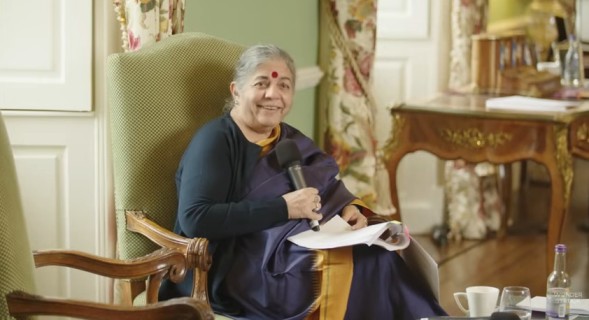
Editor’s Notes: In this profound lecture at the 2024 Consciousness Symposium, renowned scholar and activist Dr. Vandana Shiva explores the intersection of quantum physics, consciousness, and ecological activism. She challenges the traditional mechanistic worldview, advocating instead for a “quantum thinking” approach that recognizes the fundamental entanglement and non-separability of all life. Throughout the talk, Dr. Shiva highlights how shifting from a paradigm of domination to one of participation can address modern crises in agriculture, climate change, and social justice. (Oct 22, 2024)
TRANSCRIPT:
Understanding Ecological Apartheid
UNIDENTIFIED SPEAKER: Apartheid is the South African word for separateness and ruling on the basis of separateness and superiority. Ecological apartheid is the basis of the rest of the beings are inferior and they are objects for us for manipulation. Whereas an entangled world is a world where all life is entangled.
Introduction of Dr. Vandana Shiva
UNIDENTIFIED SPEAKER: Good morning everyone. It’s another honor to introduce Vandana Shiva. Vandana is an Indian scholar, an author and activist. She holds a PhD in physics and has written more than 20 books. Let me read you a few of the titles. These include Making Peace with Earth, Staying Alive, Monocultures of the Mind, Democratizing Biology, Soil Not Oil and Stolen Harvest.
Let me also read part of Vandana’s CV. She is based in Delhi and she is referred to as “Gandhi of Grain” for her activism associated with the anti-GMO movement. Shiva is one of the leaders and board members of the International Forum on Globalization and a figure of the anti-globalization movement. She has worked as a consultant for the Indian government and abroad and in NGOs such as the International Forum on Globalization, Women’s Environment and Development Organization and Third World Network.
Bear with me. She is a co-founder of the Gender Unit of the International Center for Integrated Mountain Development and the Women’s Environment and Development Organization. Vandana has received numerous international honors such as the John Lennon Yoko Ono Grant for Peace in 2008, Sidney’s Peace Prize in 2010, Calgary’s Peace Prize in 2011 and the Wright Livelihood Award in 1993 which is regarded as the alternative Nobel Prize.
And when I hear Vandana speak, she brings the theory, but what I really, really admire of what you do is that you are able to inject that into the blood system of the world. So when we speak about consciousness, I always think of you as the embodiment of consciousness for real. So thank you very much.
Dr. Vandana Shiva’s Opening Remarks
DR. VANDANA SHIVA: Thank you very much, Alex. Thank you Elizabeth and the team that has organized this symposium outside the fact that it was going to be on consciousness. I knew nothing about it. I’m happy to be here. I apologize that I’m late.
And I’m late because I had a commitment, an annual commitment I have for farmers in central India which is an interesting place both because that’s where Gandhi moved when he left politics to build the movement for freedom. And as you know, we built it around spinning cloth. He said, “Till we are free of the empire of cotton and make our own clothing, we will never be free. We can shout as many slogans as we want to. We can go to jail many times. But our freedom will come from making our own cloth because the British empire was an empire of cotton.”
And that’s the place where we started the organic movement in India in 1984 in an organized way. Also the place where the GMO BT cotton was introduced in a very, very big way. It became the capital of the BT cotton, but it emerged very fast to be the capital of farmer suicides. And when that started, I started to work in that area and made a commitment to the farmers there, I’ll be with you once a year, every year to ensure we make the shift. And that date was, you know, that’s where I was.
Quantum Consciousness and the Mechanistic Paradigm
I said I would talk on quantum consciousness. I definitely will not talk because I am not a biologist. I’m not a neuroscientist. I’m someone trained in quantum theory who has brought that learning to life, to everyday life.
And a century ago, the quantum consciousness started to emerge in the world. And it was radical both because of what it was, but it was radical because of the paradigm. It was shifting away from the mechanistic paradigm. And I’ll talk a bit about those details because most of us, you know, don’t have any idea of the roots of how much time and energy of the empire was spent on building a mechanistic science and mechanistic philosophy as the only way to think, as the only legitimate science.
So the significance is huge, but I think the potential and quantum theory is totally based on potential. The potential is even more immense because every door that the mechanistic thought shuts down, the quantum thought opens up. And I think that’s the power. That’s the power.
So a century ago, quantum theory showed that the mechanical view is false at every level. The world is not constituted of static things, but of potential and transition probabilities. That’s all we have. It also recognizes interconnectedness through the principle of non-locality, non-separability, entanglement, action at a distance.
Because all of mechanical philosophy is based on the fact that everything is static and inert, till you move it by force. Force comes into the picture for any shift. Whereas quantum theory recognizes that change is the only thing. That’s the basic process. And in the world, dynamic change is what we have.
The Problem with “Classical” Thinking
I don’t really like the word classical because it makes you think that it’s something more sophisticated. Classical music is fancier than the Highland music you were listening to last night. There’s nothing classical about it because a short 300 year bad experiment with violence.
And the core part of it is separation. Of separation of every kind. Separation of humans from nature, separation of observer from observed, separation of every part of every being. And the quantum world is based on total non-separation.
As Niels Bohr stated, “The extension of our experience in recent years has brought to light the insufficiency of our simple mechanical conceptions. And as a consequence, has shaken the foundation on which the customary interpretation of observation was based.”
The Quantum Physicists and Eastern Philosophy
And interestingly, the quantum physicist, and if you think of it, normally there’s one system imposed. And that is called the scientific theory of the time. But the quantum theory emerged with a play, an inquiry by different scientists, all debating each other intensely. Just follow the debates between Einstein and Bohr and Heisenberg and Bohr. They worked out equations on which everyone agreed and then they thoroughly disagreed on what that meant.
But every one of them, I think, because the shift was so huge from the mechanical world, which was the context in Europe at that time. Interestingly, so many of them turned their consciousness, in terms of understanding the reality they were dealing with, to the Vedas and the Upanishads. Because that’s where the wideness of consciousness was available.
Max Planck on Consciousness
So Max Planck, who actually is the founder, because his understanding that energy is absorbed and released from materials in discrete packets. That’s where the word quanta begins. He says, “I regard consciousness as fundamental. I regard matter as a derivative from consciousness. Everything that we talk about, everything that we regard as existing postulates consciousness.”
So not the typical view that consciousness is a product of a part of our biological function called the brain. The opposite flow is there, and Schrödinger was inspired very much by the Upanishads.
Schrödinger on the Unity of Mind
He said, “Mind, there’s only one mind. There’s no separation between subject and object. The barrier between them cannot be said to have been broken down as a result of recent experience in the physical sciences, for this barrier does not exist. Individual consciousnesses are manifestations of a single mind.”
And what I find interesting is that till even less than a decade ago, the focus was on the mind. And suddenly there’s a focus on consciousness studies, consciousness as an object to study. And then, of course, we get from that all the flow of, “Do the computers have a consciousness and artificial intelligence as a consciousness?”
And Schrödinger goes on to say unification of minds is consciousness. I hope I see it as the holding together of the universe. “One mind, the self is borderless, the same elements compose my mind and the world. The world is given to me only once, not one existing and one perceived. Subject and object are one.”
I mean, the first time I heard the word “hard problem” was at your seminar at Paris. And I said, typical of Cartesian thought to take a constructive divide and then keep wondering how you’ll overcome the divide rather than realize that the divide is constructive. And these were the big understandings of the quantum thinkers and physicists.
Growing Up in the Himalayas
My own entry into quantum theory is I’ve grown up in the Himalayas, in the forests of the Himalayas. My father was first in the British army and then joined the forest and became a conservator. At that time, our forest was still forests and the Himalaya was still Himalaya. They weren’t crumbling under the burden of blasting for dams and highways and trains. They were steadfast, as Krishna has said, “I am as steadfast as the Himalaya.”
And when we travel, we stopped in what were called rest houses and we traveled on horseback and these rest houses are tiny, just like the libraries in this house. You know, the books for you to pick up and there’d be little two or three shelves. And one little book I picked up, a young girl was in “Science and Social Responsibility, Quotes from Einstein.” That’s what it was. And it inspired me hugely. The idea of being a seeker, but also being related both to the consequences of your actions, as well as to the society of which you are part. And I said, that’s the kind of person I want to be.
The Journey to Study Physics
And I went to schools. We didn’t teach physics, but I learned my physics and did it. And I joined for a Ph.D. in India. But my guy, the top particle physicist of India, was so good that he kept being appointed to this new department and this new university. And he shifted four universities in one year when I joined. And by the end of it, I said, Dr. Biswas, I cannot. And in India, registering in a university, finding a room, a hostel is not an easy job. But so by the fourth shift, I said, Dr. Biswas, I’m leaving and I will continue the work that I was trying to do with you.
And in that period, I got to read a lot, because no guide isn’t there to guide you. And I started to look for all the big because the quantum first puzzles throw themselves up. And I found Bohm, you know, as the person who was giving deep explanations of what was going on. So I wrote to Bohm and I said, I want to join you. He was at Birkbeck and he said, I’m sorry, we have no fellowships in England. But my student, Jeffrey Bub, with whom he did the second hidden variable theory, he’s in Canada and in Canada, the University of Western Ontario, they had started something unbelievable called the colloquium and quantum theory.
The Canadian Council attracted the best minds, physicists, logicians, anyone thinking about quantum theory from any dimension and put them together. And that’s where Jeffrey Bub was when I wrote, because I had to go through the rituals of getting grad school and completing all the requirements, which I did because I knew exactly what I wanted to study.
The Two Problems of Quantum Theory
And what I wanted to study was solve the two problems that are still preoccupying. It’s not over, actually. The two problems that arise all the time in quantum theory. The first was hidden variables. The idea that somehow you can find determinism. But the problem grew deeper because von Neumann wrote a paper saying it’s impossible. And Bohm, as he was always looking for wonder, he said, well, I’ll make it. I’ll do it. And I don’t have to sacrifice quantum theory for it. So hidden variables won.
And the other was the whole issue of non-locality that gets thrown up in the Einstein-Podolsky-Rosen paradox.
But both the very idea of entanglement of the observer and the observed, as well as systems related to each other, no matter how much they are separated in space and time, they involve entanglement. And that word was used by Schrödinger. He said entanglement is the characteristic, a trait of quantum mechanics. It’s very fashionable these days in every discipline.
Four Lessons from Quantum Mechanics
So the four lessons I personally learned, which have stayed with me, is first the fact of non-dualism. I think that’s why so many of the founders turned to the non-dualistic philosophies of India, like Vedanta. Bohr called it complementarity. Repeatedly, that there is no observer-observed divide, no excluded middle. And I take it even more to say there’s no either-or. When Bush was justifying the Iraq war, remember, he said, “either with us or against us.” I said, so much of this either-or mentality is at the root of the hard problem in politics. Because you first divide.
And the beautiful part of there being no observer-observed divide is there is no thing in the world, no stuff in the world. The world is just potential waiting to happen. And that potential becomes the particle or the wave through the, not an interaction, interaction is between two existing things, but an interaction where what you’re observing is transformed from potential to real in the process of the observation and the measurement.
And the world is not made of individual entities. As Bohr put it, “atomic physics has taught us that the unavoidable interaction between the objects and the measuring instrument sets an absolute limit to the possibility of speaking of a behavior of atomic subjects, which is independent of the means of observation.” Remember, the entire edifice of the mechanical science and the word overused was objectivity. That there’s a static world out there. And the more powerful you can be in terms of getting to it, the more objective you are. And I’ll come to some of the quotes of the founders of that philosophy.
For Bohr, the world is not made of individual entities. For Bohr, in the quantum world, no result of an experiment can be interpreted as giving information about independent properties of objects. And as a result, it inherently connects the situation and phenomena in relationship. And at the larger level, it just tells us that we are part of nature, that we are seeking to understand. We are not spectators. We are not masters.
Non-Locality and the EPR Paradox
The second big principle is, of course, non-locality, thrown up by Einstein’s imaginary experiment, called the EPR paradox, where he showed that when a quantum system is subdivided and the two subsystems are separated in space and time, their state is non-separable. And this non-separability, no one could disagree with it. The interpretation again was, does it mean that we could somehow build locality through other schemes?
And again, Bohm puts it so well, “the reason subatomic particles are able to remain in contact with one another, regardless of the distance separating them, is not because they are sending some sort of mysterious signal back and forth, but because their separateness is an illusion. At some deeper level of reality, such particles are not individual entities, but are actual extensions of the same fundamental something.” And I call this same fundamental something consciousness.
Uncertainty and the Role of Imagination
And from this then arises uncertainty and indeterminism as irreducible. So when Feynman wrote his paper, and then Bohm responded by creating a hidden variable theory, and then the world thought hidden variables was about bringing determinism back into the picture. And he says so clearly, that was never my intention. My intention was merely to say that you can never ever tell beings who can imagine to not imagine. As he says, to show it’s wrong and throw out hidden variables because they could not be imagined is just bad science, because imagination is what makes us creative. Thus the existence of even one consistent theory was enough. And I made a consistent theory that could reproduce all the quantum phenomena. It didn’t try and undo it.
If one such theory is possible, then the natural implications go to this argument, why not try and find them? But that is the work of the scientists, not blocking out saying this is impossible and that’s impossible. And never was it about bringing back determinism. He accepted totally indeterminism as irreducible. And then later his student, Bohm, who became my guide, continued the same work of maintaining quantum probabilities by adding additional variables, but still getting the quantum probabilities.
Getting Away From Reductionism
Another feature of the quantum learning is to get away from reductionism. Because all of mechanical thought, which is based on inert objects, is also based on separating parts of the object. It’s based on reductionism. And the quantum scientists constantly talked about wholeness. Bohm talked about complementarity as a phenomenon of quantum wholeness.
Heisenberg said, “The world thus appears as a complicated tissue of events in which different kinds alternate or overlap or combine, and thereby determine the whole. In classical mechanics, parts determine those of the whole. The situation is reversed in quantum mechanics. It is the whole that determines the part.”
And David Bohm then did a book called Wholeness and the Implicit Order. And it’s a very… He really liked to go deeper, to deeper levels. And he says, “There is an enfolded implicit order. And space and time are no longer the dominant factors determining the relationships of dependence and independence of different elements. Rather, an entirely different sort of basic connection of elements is possible, from which our ordinary notions of space and time, along with those of separately existing material particles, are abstracted as forms derived from the deeper order. These ordinary notions, in fact, appear in what is called an explicate or an unfolded order.”
And later, when I started to work with seeds, I realized in that little seed is the implicate order of the plant it will become, the tree it will unfold into. And this basically is the power of reproducing patterns while changing all the time. Because those two things, again, were separated in mechanical philosophy. You know, either you can be the same and static, or you can be changed through force. The self-evolution, the self-organizing, the autopoiesis of the living world, didn’t even have a place in it.
The Founders of Mechanical Framework
I could go on and on and on with this, but let me just share with you some quotes which I feel are still dominating our thought from the founders of what the mechanical framework is. People assume that the mechanical framework was founded by Newton. You know, with his equations. But Newton came a hundred years after the real founders, who are Bacon and Descartes. One century before Newton, they laid out the foundations.
And even though Bacon is so important to both the empires it was then and the reach of the empire, I find him as kind of an unknown entity. Most people forget he was the Chancellor of England at that time. And as the Chancellor of England at that time, he was also made in charge of the Inquisition.
And what was happening in the early 17th century on Inquisition? Who was being tried? The peasants who were defending their commons. They were part of what the women who knew midwifery, women who knew their herbs. I know these have been presentations at this symposium. They were all witches.
And again, the other part is long before the rest of the world was colonized, Europe was colonized through a papal bull ten years before the papal bull that followed Columbus. And this was about not allowing diversity of thought. Treating any freedom of thought as part of Inquisition. I think two bishops in Germany wrote a book called The Hammer of the Witches. And nine million people were killed for thinking in their own way.
Bacon: Chancellor and Chief of Inquisition
So, Bacon was not just a Chancellor. He was Chief of Inquisition. But he has been rendered the father of modern science. You know, what science will be has been defined by him. And he talks about, in his Novum Organum, he talks about a new instrument of human inquiry that will satisfy humanity’s imperial ambitions.
Again, see, humanity’s imperial ambitions. The poor people who are being colonized are not part of the imperial ambition over the natural world. Bacon assumed that thinking mechanically in denial of our relationship with nature and nature’s living process will lead to infallible knowledge and total mastery over nature. So, the seeking of determinism was a seeking of control. And with it came arrogance. And the concept of mastery.
As Jason Hickel has written in a book for which I was asked to write a promotional blurb, Bacon actively sought to destroy the idea of a living world and to replace it with a new ethic that not only sanctioned but celebrated the exploitation of nature. He transformed nature from a nurturing mother to a common harlot. For Bacon, science and technology were to serve as instruments of domination.
The Masculine Birth of Time
And then he wrote a book, most people don’t know, a book called The Masculine Birth of Time. That all knowing that was in relationship with nature, knowing that we are part of nature, was somehow effeminate and feminine. And he had to build this new kind of science. And he said the only way, and this comes out of his being in charge of the Inquisition, he said the only way you can know the secrets of nature is through violence. Which would force her out of her natural state and squeeze and mold her, and then we can manipulate her. And the whole idea of extraction flows from that.
He even says we’ve got to declare war on nature so that our forces, our united forces, can be against the nature of things. To storm and occupy her castles and strongholds, and extend the boundaries of human empire so far as God Almighty in His goodness must permit.
Boyle and the Royal Society
And then Boyle became the founder of the Royal Society and the first director. The Boyle’s Law comes from him. But he was also the head of the Church of England, and he said the idea that we must respect nature and have reverence to nature—the session we had yesterday afternoon on Taoism and on the Mayan philosophy—it comes in the way, it’s an impediment for our creating an empire over lesser creatures of the earth. And that’s where anthropocentrism begins. That the rest of life is just for our exploitation, it doesn’t have life.
Descartes’ Division
And of course, Descartes took it further by dividing the world into res extensa and res cogitans. And for me, Descartes is still so alive. Yesterday’s discussion on artificial intelligence took me to the fact that the whole philosophy of the transhuman philosophy is bringing Descartes to life in this period. And he basically, by dividing and imagining that he’s a thing—I’m a thinking thing without a body—”I think therefore I am” is what he said.
And this is how sophisticated he is. “Next I examined attentively what I was. I saw that while I could pretend that I have no body, and there is no world, and there is no place for me to be, I could not for that pretend I did not exist. That I could imagine everyone around me did not exist. You don’t exist, none of you exist. I saw that the only thing I could be sure of, that I think and therefore I exist.”
And everyone’s creating hard problems out of nonsense like this. There is no division between mind and matter. And what is called dead matter, as res extensa, which means the world only has dimension and weight, because that’s all you could measure at that time. You can measure a few more things now, but the world was reduced to the measurable, not the experienced, not the consciously lived.
Quantum Thinking as Foundation
Let me, in the few minutes left, share with you how my quantum thinking—still people ask me the question, you know, how did you shift from that work to the work you do today? And I said I didn’t shift. I continued on the basic foundations of indeterminism, entanglement, non-locality. And out of all this comes the recognition of participation.
That if there is no observer-observed divide, I cannot be the master. Then I can be a participant. It brings with it humility. And for me, consciousness, as I said, is the connector, it’s the seeing, the being, the doing, all of it in one. Not divided into different dimensions. And that’s where, it’s interesting, because a lot of the bio is usually downloaded from websites. And the interesting thing is, all of us who live from integrity of our consciousness, we are defined as anti. I’m defined as anti-globalization, rather than a defender of local sovereignty. I’m defined as anti-GMO, rather than defender of autopoiesis of life.
Returning to India: A Choice Between Paths
Because let me just run through quickly. So I went back to India, and I had two paths before me, to continue work that still excites me. This is the reason I was so interested in coming to this meeting. I still get so deeply inspired by the quantum world. And I could continue, Tata Institute of Science, Indian Institute of Science. And here I was in India. I was seeing new issues coming, new ecological issues growing. I just participated in the movement of Chipko to protect the mountain forests. And these are life and death issues today.
One area where beautiful forests have been deforested for tourism, and building more rest houses and guest houses and hotels, has just had a landslide with 350 people have been killed. And why not? So what the women of my region were doing in the 70s is more than ever relevant perhaps today.
Understanding Violence Through Quantum Thinking
Around that time, I’d done my MSc Honours in Particle Physics from the University of Punjab. In 84, Punjab erupted in huge violence, 15,000 people were killed. And I took my quantum thinking to understand what’s up. I was doing a program for the United Nations University. And I asked a simple question. So what changed the potential of the Punjab of peace that I knew to a Punjab of violence that is there now? So what is the contextual causality of that shift in the potential?
The Green Revolution: Questioning the Narrative
And then of course, when I started to look, I realized something called the Green Revolution had been invented. Even yesterday, it came up in the discussion, the world would have starved without it. Not true. Just by observation, I could see these fields are empty linear lines of one crop. Whereas we have systems of nine crops, Navdanya, the movement I started means nine crops, 12 crops. And my eyes could tell me that the more the biodiversity density, the more the food that you’re growing.
So I started to evolve new systems of measurement. The typical system in the Green Revolution is yield per acre, where you take a part of a part of a part of a farm that goes as a commodity to the market and only measure that. You don’t measure the state of the soil. You don’t measure the state of the farmer. You don’t measure the state of the food or the biodiversity that went or the emissions that were created.
And I said, what matters about food is the health it gives you. So instead of yield per acre of a commodity, we will measure health per acre of an ecosystem and of the food that it produces. And our studies have shown that you can have two times the food the world needs by protecting the biodiversity of the world and intensifying it.
GMOs and Genetic Determinism
And this brings me all, and then, of course, the GMOs came along. Maybe in the question and answers, we can talk a little more, but it was based on, Descartes on drugs, master molecules, one molecule in that beautiful orchestra of molecules as the master determining the rest and the one that’s inert without the rest. And genetic determinism.
So I’ve never done biology. I haven’t had a class of biology. But I live in a world that’s a living world. And you can reach out to friends who know more, which I did. Some amazing people.
I mean, the two scientists in England that I interacted a lot with to understand these complications. One was Brian Goodwin. I don’t know how many of you know him. He was a development biologist. Development had disappeared. And the other was Dr. Mae-Wan Ho. The quantum theory began with a quanta. And five years after Planck’s paper, Einstein wrote his—he wrote five papers at a time. Can you imagine five papers? And one of them was on the photoelectric effect. That light itself comes in one time. And he defined the photon. And the photon is at the heart of life.
The Role of Photosynthesis in Life
So in the last few months, there’s been a fascinating debate. Someone asked Mr. Gates. So a lot of people want to plant trees to deal with climate change. And as is typical of him, he said, “But those are idiots, we are the science people. We know it’s nonsense, that trees can do anything.” It’s because of those big carbon capture machines that are being put up is what he hopes will absorb the excess carbon dioxide.
So all of life begins with the sun’s energies and with photosynthesis. And all of photosynthesis is a photon lifting an electron out, and then the electron falling back into its original state. And that energy is the wondrous energy that keeps the world going.
Schrödinger’s Question: What Is Life?
Schrödinger asked a very basic question in a little book called What is Life? Here’s this quantum physicist with the Schrödinger equation asking what is life? And he explains that life creates negative entropy because all machines create entropy which is waste energy, which can’t be used, and that’s the pollution. I mean, one could think of climate havoc as entropy problem.
So how come life doesn’t create entropy? Plants don’t heat up, they’re working away, but they don’t heat up. Because their energy is not like the energy of a machine. Their work is not like the work of a machine. And for that you’ve got to go back to the photon, you’ve got to go back to photosynthesis. You go back to the relationship between the quantum view of the world, the idea of autopoiesis, the fact that life organizes itself and is able to store energy for its growth.
Yesterday I think there was a lot of talk about machines don’t grow, they don’t replicate. But they do use a lot of external energy. And I think the beautiful thing about these connections that we need to make much more in our basic thinking is they open up the door to creating a world of deep participation, not just among human beings, but within all beings.
Earth Democracy Versus Ecological Apartheid
And that’s what I call Earth democracy. I call the dominant system ecological apartheid. Apartheid is the South African word for separateness and ruling on the basis of separateness and superiority. Ecological apartheid is the basis of an empire of the world on the basis that the rest of the beings are inferior. And they are objects for us to be manipulated.
Whereas an entangled world is a world where all life is entangled. And instead of some powerful man determining the future of extinction of the rest of life, all beings are determining each other being. So there are two words that we use—the word so hum. “You are, therefore I am.” And that to me is entanglement. And the Africans use the word ubuntu, which means the same thing. “You are, therefore I am.”
And ecologically, you could turn to the tree and say, that’s where we get our oxygen, you can turn to the lakes, you can turn to the grass, you can turn to the soil.
Consciousness Beyond the Brain
I’ll leave you with two questions that I think are growing. In my mind, they’re definitely growing. More and more talk about consciousness being in the brain, and you can study the brain and you get the study of consciousness. But if new work and ancient learning of Ayurveda teaches us that it all begins with the gut, and scientists are now calling the gut the second brain, what about consciousness?
Then related to this is the fact that new work is showing that the health of the soil and the biodiversity of the soil is totally entangled with the biodiversity and health of the gut. It’s one continuum. And you cannot divide them, you cannot separate them without consequences, both for the planet as well as for all chronic diseases. Now are being recognized as being diseases of the gut microbiome and metabolic disorders.
But also the gut and the brain are connected. And the roots of the plants is where the neurological activities in the soil takes place. And you just add a little organic matter and life bursts in the soil. Nutrition increases in the plants. And Darwin called the roots of the plants the brain of the plant. And so how can we localize brain activity only to one human being, one species and one part of one species? When it’s pervasive everywhere. And I think opening up to the wonder of creativity, consciousness and life is the work for staying alive with other life on this beautiful planet. Thank you.
Q&A Session
SPEAKER: Hello. Okay, thank you, Vandana. I receive your presentation as a blessing. Thank you. All right, we have about maybe 10 minutes, maybe 15 for questions. Yes, Philippe.
PHILIPPE: Thank you. That was really fascinating. I really like the idea of consciousness playing a fundamental role in quantum physics and removing the hard problem. And I’m actually developing such an interpretation myself for the philosopher of physics. But I’m not saying, and maybe you can help me understand this, why it’s something we find on all interpretations of quantum mechanics. I mean, I can see if you think consciousness collapses the wave function or the observer collapses the wave function. Okay, you’ve got some central role for consciousness. But if you have the Bohmian view you like or the Everett view where you don’t have collapse, or if you have something like GRW or Penrose’s view where you have collapse, but it’s nothing to do with an observer, then I don’t see why consciousness has to play a central role. And then maybe we’re back to the hard problem. I don’t know. You tell me.
Knowledge Beyond Western Science
DR. VANDANA SHIVA: Yeah, for me, quite simply, understanding and knowledge doesn’t begin with a small part of human history. So I never cite, you know, so-and-so says this and so-and-so says this, and that’s the rest of the world. Partly because I’ve been humbled by ordinary people in my country. You know, I say I did a PhD in quantum theory in Western, but I did a bigger PhD with the women who’d never been to school, who did the Chipko movement, who taught me about every plant, who taught me about biodiversity, who taught me the connections between the forests and the rivers and landslides.
So I think part of the whole Baconian idea was not just turning nature into a slave, but also a rule of a few experts. And it’s a very artificial construction, because I believe everyone is an expert. You know, people who clean this building are experts in keeping it clean. The people who are serving us are experts in service. And I think the hierarchy, the epistemic hierarchy that has been created, not just between humans and nature and objects and observer, but between some people and others is a very big part. That’s the hard problem. Apartheid is the hard problem. And if we can address that and find ways to participate with respect, dignity, celebration, joy, we address the hard problem. Thank you.
Indian Interpretation of Consciousness
And just one more little thing about this. The quantum world is not in the Cartesian world. It’s in a phase space. A lot of Indian interpretation is in spaces that you cannot reduce to the typical space time and physical space. And they talk about us as humans as having multiple sheets, all of which have consciousness. The outermost layer with which we interact with the world is how we eat food. So it’s the annamaya kosha. And then it’s the way we breathe. It’s a more subtle level. And then how we sense the world.
And then how we process the knowledge through wisdom. And I think that’s part of the missing debate on artificial intelligence. Wisdom, which is your right wing brain. Computation can be done with the left brain. But all of that distillation and processing. And then finally, the ultimate. The ultimate state is pure bliss and pure joy, the bliss state, the ananda mayakosha. So what is the objective of life? Some can say it’s staying alive biologically. But for Indian philosophy, it has always been finding joy in the oneness with the consciousness that is of the world. So it’s not about just one phenomena called the quantum collapse.
Q&A: Decades of Activism and the Power of Coercion
UNIDENTIFIED SPEAKER: Thank you for your talk. And I kind of have a two-part question, I guess, which is, I saw you speak 15, 20 years ago. You’ve been doing this such a long time, going all over the world and speaking to people, writing multiple books, just working your butt off to try to change people’s minds. And my question is kind of, why do you think this other point of view is so seductive? And how do you see, like, do you see change? Do you see people’s minds being opened to new ways of thinking? Not even new ways, old ways of thinking about things?
DR. VANDANA SHIVA: Well, first, I don’t think the issue is, right now, it’s not seductiveness. Seductiveness means everyone is going along with it. I find more and more people having doubt. Yesterday’s presentation on the rising generation was, you know, lack of trust. So, old, young, nobody is falling into it. What I see is coercion. And in a sad way, you know, this idea of nothing changes without force. More and more force and violence being used. Why did I quote from Bacon and from Descartes? Because they always talk about violence and force. For them, that is the way to establish your power.
Seeds, Patents, and Seed Satyagraha
And, you know, for people, because we’ve divided our world into so many silos, people think, you know, I did Green Revolution, I did GMOs. But these are all words that divide up the common life experiences of ordinary people. And people have been, you know, there’s closure. Why do I work on seeds? Because there was a meeting in ’87 where the pesticide industry said, “Now we have to make our profits from seed. And the way to do it is to do genetic engineering, so we can claim we’ve invented something new. And patent life, through patents on seed is where we make our money.” And then they said in a way to force farmers to stop saving seeds and make it illegal to save seeds, “We will write an international law,” which became the Trade-Related Intellectual Property Rights Law, WTO.
All three statements were blatant, outrageous, unscientific statements that seed is an invention of the corporations. It’s therefore intellectual property. And that you can criminalize the basic acts of taking care of life. And so I said, I’ll save seeds. And I will deal with the laws. And I will deal with the laws also in ways that Gandhi taught us, Satyagraha. The urge of truth. You know, he practiced this in South Africa first. But he did the salt Satyagraha when they tried to monopolize salt making. He picked up salt from the sea and said, “Nature gives it for free. We need it for our survival. We will make salt. We will not obey your laws.”
So we translated that into the seed Satyagraha. Seed is brought to us by nature, evolution, and our breeding over thousands of years. And we will continue to save and share seeds as our moral and ecological duty of freedom. We will not obey laws that prohibit saving and sharing seeds. So we did that. But I also helped write our laws, which says plants, animals, and seeds are not human inventions. That’s addressing the anthropocentric arrogance of ownership of a life.
And you said, I’ve been going long. But, you know, trees have been going long. This plant has been going long. And I come back to the negative entropy.
That when you work in alignment with living systems and their laws, a tree doesn’t burn out, does it? Why should one burn out when you do the right thing? You find joy.
Final Question on Practical Gardening
DR. VANDANA SHIVA: So we have time for a final one.
AUDIENCE MEMBER: Oh dear, I love Bacon’s book on gardening. And, you know, I wondered on a practical level, you know, in your quotidian life, you know, how far in 2024 should we take this? Because when I stand in my garden and I smell the chamomile lawn that I partly grew because of reading Bacon, I do have to admit that when I haven’t been weeding, I feel overwhelmed. And when I’ve been weeding, which I call tending, I feel a sense of bliss. And I feel the closest to consciousness as it’s been described to me in the last few days. So as a Westerner who lives, you know, in the country just outside London, should I give up gardening? How far should I take it?
Farming Without Farmers, Food Without Farms
DR. VANDANA SHIVA: Well, in my world view, having acted ecologically and understood systems and understanding where the world is being taken, where the slogan now, sadly, you know, if you reckon, and I know the protests are happening here right now, but every European country has had protests since January. The slogan now is “farming without farmers, food without farms.” Farming without farmers, I mean, just look at the laws being put. Don’t grow food. If you don’t grow food, you’ll be paid. If you grow food, you’ll be punished. But food without farms is basically factory food. And the propaganda is it will solve the climate problems.
I’ve just finished writing a new book which will come out called Nature of Nature: The Metabolic Disorder of Climate Change. Because the argument is being made, if you produce food from the lab, you will solve the climate problem. Opposite, you will need five times more land for the feedstock of the microbes, the cells, whatever is working in those vats. And because it will be working with huge energy and huge entropy, you will have 25 times more emissions than we have today. It’s not a solution.
So gardening is not just, it’s tiring, but it’s joyful, as you said.
The Gardens of Hope
In the place where I’ve come from with that obligation, when I would go to this region, the men had committed suicide because they had planted BT cotton, used more pesticides. And then finally, the creditors who are the agents of the companies would come and say, “Your land is mine.” “But I never sold my land.” “But we gave you this and this and this on credit.” “But I never sold my land.” They’d just fill a form and try and grab the land. They’d just go and take one last credit for buying a bottle of pesticide and going to his field and ending his life.
And I’d then go visit the widows. They’d lost their land, they’d lost their husbands. They’d seen no hope. So that’s when I started the Gardens of Hope. I said, you know, you have children to take care of. You can grow some vegetables, but your mind will be preoccupied. Exactly like you’re saying, you know, just becoming part of the earth and becoming part of the earth is joyful.
A lot of people say, “Oh, farmers don’t want to farm.” I said, I’ve never heard a farmer saying, “I don’t want to farm.” I’ve had others saying, “Let’s get rid of the farmers from the land.” The two different, you know, responses.
Why Gardens Are Important for the Future
So why is the garden so important for the future? During COVID lockdown, look at the way gardens spread. In the communities where we work, these Gardens of Hope we started is what saw communities through. Because the places that were growing monocrops for the global market, there was nobody to pick it up. The supply chains had collapsed. And these gardens were taking care of people. And of course, the storm will come and the flood will come and the gardens will get destroyed, but you can plant it again.
But you don’t object, excuse me, but you don’t object to putting my joy as more important as the mastery over the lawn.
No, how is joy and participation mastery? It’s not.
But I have to kill weeds to make it look pleasurable. Otherwise, it’s just chaos.
But, you know, there’s a very beautiful Upanishad in India, which is a very good way to get rid of all the puzzles in the food system. Because in the West, because everything has been developed as outsiders, we are outside nature, we are outside the food cycle. And then we try and invent. And that’s why the fake food is coming up, you know. Oh, I’ll be outside. You’re not. You’re still in the food system. It’s just more distance, more intensive in energy, more intensive in resources.
So the Tertiary Upanishad says everything is food. Everything is something else’s food. The second thing it says is, of course, to eat. When the microbes will eat us, they’re having the feast. Yeah. So eating is not the crime. Eating is not the crime. Killing thoughtlessly, that is the crime.
The Forest Goddess Prayer
So recognize, I’ll give you a simple example and conclude. So when I was working with Chipko, you know, we’d go to the forest. I wanted to understand in the work of the women, how much load are they carrying? And a woman stopped at the border of the forest and she took off her slippers. And I thought she had a thorn. So I said, wait, I’ll take it out. She said, no, no, no, I’m just taking off my slippers to pray to the forest goddess, to apologize and say, I am coming. And of course, I will hurt you a bit, but I promise I will never take more than I need. I will just take enough to take care of my cows and my family.
So the sense of enoughness and limits, which is a sense of respect for the other, to whom you’re related, that’s non-violence. Violence is getting rid of that relationship and not knowing when to stop.
All right. Wonderful. Thank you.
Related Posts
- Transcript: Maya Angelou’s Greatest Life Lessons on Oprah Podcast
- Transcript: The Next 50 Years: Humanity, AI, Power w/ Yuval Noah Harari
- How to Stand Out in an AI World by Thinking Better, Not Faster: Sol Rashidi (Transcript)
- Modern Wisdom: w/ Alex Petkas on True Story Of The Odyssey (Transcript)
- Reconstruction: Malcolm Gladwell Interviews Barack Obama (Transcript)