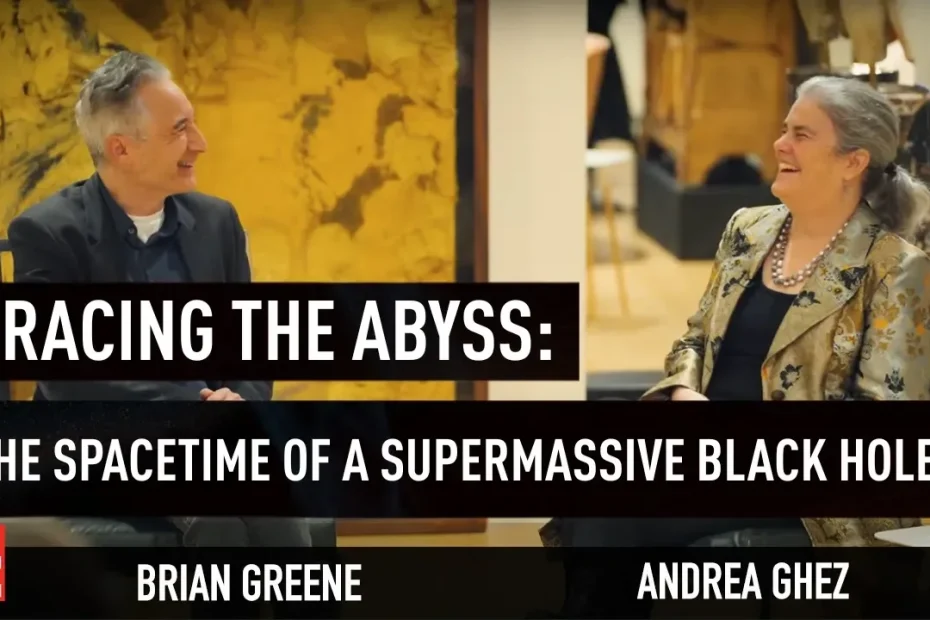
Read the full transcript of a conversation between Brian Greene and Nobel Laureate Andrea Ghez titled “Tracing the Abyss: The Spacetime of a Supermassive Black Hole”… premiered Mar 1, 2025.
Listen to the audio version here:
TRANSCRIPT:
Introduction
BRIAN GREENE: Thank you all for coming tonight for this conversation on the nature of one of the strangest and still very mysterious, still right at the forefront of research, this arena of black hole physics. We’re so thrilled to have as part of the conversation Andrea Ghez, who is a chair professor at UCLA. She’s also a Nobel Prize winner. Her Nobel Prize was for work that we’ll be at least partly discussing tonight, which was really the first convincing evidence that there is a massive black hole at the center of our Milky Way galaxy. We will get into the details of that in a moment.
Early Influences and Background
BRIAN GREENE: Andrea, I just want to start with it’s almost a hackneyed but very famous quote of Isaac Newton where he described, “I’ve seen further because I’ve stood on the shoulders of giants.” Murray Gell-Mann, who is a fellow Nobel laureate, had a paraphrase of this, which is sort of a less euphonious version where he described, “If I’ve seen further, it’s because I’ve been surrounded by people of low stature.” As you think back, it could be parents or whatever, where do you see the dominant influences that really set you on your trajectory?
ANDREA GHEZ: “Dominant influences” – that’s a strong word. I see the giants that I stand on from both a personal and a professional point of view. You don’t get to the point where you think about how you’re going to engage with black holes without first getting to that point where you have the opportunity and, in a sense, the education to do so.
I’d say my parents are by far the first giants whose shoulders I stand on. They were really important in terms of how I got to where I am. They’re really different people. They come from very different places. And I think that difference really helped me understand how science is done – that contrasting ideas, that dialogue, that comfort with discomfort, because of course so much of research is an uncomfortable place. Because you don’t know if you’re on the right track.
BRIAN GREENE: And when you say they were different and came from a different place, what do you have in mind? Say more.
ANDREA GHEZ: Well, they were different from a religious point of view. My dad’s Jewish. My mom’s Catholic.
BRIAN GREENE: That’s our same blend right here.
ANDREA GHEZ: Oh, well, it’s a rich and interesting blend. My dad grew up in Europe in big cities from a well-educated family. My mom grew up in a tiny little town in Massachusetts, very much a blue-collar family and didn’t go to college. So their paths were very different.
My mom is definitely somebody who lived the American dream. I was born in New York when my dad was a grad student at Columbia. She had two kids here, one in Chicago and then the third in Chicago. And evidently, we were driving her nuts. So she went to an art gallery and said, “Can I have a job?” She got a job as secretary. When she moved to Chicago, she did the same thing and then became the director of the gallery. So she became a very influential person in the art world. I grew up with that. I grew up thinking that this was just what you did.
BRIAN GREENE: Did they push you towards science, or was there any agenda that they had in mind for you?
ANDREA GHEZ: No. I think they both thought education was really important, and they shared a love of the arts. So they certainly gave us that incredible opportunity to have a good education.
I would say in terms of where I went, the seed of that probably can be found in the early moon landing. The family getting so excited about seeing this. Now I’m about to tell you how old I am. I was four years old.
BRIAN GREENE: Younger than us.
ANDREA GHEZ: Oh, so now we’ve dated ourselves. I think that was a really important moment for me in terms of getting excited about the universe and being in a setting where that excitement was nurtured. I got a telescope, which lasted for a little while until we started looking at the neighbors. But it got my little four-year-old brain working. And my dad, who was an economist, really believed that math was the queen of the sciences.
Educational Journey
BRIAN GREENE: Did you ever think about going in this theoretical direction? Math.
ANDREA GHEZ: I actually went to college wanting to major in math.
BRIAN GREENE: You majored in math?
ANDREA GHEZ: Yeah. I really thought that was the way to think about all these conundrums that my younger brain couldn’t wrap my head around. You know? Space, the edge of time, the beginning of time.
BRIAN GREENE: And this is MIT.
ANDREA GHEZ: Yeah. I went to MIT and took those first theoretical math classes and was taking physics. And I thought, “Oh, that’s my language.” So, that was my jump over many parts.
BRIAN GREENE: MIT, back in our era, if I can join us together, because we’re close enough in age, were there many women majoring in math?
ANDREA GHEZ: No. There were not a lot of women at MIT in general. Although MIT has had women at that school since the get-go. I went from MIT to Caltech. And you can tell, in hindsight, there was an openness at MIT because there had been an existence proof, even though there weren’t a lot of women at the time.
BRIAN GREENE: And you finished in math at MIT, or did you switch?
ANDREA GHEZ: I switched.
I think he really helped me understand how important it is to get students involved in research. And he gave me, when I think back, just incredible opportunities. I’m kind of amazed that I got access to the things that I did – simply getting into the lab, learning to code, working in a group setting, and then getting the opportunity to go to the telescope.
BRIAN GREENE: So you did observing.
ANDREA GHEZ: I went, yeah. And I fell in love with the romance of the telescope, very old-fashioned telescope observing that I did. Now, I did a kind of observing that’s just not really done today, where you actually look through an eyepiece of a gigantic telescope. And you have to get on ladders as the telescope goes over, but you’re out on the dome floor.
BRIAN GREENE: It’s like Edwin Hubble.
ANDREA GHEZ: Oh, yeah. And with photographic plates. This is definitely old-school astrophysics.
Career Path and Research Focus
BRIAN GREENE: And then from there was to Caltech, you’re saying?
ANDREA GHEZ: From there, I went to Caltech. And, actually, there, I also started very old school. Actually, that’s skipping a beat.
So I went there thinking I wanted to do stellar mass black holes in high energy astrophysics. But one of the things that I think is so important for all of us is paying attention, paying attention to what’s emerging and what might be new and exciting. So I was there, and there was a new technique that was emerging, this technique that I actually did quite a lot of work on for correcting for the blurring effects of the Earth’s atmosphere. And the promise, and this is always true, we over-promise, was that you could find supermassive black holes at the center of galaxies. But it was over-promised. So I had to do a left-hand turn. It’s kind of interesting in terms of how we have these paths. And they take these twists and turns. And sometimes they come back.
Understanding Black Holes
BRIAN GREENE: Now you mentioned two kinds of black holes in your remarks so far, mass and the super mass. Maybe it’s worth explaining the difference between them and how people think about these two categories.
ANDREA GHEZ: Sure. I’m not sure I could look at you and do that. I think I have to look at you.
There are—well, let’s even go back. Einstein had these ideas about how gravity works, and an outcome of his theories, theoretical ideas about gravity predicted black holes. And he didn’t even quite believe his idea, which is also kind of interesting in terms of how science is done.
But then people started to think about, well, where might black holes show up in the universe? And the first kind of black holes that people thought about were the ones that come out of the evolution of very massive stars. So we call those—I don’t know what you would call them—stellar mass black holes.
BRIAN GREENE: The little ones. I think of them as the little ones.
ANDREA GHEZ: Or you could call them the ordinary black holes. But the reason they were important is that there was a theoretical concept of how you would get to the conditions that a black hole would be formed, so predicted theoretically. And then there were beautiful observations that came later demonstrating that these things existed.
And then what came next is a very different story about the other class of black holes, the supermassive. And as you might imagine, supermassive means really big. So rather than ten times the mass of the sun, it’s more like a million to a billion times the mass of the sun.
And it wasn’t theory that got us going on that. And that’s what I think is interesting in terms of these two kinds of black holes is that the story highlights the two ways in which we can engage with science. I guess there’s a little bit of a pas de deux in terms of how that evolves.
So in the supermassive black hole case, it was observations of the center of galaxies that didn’t make sense. And people started to wonder, well, could you solve this by introducing the idea of these really massive black holes? So spawned by observations, pushing theory, pushing observations.
And in fact, it was this latter. Well, I started with the former and then got interested in the latter.
BRIAN GREENE: And so did it, for instance, trouble you that there wasn’t a good theory of how these supermassive black holes would form? Or were you just taken by the fact, hey, the universe ultimately is the judge of what’s real. And if it’s telling us through observations, that’s good enough.
ANDREA GHEZ: I’m looking for a good problem. You know, if it’s intriguing, if it’s interesting to you, if you can solve it, it might be interesting to others, and you have the capacity to solve it. To me, that’s the path. That’s the thing I look for. If you can’t explain it, that’s up to others.
The Nobel Prize-Winning Work
BRIAN GREENE: And so when did you start seriously thinking about the project that ultimately—and I’m happy to follow the steps, because it’s a fascinating story that leads to the Nobel Prize winning work.
ANDREA GHEZ: So when I was at the end of graduate school, it was clear that if you’re going to ask this question of supermassive black holes, actually, the way I had started was not the way to do it. That looking at the center of our own galaxy was the best place to look.
And one of the keys—well, there’s a couple different ways to approach this. One is that it’s close. So you’re going to have better opportunity to see more detail. But you have to go into the infrared. So the center of the plane of our galaxy, there’s a lot of gas and dust. And the dust absorbs the optical light. So you can’t see it at optical wavelengths, what your eye detects. So you have to go into the infrared.
And so part of the story is the evolution of technology in a couple of different fields. So in some sense, it’s a little bit right place, right time, and paying attention to what science gets opened up as your technology gets better. So infrared detectors were developed. Actually, LA was a big place that they were being developed, which is one of the reasons that UCLA became a great place to do infrared astronomy. There was that synergy and the understanding that was going to be exciting.
So, infrared means you can see it. And I was looking. I just started a job at UCLA. So really, what I was thinking about was what problem can I do to get me tenure? Coming out of grad school, I’ve been working on something completely different. I was thinking about star formation, how stars like our sun would form and under what conditions they might or might not form planets. So that was my left-hand turn.
And so this was started as a high risk, small investment, didn’t know if it was going to work. But of course, in our evolution of scientists, you got to do different things. You got to explore different ideas. So this was sort of a seed project.
BRIAN GREENE: And this project was to find evidence that there was a supermassive black hole at the center of our galaxy.
ANDREA GHEZ: Yes.
BRIAN GREENE: That was the goal?
ANDREA GHEZ: That was the goal, to look at the center of the galaxy, to develop a new technique with big telescopes. Oh, so an important part of this story is at that time when I had first joined UCLA, UC and Caltech had just built the largest telescope in the world. And I knew this because I was a grad student at Caltech, and I saw those first images. And what I wanted more than anything else in the world was to get access to that. I didn’t know how much they offered me for a job, you know, for a salary.
The Importance of Telescope Time
ANDREA GHEZ: I didn’t care how much startup money they gave me. I was like, just get me that telescope time. So, I mean, that’s hilarious, in terms of what young faculty think about today. I made sure that Columbia gave me parking, but that does exactly.
BRIAN GREENE: And I don’t—New York City kid right there.
ANDREA GHEZ: I’m telling you. I still don’t get parking.
Yeah. So the big telescopes were key. And I was interested in developing a new way of using these big telescopes. Because if you’re going to ask this question, you not only have to take a picture in the infrared so that you can see what’s at the center of the galaxy, but you have to overcome the blurring effects of the Earth’s atmosphere. And that’s what I had done a lot of work on. And big telescopes give you fine detail. So that’s sort of the beginning of the story.
BRIAN GREENE: And so you envision this as a few year project?
ANDREA GHEZ: Yes. I envisioned it. My first proposal said, in three years, we will accomplish this. And, you know, I’m still doing this thirty years later. And this proposal was turned down.
BRIAN GREENE: It was turned down.
ANDREA GHEZ: Yeah. The very first proposal. So you can imagine. You know, you’ve got the job. You’ve got an idea, and it was turned down. And it was turned down because there were three reasons, actually, that were given. One, your technique won’t work. Even if it does, you won’t see stars at the center of the galaxy. People hadn’t done that. And, even if you do, you won’t be able to see them move. And that was the heart of the experiment. You really need to be able to measure the motions of stars.
Hunting for Black Holes
BRIAN GREENE: So just give us a sense. So your goal was to sort of see the black hole’s effect on the orbits of stars?
ANDREA GHEZ: Right. And I’m not going to look at you again. Have to say this. So, you know, black holes are objects whose pull of gravity is so intense that nothing can escape them, not even light. So, you know, the classic thing to ask is, well, if you can’t see them, how can you find them? How can you observe them? How can you study them?
And so the basics of this work is that you use gravity. So black holes have strong gravity. And so you’re looking for how stars move under the influence of gravity. I mean, it’s the same way planets orbit the sun. So it’s the exact same physics, just not as extreme. And each orbit tells you how much mass is inside its orbit.
So the game is to get as close to the heart of the galaxy where you think the black hole is and show that there’s a lot of mass inside a very small volume. And so, in fact, this project has gone in stages because we were, again, you know, you have to think back. People didn’t think that we could do it. And while we think it’s quite obvious today that there’s a supermassive black hole there, there was controversy at the time around whether or not that was even a reasonable thing to think about in our galaxy, which didn’t have any of this sort of extractivity that led people to think about supermassive black holes in the center of other galaxies.
BRIAN GREENE: Yeah. So the original idea was you just measure speeds, how fast things are moving. So you take a picture. You have your technique. A lot of computational in the background.
ANDREA GHEZ: Actually, adviser this is such a nontechnical way of describing what I do, but I’m going to go for it. It’s like taking the twinkle out of stars. Very romantic. But it’s really a lot of computer work to really try to figure out what’s there and what the atmosphere is doing.
So you take a picture. And if you take a series of pictures over time, it’s a time lapse movie. And you can measure how fast they’re moving. And if stars that are very close to the center are moving much, much faster than further away, you know on average that there’s a lot of mass inside the typical distances.
But there’s a lot of assumptions in doing that. So the great thing I love about science, you take one step forward, and then the community says, nice, but there’s all sorts of other things that could explain what you’ve done so far. I mean, we can increase the evidence by a factor of a thousand. I thought that’s pretty good. And yet, you know, people are creative.
The theorists said, well, you know, we can come up with alternatives. And I was teaching—you might appreciate this. I was teaching freshman physics. So I was very much in the mindset of, well, gravity. You’ve got velocity. Well, the next thing that happens is acceleration. It’s going to curve. And so it wasn’t very hard to figure out that if they just gave me a little bit more time, now they’ve given me three years, now I’m getting piggy. Just two more years, I can see that acceleration.
Overcoming Rejection and Fear
BRIAN GREENE: Right. But before we get to the—sorry. Okay. The great moment there, you were turned down the first—So as a young assistant professor, I gather, thinking about tenure, you persevered, obviously. You didn’t take no for an answer.
ANDREA GHEZ: I was so convinced that this would work. I mean, I couldn’t understand actually why somebody would think this wouldn’t work. It was just so—to me, from my perspective, where I was coming from. And but it was risky because people hadn’t done it.
And what I had to appreciate—and I didn’t appreciate at the time, well, guess I did. Telescope time is really precious. So it’s hard to convince people to take a risk. And I was really young. I mean, not only was I an assistant professor, but I was one year out of a PhD program. So I was young for an assistant professor. So I was completely new kid on the block.
I had convinced those UCLA guys to give me a job. But there were a lot more people who had a seat at the table. So what I learned very quickly is I had to go talk to people. And in fact, in terms of the story, that’s an interesting part as well. I hated public speaking.
I mean, with a no. It wasn’t hated. I was afraid of public speaking, so much so that I’d gone to a grad school where they wouldn’t make me teach.
BRIAN GREENE: You didn’t even want to get in front of a group of students?
ANDREA GHEZ: I didn’t even want to get in front of students. I was deathly afraid. So I didn’t like to write. I didn’t like to talk. You know, I thought those problem sets were great. They give me a puzzle. I’m good.
BRIAN GREENE: And so how did you get over that? You must have gotten over it.
ANDREA GHEZ: I clearly did. My adviser, one of the first times I had to give a talk in grad school said, you gotta get over this. I mean, I really couldn’t get the words out. And so late in my grad career, I had to teach. Right. So I wasn’t getting out of that.
And I considered all sorts of things. I thought, maybe I should go take Toastmasters. You know? But the truth of the matter is you get up. Oh, actually yeah. Sometimes in thinking historically, it’s hard to understand how you convinced yourself to do something.
So I was at Caltech at the time. And Caltech is a very small place where they let the professors do the discussion sections. And at that time, I was still—I was already interested in encouraging young women to go into the sciences. Because having been at MIT and Caltech, I was getting the hint there weren’t very many.
So I decided that it was important to teach. If I was going to have to teach, I wanted to teach freshman physics. And so this actually required me to go argue with the person in charge of this, that I should be able to teach this. So I think I just got so passionate about the mission that it just helped me overcome the fear.
It was probably still there when I got to UCLA. And I’ve actually done all my teaching at the intro undergrad level because I think that’s the most effective way of encouraging the young women into the field, showing the greater population that people look different.
BRIAN GREENE: Yeah. Good.
ANDREA GHEZ: And that includes the young men, right, if you want to change the way people think. So I did one of these big classes, not four times a week. And you just can’t get—you can see I still have a little bit of a stumbling. You can’t get nervous that often. Just there’s a limit on your body that you need.
BRIAN GREENE: Right. Right.
ANDREA GHEZ: That’s how I got over that. But, and that was really important because in order to convince people to give you the telescope time, the key is you’ve to go give a lot of talks. So I went up and down the California coast giving talks.
The Discovery Process
BRIAN GREENE: And at some point then in those talks, in fact, you should—I assume that you were and your team were waiting for that first evidence, I guess, of stars starting to make the turn around what you hoped would be a black hole. Was that sort of a photograph by photograph looking for that acceleration?
ANDREA GHEZ: So the talking was to get the time.
BRIAN GREENE: Yes. So we’re not yet at the time.
ANDREA GHEZ: Yeah. But once you get the time, stage one is you take images. In fact, we basically took three. You take one. You know the technique works. You know they’re stars. You take another one. You connect the dots. You know they’re going fast. You take another one, and you believe it. So, you know, you have to understand how well you can do this. So that was step one. You got the speeds. You got the velocities.
Then next two years, you start to see them go around the corner. And that’s acceleration. And that’s a fundamental measurement of the gravitational influence. But there’s a lot of degeneracy at that point. But you know—you know that there’s something more compact than what you did in stage one. You announced that. Still, there is pushback.
And that’s probably actually, that paper is probably one of my favorite papers that we wrote. It was super, super, super simple. But it allowed us to understand that the orbits of stars would be short, that they could be as short as ten years. And then you know, oh, you’re in business. Well, one, you’ve got five years worth of time.
BRIAN GREENE: Yeah. They’ll give you five more.
ANDREA GHEZ: Right. And you can do so much more with the individual orbits. You can find the mass to a much smaller volume. So that argument, which is increasing the density, is the heart and soul of the case.
So at this point, we’ve increased the evidence by a factor of ten million. So that’s a huge—and at this point, there’s no pushback. There’s no pushback about the conclusion. And what’s remarkable is that not only is that the evidence in our galaxy, but that became the strongest evidence in any galaxy for the existence of supermassive black holes.
Competition and Collaboration
BRIAN GREENE: And so this was a maverick project, but there was also another team, if I’m correct, that was also doing this. Right? Is that—and how was that relationship? How did that work?
ANDREA GHEZ: I could write a book on this. It’s a book I’ll never write.
Well, I mean, interesting science always has competition. So you can make all of this look nice and easy. And but an interesting problem is going to attract multiple teams. And I would say that it’s been super important that there were two teams going at this for the past thirty years because there’s nothing like competition that’ll keep you on your toes. And there’s nothing like competition for finding your mistakes or learning from each other in terms of how to do it better.
So people often ask, well, why didn’t you collaborate? And I say, well, we kinda collaborate on a very slow cadence. You publish. I publish. You go give a talk. I go give a talk. So there is communication.
But I think there’s—I guess my school of thought or my approach to this has been it’s so valuable to keep the independence of thinking. I mean, once you do the merge, then you get groupthink. So I think it’s been beneficial. It’s been highly educational in terms of how do you deal with high profile, at times intense competition. And that’s very much how do you—what style, what kind of scientist do you want to be?
Certainty and Future Directions
BRIAN GREENE: Now presume you had growing confidence that your work was establishing that there was a supermassive black hole at the center of our galaxy. Can you think back to a moment when you crossed a threshold in your own mind and you were absolutely certain that this was correct?
ANDREA GHEZ: You know, I was convinced at every moment, but I accepted that there was pushback. And I came to understand, oh, you know, these are really interesting ideas. They were getting more and more exotic.
I mean, my favorite one was when the particle physicists got into the act, they said, well, it could be a fermion ball. It’s like, okay. We’ve never heard of this. But, yeah, it could be a ball. Let’s learn about this. And, and so it was kind of fun. It’s like, okay. Again, just fodder. Okay. You’ve gotta go further.
And then what got even more fun is that you can go beyond, is there a supermassive black hole? You can get into understanding the characteristics of a black hole. You can start to think about, can you test how gravity works near a supermassive black hole? Can you test for the presence potentially of dark matter around the black hole? Can you start to look at and understand the relationship between the black hole and its host galaxy.
So it became far richer than I could possibly have imagined and completely dwarfed what I had been doing at the outset.
BRIAN GREENE: Yeah. And at one point, just that was no longer the thing. This project had gone so many different directions.
ANDREA GHEZ: Right.
The Nobel Prize Call
BRIAN GREENE: And again, just to be candid, it’s not often that one has a conversation with someone who’s had that call at whatever ungodly hour it is. So there must have been a point when you thought, “Maybe this could rise to the level of a Nobel Prize.” Was that a period of time? Were you waiting by the phone as some of our colleagues do?
ANDREA GHEZ: You know, people always ask, “Did you have any hint?” The only way I knew that there was some discussion was—you know, I don’t know how the sausage gets made because that’s secret. But there is clearly a back and forth of people getting nominated. You should know that the average time between somebody’s first nomination and when they win is ten years. So this is a very long process.
My understanding is that there is a curation of these prizes. What is a field that might be interesting to recognize? And then it comes back about who should be recognized. So it sort of starts with names and ideas, curation of something, and then who should be recognized for it. You have this really incredible engagement.
BRIAN GREENE: So how did you know?
ANDREA GHEZ: This is absurd, actually. At some point, people would occasionally say after a talk, “You know, maybe one day this will get a Nobel Prize.” That you think, “Okay, flattery.”
But when people say, “There’s no way this is going to get a Nobel Prize”—people said that to you? To my face—you think, “Oh, there’s a discussion.” Because otherwise, why say that?
The 2020 Nobel Prize Call
BRIAN GREENE: So you did get that phone call?
ANDREA GHEZ: I did, and it was 2020. So October 2020. Think about where we were in October 2020—this is pre-vaccine. I still have a home phone. I have no idea why I still do. So when it rings at two in the morning, I wasn’t thinking prize. I was thinking, “Who’s sick?”
But very quickly, at this odd hour in the morning, you realize, “Oh, this is that call.” There are aspects of that morning that really stay in my brain because I was invited to participate in the press conference. It was suggested to me that I might want to think about what I would want to say or not say to the press. I thought, “I’m going to make some coffee.”
I’ll never forget what the first reporter asked. I won’t get the phrasing right, but it was something along the lines of, “How does it feel to get a Nobel Prize at a time when science is increasingly under attack, and yet we need science to get out of COVID?” And I thought, “Oh my goodness. This is not physics. This is not astrophysics. This is a different kind of prize.” That, I think, was the thing that struck me most.
BRIAN GREENE: Did you acclimate to that sort of new role that you get thrust into?
ANDREA GHEZ: I mean, I guess I would say you have to figure out how you want to wear that mantle of the prize because all of a sudden, people want something different from you. They want you to be a spokesperson for science. They want you to encourage their students.
And because I was the fourth woman ever to win the Physics Prize, which brought the percentage of women to two percent, there was a whole other layer of invitations, requests, sense of responsibility. It’s an opportunity and a responsibility. So how do you want to engage with that?
BRIAN GREENE: And so did you do that for a period of time wholeheartedly? Or was it really wrenching to move away from observation and analysis?
ANDREA GHEZ: Well, the plus of getting a Nobel during COVID is that there’s an expectation in your first year that you give a lot of talks, but I could do them by Zoom. So I could go all over the world and talk to the little green dot, close the computer, and go back to work. It’s an ongoing exercise.
Current Research Directions
BRIAN GREENE: Is the project continuing? What would you say are the most exciting directions that you’re working on now?
ANDREA GHEZ: Oh gosh. A couple different directions. What I call the key project of the continuation of the orbits is now looking for what’s called precession, so the idea that the orbits don’t come back to where they started. There’s two reasons why that’s going to be true. One is general relativity, so how gravity works close to the black hole should change the orientation of the orbit.
You basically need a measurement of the whole orbit, which goes around—well, the best one is sixteen years, the star that’s the most powerful in terms of its ability to probe this. So you need to go once around to have a seat at the table. And then you can get into this business of deviations. We’re now at the point where we can actually see these deviations.
This is the hardest part of this work. We’re not quite agreeing with the other team. This is my favorite part of doing science because either you’ve got a discovery or a mistake. And you don’t know. So we’ve spent a huge amount of time kicking the tires, trying to figure out what’s going on.
It’s definitely precessing. It’s not coming back to where it was supposed to be in the beginning. Most likely, Einstein got it right, and it’s compatible with what you would predict based on the mass of the black hole. But it’s not quite going far enough. And if you believe it—and I say if, this is like a huge if—this would be the presence of dark matter around the black hole or something else, or a binary, or something that makes it deviate for some other reason.
We’ve encountered this so many times in this project where you see things that don’t make sense. And I have to say, that is my absolute favorite part of doing research—when things don’t make sense. In the past, it’s mostly been around the data where you get a lot of other information other than just the information about the black hole. You get information about its environment. I would say almost every prediction that we could make in terms of what we should see there has been inconsistent with the observations.
Today, the aspect of that that I’m most interested in is the role of binaries, pairs of stars. People never used to think about binary stars at the Galactic Center. They said they couldn’t exist. They also used to say they didn’t think about young stars because they said they couldn’t exist. But that was my thesis, young binary stars.
So I was delighted when we discovered these young stars that you don’t expect. And then other things that we actually had no explanation for, but one idea is that they could be binary stars that the black hole drove to merge. So they’re black hole driven binaries as a concept. Now we’ve been able to reanalyze the data in a different way. You take what you have, and you slice and dice it in a different way, and you can look for binaries.
You see far less of them, actually none of them, as you get close to the black hole. So it gives you insight into how the black hole interacts with its environment. The data set has taken us in all sorts of different directions because you have this really rich set of information that you can mine to pursue a lot of different ideas.
The Joy of Scientific Confusion
BRIAN GREENE: One final question. If there’s one question that you could gain insight into or maybe even answer by, say, the end of your career, can you nail it down to sort of one thing that would really feel like it all came together?
ANDREA GHEZ: Oh, I think that’s too curated. I hope not, I guess, is what I would say. Because I find that science is the most fun when things pop up, questions that you didn’t even think to answer. That’s the most fun.
I remember talking to a reporter who said, “You know, you seem most excited when you’re confused.” And so I guess that would be my hope for more confusion.
BRIAN GREENE: More confusion. Well, look, good luck with your confusion. Let’s just open up to some questions. Why don’t we start with Bill?
Q&A Session
[BILL]: Now my question is, when you were describing the orbits, you were describing Newtonian mechanics. A little bit later, you’re describing relativistic mechanics. And then there’s a part where there were a little bit of fermions in there, a little bit of quantum mechanics. How do those all fit into your current view of what you’re doing? Because it sounds like it’s a mixture, pretty rich mixture of all three.
ANDREA GHEZ: Yes. There are a couple of different angles to that question. One is when you begin, it’s really hard to distinguish which regime you’re in. You need enough information to get a seat at the table to see the deviations from the Newtonian version. That’s why I said you need to go all the way around once.
The first one was just Newtonian. It was simple Kepler’s laws. I mean, it was so simple that you could bring it into a freshman class on physics. It was velocities. It was accelerations. It was absolutely classic classical physics. But that’s the beauty of this work—the longer you go, the more you nail down. And you start to see those deviations.
Now I’ve forgotten where I’m going with this. So Newton doesn’t work. Time gives you access to beyond Newton.
We were talking about where does the special relativity come in, where does general relativity come in, and where does quantum mechanics come in?
So what you’re looking for is deviations from Newtonian mechanics. We take two kinds of observations. One are images over time, and then the other are spectroscopic. The images get you how things move on the plane of the sky, and the spectroscopy gets you the motion along the line of sight. There’s different things you can test at different parts of the orbit. What’s clear is Newton just doesn’t work anymore.
We’ve built up the story or the tests of different aspects of testing Einstein’s ideas about general relativity. We’re at the point where we’re having a hard time just saying it’s just a black hole plus these other descriptions of gravity. How can we go the next step? You could say, “Well, maybe your theories of gravity aren’t right.” But I think it would probably be more likely that you just don’t understand what’s at the center of the galaxy, that there’s more dark stuff than previously understood, which is really exciting. That’s where we’ve been since roughly 2018.
[BILL]: I had an opportunity to travel to work at the Giant Magellan Telescope. Are you eager for that to be built and to look at those results?
ANDREA GHEZ: Oh, you know, you have to know that’s the competing team. But yes. For the work that I do, it’s all about getting the sharpest images out there. So bigger telescopes. This is why I wanted access to Keck. It was, at the time, the largest telescope in the world. And we had a ten-year lead.
But we’re only looking at the tip of the iceberg in terms of what’s at the center of the galaxy. I should add, because it’s sort of part of the story, that almost every prediction for what you should see around the black hole is inconsistent with the observations. I used to joke, “Job security.”
There’s way more to do. What you need to do is to see those fainter stars, and you need a big telescope to do this. There’s three telescopes, three proposals around the world. There’s the European Extremely Large Telescope, the Giant Magellan Telescope, and the one that’s near and dear to my heart because the University of California is part of it is the Thirty Meter Telescope.
All of these—I’m agnostic. Doesn’t matter. The sky, the universe is equal opportunity. That would really change our understanding of what’s at the center of the galaxy. So you should be lobbying for all three.
From my perspective, today is actually an interesting moment. There’s just been a review of the US involvement where the National Science Foundation is really assessing their ability to invest in these telescopes. They were actually pulled out in the last round of US budget compromises. So they’re getting close, but they’re not cheap.
BRIAN GREENE: Other questions? Yeah, Richard.
[RICHARD]: I think I heard you mention Brian’s question about you might have been part of an atmospheric stabilization project as well.
Overcoming Atmospheric Distortion
BRIAN GREENE: And so I’m curious about that. Were you involved in these lasers that can help remove distortion? And are there space telescopes either existing or planned which could help your work?
ANDREA GHEZ: Absolutely. So in fact, a large part of my work has been all about how to overcome the blurring effects of the Earth’s atmosphere. That’s really the heart and soul of the technical aspect of our work. The problem is the atmosphere is like a river, and it distorts our images of the universe.
There are many different ways in which you can overcome those distortions. In the beginning, it was really simple approaches that gave you the bare minimum of what you needed to do this work, but nothing else. At that time, it was hardware cheap, computationally expensive, and only the tip of the iceberg.
Ten years into it, it got to the point where you could do this technique called adaptive optics. It’s actually an amazing story of collaboration between science and the military. The atmosphere is a problem for people in astronomy and astrophysics, but it turns out the military also wants to look through the atmosphere both up and down. As our community was making advances, we got to the point where the military basically said, “Yep, we know how to do this,” and declassified a bunch of technology.
That, of course, was a moment of incredible transformation in astronomy. It became a simpler problem of taking this technology that was designed to look at what we call near-Earth objects and applying it to things that were much more distant. This technique produces beautiful images because you have these lasers coming out of these telescopes. It’s really cool technology.
Not cheap by any stretch of the imagination compared to what we were doing before, but a much more powerful technique. You can see things that are much fainter, much deeper. In the beginning, we could only look at a single wavelength, which is like taking photos in black and white, and they were really grainy. So all of a sudden, it was just transformational in terms of what we could see.
For the first decade, we were doing this computationally intensive work. There were probably five people in the entire world who were going after this. But it did overcome the blurring effects of the Earth’s atmosphere. But this next game, which is called adaptive optics, was so much more powerful.
It not only allowed us to—well, it got us to understand that we could go so much further. Nobody was talking about tests of general relativity. No one was even talking about complete orbits. And it was that advance where it was an incredible moment. Like, there’s so much more to do here.
And not only did we realize that, but there were people writing papers about what was possible with this experiment. That’s pretty fun when you get other people to say, “Oh, this is what you could do in the future.” We had some of it, but they gave us some other ideas.
Space Telescopes vs. Ground-Based Observation
BRIAN GREENE: Space telescopes?
ANDREA GHEZ: Oh, space telescopes. The power of this technique in this setting goes as the diameter of your telescope to the fourth power. So space telescopes are smaller than what we have on the ground, even with James Webb Space Telescope. So it’s sort of sacrilege, I realize, to say that. And we even have a program with James Webb Space Telescope.
But in the center where you can do this kind of work, what we call “confusion”—I mean, it’s a great word in astronomy. We say we become “confusion limited.” That’s how I feel some days. But it means that the stars just blur together so you can’t resolve them. So it’s all about resolving power, your ability to see that fine detail.
In the middle where the orbits of stars get shorter as you go closer to the black hole—and, actually, you know, if you think about it, it is amazing that we’re seeing things that move or change on a human lifetime. It takes two hundred million years for the sun to go around the center of the galaxy. Like, we are not measuring the whole orbit. And here we are.
We have the opportunity on a human lifetime to say, okay, one time around gives you the overall properties. And then you’re going to get into these more sophisticated questions on the second pass.
Scientific Rivalry and Collaboration
[DENNIS]: Yep. So you and your rival shared the Nobel Prize. How are you getting along these days?
ANDREA GHEZ: I think pretty much the same as we always did. I don’t think of these prizes as something you’d go after. I think once you get into that mindset, your brain turns off. So it’s not something that I anticipated. There’s still interesting science to do after it. We were still doing that science, so we still keep going.
The two teams benefit a lot from each other, a tremendous amount. There’s nobody like a competing group to find your mistakes. You’re in a regime that nobody else has probed before, so you want those people who are looking really critically at what you’ve done. I think there’s been an interesting ratcheting over the years. Sometimes we collaborate.
[DENNIS]: Really feel…
ANDREA GHEZ: You need to buy me a drink for me to answer that. No, I mean, in all honesty, it’s been a good way of doing science. You have to have the critique to push you forward. And I think the science that has come out has been so much better than either one of us could have done alone.
Black Holes and the Origins of the Universe
BRIAN GREENE: Final question in the back. Yep.
[AUDIENCE MEMBER]: Yes. I wonder if you would give us your sense as to whether black holes can enlighten us about the origins of the universe. In other words, do you have a sense of how long they’ve existed or how they fit into the origins of the universe, what they tell us about it, what they tell us about its time span and what they tell us about how the actual explosions or expansions took place? Do they give you any indication of that at all?
ANDREA GHEZ: The question of the origin of the universe—I mean, there’s no bigger question than that. I guess the thing I would say is that the challenges that are faced when we think about that early universe moment have some of the same physics and attributes that are posed by black holes in later times. So there is a connectivity in terms of the kinds of physics one has to think about to solve these two problems. And I am sure Brian has way more to say about that.
BRIAN GREENE: Well, that’s a perfect segue because our next patron circle event is January thirtieth in which I will give the answer to the argument.
Related Posts
- How to Stand Out in an AI World by Thinking Better, Not Faster: Sol Rashidi (Transcript)
- Modern Wisdom: w/ Alex Petkas on True Story Of The Odyssey (Transcript)
- Reconstruction: Malcolm Gladwell Interviews Barack Obama (Transcript)
- Transcript: “How to Win Without Crushing Your Soul” – Graham Weaver
- Why Early Legal Action Matters After a Cryptocurrency Investment Scam