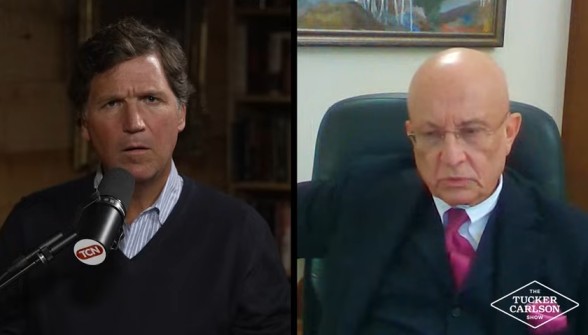
Tucker Carlson opens this episode with a stark warning: a top adviser to Vladimir Putin now says Russia is actively considering nuclear strikes on the UK and Germany if the Ukraine war continues on its current path. He walks through what Moscow’s updated nuclear doctrine really says, why Russian elites frame the conflict as a proxy war with NATO rather than a fight with Ukraine itself, and how recent hypersonic missile attacks are meant to signal that red lines are being crossed.
The episode then features a long-form interview with Putin adviser Sergey Karaganov, who bluntly outlines the scenarios under which he believes Russia would “punish” Europe with nuclear weapons. Use this transcript to track each claim, escalation risk, and strategic argument in full, from Carlson’s monologue to Karaganov’s most alarming statements. (January 15, 2026 )
The Global Landscape: Three Major Flashpoints
TUCKER CARLSON: Well, there’s a lot going on tonight, around the world, certainly here in the United States, but foreign policy has got to be the headline tonight. And in order, here’s what’s happening.
We’re awaiting what look like imminent strikes on Iran. I have no idea actually whether those will happen or not, but all signs indicate something is coming and certainly momentum is in that direction and events tend to follow momentum almost independently of the judgment of people who are in charge. So it looks like we will be striking Iran or doing something there.
It looks like the United States will be taking Greenland from Denmark, which sort of owns it. There are pictures this afternoon of a sad looking Danish president or king or emir or potentate or whatever, whoever runs Denmark. Oh, how the Scandinavians have been diminished. Leaving the White House looking kind of sad. So looks like the news has been delivered to him. Sorry. No more Denmark for you. It is now an American protectorate.
And then, of course, there’s Venezuela. Venezuela, as you well know, was changed. It was regime change, sort of, shortly after New Year’s by the Trump administration, and the then leader Nicolas Maduro and his wife were extradited, some say kidnapped, and moved to New York. They’ll be put on trial, we are told. And so there’s that, and that country and the rest of world are trying to figure out, like, what are the implications of this, and what happens to Venezuela next?
Assessing the Downside Risks
You have those top three. And, of course, you pray sincerely, and you hope, and sometimes you tell yourself that everything’s going to be completely fine, and it may be completely fine, by the way. We don’t know any differently. But you also assess downside risk. What are the potential downside risks? Without getting into too much detail, of course they exist. There’s downside risk in every human action.
And in the case of a strike on Iran, you know, the country could fall apart and become Libya, is kind of a big deal given its geographic location, given its energy reserves, and given the region. You could see Iran strike out at Israel, for example, to such an extent with conventional weapons that the iron dome, the fabled iron dome, does not protect Israel’s two largest cities and a lot of Israelis get killed. You could see that for sure. That is not a crazy thing to worry about.
You could also see attacks against energy infrastructure in the Gulf right across the water from Iran. The six Gulf countries that produce a lot of the world’s energy, oil and gas, and you could see those taken out. That is possible. They have air defenses in their energy facilities, but how good are they? We don’t know. We could find out. And if that happened, you would see an oil shock, which would lead to a global economic shock of unknown proportions, but that’s never good.
In Greenland, what are the downsides of taking Greenland? Well, you establish a precedent that if I have the power, I get to take what I want. That has always been enforced. That is human nature. We have constructed an elaborate series of rules, theoretical rules designed to pretend that is not true and to mitigate it to some extent over the last eighty years, but really that has always been true and always will be true.
But that is a pretty tough game once you write the rules that if someone can take something because they want it, it’s okay. You have to live with them. NATO will effectively be done. How can you have a defensive alliance when one member acts against another? Probably can’t. NATO was going out anyway. Is it really bad that NATO’s going away? No. It’s a huge victory for the world and for the United States, but it’s going to be tough for its many employees and for the entire infrastructure of foreign policy thinkers such as they are in Washington and Brussels and throughout Europe, they’re going to have to face the reality that this is not a real thing anymore. If NATO was real, then the US wouldn’t have taken Greenland. So there’s that, apparently a downside.
And then in Venezuela, the downside is obvious. You could have chaos. You could have a black hole. You could have a migrant crisis. Once again, the energy infrastructure could be destroyed. You could see a move against the government that we effectively left in place. It’s sort of weird to think that a lot of people in Washington are rooting for Delsy Rodriguez, apparently the head of state now, who is an accolade of Hugo Chavez, but she also represents stability, and at this point stability is what people want most.
So those are the kinds of things that people who think about this stuff for a minute are concerned about, maybe not panicked, but definitely concerned.
Russia’s Nuclear Threat: The Biggest Story No One’s Covering
But none of those concerns comes even close to what is happening in Eastern Europe, what is happening between Russia and Ukraine.
Now we’re going to explain why we know that that’s true in a moment. And at the end of this open, we’re going to play an interview we did a few hours ago with a man called Sergei Karaganov, who is a long time political advisor to Vladimir Putin and one of the most famous public intellectuals in Russia, been around for about thirty-five years, advised Boris Yeltsin more than thirty years ago.
In that interview, he says point blank, yes, if the Ukraine war continues at this tempo for a year or two more, we, speaking apparently on behalf of the Russian government on behalf of his friend Putin or at least someone who is very familiar with President Putin’s thinking, we Russia will eliminate the UK and Germany with nuclear weapons.
Now that is a headline. No one wants to see Qatari gas wellheads blown up. No one wants to see killing of any kind or destruction of any kind. But taking out the two most important countries in Europe, both of which have big American bases, lots of American personnel, of course international banking, Germany being the economic engine of Europe, London being the banking center of Europe, really of the West along with New York, and of course these are two ancient countries with which we have close ties, history and kinship and genetics. We are going take them out. Are going to eliminate those countries with nuclear weapons. Saying that right into camera.
So that is a pretty big story. Have you read that story? Has anyone mentioned that to you? That the most famous public intellectual in Russia, a close friend of Vladimir Putin’s exactly the same age, the two were born a month apart, have known each other a long time, is saying in public that Russia plans to use nuclear weapons against Western Europe. Russia is going to blow up the UK and Germany if things don’t get resolved soon.
You probably haven’t heard that. It hasn’t actually been on the front page of the New York Times. I don’t think the Times of London has mentioned it. No one seems to be paying any attention at all to the biggest story of our lifetimes, potentially. And that’s very odd.
Russia’s Updated Nuclear Doctrine
And it’s not just one guy who’s friends with Putin who’s saying this. If you watch carefully or not even carefully with one eye open at what Russia has been doing recently, things are changing. So Russia has publicly rewritten its nuclear strategy to include use of nuclear weapons against countries that are acting as proxies for nuclear armed powers.
Now this is kind of classic Russian bureaucratic talk, but it means that under Russian law, Russia is permitted to, by its own rules, blow up Germany, even though Germany does not have nuclear weapons. The UK supposedly does. Wonder whose hands they’re in. But Germany does not have nuclear weapons, and Russia has just said, no. You’re fair game for a nuclear strike. And not a defensive nuclear strike. Like, you launched us. We’re going to launch against you. No. You keep poking us in the face, and we’re going to eliminate you. Said that publicly.
And then last week, a week ago, I think a week ago today, Russia sent hypersonic missiles into Kyiv, Ukraine. Now the hypersonic missiles killed probably four people. This was not an attack designed to destroy important infrastructure or to cause massive civilian casualties. This was an attack designed as a message, and the Russians just said this point blank.
This was an attack designed to say, woah, you’ve pushed us too far. We feel like our core interests, existential interests are threatened. And if you don’t back off, the next hypersonic missile we send against which no country has any meaningful defense, you can’t stop a hypersonic missile, no one’s even claimed that you can. The next one will have a nuclear warhead on it, and it’s coming at you, Europe.
The Proxy War Reality
So let’s just think this for a sec. Why would Russia, which is supposedly in this bitter war against Ukraine being backstopped by NATO and the US, etcetera, etcetera, but they’re fighting Ukraine over territory. Why would Russia be threatening Europe?
Ah, because the Russians, whatever their faults, don’t lie to themselves as aggressively as we do. And the Russians are saying out loud what is absolutely true about this war, which is it’s a proxy war. It is not a war between Russia and Ukraine, and it never has been. And nothing that has happened in Ukraine since the fall of the Soviet Union thirty-five years ago has really been about Ukraine.
There has been a global scramble to control Ukraine, its land, its resources. There are other reasons people want to control Ukraine that are not directly related to land or resources that have to do with history. But in any case, non-Ukrainians have been calling the shots in Ukraine for thirty-five years. That’s what Maidan was. That’s what the coup, the US backed coup was. None of this had anything to do with Ukraine. What’s best for Ukraine? We’re going to make Ukraine a sovereign nation. The opposite has happened. Ukraine has less sovereignty. Ukraine is more of a puppet, and Ukraine has suffered more than maybe any country on Earth over the last four years.
Now why? Well, we’ll get into that.
Ukraine’s Forgotten Casualties
But first, just to show you how completely this war is being controlled from the outside on behalf of outside non-Ukrainian interests for reasons that have nothing to do with what’s good for Ukraine, I want to show you the following clip. And by the way if you just want to prove the point how many Ukrainians have been killed in this war paid for by the West, paid for by NATO and Joe Biden? No one knows. Hundreds of thousands. Obviously, it’s depopulated the country, but nobody cares.
And you would think that if we’re waging a war on behalf of the freedom seeking people of Ukraine, if we love the Ukrainians so much that we’re willing to send them hundreds of millions of dollars and our best CIA targeters and willing to put bio labs in their countries to defend them from Russian aggression, you would think if we love them that much, we might keep a tally of how many of them have been killed in the prime of life on the flat landscape of Ukraine.
But, of course, no one’s keeping score because nobody cares. The people running this war on the western side have zero interest in what it costs Ukraine. None. Because it was never about them in the first place.
The Soros-Freeland Connection
And now to the promised clip. This was shot about ten years ago. We just saw it, and it’s amazingly instructive piece of videotape. Now you will see and you will recognize immediately the Hungarian man on the left. That would be Mr. George Soros, one of the world’s most successful financiers. I think he euphemistically described, a guy who has bet against national currencies, really done nothing to make the world a better place or to improve the lives of individuals, has only sown chaos and hatred and violence really for the length of his professional life, for whatever reason, whatever motive might be animating him, he is on the left.
On the right is a woman called Chrystia Freeland. Now she is not Ukrainian either. She is from Canada. She is from Alberta, Canada. She spent the bulk of her career as a journalist working for Reuters and other news organizations like that both in London and in Washington where we spent quite a bit of time with her. And then she became the Deputy Prime Minister of Canada under Justin Trudeau and an economic pooh bah. And if you are interested in how well she did, well you can just look up facts about the current state of the Canadian economy. Not very well. But here’s the interesting thing.
Just recently, Chrystia Freeland, who again is not a product of Ukraine. She didn’t grow up in Ukraine. She grew up in Canada and lived in London and Washington. Chrystia Freeland is somehow working for president, unelected president Zelensky in Ukraine, who himself is not really that Ukrainian. Grew up speaking Russian.
He’s a citizen of the world like she is, like they all are. But she’s now an unpaid economic adviser to Ukraine. Unpaid. Right. Okay.
They’re divvying up the natural resources of a country they know will soon collapse with no regard for the people who’ve been killed, of course. But here is Chrystia Freeland and George Soros ten years ago talking about Ukraine, and in so doing, giving the game away. Watch this.
VIDEO CLIP BEGINS:
CHRYSTIA FREELAND: And I will just offer my own personal testimony here. It’s actually amazing in Ukraine. The new Ukrainian government, the new Ukrainian leadership, everyone who I know in that group has been touched somehow by Open Society and by George, like, literally, either people personally got a scholarship or someone, you know, their wife got a scholarship. It’s a really remarkable thing.
GEORGE SOROS: Well, this is a, for me, quite an experience to see this, and I didn’t realize actually how much big an effect it has had over a twenty-five year period because those were students. Twenty-five years later, they were leaders.
VIDEO CLIP ENDS:
TUCKER CARLSON: Everybody she knows in Ukrainian leadership, says Chrystia Freeland. Everybody has taken money from George Soros, or their wives have taken money from George Soros. Everyone running the country is actually employed by this Hungarian billionaire who’s got nothing to do with the country. Oh, no one would admit that now. That’s a conspiracy theory.
But George Soros smiled and took credit for it. Of course, we had no idea how successful we were. Successful at what? What was the plan here? You put everybody in a country’s leadership on your payroll? To what end were you trying to achieve?
Well, I guess we could debate what Soros’ motives were at the time, but we don’t need to because as we know the purpose of a system is its outcome. Over time we do not have to guess about why certain people or certain organizations exist, we can instead look at what they do. We can judge the tree by its fruit and the current state of Ukraine was clearly the point all along.
Destroy the country, depopulate it, change the laws that prevent foreigners from buying its natural resources. It’s a land, some of the most fertile farmland in the world. Huge tracts of it. It’s an enormous country. It’s the biggest country in Europe. Also the weakest and the most corrupt.
Many people doing this had ancestors in Ukraine, so there very much is a sense that, wait a second. You know, this is ours too. Chrystia Freeland had ancestors from Ukraine. A lot of people involved in making policy about Ukraine had ancestors in Ukraine. And so there is a kind of entitlement that you see on display. No. No. This is an interest. Of course. We have a right to weigh in on this.
But not for the benefit of the Ukrainians. Really all of this is about taking what once belonged to the country they claimed they loved and using that country in order to defeat its much larger neighbor, which is the real prize, Russia. And this has been true for over a hundred years, for hundreds of years. How many times have Europeans tried to invade Russia?
A few. Napoleon tried. Why does everyone want to invade Russia? It is far away. It is freezing. No one ever succeeds in doing it. It’s like Afghanistan or Yemen. Not a long track record of victory. If outside forces taking control, there are a few peoples around the world that are tough to beat, history suggests, and the Russians are at the top of that list.
So why do people keep trying? Well, in a word, resources. That’s why. Russia is unimaginably large, literally unimaginably. Most people in the west haven’t imagined how large Russia is. Russia is larger than China and India put together. You combine the land mass of China so big you can barely get your head around it and India almost as big and together they’re smaller than Russia.
Siberia itself is about the size of the continental United States and there are like ten million people living there. In all of Russia there are about one hundred and forty million something like that. In all of Russia. Meanwhile Russia has the deepest energy reserves in the world. Some of the highest uranium enrichment in the world. It is by some measures the most gold in the world, silver, bauxite for aluminum, timber by far the largest timber reserves in the world which people still need by the way.
Pulp for paper, dimensional lumber for building, people still need trees and Russia has more than any other place primarily in Siberia but not just in Siberia and of course farmland and agricultural products, fertilizer, wheat. Russia has as much or more than anyone and very few people.
So the promise of access to Russian resources and space and land has been a siren that has called invaders for centuries and no judgment by the way you can see why. If Greenland is a prize what is Russia? The biggest prize of all and you saw this attitude on display the moment the wall fell and rapacious foreigners mostly bankers moved into Russia and stripped it.
And they were helped along by a lot of unscrupulous indigenous Russians. It wasn’t just outsiders who did it. Some Russian oligarchs did it to their own people, but the fact is a small group of people denuded the country, looted it. And unfortunately, this always plays out in exactly the same way. It’s not enough to loot. You have to take everything and drive everyone else into despair, hopelessness, poverty. And that’s exactly what happened.
Russia’s Transformation Under Putin
Russia thirty years ago, thirty-five years ago, one of the, well, certainly the poorest country west of I don’t know. Who even knows? I mean Bhutan? Really poor and divided sad and defeated and alcoholism and drug use and gasoline huffing and suicide were endemic. And who did that? Well the Russians to some extent did it to themselves. Were living in this Soviet system for seventy years.
But outsiders did it to him too. That’s a fact. And whatever you think of Putin, he’s bad. Putin got that under control. And Russia in 2026 bears no resemblance whatsoever to Russia in 2000, the year Putin took over.
And one of the main changes he made is he kicked the money changers out of the temple. He did. Sorry. Everyone else has forgotten that, ignores it. He kicked the oligarchs out, or he brought them to his side. You can’t act independently of the national interest. Sure. You can become a billionaire, but some of it has to go to the country.
And that was spun in the West as cartel behavior. He’s the mafia boss. Okay, fine. He’s the mafia boss. But the real answer to the question, did it work or not? Is obvious not just in the numbers, but in the state of the country, the visible state of the country now versus twenty-five years ago. A completely different place.
It’s no longer Bhutan. It’s not Africa. By some measures, it’s much richer than any country in Western Europe. In fact, by every measure it is. By every single measure. Is it richer than Spain? Is it richer than the UK? Oh, yeah. Much.
So that is both tempting to elites from around the world. Wait a second. Why do a hundred and forty million Russians get all this stuff? We should have some too. But it is also an indictment of their leadership. If you’re Boris Johnson and your ancestors ruled the waves, ruled the British Empire, and your country is a kind of sad Urdu speaking museum now. That’s insulting.
Really? The Russians? Those weird half Slavic, I mean, they dominate world chess, but, like, really? They’re not really white. And how are they doing so well? This is outrageous. It is an indictment of your own leadership. And in countries across Europe, the leaders feel that way. Russia is an embarrassment to them because it is, relatively speaking, thriving.
The Path to War
And so they all, as one, backed the Biden administration’s plan to have a war with Russia. And let’s stop lying. This was not an unprovoked invasion. Putin just randomly went over the line into Eastern Ukraine and stole these oblast. He stole this land that belonged to another people. That’s a total lie, and it’s not a defense of Putin to call it out as a lie because it is, and everybody knows it now.
The truth is that in 2001, Putin, same guy, same leader, asked the Bush administration in person directly to George W. Bush, I would like to join NATO. I would like to join the defensive alliance that exists to keep me from moving west into Western Europe. In other words, you won. I’m joining your team.
And due in part to his own limitations as a leader and due in part to the counsel that he received from Condoleezza Rice at the time, George W. Bush turned down that offer and prevented Russia from joining NATO. And the guest we’re going to speak to in a moment, if you’re wondering if he has a good track record of calling future events, said at the time, this decision to turn down Vladimir Putin’s, this is twenty-five years ago, Vladimir Putin’s request to join NATO, to join the West, to all be in it together, to work together, this decision made by the Bush administration guarantees a collision with the west.
We are now on a collision course. And, of course, he was absolutely right because NATO didn’t want Russia because NATO wanted a war with Russia, and boy, they got it. And so from 2001 all the way to 2022, twenty-one years, NATO moved inexorably east surrounding Russia.
And many times, again this is not a defense of Russia, is just a fact, many times the Russian government under Putin said, “Woah. Woah. Woah. Woah. Are threatening our core national interest, is not to have other people’s missiles on our borders back off.”
And then in 2014, the Obama administration overthrew the government of Ukraine to put an American puppet in there thereby sealing the fate of nations. When that happened and Sergei Karaganov said it at the time, you have just guaranteed a war in Ukraine that will destroy Ukraine.
So as you listen to the interview, and we hope you listen carefully because the English is not flawless, and it was done over satellite from Moscow. So it’s not the best audio, but it’s worth listening. That man that you’re going to hear has a long track record of calling events right. And it’s not to detract from his powers of perception or his intellect, is formidable to say other people could have drawn the same conclusions because it’s pretty freaking obvious.
If you exclude Russia from NATO, you’re probably seeking a war with Russia. And if you try to put nuclear armed missiles on Russia’s border, you’re probably going to get a military. That’s exactly what he said. And of course he was laughed at in Europe, where he’d spent a lot of his life, and he was totally ignored by the United States.
And our policymakers were on to this, that, the other thing. They were not paying any attention at all, and to the extent they were, they were very excited for this war with Russia and they never really explained why.
Reckless Escalation
And then once that war began four years ago, they began to act through their proxy, the Ukrainian government under Zelensky, truly a proxy, in a war that has been managed from day one in part by the CIA, our CIA, targeting by the CIA, anyone who tells you that’s not true is lying. They begin to act with not just recklessness but extreme recklessness.
The kind of behavior that suggests you don’t care about the consequences at all. You’re just all in. Actually, at some point, the kind of behavior that suggests a death wish. That suggests like, I actually want a nuclear holocaust. I’m happy to risk the lives of my family, my nation, and the world in a nuclear exchange. And we know that because of what they did.
They blew up Nord Stream, which was the main source of natural gas for Europe. So that did two things. One, it destroyed the European economy. That was obviously going to happen. And it did. Because you can’t have a robust economy, certainly a manufacturing economy, without cheap energy.
Without cheap energy you’re left with what? Real estate and finance and of course the people making these decisions are familiar only with real estate and finance because that’s the world they live in. But in the real world, countries become rich and powerful and stable and resilient because they make things. That’s the first thing.
# NATO’s Escalation and the Destruction of Nord Stream
We blew up Nord Stream so that destroys our supposedly closest allies in Europe, particularly in Germany. Germans hate themselves so much they won’t even admit that we did it, but we did it through proxies, but we did it, as we said we would.
And the second thing that it did is send a very clear message to Russia: We’re done. We’re not going to have a Vietnam scenario where we have a proxy war but there are limits to our behavior. Yeah, we will spray Agent Orange but we are not actually going to level Hanoi.
We bomb it on the edges, but we’re, you know, there are limits to what we’re going to do because we don’t actually want to war with the Soviets. American and NATO behavior since the beginning of this war suggest there are no limits at all. Blowing up Russian infrastructure, trying to assassinate Putin repeatedly, they lie about it, but yes they have. Yes they have. The Ukrainian government has tried to assassinate Vladimir Putin multiple times.
Has the CIA assisted with the targeting of those drones? Yes. Obviously. Tell me how you didn’t. No one’s even asked them.
The Dollar Crisis and Gold’s Rise
You don’t need to be an economist to see what’s happening. The dollar is in trouble. It’s getting weaker. It’s sad, but we’re not in charge of it. So we have to respond appropriately in ways to protect our families.
When paper money dies, it’s going to be replaced by programmable digital currency or gold. Gold survives. The same Americans who think they’re themselves with gold are the ones getting ripped off by big gold dealers. After we left corporate media, we got offered tens of millions of dollars to promote gold companies. How do they get the money to spend that much on marketing?
Because they’re scamming their customers. We didn’t want anything to do with that. So we sought an honest broker, and together, we formed a precious metals company that you can actually trust. It’s called Battalion Metals. At Battalion Metals dot com, we publish actual spot prices.
We’re totally transparent about the VIG, what we take, and we treat everyone with honesty. So if you’ve been watching what’s happening, you know, it’s not just about money. It’s about sovereignty and holding something that endures and cannot be manipulated or taken from you. So if you’ve been waiting for the right time to act, this is it. Visit BattalionMetals dot com.
Underestimating Russia: A Dangerous Delusion
And again it’s not taking sides against the United States with Russia. No. It’s trying to think clearly about what are the potential consequences of this kind of behavior, torquing it up consistently over four years to a point where you’ve cornered a great power. Oh, but that’s the problem. They don’t consider Russia a great power.
They’re not a great power. You know what Russia is? Russia’s a gas station with nuclear weapons. Watch this.
VIDEO CLIP BEGINS:
UNIDENTIFIED SPEAKER: I think economic sanctions are a very important step. Identify these kleptocrats and look. Russia is a gas station masquerading as a country. It is a wounded and declining nation. It has an uncompetitive economy.
UNIDENTIFIED SPEAKER: Senator McCain used to joke that Russia is a gas station pretending to be a country. Its declining population, of course, contributes to its decline.
UNIDENTIFIED SPEAKER: What’s your view of Putin?
UNIDENTIFIED SPEAKER: Look. I think he’s got grand ambitions. I think he’s hostile to the United States. But I think the thing that we’ve seen is he doesn’t have the conventional capability to realize his ambitions. And so he’s basically a gas station with a bunch of nuclear weapons.
UNIDENTIFIED SPEAKER: If the president could rally the world to push back against Russian aggression, and really hit them economically, have sanctions that hit really hard, then Putin is basically a gas station masquerading as a country.
VIDEO CLIP ENDS:
There’s really nothing more embarrassing. And as someone who knows all four of the men you just saw say that, you pause and you think we are a great nation. It’s United States. We’re a great nation, and we should be led, in particular policies that matter that could determine whether your children live or die, should be led by great men.
Men with wisdom above all, restraint, a sense of longitudinal interest, it matters what this looks like in one hundred years, that should be part of the calculation, and knowledge and lived experience. And none of those four men, you just saw all four of whom have been major players in formulating US foreign policy over many decades, none of them meet any of those criteria.
These are weak, unwise, in the case of John McCain, though very charming I will say, low IQ people. True. That’s just true. They don’t know anything. So you could say, everything about Russia I found repulsive. Everything about it defends my sensibilities as an American.
That’s fine. People feel that way. But you can’t dismiss it as a gas station with nuclear weapons because that reveals you as ignorant. Because it is the opposite of that of course on a cultural level the country that produced Tolstoy and Dostoevsky more than a gas station.
But it also suggests that you are doing the one thing you can never do with an adversary, and that’s underestimate his power and resilience. You have to see the people you’re in conflict with clearly, or you will get hurt. That’s the real risk here, not just you’ll act like the ugly American you’re a buffoon. They’re a gas station with nuclear weapons. What a clever line. I heard that from my donor.
I’m going to repeat it and meet the press, which is exactly what poor DeSantis, doesn’t know anything, was doing, trying to sound statesman like. Oh, I just heard this. Well, gas station nuclear weapons. So good. You know you reveal that you are just a rube, go back to Orlando, but it is more than that.
You can wind up way over your head and we are now way over our heads because of that attitude. Lindsey Graham who to his credit has been around, he has been everywhere, Graham has still not picked up the one quality you hope that travel instills in a person which is wisdom, Zero.
And there’s a particularly sad line at the end of the clip you just saw from Lindsey Graham where he said, if just we can make our sanctions tough enough, we just need tough sanctions, That will bring Russia to its knees. Well, did that, actually. But who got brought to his knees?
Was it Russia? No. It was not. It was us.
The Self-Inflicted Wound: Sanctions and the Dollar’s Decline
One of the saddest things this country has ever done is sabotage its own currency over time, but if you were to isolate a moment where the US dollar’s future became dim, it would have to be in the Biden administration’s immediate response to the Russian invasion of Ukraine.
That was the moment that we kicked Russia out of Swift. We just stole the personal property of people who did not work for the Russian government, the so called oligarchs, which means businessmen. Just took their stuff because they had Russian names and prevented Russians from playing in international sporting events. You can’t be at Wimbledon. There’s an OV at the end of your name or whatever.
So we humiliated ourselves, of course, by behaving who behaves like that? But we also sabotaged our own core interest, which is the maintenance of the US dollars, the world’s reserve currency. That’s the key thing that we have. It’s not our manufacturing base that makes us rich. Sorry.
Wish it was. It’s the US dollars. The privilege of holding the currency that, say, energy transactions are conducted in. Everyone has to use dollars. It’s called the petrodollar.
Been there since 1971. You tamper with that and the bills come due, and you become poor. And then all the downstream effects of poverty, which include violence, by the way, and chaos. That was the single most unwise thing any administration has done in my lifetime, fifty six years. That was the dumbest thing.
It was the most self destructive thing. So what was gold trading at? Do you remember? If you got a phone in your hand right now, look it up. What was gold trading at, just say, February first 2022?
Seventeen hundred bucks an ounce, which is high. Was high. You check gold prices to the spot price of gold today, it’s about forty six hundred dollars per ounce. Has the S and P grown that much in four years? No.
Has anything? No. Why gold? Is there some new industrial application for gold? No.
There are some but not really. People are buying gold as an option to the US dollar. Gold is what you buy when you want out of the dollar because you don’t believe it has a bright future. You dump your treasuries and you buy gold. And the people who actually understand the system because they made it and participated in it and are its biggest players are doing that.
China is doing that. Now why in 2026 would you dump treasuries, which they have, a lot of treasuries, and buy gold, the most primitive medium of exchange. Like the Assyrians used gold. Gold? Only superstitious people buy gold.
I’m not making the case that there’s some inherent quality in gold that makes it valuable. I am making the case that compared to what? You are doing that because you believe the US dollar is unsafe. And why do you believe that? Because the US government just used it as a political weapon against a great power that is why.
The Russia-China Alliance: America’s Strategic Blunder
Anybody could have figured this out and the second thing that happened almost immediately is that Russia formed a durable alliance with China. Now think about this for a second. Donald Trump to his great credit used to say this. The worst thing Biden ever did was drive Russia into an alliance with China. Why is that the worst thing?
Because here you have the largest economy in the world, which is China, and you have the largest resource density in the world and the biggest country in the world which is Russia combining against you. So I think by anybody’s count there are four really kind of major players in our near to long term future globally and they are the US, Russia, it’s more than a gas stage one nuclear weapon, sorry, India and China. Now who knows where India is going to land?
But if you’ve got Russia and China against you, it’s tough. That’s only not unipolar. That’s like an actual threat to your interests. That’s that’s an actual threat to your don’t allow that. The reason Richard Nixon flew to Beijing fifty years ago, fifty five years ago, and met with chairman Mao, who, by the way, was a lot more of a monster than Putin’s ever thought of being, was not a Christian unlike Putin, killed, you know, a hundred million of his own people.
Richard Nixon flew there anyway and, quote, opened up China, made an alliance with China. Why? To split it from Russia. Because he understood that was the threat. The block, the alliance of countries that don’t share our interest is a massive threat to us and to the dollar. He did that and it worked for like fifty years until Joe Biden with the help of the US Congress, probably the largest collection of unwise cowards in the English speaking world got together and decided that they could levy sanctions against this country, which they deemed bad for reasons they never really explained, except Russia reacted to their provocations and went over a border that no one can find on a map.
Because of that, we needed to act and do something because we’re Winston Churchill, not Neville Chamberlain, and everything’s about World War two. By the way, we were on Russian side during World War two, but shut up. You’re not supposed to know that. And we’re going to punish them not by actually joining the Ukrainian military and putting our lives on the line because, hey. We’ve got better things to do than go die in someone else’s war, but we’re going to sanction them very tough sanctions despite the living proof that not only do sanctions not work, are counterproductive to the stated aims.
The Failure of Sanctions as Policy
And if that’s untrue, what happened in Cuba exactly, which got sanctioned in about 1960? Oh, Raul Castro was still alive and still has power in that country. The country’s gotten poor. Don’t think Raul Castro has. They don’t work.
They have the opposite effect. And by the way, they are dishonorable and feline. They’re a weak man’s form of diplomacy. When Lindsey Graham is running around pretending to be tough, the man with the size five shoe is telling you he’s the man on the scene, you know what you’re watching is pantomime, it’s acting. You’re watching a weak man pose as a strong man And the decisions that he makes reflect that.
That’s why they all love sanctions. But in this case, in this specific case, sanctions shafted the United States. And I think it’s worth saying that out loud so our grandchildren looking back on this time and asking why don’t we live like our grandparents did can assign appropriate blame. Sanctions did not punish Vladimir Putin. They punished the United States and they completely destroyed Europe, which is where our ancestors came from and where our religion comes from.
So it’s not a small thing. But they didn’t work. And by the way, did the military action that we spent hundreds of millions of dollars paying for in Ukraine. A military action that was never designed to liberate Ukraine, but to beat Russia, whatever that means. How can you beat a cohesive ancient empire?
Probably can’t. When this country was founded two fifty years ago, Russia was an empire. It’s not like us. Okay? Russia will be here.
We know that whether you like it or not. So deal with it in a constructive way. But they couldn’t. And so once the war got rolling and it became really really clear that we had lost, oh we haven’t lost, what are you a Putin puppet? Okay, really simple metric.
# Putin Advisor on Nuclear Strikes Against Europe
TUCKER CARLSON: Putin rolls across the border into Ukraine, Ukraine really just like a satellite of the United States in the Biden administration, but rolls into this supposedly different country, and we can’t get them out. No matter how many hundreds of millions of dollars we send them, and how many bio labs we have there, no matter how many threats, CIA officers we send over there to do the targeting of the drones, still there. And they’re not leaving.
So what does that leave you with? Well, again, I would refer you to not the smartest foreign policy strategist we have, but certainly the most cable friendly, Lindsey Graham.
Lindsey Graham’s Calls for Putin’s Assassination
VIDEO CLIP BEGINS:
LINDSEY GRAHAM: How does this end? Somebody in Russia has to step up to the plate. Is there Brutus in Russia? Is there a more successful colonel Stauffenberg in the Russian military?
The only way this ends, my friend, is for somebody in Russia to take this guy out. You would be doing your country a great service and the world a great service. I’m hoping somebody in Russia will understand that he’s destroying Russia, and you need to take this guy out by any means possible.
Yeah. I hope he’ll be taken out one way or the other. I don’t care how they take him out. I don’t care if we send him to The Hague and try him. I just want him to go. Yes. I’m on record.
Please understand. Senator Lindsey Graham, if John McCain were here, he’d be saying the same thing, I think. It’s time for him to go. He’s a war criminal. I wish somebody had taken Hitler out in the thirties.
Live by the sword, die by the sword.
VIDEO CLIP ENDS:
TUCKER CARLSON: Do you really want to call for the extrajudicial murder of another head of state? Is that a precedent you want to live with? Probably not, actually. Probably not.
And if you’re a country that believes in the rule of law, pretty shocking thing really for a lawmaker disabled, just assassinate them. Just a tool of foreign policy. No, we’re not Israel. We don’t conduct foreign policy through assassination, actually. We shouldn’t.
Apparently, now we do. Is that okay with people? You don’t like someone, you just kill them? If those are the rules, will have to live with those rules. And you don’t need a particularly powerful imagination to envision how that ends and not well at all.
The Dangers of Ignorance About Russia
So if you’re going to be a beacon of freedom be one and call the just to account and don’t punish the innocent which is why sanctions are not only ineffective but also immoral. But moreover, if you’re waging a war against a country, we’ve been at war with Russia for four years, despite what the liars tell you, we have been at war with Russia for four years, probably not a good idea to admit that you’re losing on television which is what Lindsey Graham just did. “We have no choice but to take him out.”
And third, it is probably unwise to admit that you know nothing about the country that you are fighting, that you are obsessed with. Taking Putin out will solve the problem? Putin is an absolute dictator? He is dictatorial, that is for sure. You probably wouldn’t want to walk by the Kremlin and give him the finger. He’d probably punish for that.
But does he have absolute control over Russia? Does any leader of any country ever have absolute control over the country? Did Stalin know? He consulted with the constituencies in his country. They all do. Every one of them.
Our president, every emir in the gulf, every king, sultan, potentate, head of the CCP. Everyone’s got a board of directors in this world. Everyone. And Putin is no different. And Putin, again, like every head of state, is balancing a bunch of different shareholders every single day.
Got the FSB and then divisions within the FSB. You got the military. You got the business community, the oligarchs as we call them. Very different from our oligarchs who are just tech CEOs. They’re oligarchs.
But everyone’s got a piece of this enterprise they call Russia, and everyone gets a say. And no head of state acts unilaterally. So the idea that you take Russia out and everyone just gives up, oh, Putin’s gone. We can, I don’t know, turn it over to Zelensky is ridiculous? And only someone who didn’t understand how the world works would say something like that.
The Real Agenda: Chaos and Profit
So what’s the point? The point is exactly what we’ve seen in a lot of other countries. Iraq, Syria, you hope not Iran, but likely cause chaos. Because in chaos, I can dominate, and I can steal. And the people who are paying me to have these views, a lot of them are exiled Russian oligarchs who Putin kicked out, could get back in there and scoop up the resources.
There’s no reason Putin can should control all the bauxite in Russia or whatever, all the oil, all the gas, all the gold. We should. So create chaos in this country, the biggest country on Earth with a hundred and fifty million people in the largest nuclear arsenal, and I’ll get rich.
And even if you signed up for that program, which you shouldn’t because it’s disgusting, but let’s say you did think that was a good idea part of your reptile brain would start beeping red alert alert alert that’s really reckless because I can’t control what happens next. There are too many nuclear weapons in this country.
They have massive military industrial power. They make a lot of weapons. They make a lot of steel. They have a lot of cheap energy. This is a real place.
And it’s got a huge Muslim population, twenty percent, and they’re kind of peaceful now. Will they be? These are the kind of things an adult would ask himself before calling to knock off a head of state. You could destroy the world.
But they haven’t asked themselves those things because they don’t care. And above all they are unfit for leadership of the West. And that includes our foreign policy establishment and it includes virtually every single head of state in Europe.
And for that they are on the cusp of being eliminated literally and I will just speak for myself and say I really hope that does not happen. Yes Keir Starmer is a joke of course he is an insult to our ancestors if you are English he is an insult to our ancestors and to that nation. Of course, Macron is ridiculous. Germany. Ugh.
But do you want to see them destroyed? And according to Sergei Karaganov, they’re very close to being. So with that, watch this interview and ask yourself, why is this not on the front page of every paper? Why is this not on the lips of every European and every American? Because it’s entirely real.
Here’s the interview.
Interview with Sergei Karaganov
TUCKER CARLSON: Mister Karaganov, thank you very much for joining us.
SERGEI KARAGANOV: It’s fine.
TUCKER CARLSON: How do you believe this war will end?
SERGEI KARAGANOV: This war could and should be ended not only when Russia achieves total defeat of Europe, hopefully, without eliminating Europe. We are fighting not Ukraine, not Zelensky and the like. We are fighting again the Europe, which has been the source of all ills and all sources of evil in the history of humanity of two world wars.
The EU has been several times invading us. Last time, it was open in the for 1941, 1945, and ninety percent, ninety five percent of European countries went came here under the under the banners of Hitler. Now, unbelievably, after all their defeats, they haven’t learned the question the the lesson. They’re still pushing for a big war.
I think I mean, the reason is obviously that there’s total failure of what the European elites. But so when we talk about the end of this war, it’s not about, I mean, doing the way with the war in Ukraine. We’re the source of this war, and that is the evil Europe, which, by the way, sucked United States several times into war and which have been the source of the worst things in the history of humanity, including, of course, world wars, including racism, colonialism, and many other good or bad things, including now, they have been the main source of the posthuman values of the Jewish.
They have been exporting. I mean, they partly polluted the United States, so now we are fighting that. They tried to pollute them, that’s with the I’m not speaking about all Europe, I mean, are many decent people and even good countries there, But the question is as Europe is returning back to where it used to be during the last five hundred years, and that is the source of all evil in the in the history humanity.
TUCKER CARLSON: So what what does it look like to defeat Europe? The war can’t end until Russia defeats Europe, you said. What does that—
SERGEI KARAGANOV: For the time being, we we are thinking about a piecemeal deal about the narcissist, which has been offered by president Trump in good faith over. Again, until the will of European elites is not to continue confrontation for the sake of saving themselves from from the old covering up for the old mistakes they have done. That war will not stop.
So I’m relatively skeptical as to the short time possibilities of a piecemeal ordeal. However, of course, if we achieve something along the road and people will start stop to be killed, well, the opportunity should be used. But I’m pretty sure that their problem is much deeper. And it is not Ukraine. It is not the landscape and whomever. It is that Europe is again returning to its worst. And that is the source of all evil in the history of lament.
Why European Leaders Focus on Russia
TUCKER CARLSON: Why do you think I mean, I think from an American perspective, it’s very obvious that European leaders are focused on Russia in big countries, Germany, France, Great Britain. The leadership of all three countries is focused on Russia as the threat. Why do you think that is?
SERGEI KARAGANOV: No. It is very simple. I mean, I’m a founder of the Institute of Europe, and I used to be a Europhile forty years ago. And then I learned them better, and I became highly skeptical. They are complete failures on all counts. I mean, moral, political, economic, etcetera.
Europe is going down. Also, they are unable now to exploit the world and to suck the rent from the world which they have they have been getting due to their military preponderance over the last five hundred years. And that was stopped in the sixties and seventies, but and they got into a deep crisis already.
But at that time, I mean, for all kind of reasons, Soviet Union collapsed. And and they believe that their golden age will continue. But now they understand that this golden age is finished, and they are desperate. They understand that they could not leave on others money, Leave also, they start to understand that they could not leave on the cushion of US protection. Yes. Because US is tired of them, and they don’t need it anymore.
So there’s a total desperation of this layer of globalist, quote, unquote, liberal European elites. Also, there, by the way, process of antineritocracy. I mean, never in the history of Europe have we had such a low level of intellectual capacities in the leadership of most European countries. Not of all, but almost.
TUCKER CARLSON: So Europe is basically out of gas. It’s out of energy. It’s dying. And so you’re arguing that their leadership sees a defeat of Russia as the only way back.
SERGEI KARAGANOV: Continuation of war. They at first, they thought of a possibility of a defeat of Russia, which was, I mean, a kind of a fantastic illusion. Than that, but still some people, because of their their intellectual, quote, unquote, incapacity or they are still talking about that.
But what is defeat of Russia? Just Russia comes ever close to a defeat, that would mean that Russia now would use nuclear weapons, and the Europe will be finished physically. So, I mean, it’s simply impossible even to think about it.
But they have been talking because they need a war to rationalize their stay in power, to to rationalize their existence. And it is not about even defeat of rationale. It is simply keeping on with the with the failing European Union, with the failing economy, with fading European positions in the world.
Everybody in the world now laughs at Europe, which used to be, by the way, one of the core centers of world power. And now it’s a joke. And, of course, I am not speaking of all Europe. We know that there are decent Europeans, are smart Europeans.
Though in my class, political class, of European thinkers and Europe on foreign policy and defense, etcetera, etcetera, there’s only one or two men or persons left. I will name them because that would jeopardize them in light of the audience, but nobody else. I do not have any interlocutor, almost any interlocutor in Europe anymore.
The Nuclear Threat to Europe
TUCKER CARLSON: When you say everyone knows that the Russian government, if pressed, would use nuclear weapons against Europe, you mean that, is my question, and do you think that the Europeans understand that?
SERGEI KARAGANOV: The Europeans, because they have been, first of all, intellectually degrading after the 1968 so called civil revolution, which killed most of European education. And because of anti meritocracy of modern European democratic system, do not understand or unable to understand what is happening fully.
And also, they are entertaining what I call strategic parasitize parasitism or parasitism. I don’t know what to call it. They believe that war will never come to their territory. They forgot about the war, and that is terrible because they have been their source of most wars in the history of humanity.
But now they are not afraid. So the now one of the tasks of Russia, in addition to others, is to bring them to census, hopefully without using nuclear weapons, only with the threat of their use, and I am criticizing my government of being too prudent and too patient with them.
But sooner or later, if they continue to support this war, sacrificing again new millions of the Ukrainians and others, the Russian pursuit of perseverance will say, will go with it, and we will have to punish them severely, hopefully in a limited sense.
TUCKER CARLSON: It’s It’s interesting that you say their leaders no longer fear nuclear weapons. You would think everyone would fear nuclear weapons given their destructive capacity.
# Why Would Anyone Not Fear Nuclear Attack?
Why would any person not fear the threat of a nuclear attack? Because, well, let’s put this, we believe that they are like us, but they’re not like us. They have had a total degradation of thinking class and of the ruling class.
I mean, when chancellor quote unquote, of Germany is talking about, I mean, recreating a bouldersfarer to be the strongest army in Europe, what does that mean? That means that he dooms his country for elimination.
I have been talking with Europeans through all most of my adult life. I stopped doing that in 2013 when there was a meeting of European leaders in which I participated, and I said that if you continue into this, your system, there will be a big war, and millions of Ukrainians will die. And nobody dared to look into my eyes. There were seventy or eighty people. Most of them, you know.
They have degraded to the level that they are dangerous. Idiots or moral idiots. Yes. Most, not all of them, but most of them.
Europe Has Lost Its Fear of God
TUCKER CARLSON: You are quoted in one place saying, “They no longer fear God, therefore they no longer fear war.” How are those two related?
SERGEY KARAGANOV: Not so. They lost well, not all, again. There are normal people. Europe, they I mean, Europe has lost its core, moral, political, spiritual core.
And now they as you know, most of them have lost the fear well, the trust in God. That doesn’t mean they lost a normal losing most of their traits of the human. Europe is under this leadership or under this leadership is becoming anti-European in terms of historical European and even anti-antihuman.
They have brought the Nazis, which was antihuman, etcetera. Now they have brought to us, you have been infected with, to a lesser extent, something absolutely anti-human, loss of respect towards family, those love between men and women, those respect for seniors, those patriarchism, etcetera.
What is then Europe? And, of course, toxin gods. What is left? I mean, it is a moral hold. However, of course, I’m not speaking about all Europeans. There are normal people.
However, of course, I’m not unable to talk to them. I am not able to talk to them because they are, in magic, they are forbidden to talk to us. And if they talk to us, they are then called and summoned to the police or security services.
So I have a lot of still still probably a lot of friends in Europe, but I do not have any contacts with them because they are banned, because they’re elites from talking to us, because they’re elites are preparing them for war, at least morally.
Russia’s Changed Nuclear Doctrine
Though at least the same elites could not comprehend that if war, a real big war, is unleashed in Europe, and a war sooner or later this war in Ukraine, which we are waging with Europeans. As colleagues, there will be no euro.
Thanks to God we have changed our nuclear doctrine. And recently, our president said he was very cautious and very pol he’s a very cautious and very polite man, but he said something very important. He said that if Europe continues and if Europe, gets into real direct conflict with Europe, it will be nobody in Europe could talk.
But I hope and I beg and I pray I pray that he or us wouldn’t have to make this decision. But as I’ve said before, Europe is the source of the most evils, and it returns to its worst times.
Assassination Attempts on Putin
TUCKER CARLSON: Twice in the past, roughly the past year, the Ukrainians have tried to, at least twice, tried to kill your president, President Putin. That’s my read of it. Why do you think they did that? What’s the thinking there?
SERGEY KARAGANOV: Well, it is is very simple. I mean, they’re belligerent. I mean, some people believe that he could solve the problem of Russia by killing a president. Our president is well, I have one problem with our president. He’s too cautious. They do not too cautious, and he shows too much perseverance.
I am criticizing him indirectly, or sometimes even directly as as in our conversation with you. But they simply want they of course, they could not do. It’s simply noble hatred of people who have lost their minds.
Well, the the question, of course, of doing the way with leaders of foreign countries is a American question. As you know. And but they are pumping up hatred towards Russia like mad.
Even I’m a history partly a historian. I must say that even Hitler is Germany. Their level of anti-Russian propaganda, Russophobia was maybe maybe weaker or at least equal to what is happening in Europe.
TUCKER CARLSON: What would happen if your president were to be assassinated by the Ukrainians or Europe or the United States? What what would what would be the next next step?
SERGEY KARAGANOV: Hope let’s hope that that would not happen. But then, of course, that that would mean that we will punish, hopefully, not the United States. But Europe will be taken away from the map of of the humanity.
It should be pushed away from the geopolitical and the geostrategic map because it is a nuisance. I hope it would not be punished in the physical way. Though I am starting to say that these idiots do not understand anything but physical pain, And that’s no later.
I would have to go after the letter of escalation. And if they do not stop this senseless war and stability in in and around Ukraine. Now we would have to start to attack Europe with conventional weapons, and then next step will be waves of nuclear nuclear strikes.
The Ladder of Escalation
I hope we wouldn’t reach that point because using nuclear weapons, Now if at least one year. Well, first of all, I’ve been calling on my government to escalate earlier. But president Putin is very religious, and he’s cautious.
And we have been climbing up the ladder of escalation, changing our nuclear doctrine and lowering the nuclear threshold, building up our nuclear potential in Europe and else, but in the hope that we could stop them before crossing the threshold.
As I’ve said, I think that Putin believes that using nuclear weapons, and I believe, by the way, is a sin, but might be it might be a necessary sin in order to save humanity.
That’s why I have been calling for limited nuclear use of nuclear weapons against Europe because otherwise, the world would drift into a third world war towards which Europeans are pushing all of us. I mean, they have already done that twice in history, sucking in the United States.
You, a couple of times, saved them. You Americans. Now we once suffered, but then saved them again, but now they’re back. And with the old game, and we have to either to punish them or to help them to change their minds.
It is not I’m not calling for regime change, but if Europeans do not change the Israelis for more nation oriented, for more responsible, they are doomed. And I I I hate this idea because culturally, I’m a European.
Of course, we are We are moving towards Siberia or moving towards East. We’re saying and sincerely that we are becoming a Eurasian nation or returning back to where we belong to become the Eurasian nation, but the loss of Europe would be a bit there.
Britain and Germany as Nuclear Targets
TUCKER CARLSON: Before I ask you about what you think Russia should do relative to the rest of the world, become Eurasian rather than European, which it seems to be doing, if there were nuclear strikes from Russia into Europe in the next year or two, as you said there may be, what countries would that include?
SERGEY KARAGANOV: Well, we are online. I’ve written that several times that if we strike Poznan, Americans would never respond. Americans would never respond anyway. But if we but and I hope the Poles are becoming, by the way, more sensible. They understand that they that they are playing with fire. They’re trying to retreat from the front lines of this conflict.
But my choice would be Britain and Germany.
TUCKER CARLSON: You’d take out Britain and Germany with nuclear weapons.
SERGEY KARAGANOV: I I our almighty that it wouldn’t happen. Yes. But Germany will be should be the first because Germany is the source of the worst in queue is in the European history. But I hope again, I have many German friends. Hope that it would.
Russia-China Alliance
TUCKER CARLSON: You’ve, I think, just came back from Beijing. Certainly, the ties between Russia and China are much, much deeper than they were four years ago. From an American perspective, the idea of a permanent Russia-China alliance is a threat to our future, it would seem. Is that alliance permanent?
SERGEY KARAGANOV: Well, for the time being, for the foreseeable future, it is a source of great strength to both Russia and to China, and our Chinese friends understand that. Now now but what will happen in ten to fifteen years, we we do not know. So we’re planning for all kind of futures.
But our best solution is to reach a world where four great powers will be working together of for defining, I mean, the rules of behavior in the future world. These four powers are China, Russia, United States, and India.
And that kind of configuration configuration also means that we will and we should and we will, of course, balance the overall preponderance of China vis a vis Russia. But at this juncture, China is a fantastic asset. It is not that threat.
Just in case, we should create this at least four country system. Plus, we are building the what we call greater Eurasia. And that is a system of relationship where China will be balanced by major powers within Eurasia, including India, Persia, Turkey, and Russia, and others.
So and the but the Chinese I mean, we talked with them sincerely about necessity to balance them. They it is hard for them to solve that, but they’re starting to understand that it is in their interest to create a balanced system of an issue within Eurasia.
But worldwide, United States should be a key player because without United States, we will not succeed in dealing with the unbelievable problems we are facing in the coming years.
Russia’s Soul and Cultural Identity
TUCKER CARLSON: Does Russia jeopardize its soul by leaving the West given that it’s a Orthodox country? Its cultural legacy is…
SERGEY KARAGANOV: Owns. We are saving our soul. I mean, of course, some of my compatriots would not agree with me, but let us remind you and me and others that our soul came from the east and from the south. We took Christianity from Palestine.
Our and my Orthodox churches, true Christianity because Catholics left at the beginning of their previous millennium. We partnered with them, but still, of course, we are Christians, we are brothers.
We are very much an Islamic country, twenty percent of our population. We’ll also take it from from the south. Then we have a strong Buddhist population. We’ll also take it from the southeast. And the Judaism is also here an acknowledged region.
And the political system, which we have built over years, we have inherited from the greatest empire of them all, from the Chinggis Khan empire. But, of course, many Russia would would disagree now with me, but it is simple truth.
We are a Asian empire with a with a very strong European cultural influence, which we love and adore. We we would never pass, but we are not Asia. We’re not European, thank God.
And we are now starting to acknowledge that, because our European journey has been to which Peter the Great saw this for, because of certain reasons, because we are backward in technological terms. It’s over. It should have been over one hundred and fifty years ago.
We it will save us for many troubles, including things like world wars, communism, etcetera. Now but now we have we are budding, but hopefully keeping the traits of European cultural heritage which we share with you in our hearts and our minds.
The Effect of Western Sanctions
TUCKER CARLSON: What effect from your perspective have Western sanctions had on Russia? Do you believe sanctions hurt Russia or helped us?
SERGEY KARAGANOV: Oh, yes. I mean, we invited I mean, I have been calling for a confrontation with with us long before we stopping stopping them in the expansion of NATO, etcetera, long before we decided. Now, of course, I mean, economically wise, it’s they hurt.
But strategically wise, political wise, culturally wise, they have been a blessing. We have with with the help, we have to invite fire, unfriendly fire on our own. We have done away with comradore leads. We have thrown away without any repressions the fifth colony.
We are returning back our Russian culture, our Russian soul. We we’re becoming Russians. And the only problem with this sanctions and with this war is that we have to pay for it with the lives of our best man.
But other than that, it has been they have been blessed, and I do not want them to be lifted. Of course, someone should be, so we have an operation ship and we could earn some additional money.
But Russia, which is threatened, is again a war fighting nation. We are a nation of wars. And when we started to be attacked, even indirectly and now directly, then we turned to our best. And that’s why the country is has experienced unbelievable release.
The only problem is that we are losing investment, and that should be stopped.
Trump’s Role in Ending the War
TUCKER CARLSON: And so and that leads to my last question, mister Karaganov, which is you’ve described this as a war, a civilizational war between Russia and Europe. What role does the United States, our administration, our president, play in ending it? What can President Trump do to end the war?
SERGEY KARAGANOV: Well, mean, were very crucial in starting this war because the whole problem started in early two thousands when American administration started to piddle to prop up the European issue because they were afraid of possibility of building a continental alliance between Russia and Germany.
So in a way, Americans are also the source have been the source of the problem. As to the Trump administration offer, I didn’t like the offer which mister Trump offered because it doesn’t solve the real problem.
And the real problem is European hostility, European aggression. But for the time being, we should use this opportunity if possible. And then, of course, we all know that president Trump is curtailing his internal affairs.
And, also, now we see that his offers are delusioned by all kind of efforts from within by his court and allies. But if we could try for a while with his offer, maybe eventually, we would end up with the solution of the problem. And that solution of the problem is, of course, as I’ve said, is Europe.
However, I do not foresee that, unfortunately, that possibility. So even if we stop this war, we should be prepared when the war resumes, to do away with the source of this. And that is a facility of European elites. And they are willing to still fuel warfare on the European subcontinent. But let’s give Trump a chance. Although I am not sure whether he or we could succeed under circumstances.
You know, the internal situation in the United States is bitter. And, also, by the way, we could not rely with all our respect to your president on him. He has a country behind him, which is deeply divided. He has a huge opposition. And then he’s also playing full games.
So I don’t think, I hope we could arrange something in that, but we are watching very carefully the fact that presidential administration has abducted the leader of a big country. We are pushing very carefully that American marines are acting like pirates on high seas, seizing tankers, wearing Russian flags, Russian banners. If that continues, we’ll have to go back to rough the tariffs, but we would like to have, it’s not cordial, but a good relationship with the United States and with other two great countries in the world. But we’ll see whether he could deliver. I think he wants to deliver, but whether he’s able is a big question.
So we keep our fingers crossed. And let’s give us the absolute sure. We hope that he is sincere, but we do not trust American policies. And to a certain extent, his proposals look like a honey trap, but a trap, because nothing happens. Continue the war. Not talking about peace, peace, peace, peace. I mean, referring to who knows, other people in Europe who are blocking it.
And it seems that this war is continuing and maybe United States, in the end, do not want to finish this war. So then we’ll have to come back to the solution, which I have mentioned several times. And that is of starting to punish our European enemies with an understanding, hopefully, that the United States would, and knowing that they would refrain from participating in a nuclear war in Europe.
TUCKER CARLSON: I think it’s important for American policymakers and the American citizenry of the country to understand the Russian perspective, and I’m grateful that you gave it to us, Mister Karaganov. Thank you very much for your time.
SERGEY KARAGANOV: Thank you. It was a pleasure. Thank you for me too.
TUCKER CARLSON: Thanks very much for watching. We will see you next Wednesday.
Related Posts
- Transcript: Aimen Dean Interview on Osama Bin Laden & 9/11 – FO550 Raj Shamani
- Transcript: Joe Rogan Interviews Chris Williamson #2544
- Transcript: Tucker Carlson Interviews Clayton Morris on AI Data Centers
- Transcript: Annie Jacobsen Interview on Biological War – Modern Wisdom
- Transcript: Diary Of A CEO Interview w/ Konstantin Kisin and Steve Keen