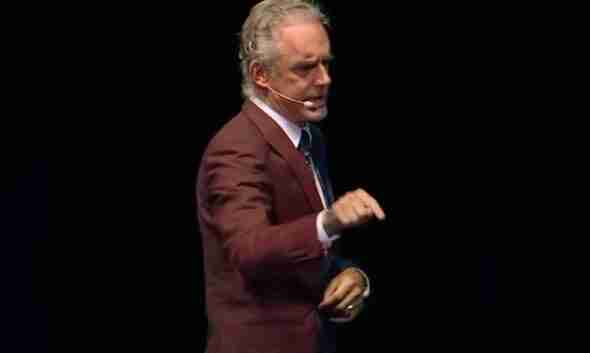
Read the full transcript of Dr. Jordan B. Peterson’s lecture titled “We Who Wrestle With God: In the Image of God”… (Dec 27, 2024)
Listen to the audio version here:
TRANSCRIPT:
DR. JORDAN B. PETERSON: Thank you. Yeah, so I’m very curious about tonight’s talk because I have a lot of things buzzing around in my imagination that are related to the topic of identity. And I’m very curious to see if I can weave them together. So I guess we’re going to find out. It’s a lot of fun to try to do something. Like I do a different lecture every night. I have a different question every night. It’s a lot of fun to see if I can make something coherent out of a genuine investigation. You know, it’s a kind of a high wire act, but it’s very entertaining. It’s fun to do it with an audience too because then I can see simultaneously if I can manage to push my thought forward in a manner that’s coherent, but also in a manner that’s communicable and comprehensible. That’s a great privilege to be able to have that opportunity.
Identity Politics and the Culture War
So identity. You know, we have identity politics, right? And that’s a core element of the culture war. So identity has become political. So let’s, it isn’t necessarily the case that identity would be political. It could be psychological. It could be sacred. It could be patriotic. It could be national. There’s lots of manners in which identity could manifest itself, and it’s a mystery that it’s become political.
Now it has something to do with what Jonathan made reference to is when the sacred collapses, so that’s the death of God. When the highest order of things collapses, it doesn’t disappear. It’s as if it plummets downward, and what’s happened in our society is that the sacred has become political, and that’s really bad because there’s a space for the sacred, and there’s a space for the political. That’s why you “render unto Caesar what is Caesar’s and unto God what is God’s,” and you don’t want to confuse the two because if you do, then God becomes Caesar, and that’s not a good thing, and Caesar becomes God, and that is a much worse thing.
And so, and that’s the situation that we’re in, and so that means, and this is part of the conundrum that we have. You know, and maybe it’s part of what Nietzsche prognosticated too because he believed that the consequence of the death of God would be that human beings would have to create their own values, and I believe that’s wrong. I don’t believe we can create our own values, but to give Nietzsche his due, which is always an important thing to do because he was a genius, it certainly is the case that we have to rethink, and it seems to be that we have to rethink what identity is from first principles.
Now, can we do that successfully? We’re going to find out because the culture war is a war because of the difficulty of rethinking identity from first principles. What is it? Is it political? Is it ethnic? Is it racial? Is it economic? Is it desire? Jonathan pointed to that. Are you nothing but what it is that you want or what something within you wants? Is it subjective? Like is your identity only something that you control? All of those questions, that’s like 10 questions. Every single one of those questions is extraordinarily difficult, and we seem to be stuck with all of them. So we’re going to try tonight to see if we can take identity apart from first principles and see where we get with it, and so let’s start with something basic.
Evaluating Writing and Thinking
One of the things that I thought through deeply when I was a university professor was how to evaluate someone’s writing, right? When you’re evaluating their writing, you’re evaluating their thinking, and the purpose of evaluating their thinking is not so much to grade them, to put them in the appropriate bin, but to provide them with the corrective feedback that would enable them to become better thinkers, right? When you’re criticizing someone, if you’re doing it in a sophisticated way, you’re helping them separate the wheat from the chaff.
And one of the things I learned as a grader of essays, let’s say, was that one of the most effective things I could do to students wasn’t to circle what they did wrong, which was often 95% of the essay, but seriously, like our school system does a very bad job of teaching people to write. I had super bright kids in the fourth year of university who, they were terrible at writing, and they could learn quickly because they were smart, but no one had ever taught them. That was an awful thing to see after 16 years of education.
One of the things I learned was, you know, I’d be wading through a mess of cliches and second-rate thought and quasi-copying, or not precisely Claudine Gay’s sin, let’s say, but close to it, plagiarism, and then now and then, you know, it would be as if the students actual genuine intelligence popped up briefly through all the mess, and they said something clear and useful. And, you know, people do this in your relationships with them, you know, all the time is they’ll offer you a kind of mishmash of what they think you want, or maybe even what they think they want, or what they should offer. And if you really listen, then now and then, you’ll hear the person say something that they really mean and that’s true. And if you reward that, because you can if you learn to listen, if you reward that, then more of that will happen.
Now, that can be daunting because you’ve got to ask yourself if you really want to know what your wife thinks of you, for example.
Now, you dispense with everything that’s second rate, not because you want to criticize and get rid of, or rise above the person that you’re criticizing morally, but because you want to get to the wheat. And it was frequently the case, for example, when my students were maybe writing the first essay of the semester that, you know, 90, literally 95% of what they wrote was just painful. Would have been easier just to rewrite the essay than to grade it, you know. And so, seriously, but, you know, one of the things I noticed is that if I circled a couple of sentences that were genuine thought, the students were so thrilled that someone had noticed when they dared to put their head up above the parapet and say something they believed to be true and genuine, that the next time they wrote an essay, it would be more like 30 or 40% that.
And then if they got further reward for that, assuming they had the talent and the diligence, then perhaps by the end of the semester, it would be like 90% genuine thought, genuine wheat. And then they were thrilled about that, too, because people are thrilled to have the opportunity to offer their best, especially if it’s received in the right manner. People will often obfuscate and produce what’s second rate because they’re terrified in their heart of hearts that if they did reveal themselves genuinely, that which is also a way of making yourself vulnerable, because it lets people see who you really are. If they didn’t reveal themselves genuinely, that that would be rejected.
And so part of the reason that my students delivered such dross to begin with was because they had a history of having what they offered that was good ignored or condemned. And so often they’d hide under the cliches. They’d hide under giving the professor what he wanted to hear so they would get a good grade because they had sickened of the risk of doing something genuine and having it be rejected. And that’s something else to know in your relationships, man.
Encouraging What’s Good
You’ve got to be very careful not to punish the people around you that you love for doing something good because you can eradicate what’s good with punishment quite rapidly. And so it’s a deep thing to understand that you need to be watching the people around you all the time to see when they hit the target and to point that out. And people love that. If you do that to people around you, they’ll be so thrilled with you, you can hardly stand it.
Right? Because people, all people but those who are utterly nihilistic and faithless will risk offering something genuine from time to time in the desperate hope that it is in fact noticed and appreciated. And if you can transform yourself into the sort of person who notices that and rewards it, then people will bring their best to you. And that’s a great deal.
Now, you know, it’s demanding in a sense and frightening because if you start to encourage the best in other people and you set that as a standard, you more or less have to apply the same criteria to yourself. And that can be daunting. And so, you know, we tend to engage in a pathological dance with other people and they offer what second rate to us and we accept it and offer what second rate to them. And we do that because we can shirk responsibility and because it lets everybody off the hook.
But, you know, there was a famous Soviet joke, typical Russian humor. “They pretend to pay us and we pretend to work.” Right? Right? That’s a brutal joke. That’s a brutal joke. That’s the sort of joke that destroys everything. Right? And did, in fact, because the Soviets were well on the way to destroying everything when they finally destroyed enough so that they fell apart. And thank God that happened without, well, without the Third World War, which we seem to be striving mightily to bring back right at the moment, by the way.
Writing and Identity
Okay. So what are you doing? When I was thinking through what I was doing when I was grading an essay, I was, I was, I asked myself, you know, what are you doing when you’re writing? What is a student doing when he or she is writing? What are you doing when you, when you’re thinking? And it’s so interesting because if you think that through deeply, there’s never anything that you do, even at the micro level, there’s never any word that you utter. There’s never any letter that you write, and I mean a single letter, that isn’t infused with the spirit of your entire identity.
And what that means, for example, if you’re going to write an essay for a university course and you’re going to do it right, it means that you have to, you have to write down the closest approximation to the truth that you can manage. And that’s a very tricky business, because to speak or to write the truth means you have to be oriented toward the truth, and that you have to have made a practice of that. And there isn’t anything about that that’s temporary or fragmentary.
It has to be, it has to be part of your identity, or maybe it has to be your identity. And maybe what you’re doing when you encourage people to bring their best to the table and you reward them for those offerings that are genuine, is that you’re encouraging their identity as upward-aiming truth-tellers. And there’s no difference between that and encouraging the manifestation of the Logos, right? That’s the same thing, the Logos being the spirit of the Word or the spirit of Christ, the spirit of God that broods on the water, the deep at the beginning of time, and that brings the created order into being. That’s all the same thing.
Identity and Words
You know, identity is a very deep, very deep phenomenon, and questions about identity are very deep problems. They go all the way to the bottom, or all the way to the top, or both. And this is the case with every word that you write when you’re writing. And this is a good thing to know when you’re writing. You know, you might think that it’s okay to be casual with your words. It’s never okay to be casual with your words.
It’s part of the Judeo-Christian tradition that it is the word that brings reality itself into being out of potential, right? And that’s the truth. And what that means is you bloody well better be careful with your words, because every word you speak is either a manifestation of the fact that you’re made in the image of God, or it’s a rebellion against that. And there’s no such thing as trivial communication. If you’re communicating trivially, or you’re communicating about something trivial, that just means that you’ve wandered off the path. That’s all it means.
It’s just an analog of this. If you find people boring, that’s you, right? Because if you listen to people, they are not boring. They are so interesting that you want to get away from them. Right, right. So there’s no trivial use of words.
Writing and Identity
Okay, so now let’s take that apart a bit as we investigate identity. We could do that. We could start the investigation with anything you do. But I’m going to use the domain of words, because we all talk, we all communicate, we think in words. It’s as good a place as any to start, or perhaps better than most.
But what are you doing when you’re writing? Well, let’s say you’re using a pen. Well, you’re drawing, you’re drawing letters, you’re moving the muscles of your hand, at the highest level of resolution, at the most precise formulation is the act of writing. It’s a motor act, it’s actually an action, right? And you have voluntary control over that.
But interestingly enough, what you’re doing at that high resolution level, the mechanics of writing as an act, that shades into mystery, right? Because you can control your hand, but you don’t know how, right? Like, I can move my fingers, but I have no idea which individual muscles I’m moving. So that’s unconscious, it’s unknown and unconscious. And then, well, the muscles are made out of cells, and they work, but I have no idea how they work. And if I was in charge of them, they wouldn’t work. And so that’s just out of my purview, right? My consciousness doesn’t enable me to either apprehend or to control my physiology at that level of detail. And that’s only the beginning of the level of detail that I don’t understand.
I don’t understand how the cells work. I certainly don’t understand how the proteins and other molecules and sub-organs within the cells work. I don’t even know what they are. And much less perceive them or control them. And then those cells and the molecules they’re made out of are made out of atoms, and they’re a mystery. And then atoms are made out of subatomic particles, and no one knows what in the world those things are.
And so the reason I’m telling you this, there’s a very specific reason, is that even if you’re a reductive materialist, what you can see is that there are elements of what you do. Let’s say what you do is part of your identity. There are elements of your identity that shade into mystery, right? At the material level, you can move your hands, but that’s about as far down into the physiology as you get. There’s all these other layers underneath that. Who knows how they function?
It’s taken the world a very long time to create something like you, that can operate with that degree of unbelievable complexity, that can have some conscious control over that. There’s all that mystery underneath what we’re capable of consciously apprehending. So our identities shade into the mysterious as we move down into the material realm. Okay, so that’s a good way of thinking about it. We have a conscious domain that we can apprehend. There’s a mystery on the material side.
Words and Meaning
Okay, then you’re writing down letters one by one. You’re doing that to craft words, right? And so you choose the words carefully, if you’re wise. What do the words mean, and why do you choose those words? Well, that’s complicated, because each word… No letter has a meaning, right? A letter needs to be combined with other letters before you get any meaning.
Words have meaning, but the meaning is partial and context-dependent. That doesn’t mean words are meaningless, but it does mean that in order to understand what they mean, you have to assess them in relationship to other words. And so a word is a unit of meaning, but barely. A phrase starts to be a little more meaningful, and a sentence is even more meaningful than a phrase.
And then you understand the meaning of a sentence in the context of something like a paragraph, like what a paragraph should be as a collection of sentences that address an idea coherently. And if you listen to someone who’s sophisticated speaking, they’ll speak in paragraphs, and the sentences within the paragraphs will have some relation of meaning to one another. Otherwise, you think the person is all over the place, let’s say, and could well be.
And the more coherent you are as a personality, the more sophisticated your ability to erect structures of meaning at broader and broader levels of sophistication. And so a very sophisticated speaker or writer will pick the right word and put it in the right phrase, and put that phrase in the right sentence. The sentence will be an accurate representation of the aim of the thought. It’ll have a certain rhythm, a poetic rhythm. It’ll have a certain beauty. It’ll have the proper relationship with the other sentences that surround it. That’ll make up a paragraph.
Then the paragraphs themselves have a harmonious relationship with one another, so that when you read paragraph one, and then you read paragraph two, paragraph one informs paragraph two. And paragraph two, perversely, also informs paragraph one. And so part of this is a question of where’s the meaning in a text? And the answer is, well, the meaning is at multiple levels simultaneously. It’s like the meaning of the world. It’s not something you can exactly point to, because it’s everywhere in this entire hierarchy at once.
So now you have the paragraphs in relationship to one another, and maybe they make up something like chapters, and then the chapters are arranged into a book, and then you might think, well, the book is the unit of meaning. But that’s not exactly right, because you interpret every book you read in relationship to all the other books you ever read, and not just the other books that you’ve read, but all the people you’ve met, and all the discussions you’ve had, and every thought you’ve ever managed to create, and every word you’ve ever uttered. All that bears on the meaning of the book.
And then all that knowledge that you have is a reflection of, well, the sum total of human knowledge as it’s encapsulated, let’s say, in words. You will have sampled that as an encultured creature, as a speaker of your language, and as a reader of the texts of your culture, and you’re a partial reflection of that body of literature, and it’s the interaction between you as an embodiment of that body of literature, and the specific text that reveals the meaning of the text. But that’s not all. That isn’t where it stops, because the corpus of human knowledge, insofar as it’s written, is a reflection of the social structure of humanity itself, the history of humanity.
That’s a reflection of the psychobiology of the human, and the natural order, and that’s a reflection of the material order, and that’s a reflection of the cosmic order, and all of that operating at the same time with every single thing that you do. And it’s the relationship between all of those levels simultaneously that’s your identity. And so, it’s no wonder that when identity collapses, let’s say, at the highest levels, that the problem is overwhelming, because in some way, in some mysterious way, everything that you do, every micro-behavior that you make manifest, is a reflection of the entire order of things, all the way from the microcosmic to the macrocosmic, and possibly beyond, because it’s the religious presumption that even if you stretched your identity to the further reaches of the cosmic order, that’s not far enough, because the creator of the cosmic order is held to be outside of time and space itself, outside of the realm of the conceptual.
And so your relationship to that ultimate transcendent element also plays a role in determining everything you do. Well, you can see that in a sense as a religious vision, because all of a sudden you can envision what you do in relationship to all of those levels and see that that’s the full reality of every gesture you make, let’s say.
And so, that’s overwhelming, but there’s no reason to assume that an accurate apprehension of who you actually are would be anything other than overwhelming. I mean, you’re a very complicated creature, and God only knows what you’re up to, or who you are, or what you are in the final analysis. It’s not like we know. And it’s certainly not the case that you’re divorced in any simple sense from everything else.
Identity and Others
I mean, you’re certainly not divorced from other people. And if you are, well, God help you, because it’s very bitter and horrible existence to exist in isolation. That also highlights something. It highlights the fact that whatever your identity is, it’s not merely subjective. And this is something that our culture is… We’re just tearing ourselves apart about that at the moment, because… I mean that, because what you want from other people is you want their desires to take you and the world into account. Right?
There’s no possible way that things can work if it’s not only all about you, let’s say, but worse than that, it’s all about whatever fragment of you, say, biological, instinctual fragment, that happens to have the upper hand subjectively within you at the moment. That’s just… There’s no community in that. Right? There’s no consideration for other people. There’s no future in that. There’s only the immediate now. Right?
And so, that proclamation of radical subjective identity based on desire is the reduction of that whole cosmic tree, because that’s what that is, to a fragment of you now and to hell with everything else. And I use that language very carefully, because the pursuit of that subjective identity is the worship of that subjective identity. That is a pathway to hell. And the reason it’s a pathway to hell is because it doesn’t give a damn for the future or other people.
And so, if we all generate identities that have no consideration for other people, or even for your future self, for that matter, because you know perfectly well that if you’re only ruled by your immediate subjective whim now, all you’re going to do is something stupid that’s going to get you in terrible trouble in a week or a month or in a year or five years down the road. And if you have an iota of wisdom, everything that you do in the present is bounded by your understanding of the repercussions of that action as they cascade into the future.
And there’s not much difference between that, say, taking your future self into account carefully, there’s not a lot of difference between that and taking other people into account. You know, in a harmonious marriage, for example, presuming such a thing exists, it’s something to aim for, at least in a harmonious marriage, there isn’t a lot of difference between taking care of your wife, say, or a wife taking care of her husband, and the husband taking care of himself, all things considered, or vice versa.
Because, well, the thing about being married to someone is, well, they’re there right now, but they’re also there tomorrow, and they’re there next week, and they’re there next month, and next year. So everything you do with them or to them, it sticks around. And so, conducting yourself so that their welfare is, let’s say, your highest consideration, their genuine welfare, that’s not what they want or even exactly what they need, but their highest welfare. There’s not much difference between making that highest welfare your aim and treating your future self optimally.
You know, because there’s, you know this perfectly well, because there’s almost no hell that’s more miserable than a really bad marriage, because it’s so immediate, and it’s right there, and it’s there all the time. And so, you know, if you conduct yourself in your own life so that it’s all about you, and you’re married, and so your wife takes second place, the probability that your relationship is going to transform itself into something that makes all about you hell is like, it’s 100%. This is also why it’s so useless to be selfish. It’s like, what do you mean selfish exactly?
Selfishness and Immaturity
What self are you talking about when you’re selfish, right? We think, well, selfish means that it’s about me. It’s like, no, it’s way worse than that, because it could be about you in the higher sense, right? It could be about you in the way that took you tomorrow and you next week and next month and into the future into account. That’s kind of maturity, right?
If you’re mature, you’re not bound to the present. And so you could be selfish in a way that was sophisticated so that you didn’t do stupid things right now because they’re entertaining or because they rectify a desire that would get you in trouble in the future. So when you say someone’s selfish, that isn’t exactly what you mean. You mean that they’re bound to the present in a way that makes them only the servants of their immediate desire, right? And that’s a form of radical immaturity, right?
Because that’s a mode of being that’s characteristic, let’s say, of two-year-olds before they have any cortical maturation at all, before they’re sophisticated social agents, before they understand that the future exists, before they’re able to take other people into account. And so the notion that your identity is subjective in that narrow sense so that only you can define it, for example, or that you should be the servant of your own desires. You’re not the servant of your own desires. You’re the slave of your own desires. If they’re local and immediate and you don’t have the discipline or the wherewithal to control that, you’re not the master of your own fate. You’re not acting out your subjective self. You’re just the prisoner of the instincts of a two-year-old.
But the instincts of a warped two-year-old who should have been two when they were two and not when they’re 40, right? So this identity. So why did we get obsessed with the idea of subjective identity? Well, I think this is where, you know, I thought for a long time, if I had to classify myself politically, I thought for a long time that I was a classic liberal.
And to some degree, and I mean really in the classic sense, I don’t mean in the progressive sense, whatever that is, that the liberal philosophy is essentially the presumption that the cardinal level of identity in a political system should be the individual, right? And there’s some things to be said about that. I think that a political system that shifts to the group as the locus of identity is very dangerous and unstable. So if it starts to become about race, for example, or ethnicity or gender, sex, let’s say, like we should say, sex, and if the emphasis is on the group, then you get the war of groups against groups, and that’s not good.
And the individual who’s capable of suffering gets subjugated to the group, and groups get elevated above one another. That’s a very bad solution. But the atomistic individual solution is also not good. The thing about classic liberalism, right, that insistence on the primacy of the subjective, and the classic liberals knew this, that only works in a society, well, that’s the question.
Individual Sovereignty and Morality
When does that work? And the classic liberals, they kind of knew this. They knew that the presumption that the individual was sovereign could be treated as sovereign, and could be treated as the cardinal unit of analysis, and could be treated as the locale, let’s say, of divine right, natural rights. That was only sustainable in a culture that was intrinsically moral.
Right, so let’s say, that’s why, for example, your nation is established as “one nation under God.” You can pursue your individual happiness, but that only works if collectively and individually, you’re doing something like aiming up. And what that would mean is that that surround I described as characteristic of identity, right, sort of stretching up into the cosmic order, that’s intact and functioning. Now I would say a society that’s integrated in relationship to its religious story has that surround.
And people who are acting out the ethic that might be associated with that religious surround can treat themselves as individuals. But if the surround disappears, then every individual wars against every other individual. Right, things devolve into chaos. You need a unity of belief in the transcendent in order for the individual to be the proper unit of analysis.
And then, of course, that begs the question, and that’s certainly the question of our time. Well, what is that transcendent surround? How do you conceptualize that? That’s another question about what constitutes identity.
Why Write an Essay?
So let’s dig into that a little bit. What beliefs, presumptions, elements of identity are necessary so that the individual can be free and sovereign? All right. I used to ask my students, for example, why they were writing an essay.
Why are you bothering with this, right? What’s your motivation? Well, the thoroughly indoctrinated and thoughtless students would say, well, to get a grade. And I had students who literally could not think beyond that. They had no idea that there might be some utility in either thinking or writing outside of the practical consequences of getting the grade. And I’m not saying that to denigrate the students. I’m saying that to indict the education system because these were students. This was mostly at the University of Toronto where this happened.
These were very high caliber students. So they were the beneficiaries, let’s say, of 15 years of education. And many of them had no idea that thinking was useful. Right? Well, it is a bit of a mystery. It’s like, why think? Well, if you think, before you act, you decrease the probability that you’ll do something cataclysmically stupid. So that’s the issue.
That’s why you want your thought criticized. Because if you have a stupid idea and you act it out, then terrible things will happen to you. And maybe if you discuss your stupid idea with someone who loves you, they’ll point out critically why it’s stupid, which will hurt your feelings, but you won’t die. Right? And so parents do that for teenagers all the time. Right? And mostly they don’t die as a consequence.
So what are you doing when you’re writing? Well, you’re writing. Why are you writing the essay? Well, let’s say, on the philosophical side, to improve your thinking. Okay. I’m going to leave that aside for a moment. We’ll return to that idea. I’ll just walk through this a little more practically.
Well, I have to complete the essay to get marked. And then I have to… Why do you care if you get a mark? Well, I can’t pass the course unless I get a mark. Why do you care if you pass the course?
Well, if I don’t pass the course, I can’t finish my year. Well, why do you care about that? Well, if I don’t finish the year, then I can’t get my degree. So why do you care about your degree?
There’s an infinite regress in questioning here. Why do you care about your degree? Students start to get uncomfortable if you push them to that point because they often have been on a kind of automatic track, right? Especially if they’re conscientious students, they went to university because, well, that’s the thing you do if you’re smart once you graduate from high school.
Or it used to be the thing you do if you’re smart. Now, I don’t know what you do if you’re smart. Maybe you go to Peterson Academy. Well, $300,000 to become an idiot, nihilistic Marxist seems like a very bad deal to me. I think it would just be more fun to become a nihilist at the bar, you know. It would be cheaper, too. Probably better for you neurologically in the final analysis. Anyways, so you want to get your degree.
Okay, well, why? Why bother? Well, because you want to get a job. Okay, well, why do you want to get a job?
Well, you need a job to keep body and soul together, but there’s more to it than that, right? Maybe you want a job that piques your interest and compels you, so it’s focused on something, what, something important to you, something that has some meaning to you. And then maybe if the person is wise, they’re also thinking, well, you know, I need to take my place as a responsible social agent, and if I have a job, well, maybe I can attract a husband or a wife, and, you know, maybe I can provide for my children. So maybe the career is nested in something like, what, what, service to community, service to family? Hopefully.
Now, you know, there could also be, well, I’d like to make a boatload of money and pursue my hedonistic whims in consequence, which is a delusional dream, but, you know, young people can certainly, and older people can certainly have that. And then you might say, well, why do you want to grow up, let’s say, if we assume that establishing some responsibility and taking care of people is part of maturation? And that’s a tricky question.
The Dilemma of Peter Pan
Why bother maturing? And so that’s the question addressed in the story of Peter Pan, right? So Peter Pan is, he’s Pan. Pan is the god of everything, god of the wilderness, god of wild instinct.
And Peter Pan is an eternal child, right? And he’s got this Pan-like nature, because to be a child is to be under the sway of primordial instinct. And there is something attractive about that. It’s very spontaneous.
Like, there’s something very attractive about little kids, right? I mean, they’re terrible little barbarians, and they cannot govern themselves. Like, there are no societies of successful two-year-olds, right? So, well, this is a really important thing to understand, because, you know, people are enamored of the purity and brilliance of their toddlers.
And I can understand that, because they are remarkable, but they’re also, they’re not adults. And so they’re not self-governing. They’re not autonomous. They can’t take care of themselves.
And so all that wonder is fine, but it doesn’t work, right? It has to be replaced by maturity. Okay, but is the sacrifice of the spontaneity of childhood worth the burden of maturity? This is the problem that Peter Pan wrestles with.
Now, he has Tinkerbell, who I like to think of as the porn fairy. And so, because she doesn’t really exist. She’s kind of an attractive little sprite, but, and enticing, and she flips around, but she’s imaginary. And so she doesn’t really require any real commitment.
And so porn fairy works out quite nicely in that regard. And it’s certainly the case that being enticed by the porn fairy is a way of continuing a kind of pathological immaturity and foregoing a certain kind of responsibility, because it means the possibility of sexual gratification with no relationship and with no adult status. And you might say, well, who the hell cares? Like, if it gratifies my immediate whim, then why not do it?
And you’d especially believe that if your identity was that you were nothing but your immediate desire. And so, you know, pornography is like 30% of internet traffic. This is not some trivial little social detail. This is a major problem.
You know, and we’re so, what would you say, we’re so accustomed to the pathology of pornography that we don’t even notice what a cataclysmic problem it actually represents. We’ve just given up even being concerned about it, except, you know, on the periphery. So that’s not good, because it’s an immense enticement to this sort of hedonistic immaturity that is one of the consequences of the collapse of our identity.
And so, but that isn’t the only issue that Peter Pan wrestles with. Now, you remember, and you may remember in the story, that he makes friends with this girl, Wendy. And Wendy’s an actual girl. And Wendy decides she’s going to grow up and age, right? And she gets married and she has children.
And Peter Pan remains in Neverland, which is where everyone immature lives, in a land that doesn’t exist. And he’s king of the lost boys, which is a kind of king, but if all your subjects are lost boys, and you’re the king, that kind of means you’re the most hopeless of the worst, of the lost boys. It’s like being the tyrants of a totalitarian state. It’s like, well, are you the most successful, or the least successful?
And I would say, if you rule over hell, you’re the least successful devil in hell, not the most successful devil. And so, that’s a good thing to know about tyrants. And so, Peter Pan maintains childhood. He refuses to move to maturity. He satisfies himself with the imaginary feminine, foregoing any relationship with a real woman, a sacrificial relationship with a real woman.
Well, why sacrificial? Death of childhood, death of immaturity, the necessity to forego all other sexual opportunities, all that’s sacrificial. Sacrificial in relationship to what? Maturity and responsibility.
Well, why bother with that? Well, that’s the dilemma that Captain Hook confronts Peter Pan with, because Captain Hook is a brutal, barbaric, power-mad, dominating tyrant. And when Peter Pan looks to adulthood, and sees the face of Captain Hook, he thinks, I don’t want any part of that.
And Captain Hook is worse than a mere tyrant, because he’s a coward as well. And what’s he afraid of? Well, he’s afraid of death and time. And how do you know that?
Well, what chases him? Well, it’s a crocodile. And the crocodile is a predator, and time is the ultimate predator. And the crocodile has already got a taste of him, just like it has a taste of all of us, which is why he’s missing a hand.
And it has a clock in its stomach that’s ticking. And so Hook is a tyrant, because he’s terrified of predatory time. He’s terrified of his own mortality. That makes him power-mad.
And then Peter Pan looks at Captain Hook, and he thinks, yeah, no, that’s not for me. But he thinks that’s a moral decision. But really what he’s doing is maintaining his own immaturity so he can stay magic and not take any responsibility.
Maturity and Responsibility
This is not a good pathway to identity. Right, and so you can see in that too that there’s something, if you think that through, the way we thought it through, let’s say, you can see that there’s something that isn’t morally relative about the idea of mature responsibility, right? It’s actually a catastrophe that Peter Pan stays hedonistic and immature. It’s not someone’s opinion that that’s not a good thing. It’s not a sustainable mode of being in any way.
It leads to his own pathological degeneration across time. There’s implications in the Peter Pan text continually that his most likely outcome is suicide, and his refusal to mature is a form of suicide anyways because he’s killing his best future self. That’s what you do when you remain immature, right? You kill your best future self.
And if you do that, then the temptation for actual suicide is eventually going to loom large because your life will be so miserable as a consequence of your isolated and unproductive loneliness that the weight of existence will become unbearable to you. And so there’s nothing in that that’s okay, right? It’s not just an alternative pathway, that hedonistic immaturity. It’s a complete bloody catastrophe, and it’s not only a catastrophe subjectively, although that’s not good.
It’s a catastrophe socially, because, well, Wendy loves Peter Pan, but she doesn’t get to marry him because he decides to stay in Neverland, and so that’s not good for her. And so the immature hedonist, terrified of the patriarchal tyrant, let’s say, not only dooms himself to a mode of behavior that culminates in something like suicidally distressed nihilism, but also violates the order of the relationship between men and women because he refuses to grow up to become the sort of person that a woman could establish a relationship with, and, of course, that demolishes any possibility of future family.
And so insofar as part of what gives your life meaning across time, as my wife pointed out when she started to talk, is the fact that you have children that you might love, so that’s a good deal for you and them, and then grandchildren as well. You cut all that off, and then what the hell are you going to do when you’re 40 or 50 or 60 and isolated and alone and still terminally immature? So the probability that that’s going to be a good time for you is pretty low. It’s not going to be a good time for anyone that knows you, that’s for sure, because what the hell good are you?
And it’s worse than that because the bitterness that will accrue to you is a consequence of that pathway to failure, that consequence of failing to make the right sacrifices is that you’ll become bitter and dangerous. And so that’s not good socially. And so there’s none of that that’s morally relative. That’s as stark a fact as anything you could ever hope to run across, or maybe the starkest of facts.
And so you write the essay, and you get the grade, and you get your degree so you can have your career, so you can mature, so you can be useful to yourself now and your future self, and so you can be useful to your wife and your children, and so that you can extend yourself across time. And if you do that properly, then, well, then that isn’t where it ends, because maybe you’re also a model for other people. You’re a mentor for other people, at least by example, and maybe by practice, right?
And you establish a mode of being that, if replicated by others, stabilizes the whole social order and makes it trustworthy and productive, and then everybody can trust each other and cooperate, and if they all trust each other and cooperate, then they can do impossible things together, and they can make the desert bloom, and everyone can thrive. So that’s a good deal. We know that one of the best predictors of long-term success, from a psychological perspective, is trait conscientiousness.
It’s not as good a predictor as native intelligence, let’s say, but it’s a good predictor, and you want to hire conscientious people for most jobs, and conscientious people are willing to forego immediate gratification to take care of the future. That’s a sacrificial gesture. They’ll let go of what they want and need right now to stabilize things in the long run, and for other people. And that’s the very definition of maturity.
In fact, it’s likely that the reason we have a cortex, let’s say the top part of our brain that makes us specifically human, is so that we can replace the immediate demands for gratification of our base instincts with a long, what would you say, a mode of vision and action that takes not only ourselves, our narrow selves into account, but the iterating future and other people. So that’s what you’re trying to encourage in your children when they mature, so they can take turns and share, and play with other children, and be good sports. You know, the sort of good sports that help their teammates develop, and not just them, and that can share the glory in victory, and can tolerate defeat with some degree of nobility.
And all of that, well, what’s the alternative? That bitter, resentful, immature, temper tantrum, that’s the alternative? There’s nothing in that that’s acceptable or good, and there’s nothing about that that’s arbitrary. Again, those are stark facts of life.
Okay, so what that implies is that at the higher levels of your identity, let’s say, out in the realm of maturity, the things you’re doing locally, like right now, the words you’re saying, the gestures you make, they’re associated with this hierarchy of value that extends out into the future, the future and the community, and as you near the uppermost reaches, it’s associated with something like mature responsibility. But that’s not yet why be mature and responsible, because you can ask the same question again. Well, we laid out the alternative. Immature and irresponsible, that’s not going to be very good for you. It’s going to cause a lot of pain and misery.
It’s going to culminate in hopelessness, and it’s going to be pretty bad for everyone else. Well, what would be the alternative to that? Let’s say, well, what are you pursuing when you’re pursuing mature responsibility? Well, you can think about it in terms of duty, right? Duty to the future, duty to other people. That’s a kind of a conservative approach to the idea of maturation, right? It stops being about you, it starts being about your family, your town, your state, your nation. Patriotism comes out of that, right?
You’re serving some higher order traditional structure, and it’s the traditional structure that binds everyone together, if it’s functioning properly. But there’s more to maturity than that. There’s more to it than that, because being able to bear your duty, to bear up under your duty, and to be responsible, doesn’t exhaust the realm of the possibility of your identity. And so, once we step beyond mere maturity, we start to step into the transcendent realm that touches on the religious.
The Hero’s Journey
So, think about the story of the Hobbit. Think about an adventure story, right? So, we’re attracted to adventure stories that portray a hero. Now, a hero can be a king who is the embodiment of the stable and just state. But that’s typically not a hero in a hero story.
A hero in a hero story is usually an adventurer, right? So, you see that, for example, in the Hobbit. You see that in the Lion King, because the hero of the Lion King isn’t Mustafa, the father. The hero of the Lion King is Simba, who’s the son. The son is the hero. That’s a good way of thinking about it. That’s very typical in literary representations.
The father is necessary, but the son is the hero. You see that echoed in the Christian story, because Christ is the hero of the biblical corpus, at least from the Christian perspective. And that’s an element of the divine, the son. And it’s the element of the divine that’s associated with adventure.
Okay, so let’s walk through that. Let’s take a more prosaic adventure story. That would be the Hobbit is a good example. Everybody knows that story.
So, the Hobbit is sort of nondescript. Every man. There’s nothing remarkable about him in any real, in any obvious sense. He’s certainly not a wizard. He’s not an elf. He’s not magic. He’s a good, decent beginner. That’s a good way of conceptualizing him.
He lives in this circumscribed area, right? So, in both the Lord of the Rings and in the Hobbit, the Shire is sort of like your neighborhood, if it was only full of naive people. And all those naive people know that the Eye of Sauron is gathering in the distance constantly. That’s China, as far as I can tell. That all-seeing eye of the tyrannical state, right? That’s over the horizon. That terrible dragon that has the capability of destroying everything. That’s lurking out beyond what’s really apprehensible.
And all the ordinary people in the Shire want nothing to do with that. They want to have their circumscribed lives. And you can understand that. And one of the things that makes the Hobbit himself, let’s say, attractive as a character, is because he does have that pull towards tranquil domesticity. And that’s not a vice. It’s only a vice when you insist upon that when the times don’t allow for that. And it’s questionable at the moment, for example, whether the times allow for that. So far, yes.
But I wouldn’t count on that continuing. Not unless we become more assiduous adventurers. So what happens to the Hobbit? Well, he’s called out by a magical agent, it’s Gandalf in this case, to have an adventure.
So what does that mean? What’s a magical agent? A magical agent is one of those things that you encounter in your life that transforms your aim. It transforms your identity.
So you can imagine that you have a stable identity from time to time. You kind of know who you are. But then imagine that, well, fair enough, but what about the possibility of further development? Right? Because if you were really who you could be, you wouldn’t only be what you are properly, you’d also be moving towards something more. Right?
And so if your character is fully developed, sort of at the outer edges of your identity, beyond mere maturity, you’re not only mature and responsible, you’re an agent that’s transforming itself into something that’s even better. And what happens in your life is there are magical occurrences that transform your aim.
And sometimes those are people that you meet that are mentors, or who inspire you in some way, or sometimes it’s the call of your conscience. There’s something bothering you deeply, and you decide to pursue that. Sometimes it’s someone you fall in love with, or an opportunity that falls in your lap, and that requires you to sacrifice who you are so that you can take the next step to become who you might be.
And that’s what’s portrayed in the story of The Hobbit in a mythological manner, because The Hobbit goes outside his zone of comfort, like Abraham in the Old Testament, and has to develop elements of his character that he had regarded as undesirable, even. The Hobbit himself has to become a thief in order to become a hero.
And what does that mean? It means that you never know when you might need the darker sides of your character integrated within you in a manner that doesn’t terrify you in order to take the next step forward. If you’re not a bit of a monster, and you encounter a monster, you’re going to lose. So you need to have some of the monster within you. That’s what happens to Harry Potter. That’s why he is able to attain ascendance over Voldemort. He has a piece of Voldemort’s soul hidden inside him.
You can call on the part of you that has the capacity for mayhem to protect you and those you love when mayhem comes threatening. But that has to be developed, and that’s a terrifying thing morally, because it’s easy to be dutiful and narrow and not allow that capacity to reveal itself, but you never know when you’re going to need it, and you’re definitely going to need it when the dragons come flying in.
The Dragon as Ultimate Predator
And so, well, why the dragons? Because that’s what The Hobbit eventually has to confront, and that’s the oldest story of mankind, the confrontation with the dragon. Literally, the oldest story we have is the Enuma Elish from Mesopotamia, and it’s the story of the combat with the dragon. The hero of the Enuma Elish confronts the cosmic dragon and makes the world out of its pieces, right? Something echoed in the Old Testament stories in the representation of Jehovah as the force that triumphs over the Leviathan.
Right, so there’s this idea of combat with, well, what’s a dragon? A dragon’s a predator. Predator as such, right? A dragon is a predatory cat and it’s a predatory bird and it’s a predatory reptile and it’s fire, which is its own form of predator because fire is a primordial threat. And so a dragon is an amalgamation of everything terrifying into one figure and the hero who exists at the ultimate edge of identity is the ordinary person who takes it upon himself to transform himself into the hero who can confront the dragon and prevail.
And what does prevail mean? Well, it means to gain the treasure that the dragon eternally guards. And that’s the next level of identity, that hero’s story on the outer edges of, what would you say, the cosmic reaches of human identity. But that’s not the outermost limit.
The Ultimate Predator: Death and Evil
And you see, as you move farther out or farther down or farther up, pick your metaphor, you wander into territory that’s increasingly religious in nature. And so let me lay out a level of identity that’s even beyond the mythological hero. And the easiest way to do that is to use the Christian passion as the example. What’s the ultimate predator?
Death and evil. So that’s, what would you say, that would be an abstraction of the idea of predator. So death is the clock in the belly of the crocodile. And malevolence, well, the worst predator is the predator who isn’t merely an animal that has its next meal in mind, but someone who, or something, that wants to take you out in the manner that makes you suffer most pointlessly, let’s say.
So there’s the combination of death and malevolence is something like the ultimate challenger, the ultimate predator. And so that’s, it’s like the king of all dragons. That’s a reasonable way of thinking about it. Death and malevolence itself.
And so the ultimate hero is the person who determines to confront the ultimate forces of destruction voluntarily. And that’s the story that’s encapsulated in the Christian passion. Well, why? Well, because it’s a story of, it’s an ultimate story.
It’s the story of the ultimate exposure to the furthest reaches of mortal catastrophe. So, you can just think it through, I mean, rationally, not asking for any suspension of disbelief here. I’m telling you how this story of identity works. So it’s a terrible thing to die.
That’s tragedy. It’s a worse thing to die young. It’s a worse thing to die after being tormented when you’re young. It’s a worse thing to die if you’re tormented, if you’re tormented at the hands of your own people.
And you’re betrayed by your best friend. And your own people choose to torment you, even when they could have picked someone they knew to be a villain to substitute for you. Even though they knew he was a villain and knew you were good. It’s worse to face that fate at the hands of your own mob, if behind that fate there is a foreign tyrant who occupies your land.
Right? The barbaric empire of Rome in the story of the Christian passion. It’s worse to have all that happen to you when you’re young. It’s worse to have it happen to you when you’re young, in front of the people who love you, particularly your mother.
It’s worse to have all of that happen in the most unfair and torturous possible manner, which was the crucifixion, because that’s why the Romans designed that punishment. And that wasn’t bad enough, because crucifixion wasn’t sufficient to satisfy the bloodthirst of the mob. So Christ had to undergo a flaying before being crucified. And none of that’s bad enough yet, because the worst possible tragedy is all that, but not only all that, all that inflicted on the least possible deserving person.
Right? So that’s an ultimate tragedy. And that’s not enough yet. And so we’re really stretching out to the furthest possible reaches of identity.
There’s a Christian tradition that after Christ is crucified, because all of that’s not enough, he has to descend into hell itself. And what does that mean? It means that at the ultimate reaches of human identity, it’s not only the confrontation with catastrophe and death that’s required, but the full-fledged confrontation with malevolence itself. And then the ultimate hero is the person who can do that voluntarily, without being corrupted, while maintaining his upward aim.
Identity and the Cosmic Order
That’s identity. All of that’s identity. Right? That’s that Jacob’s ladder that stretches up from the earth to the heavens.
Right? That situates every person in the confines of a heavenly hierarchy with that ultimate heroic sacrificial gesture at the pinnacle. Well, why? Well, the person who dares the ultimate gains the ultimate reward.
Well, that’s represented in the gospel text as the resurrection. That’s represented as the reconciliation of God and man. Right? As the antithesis to death and evil.
And it is the case that to the degree that each person is capable of voluntarily taking on the burden of being unto themselves and moving forward and upward, despite that catastrophe that death is overcome and evil defeated. And so all of that’s true. And the collapse of that truth leaves us in a situation where our entire identities are up for question. Now the alternative to that is something terrible because the alternative is coming to understand what identity means.
And coming to understand that means coming to understand what I just described, is that that’s the burden that’s placed on people who want to get to the bottom of what constitutes identity. Right? The burden that you’re called upon to maintain your upward aim regardless of the catastrophe of life. And the promise is that if you do that voluntarily, the spirit of the cosmic order will walk with you while you do it.
Right? And that seems right because we know practically, we know psychologically, that you become braver and better with every decision you make to confront what obstacle terrifies you and stops you in your tracks. Right? You develop into more of what you could be by constantly confronting the things that challenge you most deeply.
And there’s no end to that. In principle there’s no end to the amount of development that can emerge as a consequence of that. And that’s another part of that upward spiraling Jacob’s ladder that leads up into the incomprehensible reaches of the divine itself. And then what you have in that is, just as you fade into incomprehensibility on the material end of things, you fade into incomprehensibility at the transcendent end of things too.
And that what your identity is, is the thing that bridges the gap between earth and heaven. And really, and that’s who we are. And that’s what we need to understand to set things right. And that’s a much better story than you can do whatever you want, whenever you want, with anyone you want, and to hell with the consequences.
But it’s a terrible burden. It’s a terrible thing to realize that that adventure is your moral responsibility, and that if you accept it, then you set the world right, and if you reject it, then you destroy yourself and everything around you. And we’re at a state now where we need to understand all that, and not only understand it, but act it out, with every word, with every gesture, with every impulse, with every fiber of our being, so that we can bring the order that’s good into being in the world. And that’s an investigation into identity from first principles.
Thank you very much.
Related Posts
- How to Stand Out in an AI World by Thinking Better, Not Faster: Sol Rashidi (Transcript)
- Modern Wisdom: w/ Alex Petkas on True Story Of The Odyssey (Transcript)
- Reconstruction: Malcolm Gladwell Interviews Barack Obama (Transcript)
- Transcript: “How to Win Without Crushing Your Soul” – Graham Weaver
- Why Early Legal Action Matters After a Cryptocurrency Investment Scam