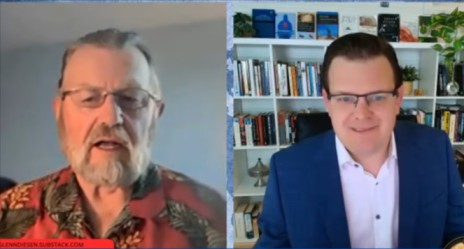
Editor’s Note: In this episode, Glenn Diesen and former CIA analyst Larry Johnson discuss the possibility of a de-escalation between the U.S. and Iran, focusing on a reported memorandum of understanding. They explore the complexities of these negotiations, the role of regional actors like Pakistan, Qatar, and the UAE, and the significant domestic and international obstacles that could threaten a potential peace deal. (June 13, 2026)
Introduction
GLENN DIESEN: Welcome back. We are joined today by Larry Johnson, former CIA analyst, to discuss what is happening now in the war against Iran. So thank you for coming back on the program.
LARRY JOHNSON: I’m trying to get that light shining in the corner. I just checked into a hotel. So, on the road.
GLENN DIESEN: Well, I’m not sure where to start here because there’s so many times we’ve heard Trump, after every bomb raid, he essentially comes out and says, “Well, this time we’re very close to a deal.” We heard this story many, many times only to see him beat the drums of war again the next day.
But this appears to be something different though. We hear from the Iranians as well that there is big movements, not a deal, but at least an agreement on a shared understanding and a plan to move forward. Given how far apart the sides are, this is quite remarkable. So I was wondering, what is going on? What does this mean?
The Memorandum of Understanding
LARRY JOHNSON: Listen, I’m fully empathetic with how you’re feeling. I was on Garland Nixon’s podcast yesterday. I put on a neck brace, the things that people wear when they have whiplash from a car accident. I put one of those on because it was symbolic of what we’re going through.
One moment Trump says he’s going to, quote, “bomb the shit out of Iran.” And then the next moment he’s like, “Hey, all we’re saying is give peace a chance.” He goes from being Dr. Strangelove to becoming John Lennon.
This process has been shepherded by Pakistan. They’ve been at the center of it. And the information that Pepe and I were given, it’s turning out to prove to be true. The Pakistanis the other day were talking about walking away, but they didn’t. Qatar got involved.
So it looks like what they have produced is based on that 14-point document that Iran introduced back on April 8th, and they’ve come up with a memorandum of understanding. It doesn’t mean that they’ve actually got agreements on each of the issues, but apparently one of the key acts of good faith has been carried out by the United Arab Emirates, who turned over reportedly $3 billion the other day.
When I first heard that report, I was skeptical, but there’s another report out now saying they’re going to turn over a total of $20 billion, and this $3 billion was the first of that tranche. So Iran is starting to see some money, because one of their red line demands was, “You’ve got to unfreeze the assets.”
The other more fundamental demands that they absolutely insist on are: the lifting of the sanctions, the recognition of Iran’s control or sovereignty over the Strait of Hormuz, lifting the blockade by the United States, and a permanent ceasefire in Lebanon — getting the Israeli troops out and actually withdrawing the Israeli forces from Gaza as well. There’s no sign that Iran’s backed off of that. It’s just now a question of at what point in the process does that come to the forefront.
Iran’s Conditions and the Steps Forward
GLENN DIESEN: Yeah, well, I saw from the Iranian side — that is, Araghchi — he came out as well and was making the point that the memorandum of understanding will lay this out in different steps. That is, first step, we’ll do this. Once it has been achieved, we’ll move to the next step.
So the first step apparently would be: they sign this memorandum of understanding, and once it’s signed, all of Iran’s assets will be released and they will not be frozen again. This is kind of the deal. And once this is done, they can move on to the next step.
So this is quite significant. Releasing the sanctions is not the most difficult thing to do compared to the other tasks, but it is a show of goodwill, because there have been so many nonsensical negotiations. And also, once you get this out of the way, it’s going to essentially be a cost for the US as well to go back on what is promised. So it’s a good first move. But what are the other things that have to be included into this deal?
LARRY JOHNSON: Well, again, lifting all the sanctions — not just oil. So part of the initial gestures will be lifting sanctions on oil. That benefits Trump as well, helps get some more oil out into the market. But ultimately, getting all of the sanctions lifted, lifting the US blockade.
And then I think the real stumbling block is going to be Israel. Israel’s going to have to leave Lebanon and leave Gaza. Now, if left up to them, they are not going to do it. But Trump has the leverage in terms of saying, “Okay, we’re going to cut off all aid to you, and you’re going to be on your own.” That will motivate Israel to come around.
But I candidly don’t think Trump’s willing to play that hard with them. I think Trump will lose his spine. But hey, I’m prepared to be surprised and very much mistaken on that.
The other issues with respect to the nuclear side — that’s for down the road. Now, Israel’s complaining that this doesn’t begin to address the ballistic missiles. And candidly, I don’t think Iran’s going to allow ballistic missiles to even be put on the agenda, because apart from controlling the Strait of Hormuz, that’s their other ace in the hole — their other trump card, so to speak.
The Nuclear Question and Israel’s Role
GLENN DIESEN: Yeah, on the Strait of Hormuz, I saw Araghchi make the point that living tolls would not be acceptable, but he said, “We reserve the right to charge for services given that it’s not international waters.” The Strait of Hormuz falls within either Iran or Oman’s national waters.
LARRY JOHNSON: Correct.
GLENN DIESEN: On the nuclear deal though, once Trump begins to make the point that we’ll get a deal so Iran can’t have nuclear weapons, this introduces some optimism for me.
Because if it starts to frame the conflict as preventing Iran from getting a nuclear weapon, then a deal can be made, because Iran’s made it clear it doesn’t need a nuclear weapon. So at least in that area, there’s some flexibility.
If Trump wants to claim victory, this is essentially what he wants to gamble on. Because if he sets the goal of having the Strait of Hormuz treated as if it’s international waters, then he can’t have a victory.
My concern is what you hinted towards though, which is the ceasefire in Lebanon and Gaza that has to be included into the deal. I’m assuming that Israel will do everything in its power to disrupt this peace negotiation. So if—
LARRY JOHNSON: Glenn, are you a cynic?
GLENN DIESEN: Slightly so, yeah. But this isn’t for the Israelis though. Lebanon, Gaza — by having this in the deal, they can essentially veto it anytime they want by massacring people there.
Iran’s Military Capabilities and the Pause in Strikes
LARRY JOHNSON: Or — don’t forget false flags. Israel would carry out something to make it look like Iran violated the agreement, that Iran attacked one of its neighbors.
It’s been fascinating this week watching Iranian restraint. I don’t know if you’ve picked this up, but I think it was on the Tuesday or Wednesday strikes by the United States that we saw the first evidence of Iran’s upgraded air defense system. It was reported they took down 5 Tomahawk missiles during the strike on Bandar Abbas. They also engaged an F-16 — the air defense system lit it up. The F-16 knew it was going to be engaged and bailed out real quick. So that’s FLIR assistance from China and Russia that have upgraded them on that.
Then their retaliatory strikes — they were not massive, but they were incredibly precise. I have some information with respect to one of those, that it was extremely damaging to US strategic capabilities. In other words, the US ability to — if they were launching intercontinental ballistic missiles — my understanding is that whatever was taken out in Bahrain was a critical, uber expensive component. And the feeling on the US side was that the only way that could have been targeted was with Chinese and Russian assistance.
Similarly, on this very last strike, they hit another radar that was in Bahrain and took it out. Then they were hitting precise targets at the Muwafiq al-Salti airbase in Jordan and reportedly damaged F-35s, F-15s, and F-16s, as well as maybe an E-8 Prowler.
So Iran’s got to be feeling a little more confident from a military standpoint that they were not just getting beat up with no response.
What I’m seeing right now — we’re not seeing any of the signature activities you would expect to see from the United States militarily if they were planning additional airstrikes. It’s going to be about 5 o’clock here, so that’s about 1:00 or 1:30 in the morning over in Iran. Usually this is the time when US military strikes are lighting off, and we’re not seeing anything. That says that these talks are real and the negotiations are genuine. They’re not just a facade. Now, whether they can hold up — that’s a whole other issue.
Skepticism and Iran’s Targeted Retaliation
GLENN DIESEN: Yeah. Well, I know skeptics — and I would put myself in that category.
LARRY JOHNSON: Me too.
GLENN DIESEN: Well, my skepticism is on the idea that Trump wants an end to the war. I think the deception in the past is because they want to defeat the Iranians. They don’t want to have a peace agreement and live side by side. But they must be sinking in that they can’t achieve their objectives. They can’t defeat the Iranians. And the longer they have this thing dragging on, the more pain Iran’s going to bring to them. So why wait until the bitter end?
It looks as if — well, again, it could be that this is the realization that they have to throw in the towel. But what do you make of the strikes they had? Because when the Iranians had the retaliatory strikes, they appeared to focus on Bahrain, on Jordan, and Kuwait.
LARRY JOHNSON: Yeah.
GLENN DIESEN: I kind of had assumed that any retaliatory strike would prioritize the United Arab Emirates for destruction. But do you think this is linked up to the deal, given that they just handed over a few billions? Is this one of the steps — the Iranians showing that they will cease all hostilities if they see some reciprocity?
LARRY JOHNSON: Yeah.
GLENN DIESEN: Yeah.
The UAE, Qatar, and Pakistan’s Diplomatic Role
LARRY JOHNSON: I mean, UAE is like the most obnoxious relative at the table. You want to punch them in the face. They have been consistently siding with Israel until recently. And they were quick to come out and condemn Iran for retaliating for having been attacked.
However, Monday, that delegation from the UAE went to Tehran. And I think, for the UAE, it’s an economic calculation. They’ve really taken a beating in the course of this war, now 105 days old, 106 days old. They’ve suffered significant economic damage and are looking to get back into business. They’ve got that free trade zone, Jebel Ali, that has just been shut down, dead for the entire duration of this war.
So reportedly they’re going to play a critical role in returning some of the frozen assets. The day after, so they went Monday, the next day Tuesday, the Qatari delegation shows up and they stay. Many thought that they would leave Tuesday afternoon and as soon as they left then the United States would start up the attack again. But apparently they stuck around, they stayed overnight. So they were there during one of the attacks, even if it didn’t really hit Tehran. But it was close.
And so Qatar apparently played a role with the Pakistanis in getting, working out a document that they could all agree to. Now, the other thing that’s going on behind the scenes that Pepe and I, Escobar and I have been told, and I believe it’s true, is that Pakistan is also negotiating with Qatar and Saudi Arabia, and helping them plan their escape from being under the control of the United States, or separating themselves from being a host for US military personnel.
And that is an interesting— in the 14-point document that Iran presented to the United States, one of the points was that the United States withdraw its military personnel from around Iran. Whether they’ll get that or not remains to be seen, but we have seen reluctance — let’s call it no enthusiasm — on the part of the Saudis or Qataris to allow their bases to be used by the United States. But specifically, they’re not allowing Israel to overfly their territory at all. So that has put some brakes on what the Israelis could do in terms of engaging militarily.
So this is a pretty complex diplomatic effort, and Pakistan’s not doing this on its own. Pakistan is doing it with the full support and encouragement of China as the principal, but Russia as the secondary. So this actually comes down to broader constructing a BRICS order, a new international economic order that’s going to be free of Western pressure and sanctions. Like, Scott Bessent can threaten, “Oh, we’re going to seize your dollars,” and all Iran’s going to say is, “Well, we’re selling our oil in yuan, so screw your dollars.”
What Will the Region Look Like After the War?
GLENN DIESEN: I was going to say, well, what will the region look like after this war? Again, we’re delving into speculation. We don’t know what’s exactly in this memorandum of understanding. We don’t know the different steps, if they will be followed. But we do know what is important for the Iranians. I mean, if they are willing to not cede the Strait of Hormuz, but if they’re willing to show some flexibility, then for me it indicates that at least perhaps the Gulf states have made some commitments to perhaps limit the presence of US troops. Because the whole purpose for the Iranians is that holding onto the Strait of Hormuz is an instrument to decouple the US a bit from the region.
LARRY JOHNSON: So this objective will stand, but let me ask you, what areas do you think they might be flexible on?
GLENN DIESEN: The toll, how much you would charge on ships going through. I think all of this is a means to an end. And the end would be to have a tool to encourage the countries of the region to remove sanctions and to expel US bases, as a favorable term, terms for access. If they go along with this —
LARRY JOHNSON: Oh, you’re back. Yeah. I see you moving. Okay. You froze up there momentarily.
GLENN DIESEN: Yeah.
LARRY JOHNSON: I don’t know if it was you or me.
GLENN DIESEN: Could be at my end. Yeah.
LARRY JOHNSON: Yeah. So anyway, you were saying.
GLENN DIESEN: Yes. I was saying, I assume that if they’re willing to be less strict on what they charge going through the Strait of Hormuz, how they’re going to run it essentially, it’s because they’re getting other guarantees that the US will reduce their presence.
I’m just thinking, how do you see the region forming after this war? Because a lot of things have changed. There is Iran extended its security guarantees to, or its extended deterrence to Lebanon. We see the US would be out of its mind to try to attack Iran again. This has been a very painful experience. But how much do you think Iran’s position in the region will change as a result of this?
Iran as a Moderating Force and a New Regional Alliance
LARRY JOHNSON: Well, actually, I think Iran would be a bit of a moderating influence. I mean, let’s be candid about Gulf Arabs — they’re like a bunch of nasty high school girls. There’s that movie, Mean Girls. So, okay, 7 years ago you got Saudi Arabia and the United Arab Emirates, they’re mad at Qatar. They tried to impose an embargo. Why? Because Qatar was having relations with Türkiye and was supporting Hamas.
Okay, then let’s jump 2 years ago. Now all of a sudden it’s the Saudis mad at the Emiratis and threatening to go to war. So it’s just — these so-called Gulf Arabs are not united at all. They’ve been getting pissed off at each other over just some of the most ridiculous things. And the irony was when the Saudis and Emiratis were going after Qatar, who was the one country that came to the aid of Qatar? Iran.
So Iran has been careful in its diplomatic efforts, and I think it’s with strong encouragement from both Russia and China. It was now 2 years ago, maybe 3, that Saudi Arabia and Tehran basically repaired their relationship. I mean, they had been at odds. They’d been fighting a proxy war in Yemen, with Iran backing the Houthis and the Saudis backing the government, the regular government. But anyway, they bridged that gap. They settled that difference.
And what Pakistan is also doing, again with the encouragement of China — we can’t ignore China, the hidden hand here — they’re talking to Egypt, Türkiye, the Saudis, Iran, and with Pakistan forming a new, if you will, a NATO-style organization for that region.
And this becomes especially interesting this week with Israel’s verbal attacks and threats on Türkiye, just getting into a proverbial pissing match with Erdoğan. The only one who’s got as big an ego as Donald Trump is Erdoğan. So he didn’t take kindly to that. And I’m sitting here trying to figure out what are these Israelis thinking? This guy controls a major source of their oil. He could cut it off in a heartbeat, and instead they’re threatening him, saying “we’re going to attack you and destroy you.” Color me surprised.
So that’s where I think that this proposal from China through Pakistan — that these countries come together to form a defensive alliance against Israel — is something that’s starting to resonate. And Israel’s position, at least from the standpoint of public support in the United States, will be much more vulnerable. They’re not going to have the reflexive support.
And even if they succeed in getting themselves completely insinuated into the National Defense Authorization Act — the Section 224 and Section 622 — they’re trying to basically like a parasite embed themselves in the host so that they’ll never be subject to any kind of political controversy coming down the line.
So I see the military effort increase among those countries as well as levels of economic cooperation. I mean, frankly, Qatar’s got some years of rebuilding to do ahead of itself because of the damage it suffered early on in this war. I’m not sure how much physical damage the Saudis took. Bahrain will probably become part of Iran again. And Kuwait, we can see it get folded back into Iraq. So yeah, there’ll be some changes, I think.
Secrecy Around the Deal and the Risk of Sabotage
GLENN DIESEN: Yeah, I’ve been looking at Kuwait as well. Its continued independence is highly questionable. Well, one of the reasons we don’t know too much about this memorandum of understanding and the possible deal that will follow is there’s been encouragement to keep the media quiet. I was wondering, how do you read this? Is this for people not to oversell the story, or in order to create the wrong expectations, to sabotage it?
I mean, the concern for sabotage is on all sides, to be honest. Because one often looks at the American side — there are many who do not want this deal. The Israelis are obviously also eager to sabotage. But also within Iran, you have the hawks, many hawks who also say, well, for good reason, they are in a strong position now. This is the time to put an end to their enemies, not to accept a deal. And of course, you can understand why they would be hesitant to make any deals after everything that’s happened. But anyways, my point is that on all sides, you find some saboteurs. Is this why there’s so much secrecy in the media?
LARRY JOHNSON: Yeah, I think particularly on the Trump side of the house, they are trying to prevent a further firestorm. All the social media influencers that are paid for by the Israeli government went on starting Sunday — boy, they went on a blistering attack on Trump. And he was getting phone calls from people like Lindsey Graham and then Sheldon Adelson’s widow. And he succumbs to that pressure.
But I think right now, another element I meant to mention earlier is that oil company executives reportedly went in to brief Trump and they said, “Oh my God, this is going to be terrible.” The headline was they’re desperately trying to warn the White House about major fuel disruption that is imminent. And this official again refused to be named out of fear of retaliation. But the potential for real economic chaos in the United States is scaring Trump as well.
And so he’s caught between — okay, if he gets this war, gets at least some sort of peace in place with Iran and can take credit for saying, “Hey, Iran’s promised they’re not going to have a nuke” — which that’s been Iran’s position all along — then he can take a victory lap with that without people pointing out you got something that’s weaker than JCPOA. But okay, take it as a victory.
So he can then try to get the world — it’s not just oil, it’s liquid natural gas, urea, and sulfur, and helium — get all of that back into some sort of order, hoping they can restore it. And it’s going to take a minimum of 3 months and maybe much longer if they actually get an agreement within the next 3 or 4 days that endures.
But you’re correct, Glenn. There is — I’ve already seen headlines about Republican senators criticizing Trump for what they’re reading as the nature of the agreement. And they’re going to be calling the White House and saying, “What the hell are you thinking? What are you trying to do?”
So it remains to be seen if Trump can put up with this kind of pressure. That’s why I think ultimately the deal’s going to collapse, because I don’t see Trump having the stamina or the strength to resist the intense domestic pressure that’s going to come from the Zionist lobby.
Media Speculation, Trump’s Image, and the Risk of Derailment
GLENN DIESEN: Well, the Iranian Foreign Minister Araghchi was making the point that the media should not speculate what’s in this deal because that essentially could be a pathway towards derailing it. He could have added, but I’m glad he didn’t, that keep Trump away from the media as well, because every time he’s in the media, he has to sell the strongman image.
So he has to go through the same talking points. That is, Iran is begging for a deal, we’re dictating the terms, they’re going to get not a dollar of the frozen assets. They will give up all nuclear material, the Strait of Hormuz will be open, our ships are going in. One wants to start locking yourself into this maximalist position. It’s very difficult to essentially commit to a memorandum of understanding, which compared to the previous statements of Trump, this would be reality catching up. This would seem like a capitulation.
So I think, yeah, keep Trump away from the media and at least get the ball rolling. If they can get into that one step of releasing the Iranian funds, then it would be very painful for the US to step back and then lose what it’s already put into this deal. But yeah, I had the same thought as you. I have a, well, I assume that it will fall apart at some point, but I really hope I am mistaken though. But what do you think is going to crack first?
Israel as the Breaking Point
LARRY JOHNSON: I think it’s going to crack on Israel. Israel will refuse to leave Lebanon and Trump will refuse to use the leverage he has to force them out. You know, we had the experience with Ronald Reagan back in 1982 and Sharon was the general, he was rampaging in Southern Lebanon. And I think Netanyahu was prime minister — I may be mistaken on that — but whoever the Israeli prime minister was at the time, Reagan called him up and said, basically, get the hell out or else we’re cutting you off. And they left.
So there is precedent for this. And Eisenhower did it to the Brits and the Israelis back during the Suez Crisis. Was that ’53, ’54? So there is precedent for it. It’s just a matter of, well, is Trump willing to do that?
Now, according to Robert Barnes, they had a session a week ago, week and a half ago at the White House with a pollster, Rich Barris, who is an outstanding pollster. And he basically told Trump, he said, “Look, the majority of the American public is looking at you like you are Bibi Netanyahu’s prison paramour, that you’re basically his b.” Was how he put it. And Trump recoiled at that. Nobody’s going to — I’m not going to be anybody’s b. Okay. So prove it now.
And the orders that will be given to Israel is pull out now, get back inside your borders. Now, the opposite side of that is that Hezbollah then has to end its attacks. But I think that they will do so, because as part of this broader peace deal and in support of Iran. So, you know, this thing, it’s not impossible, but boy, there are a lot of pitfalls and booby traps that could derail this very quickly.
Trump’s Difficult Position
GLENN DIESEN: Well, overall the Trump presidency looks like it’s in a difficult spot too, because again, he was elected on making America great again in terms of putting an end to some of the mistakes of the past decades — these forever wars. Then he walked away from the no wars position by essentially saying that through the strongman approach he would restore the dominant position of the United States. So pump up the military budgets, defeat its enemies. Then of course he lost a lot of his supporters.
But now, for him, who has positioned himself as the strongman who would defeat America’s enemies, he has to make very painful concessions. And I think this is what the US does need now though, because it’s not easy to climb down from that position of the only world superpower, and now having to accept essentially a defeat to countries like Iran and accept a diminished position in the world. It must be difficult. I just can’t see it going through though.
The Pattern of US Military Failure
LARRY JOHNSON: Well, look, the problem, Glenn, is that the United States has been in denial now for, let’s call it, 4 years. So let’s go back to the start of the special military operation in Ukraine. From the outset, that was a proxy war with Russia using Ukraine as the stand-in. And the United States brought intelligence, it brought weapons — started with HIMARS and ATACMS and F-16s — and they were trying to resupply 152 or 155mm artillery shells. And what happened? The United States failed to move the needle against Russia. Russia steadily beat down Ukraine.
Then we come to Operation Prosperity Guardian, and again, this is not just on Trump. Remember, Operation Prosperity Guardian started in December of 2023 under Joe Biden, that they were going to establish freedom of navigation in the Red Sea. And for about 15 months, they failed. Donald Trump enters the picture at month 13 or 14. And so January, February, start of March, they announced, “By God, we’re going to show those Houthis now who’s boss. We’re not going to be a bunch of wimps like the Biden administration.”
So they put two carriers — they ultimately had two aircraft carriers in the Red Sea — and were actively bombing Houthi positions. And whereas in the previous 13 months, the Houthis were shooting down an average of one MQ-9 Reaper drone a month, they now started shooting down one a week. The base price of the airframe alone is $35 million. When you attach the optical pod — the pods for recording video and firing Hellfire missiles and other things — that pushes the cost up to a minimum of about $60 million apiece.
So what did the Houthis do? They destroyed 25 of those, 7 of them in the 7 weeks that Trump hung in there, which is almost $2.4 billion. And Trump ended up declaring, “Oh, they’ve capitulated, we’re out.”
So now here with this war with Iran, we’re seeing a consistent theme that there are clear limits to US military power. It is not this behemoth, this Goliath that cannot be defeated. It’s a Goliath with feet of clay, among other things.
The Limits of US Military Hardware
And it’s not just on the effectiveness of the weaponry. We’ve seen with the Patriot missiles, it was supposed to defeat all of these ballistic missiles, and instead the United States has only produced roughly 6,500, assuming they’ve been able to maintain production through the first 5 months of this year. Well, when you realize that you have to fire 2 of those to take down 1 ballistic missile, that means if you’ve got 6,400 — to make it easy — that means you can shoot down 3,200 missiles.
For heaven’s sakes, Russia has fired over 14,000 missiles in the course of the war with Ukraine. And the number that Iran has fired against Israel is probably up in the range of 3,000. So right there, if the United States had actually employed all of those assets against that, they would have exhausted them.
And then to top it off, they’re extremely expensive. The Patriot PAC-3 goes between $4 and $6 million. And then to add to the difficulties, the supply chain for it comes out of China. The Tomahawk cruise missile, for example, requires 18 different rare earth minerals that come out of China, plus tungsten. So the United States has this offensive weapon that’s basically dependent upon supply chains from China and Russia. You put all that together and you’re going, you know what, maybe the United States is not as super a superpower as we thought.
How a Deal Would Reshape the World
GLENN DIESEN: Yeah, I think it’s hard to argue that the US didn’t overextend itself, but this is my point. I think it would be the best thing for the US to also scale back a bit, to prioritize what it wants to do, because at the moment attempting to do everything is just a terrible plan.
But let me just ask a last question. How do you see — if this memorandum of understanding goes through with the Iranians, or if it doesn’t and we’re looking towards an Iranian victory probably anyways — how does this change the wider world? How would the position of China or Russia be impacted by this?
LARRY JOHNSON: Well, A, it’ll boost their prestige. B, for China — China has probably taken the biggest hit of the BRICS countries from the closure of the Strait of Hormuz, in part because it had actually invested in Saudi Arabia and the United Arab Emirates. So it’s going to want to recover some of that money.
But this is going to be touch and go for at least 2 weeks because we haven’t got the details of this process, and it’s going to hinge on continued meetings, continued diplomacy. And as you recall, the JCPOA took what, 18 months, almost 2 years to negotiate. So we could actually find ourselves in this whole negotiation process for a long time. But the good news there is they’re going to not be shooting at each other, and that will reduce the risk in the Strait of Hormuz.
Because the only way you can fully open the Strait of Hormuz is for Iran to say, “Okay, it’s open. We’re not going to be shooting at any ships.” They do have to pay the toll or the user’s fee, but we’re not going to be shooting. And at that point, the insurance companies would say, “Okay, good. We can go back in there. We don’t have to worry about getting hit.” But there’s no way it can be opened militarily. That was the lesson demonstrated over the last 2 weeks with all these different air attacks by the United States.
So if they get into the negotiation track — but as you’ve noted, and I agree with you — the potential for the Zionist lobby in particular, both from Israel’s standpoint and then within the United States from both the Christian Zionists and the Jewish Zionists, will put enormous pressure on Trump to back out of this deal and go back to war.
Cautious Optimism and Final Thoughts
GLENN DIESEN: Yeah, well, that’s what I’m hoping. The first step of releasing the Iranian funds will essentially be the sunk cost, something that incentivizes them to actually stick with this. But yeah, I don’t know. Well, to summarize, cautiously optimistic. I mean, this is the best sign I’ve seen since February that it actually could come to an end, but not convinced just yet. Anyways, any final thoughts before we wrap up?
LARRY JOHNSON: You know, there’s the old saying about third time is the charm, except Donald Trump has predicted this 39 times. So we’ll have to adjust that saying. 39 times is the charm.
GLENN DIESEN: Yeah, to be honest, when he first mentioned it, I just didn’t think twice. I just assumed it was more nonsense, but when the Iranians confirmed on their side, then yeah, well, again, at some point it would have to be the real deal. So hey, let’s hope this is it. And thank you very much for taking the time. And where are you, by the way? I know you’re traveling.
LARRY JOHNSON: New York City, celebrating — it’s Russia Day.
GLENN DIESEN: That’s right. So we spoke earlier about that.
LARRY JOHNSON: Yeah, yeah. So I was invited up to attend and we’re going to go to the UN mission, their UN mission here in a bit.
GLENN DIESEN: I just read in the Ukrainian media that Marco Rubio wished a happy Russia Day to the Russian people. So it’s, this shouldn’t be newsworthy, but in these days it is.
LARRY JOHNSON: Yeah, step in the right direction anyway. But keep doing your good work, Glenn. You’ve got to keep people informed and they watch you. Because just tell everybody, you ought to start actually selling Glenn Diesen neck braces. If you’re going to follow these politics, you’ve got to have a neck brace to support yourself so you don’t get whiplash.
GLENN DIESEN: Well, thanks again, Larry.
LARRY JOHNSON: All right, my friend. Take care. Bye-bye.
Related Posts