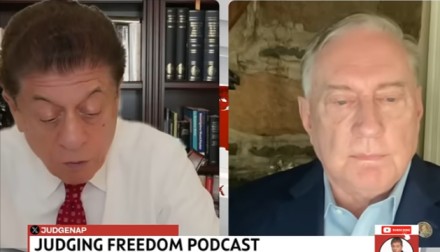
Editor’s Note: In this episode of Judging Freedom, Judge Andrew Napolitano sits down with Colonel Douglas Macgregor to analyze the escalating situation in Iran and the U.S. government’s recent, conflicting announcements regarding potential military action. The discussion delves into the skepticism surrounding President Trump’s reported negotiations, with Colonel Macgregor describing the current foreign policy approach as a potential disaster. Additionally, they examine the risks of being drawn further into regional conflict and the broader geopolitical implications of recent legislative efforts regarding intelligence sharing. (June 11, 2026)
TRANSCRIPT:
Opening: Is the Iran Announcement Believable?
Judge Napolitano: Hi everyone, Judge Andrew Napolitano here for Judging Freedom. Today is Thursday, June 11th, 2026. Colonel Douglas Macgregor joins us now. Colonel Macgregor, always a pleasure. Thank you very much for your time, particularly accommodating our time today, as you always do.
This morning at about 8:30, the president announced that he would begin a massive bombing in Iran, and within the next few days, American troops would take over Kharg Island. A lot of us scratched our heads, and then at 2:30 this afternoon, he said he called it off because the Iranians are coming back to the negotiating table. Is any of this believable?
Col. Macgregor: Funny you should ask that question, Judge. I was talking today to a friend on Wall Street, and we were trying to figure out just exactly what was true and what wasn’t. And I said, “Do you think this man Trump is Nero? Is he fiddling while Rome burns while we’re all deteriorating and falling apart here at home?”
He said, “No, no, no, no, Doug, you don’t understand. I know exactly who President Trump is. You’re dealing with the political incarnation of Bernie Madoff.”
And by that I mean, the man tells so many tall tales so frequently that even people on Wall Street that have religiously followed whatever he said, in the hopes obviously of making money, are now beginning to step back and say, “Are you kidding? This can’t be.” And frankly, I can’t imagine what he’s talking about, because everybody I trust that knows anything about the region tells me there are no talks of any kind with anybody.
Mossad Spying and Intelligence Community Dissent
Judge Napolitano: Wow. That is the same thing that your colleague Colonel Lawrence Wilkerson said just a few minutes ago. Do you think that Trump was surprised that his buddy Benjamin Netanyahu’s Mossad is spying on him in the White House and in Mar-a-Lago? The New York Times accepted the word of insiders and reported this. The Defense Intelligence Agency, which says Israel is a danger to United States intelligence— that’s how pervasive the spying is.
Col. Macgregor: Judge, that’s not really news. I don’t know about Mar-a-Lago and how well bugged that place is, but Israel is in line with several other nations that try to constantly eavesdrop on whatever is happening inside the White House or any number of different places in the Pentagon.
You know, one of the favorite spots to bug is, of course, the bar and restaurant in the— I guess not the Marriott— the Ritz-Carlton in Pentagon City. If you go into that bar and have any discussions, you might as well just put a sign up and invite everybody from DIA, CIA, NSA to listen, because they’re all there along with everybody else that has an interest in what happens in that place. So no, that’s not news, and I don’t think the Mossad—
Judge Napolitano: I agree with you, but I think that what is news is that some people fed up with this went to the New York Times and the Times ran with it.
Col. Macgregor: That’s because the Times obviously got permission from the intelligence agencies to do so, which means maybe they’re tired of it.
Judge Napolitano: Right, well, that’s the point I was trying to make. I spoke earlier today to Joe Kent, the former director of counterintelligence, and I asked him if people currently in the national security community share his view that this war in Iran is Israel’s war, that the president’s decision to go in was a colossal error, and that we should come home now. And without even thinking, he answered, “Yes, there are people in the national security community who agree with me.” Are you surprised?
The Strategic Petroleum Reserve and the Cost of War
Col. Macgregor: No, and I think even some of his closest political advisors are telling him to fish or cut bait, and at this point there’s no fish to be had, so just cut bait and get out. But that’s asking him to do something he can’t possibly do, and this latest statement is kind of a psyop of sorts. I think it is once again designed to create the illusion that there are some sort of negotiations happening, that he’s maneuvering, and that he’s finding a way out of this that’s going to satisfy his personal interests as well as the honor of the United States.
Now, the problem with this, Judge, is that while he’s doing this, he’s also cashing out our insurance policy to maintain the illusion of abundance. Right now the Strategic Petroleum Reserve has fallen from above 415 million barrels in March to about 350 million today. It’s on a trajectory to reach operational minimums— in other words, the bottom— by early autumn, probably September. So the longer you wait to act and end this, the worse the situation gets here at home.
And remember, war is an engine for inflation. And what are we witnessing? Inflation. And it’s getting worse. All the indicators are, if you’re the head of state right now: get out, stop.
Judge Napolitano: So the Dow Jones Industrial Average rose nearly 2% after Trump made the announcement about which your very wise friend on Wall Street laughed. That means that not everybody agrees with your friend.
They’re willing to make bets that things will be better— at least better enough for them to make money on it— when Trump makes these announcements. This is the 38th time he has said in the past 2 months, “Negotiations are coming to an end, we’re getting close to an agreement.”
Wall Street’s Disconnect from Reality
Col. Macgregor: Look, Judge, I know, and I don’t think the people on Wall Street— let’s be very frank about this— they’re very remote from where things actually happen. If you go to someone on Wall Street and you say the price of sulfur used to make fertilizer and refined minerals 18 months ago is now up 900%, and then you try to tell him that 50% of the sulfur that’s used for fertilizer comes through the Strait of Hormuz, he has a blank stare. They don’t understand the human impact.
They don’t understand that farm incomes right now are projected to fall between $30 and $60 billion because of higher input costs. Tell somebody there what happens if we accidentally kill a crew on a tanker from a third country in the Strait of Hormuz. What happens then? What happens if it’s Chinese? What happens if it’s Indian or Japanese? They all look at you like, “What are you talking about?” None of these people know the gravity of the situation. And so what do they do? They bet on the president.
Can Trump Restrain Israel?
Judge Napolitano: Well, how can Iran possibly agree to anything with Trump without him agreeing to restrain Israel? And the second part of this is, can he restrain Israel?
Col. Macgregor: Of course not. Why would they believe anything we say? Let’s be frank— we haven’t been truthful. We’ve lied prolifically about everything. We’ve tried to kill them on numerous occasions. We essentially promote the idea that we can kill anybody, anywhere, anytime we want to. I think the Iranians have turned a deaf ear to the whole thing.
As far as I can tell, they’ve dug in for the long haul, and this is the problem. I hear people all the time say, “Well, how long can they last? How much pain can they endure?” I think they’re prepared to endure a lot more than we are.
And I don’t know why the president brought up this Kharg Island nonsense. What good is it if you put a few hundred Marines or soldiers on Kharg Island? What have you achieved? What have you changed? Nothing’s coming out one way or the other at this point, and they’ll probably all be killed. So it doesn’t make any difference. I haven’t figured it out, but I think it’s all part of this psychological game he plays. He thinks that he’s manipulating— well, he is. He’s manipulating people on Wall Street who don’t know any better, but the rest of us, I think, are growing tired of it.
Judge Napolitano: He’s not manipulating the Iranians, because they understand the absurdity of what he said. Colonel Wilkerson reminded us that the average daily temperature on Kharg Island this time of year is 110 degrees. What are the thousands of troops and all the gear that they carry going to do in that environment?
Col. Macgregor: Drink a lot of water if they can get it, because that’s what you’re going to need most of all when you get there. It’s a dumb idea. It doesn’t make any sense. I’m sure someone in uniform at high levels has pointed that out, but it may be just another statement of no real meaning.
We just don’t know. How do you know when the man is serious and honest, and when he’s not? I can’t tell the difference. That’s why, when Bernie Madoff was finally arrested, everybody was shocked. And remember, he was very wealthy— there was no reason to cheat anybody, right? But he was compulsive. So what are we dealing with? Are we dealing with someone who is compulsive about misleading the public on everything? I don’t know.
Netanyahu, the Epstein Files, and the Insoluble Situation
Judge Napolitano: Can Trump restrain Israel? Or is whatever they know about him enough to overbear his will? And whatever his Zionist billionaire friends want— is that enough to overbear his will? Because to me, this is an insoluble situation. He and Netanyahu have created it— the Iranians won’t agree to anything unless Israel stops killing in Lebanon. If Netanyahu stops killing in Lebanon, he’s out of a job, and then you have the dominoes fall.
Col. Macgregor: I don’t vote for number one, so I have to vote for number two or number three. I think there must be reasons that we’re not aware of. Maybe they’re related to the Epstein files— I have no idea— but obviously people have the goods on him, and there’s something else at work here.
I mean, you’re dealing with someone whose personality utterly and completely refuses to accept reality. I’m not sure that he’s always lying or misleading. Sometimes I think he actually believes what he says, and unfortunately, that’s dangerous because he’s wrong.
He said, I guess a week or two ago, “The American military can do anything.” That was his statement— it could do anything. Well, on the one hand, everybody puffs up their chest and says, “Oh, he’s so proud, and that’s wonderful.” But when people told Hitler the truth about Russia and said, “Whatever you do, don’t invade the place,” and talked to him about the problems associated with it, he said, “The German soldier can do anything,” and that shut up everybody in the room. Nobody can do everything. No military power in the world can do anything. It doesn’t make any sense. So that’s another aspect of his personality that worries me.
Secretary Hegseth’s Statement
Judge Napolitano: Well, here’s an aspect of somebody else’s personality that will probably worry you. Secretary Hegseth, yesterday:
VIDEO CLIP BEGINS:
Pete Hegseth: As President Trump said, they’ve been tap, tap, tapping. You can see when someone’s trying to tap, tap, tap on a deal. Instead, they’re going to have tap, tap, tap bombs dropping on key facilities in Iran from the United States of America. And that’s not because we want to restart anything— we don’t have to restart. It’s because we are—
VIDEO CLIP ENDS:
Judge Napolitano: —the War Department is prepared to set the terms to ensure that we get the kind of deal President Trump expects. Does he really mean that? Doesn’t he understand that whatever goals the administration has cannot be accomplished by military force alone?
Col. Macgregor: Well, obviously he doesn’t believe that, or he wouldn’t have said it. He must think that, much like the Air Force and Curtis LeMay, drop enough bombs and everybody will listen to you. That hasn’t really worked very well.
Now, somebody will point to the atom bomb, but hopefully no one is seriously considering the use of nuclear weapons, because that would open Pandora’s box in the worst way imaginable. But these statements are difficult to swallow. I think he believes it, for whatever it’s worth.
Trump’s Biggest Mistake: A Historic Disaster
Judge Napolitano: How big a mistake is this war?
Col. Macgregor: This is probably the single greatest disaster of the last 100 years. I mean, this is worse than Churchill’s folly in the Dardanelles, which cost him his job, tossed him out of office, and damn near destroyed his career. It’s similar to that, and whatever happens at this point, he is going to be blamed for the failure. There is just no evidence in sight that he’s going to turn this around. So he’s the man that is going to be pinned down with the blame for the failure of this exercise in Iran.
No One Is Telling Trump the Truth
Judge Napolitano: So in interviewing Joe Kent this morning, he made a very succinct statement: “Your only way out of this, Mr. President, is to bring the troops home, and bring them home now.” And then I asked him if others around the president are saying that, and he said others around the president believe that, but no one is saying it to him.
So that’s the confabulation. He says these things and honestly believes they’re true. Nobody challenges him, warns him. I don’t know what General Cain says to him. You’ve told us of the duplicity and political butt-kissing of generals— this guy’s at the top of the heap. But does anybody say to Trump, “Have you considered maybe it was a mistake and we should just go home and fix the economy?”
The Culture of Silence Among Military Generals
DOUGLAS MACGREGOR: Well, one would hope so, but we don’t have any evidence one way or the other. The bad news is that after it’s over, we’re going to hear things. I remember during the Iraq intervention, there was this terrible decision made to occupy Iraq. Remember that we paused after Baghdad fell and finally Wolfowitz picked somebody to go over there and take control.
He gets in the room, he has all of the senior officers in the room, and he announces the decision has been made to dismantle the Iraqi government, the administration, its armed forces, to rebuild everything from the ground up to create the first Arab liberal democracy, and you need to understand that’s where we’re going. Any questions?
There was one man in the room who asked, and he was a colonel from the chemical corps, who said, “Sir, don’t you think that’s a mistake? These people aren’t going to want us involved.” But all of the generals sat there and said, “Yes, sir,” got up and walked out.
But after they walked out — one of whom, of course, was Dave Petraeus, who was there — he and others told the journalists, “Oh, I think this is a bad idea. We shouldn’t do this. Oh, this is a mistake.” Well, why didn’t you say that at the time? Because they all wanted to be promoted. They all wanted to have a hand in the future. In other words, they wanted to not only be promoted, but then retire into a comfortable environment where wealthy financial firms and banks and others would give them cushy positions and fill up their bank accounts.
Speaker B: Like Petraeus got.
DOUGLAS MACGREGOR: Yeah, so I think that’s basically it. Nobody wants to jeopardize that.
Joe Kent’s Warning: Walk Away from the War
Speaker B: Here’s that clip I mentioned to you. It’s full screen from Joe Kent.
VIDEO CLIP BEGINS:
JOE KENT: No deal is required for us to just walk away. It’s evident that we can’t stop either side from attacking the other. There is only one realistic choice we have: stay and get sucked in further into the war, or look out for our interests and just walk. No one is saying that to the president.
VIDEO CLIP ENDS:
DOUGLAS MACGREGOR: No, and there’s a reason for that, and that reason is Israel. There is fear that if you do what Joe said — and I happen to agree with him, I think he’s right — but if you do that, the Israelis will then turn to the use of a nuclear weapon. They will feel that under the circumstances that we’ve abandoned them, and the only way for them to survive is to annihilate their opponent, and the only way to annihilate that opponent in their minds is with a nuclear weapon.
Now, I’ve always worried about this because, as we’ve discussed in the past, Pakistan has made it very clear to the Turks that a nuclear weapon would be available to them if they needed it. And Mr. Erdoğan never misses the opportunity to tell the Israelis, “We know what you have and we’re not afraid of it.” And that’s what he’s saying.
I rather suspect that a similar agreement may well have been reached with Persia, with Tehran. If so, that would be suicidal on the part of the Israelis. I think that’s the sticking point.
Israel’s Leverage Over the U.S. Congress
JUDGE ANDREW NAPOLITANO: The Israelis, of course, are leveraging the United States Congress to insert two sections into the National Defense Authorization Act — you can’t make this up — which require making available to Israeli military and intelligence American top secrets. Have you ever heard of a relationship like this? A president in the future can’t stop this unless he wants to break the law.
DOUGLAS MACGREGOR: Well, first of all, I understand what you mean about breaking the law, but I would urge members of the House and the Senate to think long and hard about this, because the time is going to come when, having put your name on the dotted line and signed up and voted for it, that you are probably going to be accused of treason. And that’s a treasonous act, what we’re discussing right now. I don’t know who wrote it. My supposition is that someone like Senator Cotton is probably the author. He’s very —
JUDGE ANDREW NAPOLITANO: Yes, he is. He is the author of Section 622, which requires — it doesn’t permit, it requires — sharing of intelligence and military secrets.
DOUGLAS MACGREGOR: Yeah, well, I think it’s a grave mistake. We shouldn’t do it.
Now, under FDR, we had this thing we called Lend-Lease. Lend-Lease began long before it was actually entirely approved to the Soviet Union, to the communists, in July of 1941. Very few people know that. It ran throughout the war. There were supposed to be limits and restrictions on it, but to give you an example, in January of 1945 or December ’44, I can’t remember which one it was, Harry Hopkins, who was the personal assistant to the president and signed off on these things, transferred enriched uranium from the United States to the Soviet Union. This is January 1945. You have to ask, why the hell would anybody do such a thing?
Well, after the war ended, remember, two things happened. First of all, FDR died in March of 1945, so he was never available to be questioned. Harry Truman knew nothing about it. Harry Truman was kept completely in the dark. When he finally figured things out, he put a stop to it. But our friend Harry Hopkins also died shortly thereafter at a point in time when Hoover and others were putting together the case against him, similar to the case against Alger Hiss.
So this has happened before, and Hopkins would have been tried for treason, no doubt about it. And I think in the future, depending of course on where things go politically, but I wouldn’t exclude it, people that sign on for this thing are going to be accused of having betrayed their country.
Russia, Gulf States, and Iran: A New Alliance?
JUDGE ANDREW NAPOLITANO: Wow. CNBC is reporting that Trump claims Iran war is settled, subject to finalization, expects the signing in a few days. Well, the stock market’s open for another 22 minutes. I guess he wants to move it even further.
At the same time that that has happened, Foreign Minister Lavrov of Russia has suggested a joint Gulf State-Russia union involving Iran. “Two weeks ago, we updated this concept and sent it to all capitals. We hope it will ensure stability and safety.” Can you imagine that? Russia and the Gulf States and Iran forming some sort of a NATO-like agreement. What will that do to Israel’s impulses?
DOUGLAS MACGREGOR: Yeah, but I’m not surprised at all, and I think the reason is clear. We welched on our compact with the Gulf States. We were supposed to protect them, Judge. And it turned out we couldn’t do that, and so they are now turning to other people on the planet that could help them. And clearly Russia, which is very close to Iran, has leverage that we do not.
The assumption on the part of the Arabs is that Russia is in a better position now to build a rapport and arrangements with Iran than we are. And you know, they’re probably right. That’s the bad news, which is another reason why this notion of the Arabs signing something with President Trump that’s going to end the war and be a great deal for Iran as well as us and make everybody rich is very suspect.
JUDGE ANDREW NAPOLITANO: Very suspect. Colonel, thank you very much. We’re both having busy days, and you’re so good to give me your time today. I hope you have a fine weekend coming up, and we’ll look forward to seeing you next week, my friend.
DOUGLAS MACGREGOR: Thank you, Judge. Thanks.
JUDGE ANDREW NAPOLITANO: All the best. Wow, a long and fruitful day. Tomorrow, Friday, the end of the day, the end of the week, at 4 o’clock in the afternoon — The Intelligence Community Roundtable with Ray McGovern and Larry Johnson. Just the Politano for Judging Freedom.
Related Posts