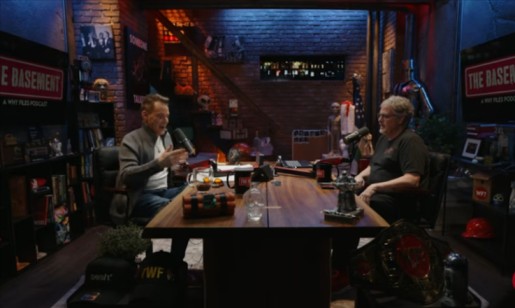
Editor’s Notes: In this episode of The Basement, AJ sits down with Marc D’Antonio, an astronomer, MUFON’s chief photo and video analyst, and CEO of a visual effects company that builds for Hollywood and defense contractors. D’Antonio shares a childhood experience of missing time that sparked his lifelong quest to find answers in the stars, leading to a career analyzing UFO footage and building deep-space detection systems. The conversation explores the scientific possibility of billions of habitable worlds, the mysterious sounds heard on Navy submarines, and a compelling theory on how UFOs might move using extra-dimensional physics rather than conventional engines. (April 7, 2026)
TRANSCRIPT:
Introduction
AJ GENTILE: Today we’ve got Marc D’Antonio. He’s an astronomer, MUFON’s chief photo and video analyst, and the CEO of a visual effects company that builds stuff for Hollywood and defense contractors. He also co-developed a UFO detection camera system with Douglas Trumbull. He’s the guy who did the visual effects for 2001, Blade Runner, Star Trek, Close Encounters. I mean, he’s a legend.
HECKLEFISH: Yeah, so he gets paid to analyze UFO footage and make UFO footage. It’s like hiring a counterfeiter to authenticate money. I love it.
AJ GENTILE: At 9 years old, Marc had a missing time experience on a school field trip. He came home terrified of the night sky. So what did he do? He asked his parents for a telescope. He turned that fear into a career.
HECKLEFISH: So the aliens scared him, and his response was, I’m going to find you. Well, that’s not a career. That’s revenge. This guy’s like nerdy Charles Bronson.
AJ GENTILE: Today we’re covering exoplanets, how life spreads across the universe, and what Marc heard on a Navy submarine that the government won’t talk about.
HECKLEFISH: I always spend some time with semen.
AJ GENTILE: Stop that.
HECKLEFISH: What?
AJ GENTILE: And Marc has a theory that might explain how UFOs actually move without engines, and I’m telling you, it’s a good theory and backed by real science. There’s also a 3-night encounter at his house involving knocking, a flash of light, and something in his sinus that he can’t explain, and neither could his doctor.
HECKLEFISH: Sounds like his doctor skipped the alien biology classes in med school, eh?
AJ GENTILE: I had a great time hanging out with Marc. He’s super smart and also very funny, and I’ll prove it. Let’s go down to the basement. Marc, welcome to the basement.
MARC D’ANTONIO: Wow, AJ. So good to be here. Thank you.
AJ GENTILE: I’m so excited to have you here.
MARC D’ANTONIO: It’s so much fun. It was a great time and a long time coming, right?
AJ GENTILE: It was.
MARC D’ANTONIO: Yeah, yeah, yeah. But it’s really cool. Good to be here. Thanks, man.
The Missing Time Experience at Age 9
AJ GENTILE: So you have a super long resume and a very wide breadth of experience, but I want to start with age 9. Got your lunch, you get on the school bus.
MARC D’ANTONIO: Oh, okay. We’re going there now.
AJ GENTILE: Let’s do it.
MARC D’ANTONIO: Okay. So, hey, so check this out. Age 9, you’re in 3rd grade. Okay, you’re excited. You’re going on a field trip to a pond.
AJ GENTILE: Yeah.
MARC D’ANTONIO: Okay, how much fun, right? My mother gave me a bag lunch with a peanut butter and jelly sandwich and some of those fluorescent orange crackers with peanut butter in them, right?
AJ GENTILE: Oh yeah.
MARC D’ANTONIO: Yeah, yeah. I get on the bus with my bag lunch holding it in my hand, okay? And I sit down, you know, making the squeaky sounds in your shorts because I was wearing shorts. It’s near the end of the year, okay?
And we get to the pond. We’re all getting off the bus. Next thing you know, I’m getting back on the bus. Wait, what’s going on? I still have my bag lunch. I’m holding it the same way. Okay. And the kids are bouncing around like, what’s going on? So I say, when are we going to the pond? And they turn and look and they’re like, “You idiot.” You know how kids are. Slap, push, punch. “We’ve been there all day. Where were you?”
AJ GENTILE: Where were you?
MARC D’ANTONIO: I don’t know. I don’t remember the day. It was the first true missing time I’ve ever experienced. I never experienced anything like that. I didn’t know what it was, so I just sort of stayed quiet in the bus, got back to the school, walked home. I was what they call a walker.
AJ GENTILE: Okay, well, hang on. Did the kids know you were gone? Were you just—
MARC D’ANTONIO: Oh yeah, a couple of them said, “Where were you all day?”
AJ GENTILE: So they were aware that you were not there?
MARC D’ANTONIO: They were aware I was not there. And I don’t know, to this day, I don’t know where I was.
AJ GENTILE: You have no memory of what?
MARC D’ANTONIO: No memory.
AJ GENTILE: You ever thought about doing regression or something to figure that out?
The Seizure and Its Aftermath
MARC D’ANTONIO: Yeah, I have, and I’m a little concerned about it. First of all, let me just finish the other part. I got home with that lunch, I put it on the counter, my mother says, “Why didn’t you eat your lunch?” We love our moms, right? And so I said, “I don’t know.” She goes, “Okay, well, go outside and play. I’ll call you for dinner.”
So I went outside and played with my friend from next door. I distinctly remember a weird feeling coming over me out there, and then next thing you know, I’m on the ground in convulsions and seizures, and I’m banging my head on the ground. Bang, bang, bang. But it wasn’t me.
Here’s the weird part.
Well, they called the ambulance, of course. They put me in the ambulance. It still wasn’t me.
AJ GENTILE: You meaning you weren’t in control? You’re kind of just watching it happen?
MARC D’ANTONIO: Exactly. I was a passive observer watching this happen. It wasn’t really me. So guess what? I’m watching this. I’m in the ambulance and I say to the ambulance drivers, “Hey, can you run the siren?”
AJ GENTILE: So you’re not frightened?
MARC D’ANTONIO: No, I was like, this is cool. And they put on the siren. I’m thinking, “Wow, cool, they’re putting on a siren for me.” I wasn’t worried at all. I should have been worried. Yes. I wasn’t. AJ, I didn’t have a worry in the world. I have no idea why I wasn’t worried.
I get to the hospital. The doctor sees my head has a bump on it, of course, because I was banging my head on the ground, right? “Oh, it’s okay. He had a concussion. Take him home. We’ll have the nurse pluck out the dirt that’s embedded in his forehead.”
Okay, that was the worst part. That hurt like you can’t believe. They’re plucking dirt out of an abrasion. Okay, if you get an abrasion, imagine plucking dirt out of it. The pain is— ah, that’s just painful. Makes people have jelly legs, right? So anyway, that was the worst part. I just wanted to go home.
AJ GENTILE: So, well, hang on. What did mom say?
MARC D’ANTONIO: “Where were you?”
AJ GENTILE: Teacher? Chaperone?
MARC D’ANTONIO: Well, no, she never knew that I missed all that time.
AJ GENTILE: You didn’t tell her?
MARC D’ANTONIO: I never told her.
AJ GENTILE: Of course we were not going to tell her.
MARC D’ANTONIO: I’m not going to get into it. Right. Oh, well, you’re going to take me to a psychiatrist now? No way. No, I’m not going to the doctors again. The hospital was scary to me, so I didn’t want to do it, man.
So I ended up going home. And the worst part was, besides picking all that stuff out of my forehead — I know that’s nasty sounding — was that they wouldn’t let me sleep for the night. Because the doctors told them, “Keep him awake.” And my mother, of course, going overboard, “You can’t sleep tonight, you’re going to have to stay awake.” And that was the worst part because I was really tired.
And anyone that has seizures and convulsions knows that afterwards you’re fatigued. Your body has just gone through this tumultuous muscle tensing and relaxation, tensing. It’s like doing a workout in like 25 seconds, 30 minutes, whatever it takes. And so I was just totally fatigued. I couldn’t even sit up on the table at the hospital. I kept wanting to fall over. And so that’s probably why the doctor said, “Don’t let him fall asleep, keep him awake.” And I’m like, okay, Marky. Okay. And Marky, that’s what they call me.
Fear of the Stars and the Telescope
AJ GENTILE: So is this missing time because of seizures or did something else happen? Just speculate.
MARC D’ANTONIO: My speculation is something happened.
AJ GENTILE: Okay.
MARC D’ANTONIO: I came home perfectly fine. If I was having a seizure, I would expect I would be dirty, filthy, have abrasions from having done it. I had nothing, nothing, AJ. Nothing on my body indicated anything until I had that seizure before dinner, pounding my head in the sand.
Okay, with that, there are people listening who have the same experience.
AJ GENTILE: What would you tell them? Would you tell them to seek medical help, keep it quiet? What do they do?
MARC D’ANTONIO: Do I look like a good example? Okay, I’ve never sought medical help. I’ve never tried to do a regression. I’m sure I’ll get offers to do regression, but you know what, I’m kind of scared of that. Okay, I’m not—
AJ GENTILE: That’s a fair answer.
MARC D’ANTONIO: I’m not going to lie. I’m not like some big brave guy that’s going to say, “Oh, of course I’ll do it.” I’m scared of it.
AJ GENTILE: When you’re 9, did you think this could be an alien abduction? Or did you not have that frame of reference?
MARC D’ANTONIO: It wasn’t there quite yet, but here’s what happened after that. Unlike any other time after that, when I got home from the hospital, when I went out to play the next day, it was fine. When night came, I was completely afraid to go out and let the stars see me.
AJ GENTILE: Right.
MARC D’ANTONIO: The stars. Wait a minute. The night is usually frightening to people. It wasn’t the night. I didn’t care about that. But the stars were scary to me. Something I felt was looking at me. I mean, that’s how I was putting it together as a 9-year-old. It was scary.
So I literally — and I think you may know enough about me to know that sometimes I attack things head-on. And even as a 9-year-old, I kind of did that. It doesn’t mean I’m brave and, “Oh, look at him go.” No, no. It just means I was scared. And sometimes you attack things when you’re scared. When you’re scared, you punch back, right? I’m scared, bang, you hit without thinking.
So I did in an intellectual way. I actually told my parents, “I want a telescope. I want a telescope, mom and dad.”
AJ GENTILE: You’re afraid of the stars, yet you want to see more of them.
MARC D’ANTONIO: I want to see more of them. And I said, “I’ve got to know what’s going on.” And I was scared to death. And the first time I went out there looking at them, I was literally like this. And I felt, this is so stupid. It’s just a star. I didn’t even know what stars were at that point. At 9 years old, I thought, well, were they alive? Were they something? What are they? The points in the sky? Yeah, we know they’re balls of hot gas. Oh, okay. That’s what I knew of stars back then.
AJ GENTILE: But something’s pulling you to look.
MARC D’ANTONIO: But something was making me.
AJ GENTILE: Making you look.
MARC D’ANTONIO: Yeah. I looked at the moon first. “Oh, I’m comfortable with that. It’s the moon. All right, so I’ll check out the moon. Wow, look at the craters, Mom and Dad, look.” “Show them the craters.” “Wow, that’s nice, Marc. Now do your homework.” “Yeah, okay, Mom.” Right.
So then I looked at star clusters and I saw these beautiful clusters of stars. I wonder if there’s anyone looking back at me right now from there. What an odd thought. Is it?
AJ GENTILE: I don’t know if it is unless I’m odd also.
MARC D’ANTONIO: Yeah. That’s why we get along, I think. But yeah, yeah, yeah. I think that you’re wondering who’s there, who’s looking back.
Heart Surgery and Early Astronomy
MARC D’ANTONIO: And so, starting around age 9, just as I reached age 10, I had to have surgery back then, a heart surgery. It was very big surgery, at Yale-New Haven Hospital. And I started embedding myself and looking at the telescope because that’s what I could do. I couldn’t do any kind of athletic stuff, they wouldn’t let me. Doctors were way overcautious and conservative back then, they wouldn’t let you do anything.
AJ GENTILE: This is because of a heart condition?
MARC D’ANTONIO: Yeah, yeah. Okay. Yeah, they had to fix a valve problem, right?
AJ GENTILE: Yep.
From Fear to the Stars: Marc’s Journey into Astronomy
MARC D’ANTONIO: Like in your car. So fix the valve. They fixed the valve, and now they basically have to recuperate. So they wouldn’t even let me climb stairs. I had to walk and I had to go to a special school that was all one floor. It was weird. So anyway, they’re overcautious, but I sunk into the telescope and I started looking at stuff. And the more I looked at stuff, again, still fearful, I began to think, I’ve got to figure out what’s going on out there.
I’d scratch my head and say, there’s something crazy out there. What is this? I’m going to figure this out. I’d grit my teeth and I’d force myself to look at something that’s scary in the sky, and I’d say, I’m going to figure this out. Now, was it just a mental thing? Maybe. But guess what? It turned me into an astronomer. Because at age 9, I said to myself, I’m going to be an astronomer.
Writing to NASA at Age 9
AJ GENTILE: Well, doesn’t that lead us to you writing to JPL as a 9-year-old?
MARC D’ANTONIO: Oh, yes. Oh, yeah. I actually, we have to get—
AJ GENTILE: I mean, this is very— I don’t know if you know how weird you are. In a great way. In a great way.
MARC D’ANTONIO: I’m out of here. No, no, you’re right. I mean, I definitely feel that I am a little weird sometimes, but I just mean this— I try to do it in a good way, man. And most of you understand.
AJ GENTILE: Yes, most of us don’t have this third or fourth grade experience where we’re writing to JPL. So what did you send to them?
MARC D’ANTONIO: To NASA? While recovering from the surgery?
AJ GENTILE: Yes.
MARC D’ANTONIO: I was bored. I would look at my telescope, but during the day, what do I do? I read books. And I realized we need a space station. I didn’t know that NASA had space stations on the docket and thoughts. I didn’t. So I created them. I actually built and created a space station plan. It was like 8 pages of torn out notebook paper.
AJ GENTILE: With blueprints and not even just notebook paper.
MARC D’ANTONIO: I drew by hand and I drew some space stations. I made two dumbbells in an X configuration that were rotating at just the right speed so that you get gravity, Earth gravity, in these dumbbells.
AJ GENTILE: You’re a 9-year-old figuring out how to do 1G with centrifugal force?
MARC D’ANTONIO: Absolutely. And how did that happen? I don’t know. But I did, and again, it happened during that pond experience. I was— yeah, well, they gave you the seed. Oh, okay, that’s scary now. All right, now you’re making me think.
AJ GENTILE: Well, all right, we’ll keep it happy.
MARC D’ANTONIO: So yeah, that’s all good. I built this space station plan and I put in rotation to have Earth gravity. I didn’t call it 1G, I didn’t know what that meant. I said, if it’s rotating, we’ll get Earth gravity. Because there were things out there in the literature talking about space stations rotating and stuff like that, so I put it together. I made twin dumbbells in an X configuration. The access hatches were— as you get closer you get zero-g at the center, right? Well, I didn’t know that. I just thought you climb a ladder to go to the next one. I’d never put that part together, but it was rotating with Earth gravity at the ends.
I had pigs in there, I had cows. Pigs for meat, cows for milk. I mean, I did all that stuff that obviously is impractical, but I also talked about cleaning the air. How do you clean the air? You’ve got to clean the air inside your space station to get rid of carbon dioxide. I knew that because I read books about what we exhale. So I figured there has to be a way to get rid of carbon dioxide out of the air. So this box here is the thing to remove carbon dioxide, and replace it with oxygen. Now we don’t do that part, but we do scrub CO2, right? So I didn’t know what that was, but I said it’s needed for a space station because where are you going to otherwise get the oxygen? Of course the animals are going to need it too.
So anyway, I did all this stuff. I wrote it all up and drew these pictures, arrows everywhere, pencil on notebook paper with blue lines. I boxed it up and I put it in a folder and I sent it down to NASA. And the NASA person that read it must have had a field day. He was a NASA scientist. He read it, and for whatever reason, it struck him. He actually wrote back to me—
AJ GENTILE: Who was he? What was his name?
MARC D’ANTONIO: I’ll tell you in just a minute, because that’s part of it.
AJ GENTILE: I don’t want to step on the punchline.
The Space Box and Gentry Lee
MARC D’ANTONIO: No, no, you’re fine. So this NASA guy writes back to me and he provides me with this giant box, which I called my space box. It was full of cloth mission patches from missions. It was full of books. It was full of models. It was full of all the stuff a kid could dream of if you’re a space nut. And I labeled it space box. I had it for decades, tattered, worn. Many of the things got lost to time, but I still had the box with a few things in it left.
And in my space station plan, in the manila envelope, he read every page, every comment, and he circled things and little call-outs, and he wrote things like, “This is a good idea, we do this,” meaning the carbon dioxide thing. He says, “It’s called a CO2 scrubber, and we do this now. Good thinking.”
AJ GENTILE: Wow.
MARC D’ANTONIO: And then he wrote me a letter which said, “Dear Mark, your space station plan I read with enthusiasm.” I just love that line.
AJ GENTILE: Wow.
MARC D’ANTONIO: I had a scientist read something I wrote with enthusiasm. I’m 9, I’m thinking I’m an adult, right? That’s how you think. And then he says, stick with the— they called it back then the manned space program, right? “Stick with the manned space program because you’ve got a future.” And he signed it with his name: Gentry Lee. Gentry Lee today, and probably retired by now, but he is JPL’s head engineer, the Outer Space Robotic Missions Directorate.
AJ GENTILE: Yep.
MARC D’ANTONIO: And I literally said, I can’t believe this. This is cool. Now back then, he was just a NASA scientist. So let’s jump ahead 45 years. I remember Gentry Lee. I should write him and find out if he remembers this. He won’t, but I’ll do it anyway. I wrote him. He writes me back. “I don’t remember this, but that’s the kind of stuff I did.” He says, “We should stay in touch. This is so cool.”
Now, I was in Pasadena because I was at a conference out there, and I was presenting for A&E, so I couldn’t leave. I didn’t have a car, but I wanted to go to JPL in the worst way to see if he was there, to make an appointment, to meet with him and say hi to him finally after all these years. I didn’t get that chance yet. But man, that guy single-handedly took a 9-year-old kid and cemented that he was going to become an astronomer.
AJ GENTILE: That’s a real gentleman to do that, take that time to do that.
MARC D’ANTONIO: He was amazing. And I’ve always given him kudos for this. We’ve talked about this, I think, in the past. I know your brother and I talked about it. For me to get where I am, I’ve stood on the shoulders of giants. None of it is— I can’t say it’s all me. I don’t have that kind of ego. I’ve stood on the shoulders of giants. I was helped along the way, and I never forget who helped me, and I always make sure I name them and give them the credit that’s due them. So that’s how it works.
But it’s so cool. And so here I am, some weird astronomer guy who believes UFOs exist and believes that we might have alien life on our planet. How the heck did that happen?
Building Telescopes and Cameras from Scratch
AJ GENTILE: So the 9-year-old kid goes into astronomy and you start building telescopes?
MARC D’ANTONIO: Yeah, I actually started making a reflecting telescope, which I never finished because I was grinding the mirror. But as a 9-year-old kid, I was also very much unable to focus. So I was grinding this mirror with a friend Mike, and we’re grinding in his basement. And I’m looking around thinking, man, hurry up and finish. Let’s get this thing so we can look at the sky. So the mechanics of making a telescope weren’t so exciting to me. Using them and looking at stuff, amazing.
And I said, but wait, I want to take pictures with them. I’m thinking, how do I attach my camera to a telescope? Now, I didn’t know that they have adapters, so I made one. No lie, out of a paper towel roll. And the camera I built out of nothing. I built it out of cardboard.
AJ GENTILE: You built a camera?
MARC D’ANTONIO: I built a camera, a one-shot camera using the Instamatic film they used to have. It was a film camera, and they used a screwdriver to wind it to the next picture. I figured that’s about right. So I would actually make this camera and then I had the cardboard attached to this paper towel roll. In the telescope, I had no way of focusing it. So what I did was I figured, well, here’s where the film is, and that’s got to be where my eye is. So I would look where my eye is. I took my mother’s ruler and went like this. How far away am I from the eyepiece?
So I got pictures, but of course they’re blurry, crappy photos. But you could see the kind of the star, and you could see a sort of a moon crater. It wasn’t unsuccessful. But I figured I wanted to take pictures, so that’s how I did it. I couldn’t afford a camera.
Building a Missile Silo on the Front Lawn
AJ GENTILE: How do you end up building basically a missile silo on your front lawn?
MARC D’ANTONIO: Oh, years later. You’re doing astronomy, right? I wanted to do astronomy, but I also wanted to share it. I took my astronomy into public outreach. I felt that that is a rigorous application of astronomy — how we’re going to leave the planet eventually. Astronomy, physics, astrophysics, and maybe even cosmology, is how we’re going to get there. So I wanted to be an astronomer to do that.
So how do you do that? Well, you have to bring other people into the discussion. You hear people talk who are in a university and they’re over your head within 5 minutes, and you’re like, well, what about the people that are watching over here? They’re not going to get it. So I made it my effort to take the complex and make it digestible. Because even if you don’t understand all the science, you should still be allowed to be in the discussion.
AJ GENTILE: That’s why you’re perfect for TV — because you make it accessible to all of us.
MARC D’ANTONIO: Maybe, I guess. Maybe that’s why they found me, who knows. But the point being that if you can make something like that digestible, well, it’s a commodity of sorts, but I don’t think of it that way. I don’t go after opportunities. This came from someone else, and I said, “Oh, I’ll do it, sure, that sounds fun.”
But the point being that when you make it understandable to people, they start asking questions, and they always start the same way: “This may be a stupid question.” And I go, “No, no, stop. There are no stupid questions. If you don’t know, you don’t know. I was you once. Just ask.” And they’re set at ease, and they ask their question. “Well, black holes really suck, right?” I’m like, “Yeah, that’s sort of true, but we don’t understand gravity yet.” We just know that they do. And then they go, “We don’t understand gravity?” Oh, that’s another discussion. So obviously, that’s very important.
The Observatory Dome and Remote Astronomy
AJ GENTILE: So tell us about the dome that you built. I just, I love the story.
MARC D’ANTONIO: Well, so I wanted to be able to bring astronomy to the masses like we’re talking about, and to do it I needed to have a telescope that was always accessible. I did not like the inconvenience of having to bring it out, 150 pounds of telescope, mount it, align it with the North Star so that I could make it properly follow the stars, because you have to do that for telescopes, for those who don’t know.
And by doing that, what I did was I bought a dome for my front lawn. It was the only dome in the entire town of Terryville, Connecticut. It’s this big giant white Minion on the front lawn, okay? I dressed it up as Stuart the Minion, in fact, for Halloween. Okay, and people are stopping, look at Stuart, banana, you know, they’re taking pictures of this giant Minion on the front lawn. How big is it?
AJ GENTILE: Because my HOA won’t let me put up a flag. How do you get a dome? How big is this thing?
MARC D’ANTONIO: I don’t have an HOA. That’s why. It was an 8-foot diameter.
AJ GENTILE: Okay.
MARC D’ANTONIO: Okay, so it stood about maybe 8 feet tall, 8 feet wide, you know, it was really, really nice. Okay. I think they called it a standard 2-meter dome. But anyway. I put my computer in there, the telescope was in there, and it was protected from the weather, mostly, except when we had like violent winter storms that ripped the shutters off and filled the whole thing up with snow, telescope, computers, the whole nine yards.
But luckily, it was cold. And I took everything out. And I blew it out with my air gun and managed to recover perfectly, right. So it wasn’t perfect solution. But it was great. And so I’d go in there, it’d be February, it’d be like -3 outside, and it has to be -3 inside too. You can’t heat a dome because there’s a slot and the warm air would go out and do this to the view.
AJ GENTILE: Ah, you need to keep everything the same.
MARC D’ANTONIO: Ambient temperatures, the outside. And when I worked in a parallax program at a big observatory, we had a 20-inch refractor that was like 35 feet long, massive dome. You’d have to open the dome hours before you’re ready to start doing observations of nearby stars, okay, to gauge their distance. And when you did that, it could be 10 below zero or 5 degrees, and you got to be in 5-degree weather.
Not only that, you had to also work in a darkroom in the dome at the same temperature to develop all those plates. It was actually glass plates because back then Yale University could actually measure these glass plates with what’s called a measuring engine back then. That’s how they did it then. Now it’s all digital, thank you. Okay, but it was crazy.
So I’d be in there, so I’m used to the cold, hate the cold, you know, and the gloves are never good enough, right? You can’t use heated gloves because it gives off heat, and heat causes you to have problems with your image. So you’ve got to be the same temperature. Just breathing can be a problem in a small dome, right?
So anyway, I built the dome. The summer months, great, okay? I had broadcast stuff in there. I broadcast to the internet, and I would actually stream it on YouTube, okay? And that was the whole Sky Tour livestream thing, right? And so people would come in, and they still do, from all over the world and just watch as I produce the universe live in real time. And we produce these images for people. And I say for people because everything we image, I give away. We have a server at skythroughlive.org. They can go on there and go grab the images we took a week ago. Even if they couldn’t attend, they could see what we took.
AJ GENTILE: The streams are a lot of fun.
MARC D’ANTONIO: They are.
The Arizona Observatories
AJ GENTILE: And you have another observatory in Arizona?
MARC D’ANTONIO: I do. I have two there.
AJ GENTILE: And you can— can you control that remotely?
MARC D’ANTONIO: I do. Yeah, because I had the one on the front lawn in Terryville, Connecticut.
AJ GENTILE: Right, the Minion.
MARC D’ANTONIO: And Minion. And I controlled the Minion with Wi-Fi. It’s like, oh, okay, that worked. Networked for a period of time. And then I realized, you know, that way I could be inside the warm house while doing it. That’s a huge leap from being in 20-degree weather because I’d be saying, and this is— oh gosh, you know, I forget because I’m so cold. And people are saying, “Oh, we’re feeling pain for you right now.” And I was like, oh, see, that’s the wrong thing, wrong message.
So I ended up working out the Wi-Fi thing, and then I’m inside. Wow, what a difference! I have a warm room now that I’m working from. Then I realized I want to put these in Arizona somewhere. So I convinced a friend to let me put one on his land, okay? And that was the first one in Arizona, out in the Sonoran Desert. You ride, you ride on 14 miles of dirt roads after the pavement to find the observatory.
AJ GENTILE: Are you triangulating objects like Avi’s doing with the Galileo Project?
MARC D’ANTONIO: Interesting you mentioned that because the other observatory in Arizona is in Benson, Arizona, which is 220 miles away. So if we image the same object from both telescopes, we could indeed do that. Okay, as long as you know the exact look angles and exact position and altitude of the telescopes, we can do the calculation. We haven’t, but we can. And that was precisely why I wanted to have them separated like that.
Because if you see something in the sky, in fact, you can, you know, I talked to Avi’s team. Ezra Kelderman was on his team. I talked to Ezra and several of his team members because I wanted to offer them a Galileo site, you know. So I have a potential Galileo site for them, you know, if they want to ever use it, and so forth. But I was also talking to him because I could maybe help them automate some of their processes. After all, I had the right software to be able to control my dome out there, and it’s not even a dome, it’s just a flat roof, okay, where the roof comes off, much quicker to acclimate that way.
And so I wrote a control program, does housekeeping stuff, turn on power, move off the roof, do this, do that, check the temperature, blah blah blah. And so that all works great. So then, when I do the actual work I’m in Connecticut, 2,600 miles away, and I thought, you know, this is a far cry from my front lawn. But if something went wrong on my front lawn, what would I do? I’d put on my hat and go out and fix it. Can’t do that when it’s out in Arizona. So I had to make it bulletproof as best I could.
Sometimes we lose power for a bit, everything gets upended. I had to have back doors to be able to shut things down, even though that only happens when you’re live, by the way. Oh yeah, right.
AJ GENTILE: Isn’t that weird?
MARC D’ANTONIO: How did you know that? There’s been times where I get in and welcome everybody. “Welcome to Sky Tour livestream. Hey guys, Marc D’Antonio here,” blah blah blah. And all of a sudden, it’s all gone. It’s like, it really fills your heart with fear when you lose connection.
But what I did was I circumvented that by having a secondary internet. The internet out there was okay. In Benson, we’re sharing it with 9 other professional astronomers on that plateau out there. And sometimes the internet goes out and then everybody’s out of the water, including me. So I put a Starlink in. So now I’m connected to Starlink. The backup is the regular, you know, regular internet they provide. So I’m paying an additional $120 a month for the peace of mind to know that from 2,600 miles away, I won’t lose connection to this telescope.
AJ GENTILE: You got to have it. And the bitter irony that you’re using Starlink, the bane of every astronomer on the planet.
MARC D’ANTONIO: I’ve said that so many times. You have to do it. Yeah, I’m taking pictures of these beautiful nebulae. And depending where you are in the sky, and, you know, and then, and the thing is, a typical session, for instance, I’ll be sitting there looking at objects in the sky, and I’ve got people from all over the world watching. Right?
And I’ve been a performer all my life. I started as a magician early on. I do a lot of talks. I speak all over the country. I’m very comfortable in front of cameras. I’m very comfortable in the sets. I’m very comfortable. I know my marks. I know where to be. And that just came with time, right?
So all that said, I started to think, well, you know, I can’t let any dead air occur. I’ve got to fill the space with something. So I put music in the background, some of which I make myself. Okay. And others of which I use from like the YouTube galleries. I hate those, but you know, I haven’t mixed in all my own stuff yet, but it makes it a show.
AJ GENTILE: It really does. You put on a show.
MARC D’ANTONIO: It’s a production. Yeah, it is. It really is a production. You’re right. And, and you know, you want to add other things. I used to have other overlays and things, but I’m one person doing 8 things at once all the time. And that makes it really hard.
The Robot and the Smithsonian
Now I’ll tell you this with a friend of mine, partner, who was also a magician. We built a robot together, and the robot would work at trade shows and go and talk to people. We actually worked an inauguration in Washington.
AJ GENTILE: A robot?
MARC D’ANTONIO: Robot.
AJ GENTILE: Okay.
MARC D’ANTONIO: And the robot gave— it was at the time, it was the president’s daughter, and we’re giving her a tour of the Smithsonian.
AJ GENTILE: Which president?
MARC D’ANTONIO: It was Clinton.
AJ GENTILE: Okay.
MARC D’ANTONIO: So it was Chelsea.
AJ GENTILE: Okay.
MARC D’ANTONIO: Okay. And we had her sign the robot and all that stuff. Whatever. So anyway, it was an opportunity, and Electronic Data Systems, EDS, Ross Perot’s old company, brought us down and said, “We would like you to take Chelsea around the Museum of American History.” Okay. So the museum escorted her around, talking to her, interacting with her friends. Now, what no one knew is that I was inside that thing.
AJ GENTILE: No, you— we were in the machine.
MARC D’ANTONIO: I love being magicians, though, AJ.
AJ GENTILE: Right.
MARC D’ANTONIO: Being magicians, we figured out how to make this large thing looks small. Clever use of black and white colors allowed us to make it look impossible for a regular-sized human to fit in there.
AJ GENTILE: This is your VFX training as well?
MARC D’ANTONIO: Yeah, it was, absolutely. Okay, and so I ended up doing this, escorting her around.
AJ GENTILE: Can we hire you to do parties or anything? Because that would be super fun.
MARC D’ANTONIO: They have. I’ve worked in Phoenix, I’ve run all over the place with this silly thing. Okay, what did you name it? Sammy. Okay, sales and merchandising informant.
AJ GENTILE: I knew it had to be something like that.
MARC D’ANTONIO: Yeah, and you know, it was sort of like a follow-on from the craze with R2-D2 and Star Wars and all that. And you believe it or not, we called George Lucas to find out if he would have any problem with us doing this, and the response we got from his people was, “Go for it, more power to you.” Now you can’t do that anymore, but we’re grandfathered in.
AJ GENTILE: You are?
MARC D’ANTONIO: Oh, hell yeah.
AJ GENTILE: So Disney’s lawyers can’t touch— good for you, man.
MARC D’ANTONIO: Grandfathered in. But you know what, I don’t do a whole lot of it anymore. I’m an astronomer. I don’t have time to sit inside a can and run around, but it’s a lot of fun.
AJ GENTILE: It sounds it.
MARC D’ANTONIO: Unless you roll over something on the ground that smells pretty bad, because then you have air conditioning that’s pulling in from the ground. Around. You know, we’ve had that happen too.
Exoplanets: The Search for Habitable Worlds
AJ GENTILE: What drew you to exoplanets? Everybody loves exoplanets.
MARC D’ANTONIO: I know. That was a question. What’d you ask? How—
AJ GENTILE: What drew you to— oh, to specializing? Or, what— how many are out there? How do we find them?
Exoplanets, Red Dwarf Stars, and the Search for Habitable Worlds
MARC D’ANTONIO: There’s about 5,200 known ones right now. But that’s a low number. We got to understand that that’s in a small area of sky relatively. When Kepler went up there— Kepler’s like a laser beam. It would focus on one star at a time. Is there a planet crossing in front? Are we seeing a light curve where the light dips a little bit and then comes back up? Are we seeing that or not?
And then came along TESS, Transiting Exoplanet Survey Satellite. It looks at like a 96-degree by 24-degree field, something like that. And it’s not a laser beam pointing at star by star. It’s looking at whole swaths of stars and saying, are any of these transiting?
So the idea was it should be able to find thousands more. Well, the TESS candidates are still being studied. There’s thousands upon thousands upon thousands of them. And I’m working with a group with what’s called Las Cumbres Observatories. We have time on big telescopes to actually do transit studies.
And I’m working with another kid who knew nothing about astronomy and has come a long way. Kid Kyle — I give him kudos. He would always say embarrassing things about astronomy and things we’re looking at when he was first starting. Now he’s an exoplanet scientist in his own right because he’s managed to do the diligence. And I’m really proud he’s done this. And if he hears this, he’s going to say, “Oh, he talked about me.”
AJ GENTILE: You’re paying it forward.
MARC D’ANTONIO: Yeah, I am. Because the thing is, I’ve helped him to understand what was going on. I would advise him. And he’s taken it to heart. And he’s worked really hard. So I don’t have an ego. I don’t care. Someone has to say it, right? Someone has to study unidentified objects. Someone has to study planets around other stars.
Why did I start? I started because I figured the stars aren’t actually looking at me. But something around those stars might be. And so I started getting drawn to exoplanets. In fact, part of my book, The Populated Universe, has a whole section on stars that might be habitable, and talks about why they would be habitable. That’s a key point.
There’s no guarantee of intelligence, and right up front we know that intelligence is a circuitous path you follow, and by luck you get some intelligence. Well, every creature has intelligence of some level. We as humans will call it rudimentary for everything below us. Aliens would probably say we’re rudimentary. Of course, we always heard that we’re just ants. We’re not ants, to aliens in my view. And the reason is because they know we can hurt them.
When you as a human — you’re far more intelligent than an elk — but if you go into the middle of a herd of elk and say, “Hey, come here, I gotta put this radio collar around your neck,” you’re going to get trampled to death. So even though the elk is not nearly as smart as you, he can kill you. That’s true, right? So we have to keep that in mind when we talk about alien life. What are they going to do? Are they going to just stop us and put a radio collar around our neck? So you walk into the house with a big radio collar. “Hey, you got any pizza left?” With this giant collar around your neck, right? How’s that going to work? We’re not going to notice? Of course we do.
Transiting, Orbital Planes, and Detection Methods
AJ GENTILE: So the concept of implants, for instance — hang on, hang on, before we get to aliens, there’s something about transiting that I want to ask you that just occurred to me. So we know that transiting is when the star luminosity dims a little bit, a planet goes in front, right? Do we have to be oriented to the orbital plane? And are we missing a ton of transits because we’re just not oriented properly?
MARC D’ANTONIO: We absolutely are.
AJ GENTILE: Really?
MARC D’ANTONIO: Yeah. Because if you look at my hand, if we see a solar system like this and there’s a planet going around it, nothing. The only way we would know is if the star does a little wobble. And that’s because the planet might be a Jupiter-sized planet. And as they go around each other, this one moves more, the small one moves more, but the big one moves a little bit. So when you look just at that motion, you’ll see a little bit of motion. Now that’s called astrometry, studying the positions of stars. It’s the most error-prone method.
AJ GENTILE: It is?
MARC D’ANTONIO: Because we can’t measure those positions very accurately. Why? Because we’re looking at stars — they’re just ever points of light to us. And when people understand that, they look at like Betelgeuse in the night sky, the upper left star in Orion. It’s a bright red star, right? Well, it used to be bright blue. It evolved to a supergiant. And so when it stopped fusing hydrogen into helium, it went off the little snaky line we call the main sequence, where stars are that are burning hydrogen into helium. We call them normal stars. The Sun is one. Alpha Centauri — those stars are others, of all kinds.
But once they stop, they leave that main sequence because now they’re going to fuse other elements. And when they do that, they swell and they become these gigantic, much cooler red supergiants. Betelgeuse is one such star. But it’s still just a point of light to us. With something called interferometry, we can actually see the shape of Betelgeuse. It’s one of the very, very few stars — that one and Antares and maybe a couple others that are as massive — where we can actually see their actual shape. And that’s it.
AJ GENTILE: That’s amazing, though.
MARC D’ANTONIO: Yeah. No other stars. Alpha Centauri, 4.3 light years away — two stars going around each other with a third one, the red one going around, that’s Proxima. Where we have a planet or two going around that one as well. Well, those two stars, the closest ones to us, we can’t see those because they’re sun-sized. If you put Betelgeuse where the sun is, it would almost reach Jupiter’s orbit in radius, right? And then you got to make that a huge thing, a huge diameter.
AJ GENTILE: So Proxima is a rocky planet? Yes? How do we know that?
MARC D’ANTONIO: Well, we don’t.
AJ GENTILE: Oh, don’t tell me that. I want the answers. I want to know that there’s oceans.
Red Dwarf Stars and the Possibility of Life
MARC D’ANTONIO: Proxima is a red dwarf. It’s a tiny little star, but red dwarf stars are the most prolific number of stars in the whole universe. The largest count are these red dwarfs. That said, the red dwarfs also have the most amount of planets around them, statistically, and in all likelihood, practically. So if that’s the case, that means that the most likely life forms might be around these stars, right?
And you might say yes. Well, if you look at Jupiter and you look at its moons, the Galilean satellites — Io, Europa, Ganymede, and Callisto — Io is going like this around Jupiter. Its same face is facing Jupiter. It’s tidally locked to Jupiter in the same way that our moon is tidally locked to the Earth.
So around a red star, any planets going around one of these red stars are likely going to have to be close to it for it to be in what we call the habitable zone, right? And if that’s the case, it also means for these little red stars that those planets are also tidally locked. So if you’re going to develop life on a planet like that, it’s probably going to be kind of on the sunset dark side, right? Where it’s on the front, it’s going to be scorching hot.
AJ GENTILE: So kind of just on the limiter. Yeah, the terminator, the terminator.
MARC D’ANTONIO: Yeah. And at that point, you might see life develop a little further in. And what would life look like there? If you’ve ever looked at cave creatures on our planet, cave creatures in the dark, they tend to have no pigment, right? They look kind of whitish gray. But the ones that have eyes — some of them don’t — but if they have eyes, they’re very big, just like the Grays we see in literature.
Long before we thought and knew that there might be planets around M stars, people were seeing Gray-type aliens. Now, is it possible — and I just ask that question as a brain teaser — is it possible that gray aliens come from these red stars, the stars that are the most numerous of any type of star in the universe? Is it possible? I can’t say no. I just can’t say no. And so they have zero pigment, they’re kind of grayish looking, they have big eyes. Is it possible that they are red star occupants?
AJ GENTILE: But wouldn’t the red stars be older stars?
MARC D’ANTONIO: Well, here’s the thing about those stars. Our sun is a 10 billion year lifetime. We’re about 4.5 to 5 billion years in. Good. We got time.
AJ GENTILE: Yellow dwarf.
MARC D’ANTONIO: Yeah, it’s a yellow dwarf. Actually, it’s a white star. It’s called a dwarf, but it’s not like a white dwarf. That’s where astronomers like to confuse you. But think about this.
AJ GENTILE: Pluto’s a planet.
MARC D’ANTONIO: Hey, it says so on my shirt. Attaboy. Yeah, it says, “I need my space,” and it shows Pluto’s one of the planets.
AJ GENTILE: There you go.
MARC D’ANTONIO: The whole ring.
AJ GENTILE: Team Pluto.
MARC D’ANTONIO: Yeah, yeah, yeah. I knew Clyde Tombaugh. I met him. We were at an astronomy conference together, and I saw him.
AJ GENTILE: Did you get into a shoving match?
MARC D’ANTONIO: No, I agreed with him. I felt that Pluto was definitely a planet. Back then there was no doubt. It still was a planet. Anyway, so when we talk about— I’m forgetting where I was.
AJ GENTILE: We’re talking about red stars.
Red Stars: Trillions of Years Old and Still Going
MARC D’ANTONIO: Thank you. So when we look at the red stars as being most numerous in the universe, one of the things that’s interesting about them is that they’re kind of flary. They give off a lot of ultraviolet flares, especially when they’re young.
And if we look at the sun, for instance, we know it is a yellow star. It’s actually not. In space, it’s white. It’s yellow because some of the blue light is being taken from it before it gets to our eye because of our atmosphere. So it looks yellow in the sky, but in space it’s white. And the condition that causes that is something called Rayleigh scattering. The problem is that as we get through more air — as we see the sun through more air — more of the blue light is being removed. So the sun starts looking redder and redder and redder as it goes to sunset.
AJ GENTILE: Sure.
MARC D’ANTONIO: Or red as it sunrises. And the reason is just because of all the atmosphere removing the blue light from that red, orange, yellow, green, blue, indigo, and violet spectrum coming to us from the sun. With the blue left out, you only have the red, orange, yellow, and some of the green. So it looks predominantly red. That relates to the green flash people see as well.
So all that said, when we talk about these red stars, these little guys, they’re like little percolators. The very first star to form in the universe as a red star is still existent and still percolating. They live trillions of years.
AJ GENTILE: Trillions of years?
MARC D’ANTONIO: Trillions, not billions. And why? Because they’re a little different animal than stars like the sun. One of the things I had to do in astronomy was build a star — a computational model of a star and make it work at all levels. I had to build a core, I had to build this envelope outside. The core has a radiative energy that comes out from the core for a certain distance, and then it turns to convection near the surface.
Well, the red stars are convective throughout their entire diameters, and that means they can dredge from outside back to the inside hydrogen fuel. So the very first star in existence that’s a red star is still alive today, so to speak.
AJ GENTILE: So if we’re what, 13 and change billion years in, how do we—
MARC D’ANTONIO: 13.8.
AJ GENTILE: Then how do we know it can survive for trillions?
The Drake Equation and the Possibility of Life
MARC D’ANTONIO: What is that? Models predict that stars like this are utilizing their hydrogen at a certain rate, and based on their mass, we know how much hydrogen’s in their outer envelopes, and we can calculate what their longevity is. The number comes out to trillions of years. So what does that mean for life? Life has a long time to potentially gestate on a planet like that. It can come and go. There could be flares that wipe it out, but it’ll keep coming, right?
I think the universe provides these templates, okay? DNA is a template undoubtedly provided by the universe, right? Adenine, cytosine, guanine, thymine— they’re nucleotides. These guys make up DNA, and that DNA is something that has been brought to our planet by asteroids, comets, and meteor impacts.
AJ GENTILE: Okay, I think they just found another one last week.
MARC D’ANTONIO: Yeah, exactly right, with the proteins. That’s right. And the Murchison meteorite was famous because it brought some amino acids to our planet. Okay, and there was a famous experiment called the Miller-Urey experiment in 1951 or ’52, and what they did was they had a flask and it was filled with the hypothetical primordial atmosphere on our planet. And they bombarded it with lightning. In other words, a spark gap. A week later, there was a brown sludge in the bottom. They examined it. Amino acids.
Now, what does that mean? It means that even the Earth with its thunderstorms and its rudimentary atmosphere was creating the building blocks of life by itself, also brought by comets and meteors and asteroids striking the planet.
AJ GENTILE: So you think there’s tons of life out there?
MARC D’ANTONIO: I do. I think that there’s tons of life elsewhere. Is it intelligent? Well, that’s the question. I had an argument with my director at the observatory when I was getting my degree. I said to him, “I think it’s a populated universe out there.” Now, ironically, that became the title of my book later, years and years and years, decades later. But I said to him, “I believe it’s a populated universe.”
Look at us. We’re carbon-based. We’re bilaterally symmetric. Same on the left as on the right. Carbon is the basis of life on planet Earth, and it’s probably the basis of life everywhere in the universe. That’s my guess. And so I said to him, “I believe that it’s not just here where this has happened. I believe it can be in existence all over the universe in a variety of ways, at a variety of levels and capacities.”
Do I think that every life form is intelligent? No, I don’t. Intelligence takes a certain path, right? I will say this though: when the dinosaurs were rendered extinct by the Chicxulub impactor 65 million years ago, there was one dinosaur whose cranial capacity was accelerating in size, and it was called the Troodon. Yes, T-R-O-O-D-O-N.
The Troodon and Reptilian Evolution
AJ GENTILE: I did an episode on it.
MARC D’ANTONIO: Did you really?
AJ GENTILE: Yes, that’s the reptilian race. They come from there.
MARC D’ANTONIO: Yeah, and so that— well, you know what, that’s funny because I used to say, “Ha, reptilians, what a stupid thing.”
AJ GENTILE: But then why not?
MARC D’ANTONIO: Then I realized that I’m really being short-sighted here, because I’m looking at this in terms of Earth development. And I love alternate histories. I do. So I work through what would happen if dinosaurs didn’t get rendered extinct?
AJ GENTILE: Love it.
MARC D’ANTONIO: What would happen? How would life change on the Earth? Well, it would still go on like it’s been going on. There would still be evolutionary mutations, right? Mutation followed by adaptation is evolution, and that’s exactly what we see.
AJ GENTILE: The Troodon was starting to form an opposable thumb.
MARC D’ANTONIO: Yes, exactly. So this thing is very important.
AJ GENTILE: Yes, it is.
MARC D’ANTONIO: Okay, and bipedalism is very important. Well, the Troodon was already kind of bipedal. Okay, so was it going to reach that status? We don’t know.
AJ GENTILE: We don’t know, but it figured out that, hey, caves are kind of safe.
MARC D’ANTONIO: Yes, that’s exactly right. He did do that. He’s a smart guy, that guy over there.
AJ GENTILE: Well, I love alternative history also. So without Chicxulub, does the Troodon become the apex?
MARC D’ANTONIO: It would become one of the smartest dinosaurs, I would think, given no other downfalls, no other impacts, events, no other biological catastrophes or anything. The Troodon may have actually preceded. Now, would the Troodon be conscious of that? I don’t know. Who knows, right? We can speculate.
But I do believe, and this is why I changed my idea— I kept thinking to myself, “Don’t go down that path, you’re going to become that guy that thinks reptilians are all around us or something.” I’m not that guy. But I will say this: I do believe that you could have races out there that may have developed off of a reptilian branch, okay? I do believe that, and here’s why.
If you look at how life develops on a planet, you have an ancient ancestor, and then what do you have? You have all these radial branches coming off it, right? Radiative adaptation. All moving out in all directions. Every one of those is a different creature, different animal, different version of the same species.
AJ GENTILE: Yep.
MARC D’ANTONIO: And those do this radiative adaptation. Many of those branches die off. In other words, they’re not successful. Now, the question is, where do the mutations occur? They occur in the DNA to begin with, right? What’s causing that? I’ll ask you a question. What do you think is causing the adaptations and the mutations in creatures just to survive?
There’s environmental pressures, right? And this one happened to be born with a thicker hide than usual, and guess what? It’s going to survive the new glacial age, and its offspring will probably have thicker hides too. That’s natural selection. Okay, but the other thing too is we have a young sun, and that young sun is spewing all this ultraviolet radiation. And what does that do to our DNA?
AJ GENTILE: It makes it unravel.
MARC D’ANTONIO: Exactly. It unravels certain nucleotides and reassembles them another way. It causes mutations.
AJ GENTILE: Yes. You got to shield from that somehow.
MARC D’ANTONIO: Yes. And thank you for the atmosphere doing that. Okay. The atmosphere was a little thicker. We had up to 33% oxygen in our atmosphere at one time, which is why dinosaurs are so big and hulking. But today, a brontosaurus couldn’t survive, right? It couldn’t have the oxygenation in its tissue required to survive. So we’d have to give it an oxygen mask— or make a little pocketbook one, like Paris Hilton would have a little pocket dinosaur.
AJ GENTILE: That would definitely happen.
MARC D’ANTONIO: You know, pocket tyrannosaurus. Hey, Rex.
40 Billion Habitable Worlds
AJ GENTILE: So give me a read on Drake’s equation regarding life. Doesn’t have to be intelligent. How many planets do you think?
MARC D’ANTONIO: All right, well, okay, here’s the thing. When Frank Drake first did that equation, it only came out to one planet, ours, right? And the reason was because that’s all we knew. There were many parts of the equation you didn’t have answers for, like how many planets out there are habitable. We didn’t have— you’d have to guess. We only knew one. 1 times 1 is 1, right? And so we had to do that, and that makes sense.
But there’s an Italian team and another team. They each did their analysis of the new Drake equation using what we now know about exoplanet populations. The numbers are now staggering, okay? We have about 150 billion stars at the low end in our galaxy, at the high end 400 billion. We can’t even see the other side of our galaxy. I mean, it’s blocked by the central bulge and all the dark dust. We’re looking through tons of dark dust all the time in our local universe, right? And we can’t see the other side. We’re guessing based on the architecture here. We’re saying symmetrically it must look like that.
That said, when you look at the number of stars— let’s say 150 billion right now— the estimate with this Italian team, I think it was, they came up with 25 million Earth-like planets in our galaxy. 25 million. I know it sounds like a lot. Want more? Okay. That’s at the low end. And if you go to the high end, it looks like maybe we’re talking 40 billion.
AJ GENTILE: 40 billion.
MARC D’ANTONIO: B with a B. As in baker. 40 billion potential habitable worlds in our galaxy. Now, that doesn’t mean intelligent life, but it sure does give it a fighting chance, doesn’t it?
AJ GENTILE: It does.
MARC D’ANTONIO: Yeah. So that’s the possibility that we’re looking at right now. And it’s between 25 million and 40 billion, kind of a range. But again, it depends who you talk to. Everybody has their own take on Frank Drake’s work. And I’m kind of in the middle. I don’t go to the 40 billion range. I actually think it’s more of a percentage of the stellar population. So based on the stellar population, the fact that M stars are the most populous in any galaxy all throughout the universe, I think we’re probably looking at maybe 10% of the star numbers in a galaxy might actually be habitable based on metrics provided by studies and so forth. So I’m kind of being a little more conservative. But 10% of 150 billion, it’s plenty.
Detecting Life Through Spectroscopy
AJ GENTILE: What technology do we need to definitively identify that kind of planet? Transit’s not going to do it, right?
MARC D’ANTONIO: Transit gives us an idea of how many— we say, okay, if we’re seeing this many, there have to be statistically this many more that we’re missing.
AJ GENTILE: We’re still kind of guessing.
MARC D’ANTONIO: That’s right. It’s still a guess.
AJ GENTILE: And what about spectrometry? What about color analysis for atmospheres? Is that enough?
MARC D’ANTONIO: Spectrometry creates the bands— you look at the different absorption bands and stuff. I’ve seen that. I’ve got one going in an observatory, actually, we’re putting in a new spectrometer to add another telescope capability. And they show us what a star is made of. But if a planet passes in front of the star, then that planet’s atmosphere is going to pollute the star’s spectrum with its own spectral lines.
AJ GENTILE: Yes.
MARC D’ANTONIO: And that pollution— we call it a contaminant in the spectrum— gives away the planet’s condition. So if you see lines come and go periodically, you know that there’s a planet doing this, contaminate, contaminate, contaminate, right? We see that contamination show up in a spectrum and bam, now we’re looking at some really interesting findings. Because now we’d say, “Wow, that looks like a planet.” And now, based on the spectral lines, we might be able to actually determine what’s in the planet’s atmosphere too. James Webb is doing that.
AJ GENTILE: That’s what my next question— have we seen anything in the color that makes us go, “Wait a second?”
MARC D’ANTONIO: Well, the thing about the spectra is, yes, we’re looking at spectra, and they do tell us what’s in there. But it has its own limitations too, because we’re only as good as the quality of the spectrum coming from the distant planet or whatever.
One of the things— I’ll give you an example. James Webb made news a couple years ago with a finding in, I think it was Kepler-18b. It was one of those planetary atmospheres. Now the planetary atmosphere was like hydrogen, it wasn’t oxygen. But it doesn’t have to be. The hydrogen atmosphere was around this planet. But it looks like James Webb is also showing another compound called dimethyl sulfide. Everybody knows what dimethyl sulfide is, even if they don’t know that name.
AJ GENTILE: If you eat corned beef and cabbage, you know it.
MARC D’ANTONIO: Good for you. Yeah, it’s actually the smell that’s only created by life. On Earth. And it’s created when the tide goes out, you smell the mud. You’re smelling dimethyl sulfide.
AJ GENTILE: So we’ve seen that.
The Universe as a Time Machine
MARC D’ANTONIO: We all know that. And well, okay, they had a finding showing dimethyl sulfide. And they’re saying, well, that was a very aggressive analysis. A repeat analysis that was more careful didn’t seem to show it. However, it’s on the radar now. As a target compound to look for, because dimethyl sulfide is only created by life. And if we can find oxygen in a planetary atmosphere of any quantity, then it’s very likely it was created only by life, because phytoplankton— I’m sorry, man, you’re breathing bacteria poop, brother. That’s—
AJ GENTILE: That we are.
MARC D’ANTONIO: That’s why we’re here. We’re breathing the waste product from phytoplankton.
AJ GENTILE: Yes.
MARC D’ANTONIO: Yeah.
AJ GENTILE: So we’re mostly nitrogen. So think of a distant planet. How do I phrase this? Color analysis. Can we tell that there is some oxygen in there or does the dimethyl sulfide— is that overwhelm the color?
MARC D’ANTONIO: No, the dimethyl sulfide is sort of a minor player. And when you’re saying color, we got to be careful what you mean by that. Because when we’re talking about the different, the spectrum, there’s different locations in the spectrum where these spectral lines will appear.
AJ GENTILE: Right.
MARC D’ANTONIO: And they’re at different nanometer wavelengths, okay? And so when we do talk about that, they could be in the red end, they could be in the blue end, or whatever, or green, or anywhere in between, or multiple sites at once, okay? Hydrogen is usually in the red end of the spectrum, but there’s a blue line in there too that you can see too. So there’s a lot of different things, but if we look at a planetary atmosphere, James Webb won’t be able to find oxygen directly, and it was always known that was true.
And the reason is because— and I’ve seen these lines, I’ve— in my spectroscopy that I’ve done, I’ve seen the oxygen lines in our own atmosphere affecting my stellar shots. And it’s actually down in the red end of the spectrum, and it’s visible, okay? It’s in the visible spectrum. Now, if this is the visible spectrum, okay, James Webb is like 200 feet that way, where it’s looking in the red, if this is red, it’s often that far infrared. Okay, right. So now, how can it see oxygen if oxygen occurs here in the spectrum?
AJ GENTILE: Right?
MARC D’ANTONIO: It can’t. So somehow there has to be a way— is— can it see it? Well, it can. Because what happens is oxygen atoms in an atmosphere collide. And when they collide, they create an infrared signature that’s out there that the James Webb can see. So I didn’t know that. It’s an inferred oxygen. I love it. Yeah, so it’s got that, it’s got the eye out for that too.
So, spectroscopy went from being kind of like a basic science in the 1800s to being this mega science now. In fact, think about this, right? I mean, this is the truth. Everything we ever knew about astronomy is just by looking at the simple light coming from something, right?
AJ GENTILE: Right.
MARC D’ANTONIO: Radio waves are light. Just invisible light. Microwaves are light, just invisible. Gamma rays are light, just highly energetic blue light, right? So obviously everything we ever looked at in the stars, it’s just the light.
And the other thing which I find interesting too, and this is sort of an aside, but I’m going to take you there because I think this is cool. The universe is a time machine. Every time we look out at the universe, we’re seeing it as it was, not as it is. You see the moon 1.3 seconds ago, you see the sun 8 minutes ago. Okay, right.
AJ GENTILE: Betelgeuse could be gone already, right?
MARC D’ANTONIO: Exactly. And Betelgeuse is like 640 light years away, meaning it took light 640 years to get here. Well, if Betelgeuse blew up way out there, okay, well, the light of it still being there is still traveling to us, so it’s still coming to us. If this is us, it’s still coming to us. And when that supernova finally reaches here, we’ll see it. Yes, but that’ll say, ah, when we see the light, it happened 640 years ago.
And I have a talk I’m doing now. I’ll be doing it on contact, and it’s about the time machine universe. We’re going to talk about what was going on on Earth when the light we see tonight left that object.
AJ GENTILE: I love that.
MARC D’ANTONIO: That’s so cool. It is. And he puts it in terms of Earth history, and people say, “Wow, you mean that object, when the light that we see tonight left that object, Earth wasn’t even formed yet?” That’s right. And now you’re seeing light. All that travel time it took to get here. Earth evolved. Earth became a planet. Earth went through 5 major extinction events. And then boom, we’re here now. Pow, that light comes in and it’s gone, and you’re a witness to it. It’s kind of a cool thing.
AJ GENTILE: I love it.
MARC D’ANTONIO: It is. It’s neat.
The Future of Telescope Technology
AJ GENTILE: Before we break and come back and talk UFOs, where is telescope technology going? Like, what’s the future look like? What are we going to see?
MARC D’ANTONIO: Yeah, and the Earth-based telescopes are still progressing, right? We have the Very Large Telescope. We have the Vera Rubin Telescope. I actually applied to be their outreach astronomer, actually, but alas, they wanted somebody else, which is fine, okay? But it would have been a Tucson job, right? But that’s okay.
So anyway, I ended up looking at technology of telescopes. And for me, the telescope pictures we’re taking today with our remote telescopes are the equivalent of some of the spaceborne telescopes of the past. So we’re finding that people with just the ability to put a telescope somewhere, a modern telescope, they have the ability to see things that just were not ever possible. And I’ll be able to take spectra of stars and maybe see the pollution in a spectrum from a planet.
So telescopes are progressing to the point now where even anyone who has no knowledge of science can do real science. Okay, of course we guide them, right? We’re trying to get them successful. We want them to be successful, right? And so we’re doing these streams, right, these live streams, and we have these two— they’re not large. One’s a 10-inch, one’s a 12-inch telescope, or 11-inch. Okay. And at different locations, sometimes I’ll run them both at the same time, and people can see a wide field view of the universe and a narrow field view of the same thing. And then they can see all these things.
But the telescope technology, we have to also couple it with remote technologies. How do you— remember, used to be an eyepiece you looked in, right? And then how many times when I was teaching astronomy for a science center, I would put something in the telescope view and then someone, “Let me see,” and they pull it. “I don’t see it.”
AJ GENTILE: Yes.
MARC D’ANTONIO: And I’m like, no kidding. No kidding. You don’t see it. All right.
AJ GENTILE: You just bump it with your elbow like, oh, okay.
MARC D’ANTONIO: Yeah. So to get rid of that, I wanted to put a camera. So I started with a regular film camera, not film camera, but a digital camera. It was a Sony A7S. I stick it on my telescope, take pictures, and pump that out over the internet to show people live. Well, that gave way to dedicated cameras, dedicated instrumentation, and now you can’t look through the telescopes that I have without looking at a screen.
Now, that’s less romantic, that’s less nostalgic, I agree. However, it’s way more instructive and way more capable. And that’s what I do. And so the telescopes came a long way. Their manufacturing processes are probably 100-fold better than they were 30 years ago. Okay. And the electronic arm for getting this stuff transmitted digitally has— we’re probably heading to a technological singularity with that. I mean, we’re climbing that slope so fast. And it’s fantastic.
AJ GENTILE: What if we unlock the ability to build in space and can construct a giant array, not a 20-foot, 200 feet.
MARC D’ANTONIO: That’s a plan. What’s the plan?
AJ GENTILE: What would we see? Well, could we finally image the exoplanets with something like that?
MARC D’ANTONIO: Yeah, actually. And here’s the thing, okay. If we make a large telescope, okay, there’s a limitation of what it can see. Okay, the Dawes limit, right? And that limit has to do with aperture. It’s aperture, aperture, aperture, aperture. The larger aperture, the smaller thing you can image, okay? Right now, the James Webb is 21 feet in diameter. Hubble’s 8. Why was it 8? You know? No. I’ll tell you. Because 8 feet fit inside a rocket tube.
AJ GENTILE: Okay.
MARC D’ANTONIO: You can’t take a circle and fit it any other way. It’s going to take 8 feet either way. Either diameter’s diameter, you can’t— sorry, diameter’s diameter, you can’t change that. But the James Webb was a departure. They used those hexagonal folded mirrors and they unfolded 21 feet out in space. First time we’ve ever done that. Okay. And so that 300 plus things had to work right for that thing to deploy right.
AJ GENTILE: Yeah.
MARC D’ANTONIO: I counted every one of them.
AJ GENTILE: I bet.
MARC D’ANTONIO: I followed that thing. I wanted that thing to work. I wanted that thing to work in the worst way. It was fantastic.
Sister Mary Ellen: A Brilliant Mind Among the Stars
And I’ve known pioneers. I’ve known a woman that worked at Goddard Space Flight Center. She was on the team that landed on Eros. Okay. And the Near Earth Asteroid.
AJ GENTILE: Yeah.
MARC D’ANTONIO: And she, believe it or not, was a Catholic nun. Go figure. She was a PhD scientist. Who knew? She was at my table in my house.
AJ GENTILE: Let’s not discount the clergy’s contribution to astronomy.
MARC D’ANTONIO: No, no, no, we certainly can’t. But we can discount that we actually make judgments of people when we look at them. For sure. Namely Marc D’Antonio, who shouldn’t have. And I know it’s an aside, but she was sitting at my table and she says, “You know, I really like the Hubble Space Telescope. I’d love to see some pictures.” “Oh, would you like me to print you out some pictures from the Hubble?” “Oh, yes, please. Please.”
So I went down, got my best photographic paper, printed about 4 or 5 of these nice shots— Helix Nebula, other things really nice— brought them up, sat down with her, and I’m telling you, yeah, and this, see this, this is hydrogen gas emission. It’s making it look red. Okay, now that got teal blue, that’s oxygen. And what it’s doing is it’s ionizing, making electrons jump off the atom momentarily, absorbing energy. When they come back in, called recombination, it gives off light.
And she’s nodding, “Oh, oh, okay.” Meanwhile, the other nun, who’s a relative of mine, is laughing. I’m going, “Wait a minute, what are you doing, Sister Florence? You shouldn’t be laughing at me.” Okay, I’m thinking. And meanwhile, I’m telling her these things and she’s nodding. And I’m thinking, little white-haired old lady. I judged. I was wrong. Because Florence said, “She’s an astrophysicist.” And I went, “Oh my God.” And she goes, “She works at Goddard. She landed on an asteroid.” “That was you?” She goes, yeah. I was blown away, man. I was blown away. I’m not worthy. I’m not worthy.
Oh yeah. And that was Sister Mary Ellen. I can’t believe it. She was a wonderful, beautiful person. She passed unfortunately, but brilliant. She took all that with her.
Now, when OSIRIS-REx went out, okay, to do the asteroid sample return, I contacted the team. I said, “What are you doing? Are you doing any kind of photo dots or anything like that?” “Oh yeah, we do. Do you have someone you want to put on there?” “I absolutely do.” What’s a photo dot? They put a little microdot on the probe, okay? And it contains all the photos and images of people that you want to memorialize.
AJ GENTILE: Got it.
MARC D’ANTONIO: I put her in there and they accepted it. So now she is circling the sun for a billion years. I think that’s really cool.
AJ GENTILE: Once again, Marc painted forward. Let’s take a quick break and we’ll come back, talk about UFOs.
MARC D’ANTONIO: Yeah.
AJ GENTILE: All right, time to enter the realm of the weird.
MARC D’ANTONIO: So wait, this isn’t all weird?
AJ GENTILE: We’re just getting warmed up.
MARC D’ANTONIO: This is great, man.
Into the Realm of the Weird: UFOs
AJ GENTILE: A story you told, I forget where it was, but it was a 3-night story. Oh, that takes us to night 1 with the knocking.
A Personal Encounter: Three Nights of Terror
MARC D’ANTONIO: Yeah, I will tell you though, when you’re a science guy, you don’t expect this stuff to happen to you. But what do you do when it does? I even did a talk, even had a lecture called “Where Does Science Go in the Face of the Unexplained?” Now, the unexplained could eventually be science. We never thought we’d break the sound barrier, right, until we did. We never thought we’d find planets until we did. So there’s a lot of “until we dids” out there.
So where does my thought process go when I know there might be alien life here, never experienced it, don’t know if it was, not sure if it was really here or not, but investigating it to try and find if it is. And then suddenly you wake up one night and you think, why am I awake? And you look over at the clock, it’s lit, it’s exactly 3:15 AM. And then you hear this. What’s that going on? And then you look and it’s coming from like the peak of the window roof.
AJ GENTILE: Sets a 3 just like that.
MARC D’ANTONIO: No, what is that? It’s happening. Something’s going on up there. I don’t even know what it is, and it’s just persistent. Now, at the time, I rescued greyhounds from the track as my dogs, and I had these 2 greyhounds. And they sleep underneath the window to the right side of the bed. My wife is next to me asleep, and there’s a window and there’s a screen. It’s August, and you can hear the sounds of the night out there, and there’s one street light you can see through the window, which is annoying to me. So as I’m sitting there thinking, hearing this thing, I’m like, whatever, and I go back to sleep.
AJ GENTILE: Did that knock wake you, or did you wake?
MARC D’ANTONIO: I’m not sure if the knocking woke me up first, and then I heard follow-ons. Maybe, I don’t know. Next night, same thing. I wake up. Come on, again? I’m hearing this, like, and it’s like a rhythmic thing. And then I look at the clock, 3:15 AM again. What is this? What’s going on?
AJ GENTILE: Are you frightened? Are you annoyed?
The Flash Blindness
MARC D’ANTONIO: I’m annoyed. I think it’s like a woodpecker that’s like mentally handicapped and he’s banging on my vinyl siding or something. So I get up and I go over quietly to the dogs sleeping under the window, and they’re looking up. They’re hearing this thing up there and they’re looking up there too with their heads up in the air.
So I lean over them, grab the windowsill, and I push my face against the screen to kind of look up. I didn’t want to open the window because I didn’t want to open the screens. I want to scare away whatever I thought was an animal. The next thing you know, I see this blanket of white light in my view, just a total white flash.
Now, when you have a flash, you see a hot spot and then it fades away. Well, that hot spot that fades away is something that you’re used to if you get flash blinded. This was a blanket white. It was just a pure white flash in my whole vision, the same across, same intensity across the whole vision.
AJ GENTILE: A flash or a sustained?
MARC D’ANTONIO: No, it was just like a boom. And all of a sudden, I couldn’t see. My eyes weren’t working for a moment. And then I’m just holding on to the sill looking out again. I take away my face from the screen. And I’m looking out at nothing. I can’t see anything, just like a haze of whitish afterimage. And then I start to see the streetlight in the distance and it starts to fade back in slowly and stuff’s coming in around it. I’m like, I was just flash blinded. What is that? Why? I’ve never seen a flash blind like that.
AJ GENTILE: Does nothing frighten you, Marc?
MARC D’ANTONIO: No, that— this whole—
AJ GENTILE: Good, I need to know you’re—
MARC D’ANTONIO: I was terrified by what you’re about to hear. There’s terror here.
AJ GENTILE: Good.
The Third Night
MARC D’ANTONIO: There’s terror coming, promise. So as I’m sitting there waiting for my vision to come back, I thought, I’ve been flash blinded, what the heck? And now I’m curious, I got to know what that is. Well, first of all, I look down because I’m leaning over the dogs. They’re sleeping under me and they were just perfectly fine down there. I look down and they’re not there anymore. They’re gone. What the heck? Where’d the dogs go?
And I turned on the light and I start looking for Tycho, my male greyhound.
AJ GENTILE: Of course, Tycho.
MARC D’ANTONIO: And Tycho is hiding in a laundry pile inside the closet. Hiding. Not just sitting elsewhere in the room. Hiding in the laundry pile. He sunk down behind the laundry pile and curled up. And he didn’t want to come out. His ears were back. Something scared him.
And Kepler, the female, was outside the room hunched down in that minimal surfaces pose. I don’t want to be seen. And she was scared to come back into the room. And both dogs from that point forward, just as an aside, never slept under that window again. They’d sleep in other positions in that room or in a different room next door. They would never come back under that window again.
AJ GENTILE: I think every pet owner’s seen this. Your cat or dog, like, sees— like, what do you see that I don’t see?
MARC D’ANTONIO: Yeah, something scared them. And so after I got my vision back, I was like, what is going on? Later on that day, I basically forgot about it. I came home from work. I was actually working a quote-unquote real job at that point. And when I came home, I went outside, looked up at the window from the outside, looking to see pecks into the vinyl siding like a woodpecker. And then maybe I hit a nerve when I turned my head or something. But it was just a flat blindness. It was the weirdest thing.
So then, that third night, I wake up again. I’m like, oh man, tapping again. No, I’m not hearing any tapping now. Now I’m just awake and I’m thinking, is this 3:15 AM again? And I went to turn my head. I couldn’t move my head.
AJ GENTILE: Oh, no.
MARC D’ANTONIO: So then I went to move just my eyes, and my eyes wouldn’t move.
AJ GENTILE: Sleep paralysis?
MARC D’ANTONIO: It was more than the hypnagogic type thing, because I use that for meditation, actually.
AJ GENTILE: So you know what that is.
MARC D’ANTONIO: I know what it is. I get into it on purpose so I can actually relax and sink. It really feels good when you do it right. So I’m sitting there going, what the heck’s going on? I tried to move my eyes. You can move your eyes. I couldn’t even move my eyes. My eyes were fixed and they wouldn’t— if I tried to move them, it felt painful, like something was restricting it. And I thought it was like a medical thing that happened. I’m thinking, oh no, I’m going to die here, no one’s going to find me or something.
So at that point, I watched from the side. I saw something eclipse that streetlight. I couldn’t look at it. But I saw it in my peripheral vision. I can see my hand here in peripheral vision while I’m looking at you. I see my hand, right? Well, I saw something pass in front of that dim outline of the window and pass in front of it. And then it’s doing this, it’s coming toward me, getting bigger in my vision. I’m like, what the hell is this?
AJ GENTILE: You can’t see its shape?
MARC D’ANTONIO: No, it’s dark. But then it extended something and it had like a— looked like a wand, like a magician’s wand, but it was like a pen. But it was glowing soft white. And it’s here, right here. And I’m looking at you in the same way that I had to look because this is where my eyes were stuck, fixed, fixated on. I couldn’t move and look down and it wouldn’t let me. But I saw, for all the world, gray long fingers.
AJ GENTILE: Oh, come on.
MARC D’ANTONIO: Like a hand. And then I felt something going up into the sinus and it was like, whoa. And then it was morning and boom. I was lying with my hands at my sides, face down in my pillow, and unable to breathe.
AJ GENTILE: Okay, why couldn’t you breathe?
MARC D’ANTONIO: Because I moved my hands up and I pushed out the pillow like that, and I looked down on a pillow filled with blood, concave, like I was sleeping in a lake of my own blood. And it came out of here, out of this sinus, and it felt like someone punched me really, really hard.
Now, could that have been just a strange nosebleed with a wild dream? Sure. Over 3 nights with a knocking and frightened dogs— there’s a lot of concurrent things going on that make this really strange.
AJ GENTILE: What are you feeling when you wake up? Are you frightened? Are you— do you— I have to go to the doctor?
The Nasal Polyp
MARC D’ANTONIO: You would think that. You would. Anyone that goes through such a terrifying encounter is going to say I got to get to the doctor and get my face checked. No, no, no. Instead, what does Marc do? Marc goes and takes a shower, goes to work, and forgets about it. Now wait a minute. Think about that. That’s not right.
AJ GENTILE: It’s not.
MARC D’ANTONIO: It’s not proper behavioral response. So it took me 2 full years of not being able to breathe out of this side of my nose that whole time from that night forward. This was blocked forever. And so it’s like this side only, the right side only.
I go to the surgeon, ear, nose, and throat doctor in Hartford, Connecticut. It’s all public record, which is cool. I go into his office. “Yeah, hi doctor, I can’t breathe out of this thing.” “And when did this happen?” “About 2 years ago.” “Oh, okay, let’s take a look.” He looks up there.
AJ GENTILE: You didn’t tell him what—
MARC D’ANTONIO: No, not just at that point. I’ll get to that though. So then he looks up there and he says, “Holy cow.” And I said, those are words you don’t want to hear a doctor say. He laughs and goes, “But I will say this, you’ve got something huge up there.” And I went, really? “Yeah, I think we can get it out.” And I said, okay, and how can we do that? He says, “Well, we can numb it up, I can reach up there, we can use a special lasso and then get rid of it. It looks like something we call a nasal polyp, but it’s like the biggest one I’ve ever seen,” he said. No lie, those were his exact words. And he’s been in business like 40 years at that point.
So he goes up there, he snares it, he pulls it out. It’s this big, size of my two thumbs stacked, and it comes out through that little hole. I felt like Arnold Schwarzenegger.
AJ GENTILE: That’s what I’m thinking of.
MARC D’ANTONIO: Yeah. “Get it out now. Pull it out. Get it out.” That’s what it felt like to me. Did you see it? Of course I did.
AJ GENTILE: What is it?
MARC D’ANTONIO: It looks like a fleshy mass. It’s disgusting looking. And it wasn’t moving. Nothing moving. My first words: “Can I have that?” I want that. Yes. I want that. “Oh, no, no. We have to send this down to pathology to make sure it’s not a malignant tumor or something. I’m pretty sure it’s benign, but you can absolutely not have it.”
And now he still doesn’t know anything yet. So I said, “Okay, well, can you at least have them check the center of it to see if there’s something in there that doesn’t belong there?” And he said, “Oh, you mean like a splinter that a machinist might get?”
AJ GENTILE: Yeah.
MARC D’ANTONIO: Yes, exactly that. “Yeah, I can do that. Why?” And you know what’s coming next. I told him the story.
AJ GENTILE: You did?
MARC D’ANTONIO: A little bit.
AJ GENTILE: Okay.
Marc’s Submarine Experience and USOs
MARC D’ANTONIO: Yeah. Not to the detail I even shared with you. He laughs. He goes, “Oh, I’m sure it’s not aliens.” Of course not. Who would think it’s aliens? No, maybe me. I don’t know. And he says, “All right, call me in a week and I’ll let you know.” Okay, thanks. I left. I call in a week. “Yeah, hi, it’s Mark.” I was— “Oh, hold on, doctor has to talk to you.” Uh-oh. Yeah, yeah, uh-oh, right? Yeah. Oh, and my heart’s going to get— what happened? Maybe it’s like my head’s going to fall off, you know? What’s going to happen here?
He gets on the phone. “Hey, Mr. D’Antonio, I just want to let you know, it’s probably benign, nothing to worry about.” Okay. “Oh, so you don’t have the results from pathology yet?” And his response was no response. He paused and he goes, “Well, I’ve seen these before. This looks benign,” he says. “But in all honesty—” hate those words— “in all honesty, because that’s what happens before you lie.” It is. “In all honesty, I sent it down to pathology and they can’t find it.” They lost it. They lost a sample of someone’s tissue.
AJ GENTILE: Is that something that happened in his career often?
MARC D’ANTONIO: His response: “I’ve been doing this for whatever, at the time, 35, 40 years. This is the first time this has ever happened in my office.” I went, of course it was. Now he says, “But it’s not a problem. It’s benign.” Okay. All right. Thank you. So I left and wasn’t happy with that outcome, but I said, I don’t know where it went. Maybe it really was lost. Maybe it really was just some kind of stupid polyp.
However, 2 years later, I went in again for something else. And you know how you fill in the intake sheet?
AJ GENTILE: Sure.
MARC D’ANTONIO: Well, I always say I’m pregnant and lactating. And I always do— I make funny cartoons.
AJ GENTILE: Don’t do that.
MARC D’ANTONIO: I do, because the medical assistants— my wife’s a medical assistant. And she has to read those too. And so—
AJ GENTILE: I’m stealing that bit. Go on.
MARC D’ANTONIO: You should. I entertain them as well, because I’m a consummate entertainer that way. I just want people to have fun. So these things are meaningless many times. But then for my career, what do you do? I told him I do special projects for the Navy. Okay. Oh, okay. So I just left it at that.
Well, I go in, I sit down, he walks in with the sheet, he’s reading the intake sheet and he’s laughing. He goes, “My medical assistants love you. This is funny stuff.” I drew cartoons and pictures, all that stuff. Because, well, you’re 45 minutes waiting for a thing that’s like 45 minutes late. I’m going to draw cartoons, darn you, right? Okay, I’m going to entertain myself.
Okay, so anyway, he sits there and he looks at me, looks at the thing, he says, “Special projects, huh?” Yeah. And I told him some more details. And then he does something I never saw a doctor do in my entire career of going to doctors, entire life. He hopped up on the exam table next to me.
AJ GENTILE: I don’t like that at all.
MARC D’ANTONIO: No, I don’t like it. I was like, awkward. Yeah, awkward. I was like this, and he goes— he’s looking out the window like we’re two kids on a cliff looking over a lake or something. He’s just wistfully— yeah, yeah, wistfully remembering. He’s like, “I just gave up my top secret clearance this year.”
AJ GENTILE: This year? So he was cleared when you—
MARC D’ANTONIO: You know it. And I looked at him and, huh, that’s interesting. Now, I know from having done work in that arena that you report everything down to your handlers, the people that you work for, at all times, because otherwise you’re liable. You actually can be criminally charged if you knowingly don’t report something that you should have.
Yep. So he probably called and they probably said, “Okay, where is this thing you took out?” And he told them, in the pathology department here at Hartford Hospital. And so they probably then said, “Okay, thank you. Okay, bye.” Under oath, on the polygraph, he doesn’t actually know who took it. Under oath, on the polygraph, he can’t say who took it and where it went.
AJ GENTILE: No, it’s all compartmentalized by design.
MARC D’ANTONIO: You got it.
AJ GENTILE: So what do you think it was? Could you feel metallic? Could you taste metallic?
MARC D’ANTONIO: No, but what I found out— what happened after— was what made me realize there was something more to this. Okay, now yes, I suspected there was more to it because of the terrifying encounter, of course. However, I second-guessed myself. Did it really happen? Did it happen that way? And as I reproduced and recreated the results in my head, watched the events over again, over and over and over, I came to the conclusion: this was real, man. I had no other way to say this wasn’t real other than to say it happened. It’s as real as me talking to you right now. Is this real or is this Memorex? Is this a brain dream? No, we objectively can decide what reality is.
AJ GENTILE: Sure.
MARC D’ANTONIO: And I decided that that was actually reality. That actually did happen. So sometimes when it was taken out, at first I would be driving down the road and I’d feel a burning pain right where it used to be. And I hear a high-pitched whine in my head. Really, really loud. Yeah, I’d have to pull over. And it persisted for like 2 years afterwards. It would do that every now and then, no pattern to it. Okay. And then it went away for like a decade.
AJ GENTILE: No more tapping, no more light, no more.
MARC D’ANTONIO: Nope. And then recently, it started happening again. Within the last 8 to 9 months, I started feeling this pain.
AJ GENTILE: From now?
MARC D’ANTONIO: From 9 months ago, from today, I would feel this pain again and hear that high-pitched whine. I’m like, what the heck?
AJ GENTILE: You know, mothership’s trying to find you.
MARC D’ANTONIO: Yeah, well, you know what it is? If you have an electrical circuit, you know all about this. You design a circuit, you try to put charge through a circuit, and the component is substandard, it’s going to go pop. And it’s going to burn, right? Or something’s going to happen. You’re going to have a short circuit. All right, it felt very much like and sounded very much like a short circuit going on up in there. Was it? I don’t know.
AJ GENTILE: Have you had it looked at since?
MARC D’ANTONIO: I have had it.
AJ GENTILE: Just your size?
MARC D’ANTONIO: Multiple MRIs. Okay, and the MRIs show clear. It’s clear. So what’s going on up there? Why is it doing that? No one knows. This is weird stuff. And like I said, where does science go in the face of the unexplained? I can’t explain this, man. AJ, I’m at a loss for words.
On Board a US Navy Submarine
AJ GENTILE: So you’re doing some special work for the Navy. And you end up somehow on a submarine.
MARC D’ANTONIO: Yeah, that was decades ago.
AJ GENTILE: Actually, I always felt like UFOs, UAP— I still call them UFOs. I’ve always felt like there’s more of them in the ocean. And your experience on that sub was very interesting to me. Can you tell us?
MARC D’ANTONIO: Yeah, I’ll tell you right now. Everybody’s always looking up for UFOs, okay? But there’s a growing number of people looking under the water for USOs, unknown submerged objects. I’ve always said to people, they go where we are not, okay? Because if you’re a science team going to study elk in the Yukon, what are you going to do? You’re going to go right out in the middle of the elk herd and say, “Hey, come here, let me study you?” Nope.
AJ GENTILE: You set up a blind.
MARC D’ANTONIO: It will kill you. You set up a blind. Yep. And you watch them from a distance. You tranquilize one, abduct it.
AJ GENTILE: Yeah. Put something in its nose. Yeah.
MARC D’ANTONIO: Tag in the ear. Okay. Well, the elk don’t notice that, but humans would. “Hey, Frank, where’d you get that tag?” “I don’t know. Got some pizza?” I mean, right? We’re not going to do that.
AJ GENTILE: Right.
MARC D’ANTONIO: We’re going to notice that stuff. So the bottom line is that they’re basically going to say we need a surreptitious way to do it. So they use sinus, potentially sinus implants, right? That’s one of the things Roger Lear was into. Okay. All that. And maybe that’s happening. Maybe that’s real. My experience seems to indicate it was, right? I can’t say. But when I was on the submarine, okay—
AJ GENTILE: And why were you on a submarine?
MARC D’ANTONIO: Okay, well, first of all, I did some project work for the Navy, and I literally was asked, “Would you like to go out on a submarine, US sub?” Yeah, who wouldn’t want to go out on a sewer pipe with end caps in the middle of the ocean? Well, at that point, I was making submarine models that actually functioned. I actually made working subs that had real ballast tanks. And these are models, but they would go in lakes. World War II German U-boats, modern submarines. I had research subs like the Alvin.
AJ GENTILE: Yep.
MARC D’ANTONIO: Okay. I did engineering talks for the Woods Hole Oceanographic Institution using the Alvin I created, which could dive deep and come back to the surface. Oh, it’s so cool. Super cool. Yeah, really cool stuff. There’s engineering there, real engineering. So that was kind of neat to actually go through all that.
Well, anyway, as a thank you for some project work, they said, “You want to go for a trip on the sub?” Yeah. I didn’t know what I was getting into. I’ve only been at subs at the dock up to that point, and I had been in the Virginia class, the Seawolf class, but I was able to go all over the boats. I mean, to be honest, I could go anywhere. I’ve been in dry dock with some of the boats and in places that people normally don’t get a chance to see. And so I said, I want to go.
So I showed up at the sub base, I think it was like 5 in the morning. The boat left by 7:30 AM. But I never even realized we left the dock until I started to feel the whole boat swimming around under my feet. And I thought, oh, I’m getting dizzy, what’s going on? Well, that’s the river and the water causing the boat to move and do this compound motion in the water. And man, I got seasick. I’m not proud, man. I was seasick, sick as a dog. All right. So I thought, oh man, I have to have dinner with the captain later in the wardroom.
AJ GENTILE: Oh no.
MARC D’ANTONIO: I don’t want to be sick. No. Okay. No. And I was scared. So once we got out to sea, okay, and they dive the boat— it feels like everybody listening and watching feels right now. You can’t tell you’re moving, okay? There’s no motion except when you go through water of a different temperature, you get a little bit of vibration, and that’s how you know that you’re moving because you’re getting that vibration of, okay, warmer water up front, colder water at the back, translates through the hull. And that’s how you know you’re moving. That’s the only way you know if you’re moving at high speed. As you turn, they bank, so you kind of feel a little weird and heavy, but you never feel like you’re being whipped to the sides. You either get heavier or you just feel that vibration. So it’s very, very little force.
So anyway, all of the motion while we’re on the surface— the boat doesn’t dive until it’s way out into the Atlantic. And as I said, it’s a sewer pipe with end caps. It rocks and rolls, brother. And that thing, it just knocked me for a loop. And I was like, oh my gosh, why did I come on this boat? The hallway’s doing this and I’m trying to— okay. Yeah.
So I talked to the kid that passes the doctor on the boat and they gave me this weird thing called a patch. Oh, I never saw that before. I thought it was like, witch doctor science. He just stuck it on my neck right there. “So you should be okay in a little while, sir.” Okay. What was that? It was scopolamine, whatever it was. Well, they tried it on the Navy before they tried it on us. Now you can get one.
AJ GENTILE: Sure.
MARC D’ANTONIO: All of them. Go to CVS, you can grab one.
AJ GENTILE: Get them in the airport.
The Fast Mover Incident: Underwater Encounters
MARC D’ANTONIO: That’s right. Exactly. But the Navy had them first. Okay. And I tried one of these new things and it worked, but it took hours, a couple hours to work. So while it was trying to work, I sat down, I asked permission to sit next to the active sonar. And just watch the kid do the sonar. And once under the water, okay, the boat felt like we feel now. And I was like, okay, if I can, I can handle this as long as my stomach comes back. I dreaded eating in front of the captain and having, you know, everything.
AJ GENTILE: You keep checking your watch.
MARC D’ANTONIO: I was like, oh man, you know, this is bad. So anyway, I’m actually sitting up straight. Now, in a submarine, it’s not quiet. It doesn’t sound like it does in this beautiful studio in the basement with a cool window, okay? It doesn’t. It sounds— there’s a cacophony of sound. There’s stuff going on all the time. You hear high-pressure air, you hear people talking, you hear machinery. It’s really, really loud in a boat, so it’s hard to hear yourself talk.
And then when you make announcements over the intercom, everybody has to stop and listen. No matter what your conversation is, you got to stop and listen because that dominates. You let it pass. Just like at the airport, you know, when they start making these announcements, you know, when someone’s on page, come back.
AJ GENTILE: Yeah, when you hear the whistle, you stop moving.
MARC D’ANTONIO: Yeah, you do. And you just stop moving and listen and let it pass. So anyway, several of those things happen too. But while I’m sitting there, I’m drifting off, sitting up vertically, you know, and I even made the mistake of trying to move the chair closer to the sonar station. They’re locked down, man. Okay. And they looked at me and go, newbie, you know, you’re a noob, man. You know? And so I go, sorry.
And so I’m trying to get my stomach back. I close my eyes, I lean back, cross my arms, and I start to drift off to sleep. Thinking, okay, I’ll get my stomach back. Dinner will be great. It’ll be fine. I’m not going to have a problem. This is all good.
And while I’m thinking that, I’m hearing, “Con sonar, con sonar, fast mover, fast mover.” What? What? I’m like, now my heart’s going— I’m thinking, is that a torpedo? Are we going to die out here? What the heck happened? Oh my gosh, I should never have come on this cruise. Of course I should never have come on this boat. I’m thinking, no, this is bad. I can’t believe this.
The executive officer, XO, comes around the corner, just sauntering around, really calm. “What do you got?” I’m like, I’m thinking, faster, dude, that might be a torpedo. We might have to maneuver, you know, get away, drop decoys, do whatever you gotta do. And that’s what I’m thinking. I didn’t say it, I’m just sitting there like this, you know, a little worried.
And the kid at the sonar turned to the side, and he’s away from me. And then the XO is up there talking down to the kid who’s facing away from me. Remember I told you it’s noisy in the boat. He gives the bearing and the range, which I did not hear. Okay, but then the XO said, “How fast is that moving?” And the kid did a calculation and he turned and he put his arms out like this and said, “Several hundred knots, sir.”
AJ GENTILE: Several hundred knots.
MARC D’ANTONIO: Several hundred knots. And he’s like, okay, what’s going on? You know, he doesn’t understand what it is. Now, sonar guys are supposed to know everything they hear. That’s their specialty. That’s why they go to school. That’s why sub school is so important. They have to learn all the sounds. They can tell if there’s barnacles on a frigate’s propeller, okay, and which one it is and how many RPMs it’s turning and all that stuff. All that stuff from the sound.
AJ GENTILE: Did you see his waterfall display?
MARC D’ANTONIO: Yeah, it just looks like The Matrix to me. I don’t know what it is.
AJ GENTILE: So you couldn’t see a shape?
MARC D’ANTONIO: There’s no shapes.
AJ GENTILE: Okay.
MARC D’ANTONIO: It’s lines. Okay. And this apparently was a transient, which I didn’t even see because my eyes were closed. Okay. And so he says to the XO, “Several hundred knots.” And the XO, without missing a beat, says, “Okay, son, log it and dog it.” “Yes, sir.” He said, “Well, sir, yes, sir.” “Now log it and dog it.” What? No way. Come on. No, no, no. Now seasickness, whatever. It’s gone.
AJ GENTILE: Of course.
MARC D’ANTONIO: My adrenaline went poof, out you go. And I got up like a big shot because I’m a big shot, right? I’m a VIP. I’ve been invited. I’m special.
AJ GENTILE: Dinner with the captain.
MARC D’ANTONIO: You see where this is going. I get up, I go up to the XO. “Sir, excuse me. I know what these fast movers may be. Is there anything I can help you with, sir?” And he looks at me and he goes, “D’Antonio, correct?” “Yes, sir.” He says, “You having a good trip so far?” “Sir, yes, sir.” “Let’s keep it that way.” And he turns and walks away.
So I was like, okay, I’ll go back. I sat back next to that sonar squirming like a little kid thinking, wow, this is crazy. I gotta get off this boat. I can’t wait to get off. I gotta research this. What are these things?
AJ GENTILE: But his calmness in that moment told you something, didn’t it? That this is something that they see all the time.
MARC D’ANTONIO: That’s what struck me. It’s like, why was he so—
AJ GENTILE: Wasn’t even fazed.
MARC D’ANTONIO: It was the term “fast mover.” Now the kid had never seen a fast mover before.
AJ GENTILE: Like 80 knots, maybe it’s a concern.
MARC D’ANTONIO: 350 knots? No, it’s several hundred.
AJ GENTILE: Several hundred. So what’s the fastest sub on Earth? 40?
Torpedoes, USOs, and the Deep Ocean
MARC D’ANTONIO: Yeah, maybe. Okay, and see, the thing is about the torpedo, let’s talk about torpedoes. Because I thought it was a torpedo. The fastest torpedo on the planet is owned by the Russians. It’s a rocket torpedo. It spews steam out of its nose and coats that torpedo body with a laminar flow of steam. So effectively, the torpedo is racing into its own vacuum.
AJ GENTILE: It’s gorgeous. I love it.
MARC D’ANTONIO: Right?
AJ GENTILE: But still, how fast?
MARC D’ANTONIO: But that’s 200 knots. However, it’s the loudest thing in the ocean.
AJ GENTILE: Right.
MARC D’ANTONIO: You can hear that thing anywhere in the ocean. It’s what’s called a desperation weapon. You fire it, they know where you are. You’re dead. It’s the last thing you ever do. Okay. It’s the last act of defiance. You know, it’s like a mouse giving an eagle the finger, right?
AJ GENTILE: Yeah.
MARC D’ANTONIO: So much for you. So the bottom line is, okay, it wasn’t the Squall torpedo. It was something else that was really quiet and moving several hundred knots. And I wish I heard the bearing and the range, you know, the angle off the boat and the distance. I didn’t have that information. I couldn’t hear that.
AJ GENTILE: Yeah.
MARC D’ANTONIO: So when I got off the boat, finally, I raced home and I started trying to figure out what these USOs were, because this sounded like a USO to me. And now I’d heard about them, I studied them, never expected to see or hear from one. And as I’m going through the USO stuff, I’m learning way more about them than I thought I actually knew.
AJ GENTILE: What are you seeing? What are you learning?
MARC D’ANTONIO: More Navy see them than ever before. The Russians I knew saw them. They’re not the only ones.
AJ GENTILE: Of course.
MARC D’ANTONIO: Other people in our own Navy did too. I started talking to other submariners. And they said, “On our boat we call those jellyfish,” which is kind of the joke because jellyfish don’t move in the water column, right? They don’t move. But if it’s moving several hundred knots, they don’t know what to call it— they call it jellyfish just to be funny, right? And just because that’s it, I mean, they have to officially call it something. So there’s other boats that call them by that name.
AJ GENTILE: Have these been photographed? No, they haven’t.
MARC D’ANTONIO: This is sonar stuff, you know, it’s all sound. Sound coming to the boat through passive arrays. So they just don’t have any idea what it actually is.
Now, in the ’50s, there was a 5-sub task force with another task force of surface ships off Puerto Rico. I think it was 1960. And one of the subs heard something and it started giving chase. The people in the boat did not know whether this was part of the exercise or not. So they’re doing what they think they got to do, give chase, right? They chased it for 2 or 3 days. It was going full ocean depth and then going all the way to the surface within seconds. It was letting them approach and then rocketing off at high speed within seconds.
AJ GENTILE: There’s no people doing that, correct?
MARC D’ANTONIO: We don’t know. Not people, right? Not people, nor even if it’s aliens. There’s no aliens, okay, that can race and do like a 90-degree turn in the sky either. As we may get to, which they don’t have to. They don’t have to, right? All right, so the point is something was out there, and they showed that this in fact was not a machine issue, a fake problem, an enigma with the machine. The machines are all working right. Sonar systems are all on top of their game, doing their thing. So what was it? To this day, we don’t know.
Now, there was a Japanese freighter traveling to Japan, another incident, and this was like the Kusagawa Maru or something like that, and it was traveling when all 6 crew members on this boat watched these silver discs flying out of the water. Okay, and they actually had the presence of mind to mark the latitude and longitude of where this was.
AJ GENTILE: Interesting.
MARC D’ANTONIO: Yeah.
AJ GENTILE: Okay.
MARC D’ANTONIO: Of course, I researched that. You know where that latitude and longitude put them? Right at the southern end of the Marianas Trench. Exactly at the southernmost point.
AJ GENTILE: It’s the deepest place on Earth.
MARC D’ANTONIO: Yeah.
AJ GENTILE: That’s where we can’t go.
MARC D’ANTONIO: The Challenger Deep. Right. Well, Jim Cameron can go there.
AJ GENTILE: Well, he can, but—
MARC D’ANTONIO: And Trieste did. Trieste did. True. But a different part of it, right? So isn’t that interesting? Why there? The point being, because they could. I’ve said this before and you heard me say it, they go where we are not. So if they go where we’re not, well, we’re never there. So they’re safe there. But wait, Marc, the pressure is incredible. Of course it is. So how do they mitigate the pressure? Oh, that’s something else, which we’ll get to.
Asking the Joint Chiefs About Fast Movers
But we do want to finish up on that fast mover thing. It took me about 2 years after that trip. I had to do a job for the Joint Chiefs. I was actually building a model for the Office of the President. Okay. It was an advanced model showing a concept, and that’s all I could say. So I bring it down and I deliver it to one of the chiefs, and I sat with them, and I know I shouldn’t have said it.
AJ GENTILE: No, no, no.
MARC D’ANTONIO: Come on. All right, Marc, you know. Yeah, I shouldn’t have said it. My brain was saying, don’t say it, don’t say it, but my words were already coming out because my mouth says things before my brain gets engaged sometimes. So what came out of my mouth was, “Sir, what can you tell me about the fast mover program exactly?” And I’m sitting there and I immediately, literally, physically went— literally covered my mouth like, oh, I shouldn’t have said that, I shouldn’t have said that.
And he just looked at me and he smiled. He goes, “I can’t talk about that, I’m sorry.” “Oh, it’s okay, sir, never mind, never mind, never mind.” And he said, “Thank you so much.” He says, “Great work, we’ll do follow-on stuff with you.” And they did. So that didn’t hurt me, luckily.
AJ GENTILE: But again, that gave you information.
Metamaterials, Douglas Trumbull, and the Disclosure Narrative
MARC D’ANTONIO: Oh yeah, by saying nothing, he said everything. And so when I drove home from Washington, D.C. back to Connecticut, that’s like a 6-hour ride. I don’t remember the drive, of course, because I was only thinking. I just drove on autopilot and got back. It wasn’t like missing time. Because for 6 hours I was ruminating about everything I was learning and all the past trip and all the stuff and all the knowledge. I was thinking, it’s like, wow, they’re here. Holy cow, they’re really here. And they’re living in the oceans.
AJ GENTILE: Do you think organizations like AARO, AATIP are connected to the USOs? Or is there another organization tracking that?
MARC D’ANTONIO: I think that the thing is, there might be. I know the Navy does. We know that for sure.
AJ GENTILE: Because we see them go from air to water and back.
MARC D’ANTONIO: Yeah, yeah. Well, remember, the XO said “log it and dog it,” right? By the way, that was decades ago. We’re not talking about last week or 2 months ago. We’re talking decades ago when that actually occurred. So they were tracking them way back then in our US Navy. Understand that.
So now you come forward and you look at AARO and AATIP and all these other project activities. And you have to say, now, these aerial objects that people are seeing, are they also the same as the underwater objects? And I believe they are, because based on going transmedium— and Darcy Ware has done a great movie on this called Transmedium. I’m not plugging, but hey, it’s a great movie, watch it. Transmedium capabilities will be automatic depending on the technology used to move that ship around.
So that said, they could be the same object. The Kitchikawa Maru folks saw these silver discs coming out of the ocean and flying. Well, there it’s a transmedium right in front of you. Water to air, water to air, water to air, over and over as they see these discs come out. So clearly they can do both. And there’s reasons why they may be able to do that.
So hearing from literally one of the people that works for the President of the United States say to me that this is something I can’t talk about — to me, it’s an admission that it exists. But we kind of all knew that at that point. But hearing it from that level, it just blows your mind. To actually say, wow, I can’t believe I heard this.
AJ GENTILE: So what’s your take on the current disclosure narrative? Do you think we’re being prepared for disclosure day? Or is it a psyop?
MARC D’ANTONIO: I do a lecture about, in part, why the government’s actually assisting in disclosure. And one of those things is they work through Hollywood too. Think about the movie The Day the Earth Stood Still.
AJ GENTILE: Of course, right?
MARC D’ANTONIO: That was a message. That message was, “We warn you about using powers and nuclear power, you got to be very careful.” Then remember movies like Close Encounters of the Third Kind. In there, the aliens are benevolent. But they don’t have a concept of time. They return people they stole decades earlier, but to them it’s nothing. But to the people coming back, it’s like, where am I? So that actually was a cool disconnect. And of course, I work with Douglas Trumbull, who did the effects for that movie. I didn’t work with him then. I worked with him for 10 years, but he was just like a grandfather to me.
AJ GENTILE: Well, just as an aside, Douglas Trumbull has built the most famous UFOs in movie history. Was he a UFO believer?
MARC D’ANTONIO: As a matter of fact, he was.
AJ GENTILE: He was.
MARC D’ANTONIO: That’s how we met. I did an NPR show about X-Files of Connecticut, and during the NPR interview they said, “Well, this special effects guy Douglas Trumbull—” my idol. I’ve watched Stanley Kubrick’s 2001 like dozens of times. I love that movie. I loved how Trumbull created all the—
AJ GENTILE: Everybody on the planet has seen his work.
MARC D’ANTONIO: Of course, everybody. And so he said, “Next time I’m going to get you on with Doug Trumbull.” I went, yeah, yeah, yeah. You know, that’s always like, wow. So I didn’t wait. I got home from that interview on NPR and I wrote an email I found for Douglas H. Trumbull. And I wrote him telling him everything. Half hour later, I get a one-page email back from the man himself. Wow. And he says, “Been to your website, fxmodels.com. Excellent in every respect. We could use you now. Can you come up and meet?” I’m like hyperventilating at that point. I’m going to meet the— oh my gosh, Blade Runner.
AJ GENTILE: Oh my goodness.
MARC D’ANTONIO: Yeah. So I meet the guy, I go up there to his studio.
AJ GENTILE: His studio?
MARC D’ANTONIO: Oh yeah. It’s a studio out in the middle of the woods in Massachusetts. And I meet in his office. I look around this office. Oh, there’s Blade Runner paraphernalia. There’s the helmet from Brainstorm. All these things all around everywhere. I thought to myself, gee, wouldn’t it be cool if I did some cool props and he had them on display in his office someday? And that happened eventually.
AJ GENTILE: So what did you get in his office? What would you build?
MARC D’ANTONIO: We worked on— there was an Apple iPad Pro commercial for the Super Bowl. We did that commercial on site, and I was in charge of doing just one effect for one small shot. And as time moved on, Doug put me into many other shots, and I ended up doing 13 different pieces of that commercial. And I even brought my son in to do a particular comet crash into the Earth’s atmosphere. And I had him build the comet and everything. He now works for the biggest TV station in Connecticut, and so he stuck with his journalism and stuff.
As a point of fact, Doug called me his chief scientist, which was hilarious. And so he’d always ask me— this is— he doesn’t need my opinion. This guy has every right to be arrogant. He has every right to just say, “Look, go away, you bother me,” and I’d accept it because he earned that right in my view, with all his body of work. But instead he’d say, “Marc, what do you think of this?” And I’ve said to him several times, he would always yell at me, “Well, you want my opinion?” “Because I wouldn’t ask you if I didn’t.” And he’d smile. So I give him my opinion. And so we had a relationship where he valued what I said, and he was actually very corroborative.
AJ GENTILE: Well, it’s super handy to have a scientist around, and collaborative.
MARC D’ANTONIO: Yeah, especially with space stuff and other types of things.
Metamaterials: Holding Possible Retrieval Artifacts
AJ GENTILE: Didn’t metamaterials land on your desk when you were working with Doug?
MARC D’ANTONIO: Oh, they did.
AJ GENTILE: You got to tell us about that.
MARC D’ANTONIO: Yeah, I held metamaterials, supposed metamaterials. From retrieval. They came from some type of retrieval, and I’ll be seeing one of the guys that actually had them when we get in contact. I gotta remember his name, but he came from MIT, a materials lab, and he came in with the receipts, with the results. And he said, “Okay, this piece here—” and they had a container.
AJ GENTILE: He brought the pieces?
MARC D’ANTONIO: I held them in my hands. I got photos of me holding these in my hands.
AJ GENTILE: So are they light? Are they heavy?
MARC D’ANTONIO: Well, to me they look like normal pieces of industrial cut off. It’s like, well, what is that, you know? But he goes, “Let’s study the isotopes of these.” Oh, this honeycomb piece of material. And I recognize that because in my shop I have a laser cutter and I have a honeycomb as the base underneath. So it looks like my laser cutter honeycomb. He goes, “Yeah, that’s where the similarity ends. Look at the isotopes.” And we went through the spectral analysis and he read me all these settings and stuff, and it’s like, well, that isotope doesn’t exist.
AJ GENTILE: Doesn’t exist.
MARC D’ANTONIO: No, that one doesn’t exist on Earth in a stable form. But yeah, it’s in there now. That isotope is in this piece.
AJ GENTILE: What metals were those in there?
MARC D’ANTONIO: I don’t know. That’s the thing — the metals had a combination of multiple different types of metals. I mean, it’s weird to say this, but you know how alloys are, right? They’re conglomerations. Well, this is one of those, but I don’t remember the specifics. He said we could detect certain known metals, but then there’s some we don’t know. And this one here, there’s an isotope in here that we can’t produce on Earth. So we don’t know why this one is in this piece of metal that’s sitting in the palm of your hand right now. I’m like, wow.
AJ GENTILE: Isn’t it true that different isotopes could be a signature of coming from a different world?
MARC D’ANTONIO: If they’re stable on Earth, then maybe not. But if they’re not stable on Earth and you find them built into a mechanism that is produced on another world, well, then they could be stable in that thing, and even on Earth they’ll be stable because they’re locked in. But you can’t make them on Earth.
AJ GENTILE: Yeah, I’ve heard someone comment on those metamaterials that, yeah, “We can do that in 1,000 years with $1 billion.”
MARC D’ANTONIO: Exactly, exactly so. And that’s the whole point. It still smacks of advanced technology, doesn’t it?
AJ GENTILE: Why did MIT choose you guys to look into that?
MARC D’ANTONIO: Because of Doug Trumbull. Doug is— he’s done presentations for them in the past. And so, “Let’s bring this to Doug Trumbull,” because they knew he hunted UFOs.
AJ GENTILE: He definitely worked SAPs. He just didn’t tell— he had clearance for sure.
MARC D’ANTONIO: No, he didn’t. As a matter of fact, when we were working on the Ufotog system, which was a UFO detection system, we were making some strides and he got a call from some DOD guys. And they said, “We’d like to come see what you’re doing.” He said, “Absolutely f*ing not.”
AJ GENTILE: Wow.
MARC D’ANTONIO: Yeah, no, you’re not welcome.
AJ GENTILE: Wow, my hero.
MARC D’ANTONIO: Yeah, “Go f* yourself.” He did not want to be— didn’t want them in the room. He wouldn’t accept them in there.
AJ GENTILE: Are you able to explain how that UFOTOG works?
UFOTOG: Marc’s Sky Surveillance Project
MARC D’ANTONIO: Yeah, because UFOTOG was interesting, because the system that Doug had developed even before I came along was that it would track objects in the sky. Now Doug, coming from a camera background, a physical practical background, he focused on having a system that could spin around really fast, and he had telescopes and cameras and detectors all aimed at one spot in the sky. And he could track a jet going through the sky and then gather information about it. What’s it spewing? What’s it doing? A spectral analysis. What’s this made of? That kind of thing.
So it had that kind of capability, but we wanted to expand it more. And I said to Doug, because he had this all in a Humvee on a hydraulic lift — remember, he’s a showman, he was a movie maker — so he wanted something to look cool and flashy.
I said, “Doug, how about if we do something a little different. What if we make platters which each have cameras and make these platters have a solar panel to power them and then just put the platters out in the desert, have them communicate with each other, set them up in a triad so all three are linked to each other?”
And I got that idea from War of the Worlds where the Martian landers would land in triads and then they would, in triangles, cover the entire United States. I thought, “We can do the same thing as War of the Worlds. We’ll put one here, one here, one here, separate them by like 2 miles each. That way, if this one detects something and then this one down here detects the same thing, we can triangulate directly. Because it means it’s far enough away that this one can see it too. But if this one sees it and this doesn’t and this doesn’t, this is a local event, and we’re just going to get the data for the one.”
So we started working on centralized servers, trying to figure out a way to get that data to go there in one place. And Doug ended up getting sick and passed away, obviously, a few years ago, which broke all of our hearts. And his wife, Julia, beautiful lady, very understanding and amazingly supportive of that man.
Man, he could be a bear sometimes. We were doing a commercial for ESPN. It wasn’t working out right. And it was 2 in the morning and he was just getting downright tired and he was just sinking deeper in his chair and he says, “I don’t know how we’re going to get this thing to work.” And we finally did, of course, because that was Doug — we always make it work.
So we ended up working to try and figure out how we’re going to get the telemetry to work. I was working on little XBee transmitters trying to figure if that would work too. And then we actually had an idea for getting the communication to go — making a round robin at all times. “Got anything? Got anything? Got anything?” Polling and then extracting the data, making it available in a centralized database.
AJ GENTILE: Did you get it working?
MARC D’ANTONIO: No, we didn’t, unfortunately. And that’s okay. We put the feelers out to get other people involved too. We wanted to make sure that people could do it right. Now there are other projects out there doing similar kinds of things, but as I started to get further into this, I thought these platters would be really cool. They’ll be self-sufficient.
All the cameras will be looking — it’s better to have single high-pixel cameras pointing at a different plot of space with overlapping fields than to have one big giant all-sky, because the all-sky is going to have limited resolution, it’s going to have warpage and distortion. A singular camera wouldn’t. So if we have enough cameras, we can cover the whole sky and be able to have a high-resolution digital zoom capability on every field we see something in. And then we could stitch those together. And we want to work on having a methodology for auto-stitching views and to recreate motion, and then tie them to other units to be able to talk to each other.
AJ GENTILE: Well, this sounds like you still have ambition to build this.
MARC D’ANTONIO: I sure do. I sure do.
AJ GENTILE: I hope you do.
MARC D’ANTONIO: Well, there’s another guy I talked to, a guy named Dave Mason. He’s been on television a lot doing some stuff, but he’s also an inventor. And David and I, whenever we get on the phone, 3 hours passes and we don’t even realize it because we’re talking about things to do. So I would definitely team up with Dave and he would team up with me, I’m sure. And we would actually make this happen because I know we can solve a lot of these problems.
There are ranches out west that people say — and this is all happening, there are TV shows about it. I think we can solve those. Because in the network’s view, they don’t ever want them solved, because if you solve them, the show’s over.
AJ GENTILE: That’s right.
MARC D’ANTONIO: And the profits go right down the tube. So we don’t want that solved. Make sure you always have questions so you can have a next season. There’s a vested interest in not figuring it out. But we’re science guys. You figure it out and blow it wide open. We’ll get a lot of people mad at us. “Can’t launch rockets anymore.” Oh, well. Too bad.
UFO Propulsion — And Why It Might Not Be Propulsion At All
AJ GENTILE: So to set up our next break, I’ve heard a lot of different theories on UFO propulsion. Yours is my favorite, because it’s not propulsion at all.
MARC D’ANTONIO: It isn’t.
AJ GENTILE: All right, so we’ll talk about that in just a minute.
MARC D’ANTONIO: Oh, wow.
Analyzing UFO Photos: 99.5% Have Explanations
AJ GENTILE: What percentage of photos of UFOs that come across your desk can be explained?
MARC D’ANTONIO: About 99.5 or 6%.
AJ GENTILE: What is it usually?
MARC D’ANTONIO: Well, a lot of people photograph airplanes, birds, dust motes that are captured in a flash. They call them orbs. But not all of any of those things are planes, dust motes, or whatever — they could be actual things. So we have to carefully examine these to see if we can determine what the conditions were that may have led to them mistaking something ordinary as extraordinary.
Because I always say, many times people capture ordinary things in an extraordinary way. And that’s because of the way cameras operate. Cell phones don’t just take a picture — that’s not how they work. They’re actually stacking all the time. They’re actually taking multiple pictures and stacking them together to get the final result. And so that can introduce its own set of artifacts into images.
So it’s a pretty extensive science. And it’s hard to know what people actually took a picture of, what they thought they saw, because if you ask 10 people what they saw in the sky looking at the same event, you get 10 different ideas.
I proved that when we were training people out in the Sonoran Desert at a boot camp — a 3-day boot camp out there. I affixed a very bright light to one of my drones, and I flew it up in the air, turned on the light, and started flying it toward people, away, left and right, until they noticed. And I was on the other side of the building from where they were, and I heard them all saying, “Look at that! What is that? I don’t know. I think that’s a Navy jet. No, no, it’s something bigger. Maybe it’s a triangle. I’m not sure. It’s moving fast. It’s got to be moving hundreds of miles an hour.”
I listened to all this stuff, chuckling, because I’m thinking they’re demonstrating everything that happens with people. They all see a singular event a different way. And that’s okay, but they have to really try to isolate what it is they’re seeing in the sky.
When I look at an object in the sky, there’s only so many things it can be. It’s either a star or it’s a satellite. If it’s moving, it might be a satellite. It could be a high-altitude aircraft where you don’t actually see the FAA lights from that altitude. It could be a black project — we’ve probably seen some of those.
AJ GENTILE: Sure.
MARC D’ANTONIO: And not even known it. The Stealth Fighter was a black project for a while. The B-2 stealth bomber was a black project for a while.
AJ GENTILE: We see weird stuff here over Vegas all the time.
MARC D’ANTONIO: And that’s just not the Elvis impersonator.
AJ GENTILE: No.
MARC D’ANTONIO: Yeah, exactly.
Marc’s Personal Sightings
AJ GENTILE: Have you ever had a sighting yourself? Like an in-person sighting?
MARC D’ANTONIO: Well, the in-person event I had was strange. With our remote telescopes — with our Sky Tours livestream telescope out in the Sonoran — I have an all-sky camera, very high-end. I built it myself, made sure it captures everything really nicely. And I caught something flying through the sky on that all-sky over the course of the night. It did a time-lapse, and every single line of it corresponded to like 15 seconds. So for 15 seconds it was going here, then 15 more seconds it was going there, then it was going here and here. It literally went — but it was a faint light.
AJ GENTILE: Do you have that footage that we can show when we cut this together?
MARC D’ANTONIO: I indeed will. I will send it to you. You’ll see the actual photograph of this thing moving through the sky.
AJ GENTILE: So if you’re just listening, Marc is indicating what it may — it goes across the sky and then upwards.
MARC D’ANTONIO: It veered off on like a 40-degree angle. And I’ve never seen anything do that before. That was weird. I’ve seen airplanes turn, that’s fine, but they have FAA-mandated lighting on them, don’t they? You can register and recognize what you’re looking at.
But wait — could have been a black project? Could have been something of ours. But to fly in a configuration where you don’t have lights, that is only used in wartime in battle zones. It’s not used over the continental United States because ATC needs to know what’s up there. So it is kind of interesting that this happened.
The second thing that I saw, again another all-sky image, was this little tight circle way up in the sky. Very, very tiny circle, sort of faint, but it was a perfect circle. It was over across two frames, each 12 seconds long. So over 24 seconds, this thing made a complete circle in the sky.
AJ GENTILE: How high up do you think?
MARC D’ANTONIO: Hard to tell — it’s a single point vantage point. But it was high enough so that if it was any kind of light that was on a vessel or a craft or a plane, you would recognize the relative brightness. When something has a brightness of a certain amount, it’s kind of a certain altitude — you can kind of guess.
But in this case, this object was a sort of dim brightness, and it curled around. In one image, it curled half the circle. In the second image, it went the rest of the circle. Same brightness. So I thought, well, is that maybe a fighter from Luke Air Force Base? Because it was nearby. But if it was a fighter, you might say, well, maybe it’s an F-18 Hornet, or maybe it’s an F-16 or something. They have a singular jet nozzle. An F-18 — they might blend into one, seen from the ground, if it’s high enough — and you’d see it as it was going away from you. But what about the other half where it’s coming right at you? There’s no nozzle there. So that one perplexed me.
So those two things I saw were very, very perplexing. Now, we’ve seen the reentry of a Chinese rocket. We’ve seen Starlink launches and Falcon 9s. That’s all cool. I’ve seen them live. They’re cool.
AJ GENTILE: But you know what they are now.
MARC D’ANTONIO: We know what they are now.
Spotting Hoaxes
AJ GENTILE: Have you ever seen a good hoax? I mean, it’s so hard to hoax a VFX artist who’s an astronomer who’s been doing this since he was 9.
MARC D’ANTONIO: That’s a tough call to try and hoax our photo analysis team. I tend to see a lot of things.
AJ GENTILE: But they try, don’t they?
MARC D’ANTONIO: They always do. I’ll give you an example. There was a hoax known as the Dome of the Rock hoax.
The Jerusalem Dome of the Rock Footage
AJ GENTILE: It’s one of my favorites.
MARC D’ANTONIO: I bet it is.
AJ GENTILE: There’s a few different angles. Yeah, go ahead. I love it.
MARC D’ANTONIO: Yeah, that few different angles was really important to me. Okay, but that’s what undid it. Was it? Yeah, absolutely.
AJ GENTILE: Okay, tell the story because everybody knows. Yeah, that sighting.
MARC D’ANTONIO: Yeah, I figured that’s why I brought it up because it’s pretty popular. The Jerusalem Old City Dome of the Rock footage, when I got it, it was like, wow, you’re hearing people talk about it, right? But you’re hearing people milling about and you’re not really hearing a specific comment about that thing other than maybe just an exclamation. And then it does a little— it looks like it’s rotating and then it takes off really fast. Okay, that’s the thing. But when it takes off, it flashes the whole city.
AJ GENTILE: Yes.
MARC D’ANTONIO: Okay. Momentarily. Okay. However, there’s other images of that. And in the other images, the other videos of this, you see a close-up of this UFO, and it looks like it’s spinning and it has lights on it and stuff. You do a comparison between that and the other video, they’re totally different. So what we saw in this close-up is not what was in this distant shot, okay? Because you can tell when something’s flashing, the bottom light should be going like, brighter and dimmer, brighter and dimmer. At that frequency, it wasn’t. So that was wrong. So then I— am I disappointing you?
AJ GENTILE: Yeah, you are. I mean, I knew, I knew it was fake, but I love it.
MARC D’ANTONIO: So it is really interesting.
AJ GENTILE: It’s fun. It’s fun.
MARC D’ANTONIO: In that part of the city, the city never sleeps. There’s always people out.
AJ GENTILE: Yep.
MARC D’ANTONIO: Why wasn’t it reported by anybody else? Why was there only like 3 people reporting it? And it just happened to be the people that filmed it?
AJ GENTILE: Right, just showed up.
MARC D’ANTONIO: Okay. And they were at this vantage point. And then somebody was down filming it from below. They saw it. Okay, supposedly. What do you think the chances are that all three of those people knew each other? Chances are pretty high.
AJ GENTILE: Yeah.
MARC D’ANTONIO: In fact, they did. They were all in a film class.
AJ GENTILE: Oh, no.
MARC D’ANTONIO: Yes, they were. And the guy that was— that was the teacher is the one that basically accepted them doing this little project to fake this. Okay, hey, you know what, it’s kind of cool because one of the first things you do when you’re doing compositions in compositing is you’ll use something simple like a flashing light, because that way you don’t have ships to worry about and shading and shadows. That’s a problem.
Having been in the 3D world, I was a 3D— done 3D animation for television and for myself for decades, so I’m familiar with how people fake stuff. And when I watch this footage I thought, there’s something wrong here, and I’m going to figure out what it is. And when I watched the 3 different versions of this thing, every one of them was different in ways that made it a fatality in terms of being an actual event.
And then we found out that there was an Israeli reporter, I believe, that actually made the breaking news that these were a film class project that was done. And that was like, wow, that’s— now I get it.
The Turkey Sighting
AJ GENTILE: Can you break my heart one more time?
MARC D’ANTONIO: Yeah. Which one?
AJ GENTILE: It’s a sighting that’s happened many times over Turkey, where in some of the frames, it looks like there’s two pilots in the craft.
MARC D’ANTONIO: I’ve seen that. I analyzed that one too. And one of the issues I had with that one was that the reflection we’re looking at is something that’s— it’s a curved reflection. Yes, that’s what I’m looking at, a curved shape, right? So you’re saying, oh, well, the ship is like a— it’s got a little like a delta wing. Maybe it’s like out of Stargate or something, right, with that little curve to it. Yeah. And then you see those two things sticking up.
Well, that one— people said, “Look, if you zoom in— ” fatal words— “if you zoom in, you can see aliens.” No, if you zoom into anything, you see pixelation, and then your brain makes it into something that you want it to be. Okay, like bunnies in the clouds. “Oh, it’s a bunny.” No, it’s not. It’s Satan, whatever, right? You can make whatever you want because your brain manufactures it, the pareidolia takes over at that level.
AJ GENTILE: They hate the P word.
MARC D’ANTONIO: They do. They do. It’s the P word. That’s right. Sorry. So that one— let’s talk about that one. Now, that one, it looks like right now, and I haven’t gotten any more data on this, to be honest, so we’ll let it rest as a potential unknown. Okay. So it won’t break your heart entirely. It looks like a potential lens reflection at the edge. Okay. That we’re looking at there.
AJ GENTILE: I know exactly what you mean.
MARC D’ANTONIO: You do, don’t you?
AJ GENTILE: I do.
MARC D’ANTONIO: Yeah. I mean, you kind of got cameras all around. You kind of know, right? You get some kind of weird reflections, especially when you have bright lights on the water. And in this particular case, there were bright lights on the water. There was a distant ship, and that distant ship at sea could have caused an edge reflection in the barrel of the camera. And I leave it at that, because it could have been that. Was it that? I can’t say for sure. And that’s the mystery, isn’t it?
The Unsolved Cases
AJ GENTILE: Are there any that you haven’t solved that you’re like, this is the real deal?
MARC D’ANTONIO: That 0.5%? The two I caught on the AllSkyCam, yes, they’re mine, but still.
AJ GENTILE: Those are points of light.
MARC D’ANTONIO: They’re points of light.
AJ GENTILE: Any craft shapes?
MARC D’ANTONIO: Yeah, I haven’t seen any that I could say are convincing. And I’ll tell you— I’m sorry, but I’ll tell you this.
AJ GENTILE: Okay.
MARC D’ANTONIO: Remember the Belgian Triangle?
AJ GENTILE: Sure.
MARC D’ANTONIO: Okay. The photograph of the Belgian Triangle? Well, that was found out to be a model. Okay. And it was a Styrofoam model with lights on it. And that’s why it was so blurry, because they couldn’t— right. But they used that as a potential for being the Belgian Triangle. And they ended up becoming the standard image of the Belgian Triangle. A hoax image was created and said it was a standard triangle.
Marc’s Sister’s Encounter
But I’ll tell you this, my sister, who doesn’t believe in this stuff, her name is Beth, called me at 2 in the morning one day. And said, “Marc, there’s something outside my window.” Well, is it a person? “No, it’s a craft over my house. I don’t know what to do.” She doesn’t believe in UFOs, never has. Very practical person.
Okay, I said, “Describe this thing to me.” I didn’t say, “Is it a triangle?” I said, “Describe it to me.” “Well, it looks like a triangular shape. It’s really dark, but at the ends, at the endpoints, there’s like these red lights.” Really? “How big are the lights?” Well, she tried to say that they’re like balls sticking up in the three corners. Okay, I said, “Is there anything in the middle at all?” “No, I don’t see anything in the middle, but it’s moving slowly across the yard. It’s pretty high in the air, and I heard this humming sound. I don’t know where it’s coming from, and I open the window and I hear it. It’s coming from up above my house.”
Now, my sister is not a hoaxer. My sister is practical, and this was— I’m listening to a shaking voice and she was panicky. “It’s all right, calm down, it’s not going to hurt you. All right, is it moving away?” “It’s moving toward the trees at the end of the yard and it’s going to go over and it’s going to end up in the rest of Plainville, Connecticut.” She said, “But I can’t really tell.” I go, “Why?” “Because all the power’s out. Plainville’s out. All the lights are out. All I’m seeing is this thing in the sky.”
Wow. So is the power outage related to this thing in the sky? Maybe. But a power outage isn’t going to wake someone up out of a sound sleep. So what was that? She witnessed something that I wished I could have seen.
And I thought that was a really, really interesting observation. I’m glad that you said that. I thought you were going to tell me it was a drone, but no— something we don’t know. And again, she can observe, obviously. She’s very good at it, but she’s not someone that can say exactly what she’s looking at, either. So she left it to me. But by describing it, she literally was describing a triangular craft that had lights at the three vertices. And they were red, a dull red, but she said they were weird looking. The lights were kind of weird, hard to look at but not too bright.
AJ GENTILE: Yeah.
MARC D’ANTONIO: And I’ve heard that before.
AJ GENTILE: I have too.
MARC D’ANTONIO: And she isn’t into any of that.
AJ GENTILE: I’ve heard sometimes the lights seem to be moving within the shape, but yeah, and they’re hard to look at because they’re weird.
MARC D’ANTONIO: It’s a weird type of light that the eye can’t really figure out. And that might be perhaps part of the propulsion or whatever we’re looking at. Who knows?
The Phoenix Lights
AJ GENTILE: So, last one, Phoenix Lights.
MARC D’ANTONIO: Oh yeah, flares.
AJ GENTILE: Or why is it seen across the whole Southwest all night? What happened?
MARC D’ANTONIO: Yeah, that’s— what you said last is very important. Okay, seen across the Southwest, all across the Southwest. The Phoenix Lights were not the flare drop exercise that is so often shown. That was an actual flare drop over the Estrellas. Been there, I’ve been in the Estrellas looking at that site, okay? Those were flares, parachute flares, but they’re not the Phoenix Lights. There’s no actual imagery or video of the actual Phoenix Lights.
AJ GENTILE: So what we see — those are the flares?
MARC D’ANTONIO: Those are the flares. That thing that’s popular from 1994 or whatever it was — that’s the actual flare drop that occurred, but that’s not the phenomenon that occurred all across Arizona.
AJ GENTILE: Nobody captured it?
MARC D’ANTONIO: No, as far as I know, if there’s stuff out there, I haven’t seen it. None of us have, as far as I know. But that was not the flare exercise — I mean, that was not the object. That was actually the flare exercise. And the thing about parachute flares is the first one that comes out is the first one to go out, right? So they drop, and the lowest one is the one that has dropped the furthest, meaning it was first out. So it goes out first, then this one, then this one. Those are parachute flares, right? Because their lifetime is based on how long they burn. The first one out is going to burn for say 12 minutes or 8 minutes, and then it goes out. But it’s going to fall the furthest as well. And then the second one will be a little higher. And that’s what we saw, was sort of in a weird line.
But the news grabbed onto that flare drop and said, “This is the Phoenix Lights.” But everybody’s saying that’s a flare drop. And they were right. And unfortunately, it doesn’t discount that the Phoenix Lights actually occurred. What it says is you accurately said that this is a flare drop, and it was. What you didn’t say though was that people all across Arizona saw this boomerang of lights moving through the sky silently.
And I’m sorry, but when you look at something like that, and you get cases like that, people who don’t even know each other reporting the same thing across a path that you can then extrapolate — that means something.
AJ GENTILE: You just said early in the break, that’s how your analysts work. You separate them.
MARC D’ANTONIO: I do. I do. I separate the analysts and I have them do all the work separately. And then we combine our research at the end to come to a common consensus only after we’ve done all of our own diligence. I think that’s the way to do it.
AJ GENTILE: I agree.
The Phoenix Lights and Interdimensional Travel
MARC D’ANTONIO: You know, so when you have all these separate people around Arizona reporting a certain thing, kind of all the same way, all right, that means something.
AJ GENTILE: I agree. My gut tells me it’s something, but my gut isn’t good enough. I like data.
MARC D’ANTONIO: Me too. I’m a data guy, and sometimes the data doesn’t tell us everything we need to know, or everything— it doesn’t tell us exactly what’s happening. We don’t know. So Phoenix Lights is a bit of a mystery. You know, we don’t know what it is, but could we figure it out someday if it occurs again? We can do it.
AJ GENTILE: Why are most UFOs round?
MARC D’ANTONIO: You know the answer, but you’re leading me on. I know you. Okay, so this is your—
AJ GENTILE: This is your theory, which I love.
Robert Schroeder’s Theory and Interdimensional Travel
MARC D’ANTONIO: It’s not my theory. It’s actually a theory of a good friend of mine, Robert Schroeder, who wrote a book called Solving the UFO Enigma. I think it’s out of print. But he covers in there that if we consider advanced physics and string theory, that we’ll be able to take advantage of multiple dimensions. Avi Loeb even mentioned that he thinks maybe they travel interdimensionally as well. I don’t know if he mentioned it when he was with you.
AJ GENTILE: He did.
MARC D’ANTONIO: Okay, so the actual definition I’m sure he couldn’t talk about because we don’t really have a full definition of how that would work, but we do have a concept, and the concept is absolutely thrilling. Because this is something that— well, this is something that got me a real cowboy hat.
AJ GENTILE: Now wait, what?
MARC D’ANTONIO: Okay, I was presenting in Texas at a big conference, and I told people this process. I said, this is probably the only way it can actually work. And I explained how this interdimensional travel possibility can work. There’s a guy in the front row, cowboy hat and boots. After the lecture, he walked up to me and he said, “I gotta tell you that everything you said, that just closed all the loops, man. That’s exactly how they work. It’s gotta be because everything you said is reflective of everything people have seen.” He says, “You know, I want you to have this.” He took his hat off his head and put it on mine. I’m like, that’s your cowboy hat, man. You don’t give up your boots, your horse, or your hat.
AJ GENTILE: That’s right.
MARC D’ANTONIO: He goes, “Well, this hat belongs to you, my friend.”
AJ GENTILE: All right.
MARC D’ANTONIO: I shook his hand and took it. It’s in my office at home. That’s a big deal. All right, so why was it so impressive? Why does it resonate? The reason it resonates is because it answers the age-old question. If the universe is so big and so vast, how can they possibly be here?
AJ GENTILE: That’s my hang-up, is the distance traveling.
MARC D’ANTONIO: Not me. Not anymore. You ready?
AJ GENTILE: I’m ready.
Four Dimensions and the Limits of Linear Travel
MARC D’ANTONIO: Okay, so consider this. Everything we’ve ever done is in 4 dimensions: X, Y, Z, moving through time. Time’s a dimension. Here’s my hand over here on the left at a certain XYZ coordinate at a particular point in time. 1 second later, it is at a new XYZ coordinate at a different time.
AJ GENTILE: Yes.
MARC D’ANTONIO: To get here, I move through every point between that first point and this last point. So motion takes us through specific XYZ points all throughout time. Voyager, 30 years to get out of our solar system, traveling linearly from Earth all the way out, and every point between here and Voyager was crossed by Voyager.
AJ GENTILE: Yep.
MARC D’ANTONIO: So wormholes, Einstein-Rosen bridges — all in the 4 dimensions. They are not something outside of our time. And when we get into this, people say, “Well, what about time travel? It’s all about time travel.” No, it’s not. It doesn’t have to have time travel involved because I believe time is linear. I don’t believe we can go back in time and get rid of Hitler. I don’t believe we can do that.
AJ GENTILE: Okay, block universe theory — you don’t subscribe to that?
MARC D’ANTONIO: Not really. I think that one of my issues is that if we look at the way the universe is constructed, we’re looking at it from the point of view of understanding 4 dimensions, no other dimensions, no other realities, no other possible — nothing else possible.
I had an occurrence in my shop that bordered on interdimensional, possibly.
AJ GENTILE: Okay, what?
A Strange Encounter in the Special Effects Shop
MARC D’ANTONIO: Yeah, this is something where I was working on a prop for a movie Doug Trumbull and I were doing. I was working on this prop, really excited. It was 3:30 in the afternoon. I was trying to finish this thing up to show Doug because I was really excited about it. I plumbed it for liquid nitrogen — we were going to have liquid nitrogen spewing out of this thing. It was an EMP device.
So as I’m working on it, I see this semi-transparent creature walk into my special effects shop. And I’m rubbing my eyes, looking — what is that? It looks sort of like water without the shine, kind of a glowy — not glowy, but sort of like an undulating mass of something. And I’m taking off my glasses, looking at it going, is that real? And I’m looking at it thinking, that looks real. So I walk over to it, and as it starts moving, it’s making rhythmic motions like a dog licking itself.
AJ GENTILE: What?
MARC D’ANTONIO: Yeah, no kidding. It’s weird. Now you have to understand, this is on the heels of seeing people that weren’t there in my house and also hearing voices of people talking that weren’t there.
AJ GENTILE: Didn’t you leave that house?
MARC D’ANTONIO: This is my new house. Now the other problem I have is that about 35 years ago I had brain surgery. I’m not an easy case, man. What can I tell you? So what happened was they operated and I thought maybe this was part of the latent injury manifesting 35 years later, 30 years later, whatever.
AJ GENTILE: Did you say, “Hey Doug, do you see this?”
MARC D’ANTONIO: No, he wasn’t in the shop. I was in my own shop, building it to bring up to Doug. Or else I would have absolutely said, “Doug, what is this?” So I had been previously seeing people that weren’t there, thinking it was just my brain replaying images it saw in the past.
I saw a lady in a dress, which scared me because I turned around brushing my teeth and there she was. I dropped my toothbrush on the tile and that loud clack made her — she was gone. I was like, what is that? Now other people would say you’re seeing ghosts. Maybe. But then I saw a guy walk by my door in a sport jacket. I couldn’t really see him clearly — I saw the cut because it was sort of like a grayish semi-transparent thing walking by, but it walked like a person and it had squared-off shoulders. It looked like a guy with a sport coat on. And I’m like, man, I don’t remember seeing that. I was literally saying, well, I don’t remember seeing that in the past, but I must have.
AJ GENTILE: Same house with the woman?
MARC D’ANTONIO: Oh yeah, yeah, yeah. And so I would hear people talking and they’re not saying, “Go kill your family” — nothing stupid like that. What it was saying was, “You’re going to go? Yeah, I’ll be there. I’m going to go there. Well, who are you going to go with? Yeah, I’m going to be there. I’ll be seeing you at 9 o’clock.” Just random talk like you hear in a crowded room.
AJ GENTILE: Right.
MARC D’ANTONIO: So much so that I went to the doctor and I had to start taking a drug to focus because I couldn’t get focused — I kept hearing people talking everywhere around me. It got so bad that one time I was working on my computer and my kids were banging around on the floor above. Bang, bang. I hear them yelling and I’m thinking their mother’s asleep. I run upstairs — empty, dark. I run upstairs to the second floor — sound asleep in their beds.
AJ GENTILE: As a scientist, you know, this sounds like schizophrenia.
Brain Monitor, the Neurologist, and the Creature on the Floor
MARC D’ANTONIO: It does, as a matter of fact. However, I wasn’t becoming somebody different. I was just hearing things that weren’t there. So I actually wore a brain monitor. I went to a neurologist. I had them at the Air Neurological Institute put a brain monitor on me. I had a button to press whenever I saw and heard these things.
They looked at the data. “Nothing there. Your brain looks perfectly fine.”
Now, cue the dog. The dog walks in, curls up. It looked like a Pekingese, one of those little yap yap dogs. It comes in, it’s curled up, and it looks like it’s licking itself. Now, I’m a stable guy. I don’t have weird stuff going on like this. So what do you do? Where does science go in the face of the unexplained? I keep saying that — it’s like a mantra. So this thing curls up on the floor and I walk over to it.
What happened next changed everything, because I stepped on it with my left foot and it felt me step on it and it got up and ran out of my shop — but took my foot with it.
AJ GENTILE: What?
MARC D’ANTONIO: Yeah.
AJ GENTILE: How does that work?
MARC D’ANTONIO: I don’t know. You know what it felt like? If you wrap a bungee cord around the base of your ankle or base of your foot, and you start to tension it and you have someone run away with it, there’s only so much ability for your leg to keep putting pressure to keep you on the ground. Then it’s going to fly out from under you and go flying.
That happened to me. My left leg flew out. I saw my left foot briefly in the sky. I felt this tremendous pain in my left knee as it hyperextended. Then I saw my right knee coming up with my right foot, and the next thing you know, I’m falling. I hit my right shoulder on my workbench, my left shoulder on the concrete floor, and my head on the concrete floor.
AJ GENTILE: When was this, Marc?
MARC D’ANTONIO: This was — oh gosh, in my visual effects shop. Trying to remember when we did that movie. Maybe—
AJ GENTILE: I was trying to get a sense of what was going on.
MARC D’ANTONIO: I’m thinking like maybe it was around 2011, 2012, maybe. I don’t remember directly. And then, so now I’m on the floor hurting, and I get up — I’m in serious pain. My leg’s killing me, my head is bleeding, my shoulder — I can’t even move my arm.
AJ GENTILE: But aren’t you going, “What the hell was that?”
MARC D’ANTONIO: I’m getting up going, “Wow, what the hell was — this is crazy.” And I actually say the words, “Did you see that?” And I’m like, what an idiot, there’s nobody here. What am I saying?
I was blown away because now I’m thinking, well, this is one of two things. We hear of ghosts interacting with people and hurting them and whatever, but I don’t believe they can actually hurt you. I think they can make you hurt yourself. But you’re not going to make me hyperextend my knee.
Or — and I coined a term for this — maybe it’s a parallel universe intersection. Maybe it’s a parallel universe creature that just is pushing into our universe because of the concurrent — or should I say, coincident spheres of universe poking and prodding. They’re always moving, maybe, in these certain different ideas about parallel universes. Maybe it’s poking and prodding where you see a little piece come through.
AJ GENTILE: Philip K. Dick believed this.
MARC D’ANTONIO: Yeah, and if you’re there, you see it. And then it goes away and it’s gone. And if your house is at a potential location where that kind of thing can happen, maybe you see more of those things than other people do. I don’t know.
AJ GENTILE: So time travel, no. Multiverse, yes. That’s where you are?
Parallel Universes, Dimensions, and the Nature of Gravity
MARC D’ANTONIO: Yeah. Okay. Yeah. And I think that’s very possible. I mean, and I call it a parallel universe intersection, a PUI, and I found a lot of other people using the term now, which is cool because I do think we need to research this. I’m not saying it’s actual. I’m not saying it’s real. I’m not saying that what happened to me isn’t some strange confluence of crazy— I don’t even know what word to put for that.
AJ GENTILE: Until we know why the wave function collapses, I think everything’s on the table. It’s all there.
MARC D’ANTONIO: And you’re absolutely right. Until we know what’s really going on in the quantum world, we’re not going to find out what this stuff all means.
This also gave me another revelation, and that was maybe people that see ghosts and people that think there are parallel universes, maybe they work together. Maybe two things can be right at once, and maybe there are ghosts. And maybe there are multidimensional beings seen across universes, and maybe they just appear in our 4-dimensional universe in the same way. So maybe they both exist. So I can see Aunt Mabel, okay, and it’s really Aunt Mabel.
AJ GENTILE: It’s really her.
MARC D’ANTONIO: Yeah, it could potentially be. But maybe I’m seeing a lady in a long dress where I don’t even know who she is, and she’s a parallel universe interloper who’s just as surprised to see me as I am to see her.
AJ GENTILE: Right, that’s what’s interesting is these worlds collide, but they’re aware of each other. It’s not like you’re just observing.
MARC D’ANTONIO: Yeah, yeah, think about that. Stepping on this thing and having it yank my leg off from under me, that constitutes rudimentary communication across some gulf.
AJ GENTILE: Yes.
MARC D’ANTONIO: And that’s— what is that gulf? Parallel universe? I don’t know. The ghostly realm? Maybe. See, our terms are not sufficient to describe what’s actually happening here. And I’ve said this before, today’s paranormal could be tomorrow’s science. We don’t know.
AJ GENTILE: We don’t know.
MARC D’ANTONIO: We don’t know. But today’s paranormal could be tomorrow’s science. And maybe this is an example of that happening. I don’t know. But think about that. Isn’t that crazy? It is.
AJ GENTILE: I didn’t expect this story.
MARC D’ANTONIO: Yeah, well, I’m not crazy. Okay.
AJ GENTILE: Oh, I know that.
MARC D’ANTONIO: I’m very firmly grounded. Okay, but when things happen, I’m open-minded enough to say we should explore this. And I think this is one of the things we should explore.
UFO Propulsion and the Fifth Dimension
AJ GENTILE: So let’s see if we can explain how that fifth dimension would work.
MARC D’ANTONIO: Okay, let’s talk about propulsion. And when I say this, it’s going to sound crazy until I explain. UFOs don’t need engines in my view. They don’t need them. They just need the ability to translate from one dimension to another. How do they do that? Well, we have to go down to the fundamental forces to see that. We have a strong force, a weak force, electromagnetism, and gravity, right?
AJ GENTILE: Right.
MARC D’ANTONIO: And gravity’s the weirdo.
AJ GENTILE: Yep.
MARC D’ANTONIO: Right. Physics—
AJ GENTILE: Physicists hate that one.
MARC D’ANTONIO: That’s right, they do. And the reason is because the other forces we can define as functions, as a wave function. We can just describe them with an equation or as a particle. Their duality, right? Light is a photon, it’s a wave, okay? An electron is a wave, okay, and it’s a particle, right? We can define it as a probability equation, right?
AJ GENTILE: Yep.
MARC D’ANTONIO: Or as a particle. That happens with all the quantum particles except gravity, which is 10 to the 32nd power weaker than electromagnetism.
AJ GENTILE: And nobody knows why.
MARC D’ANTONIO: And nobody knows why.
AJ GENTILE: The hierarchy problem.
MARC D’ANTONIO: That’s right. And exactly, why is that hierarchy problem even there? We don’t know, but we have a clue. That clue is because you’re not seeing all of it. Why are we not seeing all of it? Because we’re in 4 dimensions. What if there’s more? What if there’s another dimension? What if there’s a 5th dimension?
Well, what does a 5th dimension mean? We have to change our physics to understand that, because as I said before, everything we’ve ever done is in 4 dimensions. We’ve gone in 4 dimensions to go everywhere we’ve ever been. Everything is 4 dimensions. As such, we only know 4% of the universe. The rest is dark matter, dark energy, and whatever that means. Dark means we don’t know, doesn’t mean black. So dark matter, dark energy, who knows?
But if we talk about the 4 dimensions and a 5th dimension, we want to talk about it in terms that give us some kind of grip into the other dimensions. So we have a new construct, and that construct partly is string theory. String theory is not proven. We don’t know that it’s real. But let’s hypothesize for a bit.
Randall-Sundrum 1 and Dimensional Travel
MARC D’ANTONIO: If we can have a fourth-dimensional space with a fifth-dimensional space too, that actually corresponds to one particular variant of string theory called Randall-Sundrum 1, RS1. Randall-Sundrum 1 states that there are four dimensions and a fifth dimension. If we can access that fifth dimension, there’s a quality of that fifth dimension that is really, really strange. The farther in you go into that 5th dimension, it’s exponential.
AJ GENTILE: It’s exponential.
MARC D’ANTONIO: The farther you go in, the smaller the universe gets around you. So imagine this: you travel 12 inches out here, you go 12 measured inches on the ruler. Go into the 5th dimension some distance, you travel that same 12 inches from your personal measurement on your ship, you’re actually traveling a much bigger distance because when you come out, that expands to the size that you actually went, right?
So that means you could be at the moon. But don’t you travel all the distance from here to the moon? It took us like 2 and a half days to get there. Well, no, because you’re utilizing this other dimension. What happens is you translate to the 5th dimension from this exit point in your 4-dimensional space, let’s say Earth orbit. You go into the 5th dimension and you translate to a new 4-dimensional point over at the moon.
AJ GENTILE: And you can do that because the space is— I think Klein called it compactified exponentially. So you’re really just hopping out and back in.
MARC D’ANTONIO: You’re punching out and punching in. That’s right. Now think about that. It makes no sense.
AJ GENTILE: Before you go on with that— if RS1— and for people listening, this is a published paper from the late ’90s— if gravity originates deep within the bulk, and it’s compactified exponentially, then that would unify the theory because gravity would just be leaking back to our dimension, and it’s exhausted by the time it reaches us, and the hierarchy problem is solved.
MARC D’ANTONIO: You don’t need me. You got it.
AJ GENTILE: Well, so that’s exactly how that works. Now, how do we travel in that? Well, that’s because that happens at the subatomic level. How do you blow that up?
MARC D’ANTONIO: Well, see, that’s the problem. We don’t actually know how to access it that way.
AJ GENTILE: We don’t.
MARC D’ANTONIO: We don’t know.
AJ GENTILE: No one does.
Kaluza-Klein Particles and the ATLAS Detector
MARC D’ANTONIO: Okay, but we actually have— here is the nature of this process. Back in the ’20s, Kaluza and Klein theorized that there were Kaluza-Klein particles. They theorized that these particles could potentially have uses and characteristics that might be advantageous to us. Well, go to CERN now and there’s a detector on that Large Hadron Collider built some years back called ATLAS. A-T-L-A-S. Very different from 3iAtlas. That’s a different detector. What’s it do? Well, in part it was built to detect Kaluza-Klein particles.
AJ GENTILE: Why?
MARC D’ANTONIO: They’re only theoretical. Because if we can detect them, these are particles that are very, very interesting.
AJ GENTILE: Why is that, Marc?
MARC D’ANTONIO: Because they allow us to take gravity and actually quantify it in a way that will allow us to actually utilize it.
AJ GENTILE: Is this the elusive graviton? Yes. Ooh.
MARC D’ANTONIO: This takes us— you knew that. I know you knew that.
AJ GENTILE: And Einstein read this paper— I think the first paper from Kaluza— held it for 2 years. He couldn’t break it. He couldn’t break the math.
MARC D’ANTONIO: Yeah, because it actually made sense.
AJ GENTILE: Yes.
MARC D’ANTONIO: Yeah, it’s difficult when you’re looking at things that do make sense when you think they shouldn’t, right? And then you’re going to sit on it like he did. He sat on it for a long time.
But the point being— let’s draw a picture. Okay, you have a UFO. You asked me why they’re circular. I never answered that question purposely because I want to get to this to answer that. When you talk about how we generate those particles, we’re trying to generate them by speeding protons into a circular channel and curving them with magnetic fields, right?
When you take a charged particle like a proton— the +1 charge, made of 3 quarks— we put them into a ring like that to make them go in a circle. We have to use magnetic field containment. Every time you do that, protons want to go in a straight direction. So when you curve them, they generate another form of radiation, which you probably know. It’s called synchrotron radiation. That’s very dangerous. We don’t want that. That’s why the CERN Large Hadron Collider is hundreds of feet underground— the ground protects.
So the problem is that that is the way we’re generating particles to look at, and we’re doing it crudely. It’s rudimentary. We don’t have an efficient way to generate particles. We just look at how they splash together at the end of the channel, right? And on the basis of that beautiful collision, we can follow the trails and build digital paths that they take and say, “Oh look, that’s a quark. This one has charm.” And figure stuff out that way.
But we’re also doing that to try and find Kaluza-Klein particles. Notice I didn’t say gravitons yet. Because the elusive graviton would basically theoretically come from the fact that all the quantum particles are dual. They’re dual. We have a wave and we have a particle nature. So we now know that gravity has waves. Where’s the particle?
AJ GENTILE: Right.
MARC D’ANTONIO: It’s got to exist. We just can’t see it.
AJ GENTILE: Can’t see it.
MARC D’ANTONIO: And the reason we can’t— it’s not in our 4 dimensions. It’s originating outside in the 5th dimension. So this means that when we are subject to gravity, we can measure it, we can calculate its effects, we can send probes outside our solar system on exacting paths using gravity and propulsion. But we aren’t actually controlling gravity. We’re subject to it.
AJ GENTILE: Because RS-1 has 3 provable experiments that should prove that those gravitons are there, and we can’t find— none of them work. It’s null. It’s 3. We’re over 3.
UFO Propulsion: Particle Accelerators and the 5th Dimension
MARC D’ANTONIO: Our technology is not to the point where we can possibly do it. I would like to get more information and like to see that we can prove— we have to prove string theory. We have to actually be able to live within RS-1 for some period of time to be able to do this. I don’t think we’re there yet, but I do think that this is the way they operate.
And let me paint another picture. When we talk about the Large Hadron Collider, it’s a big ring, right? And we’re primitive. We have a 22-mile ring that we’re trying to make these particles collide. It takes us that much time, in size, to actually speed these things up to near light speed to collide, etc., etc. Alien creatures, probably being, say, 1,000 years ahead of us, would have figured out how to shrink their accelerators to generate particles that they could then use for their purposes.
So when you talk about UFOs being round, I think they’re round, especially the 30-foot sport model, as Lazar calls it, right? The coupe, whatever that is. The 30-foot diameter size — I think that they’re round like that because the outer ring is an accelerator. These are particle accelerators, and they’re generating particles that surround the craft and close the loop with gravity. They generate these fifth-dimensional particles from their accelerators, and because they generate these particles, they’re pulled into the 5th dimension because that’s where they’re going.
So I’ll call this way going home — and they pull every craft in, they pull anything within them into this 5th dimension. Now that’s very dangerous, especially in a compressed universe. If anything goes wrong in there, they’re toast, right? Figuratively and accurately.
However, if they can pull it off, if they can get in there and they can go in a certain distance, what they do is they can now punch in at a new point from within there. But based on how far in they go, that point they go to will be expanded to a much bigger distance. So theoretically, you can go from here to Alpha Centauri. A Stanford physicist figured this out. Last I checked, he calculated that using Kaluza-Klein gravitons — if they exist, they’re about 10 to the 16th times stronger than the gravitons holding us to our chairs today. He said if we can do that and use these particles like that, we could actually get to Alpha Centauri in about 20 minutes using this technology.
AJ GENTILE: Which is what, 4 light years, 4 and change?
MARC D’ANTONIO: 4.3.
AJ GENTILE: Wow, and 20 minutes?
MARC D’ANTONIO: Yeah, and we’re not traveling 4 light years. We’re not violating the speed of light because we’re not using it.
AJ GENTILE: You just hop into the 5th dimension.
MARC D’ANTONIO: And pop in. Right. It’s probably going to be like zigzagging through space between here and Alpha Centauri.
AJ GENTILE: Why would you bounce in and out?
MARC D’ANTONIO: Because we can’t probably go the whole way. We probably can’t generate the energy to go so far in that we can make the massive jump. We can’t. And maybe when we get the technology, we’re going to take a bottle-sized spacecraft and send it to the moon in 2.5 seconds. Whoa, look what we did! And then bring it back.
But the fact is, if we do that, we’re going to probably oscillate in and out. And this is key — because if you oscillate in and out from the 5th dimension to our 4 dimensions, if you do it fast enough, well, now it’s like a frequency, right? And if you can do it fast enough, you’re not here, you’re not there, you’re sort of in between, kind of in that little in-between path at all times.
So guess what? You can be in the deep ocean for as long as you want and not feel any force or pressure. No problem. You can live down there. You can hide from us. You can actually have your UFO sitting on the bottom. You can have your ship on the bottom and just sit there.
Synchrotron Radiation, Micro Black Holes, and Gravity Avoidance
AJ GENTILE: How does that accelerator protect the occupants?
MARC D’ANTONIO: Ah, well, see, that’s the thing. The accelerator — the central core — is going to be subject to synchrotron radiation as well, probably very intense.
AJ GENTILE: But not as much as the outside, no?
MARC D’ANTONIO: Well, it could. It’s radial in all directions. But the fact being, in the interior, you can shield that. We can shield the craft to prevent that.
AJ GENTILE: But that’s a torus. How do you protect above and below the plane of the accelerator?
MARC D’ANTONIO: You don’t.
AJ GENTILE: You don’t? No, you don’t have to.
MARC D’ANTONIO: You don’t have to because the occupants are inside in the middle and they’re protected. They have shielding, so that stuff is going to surround the whole ship.
AJ GENTILE: Meta-material would be useful there.
MARC D’ANTONIO: No kidding, right?
AJ GENTILE: Maybe, maybe.
MARC D’ANTONIO: There’s another wrinkle I haven’t talked about. That’s micro black holes.
AJ GENTILE: There’s a few wrinkles here. But I love it.
MARC D’ANTONIO: There are so many wrinkles that it’s like, is it even worth talking about? But yes, it is. Yes, it is, because I believe that this is the way that it may actually work.
AJ GENTILE: I think you’re right.
MARC D’ANTONIO: I think so. And I think Bob Schroeder was right too when he wrote that book.
AJ GENTILE: So micro black holes.
MARC D’ANTONIO: Yeah, the micro black holes. Okay, with a tiny particle that’s 10 to the 16th times more powerful than the gravitons holding us down, it’s going to generate a certain percentage of micro black holes. Theoretical construct — we don’t see them all the time, obviously. So if you do that, what are they going to do? They only live a few nanoseconds, a few billionths of a second. But if you keep a flow around your ship at all times, you have a certain net number.
If you’re seeing a ship using them, what are you going to see? You’re going to see the ship shimmer, right? You see it change color, wobble. You might see it wobble. You might see it vanish. And what’s it going to eat? It’s going to eat some atmosphere. It’s going to eat some light, and it’s going to eat the gravitons coming from the Earth.
AJ GENTILE: That’s right.
MARC D’ANTONIO: And it’s going to prevent the Earth’s gravity from reaching it. It’s not anti-gravity. It’s preventative. It’s preventing the Earth gravitons from getting to it, as a shield. So that’s not anti-gravity per se. That’s actually just gravity avoidance. It’s avoiding gravity very cleverly.
AJ GENTILE: Do those singularities affect gravitons out of the bulk, out of the extra dimension?
MARC D’ANTONIO: Well, that’s a very good point. When you talk about those little micro black holes outside the bulk, they’re affecting our Earth gravitons because they’re actually consuming them, in the way that we don’t even understand, right?
AJ GENTILE: Because gravitons emanate from mass.
MARC D’ANTONIO: That’s right. Go to the Higgs boson to talk about why we have mass for particles — that’s another show. But think about this: if we have a bunch of these particles surrounding our ship and we have a net number of micro black holes, it’s going to eat, like I said, air, light, all that, and give you visual effects that we see in the literature.
Of all the UFOs, we see this stuff happening. Is it possible it’s Kaluza-Klein gravitons in play? Maybe. Is it possible that it’s just a distant star shimmering on the horizon? We know it has been. Yes, that’s all true. So differentiating between all of this is the tough part within our physics.
So if we now see that we eat some of the Earth gravitons, that explains why these things look like falling leaves sometimes to people.
AJ GENTILE: Sure.
MARC D’ANTONIO: And just drifting. Because the occupants don’t have an up or down. In fact, when they disappear from one spot, sometimes they’ll vanish outright in front of you and reappear over there.
I’m an astronomer. We can say that’s the autokinetic effect. Your eye is unable to track things, right? Your eyes are always dancing around. It’s an evolutionary trait of our eyes. So you’re never going to be able to see a point light in the sky and try and follow it around. It’s not going to work, unless it’s constant. If it disappears, you’ll lose it, and it might look like it’s appearing somewhere else not very far away.
I’ve done that before and showed people that they’re actually looking at a tumbling satellite making a perfectly straight line — dash of light, no light, dash of light, no light. They say, “It’s here now, it’s there now, it’s there! Wow, it’s a UFO blinking at us!” I was taking a picture, guys. It’s a tumbling satellite, and there’s the proof. So it points out the foibles of the human eye.
AJ GENTILE: Sure.
MARC D’ANTONIO: So now take that and let’s go a step further. If your Kaluza-Klein gravitons are eating a little light, a little air, whatever, then they’re going to disappear and they’re going to get replaced with more, right? Micro black holes eat a little bit of our gravity — the gravitational particles that we haven’t found yet. And now the ship is not subject to Earth gravity, if they choose to go from one XYZ coordinate in that point, one point in time, to another.
Well, then to your eye, right in front of you, if it was this mug, it would literally disappear right out of my hands and it’d physically not be there. Whoa, it’s gone! And then suddenly could appear like here, and would really have done that — because when it goes to the 5th dimension, it’s really not here anymore.
AJ GENTILE: It’s really not.
MARC D’ANTONIO: Yeah, so as long as they can keep those particles flowing, they can actually do this process and continue to do it. So the question is, but Marc, what about the energy requirements?
AJ GENTILE: Oh yeah, and the Hawking radiation as well.
Hawking Radiation, Gamma-Ray Detectors, and Synchrotron Burns
MARC D’ANTONIO: Yeah, Hawking radiation is very important, right? What do they do about it? Why don’t we see that? Well, Doug and I were actually using this technique to try to decide if we were actually seeing UFOs or not. We wanted to create Hawking radiation detectors. Very expensive. And very, very out of reach right now.
AJ GENTILE: This is when a black hole evaporates. That’s where we get the—
MARC D’ANTONIO: Right. And we would not be able to capture that. Not with our conventional systems. So we opted for gamma rays. And if we see a thing vanish in the sky and we get a burst of gamma rays, well, that might actually indicate that we’re looking at Kaluza-Klein gravitons in play, right? And we have a gamma-ray detector on the system.
We had one — it was about that big, it was a little horn. And I thought, that’s cool, but I want to microminiaturize it. That’s what I told Doug. I want to miniaturize this and put them each on a single platter. Each platter has one. And he’s like, “You’re going to have like a million dollar platters out there. I don’t know if we want to put that kind of stuff out in the middle of the desert.” I said, well, if we can get funding for doing this, we probably could. And we could gate it off, we could make sure that they’re camouflaged, right? The cameras need to be able to see, but it could look like it’s a boulder. I could look for visual effects guys — we can make that happen, right? We can make a camera that can see and smell and taste, and then we can draw the most important invention ever. Only ever, right?
So the point being — if you look at the fact that UFOs are accelerators, they figured out how to miniaturize, they figured out how to make circular pathways and waveguides that are really small. However, they don’t shield the outside, as you’ve said. And what do we have in history? People touch UFOs — what do they get?
AJ GENTILE: Radiation burns.
MARC D’ANTONIO: And burned. What do you think those burns are from?
AJ GENTILE: Synchrotron radiation.
MARC D’ANTONIO: There you go.
AJ GENTILE: Yeah.
MARC D’ANTONIO: See, now you’re picking it up and you’re putting it together too.
AJ GENTILE: Yeah.
MARC D’ANTONIO: This is where we’re going. It seems to all match. That’s why I got a cowboy hat.
AJ GENTILE: You deserve that cowboy hat, you know.
Navigation, Power, and the Future of Interstellar Travel
MARC D’ANTONIO: You know, I should have given it to Bob Schroeder, but that was his initial thought process. And I’m really very comfortable with this thought process, because I think that looking at the universe as vast as it is, how do we shortcut? I mean, if we travel at light speed, it takes us over 4 years to get to the nearest star other than our own. It takes months to get to our own. So how do we do that? We have to do it by literally avoiding the speed limit of the universe, which is light speed. And to do that, we need to actually get out of the 4 dimensions.
AJ GENTILE: Fortunately, people are experimenting right now to try to solve that, not for UFOs, although they should keep that in mind. But just to solve the hierarchy problem. Yeah, and everything—
MARC D’ANTONIO: I mean, the disparity in the forces, I mean, it’s just incredible.
AJ GENTILE: And everything falls right into place.
MARC D’ANTONIO: But again, once we can— once we realize where gravity really comes from, we’re probably going to find that the hierarchy problem isn’t as bad as we thought, right? Because gravity is only partially visible here. We’re not seeing the whole thing, right? So if we see the whole thing, well, that might fall right into line. And guess what? Unification.
AJ GENTILE: Yep.
MARC D’ANTONIO: Right? We can do that, but it’s going to take some time. Going to take some time.
AJ GENTILE: Speculate on how navigation would work in the bulk.
Navigating the Bulk: UFO Movement Explained
MARC D’ANTONIO: It’s just speculation, but I mean, what would we do? In the bulk now, you’re in a compressed universe, right? So whatever distance you travel in the bulk, it’s literally going to be a translation to another coordinate from within the bulk too. Speculating, not actuating, I don’t know. But if you travel a certain distance, you don’t have to go far, right, to extend that to a massive amount when you come out.
Now, let’s talk about UFOs acting in the atmosphere. People say it’s going across the sky at unbelievable speeds, right? It’s making 90-degree turns in the sky. How can it possibly do that? No creatures could survive that. And they’re right. Not even them. They’re not making 90-degree turns at high speed. This is a punch-in coordinate. All that’s changing for them— it feels like we feel right in here now, in this incredible studio. Nothing’s moving. All that’s changing is the scene outside the window.
AJ GENTILE: They could just be navigating like, “Hey, Bruce, make a right. We’re a little bit off.”
MARC D’ANTONIO: Yeah. Or these coordinates. Right. I think they’re the greatest cartographers in the universe, to be honest with you.
AJ GENTILE: Well, they have to be if you’re not—
MARC D’ANTONIO: Exactly. So they got to know— “Whoops, sorry, Torg, you got us in a star. Get us over here.” So I mean, it’s really crazy. So they have to be good cartographers too.
The bottom line is, if they’re going to be able to go point to point like that, all that changes, like I said, is their view out the window. They go from this point to that point without traveling the distance. But what do our linear devices capture? Something going from here to here. And even if it went dink, dink, ding, ding, ding, ding, ding, in a very high speed, to our cameras, to our sensors, it looks like it’s going boom, right? So we translate it to a high speed. It’s not high speed. It’s zero speed.
AJ GENTILE: Zero speed.
MARC D’ANTONIO: How about that?
AJ GENTILE: I love it.
Fusion Power and the Energy Source of UFOs
MARC D’ANTONIO: And that’s why UFOs don’t need engines. They’re just translating from one XYZ coordinate to another by doing this transfer into the bulk. All they need is the power generation. And by the way, we keep mentioning power generation. Where does that come from? What could possibly create the power needed to do that?
Right now we deal with fission. Nuclear science, right? We’ve discovered that if you have exposed fuel rods next to other exposed fuel rods, they generate these errant particles that come off and heat up the fluid they’re in. And basically a nuclear reactor just makes steam. That’s all it’s for.
Now, that’s dangerous. And if the water goes away, those fuel rods begin to melt. There’s nothing cooling them, right? Witness Chernobyl, with that graphite reactor that blew the stack and poisoned all of Europe. There was fallout through all of Europe detected.
With fission power, I liken it to being in a deep valley, like a V like this. Fission is at the bottom. To make it stop, you got to push the reaction out of that deep valley to get it back to the top. The pushing out is the control rods going down to shut down the reactor, right? That takes energy. And you have to be able to do it.
The Russians had a submarine that had a kind of a runaway, and they couldn’t put the control rods down in, and it ran away. Sailors died. Submarine sunk. Some sailors were rescued, some died, because of a fission reaction gone awry. So they couldn’t climb the wall of that canyon to get out to safety. That’s fission.
Now all I have to do is bring my fingers together and go the other way. Now you have a point. That’s where fusion lives. A fusion reaction is very temperamental. Unlike fission, if fission goes out of whack, you melt down, you blow up, you do a Fukushima, you get a hydrogen explosion in your building because your spent fuel rod pool dries. You get that.
However, in a case of fusion, here’s where you are. You’re at the top of that little peak, and you balance that reaction. If it goes out of balance just a little bit, it shuts off. No nuclear bombardment of anything. No ionizing radiation. No Cherenkov radiation. No dangerous results.
In fact, one of the fuels for a fusion reactor is tritium. And tritium is harmless to us in a sense. You could rub it on your skin. It doesn’t penetrate your skin. Better yet, it’s not even cumulative. So you will get rid of it. You’ll excrete it out.
AJ GENTILE: But Marc, they say there’s no sustained fusion reaction.
MARC D’ANTONIO: Well, they say that, except that Lawrence Livermore Lab in San Francisco is making great strides, aren’t they?
AJ GENTILE: They certainly are.
MARC D’ANTONIO: And I knew one of the Lawrence Livermore Lab scientists, a good friend of mine. In fact, one of our observatories is on his land in Arizona. Top nuclear scientist for Lawrence Livermore. And so that particular conundrum saying that we don’t have fusion— well, we don’t. However, they always say it’s just 10 years away, right?
AJ GENTILE: Right.
MARC D’ANTONIO: 10 more years, 10 more years, get your stuff together, right? Fusion has come a long way. One of the problems with fusion is sustaining it, right? Because we look at the sun, we say, well, the sun has a temperature of over 15 million Celsius in the middle, and that’s fusing hydrogen into helium. It’s a process called a proton-proton reaction. There’s deuterium in there and all that stuff. But eventually you get this helium isotope, fine, great, energy is released. That’s what we want. But we want more energy coming out than we’re putting in. That’s the problem.
The idea now is, well, we can fuse a fuel pellet and have fusion occur for a split second. That’s actually big. We did that several years ago. Now they’ve achieved something else. They actually achieved a sustained reaction. They were able to do more of a fusion reaction than before. And because they’re using magnetic containment and so forth, they’re actually able to isolate the particles, isolate the heat.
And now there’s another fusion process that’s making its way onto the stage, and that is a fusion process that uses laser bombardment, that doesn’t require the containment like the other. I don’t know enough about that yet, but it’s very exciting. It’s not the cold fusion thing that people were talking about, which of course was debunked fairly.
AJ GENTILE: No, I know what you mean. It’s been used in sci-fi, but it is using lasers.
MARC D’ANTONIO: Yeah. And so this multiple laser bombardment technique is something that I’m very fascinated by. So I’m going to be following up on that. So next time we’ll talk about that, right? Kind of a thing.
AJ GENTILE: I look forward to it.
Marrying Fusion and KK Particles: The Path to Interstellar Travel
MARC D’ANTONIO: Right. So think about it. If you think about it, that means that fusion reactors are coming. CERN is looking for these KK particles. Lawrence Livermore is working on a fusion reactor. How do you generate KK particles efficiently with a fusion reactor? Marry the two together, and now you might generate maybe a little bottle-sized probe to go interstellar.
And then we’ll have the first aliens coming here saying, “Hey, no more warp drive. You guys cut that crap out now. We’re not ready for you. And you’re not ready for us.” I don’t know. It’s a joke, obviously. But we’re entering that whole— was it Zefram Cochrane?
AJ GENTILE: That’s right. The first warp drive.
MARC D’ANTONIO: Yeah. We’re entering that first thing. But it’s interesting how science fiction leads to science fact.
AJ GENTILE: It really does.
Science Fiction as a Blueprint for Science Fact
MARC D’ANTONIO: It always does. And in fact, that’s kind of weird. And it comes from, I think, biological evolution, right? We can’t think of anything with our brains that is actually patently impossible to actually do. Our brains don’t allow us to do that. Our brains are made from the material universe. We have the knowledge of the universe kind of within us, right?
When you start to think of something fantastical, is it really impossible to make? We can think of impossible things. “I’m going to invent something to make my elbow touch my nose.” Well, we know that’s an anatomical limitation, right?
AJ GENTILE: Right.
MARC D’ANTONIO: But we can’t actually think of a development that is patently impossible to actually do within the laws of physics, right? Because physics— everything we’re seeing now— and I’m sure people are thinking, “Oh, I got a few,” and maybe they do. But the fact is, it’s all in your perspective of looking at the laws of physics, the laws at the quantum levels, the laws of the universe.
People have to keep in mind, the periodic table is the same here as it is a billion light years away.
AJ GENTILE: That’s right.
MARC D’ANTONIO: The elements are the same a billion light years away as they are here, right? Hydrogen is the most populous, helium’s next. Oxygen is the third most populous element in the whole universe. And then there’s carbon. So carbon and oxygen have a love affair.
AJ GENTILE: Yes.
MARC D’ANTONIO: They’ve had it for a long time. And so we’re going to get carbon-based life. It’s going to make discoveries. It’s going to probably have intelligence, as we’ve talked about earlier today.
AJ GENTILE: Well, let’s bring it home by reconnecting to— we were talking about sci-fi movies preparing us for disclosure.
MARC D’ANTONIO: Oh yeah.
AJ GENTILE: Let’s end with that. What’s going on?
Sci-Fi, Disclosure, and the Warning of Prometheus
MARC D’ANTONIO: Well, you remember the movie Prometheus?
AJ GENTILE: Yes, I do.
MARC D’ANTONIO: The engineers— they’re going to wipe you guys out because you were a failed experiment, right? And we took issue with that. We did. Yeah, we rose up.
AJ GENTILE: They had a couple of good points, but I get your meaning.
MARC D’ANTONIO: Yeah, but the message there is humans are a bad invention and you’ve got to keep your heads down just in case life was seeded here. We want to be careful not to get our way out there and start announcing ourselves before our time.
The Blue Beacon and the Case for Visitation
AJ GENTILE: Yeah, that’s dark. I’m more of a dark forest guy. You know, I’m a keep your head down kind of like Stephen Hawking. Maybe keep quiet.
MARC D’ANTONIO: Too late.
AJ GENTILE: Too late? Too late.
MARC D’ANTONIO: You know why?
AJ GENTILE: I do.
MARC D’ANTONIO: Go ahead.
AJ GENTILE: Go ahead.
MARC D’ANTONIO: 2.5 billion years ago.
AJ GENTILE: Yeah.
MARC D’ANTONIO: Okay. Oxygen built up in our atmosphere. I knew you were going to say that.
AJ GENTILE: The blue frickin marble.
MARC D’ANTONIO: Yeah, it’s better than that, it’s the blazing blue beacon. Yeah, in the universe. And you know what, we’re how far along in human race? A few hundred thousand maybe years overall. Okay, and 4.2 million years away from Lucy, after Australopithecus afarensis, right?
Okay, well, the bottom line is that in that time, we’re looking for life elsewhere. And what are we doing? We’re looking for oxygen in a planet’s atmosphere. So it stands to reason that another civilization is going to do the same. I believe that fully, okay? And I believe it just takes about 500 years, 300 years, 500 years ahead of us to do it more efficiently than we’re doing by far.
So, for 2 billion years roughly, we’ve been announcing there’s oxygen in the atmosphere, this little blue, blue beacon. And TESS looks for a swath of planets with transits. And there’s no reason to expect that a TESS-type telescope created by an alien race is going to look for an oxygen signature.
AJ GENTILE: So we could have been visited for thousands of years then, by many different types of aliens, if that’s true.
MARC D’ANTONIO: And I do believe that’s possible.
AJ GENTILE: And if they wanted us gone, that’s—
MARC D’ANTONIO: They could do that, correct? But here’s the thing: if you’re a civilization that creates technology to travel and ply the gulf between the stars, are you actually going to go to destroy them and conquer them and do an Independence Day?
AJ GENTILE: I don’t think so.
MARC D’ANTONIO: No, you’re not coming to do an alien thing like eat the brains either. You’re not going to do that. Okay.
AJ GENTILE: You think you’d stick your finger in and say, stop messing with the nuclear weapons. You might do that.
MARC D’ANTONIO: You might do that. If they had an interest in us, right?
AJ GENTILE: Or they might just have an interest in the resources.
MARC D’ANTONIO: Or, hey, Tord, let’s see what they do with the nukes. Right? Okay. Are you sure we want to let them? Yeah, why not? What could go wrong?
AJ GENTILE: I hope they’re paying attention right now with what’s going on.
MARC D’ANTONIO: I know, right? But think about that. Isn’t that crazy? So the bottom line is then that, whereas Hollywood influences what people think, I have a feeling when actual disclosure occurs, people are going to go, “That’s it? Yep, that’s it? Where’s the fireballs? Where is the explosion? Where’s Will Smith? Where’s all— where’s this? Come on, where is it? Welcome to Earth!” But where’s all that? It’s probably not going to happen.
Disclosure, the Navy, and What We Really Want to Know
AJ GENTILE: When do you think disclosure day is? Government knows. I don’t think that’s—
MARC D’ANTONIO: Yeah, well, we know that the Navy sees these things. And here’s what the rule is. I found this out actually from the guys we talked to in the Navy. Their operative mission is to observe and report, do not engage. That’s what they do.
AJ GENTILE: But we want more than, “Hey, there’s stuff out there that we don’t know what it is.” We want to know there’s 15 races here. Here’s what they look like. The Nordics, the Reptilians, the Grays. We want to know that.
MARC D’ANTONIO: Yeah, like, “People of Earth.” Yes, right. We had Jeff. We had—
AJ GENTILE: That’s right, Jeff the Gray.
MARC D’ANTONIO: Hey, and he’s always getting messed up, right?
AJ GENTILE: Are they going to tell us that? Are they going to bring out the chart?
MARC D’ANTONIO: I don’t think that there is anyone that knows what the chart looks like.
AJ GENTILE: Oh no, no Majestic 12, no Council of Nine.
MARC D’ANTONIO: I don’t know that that was real or false. I can’t say, but I’m not going to throw water on it and put shade on it because I don’t know. Okay. Is it possible? Maybe. Maybe. I’ve read all the books. I love Corso’s book, The Day After Roswell. That was fantastic.
AJ GENTILE: Great book.
MARC D’ANTONIO: Talking about seeding technology to societies little by little, or companies.
AJ GENTILE: It’s great. I debunked most of it, but it’s a great book.
MARC D’ANTONIO: Yeah, right. The nut file he had in his file cabinet and all that stuff. Yeah. Is that possible? It’s possible. But do I fully believe it? Come on, I’m kind of fully capable of creating Kevlar. Yes, the transistor didn’t just appear overnight. Actually, it was a combination of a lot of work in the past with looking at AND/OR NAND gates and putting together computer decision-making.
AJ GENTILE: Right. So you’re going after the reverse engineering argument, fiber optics, lasers, all of that.
MARC D’ANTONIO: Yeah, I mean, there’s no reason we couldn’t have created that, right? Because we thought of it and we’re trying to put it into practice. We are very— I don’t know what the word is— creative people, right? Shannon would say, we are creative, right?
Gravitons and the Elegance of Interstellar Travel
AJ GENTILE: I’ll keep rooting for the gravitons. That’s what I’m hoping for.
MARC D’ANTONIO: Yeah, I think that’s pretty cool. I think that’s probably one of the only ways they can actually travel long distances. And it really ties it up in a knot.
AJ GENTILE: It makes it so elegant.
MARC D’ANTONIO: And it removes the biggest impediment to visitation that exists in the universe right now. And when I came to that realization, it was like half my head went poof. I was like, wow.
AJ GENTILE: I did the same when I read your theory. I said, “By George, I think he’s done it.”
MARC D’ANTONIO: Yeah. And again, I stood on the shoulders of giants. I can’t take all the credit, but I can tell you I can be the mouthpiece.
Where to Find Marc D’Antonio
AJ GENTILE: Marc D’Antonio, where can we find you online? What can we do to support you?
MARC D’ANTONIO: Oh man, well, we got a beautiful Patreon. I only have a few Patreon subscribers for our observatories, but would love more. Go to skytourlive.org. We are a nonprofit organization. I take no money. I do this out of passion and love for astronomy, and I teach people astronomy. I’ve taught classes in Bangkok from my house in Terryville, Connecticut, on astronomy, showing them the live night sky. So we pride ourselves on showing the universe live in real time, AJ.
And it’s one of those things where once you get going— they have this nickname for me, it’s “Marc, just one more D’Antonio.” Because I will find— I’ll look at this last object, okay, right?
AJ GENTILE: You’re doing an encore right now.
MARC D’ANTONIO: It’s 2 in the morning and I have to go to bed, okay, but wait, just one more, we’re so close, let’s do this. And I show them one more, and of course people like that. But then all the photos we take are available for free. They can download and see these beautiful, spectacular objects in a way that they’ve just never seen. Because people live in light pollution all the time. They can’t see what’s above their heads because they’re not allowed to. The lights ruin their night view.
AJ GENTILE: Well, I’d love to have you back to go through those images, also to go through some UFO photos and do some of that.
MARC D’ANTONIO: Oh, I like that stuff.
AJ GENTILE: This has been a joy and a pleasure and a treat. Thank you.
MARC D’ANTONIO: Thank you so much, AJ. I’ve had a great time.
Post-Show: Fact-Checking Marc D’Antonio
AJ GENTILE: Bye, everybody. So that’s Marc D’Antonio. And I went down the rabbit hole after we talked, so we can walk through some of this.
Marc’s credentials check out. He’s MUFON’s chief photo and video analyst. His astronomy degree is real. His company, VFX Models, does work for Hollywood and the defense sector. He runs two remote observatories in Arizona and livestreams the night sky through a nonprofit called Sky Tour Live. That’s all on the record. And you should definitely check out his livestream.
The Gentry Lee story confirmed. Gentry Lee is the chief engineer for the Solar System Exploration Directorate at JPL. He directed science analysis for the Viking missions to Mars. He co-created Cosmos with Carl Sagan. Marc says this guy wrote him back as a 9-year-old. Lee is documented as exactly the kind of guy who would do that.
Douglas Trumbull was very real, obviously. He passed away in February 2022 at 79. That was a great loss. He did the effects for 2001, Close Encounters, Blade Runner, Star Trek, everything. Marc says that they worked together for a decade building a UFO detection system. That collaboration is documented in multiple interviews.
Now, the physics stuff, which is my favorite. Marc brought up the Randall-Sundrum model, RS1. That’s a real paper from 1999, published by Lisa Randall and Raman Sundrum in Physical Review Letters. It proposes a 5th dimension that could explain the hierarchy problem — why gravity is so much weaker than the other fundamental forces. The idea is that gravity originates in an extra dimension and only leaks into ours — that’s why it feels weak.
CERN’s ATLAS detector is actually searching for the signs of these extra dimensions right now, including Kaluza-Klein graviton signatures. But so far, they haven’t found anything. The search is still ongoing.
The book referenced is Robert Schroeder’s Solving the UFO Enigma. Schroeder proposes that UFOs are miniaturized particle accelerators generating Kaluza-Klein gravitons to punch in and out of a fifth dimension. Now, it’s speculative, but the underlying physics is RS-1, Kaluza-Klein theory. It’s all peer-reviewed and taken seriously. And it would explain why UFOs are round, why they shimmer, and why witnesses get radiation burns, and why they seem to appear and vanish rather than fly.
The fusion stuff tracks too. Lawrence Livermore’s National Ignition Facility achieved fusion ignition on December 5th, 2022. They put in about 2 megajoules and got 3 megajoules back. The first time in history more energy came out than went in. And by July 2023, they repeated it and got almost 4 megajoules out. Fusion is no longer always 10 years away. It happened.
But here’s what we have to keep in mind. Marc isn’t asking anyone to believe in aliens, little green men, grays, or any of that. All he’s saying is that the physics exists that could explain how interstellar travel works. The Randall-Sundrum model, Kaluza-Klein particles, extra dimensions — these aren’t fringe ideas. They’re on the whiteboard at CERN. And in a week or two, we’re going to have a physicist from CERN in here, and we talk about this stuff.
As for where in the Y-Files catalog this fits, probably the Gravity Is a Lie category, maybe the Project Anchor episode, because what Marc’s describing really isn’t anti-gravity. It’s gravity avoidance. And the math, at least on paper, doesn’t break any known laws of physics. It just requires technology we haven’t built yet. Allegedly.
Marc’s book is called The Populated Universe. You can find it on Amazon. And if you want to watch him livestream the night sky for free, go to skytourlive.org. We’ll have some links down below. Until next time, be safe, be kind, and know that you are appreciated. That was almost one take. Almost.
MARC D’ANTONIO: UFOs and paranormal fun, as well as music. So I’m singing like I should. But then another conspiracy theory becomes the truth, my friends, and it never ends. No, it never ends. I fear the crab cat and I got stuck inside Mel’s hole with MK Ultra. I’ve been only too aware. Did Stanley Kubrick fake the moon landing alone on a film set, or were the shadow people there? The Roswell aliens just fought the Smiling Man, I’m told. And his name was Cold. But I can’t believe I’m dancing with the fishes!
Head to the fish on Thursday nights with AJ2 and Wubba Lubba Beat all through the night! All I ever wanted was to just hear the truth, so the Wubba Lubba Beat all through the night! The Mothman sightings and the solar storm still come to Agartha, the secret city underground. Mysterious number stations, Planet Surf O2, Project Stargate, and what the Doc Watchers found. We’re in a simulation, don’t you worry though, the Black Knight satellite, it told me so.
I can’t believe I’m dancing with the fish, and we’ll fish on Thursday nights with AJ2 and the Wobbles. Beat all through the night. All I ever wanted was to just hear the troops and weapons on repeat all through the night. Head to Fish on Thursday nights with AJ2 and weapons on repeat all through the night. All I ever wanted was to you see the truth, so the world goes on repeat all through the night.
Curly loves to dance. Curly loves to dance. Curly loves to dance. Curly loves to dance. Curly loves to dance. Yeah, Curly loves to dance on the dance floor because she is the camel. Camels love to dance when the feeling is right. Always in time.
Related Posts
- Transcript of Arnab Ray Interview: ANI Podcast with Smita Prakash #EP-433
- Transcript of Pink Floyd’s Roger Waters Interview: Tucker Carlson Show
- Tony Robbins Interview: Secretary Kennedy Podcast (Transcript)
- Transcript: Tucker Carlson Interviews Benn Jordan on the Coming Slave State
- Transcript of JD Vance Interview: Joe Rogan Experience #2526