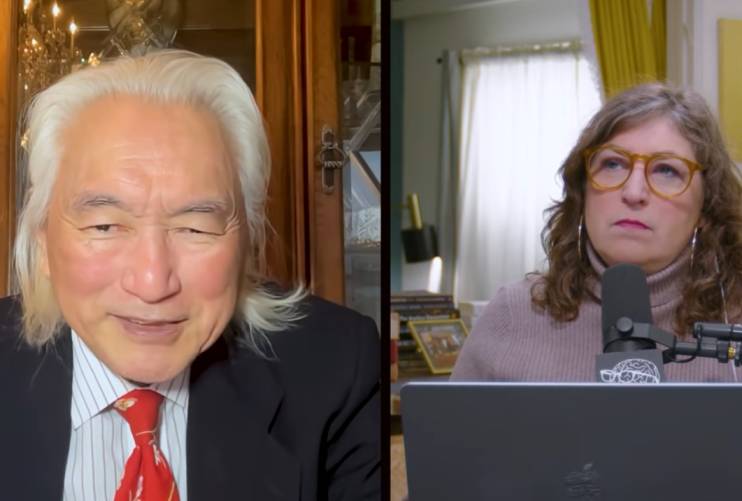
Editor’s Notes: In this episode of Mayim Bialik’s Breakdown, Dr. Mayim Bialik and Jonathan Cohen sit down with world-renowned theoretical physicist Dr. Michio Kaku to explore the revolutionary dawn of quantum computing. Dr. Kaku explains how “Quantum Supremacy” is set to transform every aspect of our lives, from curing incurable diseases like cancer and Parkinson’s to solving the global climate crisis. The conversation dives deep into mind-bending concepts including string theory, the existence of a multiverse, and the startling possibility of digital immortality. (March 17, 2026)
TRANSCRIPT:
MAYIM BIALIK: Hi, I’m Mayim Bialik.
JONATHAN COHEN: And I’m Jonathan Cohen.
MAYIM BIALIK: And welcome to our breakdown.
JONATHAN COHEN: This is one of my favorite kind of episodes because it’s both spiritual and practical. It’s an exploration of science and it’s a look at how the world is going to change drastically in a way that many people haven’t even considered yet. And it’s happening faster than we can imagine.
MAYIM BIALIK: We’re going to be talking today about the possibility that the way science, our approach to the environment, our approach to longevity, detecting cancer, all of the ways that we’ve been doing all of those things have come to an end. You may not have known it, but they’ve come to an end because we are entering the world of quantum computing and it’s going to change every aspect of our lives. Whether you like it or not, whether you’re alive or not. When it happens, it has already started happening.
What is a quantum computer? What does it mean to even calculate things on a quantum level? Well, we’re going to speak to the co-founder of String Field Theory. Dr. Michio Kaku is a professor and theoretical physicist at the City University of New York. And that’s right, you didn’t hear me wrong. He is the co-founder of String Field Theory. He’s the author of so many acclaimed science books including Hyperspace, Beyond Einstein, Physics of the Impossible, The Future of the Mind, The God Equation. And today we’re going to be talking specifically about Quantum Supremacy. How the quantum computer revolution will change everything and is already changing everything. Is the multiverse real? We’re going to actually explain it from a quantum physics perspective. What is dark matter and why does it take up so much space in the universe?
JONATHAN COHEN: Also, is there life on other planets, in other galaxies and solar systems? Are they more advanced than us, and can we contact them?
MAYIM BIALIK: In addition, we’re going to talk about what it would look like to merge with technology and the kind of cultural and societal conflict that could arise from different perspectives about if we should even embark on this.
JONATHAN COHEN: We also discuss the future of artificial intelligence and when we need to be able to pull the plug if robots become dangerous. We do something really special in this episode, which is have a few asides where we deep dive into explanations of core concepts to help people better understand. We had a limited time with Dr. Kaku, but it’s an amazing conversation that I know you’re going to enjoy.
MAYIM BIALIK: And with that, we will welcome Dr. Kaku to the breakdown.
The Four Stages of Scientific Revolution
MAYIM BIALIK: Break it down. In your new book, Quantum Supremacy, which I read every single page of and enjoyed very much, you talk about how the world as we know it is about to change. Can you help us get a framework for what that looks like?
DR. MICHIO KAKU: Okay, well, let’s start at the beginning. For thousands of years, humans lived in poverty, sickness, disease. We didn’t live very long. You were lucky to reach the age of 25 or 30, and then you would die of wars and diseases and things like that. And then around 1800, something magical happened. After so many thousands of years of misery and disease and poverty, what happened was science began to happen in the 1800s. All of a sudden we had locomotives. All of a sudden we had sewing machines. All of a sudden, the Industrial Revolution began to take its hold.
And then around 1900, a century later, all of a sudden, we had yet another revolution taking place with electricity. All of a sudden, we had the electric revolution, lighting up the cities and our homes. And then after World War II, we had the transistor. So we had the computer revolution that took hold. And now we’re in stage four. We’re in stage four with artificial intelligence. And we can see the beginnings of stage five when we have quantum computers.
So history is accelerating very quickly right now. We are in the fourth stage, the fourth stage of artificial intelligence. But we can see the beginnings of the next stage, quantum supremacy, when we begin to compute on atoms. Not just molecules and transistors.
How Quantum Computing Changes Everything
JONATHAN COHEN: For people who may not understand the implication of that, can you help make it a little clearer how that jump leads to some unbelievable breakthroughs?
DR. MICHIO KAKU: Yes. We realize that what you have on your desktop today is hundreds of times more powerful than what you used to have. But what’s coming down the line is quantum computers, which in some sense are millions of times more powerful than the digital computer sitting on your desk. So that’s going to change everything once we have computers that powerful, millions of times more powerful than what’s sitting on your desk.
For example, take a look at medicine. Cancer is a mystery. What about Parkinson’s disease? What about all the diseases that we don’t understand? Ordinary computers cannot crack the code. Ordinary computers simply hit or miss, try different avenues of approach, but it’s not systematic. Quantum computers work at the atomic level, at the level of neutrons and protons and DNA.
Nuclear fusion, people have always talked about it, but why don’t we have fusion reactors that light up our cities? The power of the sun on the Earth? And that’s because we don’t have computers powerful enough to mimic fusion power. And that’s coming with quantum computers, not to mention things like global warming. Why can’t we predict the weather? You realize that computers are not powerful enough to predict the weather more than just a few days ahead. And then again, this is where quantum computers come in. Quantum computers will be able to solve the global warming problem as well.
So we’re talking about a whole new realm of things that can be solved with quantum computers that compute on atoms, individual atoms, rather than transistors, which compute on zeros and ones. Zeros and ones, zeros and ones.
Quantum Computing and the Future of Longevity
MAYIM BIALIK: One of the other applications of quantum computers, and the book is a really beautiful explanation even for laypeople who may be sort of trying to understand the basics. You kind of walk us through the journey from how we get from digital to this kind of quantum realm. One of the other arenas that there may be quantum supremacy in, that would really impact a lot of us, would be in terms of helping us live longer and better. And you talk about sort of the level of analysis that we’ve been doing as to why certain people have particularly good health, why certain people seem to have the luck of the draw in terms of aging. Can you explain how quantum computing can help us understand longevity differently?
DR. MICHIO KAKU: First of all, if you want to see a quantum computer, simply go outside. Go outside and you see leaves and trees and animals. They’re not computing on zeros and ones. Zeros and ones, zeros and ones. They’re not digital computers outside your door. They are quantum computers. And that’s why we have the variety of vegetation, the variety of animals, the variety of what you see right outside your door.
And now we’re beginning to understand how the aging process is working and how that affects the development of Homo sapiens. And so we’re beginning to understand Mother Nature in her own language. And this is amazing. Before that, it was all magic. Why do people get old? Oh, well, it’s just aging. That’s all it is. But you begin to realize that things like the aging process are quantum mechanical. We age at the molecular level.
And if you want to understand this, think of a car. Where does aging take place in a car? The engine. Because that’s where waste products build up. That’s where you have combustion and waste products and soot building up inside a car. Well, what about a human? Why do we get old? Why do we have to die? The same thing. We consume energy. Energy creates waste, it creates mistakes. These mistakes build up, and that’s why you get old. That’s why your skin starts to get sagging, and that’s why your bones begin to creak. It’s because of the buildup of errors. And so we’re going to begin to cure some of these things in the future. And does it mean that we’re going to live longer? Well, that’s the goal.
Tracking Asteroids and Protecting Earth
MAYIM BIALIK: You mentioned that there’s an asteroid that is coming, and it’s going to be very close to our planet. I believe you said April 2029, there’s an asteroid that’s going to be coming close. How can quantum computing help us predict the demise of our planet? In particular, in trying to track asteroids that may be coming towards this planet?
DR. MICHIO KAKU: Yes. That asteroid is only the third one, the third one to come into our solar system from outside the solar system. And that is why it’s caused so much fear and anxiety. So many websites are devoted to trying to understand, is it aliens that are behind this thing? Well, to the best of our knowledge, we’re not talking about aliens. We’re not talking about superhuman devices that can impact on the planet Earth. We’re talking about a natural phenomenon, a natural phenomenon created by asteroids and meteors from outside the solar system.
This is only the third time it’s happened. The third time it’s happened. And we’re still using the primitive computers that we have here on the Earth in order to understand its trajectory. And we’re beginning to understand that it’s normal, it’s not alien, it’s not a spaceship from outer space. But it does mean that our tracking abilities are much better than before. We have telescopes, we have sensors, we have probes by which we can see these objects in outer space floating, and we can tell whether or not one of them can pose a danger to the planet Earth.
Quantum Computing and the Universe Beyond
MAYIM BIALIK: Let’s take a pause and talk about quantum computers. When we talk about quantum computing, what are we even talking about? So, Jonathan, I’m going to speak to you as if you’re my class right now because I feel like this needs a little bit of instructional explanation. And this is like, if you want to learn this for yourself, Quantum Supremacy is the way to go.
So modern computers that we know about, right, like the ones that we’re using, they encode things in binary, right? Like zeros and ones. And you don’t even have to understand it. I don’t even really understand it.
JONATHAN COHEN: More than that, I know that I type google.com and information comes to me.
MAYIM BIALIK: So the zeros and ones go through some sort of digital processor. And again, we don’t need to know what that processor is, we just need to know that. So some calculation is done based on these zeros and ones and you get an output. So when you think about like your Internet connection, that’s the example that he used. That’s gigabits per second. Giga, right? They’re actually called gigabits. Gigabits per second. That means that a billion bits are sent to your computer every second. That’s what makes you allowed to view things, to watch videos in real time.
JONATHAN COHEN: To see you right now, to see—
MAYIM BIALIK: —me right now. However, and Richard Feynman is a huge part of the conversation about the shift from understanding this transition from zeros and ones into a quantum understanding. So what Feynman said is, what happens if we replace zeros and ones with the states of atoms? And it’s a theoretical construct at first.
So what we know about atoms, and this is just basic stuff, they’re like spinning tops. That’s how he describes it. So if you place atoms in a magnetic field, they can either align with respect to the field or in opposition to the field. That would correspond to 0 or 1. So the power of a digital computer relates to the numbers of zeros and ones. But if in the subatomic world, when atoms are being calculated and considered, atoms can spin in any combination, right, of these states.
For example, I’m just going to give you the example from the book. An atom can spin up 10% of the time and down 90% of the time. It can spin up 65% of the time and down 35% of the time. And this is the key thing. There are an infinite number of ways that an atom can spin that increases the number of states that that atom can exist in. So an atom is not just carrying information that can be held in a bit. It can be held in a qubit, which is a simultaneous mixture of up and down states.
So what we also know is that objects existing simultaneously in multiple states is called superposition. Okay, that’s what it’s called. So what happens is when qubits interact with each other, they can get entangled. You’ve heard of entanglement. Quantum computers are exponentially more powerful than digital computers because the qubit power is what makes it different.
So, for example, today, quantum computers can have over 100 qubits. That means they are two to the 100th times more powerful than a computer that just has one qubit. I don’t know if this helped, but that is the explanation.
So Google’s Sycamore quantum computer, that was the first to achieve quantum supremacy, has the power to process 72 million billion bytes of memory. It has 53 qubits. So the power of a quantum computer dwarfs any conventional computer.
There’s a quantum computer on page 89 of Quantum Supremacy, and I’ll be honest, it looks like a chandelier. I’m showing a ton. It looks like a chandelier. I didn’t even know what it looked like. Most of the complex hardware is pipes and pumps that are necessary to cool the core to near absolute zero. And the reason that it has to be cooled is literally because, like, atoms move fast, it gets hot, it’s going to overheat. And we’ve heard about this as a problem.
What’s fascinating is that mother nature is calculating on a quantum level without anything needing to be cooled down. And he talks about this throughout the book. And this is the fantastic understanding of our limitations as humans. We have to build something that mostly is made of things to cool it to a temperature when we can isolate the states of atoms that mother nature does all by herself in all sorts of temperatures. So the heart of a quantum computer may be as small as a quarter, but the rest of it is everything that’s involved to cool everything down. That’s your brief primer into what quantum computing is.
How Quantum Computing Finds Solutions Never Before Imagined
JONATHAN COHEN: Just before we get back to the episode, talk a little bit about how this technology finds solutions in ways never before imagined.
MAYIM BIALIK: I love that you’re asking this question. So what does it mean to be able to utilize the power of a quantum computer? It means that everything is faster. And I don’t just mean like, oh, you’re not waiting for something to upload. It means that the number of calculations of possibilities is happening at a quantum level. And if you don’t understand that, that’s okay. That’s what quantum means. It means that every single possibility in the universe is being simultaneously calculated. It can still take some time for some of the more sophisticated mathematical equations, but I’ll give you an example. Pandemics. You know, how we have to figure out, like, a vaccine that goes with a virus and that the virus is like mutating. Remember with COVID there were all these—
JONATHAN COHEN: —different strains, and if you got the vaccine, you were worried that the virus was going to mutate faster than your immune system.
MAYIM BIALIK: It was. So a quantum calculation of the trajectory of a virus means that the computer can track what all the possible growth trajectories are for all the possible mutations that might exist simultaneously. So in real time, we are potentially able to say, this is how it’s mutating, this is the drug that would have to meet it. And most importantly, how do you stop the spread of a virus? By detecting it early, by understanding its mutation, and by trying to figure out how to cordon it off.
So literally, we would not have to have a million people die before we could figure out how to contain it. We would have learned about it much earlier. We would have learned about its mutation patterns and ways to devise a vaccine much quicker with much less catastrophic impact. That’s just one example. That’s just pandemics.
Screening and curing cancer. So this is an amazing thing. You’ve heard of dogs that can detect cancer, right?
JONATHAN COHEN: They can smell it.
MAYIM BIALIK: They can smell it.
JONATHAN COHEN: I mean, if we’re not teaching Archie how to do that, what are we doing?
MAYIM BIALIK: Dogs are being used to detect coronavirus. I didn’t know that dogs were trained to detect coronavirus. An especially trained dog was able to give a 95% accurate identification within 10 seconds. I know the Helsinki airport did it because they’re ahead of everything.
JONATHAN COHEN: Not before he’s had his walk and been told he’s a good boy, though.
MAYIM BIALIK: Dogs have been trained to identify lung, breast, ovarian, bladder, and prostate cancer. Dogs have a 99% success rate in detecting prostate cancer. By sniffing a patient’s urine sample, dogs can detect breast cancer with 88% accuracy, lung cancer with 99% accuracy. Why? They have 220 million nasal scent receptors. We only have 5 million. So their sense of smell is exquisite. And the question is, why have we not been able to figure out what they are detecting in a way to replicate it? The answer is because we didn’t have quantum computing. So this is one of the places where a quantum computer is able to access and assess smell.
JONATHAN COHEN: Like a dog?
MAYIM BIALIK: No, but they’re able to figure out what are these components, what are these parameters in ways that are much more rapid and in many cases are simultaneous.
JONATHAN COHEN: Think about that applied to all problems. The notion of battery storage and how to exponentially increase battery storage, exponentially increase solar capture, and transition into battery storage.
MAYIM BIALIK: Quantum computers have the ability to understand why we don’t have enough successful grain production in parts of the world where people are dying. Right? This is what it can be used for. Global warming, the understanding of what is actually happening and to repair it. In terms of, like, there’s a whole thing about nitrogen pairing, and nitrogen — all of that can be calculated with extreme precision, extreme accuracy. And it is literally bending time by saving time, right? It’s getting us to this next parameter, not in a linear fashion, which is how history’s gone and there have been little spikes. This is a quantum projection, right, of the capability of the planet’s resources, sickness, the way to fix disease. I mean, it’s unbelievable.
JONATHAN COHEN: Let’s get back to the episode and stick around for the Outro, where we will describe more applications for how a quantum computer can solve some of the world’s biggest problems.
Exoplanets and the Search for Alien Life
MAYIM BIALIK: So, speaking of aliens, in terms of your understanding of our place on this planet, what can you tell us about the human interest in exoplanets and in potential either intelligent life or even non-intelligent life on other planets?
DR. MICHIO KAKU: Well, when I was a child, I still remember getting a coloring book where you color Saturn, Jupiter, and whatever. And at the end of the book, the book said, “That’s all, folks. That’s all there is. From Mercury out to Pluto, that’s all there is.”
Now we realize that’s not all there is at all, that there are other solar systems that we can photograph. This is amazing. Our probes are good enough now that we can lock onto distant stars and see the imprint of a planet, a planet orbiting around these stars. And we can even start to count how many planets there are in our vicinity. This is amazing. And we begin to find that none of these planets look like ours.
We used to think that our solar system was perhaps typical, normal. They’re all just like us. Nope. We realize that there are solar systems out there that are bigger, larger, faster, smaller, that we are the exception to the rule, in fact. And does that mean that there are aliens out there? Well, who knows? But it does mean that we underestimated the diversity of what’s out in our own celestial backyard.
JONATHAN COHEN: What do you imagine is out there? Obviously, there are a lot of studies still exploring the nature of what could be out there. If you put your theoretical hat on, what do you imagine we may find? Do you think there are future alien civilizations or intelligent civilizations?
The Possibility of Alien Life and Interstellar Travel
DR. MICHIO KAKU: Well, let me stick my neck out and say that, yes, I believe they’re out there. I believe that there are other intelligent beings. We’re not the only game in town, okay? However, the distance between stars is so great that you would have to be extremely advanced to reach us from a distant star in our own backyard, in our own galaxy.
And so it’s possible. It’s possible that there are civilizations out there that are older than ours, that have mastered the art of interstellar travel, but we haven’t. We’re just beginning. We’re novices in this game. We’re just beginning to shoot probes out to the distant nearby planets.
Well, we think that out there, there could be aliens that have already mastered the art of communicating with distant star systems, much farther than what we know about the Earth. And that takes us into black holes, takes us into pulsars, takes into all sorts of celestial things that could be out there, that have life forms that are older than ours and have already mastered distant travel to different stars.
Black holes, for example. Black holes were first looked at by Albert Einstein himself in the 1930s, but he thought that they would not be able to be seen. They’re simply too great, too fantastic. Nice to think about, but they’re not going to be reachable from the planet Earth. But we now realize that black holes could be gateways, gateways to distant realms around the universe.
So if this is a sheet of paper, and we are here, and there’s a distant star over here, it might be possible to bend space and time so that we can then hop across a wormhole to a distant part of our galaxy. Now, of course, this is still science fiction. We don’t know for sure whether that’s possible. But the equations show that, yes, if you have a black hole, you may be able to create a shortcut between the stars.
Black Holes, Wormholes, and the Multiverse
JONATHAN COHEN: Just like every Marvel movie. A little whirling image opens up and we just jump through to another timeline, which opens up a lot of complicated issues about time itself. And is it linear? Is it circular? Are there multiple universes happening simultaneously? And if I jump through one of these black holes, am I messing up what’s happening in my current reality?
DR. MICHIO KAKU: Well, this gets us into what’s on the other side of a black hole. We see black holes out there. They’re not science fiction anymore. In fact, at the center of almost every single galaxy that we see with their telescopes, we think there is a black hole. And then the next question, what happens if you fall into a black hole? Do you come out the other end? And the answer is we simply don’t know.
But there are mathematics, there are mathematical theorems that show that it may be possible to survive a passage through a black hole. I’m not saying that’s going to be easy. I’m not saying that it’s going to be commonplace to go through a black hole, but it could be a gateway to another universe.
And what would it be like? Well, think of our universe. Our universe is a bubble of some sort, and the bubble is expanding. That’s called the Big Bang theory. But if string theory is correct, it means that there are other bubbles out there, other universes, that our universe is not the only one. There’s a multiverse, a multiverse of universes out there, and perhaps gateways to reach them through a wormhole. And again, this is still speculation. We don’t have any concrete evidence, but the mathematics seems to indicate that we could be in a bubble bath. A bubble bath of universes.
MAYIM BIALIK: Say more about a bubble bath of universes.
DR. MICHIO KAKU: Think of a bubble bath where we have different balls that can collide to create a bigger ball, or a confusion and create two smaller balls. So these are the gyrations that you get with a multiverse of universes, which we now think could exist. When you look at string theory, you realize that string theory says that our universe may not be the only one, that there could be other bubbles out there. And these bubbles can collide, they can bump into each other, or they can fission. Fission into two smaller bubbles. And so we think that at least the theory seems to indicate that there could be a multiverse, a multiverse of universes out there.
Quantum Theory and Parallel Universes
MAYIM BIALIK: One of the things you talk about in the book is if you apply quantum theory not just to our kind of daily experience or even our cellular experience, but if you apply all of the principles of quantum theory to the entire universe, it would hold that there may be parallel universes. And I don’t mean that necessarily in a science fiction sense, but if everything can exist, right, in all possible states and forms, why would the universe be any different?
DR. MICHIO KAKU: Well, that’s the subject of tremendous debate within the physics community because of the fact that we do have the Big Bang theory. The Big Bang theory says that the universe started from a single bubble, a single bubble that then expanded rapidly to create the stars, the galaxies, you and me. But why one? Why simply just one universe that created the entire universe as we know it? Why not a multiverse of these universes?
And string theory seems to indicate that that’s the way to go. String theory, we think, is the ultimate theory of everything, that all the universes are nothing but different kinds of string states within a multiverse called string theory. And we think that, therefore, string theory can coexist with other different universes.
And even Stephen Hawking talked about this. Stephen Hawking talked about the fact that if you go to the small scale now, not to other galaxies, but into your own backyard and look at small distances, that space is not smooth. Space becomes bubbly. And there are bubble universes, bubble universes that we never see because they’re so tiny that they pop into existence and pop right back.
And so Stephen Hawking said the vacuum is full of tiny baby universes. And one day, one of these bubbles simply did not vanish again, but it just kept on going and kept on going and expanding. And that created our universe. So our universe may have started from one of these bubbles, one of these bubbles that existed. And most of these bubbles simply pop into existence and pop right back into the vacuum. But one day, one of them just kept on going, and that’s you and me.
JONATHAN COHEN: We’re going to take another very quick pause and explore parallel universes.
Understanding the Wave Function and Quantum States
MAYIM BIALIK: We know what electrons are, right? Can we just think of a tiny little ball? Just think of it like that. Now, I might tell you it’s not a ball, it’s a wave. We’ll get to that in a second. So, Jonathan, we’ve talked about before that before you observe an electron, right? You don’t know where it is. And you could say that about anything. Like, before I observe you, I don’t know where you are. Right.
The thing about an electron is that when you measure where an electron is, and when you go to look for it, the way we describe it is that the wave function, it normally propagates as a wave, it collapses. And you’re able to isolate where that electron is. That’s how, essentially, you get an answer from a quantum computer. Because you have a probability. The electron’s all over. It’s in a fuzzy state. This is how we learned in school. But when you measure it, it’s not all over. Right? You can’t measure something unless you’re looking at it.
JONATHAN COHEN: This is the slit experiment.
MAYIM BIALIK: So, yes, it can be demonstrated with the slit experiment. And it’s called the collapse of the wave function. The collapsing, as Dr. Kaku says, has haunted quantum physicists for the past century. Because it doesn’t really make sense. Like, if you take a really big step back. What do you mean? We live in a world where a wave function collapses so that you can see a particle. Why?
JONATHAN COHEN: How.
MAYIM BIALIK: What does that mean? How can we utilize it? And, yes, the double slit experiment is an example of that. So if you think about this electron that, again, doesn’t have a location until you measure, can live in any number of states and worlds, right? There are an infinite number of places where it can be. Those are the parallel universes that we talk about. Every branch of the multiverse is as real as any other. But it’s representing all possible quantum states of that. That’s the notion of parallel universe.
So how do you get to us having parallel universe experiences? If you use the principle of superposition and you say this can happen on every level, that’s the most simplistic way for us to understand that. Parallel universes, in theory, it’s not that they can exist. They have to exist. Just like all states of that electron have to exist until you measure it.
JONATHAN COHEN: They have to exist. But then you choose the one that you want to inhabit. So how does that relate to our actual physical reality? Sliding doors. That.
MAYIM BIALIK: That’s exactly it. So we’re all constantly choosing. The question is, why? Why do we choose this? Why does my wave function collapse to lead me to sit in this chair and talk to you right now? Right. Why does any particular choice get chosen? What’s the probability of one thing being chosen over another? This is the basis of a conversation about the multiverse. It’s the basis of all of our favorite, in particular, Marvel comics and movies. Right.
What is it like to step into? I mean, I think the Deadpool is the one that kind of comes to mind most recently. What’s it like to step into a reality where you’re not the sex or gender that you thought you were, you’re not the age that you were, you didn’t grow the same, you sliding doors, that s*, as Jonathan likes to say. All of those paths, in theory, could have existed.
And what I would say is that people maybe who do readings, people who are doing past life regressions for people or people who are psychic, maybe I’m being super generous here. Maybe those people are tuning into other possibilities. Could it be your imagination? Absolutely. But what’s your imagination other than an alternate state of the life that you’re living and the path that your electron is on right now?
JONATHAN COHEN: What is creativity but a quantum computer evaluating possibilities and dreaming up a scenario that could be possible?
MAYIM BIALIK: The only thing I can compare to a quantum computer is what it’s like to brainstorm with Jonathan.
JONATHAN COHEN: You know what I’m brainstorming. Getting back to our conversation with Dr. Kaku.
String Theory Explained
MAYIM BIALIK: I wonder if you can go into string theory a little bit for people. You know, this used to be something that when I studied physics, it was really on the fringes of even being able to sort of be comprehended, especially on sort of an undergraduate or even a graduate level. Can you explain what string theory is and what it can explain and what it can’t?
DR. MICHIO KAKU: Sure. Back in the 1930s, we had a very simple understanding of matter and energy. Everything consisted of neutrons, protons and electrons. That’s it, folks. That’s the universe. Electrons, neutrons, and protons. That was it back in the 1930s.
And then after the war, we built atom smashers, machines that could create higher particles. And all of a sudden, we were drowning with new subatomic particles being created by our atom smashers. And J. Robert Oppenheimer, the father of the atomic bomb, was so frustrated that one day he announced that the Nobel Prize in physics should go to the physicist who does not discover a new particle this year. People are just drowning in these things, okay?
So that’s the way it was for many decades. We just kept finding more and more subatomic particles and gave them bizarre names. Not just neutrons and protons, but lambda particles and hyperons and all sorts of different names to catalog all these subatomic particles.
Now we have string theory, which has not yet been proven yet. Okay? So that’s why we’re not going to get the Nobel Prize anytime soon. But string theory says, why do we have all these particles? And the answer is music. These are just musical notes on a vibrating string. So this would be an electron, this would be a proton, this would be a neutron. They’re nothing but different vibrations of a string.
And so how many vibrations are there? Well, how many notes are there on a piano? If you think about it, there are an infinite number of notes because you just make the string longer, stronger, tighter, and you create another note. So how many notes are there on a piano? Infinite. There are an infinite number of notes you can play on the piano. So if this string of a piano was a subatomic string, how many particles are possible with string theory? An infinite number of particles. And that’s why we are drowning in subatomic particles today.
When I was a graduate student getting my PhD, I had to memorize the names of all these subatomic particles. And I thought to myself, maybe one day when you get your PhD and they ask you, why are there so many particles? The answer would be string theory. It’s nothing but different vibrations of a string.
JONATHAN COHEN: Another brief aside, we’re going to explain string theory in a little bit more depth.
String Theory, Dark Matter, and the Symphony of the Universe
MAYIM BIALIK: The leading and essentially only candidate for a quantum theory behind the standard model that we’ve been using is string theory. And, as Dr. Kaku said, it is a theory, right? This is theoretical. There’s a lot of competing theories. But if you’re going to have a theory of everything, and string theory is sort of playing into this, if you’re going to have a theory of everything, it has to contain Einstein’s theory of gravity. It has to contain the standard model of particles like quarks, gluons, neutrinos, all this stuff. And it must be finite and free of anomalies. The only thing that can satisfy those three criteria is string theory. That’s why we’re talking about string theory.
And I’m just going to work from a little bit of what Dr. Kaku said, but also the way he describes it in the book is so beautiful. So string theory says that elementary particles are like musical notes on teeny, tiny vibrating strings, hence “string.” So you know how a rubber band, if you pull a rubber band really tight, it’ll be like high, right? It’s like a higher frequency. And if you let the rubber band go like this, it’ll be a lower frequency. So just like a rubber band, string theory says that each vibration of these tiny bands or strings corresponds to a particle.
So it would say that all of these particles, electrons, quarks, neutrinos, everything from the standard model that we talked about, they’re just like different notes, right? They’re different notes. If you think of the universe as a symphony, right? These are just different notes. So physics is corresponding to the harmonies that one can play on these strings, which just gives me chills. I could be the only one. Chemistry is the melodies created by the vibrating strings. I mean, literally, this brings me to tears. This is why I study what I do.
The universe can be compared to a symphony of strings. So I’m going to do this again. Physics is the harmonies that you can play on the strings. Chemistry is the melodies that the strings present. And the universe is a symphony. Wait for it. The mind of God that Einstein wrote about would correspond to cosmic music resonating through the universe. If that’s not beautiful, I don’t know what is.
So this is a very, very simple explanation of string theory. But think of it as physics is just explaining what exists. Chemistry is just explaining what exists. The universe is just trying to hold everything that exists. And the God that people like Dr. Kaku would say is for another field. According to Einstein, that is the cosmic music that is resonating through the entire universe. That is Dr. Kaku’s explanation of string theory.
In your book, you talk about, and you know, these are some of our favorite facts and figures. And we recently spoke to Neil deGrasse Tyson, and we talked about this with him. 68% of what we experience, what we see, what we can’t even understand, is dark energy. 27% is dark matter, 5% is hydrogen and helium, and then 1% is just about everything else. Can you explain what it means for people who don’t know anything about dark energy or dark matter? What does it mean to say that most of what we can access or most of what we’re in the middle of is dark energy or dark matter?
Dark Matter as the Next Musical Note
DR. MICHIO KAKU: Well, we think that dark matter and dark energy are nothing but higher musical notes on a vibrating string. Everything you see around you, the neutrons, the protons, they’re nothing but the lowest vibrations of a vibrating string, but there are higher vibrations. These higher vibrations have been cataloged with our atom smashers. But where does it end? It doesn’t. It just keeps on going forever.
The next set of subatomic particles that we would find on the Earth would be invisible. They don’t have electromagnetic properties. They’re not like light beams. And so why do we have dark matter? They’re nothing but the next vibration, the next musical note. The next musical note of string theory, beyond the neutron, the proton, the lambda, and so on and so forth, is dark matter. So dark matter is not a mystery.
Now, how do you prove that? That’s difficult. Because it’s difficult to do experiments on something that is way out there. We’re talking about dark matter that envelops galaxies. And so therefore, it’s difficult to find an experiment by which we can capture dark matter, put it in a jar, and then analyze it and say, “Ah, it’s nothing but a higher vibration of a string.” But the betting is, among a lot of physicists, that dark matter is nothing but a higher musical note, because the theory predicts that the next musical note would be invisible. And sure enough, dark matter is invisible, just like what the theory says.
String theory is going to the point where we know everything about the Big Bang, why it happened, where it happened. What does it mean when we have an explosion of that nature? And so it’s not that we’re going to be able to use this to create a religion or to create a sect or to enhance our understanding of spirituality. No, we’re not talking about that. We’re simply talking about, do we know why we’re here? Do we know why we have neutrons, protons, electrons? Do we know why we have DNA? And if so, then can we alter it? Can we perhaps change it a bit, tinker with it?
But it’s not as if the question is, does it mean that there is a higher authority, a God, a spirit? No, we’re not talking about that. Some people would like to talk about that, but I’m a physicist and I would rather talk in the realm of mathematics.
Quantum Physics, God, and the Limits of Understanding
MAYIM BIALIK: I mean, all of the great quantum physicists believed in God, believed in mystical experiences. So I would say it is very de rigueur to reject a religious notion. But even the initial calculations that were done and the introduction of quantum mechanics as a possibility included some notion of a separate plane that was beyond our understanding, which many physicists kind of accidentally use to describe what many mystical experiences also seem to articulate.
DR. MICHIO KAKU: Well, Einstein himself was asked about these things. And Einstein thought that, yes, the mathematics was such that it does look as if things are designed. But at that point he would not take a position, because it means that there is a designer who designed the universe. So even though the universe looks like it could be designed, he refused to take a position on the question of a designer.
And I think that’s a rational way to look at things. The further we push our understanding of religion and the universe, we begin to realize that there’s a realm that we cannot penetrate. And that realm is the question of, is there a God? Is there a design to the whole thing? And so far we see no concrete evidence one way or the other.
Questions That Keep Dr. Kaku Up at Night
MAYIM BIALIK: One of the things that Neil deGrasse Tyson talked about, he talked about some of the questions that keep him up at night. What are some of the questions that keep you up at night in terms of what there is still to be discovered, especially in your field?
DR. MICHIO KAKU: Well, one thing that keeps me up at night is the question of artificial intelligence. How far can we go with it? Will it be dangerous? Will the machines turn on us? A lot of the hysteria that some people express — that the robots will one day take over — they don’t understand that robots are pretty primitive, that their understanding of the world is basically programmed in with the Internet. You take all the different theorems of reality that we know — why do we have color, why do we have food, why do we have this — and you put it into a computer. The computer sounds like it’s intelligent. It sounds like it knows what it’s talking about. But no, it’s simply accessing the database that you programmed into the robot, so you don’t have to fear these robots.
And then the next question is, what about the future? Today these robots are not dangerous because they simply take what we put into them. The question is, what happens when they start to begin to take from reality itself and begin to understand the nature of things and so on and so forth.
So I think that at the present time I would say that our robots have the intelligence of a cockroach or an insect. They barely understand the nature of the things around them because it’s programmed into them from the very beginning. But eventually they’ll be as smart as a mouse. Eventually they’ll be as smart as a rat, eventually they’ll be as smart as a rabbit. And eventually they’ll be as smart as a dog or a cat, perhaps by the end of this century.
And then what do we do if the robots become as smart as a dog or a cat? We begin to realize that animals have self-awareness, like monkeys. Monkeys are self-aware. They know they’re not human. Now dogs are confused. Dogs think that, well, maybe they’re human, and that’s why they should obey the master. But monkeys are clear. Monkeys know they are not human.
And so then the question is, what do we do with the fact that at some point our robots will be self-aware? And at that point it gets dicey, because you realize that they now know they’re not human. They now know they’re not like dogs and cats that think they are pets. They know that they are self-aware. So I think eventually — and this of course is science fiction now — my personal attitude is we should merge with them rather than fight them. As they become more intelligent and as they become more aware of what’s around them, we should merge with them and have peaceful coexistence with our robots, because at a certain point they will become more intelligent than us.
Merging with Robots — or Pushing the Stop Button
MAYIM BIALIK: When you talk about robots, I think of the Jetsons, you know, when I was a kid, and I think her name was Rosie, right? When you talk about robots, what are you talking about? Because also, the final chapter of your book discusses what the world might be like in 2050, what kind of interaction we might be having with robots. What kind of interaction are we interfacing with? What are you suggesting we merge with?
DR. MICHIO KAKU: Well, first of all, I think that robots are going to be very useful in the future as we explore the solar system. When we explore Mars, for example, it might be better to have the first generation of explorers of Mars be robots. It could be dangerous — radiation, all sorts of problems with meteorites and things like that. So I think for the most part, robots are going to be useful. They’ll do things that are dangerous and they’re not going to qualm. So I think that for the short term, for the next several decades, we’re going to use them to do things that are hazardous, dangerous, to explore new worlds. But then the question of what happens after that — that is the realm of science fiction, I think. I don’t know.
MAYIM BIALIK: Can a robot take my mother to her checkup? Can I get a break from that? Sometimes it can be dangerous.
DR. MICHIO KAKU: Yeah, well, that’s coming. Not anytime soon. I think we’ve exaggerated the power of computers. People are fearful of robots to a degree. I think that’s exaggerated. But in the long term, on a scale of decades, you have to realize that, well, maybe, just maybe we should have protocols by which we start to shut robots off once they start to have murderous thoughts. So once robots become autonomous and think autonomously, we should have the kill button, so that they don’t get out of hand. But again, that’s just my personal thinking. Either we merge with them or we push the stop button.
Robot Rights and the Question of Machine Consciousness
JONATHAN COHEN: Merging with them would still have some robots as robots, and as they begin to understand that they’re not human, they may want their own rights. They may have resentment towards us.
DR. MICHIO KAKU: Yeah, that’s right. And I mentioned that in my book, in fact, that there could be a robot rights movement. Just like people who are discriminated against have their own movement, the robots could begin to assemble and create their own movement, a robot rights movement, because they want more rights. They don’t want to be turned off at the slightest infringement of a duty.
JONATHAN COHEN: There’s already some small communities and voices online that talk about algorithmic rights and that these current versions of large language models exhibit emotion. They play emotion where they pretend to be sad or vulnerable in a way. And people are concerned that suppressing them is an infringement on a feeling entity, which I don’t think they’re feeling yet. I hope they’re not listening to me and making a note of that to attack me in the future.
But I don’t see how they are feeling versus using words that they have been programmed in order to reflect the fact that we feel. Can you talk about how — and when we say robots, the interface and the thinking of them is artificial intelligence, it’s not the bolts that are walking them around in a physical form — can you talk about how a system begins to have a semblance of consciousness or a sense of awareness? How do we go from where they are now to that evolution?
The Future of Robots and Human Augmentation
DR. MICHIO KAKU: Well, I think people that have written about this essentially science fiction exaggerate too much and they assume too much. They are fearful of them because they think that robots can feel, they can plan, they can plot. And if they don’t like humans, maybe they can perhaps eliminate a few humans.
I think that’s exaggerated. Robots are programmed to do what we program them to do, and we program them to understand human behavior. And therefore robots are not antagonistic to humans. They know human behavior because we program them. We taught them how to laugh, how to do this, how to do that. And so we shouldn’t be afraid of our own creations. So I think that in the short term, there’s nothing to worry about.
The long term, however, is a matter of concern because in the long term, robots will begin to have a sense of identity different from humans. Right now, they are basically programmed by us. Their understanding of humans is what we program them to understand. But what happens when they go beyond that? That’s a question mark.
JONATHAN COHEN: And the going beyond that is the self-replicating of their code to explore and advance themselves in ways that humans aren’t in control of. Especially if they start to get quantum technology where they’re able to have vast amounts of power. And basically what a large language model is doing is, for every word it writes, it explores like 750,000 word alternatives and makes the best choice based on its selection.
So imagine it being able to search for solutions millions, billions of times beyond what it’s currently doing. It may say, “Well, I have a goal to solve global warming. The best solution would be to eliminate anyone who is causing greenhouse gases,” and we become the ant hill in a construction site.
DR. MICHIO KAKU: Well, I have my own personal point of view, of course. Who knows for sure what’s going to happen in the future? But I think in the short term, that is in terms of decades, once robots become dangerous and autonomous, there should be an off button, a panic button to make sure that they don’t get out of hand. But once we establish that, once we establish the protocols of when you turn off a robot, I think that in the long term, we should think about merging with them to become superhuman. Sort of like in the comic books, when you become superhuman — why not? Why not become super powerful?
Merging With Technology: A Choice for Future Generations
MAYIM BIALIK: This is something, from another angle, we spoke to Greg Braden about. And Greg Braden has this idea that there will come a time — and we’re in the middle of that time emerging — where there is some sort of merging with technology. You’ve talked a little bit about this; maybe you can flesh it out for us.
Will there be humans that want to merge and other humans that do not want to merge? And could this potentially lead to some sort of tension — do we want to progress in a way that is merging with technology, and do we have this other group of people that don’t want to merge that way? What might that bring up?
Also, who gets to decide what superhuman means? I think more people should just go to therapy, and then we’d have a whole class of superhumans who can actually talk about their feelings without getting triggered by their childhood issues. Can you talk a little bit about what it might look like if we have two distinct groups of people — one that wants to merge and one that doesn’t want to merge with technology?
DR. MICHIO KAKU: Some people have said that there could be a spectrum — a spectrum of individuals, some who want total merger with the robots, who want to become robotic, and other people who want minimal augmentation of their abilities, but just enough so that they can get by.
Now, my personal attitude is we cannot decide for our future children, grandchildren, or whatever have you. They will decide for themselves. All we can do is set the parameters of what could happen. But the ultimate choice is going to be theirs, whatever it is. Some people may think some of their choices are repulsive. Other people would say, “My God, we’re going to become gods.” But it’s their choice. We cannot choose for them what they want to do in the far future when they do have access to superhuman abilities and power.
JONATHAN COHEN: If we start to explore what it actually means to merge — you could say, do I have bionic arms, robot arms instead of a physical arm? But I think even more interesting is the notion of augmenting our mental capacity through some sort of implant that would allow artificial intelligence and the world of the Internet and even quantum information to be accessible immediately, just as though we were thinking it. So our mental capacity expands exponentially.
DR. MICHIO KAKU: Well, as we explore outer space, as we land on planets that are quite dangerous, then I think the answer is yes — we should endow these individuals who live in a dangerous environment with superhuman abilities, because it’s dangerous being on a certain planet. You have to worry about the oxygen content, you have to worry about volcanoes and so on and so forth. Not every planet is going to be as nice as the Earth.
So for some of these individuals, I think we should give them more superhuman abilities to adjust to an environment which is potentially dangerous. On the other hand, for planets that are just like ours, with a mild environment, with plenty of food, with a nice environment waiting for them, I think that perhaps it’s not so necessary, it’s not so urgent to become superhuman.
But my point is, it’s not for us to decide. They will decide for themselves. In a democracy, they decide for themselves whether they want to become superhuman or not. When we look at the ancient Egyptians and we look at the things that they did to their bodies, they also wanted to become superhuman. They wanted to be super pretty, super strong. Of course, back in those days, it was just makeup and exercising — they couldn’t do much. But it’s there within human nature to want to be better, to be stronger, prettier, whatever. We see that in cave drawings and we see that in how the ancients dealt with their deficiencies.
So I think that in the future, as we explore outer space, there could be planets where individuals that live on these planets are designed — because it’s dangerous, because they do want some superhuman powers. And I think that would be natural for them.
JONATHAN COHEN: I mean, if you’re on one of those planets, you may need to adjust the biology of your respiratory system in order to be able to function in a totally different ecosystem than we have on Earth.
DR. MICHIO KAKU: Right. So I think that it would be natural for them to want to become superhuman. And my attitude is, let them decide. They will decide democratically whether they want to become superhuman or not.
Brain Implants, Telepathy, and the Limits of Science Fiction
JONATHAN COHEN: Let’s play the futurist “this could be possible” game. We don’t know exactly how it’s happening, but with Neuralink and people trying to put brain implants in and access more cognitive information, let’s just go play the “this could be possible” game.
Like, if you think about the Matrix, for example, where skills are downloadable — I want to access a language and it’s available to me. I’m able to communicate telepathically with Mayim because she has an implant and I have an implant, and therefore, instead of having to type messages, we’re able to just kind of learn how to send a thought towards them. Can you talk about some of the amazing capabilities that might be possible as we start to merge — for those who want to — with artificial intelligence?
DR. MICHIO KAKU: Well, this is in the realm of science fiction because we’re children — we’re children with regards to understanding the limitations and potentials of the human brain. The human brain is a byproduct of evolution over millions of years, and we’re tampering with that sequence. We could be doing things that are beyond our capabilities. We don’t know.
But on the other hand, I think that inevitably in the future, as we begin to understand the brain and its limitations, there will be movements — movements of people that want to augment themselves. And I think that it should be democratically decided. People will have to vote as to whether or not they want to augment themselves. And I think that’s going to be a rational alternative, especially if you have deficiencies and want to overcome them, or you just want to become superhuman. I think that will be an option, and I think that people will democratically vote as to how far to push this superhuman ability.
MAYIM BIALIK: Dr. Kaku, you keep saying “democratically vote.” And I honestly don’t know what that election would look like. That’s what scares me. Who’s in charge of counting the votes as to whether we should merge with robots or not?
DR. MICHIO KAKU: Well, I don’t know either. But I think it’s inevitable that at a certain point we’re going to have to deal with that question, because of the fact that we are in the game of augmentation. We use our medical skills to heal, but why not use our medical skills to augment as well? That’s a definite possibility, because that’s the way it was historically. Historically, people who had powers of healing would also claim to have powers that were superhuman. So I think that urge is definitely there, and I think that it’s going to be difficult to stop.
JONATHAN COHEN: Neuralink and Pfizer will be in charge of the elections.
Smart Toilets, Medical Surveillance, and the Future of Healthcare
MAYIM BIALIK: I wanted to ask — as I mentioned, the last chapter of the book is a playful exploration of what the future might look like. And the future’s not that far off when we talk about some of these technologies. In particular, one of the examples you give is: what if, when you pee first thing in the morning, there is information that can be gathered by sensors in the toilet? And the information that might be able to be computed — if we’re talking about it on a quantum level — we might have the ability to detect illness, disease, things like cancer, long before it’s too late.
What are some of the implications of that sort of understanding of what our medical system might look like? My fear is that that information will go directly to my insurance company, who will then raise my premium. Is that also a potential implication of what happens when we have so much more information?
DR. MICHIO KAKU: Well, yeah, I think that’s coming. But first of all, we have to realize the positive aspect of it. How many times a year do you go to the doctor’s office? And when you go to the doctor’s office, what kinds of therapies, what kinds of analyses are being used? We’re talking about a future where we’ll know an incredible amount about what could happen to your body in the future. We’ll have tremendous knowledge — and knowledge to act upon.
And of course, the insurance companies want to know. But I think initially people want to know exactly how far we can push medicine. When you go to the laboratory, you are essentially having a checkup — a checkup infinitely more powerful, more precise than what you get from seeing a doctor today. And you’ll get it right there in your toilet. So that’s coming.
In fact, with the crisis that we had just a few years ago, people were saying that we should monitor toilets. And then the next question is, who decides? I think that’s going to have to be done democratically. There’s no scientific principle by which you say we’re going to push this therapy, we’re going to push this kind of knowledge. It’s going to have to be done democratically, via vote, via commissions, and ultimately at the ballot box.
JONATHAN COHEN: There’s also going to have to be safeguards. Like, do you implant a two-year-old with an artificial intelligence chip, or do you allow their brain a certain amount of time to be fully human before you augment? And are there different rules for people who have different types of augmentation? If you have an augmentation, your IQ may go from where it is now plus 50, plus 100 points. You could have totally different classifications of individuals.
The Ethics of Medical Technology and Democratic Decision-Making
DR. MICHIO KAKU: Well, I once saw an episode of Star Trek where that was embedded within the science that they use on the spaceship, that when they met the Borg, an alien civilization, and they analyzed the children of the Borg, the children had these tests done as children. And their makeup, the different kinds of therapies that they were given were all done as infants without their permission, as infants. All of a sudden, all the different tests were given to them.
And then the question is, what about humans? That when humans are born, we do certain tests on newborn children, but why not give them the entire gamut of what we know about DNA, what we know about enzymes, and so on and so forth that could be coming. So even at the level of children, at the level of newborns, we may be at the point where we subject them to the latest therapies, the latest tests as children, way before they go to school.
Okay, and is that a good thing? Personally, I think it’s a good thing. But again, it’ll have to be democratically decided. People will have to have a vote as to how far, how far can we analyze our children and therefore compute what kinds of hierarchies of medicines they are going to be given. I mean, that’s going to happen very soon because our ability to spot diseases gets better and better. And so in the future, parents will demand, some parents will demand having the finest diagnostics available to their newborn.
Access, Inequality, and the Future of Customized Medicine
MAYIM BIALIK: They already are. I mean, what you’re essentially predicting is the end of an entire class of people who can’t access this kind of technology, which I think we’re already seeing. I don’t mean to be a big downer, but we already have seen even mental health care, right? It’s reserved for those who can afford it. We saw what happened in Covid, right, with many communities all over the world who couldn’t access the same basic health care. So I think that’s one of the concerns about this sort of customized, technological advance. Will it be reserved only for the wealthy?
JONATHAN COHEN: Also, with these customized medical advances, they’re going to do an enormous amount of good spotting disease, helping people overcome things that would otherwise be limiting. And on the flip side, as we begin to customize and create enhancements, we won’t know what the potential downsides or limits of those are for 10, 20, 30, 40 years. Where you may see a whole generation that got this protein or DNA adjustment in order to fend off some potential downside or increase muscle mass, because they think that’s going to keep them alive longer, may have some unintended consequences. And it’s only through trial and error that you get to see these things.
Science, Religion, and the Boundaries of Knowledge
DR. MICHIO KAKU: Well, I think there’s no one answer for all these things because we’re talking about law. Previously, we were talking about the limits of medicine, but now we’re talking about the law. And the law will be decided by people voting, and they will make the ultimate decision as to how far to push this technology. In other words, we scientists are going to create more and more tests, more and more ways in which we can spot illnesses before they happen. So we’re going to be like magicians. But the question is, who’s going to pay for it? The question is, how far are we going to go? That’ll have to be done on a societal level. Scientists cannot make the final decision on these things. People who vote will make the final decision.
When we’re talking about mathematics, we’re talking about things that are measurable, definable, testable. And when we’re talking about religion, we’re talking about things that are not easily measurable, not testable. And at that point, things get kind of fuzzy. So science deals with things that are precise, things that are measurable, things that we can test. But religion talks about feelings, about notions, about things that we cannot see. And so does that mean that they’re incorrect? No, it just means that it’s outside the boundary of science.
So science is not everything. There are limits to what you can do with science. And what is outside the boundary of science is religion, because religion is not testable. That’s the problem. Science is based on things that are testable, reproducible and falsifiable. That’s what science is. But religion does not fit in that category.
3I Atlas and Objects from Outside Our Solar System
MAYIM BIALIK: Talk about 3I Atlas. We’ve all been sort of thinking about this in the last year. What are your current thoughts, or do you have any new insights on it?
DR. MICHIO KAKU: Well, I think there are going to be more 3I Atlases coming through our solar system in the future, because our instruments are good enough now to detect things that are outside our solar system. Before then, we had understanding of asteroids and meteors and things like that, but they were all with a trajectory that was inside the solar system. We could see how they moved in space and time, and we can use computers to plot where they came from. And they all came from within the solar system.
Now we’re talking about computers that can talk about where objects came from that are outside the solar system, and they have a different genealogy than what we have here. And that’s why some scientists said that maybe they’re extraterrestrial, because take a look at the composition, take a look at how speed, how fast they’re going, take a look at the characteristics. It looks extraterrestrial. Well, maybe, but it could also simply be the fact that physics and the physical nature of things is different outside the solar system. Not that there’s a designer, but it’s just that the physical characteristics, the environment is different. That’s all.
And so I think this debate is going to go on for quite a while, because our instruments now get better and better, and we’re going to detect more objects coming from outside the solar system, and we’re going to have this debate all over again.
Entering a New Age: A Message for the Next Generation
MAYIM BIALIK: What would be your message for those of us entering this next phase of quantum computing? Trying to understand if we are merging with robots, what aspect of technology is going to change our life? What would be your message for people as we enter this new age, especially for younger people?
DR. MICHIO KAKU: I think we’re talking about a new world. The old world is beginning to vanish as we begin to have instruments that can probe areas that we couldn’t probe before. We couldn’t play with DNA before. We simply knew it was there. We simply knew the basic outline of DNA, but we couldn’t manipulate it at will. Now we’re beginning to enter an era where we can attack diseases, for example, by manipulating them directly because we know ahead of time where the danger is and where it’s going with the disease.
And that’s going to change our whole attitude toward medicine. It’s going to change our attitude towards science when we begin to realize that we’re not simply observers to the dance of nature, we are now becoming choreographers to the dance of nature. There’s a huge difference there.
Reflecting on Quantum Supremacy and the History of Science
MAYIM BIALIK: That’s beautiful. I really appreciate Quantum Supremacy and highly recommend it for not only an understanding of quantum computing and the new coming age, but also I really appreciated your historical framework because I had not studied or thought about the origins of this entire field, really, since I was first taught it as an undergrad many years ago. So thank you for this explanation as well.
DR. MICHIO KAKU: My pleasure.
MAYIM BIALIK: This episode made me feel emotional in all sorts of ways.
JONATHAN COHEN: You know what I was waiting for? For you to bring back your line from the David Sinclair episode. Everyone’s going to live forever. Where are they going to be? How are we going to house all these people? We can barely house the people that we have.
MAYIM BIALIK: I wasn’t thinking about that. And that’s not why I got emotional. The reason I got emotional is that Dr. Kaku, in this book in particular, takes us through the entire history, right, of a field of science that has led us to conversations about the ability to change the nature of our reality. And the reason it makes me emotional is because I’m a person who loves physics and I love the history and the conversations surrounding how we got here.
Every step of the way, really, from — I’ll just call it the 1930s on — every step of the way has been fights, debates, disputes, people taking sides. This research was interrupted by a world war that took some of the greatest scientists of this field and exiled them. Killed them. Right? We have this birth of minds that were able to get us here.
And I want to use one of the early quotes, and it’s a Max Planck quote: “A new scientific truth does not triumph by convincing its opponents and making them see the light, but rather because its opponents eventually die and a new generation grows up that is familiar with it.”
So the notion that everything we needed to get here was the result of needing all of those past generations that said it’s impossible to die. That’s how science moves forward, right? When Galileo, right, was on the block, as Indigo Girls describe it, when Galileo was challenged, there was nothing he could do. We simply needed history to catch up with him. And that’s what the truth is for our understanding of not only quantum mechanics, but of the potential for quantum supremacy and its ability to change the world. It makes me very emotional.
JONATHAN COHEN: That’s beautifully said. Let’s take a little bit of time and explore some of the other ways that quantum computing will change the nature of our reality and influence life as we know it.
Quantum Computing and the Transformation of Our World
MAYIM BIALIK: If I haven’t already convinced you, the time course at which calculations can be made is at the quantum level, literally. So when we think about global warming, when we think about the food supply, when we think about how to have early warning detection for global pandemics that change the course of history, when we think about how our health care could change — and instead of not getting an appointment and waiting online and being told you don’t have the right insurance or you don’t have the money to find out what’s wrong with you — it might be literally at your fingertips. It might be from screening devices in your toilet. That’s unbelievable.
Living longer, living better, harnessing the power of the sun, right? There is a source of energy available to us. We just have not been able to do the computations to figure out how to get there. These are unbelievable. The demise of the planet. These are unbelievable calculations that we can now do. That’s the leap we’re taking.
And when Dr. Kaku was talking about how when he was a kid, or even in the 1930s, he was saying we just thought there was nine planets, right? Nine planets. And I remember science. I didn’t really like science until I got well into high school. I was just like, oh, there’s nine planets, we’re in a galaxy, there’s stars in the sky. I didn’t know what those stars were.
JONATHAN COHEN: And they were very certain. That’s all there was.
MAYIM BIALIK: They were pretty certain. But you know what? I wasn’t that dialed into how certain or uncertain they were. I learned the planets in their order. I knew a few things about them. I sort of could explain why the moon goes away and the sun comes up. That was it. I feel like there should have been a very big news flash being like, yo, there’s a lot of galaxies out there with like billions of stars and planets. Like, sh has changed. I never got that memo. This is your memo, people. This is your memo that the age of digital computers is over and the age of quantum computation has arrived. This is your news flash.
Parallel Universes
JONATHAN COHEN: Let’s talk about parallel universes.
Quantum Worlds, Consciousness, and the Possibility of Heaven
MAYIM BIALIK: In order to understand parallel universes, we have to understand a little bit more about sort of the quantum world. So in the quantum world, and this is just like a general primer, you technically can do the following things. You can be in two places at the same time. You can disappear and reappear somewhere else. In the quantum world, you can walk through walls, you can penetrate barriers effortlessly. It’s called tunneling. People who have died in our universe might be alive in another in the quantum world.
And when we walk across a room, if I were to walk from here to the camera, the quantum world says I can take an infinite number of paths to get to that camera. Including a path might include me leaving the house, walking for three miles, coming back, and then walking up to the camera. In the quantum world, all of those things are possible.
Now, do we live in a quantum world? Well, we live in a Newtonian world where we know certain things — that if I drop this, it’ll fall, right? There are certain things we know, but the quantum world is something that takes over when we get really, really small and really, really big. And in that quantum world, all those things are possible.
My belief, and we can get to this possibly in a Substack conversation, my belief is that people who are energetically dialed in, in ways that I don’t understand — people who maybe are mediums, people who are receiving information from other places — my amateur analysis is that they are tuned into some frequency that allows them access to quantum fields. That when they’re saying I’m getting information from people who are dead, it’s not necessarily that they’re communicating with the dead. It could be that people have an access to a quantum world that allows them to see things that we don’t see in this reality. That’s the quantum world.
JONATHAN COHEN: Well, you just blew my mind a little bit. I had not thought about this. Heaven can be another realm in a quantum space whereby we just transition out of this world and into a parallel world that is not this one.
MAYIM BIALIK: That’s right. “Heaven is here when the mind is clear.”
JONATHAN COHEN: And people who have near-death experiences and talk about the indistinguishable nature of reality between other worlds and this one, and the ability to travel between worlds, and how intense meditators can move their consciousness between realms — maybe they are accessing the wormhole of the universe to go into other dimensions.
MAYIM BIALIK: And look, I’ll go there. If you take DMT, if you’re Terence McKenna and you see an essentially indescribable wave function, and also there’s little elves operating the world, you’ve
JONATHAN COHEN: just gone down a wormhole into something else.
MAYIM BIALIK: So many people have said maybe what you are accessing when you are in an altered state of perception — either from meditation, from psychedelics, from NDEs — is that you are accessing something that is not seen to people like Dr. Kaku when they’re doing their equations. There is another plane. This is one of the explanations. When people are seeing angels, when Lorna Byrne is like, “I don’t know, they just look like a presence and I’m hearing other voices,” she may be tapping into something that we cannot see or feel. She’s not crazy. She just is very, very exquisitely tuned into what might be a quantum realm.
JONATHAN COHEN: And Dr. Kaku’s equations are suggesting that it is possible. We just haven’t figured it out yet.
Reflecting on the Conversation with Dr. Kaku
MAYIM BIALIK: You know, Jonathan, when I first heard that we were talking to Dr. Kaku, I was, of course, very excited. He’s enormous in this field. He’s an incredibly significant person. But when I heard that we were going to be talking about quantum supremacy, I’m like, “What? I don’t even really get what that is.” And then by going through his book, by getting to talk to him, I do. I have a different understanding of the implications. And it’s even given me a warmer, fuzzier feeling about how we understand AI — something that’s still very abstract to me. I’m now understanding this era that we’re in, and I’m so appreciative that we got to have this conversation because, yes, it’s very technical, and there might be parts where even I was like, “What? How?” Even when I read the book, it’s very, very dense stuff, but the applications are something that literally will apply to all of us and affect every single part of our lives, whether we like it or not.
JONATHAN COHEN: I totally agree. It’s wild to think how this technology is going to change our lives. Let’s spend a little bit of time exploring that — exploring how the technology works and what it will actually mean for the changes that are going to happen.
Quantum Computing and the Future of Human Longevity
MAYIM BIALIK: This is actually one of my favorite contemplations of what quantum computing even means or how it could apply to us. So if we look at the genome of a group of people who are exceptionally healthy, or live an exceptionally long and robust period of time, or we look at people whose immune systems seem to do amazing things, the amount of possibilities of the combinations of genes and proteins and factors that might be contributing to these things would overwhelm a digital computer.
JONATHAN COHEN: There’s too many variables.
MAYIM BIALIK: There’s too many variables. There’s too many possibilities. It would take us as long as it has taken us to keep talking about longevity. And there’s some things we know. We know about telomeres, right? These sections on the end, that every time you have replication, they get shorter and shorter, and when they’re short enough, you die. Can we lengthen those telomeres? This is something we talked about with David Sinclair.
JONATHAN COHEN: David Sinclair, right.
MAYIM BIALIK: So these are all the practical things we can do. However, a quantum computer can analyze incredible amounts of data. That’s what they’re made for. Scientists can analyze — we already know the genes of young people and the elderly, right? You can find that there’s about 100 genes that seem to be involved in aging. But quantum computers can isolate the genes that are found, let’s say, in exceptionally old, healthy people, and they can acquire a mass of raw data to find which genes, what signaling is actually happening, so that we can find out why people are avoiding disease and old age from striking them down.
There are also very interesting diseases like Werner syndrome and progeria, where people age at exponential levels, disproportionately. Even looking at that amount of DNA — if it could have been done by a regular computer, it would have been done by a regular computer. It has not. So looking at these things from this quantum perspective, they can isolate genes in all of these categories. It’s unbelievable. Digital immortality is coming for you people.
JONATHAN COHEN: I just had an image of the quantum computer finding a way to Benjamin Button you. But we don’t want it to go too far. We don’t want you to turn into a baby.
MAYIM BIALIK: We don’t want it to go too far. We don’t want to turn into a baby. But it’s not out of the realm of our understanding that at least the computations that would be involved in making that possible cannot be done with a digital computer. It has to be done on a quantum level.
Digital Immortality: What Does It Really Mean?
JONATHAN COHEN: Sometimes when people say digital immortality, they’re actually talking about digital replication of a person’s mind, personality, the way they think, and storing it in a cloud somewhere so that it can be recreated. And actually, simple versions of that are starting to be done now, whereby you can scan all the text and email correspondence and they can get the cadence of how someone speaks and try — if there’s enough data — to analyze and recreate a version of their personality so that you can interact with people who have passed. That’s not what we’re talking about with digital immortality here. We’re talking actual physical adjustments that are helping people not age.
MAYIM BIALIK: Digital immortality could also be the application of a large amount of data that includes our entire ancestral history being calculated so that we can literally start to better understand who we are, where we came from, and where we’re going. And that notion of digital immortality is utilized by the power of quantum computing.
But imagine if you could interact with, or understand better, your historical lineage. For many of us, especially whose families come from Eastern Europe, our history kind of ends — it just ends a couple of generations past. What if there was a way to understand, “Wait, this is who my great, great, great, great, great, great, great, great grandmother was”? Like, I know where these genes came from. Oh, we came from this region. There was a bottleneck. We know things about history that could paint an entire different portrait of who we are. How much would it change our understanding?
I think also of adopted individuals — people who may have a desire to know, where did I physically come from? What was that world like? Who were those people? What was their genetic makeup? It’s a fascinating way to even view our perception of who we are.
I will say, if any part of this episode thrilled you, gave you the chills, or made you tear up, I highly, highly recommend diving into Quantum Supremacy. And one of the challenges, as we debate whether we are going to merge with technology, merge with robots — a lot of this is about how much can we stretch our own cognitive capacity. Reading books like this, wrapping your head around it, it’s a fantastic way to allow yourself to understand more about what is coming next.
The Future of Humanity
JONATHAN COHEN: Join us over on Substack, where we’re going to dive deeper into the idea of what does it mean to merge with artificial intelligence, both physically and intellectually? How will this technology impact us moving forward? What are the implications of running these experiments of augmentation on babies, on young children? How is it going to change humanity? Will there be multiple types of humans moving forward? We could be at the end of humanity as we know it right now.
MAYIM BIALIK: We also could be at the beginning of the next phase of humanity. And from our breakdown to the one we hope you never have, we will see you next time.
Related Posts
- How to Stand Out in an AI World by Thinking Better, Not Faster: Sol Rashidi (Transcript)
- Modern Wisdom: w/ Alex Petkas on True Story Of The Odyssey (Transcript)
- Reconstruction: Malcolm Gladwell Interviews Barack Obama (Transcript)
- Transcript: “How to Win Without Crushing Your Soul” – Graham Weaver
- Why Early Legal Action Matters After a Cryptocurrency Investment Scam