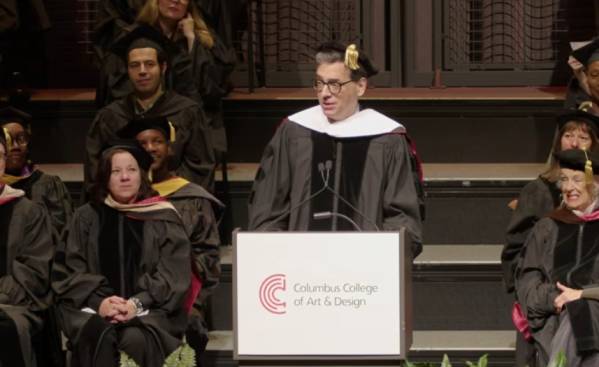
Editor’s Note: In this inspiring commencement address at the Columbus College of Art & Design, bestselling author Daniel Pink shares essential insights for the Class of 2026 on navigating a rapidly changing creative world. Drawing from his expertise on motivation and human behavior, he explores the profound importance of cultivating one’s unique taste as a guide for both life and career. (May 22, 2026)
TRANSCRIPT:
DANIEL PINK: All right. Thank you. Thank you very much. Good morning, everybody. Good morning. Dr. Corn didn’t tell me this was going to be interactive. Okay, this will be fun, then.
So, for you graduates here today, today is a day that you will remember forever. So, on this momentous day, this unforgettable day, I come before you to talk about mashed potatoes. You’re welcome.
Now, to understand what I mean, we’ll have to travel back in time 50 years. I grew up right here in Columbus during the 1970s. Quick show of hands, how many people have any recollection of the 1970s out there? Oh, wow. Okay. So, here we go.
As those geriatric hands will remind you, the 1970s were a very different time. The issues our country was dealing with then are almost incomprehensible to us today. Back then, Americans faced high inflation, anxiety about jobs, gas prices clicking upward each day. There was unrest in the Middle East, a bitter conflict with Iran, and sitting in the White House was a president whom some people adored and others said was unfit for the job. As I said, wildly different.
The Mashed Potato Revelation
And about six miles east of where we gather this morning, I was eating dinner with my mother, my father, my brother, and sister around a yellow Formica table, which is where our story begins.
Now, dinnertime in my household was not a lavish affair. Hot dogs maybe, tuna casserole, sloppy joes, and on the exciting nights, meatloaf. However, I call your attention not to any particular main course, but to the most frequent side dish, mashed potatoes. These mashed potatoes. Hungry Jack instant mashed potatoes. They still exist. I bought these at Walmart. And they are truly a triumph of American ingenuity.
Here’s how to make them. Boil some water. You add these flakes. Toss in some margarine, stir, and voilà, mashed potatoes.
Now, one evening, when I was about nine years old, I found myself not at that yellow Formica table, but at the home of an elderly relative. She was serving dinner. And onto my plate, she plopped a few scoops of mashed potatoes. And right there, right then, my life changed. Forever.
These were the best mashed potatoes I had ever eaten. Smooth, fluffy, creamy, substantial, savory, rib-sticking. They were glorious.
I had to see the box from whence they came. So I slipped into the kitchen. And what I learned blew my mind. There was no box. My elderly relative had made the dish using some kind of prehistoric wizardry. She had bought potatoes. Real potatoes. She boiled them. Then she mashed them with a masher. She added butter. Real butter. And cream. Real cream. And salt. And she stirred it together. And at that moment, I discovered something about myself. I had taste.
I don’t mean I had taste buds. That is not what I mean. I mean I had taste. Preferences. A point of view. An emerging sense that some things in the world were good, and others were less good, and this distinction mattered.
The Most Important Thing You Built Here
I tell you this story, graduates, because there’s a lesson buried in those potatoes. Over the last four years at this amazing place, you built skills in animation, in fashion, in film, in photography, graphic design, games, fine art. You’ve made lifelong friendships. You’ve completed challenging projects. You’ve landed primo internships. But what you might not realize is that thanks to all of that, you have achieved something more important. You have developed taste. Aesthetic judgment. A point of view. The sense that some things in your midst, some things that you create are good, and others are less good, and that distinction matters.
Class of 2026, I’m here with good news. That taste that you’ve developed as art and design students, that taste that you will deepen as creative professionals, will save you. It might even save us.
In an Age of Artificial Intelligence, Taste Is Your Killer App
Now, as should be clear at this point in my remarks, the qualifications for being a college commencement speaker are basically non-existent. But there is one teensy requirement. Under a little-known federal law, every commencement speech during the year 2026 is required to contain the phrase “in an age of artificial intelligence.” So let me comply.
In an age of artificial intelligence, taste will be your killer app. Your taste will set you apart and get you ahead. Your taste will make you the best at what you do, and if you really work it, your taste could make you the only at what you do.
Here’s a dirty little secret they don’t want you to know. At lesser institutions, like Ohio State or Harvard, people who haven’t studied design, who haven’t studied art, who haven’t devoted four years to imagining and prototyping and creating, they risk being left behind. Because large language models like ChatGPT and Claude are astonishing at generating options. Type a prompt, and they will deliver dozens, even hundreds of choices. But you have to decide what’s extraordinary and what’s mundane. You have to decide what will serve your client and what will shortchange them. You have to decide what will delight your audience and what will bore it, because these models have no taste, no preferences, no point of view. They have no idea what’s good or what’s bad. They don’t even care. They just predict the next letter or line of code in a sequence.
You have taste. They don’t, which means over the long haul, they need you a lot more than you need them.
The Scarce Skill Is No Longer Execution — It’s Discernment
For most of human history, people could often imagine something remarkable, but they lacked the tools and the technical know-how to make it real.