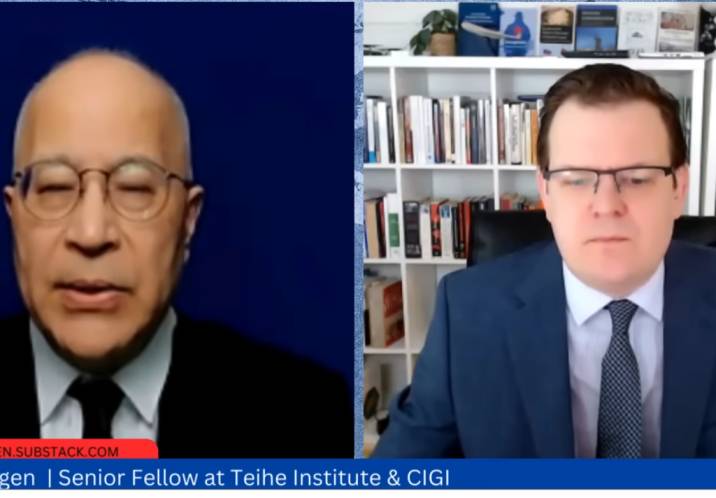
Editor’s Notes: In this insightful discussion, Professor Glenn Diesen and Einar Tangen explore the “Age of Irrationality,” analyzing how escalating global conflicts could lead to a devastating economic crisis and the threat of nuclear war. They examine the interconnected tensions between Israel, Iran, and the U.S., highlighting the potential for a worldwide depression triggered by disruptions to critical energy supplies. Tangen provides a unique perspective from Beijing on China’s role in seeking stability as the world shifts away from Western hegemonic dominance toward a multipolar order. This conversation serves as a sobering warning about the consequences of abandoning diplomacy and the urgent need for rational international cooperation. (Mar 13, 2026)
TRANSCRIPT:
Introduction
GLENN DIESEN: Welcome back. We are joined today by Einar Tangen, a senior fellow at the Thai Institute and the CIGI, to discuss what is happening in Asia and Iran and of course how these are interconnected. So thank you for coming back on.
EINAR TANGEN: Thank you for having me. I’m sorry that we have to meet in these circumstances. It’s a sad, sad, weird thing. As we were discussing before we got on, you have a situation where you have people acting with no idea why they’re going in or what they’re going to get out or how to get out. It’s just unbelievable.
Making Sense of the War: A View from Beijing
GLENN DIESEN: Well, I thought if we start off with a bit wider picture before getting on how this is received in Asia or impacting Asia — how, sitting in Beijing, how do the people there and you make sense of this war? Why has the US gone in? How do you make sense of the Iranian policies?
The Three Timelines: Israel, the US, and Iran
EINAR TANGEN: Okay, so there’s a lot to unpack here. It depends on who you talk to and what level they’ve studied this on. Some people that I’ve talked to say, look, you have two timelines that are at work here. Oh, actually three.
The first one starts in 1996 and that’s when Richard Perle puts out this report, “A Clean Break.” He gives it to Netanyahu and it outlines that the future of Israel should be based not on a two-state solution or accommodation or trying to negotiate a peaceful solution, but that they should try to actively undermine all nations around them in an effort to establish dominance. And that in essence is what has happened. Although Netanyahu said publicly, “Oh, I’m not going to go along with that.” But for 30 years he’s been claiming that Iran has nuclear weapons or is about to have nuclear weapons within two weeks or two days or two months or whatever. And that’s been very, very consistent.
What does Iran represent to Israel? Well, after the fall of the Shah, Iran is very bellicose towards Israel. They take the Palestinian issue up and they say, “You’re an enemy,” and this sets the stage. So Israel is not capable of attacking Iran. There are seven and a half million Jews, there are 92 million Persians or Iranians, and there’s a thousand miles in between. So it’s just not even capable that you could have boots on the ground and do anything with any serious intent.
So they’ve always needed the US to be on their side on this, and the question is how to get the US there. Obviously he was crying wolf all the time over these nuclear things. But presidents in the United States were very loath to get involved in a war with Iran, which is a sophisticated country, 19th largest in the world by population and also by land size. It’s also a very difficult place to invade, as you saw in the Iraq-Iran war. They have mountains surrounding basically the entire country. Once you get into those mountains, you’re in a quagmire. It’s very difficult to get through machines and tanks and things like this, and troops — perfect places for ambush and things like that, much like Afghanistan.
Trump, Netanyahu, and the Push for War
So the second timeline is that Donald Trump is facing real problems with the Epstein files, with the failure of his domestic policies, latent corruption — the list goes on and on. And his typical response is to try to divert attention. And he does that on a daily basis. He walks in and just releases what I call dead cats and white rabbits — he puts the dead cat on the table and says, “Oh, what’s that?” And then they follow the bunnies around the room as they hop around. And these are the lies and the untruths and the outrageous statements that are made. But that wasn’t working until he got to Venezuela. That actually was able to turn the narrative away from Epstein, even though it was for a short while.
So he was convinced by people around him. And Netanyahu, remember, was at the White House for four days just two weeks prior to the invasion — or attack, whatever you want to call it — plotting, and they had set the date when they intended to go in. And Trump was convinced by Netanyahu, probably by Hegseth and the people around him, that you could run in there, do a decapitation strike, and it’ll be just like Venezuela. “You’ll be a hero. You’ll be putting your stamp on the world.”
Well, the only problem he had is that the CIA said, “No, that’s not what’s going to happen.” First off, there’s no imminent threat and you haven’t prepared the United States for an imminent threat. Even in Iraq, which was completely fictitious, they at least spent the time to whip American opinion into a frenzy that they’re about to be attacked by a nuclear Iraq. So in this case, they didn’t do that.
The military also told him, “This is a no-go.
We don’t have the wherewithal to do this.” It’s a simple matter of math. We have enough missiles and countermeasures to protect ourselves against X number of missiles. And by the way, Iran has 10 times that number of missiles. So if they start firing at us, at some point we either have to withdraw or our assets are going to be sunk, or our bases are going to be destroyed.
Iran’s Strategic Calculus
So that was two timelines. The last timeline is Iran itself. Iran was in a situation where for the last 20 years it has been anticipating an attack by the United States. They had a warm-up during the 12-day attack last year and they have basically been calibrating themselves on how to respond asymmetrically to this military situation.
And they hit on, “Well, what do we have? We cannot fight the US toe to toe in terms of armies and things like that, but we can keep them at bay. We can delay. And while we delay, we’re going to bottle up the Straits of Hormuz,” which of course, as everyone knows, is 20% of the world’s oil that is exported. It has a devastating effect on everybody involved.
China’s Position and the Oil Crisis
And that’s where China is looking at this thing. They’re saying, “Okay, we can’t prevent the blunders of what Israel and America are doing.” They’re puzzled. They don’t understand if there was ever an exit plan. It appears now that Netanyahu thought that getting the US involved, he could get them there in a kind of forever war, and then Israel could sit back and watch the destruction of Iran, piecemealing of it, and therefore it would be less of a threat.
I would disagree with that. I think the pieces of countries become very radicalized very easily, and their natural enmity would be towards Israel. So I think they were, and have with Gaza and this type of action, ensured that Israel is going to be subject to attacks by terrorist organizations new and old for the foreseeable future.
So then moving ahead, what is China thinking about? Well, they’re looking at the economic damage. China, during the last two months, has increased — they must have had some feeling that the US and Israel were going to attack — they increased their buying of oil, extra oil, by 16%. So by different estimates, they have somewhere between almost 1.1 billion barrels of reserve oil. But reserves run out. And this is the issue — it’s a time issue. China’s trying to figure out if this war is going to go on for years or if it’s going to go on for a few more weeks. No one seems to know definitively. Donald Trump doesn’t seem to know.
His problem is he is, in fact, subject to this mathematics. The number of missiles that the Iranians have outnumber the number of defense missiles that we have. You see them transferring missiles from South Korea, much to the dismay of the South Koreans, in order to do that. They wouldn’t be doing that if they had anything else. And it brings up a whole bunch of issues. Where are these going to be replaced? And do they think that China is going to sell them the rare earths necessary to produce these kinds of missiles and these weapons? I don’t think so. So the US is digging itself into a deep corner.
Trump has responded by, one minute being bellicose and determining he was going to wipe everyone out and throwing warnings that he’s going to get really tough if they do this or if they do that, to saying, “Victory! We’re going to be out of here in no time.” Right now, there is no path, because even if the US left in five minutes from now, it’s not over. Iran does not trust the US because it used the supposed peace negotiations as subterfuges for attacks. And as a result, they really don’t want to sit down with the US as it is currently put together.
What they’re interested in is seeing a US that is severely weakened, coming to the table and being rational and reasonable about how this is going to be settled. So they have — their Supreme Leader, who is also their religious leader, has been killed along with many others. This is not something that’s going to go away. He’s been martyred. He was 86 years old. He was killed in his compound along with a number of his family members. And now his family member is the new Supreme Leader. And he has already started saying, “Yes, our only choice is nuclear weapons, and we are going to fight this to the bitter end.”
The Risk of Nuclear Escalation
So the situation is rapidly deteriorating. It doesn’t just involve the Middle East. China has partners with all of them and it threatens their supplies. In all likelihood, they will turn to Russia, but everyone will be turning to Russia. Iran says $200 a barrel — we’re really around that $100 level. But as time goes by and the reserves run out, you’re going to see that number go upwards, somewhere between $200 and $300. That’s four to five times.
And I’m not speaking about this just to throw some numbers out there. Go back to 1973. Between 7 and 9% of the world’s available oil was cut off by what would soon become OPEC. And that resulted in 4x pricing of barrels. So what was $10 one day was $40 the next. If you have that here now — and that was only 7 to 9% — you’re taking 20%. Oil is not something you can do without. If you’re running an airplane, you can’t say, “I’m going to run it on air or alternate fuels.” Yes, you could gin up some corn fuel and things like that, but that would take a tremendous amount of time and there just isn’t enough to do that right now.
So there are very few alternatives. If you’re running trucks, you need diesel. And this is going to affect countries all around the world, especially those that don’t have reserves in the short term, but long term it’s going to have a tremendous amount of effect. We’re talking about over 20 million barrels a day. That kind of capacity does not exist. It cannot be ramped up. Trump has already been told by the frackers in the United States that “We can’t cover that. We can increase the number of barrels by maybe 1, 2, or 3 million, but we’ll never get to 20.” And that’s going to take time. And then you have the logistics cost.
So this is going to spark an economic crisis that could lead literally to a worldwide depression. And if that happens, it’s not good for China, it’s not good for the world. China is probably in a better position than most because it’s the low-cost provider. To the extent that you have to have things, you’re going to buy them at what you hope is the cheapest price possible. So China has an advantage there. But the global turmoil this will cause — as economies fail, you’re going to have civil unrest as people try to blame one group or another, or it becomes a kind of “I get it or you get it” zero-sum game. These are dangerous times.
But that isn’t the end of it. The problem here is that you have two nuclear-armed nations — one, the US with 5,000 warheads, and then Israel, undeclared, with somewhere between 110 and 120 nuclear weapons. Israel is for the first time getting pummeled. It is suffering damage. And this is not something the Israeli people expected. They thought the Iron Dome made them impervious — maybe a rocket here, maybe a fatality here and there, but nothing really serious. Now they are experiencing the war that they have brought to other nations.
And the danger is that you have somebody like Netanyahu, fearing that the US might leave, concocting some reason to start using nukes. If that happens, depending on how many he uses, this turns from a regional conflagration into a global one. Iran sits at the intersection of the Eurasian jet stream. That means that if you blow something up and it’s nuclear, that nuclear fallout is going to go literally around the world. It’s going to hit all the Central Asian states. It’ll affect India and then it’ll affect everything along that area, and eventually it goes around the world. So there will be climate change — they estimate 10% less productivity in terms of crops. You’re going to have severe climate differences, droughts and areas of heavy rain. You’re going to have toxicity ongoing, things like that.
China’s Role in Preventing Catastrophe
Now, China’s concern is that things don’t go off the rails, that there has to be some way of controlling Netanyahu from doing this. He obviously is under threat domestically from all of the lawsuits and criminal suits against him because of allegations of criminality and theft, deceit, et cetera. There has to be some sort of offer for him.
So at this point, China is preaching that it’s time to go to the table. The question is, what has to be at that table in order to do something? Neither party — Iran has no reason to trust the United States sitting across from them. It’s just pointless from their point of view. But if you can bring together regional middle powers — for instance, the BRICS, and also Turkey, Egypt, the Gulf Cooperation Council — and of course Israel, get them around the table, and make it clear: “Israel, if you light off a nuclear bomb, the consequences will be severe. You’ll be cut off completely in terms of economics, and your nation will suffer.”
But they have to provide a carrot. My guess is that the carrot is going to have to be offered to both Netanyahu and also Trump. This is not going to go down well in the annals of history, and it’s not going to go down well with the populace. As long as you win, you’re invulnerable. Once you lose, things get tough. And so they’d have to be given some sort of alternative to being incarcerated or prosecuted as criminals or something like this. And I don’t know how that would all come together, but I don’t have the greatest imagination. I’m not that smart.
But there has to be some way of keeping this from going nuclear. That’s why I think that China has not closed the door — despite very strong comments about Iran — to a visit by Donald Trump, because they believe that the only way to deal with Donald Trump is to keep him at the table, to have him looking at little bits and pieces, transactions. He understands transactions. He doesn’t understand promises. He doesn’t understand what you did for him yesterday — he only understands what he can get from you today and tomorrow.
So I think they’re going to try to continue to engage with him and try to figure out some way to keep this ill-advised war from turning into a conflagration that will literally ruin the world.
The Collapse of the Hegemonic Order and Its Global Consequences
GLENN DIESEN: I think what makes this all so dangerous is that it’s all happening or caused by a wider, larger phenomenon which is not just the end of the change of world order, that is the end of the hegemonic order, but also the much larger picture of the end of Western dominance. Because this is built into — this is why under such situations when countries feel that they have, at least great powers feel, an all-or-nothing strategic positioning, that they’re willing to take great risks and do foolish things.
So for example, in the United States, the objective is to reverse the relative decline. So restore US hegemony or make America great again. And so either they achieve this by succeeding in countries like Iran, or they will drive the country into the ground. So this again, all-or-nothing mentality. And the actions — not just rhetoric but actions — reflect this as well.
And indeed it’s not just Trump, the United States — with Biden as well, you saw Europe now in terms of the war on Russia, the Iran, possibly with China. And I would even say that it can be extended to Israel because Israel’s “Clean Break” strategy it’s had since 96, or at least this document that was written for Netanyahu suggesting peace shouldn’t be achieved through compromise and negotiations, it’s by defeating rivals, just knock them out.
There’s a reason I think this came up in 96. This was at the beginning of the hegemonic era. Why would, if you’re backed by the world hegemon, why would you make concessions? Why would you make compromise? So essentially you can just do what you want. Now we’re at the end of that cycle. Hegemony is over, unipolarity is over. And so Israelis all seem to be in that position now. Either this is your final moment, this is the final opportunity to knock out Iran, otherwise you’re going to have to learn how to live with it.
So again, it’s this very dangerous strategic moment where they have the willingness to do absolutely crazy things. And this is why I think as the war in Iran drags on now, it’s also dangerous. I mean, what are the US options now? Because the regime change failed through decapitation, the idea that they can collapse the Iranian army doesn’t work. As Trump said, they don’t really have any good military targets left to target. As you said, ground troops isn’t really an option. They can’t get the proxies like they were able to get the Ukrainians, for example, to fight. They don’t have this either. They couldn’t get the Kurds. So all you have now is destruction to compel capitulation.
But as you said, the Iranians, they’re fighting asymmetrically. They have to go after US bases in energy-producing countries, also block energy exports. But I don’t see anyone climbing down. And so not just a long war, but a war which will then escalate and escalate with very unpredictable consequences.
Which then begs the question, how will this affect the security dimension, affect East Asia? Because we’ve already seen not just the alliance system in the Middle East being undermined, also in Europe, but now in East Asia as well. We saw the THAAD missiles and the Patriot missiles being pulled out of South Korea to be sent down to the Middle East. This is all symptoms of a hegemonic era system breaking down.
How will this rattle East Asia? Because if you’re in South Korea, you would have to start to challenge some of this. If you’re in Japan, you’re going to have to start to challenge the idea that what existed for the past 35 years will be here tomorrow.
Energy Shocks and the Irrational Age
EINAR TANGEN: Well, exactly. You’ve already heard complaints from Saudi Arabia that their shield — these American bases — turned into targets and then they weren’t defended. And what they’re doing now is they’re reassessing whether or not they have the money to invest a couple of trillion dollars — not them, but collectively — into the United States.
In terms of East Asia, this is a huge shock. You haven’t heard much about it, but what is somebody like Japan going to do? Their oil comes over the sea, coming from the Persian Gulf. They don’t have huge reserves where they can hold out for two or three years. I think they have a couple of weeks or a couple of months, depending on whether they’re able to secure additional ones. But any oil that they get from now on is going to be extremely expensive. And this completely upends the efforts of the current Takahashi to change Japan’s economy. They’re out the window. Inflation is going to be rampant. Costs of everything are going to go up.
You have Japanese people who feel like American people, like European people. There seems to be a common malaise among developed nations that they don’t have any money, that they’re living kind of hand to mouth, things are not good. And now you have something like this going along where the price of gasoline and everything associated — because people think, “Oh, gas is up. Well, don’t drive your car so much.” Nonsense. They depend on fish. Fishing boats, last time I checked, burn a lot of diesel. I mean, already you’ve seen Thailand say that half their fishing fleet is not going out. That means that the boats that do go out and pay for the expensive diesel are going to be charging more for the fish that they catch.
Fertilizers — 40% of fertilizers coming out of the Middle East — now they’re not. So you have a situation where you have to have the fertilizer in order to grow the crops. If you don’t, you’re in big trouble. Your yields will go down. As a result, the price of food is going to go up.
We run on an energy economy. Our mutual good friend War Powell has written a book about how important energy is and how it’s the deciding factor the more that you advance into a digital economy. But it’s still a massive factor when you’re dealing with a conventional economy. As a result, there’s not enough time in terms of global reserves to soften the blow so that you can switch over to renewables like sunlight and wind. In the US, obviously Donald Trump would fight them, as he already has done. Other countries might want to do it, but for instance, Europe is clutching their pearls and saying, “Oh, we don’t want cheap solar and wind power, we want to build it ourselves, even if it’s two or three times more expensive.” The question is, will they feel that they have that luxury in the near-term future, or will they feel that they have to react?
But going back to one of the things that I always think about when we do our shows, Glenn — the evil that is created when people create false economies, that it’s either this or that, you’re either with me or against me, you’re either good or you’re evil. This is what’s unsettling the world. In political systems around the world, the voters are being driven by fear, by hatred, because that’s easier to do, especially when times are not good. And you’re making simplistic claims that you can solve everything with the wave of your magic chainsaw — in the case of Milei and things like this. It just doesn’t work that way. You can change governments, but you cannot change the problems that they face.
And how are we reacting to it? You were flummoxed. How is it possible we are acting so irrationally? And I say it’s because we are in an irrational age. People are feeling their way through life emotionally. They feel like victims, and as a result, they’re more likely to victimize others. And this is the sad reality of human nature.
The Ripple Effects Across Asia
If you go to other areas — South Korea, also in deep, deep trouble. Indonesia, they have some oil, but not enough. Malaysia, all of these areas. Vietnam is going to be very hard hit. They were an alternative kind of a place to set up shop and produce things with inputs mostly from China, and then sell them off as “made in Vietnam.” You can look at a chart, you can see the amount of imports from China is roughly equal to the increase in exports going to the United States, Europe, and everywhere else. Higher oil and gas prices — energy prices, period — are going to hit them very, very hard.
India, they’re in a horrible situation. Despite the green light to purchase more Russian gas and oil, it’s going to be more expensive. They’re going to be looking at a situation where they need fertilizers and diesel and all these things to run the generators. They’re going to be in very, very deep trouble. They can tell people to work from home, but everything is wrong. This is a country that has regularly scheduled brownouts, sometimes blackouts, depending on how bad it gets.
So energy is something that we all use. Iran is not just bottling up the Straits of Hormuz, they are also attacking facilities that process oil, so that no matter how much oil you have — it’s like rare earths — if you can’t process it, they’re useless. It’s just a bunch of dust. So this is really hurting them.
Everybody — but Iran has taken the position that “We don’t care. We’ve been attacked, no one came to our defense. We therefore will go do what we think is necessary in order to solve this. And the only way we can solve this is to bring America down to its knees, to collapse it, create a global depression, get Donald Trump out of there and get somebody who thinks differently.”
But the damage being done to others is incalculable. This is not something that’s going to go away within six months. This is something that we’re going to be dealing with for the next 10 to 15 years, let alone after that, when you start dealing with the terrorism and extremism that this is causing. That’s the part I don’t understand. If you read history, you understand that doing these things doesn’t help — it hurts. So the question is, why are you doing them?
Existential Threats and the Logic of Desperation
GLENN DIESEN: Well, this again goes back to the idea that when countries see themselves facing something existential, what they’re willing to do when they have their backs against the wall. One should never put any country in this position. That was more or less the peace speech by John F. Kennedy as well. And so I can understand what the Iranians are doing because they see this as an existential threat. And I agree with that. If the US and Israel didn’t get the regime change and destruction of Iran last time, they can’t get it this time, then they’ll have another go at it. So the fact that they can’t keep the status quo going — I mean, how long has this pressure been going on in Iran, this crippling sanctions, these threats of attacks. I mean, it’s —
EINAR TANGEN: 79.
GLENN DIESEN: Yeah. And there’s never any proposals for how can we learn to live together. It’s only the game on the table of how can we knock out the Iranians. This is it. And not even the government, because ultimately, if you want regime change without a replacement government — they are talking more or less now about Balkanizing Iran.
So when you call this the age of irrationality, I think that’s a good description because I see this here in Europe as well. We’re facing now this massive energy crisis which is going to result in an economic collapse, and of course you might face a nuclear war yet. They don’t want to get any energy from Russia, which can stabilize the energy markets and the economy. And they call this energy security.
EINAR TANGEN: It’d still be expensive.
GLENN DIESEN: Yeah. And they don’t even want to talk to the Russians, they don’t even want diplomacy. I mean, if you see where we’re heading now — and again, even if the war is over today, the consequences of this will already be immense. And there’s no way this war will end anytime very soon. And yet there’s nothing that can be done in terms of rational discussion, talk, diplomacy, nothing at all. But let me just ask —
Is a Westphalian Moment Possible?
EINAR TANGEN: I just wanted to ask you. Do you see the possibility of a Westphalian moment when Europe — like they did between the Catholics and the Protestants — reach a point where the slaughter is so great and the bankruptcy is at a point where they cannot prosecute a war, whether it’s in Ukraine by proxy or anywhere else. And they suddenly say, “Okay, you be you, I’ll be me. We just keep our borders and go forward.” Do you think that’s possible? Or is that the only rational ending? And why hasn’t Europe learned from their own history?
GLENN DIESEN: I don’t know, but I think this is the only rational solution if we don’t destroy ourselves. Because that was the only rational solution back then in the Thirty Years’ War —
EINAR TANGEN: From —
The Illusion of Western Dominance and the Colonial Mindset
GLENN DIESEN: 1618 to 1648, this was what they discovered, that no one power would be capable of essentially establishing dominance overall. So there would be no hegemonic solutions. All we did was kill each other in huge numbers. And the balance of power would just shift. If it looked like anyone would actually be able to dominate, then there would be a rebalancing. And at the end of the day, the only solution was again the Westphalian system. That is, let’s just agree to have several centers of power based on sovereign equality. As you said, you be you, I’ll be me.
And we’re not there yet because the Europeans do not have the political imagination to envision anything besides dominance. Also in Europe, this is part of the problem. We have a whole political class over the past 35 years being raised on the idea that as long as the west dominates, liberal democracy and human rights will thrive and we will enter a golden age of perpetual peace. The whole Immanuel Kant idea. This is what they built their ideology on.
So the fact that you will have a decline of Western hegemony means we go back to a ruthless old time when countries compete for power and values and ideas. But why? When we’re dominant, then there will be prosperity and peace for everyone, and our values are superior. So there’s no good alternative. This is kind of the mentality — there is no alternative to Western dominance. This is why the Europeans, I think, are betting everything on this. And they’re just becoming more ideologically entrenched the more they’re challenged. And they’re heading towards a massive disaster, and there’s no room at all for course correction.
EINAR TANGEN: But what I don’t understand is they’re repeating the same mistakes of colonization. I mean, we had a period where the west dominated everything, literally, because it just took it over. It didn’t work out. And in theory, we’re trying to recover from colonization. That’s why the Global South holds a little bit of a grudge, because they were used and abused for so many years, their legitimate governments disposed of, interfered with their resources, stolen from them.
It confounds me that we understand that we’re supposed to be emerging from that. And then you have Rubio saying, “Hey, let’s bring back the good old days. We together, we can colonize, recolonize the world.” I always thought of Europe being more sophisticated than somebody like Rubio, that they understood Westphalia. They understood what they had done in colonizing the world. They didn’t want to give the money back, but they certainly said, “Well, we shouldn’t do that again.” And now we’re on the cusp of them, in essence, as you just said, just maniacally holding onto an idea which is, in essence, colonization.
Rubio, Munich, and the Return of Imperial Thinking
GLENN DIESEN: Well, I’m glad you mentioned Marco Rubio, because that’s more or less literally what he said at the Munich Security Conference back in February. That is, “Europe and the west, we used to be great. For 500 years, we had empires spanning across the world.” And then, of course, World War II happened, and we had communism and decolonization — essentially portraying decolonization as a communist plot — implying that we have to restore this dominance. And in order to restore it, we should be unapologetic. We shouldn’t have to pretend as if we’re serving higher goals. It’s quite extreme, but I don’t—
EINAR TANGEN: But how can you have a sociopath like that out there in front of people? And then half the room stood up and clapped because he wasn’t as nasty as J.D. Vance was the previous year? I mean, is this a case of Stockholm syndrome, where Europe has been under our heel for so long that if they don’t get hit too hard, they’re happy?
GLENN DIESEN: Well, the Europeans — they can’t, again, the way they see it, their only path towards being relevant, prosperous, and dominant is in a partnership with the U.S. So as I said, he was not J.D. Vance, and as long as he throws the Europeans a bone, they will be very, very excited.
But there’s something powerful about ideas. That is, if you have ideas which link your power and dominance to some sublime values, this is very attractive. Your dominance is a force for good. Which essentially is what NATO’s slogan was — “We’re a force for good.” Which means that if you dominate, this is something everyone benefits from.
And there are a lot of similarities between the past 35 years and the colonial era, because under colonization you divided the world into two groups to promote sovereign inequality. That is, sovereignty for us, but not for you. What that meant was some of the world is civilized. If you’re civilized, then you have the right and also the responsibility that comes with being a sovereign. If you’re a barbarian or uncivilized, then you don’t qualify for sovereignty. And essentially, the dominance is good because not only would one side be dominant, but you could go out to the jungle and civilize them. So your dominance and intervention is a force for good.
But what is so different in the post-Cold War era? We said, well, we have liberal democracies and authoritarians. The liberal democracies should enjoy full sovereignty. The barbarians, or the authoritarians, should not have it. And this is a force for good as long as you dominate. And also, if we can intervene into the authoritarians’ territories, or help them rid themselves of authoritarianism, then this is a force for good and we should do it. It’s not just a right, it’s a responsibility.
And this is the rules-based international order in a nutshell — that is, humanitarian ideas which should be able to create an exemption from international law. This is what we’re talking about, and this is what Europe wants back.
Closing Thoughts: On the Brink of a Precipice
EINAR TANGEN: This is all hypocrisy — hypocrisy at every level, at the institutional level.
GLENN DIESEN: Oh, it’s hard to deny, but yes. Anyways, thank you so much for taking your time. Do you have any final thoughts before we wrap up?
EINAR TANGEN: Any time, yeah. I’m hoping that people — I mean, I think your audience probably agrees with you. But I’m hoping that others who watch this understand that we are on the brink of a precipice, and beneath us lies a nuclear ruin. And if we don’t start pressuring our governments to be rational, they could very well just jump off because they figure it’s better than the alternative. And they could take us, unfortunately, with them.
GLENN DIESEN: Well, thank you again for your wise words. And hope to see you again soon.
EINAR TANGEN: Yeah, same with you. All the best.
Related Posts