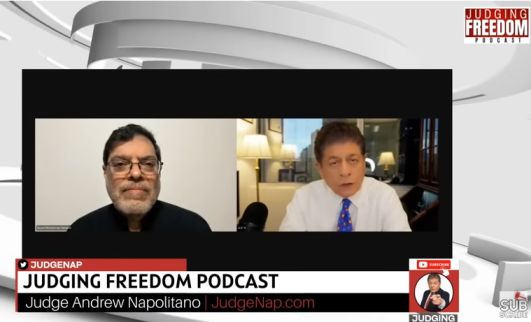
Editor’s Notes: In this moving episode of Judging Freedom, Judge Andrew Napolitano speaks directly with Professor Mohammad Marandi, who joins the program live from a defiant Tehran amidst ongoing American and Israeli military operations. Professor Marandi provides a firsthand account of the resilience of the Iranian people, the tragic human cost of the conflict—including the destruction of a girls’ school—and the strength of the nation’s unified response during a period of transition. Their conversation offers a rare and powerful perspective on the ground, challenging Western narratives and highlighting the deep-seated resolve within Iran to preserve its identity and future. (March 12, 2026)
TRANSCRIPT:
“Undeclared wars are commonplace. Tragically, our government engages in preemptive war, otherwise known as aggression, with no complaints from the American people. Sadly, we have become accustomed to living with the illegitimate use of force by government. To develop a truly free society, the issue of initiating force must be understood and rejected.”
Introduction
JUDGE ANDREW NAPOLITANO: What if sometimes to love your country, you had to alter or abolish the government? What if Jefferson was right? What if that government is best which governs least? What if it is dangerous to be right when the government is wrong? What if it is better to perish fighting for freedom than to live as a slave? What if freedom’s greatest hour of danger is now?
Hi, everyone. Judge Andrew Napolitano here for Judging Freedom. Today is Thursday, March 12, 2026. We expected to have Professor Mohammad Marandi with us, but we have lost contact with him. We’re assuming it’s just an Internet issue, but of course he’s in our hearts and in our prayers.
He is, as many of you know, a longtime friend of mine for whose intellectual honesty and academic brilliance and fidelity to first principles I can personally vouch. Excuse me. So we’ll do our best to reach him, but right now we’re unable to do so. We were in contact with him last night and this morning. We don’t assume the worst. We assume that this is just an Internet glitch. And when we do reach Professor Marandi, we’ll let you know, and he’ll be on with us because he has much that he wants to tell us for the rest of the day.
If you’re watching us live, Max Blumenthal will be here in a half an hour. Excuse me. At 10:45 this morning. Oh, no. We have Professor Marandi, I am told. We do have him, Chris. Or we don’t. We do. Professor Marandi, where are you? Hang on with us, because Professor Marandi has made contact with us. Thanks be to God. He is well. I can see him popping up momentarily on the Internet. And as soon as we have him, you will see him and you will hear him, Chris. I see him on the bottom, but I don’t hear him coming up. There he is. Can you hear me, Randy? Can we hear you? Can. Can you hear me, Chris?
Technical Difficulties
JUDGE ANDREW NAPOLITANO: All right. Professor Marandi, to God we’re still working out the Internet gremlins. Stick with us, everyone. Professor Marandi as well, and is anxious to speak to all of us. And we’ll stick with him as long as we have to in order to have this conversation towards which we have all been looking forward. Give it another shot, Chris. All right, bear with us, my dear friends. Chris, you want me on another. Okay, I’m going to log off and log right back on.
Mohammad Marandi, thanks be to God, you are well and able to speak with us. My dear friend, let me start with some personal questions. How are you? How is your family? What is life like in Tehran after 10 days of American and Israeli efforts to destroy the city and destroy the will of the Iranian people?
Life in Tehran Under Bombardment
PROFESSOR MOHAMMAD MARANDI: Well, Judge, I’m mostly separated from my family and I try to remain alone as much as possible for obvious reasons. Life in Tehran continues. The streets are not very crowded. Large numbers of people are still outside of the city after the first day when the girls school was destroyed and 170 or so children murdered, and a couple of dozen staff members as well. The government shut down all schools and universities to protect the kids. And so Tehran’s population now is much lower than it normally would be.
But when I do drive around, I see some shops are open, some are closed. But I haven’t been around to many different parts of the city. So the traffic is light. But people are very defiant. Every day there are gatherings across the city, in different neighborhoods and across the country, where people go to the streets in defense of the armed forces and the state and the leader. And they have stood their ground even while they are on the streets.
And I was a part of one of these rallies, I think three days ago on Engelab Street, Revolution Street. The US and Israelis bombed nearby with a large number of bombs and people did not budge. It was extraordinary. Hundreds of thousands of people. Perhaps since the city is not — most people, many people are not in Tehran — hundreds of thousands of people were on the streets chanting. And as the bombs were exploding, I did not see a single man or woman budge. Wow, I’ve never seen such a thing before in my life.
The Resilience and Determination of the Iranian People
JUDGE ANDREW NAPOLITANO: I guess it’s rather obvious that the US and Israel have seriously underestimated the resilience and determination of the Iranian people and the strength of the Iranian military. Start with resilience and determination of people because you’re obviously closer to the people than you are to the military.
PROFESSOR MOHAMMAD MARANDI: You know, Judge, this is something that the new leader, Ayatollah Mojtaba Khamenei, has just said in his first statement — that during this week when we had no leader, the people themselves preserved the country and the state.
The armed forces, within less than an hour, began retaliation and security across the country was in place. You can walk out in Tehran, you can drive around the city and feel safe and secure because people themselves manage the country. So I think that shows the extraordinary resilience of the people in itself — the fact that everything has been functioning like a clock.
And now that the leader has been chosen, I think that it will become even more difficult for the Trump regime and the Netanyahu regime to be able to continue this war. The armed forces have performed above my expectations. They fire missiles and drones continuously and their underground bases have remained untouched. And Iran’s factories, which produce those missiles and drones, are untouched. They’re deep underground.
And so this is an extraordinarily big miscalculation. And it also shows how Western intelligence agencies and the Mossad — how incompetent they are. Because we’ve been given numbers, as you recall, of how many missiles Iran has and how long they will last. And obviously those numbers were nonsense, something that I believed were nonsense beforehand, and I said so repeatedly. But now it’s clear as day. Iranian underground bases are full of missiles, they’re full of drones, they can go on with this war, and they have plans to continue with the war until after the US Midterm elections.
Trump’s Call for Regime Change
JUDGE ANDREW NAPOLITANO: Wow. As recently as yesterday, President Trump encouraged the Iranian people to overthrow the government. I’m paraphrasing in as charitable a way towards him as I can. He wasn’t precise, as is often his technique, because — “this is your last chance for freedom for a couple of generations.” When he says things like that, A, do the Iranian people hear it? Do his words get through? And B, if they do, what is the effect on them when the person principally responsible for trying to destroy their country is giving them political advice?
PROFESSOR MOHAMMAD MARANDI: Well, they do hear it. They get it through. First of all, people have satellite TV at home and they can get all sorts of Persian language channels that are broadcast from the West and that are hostile. But also Iranian social media and Iranian news agencies do report what he says. They translate it and they put up the clips.
But I think what — I don’t think Iranians really care that much about what he says. And as we saw during this week, when we didn’t have a leader, the Iranians themselves kept the country moving forward and defending the state and their identity and their country.
But what I think what sticks, what Iranians think about, is the fact that when Trump says that he will destroy Iran and that it will never be restored — or that he can destroy Iran in a way that it can never be restored — and the fact that Western media, whether in Europe and the United States, they’re not outraged that he would make such statements, whether it’s Trump’s opponents or supporters, that he can say that sort of thing and just get away with it. I think that has a very negative impact upon many Iranians. And they feel that Western media is completely captured.
It sort of reminds me personally about when Trump gave his news conference after the Supreme Court ruling against the tariffs and he said, “Well, I can destroy countries, but I can’t impose a dollar of tariffs on another country.”
JUDGE ANDREW NAPOLITANO: Right.
PROFESSOR MOHAMMAD MARANDI: And there was nothing in the Western media about — how can he say this, that he can just destroy countries.
JUDGE ANDREW NAPOLITANO: Yeah.
PROFESSOR MOHAMMAD MARANDI: And so this lack of morality in the Western media, whether it’s the New York Times or Fox News or the Guardian or the Times, is something that I think people are noticing quite a bit.
The Destruction of the Girls’ School and Media Accountability
JUDGE ANDREW NAPOLITANO: I think you’re 100% correct. There was a little crack in that wall two days ago when a then unknown, but now lauded, very much known young reporter for the New York Times got right into President Trump’s face. And it gets to the next subject that I wanted to raise with you.
This reporter said to him, “Mr. President, why are you the only person in your government claiming that the Iranians themselves destroyed a little girls’ school and incinerated” — I’m paraphrasing — “170 little girls and their teachers? Your Secretary of Defense was standing right over your shoulder when you said this. And he didn’t chime in.”
The President has defended his outlandish allegation three times since then. The Pentagon’s own inspectors have revealed that this was a colossal error. It was. The Americans did intentionally attack that building. They claimed they didn’t know it was a school. There’s no basis whatsoever for what the President said.
Okay, all this is background to my question. How does this resonate with the Iranian people that the President of the United States would accuse the Iranian government of slaughtering, incinerating 170 little girls?
Iran’s Resistance and the Axis of Resistance Against Ethnosupremicism
PROFESSOR MOHAMMAD MARANDI: Well, there are a couple of things here. One is that this is the story of the Iranian revolution and the last 47 years, that what the west does to Iranians. They blame the Iranians, whether it’s Western media, Western think tanks, or Western elite or government officials. They impose sanctions, they strangle Iranian people, they kill people through the sanctions, lack of medicine and so on. And then they blame the Iranians for not being able to run their country or being incompetent.
They bring in terrorists like we saw a couple of months ago in December and January, by their own admission, Israeli TV, they admitted that they brought in weapons, the Mossad was involved, the CIA was involved. According to the former head of the CIA. They bring these in, they kill people, they kill hundreds of police officers, and then they blame the victim, they blame the Iranians. It’s always the Iranians.
Western media does not take blame for their overlords, for what their overlords have done because the media is controlled by the same oligarchs, or what some people call the Epstein class, what I would call the Epstein class, as the US Government itself. So that is to be expected. We’re not surprised when the person who’s involved in these crimes blames the victim.
But what many people in Iran believe, and I tend to believe, is that this strike was intentional. Judge, you can find, all of you can find this school on Iranian apps. You can find it on Google Maps. It’s clear as day that this was a school. Either the US military’s intelligence is zero and it really has no idea what it’s doing and therefore it has no right to do anything anyway, regardless of the legality, the illegality of the war — all that aside — or it did it intentionally.
And this was not like day five or day six where some young foolish officer was looking for some new target. This was the first day, day one. The strikes were pre-planned. They did all their planning. They knew what they were striking and they struck this school. And not once, but at least twice. When the kids gathered in, I think the prayer room, they struck them again.
So no one here is accepting the argument, especially since over the last two weeks, almost two weeks now, they’re repeatedly bombing civilian targets. They’re bombing apartment buildings, they’re bombing hospitals, they’re bombing schools, they bombed the Red Crescent Society, they bombed the national emergency services. They bomb local police stations, Judge. They bomb local police stations. Why? Because they want to destroy the fabric of society, for society to break down.
And that is really, when you put all this alongside the fact that for a week we did not have a leader and that the people were in charge of this country and they kept this country safe and well protected, shows the deep bond between the state — whether people in the west like it or not — the deep bond that exists between the people and the Islamic Republic of Iran. The Islamic Republic of Iran is not going away.
But Trump, ultimately, this is the death of his administration and his presidency. Because what he has done is going to be shown to the world as completely barbaric and inhumane. But also he will not succeed. And I think that his presidency is effectively over.
And just one thing, Judge, because I’m afraid later on I may forget to make this point. No one should believe that Iran wants to carry out drone strikes in California or anything like that. If anything happens in the United States, I have no doubt that it will be a false flag operation. If any act of violence is carried out — if they’re losing the war, they need those people who are behind this war — they need a reason to continue the war, to justify to the American people, and we’ve already seen them do this before to their own people. They’re ruthless. So I just wanted to point out that anyone who’s promoting this nonsense, they are a part of the problem.
Closing Remarks and Words of Solidarity
JUDGE ANDREW NAPOLITANO: I want you to know, Professor Marandi, my dear friend Mohammed, that right now you have an enormous international audience watching us. That, of course, will grow exponentially. We’re live at this moment, which is 10:30 in the morning, New York time, on Tuesday, March 12th. Once this is posted, it will grow exponentially.
This audience appreciates your intellectual honesty, your personal courage, and many, many, many of them have expressed their prayerful best wishes for you, your family, your students and the Iranian people. Please don’t think that Western media accurately reflects how the west or the rest of the world views this barbaric war. And occasionally, as I said, there are cracks appearing in the Western media when the behavior of the United States government is just so plainly wrong that even a child would know it is wrong.
I know this is an emotional and difficult time for you, and I deeply appreciate the time you have given us and your steadfast intellectual honesty. I can’t wait till we’re together again and I can embrace you and maybe your family will be there as well when these bad times are behind us. Any more closing thoughts or comments from the belly of the beast that you want the world to know about?
PROFESSOR MOHAMMAD MARANDI: What is important? I think, Judge, first of all, I have to acknowledge everything that you said to be absolutely correct. And people in Iran see this. They know that the American people, people across the world, that they are against this. This is common knowledge. People recognize that ordinary Americans, Europeans, and of course, people across the global majority are completely opposed to this aggression and these murderous acts. Just as they’ve been opposed to the genocide in Gaza and the genocidal behavior towards the Lebanese people.
Iran’s sin and the sin of the entire axis of resistance — whether it’s Hezbollah in Lebanon or whether it’s the resistance in Iraq or in Yemen — its sin is that it says no to genocide. Its sin is that it has been saying for 47 years that ethnosupremicism is immoral and wrong. Just like it was in South Africa, having a master race or a master people or a master class or anything of that sort. That was unacceptable in Palestine. It’s unacceptable.
JUDGE ANDREW NAPOLITANO: And just like it was in the United States. Just like it was in the United States of America for 200 years before the Civil War.
PROFESSOR MOHAMMAD MARANDI: Exactly. All the hostility directed towards Iran is linked to this. Iran’s opposition to what goes on in Cuba, to what they do to the Venezuelans, to what they were doing in Southern Africa, but first and foremost to Palestine and the punishment inflicted on the resistance in Lebanon. The carpet bombing in Beirut that we’re seeing now is because Hezbollah is against ethnosupremicism.
Otherwise, Iran has a Jewish population. Iran has synagogues, Iran has churches. The world was more religiously tolerant than Europe or North America for centuries. But now the United States, for decades, beginning with their support for extremist groups, for ISIS, Al-Qaeda, because of their wars — the Iraq and Afghanistan wars, the dirty wars here — they’re destroying the fabric of the entire region.
JUDGE ANDREW NAPOLITANO: Right?
PROFESSOR MOHAMMAD MARANDI: And this evil must stop. And people have to raise their voices and force them to stop.
Farewell and Gratitude
JUDGE ANDREW NAPOLITANO: Professor Mohammed Marandi, again I say thank you for your personal courage, intellectual honesty. We pray for your safety. You are so gracious in such a terrifying time in your life, the life of your family and your country, to take 30 minutes and speak to the world. Your viewers are all over the world and it’s an enormous audience on Judging Freedom. God be with you, my dear friend. I hope we see each other together in happy times soon.
PROFESSOR MOHAMMAD MARANDI: Judge, I’m very grateful for all the heroic work that you do and everyone should be grateful. God be with you.
JUDGE ANDREW NAPOLITANO: Thank you. What a great man and what an emotional experience to be able to interview him at a time, at a moment like this. So coming up, if you’re watching us live, in 10 minutes — Max Blumenthal at 10:45 Eastern. At 2:00 this afternoon on all of this, Colonel Lawrence Wilkerson. At 3:00 this afternoon on all of this, Colonel Douglas McGregor. Just Napolitano for Judging Freedom.
Related Posts