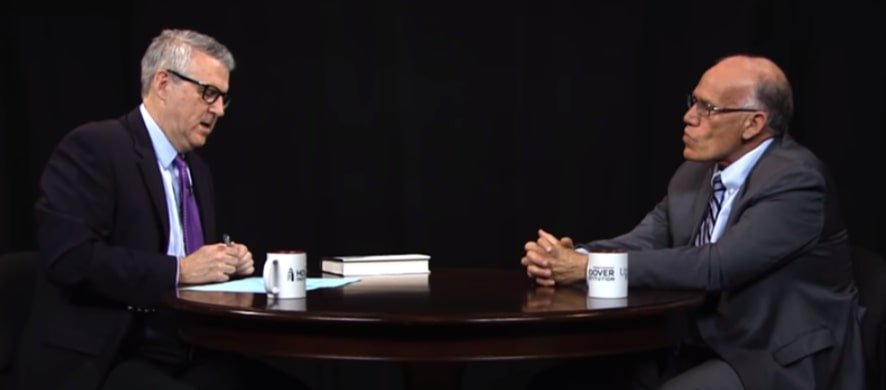
In this fireside conversation, Victor Davis Hanson sits down with Peter Robinson to chat about his motivation to write a book making a rational case for those voters who chose Donald Trump over Hillary Clinton.
PETER ROBINSON: Welcome to Uncommon Knowledge. I’m Peter Robinson. A fellow at the Hoover Institution Victor Davis Hanson is a classicist and military historian who has published more than two dozen books, including A War Like No Other, his acclaimed account of the Peloponnesian wars.
Dr. Hanson’s most recent work, The Case for Trump. Victor, welcome.
VICTOR DAVIS HANSON: Thank you.
PETER ROBINSON: You write, right here, of Donald Trump that he is… and I am quoting you Victor, “vulgar, uncouth and divisive”. You also write that you voted for him. Casting that ballot, how much regret, how much cognitive dissonance, how hard was that for you?
VICTOR DAVIS HANSON: Well, I have no regret. It was very easy, because the alternative was Hillary Clinton. And I did take him at his word that his promises would be largely kept or attempted to be kept. And then when I used those words in the larger context, I think I was comparing them to what…
PETER ROBINSON: To what?
VICTOR DAVIS HANSON: To JFK’s frolicking in the pool, to LBJ’s exhibitionism, to Bill Clinton… I don’t mind to mention Bill Clinton. But I think we have historical amnesia about what presidents are. I would have liked him to be a sterling morale, exemplar like Jerry Ford and Jimmy Carter but I am not sure there’s any equation there between that type of character and dynamic leadership… can all be wrong with Reagan after all, a sterling character and an effective leader.
PETER ROBINSON: All right. How Trump won? So The Case for Trump, you spend… there’re really a couple of cases in this book. One of them is the case for Trump.
VICTOR DAVIS HANSON: Yeah.
PETER ROBINSON: But the other is the case for the Americans who voted for Trump.
VICTOR DAVIS HANSON: Yes.
PETER ROBINSON: All right. I’m quoting you here… The Case for Trump: “Voters in 2016… 63 million of them… preferred on an authentic bad boy to a disingenuous good girl.” Explain that.
VICTOR DAVIS HANSON: Well, Trump was what he was and he had no pretensions that he wasn’t. So when he went to Fresno — he went to Tulare, California, he went to Maine, he went to Alabama. He had on the same jacket, the same weird tie, the hair, the everything.
When Hillary did it, it was you all down in Alabama and then she had a Harvard accent. When Obama campaigned he had an inner city patois. As I mentioned John Kerry put on duck gear when he went duck-hunting. Mike Dukakis put on the helmet, remember.
PETER ROBINSON: Yes, yes.
VICTOR DAVIS HANSON: But he didn’t –
PETER ROBINSON: …always the businessman from Queens…
VICTOR DAVIS HANSON: Queens accent wherever he was. And the other thing about him was he had a strange way that nobody detected except that people were informed of conveying empathy. So he said our…
PETER ROBINSON: “Our country”.
[read more]
VICTOR DAVIS HANSON: “Our vets”, “our workers”, “our farmers”. I can’t imagine Mitt Romney or John McCain who were supposed to be far more empathetic… and he went to… remember he went to West Virginia. I love big beautiful coal. Contrast that when Hillary Clinton said I’m going to put you out of work and shut down the industry. Obama had said the same thing.
So there was a way that he connected with the deplorables – the clingers, irredeemables, what John McCain called the crazies in a way that we didn’t really expect that he would given his background.
PETER ROBINSON: And then so there’s the personal authenticity but you also draw out his agenda. Again I’m quoting The Case for Trump: They — the 63 million people who voted for him — also preferred his agenda which represented “antithesis to the Democratic Party of Barack Obama which was increasingly candid in voicing socialist Broma.”
So it’s…
VICTOR DAVIS HANSON: There are moments when I think that all politics comes down to that old Henny Youngman gag, how’s your wife. That’s answer compared to what.
PETER ROBINSON: Yeah. So Trump comes across as authentic somehow where other this guy from Queens, this billionaire from Queens, seems to be what he is… there’s an authenticity that appeals to people in the middle of the country and at the same time the alternative is getting just unacceptable. Right that’s the argument?
VICTOR DAVIS HANSON: That’s the argument, and what we’re seeing now with permissible infanticide or reparations or Greendale or wealth tax or 70% income tax or Medicare for everybody or cancellation of everything, let’s cancel electoral college, let’s cancel ICE, let’s cancel all student debt, all of that stuff is a logical trajectory from the Obama administration. He was the one that took the party.
Remember when he was elected he had the most partisan record in the US Senate. So that’s the antithesis for Trump. It was with Hillary, it’s even going to be more so in 2020. And then he did something that nobody quite has analyzed… his agenda wasn’t some crazy outright. It was an 80% traditional Republican.
PETER ROBINSON: Yes, yes.
VICTOR DAVIS HANSON: Deregulation, lower taxes, repeal Obamacare, good judges, strict constructions. What was new… he looked at that electoral college and he tweaked four or five issues that the other 16 may have been for but they didn’t do it. And that was… you can’t have a sovereign nation with an open border. You can’t have immigration unless it’s legal, measured, meritocratic and diverse. Now that was a winning issue for those states.
Then he said if you’re going to go overseas, translate tactical success into strategic advantage, didn’t help you if you bomb Libya or Qaddafi out of power, or you’re bombing people in Afghanistan if it’s not resolved in our interest.
And finally he said you don’t need a magic wand to restore the interior. It’s not… remember Obama said these jobs are never coming back.
PETER ROBINSON: Right.
VICTOR DAVIS HANSON: He said they’re not only going to come back, they’re going to come back right away and in large part that was true. So that was a new message but he wasn’t the Antichrist Republican. He was a traditional Republican that took some issues, incorporated them within Republicanism and then looked at Michigan, Wisconsin, Pennsylvania, Iowa, Ohio, North Carolina and said you didn’t come out for John McCain or Mitt Romney because there was something missing in this menu. And I’m going to be the person who puts it back in.
And then finally one time…
PETER ROBINSON: Sure, sure, sure.
VICTOR DAVIS HANSON: It was a messenger too, because he was basically saying I’m crude and crass getting back to your quote at the beginning of our conversation. But he said I’m not playing by the Marquess of Queensberry rules. I’m ad libbing here.
But if Candy Crowley in the second debate tries to hide…
PETER ROBINSON: The second debate with Mitt Romney…
VICTOR DAVIS HANSON: Yes…. when she said no, no Governor Romney. Barack Obama’s correct here. He would have grabbed a mic like Reagan did. And he’s not going to say as John McCain did, I rule, I just don’t want to mention Reverend Wright. So Trump was saying I’m going to fight, I’m going to fight, there’s going to be a war room. I’m going to go after the left as they go after us. And nobody had seen that since Lee Atwater in 1988, with the tank commercial, the Willie Horton commercial…
PETER ROBINSON: George Bush was running for reelection…
VICTOR DAVIS HANSON: Yes.
PETER ROBINSON: Or running for election…
VICTOR DAVIS HANSON: Yes. And so that was part… I’m not condoning it or I’m not excusing it or not praising it. I’m just saying that at this point a lot of people would come out of the woodwork…. conservative Reagan Democrats, Perot voters, I don’t know what we call them Tea Party… if they thought somebody really wanted to win and that they wouldn’t get out ahead of the candidate, there was a lot of people said… if I support a Republican candidate they’ll know no sooner do I do it, then they say you shouldn’t say that, oh you’re too uncouth, let’s work across the aisle. Then the supporter has got the limb sawed off. McCain did that a lot to a people.
PETER ROBINSON: Jeb Bush… contrast Trump with Jeb Bush.
VICTOR DAVIS HANSON: Well, Jeb Bush said basically that I’m a sober and judicious leader. I have all the right requisites. I was governor… I meant from this dynasties, a great as nice person, he had some good ideas but he said things…
PETER ROBINSON: By the way he’d been a terrific governor.
VICTOR DAVIS HANSON: I think he was… and he was misrepresented.
PETER ROBINSON: Okay. All right.
VICTOR DAVIS HANSON: But I think he said illegal immigration was an act of love. I don’t think at the time that he ran, people wanted to go into Afghanistan, Iraq. Again I don’t think that they were into that adventurism anymore after Libya. I don’t think…
PETER ROBINSON: You mean…that they associated with his brother George W.
VICTOR DAVIS HANSON: Yes.
PETER ROBINSON: Okay.
VICTOR DAVIS HANSON: I don’t think… I think the Bushes, the Clintons… everybody thought globalization which is a good thing. It’s a westernization, it allows people in the Amazon to have glasses or penicillin gets too dark… dark islands. I mean dark in a sense they have no electricity or no civilization. So it’s good; it brings people up.
But it hollowed out the United States. It said anybody who has muscular or physical labor that can be xeroxed overseas will be xeroxed overseas, and that’s a natural Darwinian process. It’s good for you because it makes us all more efficient, we get cheaper stuff that comes in. And then you’ll have to find… learn how to code or go to the fracking fields.
And Trump said no, we got cheap energy. Our electricity is cheaper than theirs. We’ve got cheaper natural gas. We’ve got great workers. These were the muscles of America; they will be again.
PETER ROBINSON: One more contrast with a Republican whom he defeated in the primary, and that’s Ted Cruz. I can understand the argument as it applies to Jeb Bush, Marco Rubio that in a way they’re well-behaved, they’re genteel. And there was an… what people recognized in Trump was a fighter.
But Ted Cruz… he was also a fighter. How did Trump defeat Cruz? What did he have on Cruz?
VICTOR DAVIS HANSON: Well, Cruz is the last man standing in the fight for the nomination too. He’s the last man the Trump defeated.
PETER ROBINSON: That’s not an accident. So the two people of that seventeen person feel that…
VICTOR DAVIS HANSON: As you’re suggesting that were the most combative and wanted to take the argument to the enemy so theoretically. I don’t mean actual enemy. But so the adversaries were cruising… Difference was Trump was a professional reality TV star. He made his money in Repartee.
I’ll give you an example. The first debate… Rand Paul was… there’re certain things I like about Rand Paul. He said you’re the Nexus basically. I’m paraphrasing… you’re the nexus between money and influence.
PETER ROBINSON: He said that to Trump?
VICTOR DAVIS HANSON: Yes, right. Trump looked around, how do I get out of this one? And he said yes I am and you came up to my office and I brought you out a check for $10,000 and we got along perfectly after that. Ted Cruz would have not said that. But that’s what Trump… because you don’t really say that about somebody and he’s basically saying to Rand Paul, you did something as unethically as I did, when you’re supposed to say neither one of us would ever do anything on ethically.
PETER ROBINSON: Right, Trump was… this is a guy who actually wrestled in a wrestling mat.
VICTOR DAVIS HANSON: Yes. And so his idea was there’s nothing I can do that is going to embarrass me and that was baked into his support with his voters.
PETER ROBINSON: All right. According to Victor Davis Hanson, “Donald Trump’s most enduring significance is that he understood those in between — The case for Trump — This is on the state of the country when Trump was elected elitists not subject to the ramifications of their own policies ruled from on top, the subsidized poor answered them from far below… both those on top and the subsidized poor, both barely disguised a shared disdain for the struggles of those in between.” Explain them.
VICTOR DAVIS HANSON: Well, what I was trying to say is that almost every issue there was a virtue signaling component by which the Advocate assumed that because of his influence or power or superior wisdom or ally, he should be as I said exempt from the ramifications on ideology. Take walls… border walls.
Everybody’s against border walls but yet if you and I were to drive two miles out in a flow… we’d find…
PETER ROBINSON: People community after another… yes
VICTOR DAVIS HANSON: We can go up to Nancy Pelosi’s state, we can go to Mark Zuckerberg state…
PETER ROBINSON: If we can’t get in.
VICTOR DAVIS HANSON: If we were going to talk about cutting off water so that the fish could habituate the Sacramento or San Joaquin River, we wouldn’t do it with Hetch Hetchy water that comes to this area, that you just don’t do that. We all believe in the public schools, the bedrock but not for my children. They’re going to go over…
PETER ROBINSON: Hey, I just want to back up, so the Hetch Hetchy… the water that’s being used that were in the Delta…
VICTOR DAVIS HANSON: That we’re drinking right now…
PETER ROBINSON: That comes from Hetch Hetchy. And no good liberal here in Northern California would suggest putting fish in it. Only water to revive the fish population comes from the farmers.
VICTOR DAVIS HANSON: Yes, those are for little people in Fresno.
PETER ROBINSON: Got it.
VICTOR DAVIS HANSON: And the same thing about private schools, the whole Avenue. So he comes in and he says… the Trump comes into this great swath in between and says people are lecturing and virtue signaling and using you, not just economically politically or socially but psychologically. By that I think he meant, although he wasn’t explicit, he was saying that… and we saw this with the College Admission scandal recently… that the people who are most likely to say you have white privilege, you have white privilege, you have white… have it themselves.
And they point to other people that don’t, so some person of the Oklahoma diaspora…
PETER ROBINSON: In the Central Valley.
VICTOR DAVIS HANSON: Yeah, in Bakersfield who’s the grandson of a welder or a son of a carpet, he didn’t have any white privilege .And yet he’s told all the time he has white privilege. It’d be much better for his admissions to be one-quarter Hispanic or half African-American or any type of a minority classification or of a larger white class… white class I mean if he was wealthy he could go to SAT camp, he could call people up. He could do what these people did. That was the…
PETER ROBINSON: [inaudible] scandal.
VICTOR DAVIS HANSON: Yeah… or if he had more money he didn’t have to do the tawdry avenue, he could go straight through the front door and say here’s ten million dollars for that builder. So that’s what he was trying to say, he was saying to these people you’re the forgotten people. You don’t have any privilege, you’re the losers of globalization. But you don’t have the romance of the poor and you don’t have the connections with a culture of the wealthy and they dumped on you and they dumped on you and they dumped on you.
And they talked about swapping you out, bringing immigrants in. I’m speaking literally. And so that was a resonant message.
PETER ROBINSON: How did he get that? The guy was raised… now he was raised in Queens but he was raised in a pretty wealthy enclave in Queens. And so there are a couple of mysteries here with Donald Trump. His parents were wealthy, as he was with… from the moment he was born… it’s not as if they made… he was born into a rich family. He went to an Ivy League school. He had one chance after another to turn himself into a pinstripe wearing, wingtip shoe wearing, very urbane polished rich man in Manhattan. And he did turn himself into a rich man in Manhattan.
He took his father’s real estate empire and continued it and put up buildings before he went into the casinos and then before he went into television, he was a builder. But he was always the guy from Queens and somehow or other, how does the guy… how does a rich kid from Queens which is what he is… a rich kid from New York identify because the grandson of a welder in Bakersfield…
VICTOR DAVIS HANSON: He was always an outsider and he wanted it to be successful… he found out very quickly and he could build the skate rink in Central Park or he could redo a hotel but he was never going to be fully accepted given the way that his father was kind of shady they thought a Manhattan I would say. He wasn’t a premier builder. He had a lot of tenants, apartment buildings of poor people, that accent, outer borough.
And then the second thing is that he was a builder. He didn’t make his money… if we look at the top 20 fortunes in America I would imagine 75% of them are high financed media and high tech. He actually built things. Well that meant that he needed to work with unions. He needed to know who the cement workers were, the tilers, the carpenters, the electricians. And people would say that as he walked around he actually liked those people, because he understood that he couldn’t do what he does without them.
So I think there was an empathy for those people in a way. At least he could talk to them, whether he was sincere or not I don’t know. But I do know that he developed an ease of being able to communicate with people from all different classes and that they did like him.
I talked to a New Yorker, pretty important person I guess. I asked him if you had a A to F list in New York and they’d probably do, where would the Trumps be? And it would be F.
PETER ROBINSON: Not an A List…
VICTOR DAVIS HANSON: And I don’t think he would… he may have been hurt by that. I don’t think ultimately he’d care. So he was an outsider and he felt that the East Coast, West Coast, globalized coast to elite were talking to themselves. They had a certain Marquess of Queensberry rules, Republican of acting and campaigning and people in the middle said you can be amoral and be sober, injudicious; it’s not very moral to have no 3% GDP for over a decade. It’s not very moral to go overseas and take us and not translate that optional intervention into a strategic victory. It’s not very moral to have high minority unemployment.
And he hit on something. I don’t think there’s… I mean it doesn’t mean you’re going to be crass, you’re a good leader but he was just saying the two greatest people that we know as far as their sterling characters are probably Jimmy Carter and Jerry Ford back to back.
PETER ROBINSON: And they were fine men and ineffective presidents.
VICTOR DAVIS HANSON: Yes, it doesn’t mean there’s a connection but it does show you don’t have to be a saint to be an effective leader.
PETER ROBINSON: Okay. I wanted to part for a moment from Donald Trump and talk about you. You are a professional academic. You got a doctorate as a young man by writing a brilliant book on ancient Greece. You’ve produced book after book after book. Your book on the Peloponnesian wars was acclaimed everywhere it was reviewed even by people whose politics differ from yours.
And yet modern American academia is almost monolithic in its revulsion for Trump and one professional academic Victor Davis Hanson writes The Case for Trump. Okay, let me quote you: “I grew up and still live outside a small town in California’s Central Valley. In 1970, we didn’t lock our doors. In 2018 I have six guard dogs.” What did it mean to you living… continuing to live in Selma, that small town south of Fresno, and what was it that happened in Selma between 1970 and 2018 that made…
VICTOR DAVIS HANSON: How about this week… this week the last four days there were three miles from me somebody was driving, he made a U-turn in the middle of the road and killed somebody who happened to be Mexican-American and then he got out of the car and left.
Four miles north of town somebody ran a stop sign and hit a trucker, almost killed him and got out of the car and left. Last night two miles from me a man and the bicycle was shot and killed. I ride a bicycle. I used to around my area. So what I’m getting at is when you bring in a lot of people from southern Mexico, the poorest part and most of the people coming in our area are from Oaxaca. And they’re not legal and they do not speak English and they don’t have skills and they don’t have capital and they don’t have a high school diploma.
And you do it in mass, so they’re there not with Punjabis and African Americans and whites so they can integrate. We know what makes the melting pot work… measured, meritocratic, diverse immigration. Then you’re going to have a social economic problem and you’re going to need a lot of state help, education law enforcement, legal help, to give the semblance of parity. And it’s not going to work very well.
So what happened… and you combine that with globalization, and what I would call a [lattu foonia] with corporate agriculture, economies of scale and vertical integration. So what I’m saying…
PETER ROBINSON: So when you grew up… I just want to judge… when you were growing up you were which generation at that ranch?
VICTOR DAVIS HANSON: I was number five.
PETER ROBINSON: Fifth generation Swedes at that ranch in Selma and your mom and dad ran… what a couple hundred acres…
VICTOR DAVIS HANSON: 128.
PETER ROBINSON: 128.
VICTOR DAVIS HANSON: We all worked on it but here’s the point…
PETER ROBINSON: And that would have been a fairly standard size.
VICTOR DAVIS HANSON: It looked like a checkers board.
PETER ROBINSON: Every family ranches and family…
VICTOR DAVIS HANSON: …were on one side, the owners were on the other, the Israelians, the hazel hoppers, the artists… it was real diversity by the way. Mexican-American, Armenian American, Japanese American, Punjabi American.
PETER ROBINSON: And since that time…
VICTOR DAVIS HANSON: Nobody… they’re gone.
PETER ROBINSON: Two things have happened. One is globalization has made it impossible to run a family operation economically; is that correct?
VICTOR DAVIS HANSON: Yeah, I rent my 40 acres out to a wonderful man who has 12,000 acres of almonds. He’s a wonderful guy but he has 12,000 acres of almonds.
PETER ROBINSON: And so the family operation is…
VICTOR DAVIS HANSON: So what happened with all these houses, where all these houses are still there but they’re rented by people from Mexico. So one of across the street from me, the NorCal Hells Angels gang just had a shootout and it was wild. And I mean I won’t mention it because I don’t want to be shot. But I have three neighbors that are in gang, so that’s what happened.
PETER ROBINSON: And so the second thing is that you get this huge influx largely, substantially illegal. And nobody voted for that. To the contrary that takes place in defiance of the wall.
VICTOR DAVIS HANSON: Remember there was no principle to it. So when you go back and see Hillary Clinton and Bill Clinton and Chuck Schumer railing against illegal immigration, it was still a hundred thousand people a year and they were worried about undercutting wages.
And when Cesar Chavez was trying to organize agriculture, he went down…
PETER ROBINSON: Here in California.
VICTOR DAVIS HANSON: Yes, he went down at the border with clubs and tried to stop people from coming, because he felt that illegal immigration would drive down wages, and he was right. So all of this influx came and wages went down for workers. And as part of globalization employers liked it and the [Fruit Off Trailer] went, the Upright Harvester went, anything… the Del Monte can… went, they were all shut down or went overseas.
The middle class moved out. The people bought all the land on top, very medieval in California and then very cheap labor came in from Mexico and our South America. I have no problem with that but I really get angry about what changed Schumer and Pelosi and Bill Clinton was the idea there was now so many people, 20 million perhaps are Ivy League studies that… and the second generation…
PETER ROBINSON: 20 million in California or the country…
VICTOR DAVIS HANSON: Nationwide that came here illegally, another second generation, some case third generation and they’re going to vote Democratics, so they flipped California, they flipped Nevada, they flipped New Mexico in from a red to blue or purple to blue state. So it was a political decision, it wasn’t based on the merits.
Sanctuary cities became the gospel when they felt that that was a winning political issue. But it wasn’t based on a principle that people coming in should be illegal.
PETER ROBINSON: The name of the town again is Selma, your town, where five generations of Henson six now have lived. Selma’s remaining native poorer Whites ethnics and second and third generation Mexican Americans who would not or could not leave live in a town that has been transformed. Those changes were mostly a result of the laxity of immigration enforcement and import of expensive labor as you’ve just described and globalized trade policy which you’ve also spoken about.
Their once prosperous and stable community did not deserve to erode; something bad happened to decent people through no fault of their own. And because you lived there, you saw it with your own eyes.
VICTOR DAVIS HANSON: I did. And another thing I saw is that… and this is a heresy to say that some of the people who got hurt the most were Mexican American second and third generation. Because in their neighborhoods this influx went into their schools and suddenly they didn’t have very good advanced placement because a third of the student body couldn’t speak English or suddenly [inaudible] or M13 gang member would make fun of a second generation Mexican-American because he could not speak Spanish, or he’d call him a term in Spanish for sellout or Uncle Tom or something of that nature.
And so when Trump came along for all of the sensational racialized tension that we were supposed to think that he harbored for Mexico and Mexican Americans, 30% he did as well as Mitt Romney or John McCain and I have a feeling in the next election he could get thirty five to forty five percent of the Hispanic.
Well now that just seems crazy but when you talk to people in the ground they’ll say things like, I got very ill of… I got very tired of this family of gang members from Oaxaca. So I called ICE, so they deported them and now they’re calling me on a cell phone from Oaxaca and threatening me. What am I going to do? I hear that.
Or a person just said to me, I was in Walmart, he said did you read about this guy who just ran a stop sign and he hit a truck and then he took off. I said yes, the same thing happened to me. These are not Atherton residents. Atherton residents or Malibu residents want that system to continue. I mean I shouldn’t say that that’s unfair, they want the factors or the ideas or the principles that can lead to that to continue, the people who really sell –
PETER ROBINSON: They will pay no price.
VICTOR DAVIS HANSON: Oh they have walls, they put their kids in prep schools, they have guaranteed jobs. Yeah. But the people who suffer the consequences of those ideologies are often Mexican-American. And so I have a feeling that Trump is… I guess what we’re saying is that he’s trying to do something that nobody really thought you could do in America in the age of identity politics. He’s trying to redefine it as class differences and this is from a multi-million billion dollar guy in New York. He’s trying to say to African-Americans I got your wages up for the first time, three percent increase in working wages for the middle class.
I got minority unemployment down to record lows. Illegal immigration is not in your interest; it drives down your wages. Abortion is not in your interest. Abortion is much more common among Mexican American and black unwed mothers and it’s wiping out that community and we don’t want that. We want you, we need you. That’s a pretty strong message that we haven’t heard any politician or much less a Republican voice.
And so I think that even though he can be “coarse and crude”, there’s a certain populism that cuts across identity politics lines because it’s the old class argument, that you’re the forgotten people.
PETER ROBINSON: So you spent some time here. Of course, you published… you’re writing this book is he’s coming up on two years, two and a half years so there’s still time in the first term let alone any question about whether he’ll be reelected. So any reckoning has to be partial and so forth. But you think he did a pretty good job domestically.
I’m quoting you, The Case for Trump… “At home the economy in Trump’s first 600 days was better than any time in the last decade. Massive deregulation stepped up, energy production, tax cuts and talking up the American brand produced an economic upswing as evidenced by gross domestic product growth as a roaring stock market and record low unemployment.”
So two things to be observed about that. One is that’s a very compelling domestic record. And the second is that’s completely conventional Republican or conservative politics.
VICTOR DAVIS HANSON: I think it is. Except for the — we don’t know that effects, because he hasn’t lowered the trade deficit but he’s put allies, rivals and I should say enemies on notice that they’re going to have to reduce their trade surpluses and trade reciprocally.
PETER ROBINSON: So and now foreign policy, again The Case for Trump, “Abroad monthly incidents of Iranian hazing of US forces which were going on in the previous administration have remained nonexistent…”
VICTOR DAVIS HANSON: Yes, they are non-existent in the Straits of Hormuz. They’re not trying to shoot missiles at a carrier or they’re not trying to cut in front of a destroyer or they’re not trying to hijack a boat. So the question is why…
PETER ROBINSON: Because they’re scared of this guy.
VICTOR DAVIS HANSON: Because he’s unpredictable and they have no idea what he’s going to do. If Donald Trump… if tomorrow secretary John Bolton calls up Donald Trump and says the Iranians just shot a missile right across the bow of the George Bush, the carrier… I don’t know what he would do. You don’t know what he would do and neither do they and they don’t know.
So all the things he’s criticized in foreign policy of being unpredictable…unpredictability is an advantage in diplomacy.
PETER ROBINSON: North Korea?
VICTOR DAVIS HANSON: Well, I mean I was taken back when he said little rocket man but then… if you read those serial ghostwritten Art of The Deal books, it is to act unconventional to scream and yell but always they have in the back of your mind that you’re going to ask for 70%, 80%, 90 % of the deal, then take 55 and then praise your interlocutor. So no sooner did he do little rocket man than he was saying he wrote a love letter to me and he’s a great guy and the left went nuts. They hated him when he said he was… when he used a little Rocket Man, they hated him when he said Kim Jong-un was a good guy.
But what they didn’t get is that’s how Trump tries to deal to be unpredictable, to go back and forth. But the real question is have they curtailed their testing of missiles and nuclear devices, I think they have.
PETER ROBINSON: Israel… he moved the American… excuse me, we have to state this correctly. It has been a matter of American law that the embassy should be moved from Tel Aviv to Jerusalem, and Donald Trump is the one who simply did it. He fulfilled a statutory requirement that Congress enacted well over a decade ago. So he moved the embassy to Jerusalem but he did it in conformance with a law duly passed by the United States Congress.
What he has done off his own, though, is issue a statement recognizing Israeli sovereignty over the Golan Heights, shaking up the Middle East a little too much here.
VICTOR DAVIS HANSON: Well he got out of the Iran deal and he said that the Palestinians would not be getting money channeled to the UN from the United States and basically in 1947, 46, 48 there were 30 or 40 million refugees… there were Jews… they were refugees that were kicked out of the Middle East and sent back to Israel. There were 13 million Germans that walked back into Germany. None of those persecuted whether they’re Volga Germans and Russian… none of those persecuted groups today are called refugees.
So Trump came in and said I don’t understand what’s the difference. And so he did all of the things that everybody who said they were pro-Israel were going to do and then this is what I think there’s a tragic nature to this. As soon as he had done them, the people said well he has his fingerprints on those issues and I don’t want them now.
So a lot of the people who had supported these and I had read… I mean a lot of the Never Trump Right and said we got to move that embassy, we got to get out of that Iran deal, gotta get out of that Paris climate accord. We got to just recognize reality, the Palestinians idea of a refugee is all of a sudden Trump is too mercurial, Trump is too brash, Trump is sabre-rattling, Trump is unprofessional. And I guess it’s style over substance, I don’t know what creates the schizophrenia but we’re in a very strange time where the 10% of Republicans who didn’t vote for him or they’re never Trump elite, they’ve basically said all of the issues or most of the issues that I embraced for most of my life I can’t do it anymore, because Trump’s for them.
PETER ROBINSON: But so the argument of your book is a) that Trump understood millions of Americans who’d been effectively forgotten or overlooked even by Republicans; and b) that as it turns out that is not all that he did, that whereas many Republicans thought finally granted maybe he’s seen something, maybe he’s established a connection with the voters that the rest of us couldn’t. But he doesn’t know what he’s doing it’ll be a mess. And you’re saying that’s not the so. He has put together a very impressive substantive record. That is your argument.
VICTOR DAVIS HANSON: He has. I don’t think somebody… I mean I can’t think of a better Secretary of State than Mike Pompeo; he’s had two great national security advisors with — I won’t get into the Flynn, I have feelings on that, but HR McMaster and John Bolton. He’s got good appointments but… Jim Mattis, our former colleague at defense, what he was basically saying is the post-war order was pretty good but when we created it there was no German miracle, there was no Japanese miracle. Europe was destroyed; Russia was destroyed, China didn’t really exist as an economic power. There was no Japan Inc., there was no tiger economies; there was us.
And we could afford to take the hit, we could run up deficits, we could supply the world and we did that for… we intervened here, we intervened there, we kept the World Order. We kept patents, we kept copyright law, we made it possible to travel, to communicate, to ship, to trade, all within the aegis of American diplomatic and military budget and taking a hit with asymmetrical trade, because we were so rich and the world was flat. It was a wonderful thing we did.
All Trump said was, I’m not going to get rid of NATO. I just don’t quite understand why this EU economy which is about the size of ours, they can’t spend a measly 2% of their GDP on defense. And I can’t understand why Japan and Taiwan and South Korea might want not one to help and I don’t really think that 75 years after World War II I got a subsidized 71 billion dollar trade deficit with Mexico, a 65 billion won with Germany, they don’t seem to be particularly fond of us. That was just heresy .
I mean people just said he’s destroying NATO, he’s destroying the post-world War II. They just say I’m updating it.
PETER ROBINSON: Victor, here’s an argument that you’ll hear from the left but also from the Never Trump right. And I think I’m doing… this is the nasty thing to raise but you deal with it in the book and you’ve been getting hit with this, on this book circuit. So it’s the racism charge.
All right and here we have Gabriel Schoenfeld who’s a former Romney advisor, he’s writing in the bulwark quote: “Racism is America’s original sin.” By the way he cites Trump’s remarks during the Charlottesville incident and then he cites Trump this was during the campaign when he questioned whether a certain federal judge would be able to render a favorable opinion because he was a Mexican. I think Trump said… he met Mexican American but still he questioned his ability… to his impartiality because of his ethnic background.
Okay and then Gabriel Schoenfeld writes: “Racism is America’s original sin, yet with a drumbeat of racially charged remarks emanating from the White House, Trump has been setting the nation back to a darker time. Hanson’s treatment of trump’s odious lifelong record in matters of race, his sophistry in the service of a genuine evil.”
VICTOR DAVIS HANSON: No, he should be ashamed about remark Gabriel Schoenfeld said, because for two reasons. One, he didn’t read the entire text of what he said in Charlottesville.
PETER ROBINSON: Of what Trump said.
VICTOR DAVIS HANSON: Yes, he may have been sloppy, he should have understood the climate, the landscape, the geography of racial discourse. But he did say there’s this group and there’s Antifa and then there’s a good group who has a right to protest. And there’s this group, and he didn’t break down the percentages and there were white awful nationalists, and he said I don’t like those people. Read what he said and then there were other people that were good… and these are the people who objected to the toppling of statues.
In the case of judge Curiel, I said in the book that I thought you shouldn’t — my mother was a judge – you shouldn’t impair or you shouldn’t attack the efficacy of a judge, number one.
Number two, I live in an area that’s 90% Mexican-American. When I talk to people I said, you know Joe and now they will say to me, yeah he’s a Mexican guy. They don’t say he’s a Mexican American. They don’t call me a Swedish American. They don’t call another guy an Oklahoman American, they say he’s an Oak, that’s just the way it is. And Trump should have known that you don’t suppose to say publicly but that’s what everybody does.
Number two, Judge Curiel was a member of the La Raza lawyer. So when Trump clumsily said he’s in a Mexican group, he is. And I don’t think any judge would want to be a participant in the National Council of the race. And if I’m wrong, then the National Council of La Raza had no reason to change their name two years ago. Why did they change it? I didn’t force them to; you didn’t. They said you know what we don’t want to be in something called the National Council of the race. So they change it to Unidos. United.
And remember… and I mention this in the book and Schoenfeld knows that. That word came from Franco, Spain. It was reintroduced in the United States after it got… la Raza. I’m a Latin professor, it’s come from Roddicks. It doesn’t just mean the people or the tribe. As they say it means a racial component. Franco and Mussolini, twosies in Italian dropped that word in to say if you’re a Spaniard and you speak Spanish and you live in the Iberian Peninsula you’re still not Spanish, unless you’ve got racial purity. And that’s where the Chicano Movement picked it up in the 60s.
And finally, Mr. Schoenfeld should remember where we are in the political discourse. Joe Biden said — and I will collate what Joe Biden and Harry Reid said about Barack Obama — he said he’s the first candidate that can speak without a negro dialect.
PETER ROBINSON: Biden said that of Barrack Obama.
VICTOR DAVIS HANSON: He said he’s clean. What does that mean? We’ve had a candidate that ran for president. I remember Barbara Jordan, there was no more articulate brilliant speaker but to say that Barack Obama was the first time — and that both Reid and Joe Biden said that.
Joe Biden went in and said they’re going to put you all back and change. You think that a crowd of African American community would even allow that to happen, their freedom was dependent on their own initiative and US law. But to say that in pander racially… Bill Clinton said you know it was quoted, he said Barack Obama would have been serving us coffee.
So what I’m getting at is that I got — when Trump went into these racially charged arenas he shouldn’t have said anything. But if he’s going to say something what he says should be looked at the transcript of what he actually said. And then what is the allowances for slang for adhoc repartee. I don’t know what it is. But he didn’t say, as Barack Obama did, a white community they cling to their guns or he didn’t say it was own grandma. She’s a typical white person or his personal pastor — personal pastor of Barack Obama, president of United States.
I’d like Mr. Schoenfeld to explain this to me. Why did he say the Reverend Jeremiah Wright… I can’t talk to Obama anymore, because them Jews won’t let me speak to him. And he had a long history of anti-Semitism. Why did it Barrack Obama allow himself to be photographed with Louis Farrakhan, an absolute racist and anti-Semite. So if we’re going to get down and adjudicate everybody’s pedigree of everything they’ve said and everything they’ve done, let’s just do it. I’ll be happy to do it. I think it would be great and I’ll criticize Trump but I will also criticize Joe Biden and I will criticize…
PETER ROBINSON: So your argument is that at a time when racial pandering does take place, Trump is guilty of making mistakes of speaking loosely but he is not a racist.
VICTOR DAVIS HANSON: I don’t think he is. I think that when he went down… I’ll give you an example. When he went into Palm Beach all of the powers-that-be did not want him to build that more Lago Country Club. One of the reasons he did is, Trump didn’t really care who came into it as long as they were wealthy. If you were Cuban American, if you were Jewish American, Trump loved you.
In fact, the more money the better. And I don’t think his critics realized that Trump is a plutocrat. Money is the standard by which he judges success and failure, not race. You can criticize that but he’s not a racist.
PETER ROBINSON: Victor, Trumpism… is there a legacy, is there something of permanence building here? The state — I’ve got to read a couple of long-ish quotations but they set something up that’s important. Not surprisingly, you being you, you deal with important matters here.
The state of the Republican Party before Trump as you write in The Case for Trump, the idea of protecting customs, tradition, and the continuity of a broad land owning and small business middle class had been essential to classical republicanism from the Romans who built the Republic to England’s working-class citizens who resisted European revolutions. In such a conservative tradition, the hallowed and vibrant middle class was more grounded than the often self-indulgent rich and more careful and common sensical than the poor. You’re talking about Republicans, yet you’re talking about the conservative tradition that reaches all the way back to the Roman Republic.
Now among Republicans — this is as Trump comes along — there was no longer a viable social and cultural conservatism of the sort outlined by Edmund Burke or embodied by Ronald Reagan himself, a self-made man from the Midwest. Okay, in Republican dogma nothing was static, nothing sacred, the quaint idea of a sixth generation family farm like yours as something of intrinsic value to grounding regional society depended only on how wise each generation was in adapting to market reality, summed up brutally the Republican position meant that for the market to enrich society there would have to be winners and losers.
Okay, so all of that is actually quite movingly pudding, you being you, you’re the historical illusions, this is all very very powerful. But here’s what it comes down to maybe. What it comes down to is Trump saying, the Hansen family farm has value and I grant you that. So I will now deploy the coercive powers of the state in behalf of the middle class, of small business owners and of rural Americans.
And once Trump says that, and if that becomes the Republican position, then the difference in principle between the progressives and the Democrats who have their interest groups, the teachers unions, the urban poor and so forth, there’s no difference in principle. They have their interest groups and Republicans and conservatives have their favorite groups, and it’s just slugging it out every four years to see who’s going to be able to grasp the apparatus of the state and deploy it on behalf of their interest groups. Where is the national interest in this?
Okay. You see the argument.
VICTOR DAVIS HANSON: I do. You’re describing the EU and France, it’s a controlled economy and it’s got anemic growth and it impoverishes everybody in its effort to preserve these provincial towns.
It does… and here was the idea in the United States that we get 3% GDP by not doing that. And Trump comes along and says we’re going to get 3% GDP and I’m going to deregulate and I’m going to push tax cuts. And I don’t care how many wealthy people… that’s what he did.
But along with that, I’m not going to control — turn us into France but I’m going to say I’m going to force our jawbone or persuade companies that shut down to go outsource or to offshore or foreign companies that don’t play symmetrically, I’m going to — and I’ll give you an example from personal…
So I was farming, it was $1,400 a ton; 1982.
PETER ROBINSON: A ton for raisin?
VICTOR DAVIS HANSON: Yes, I was…
PETER ROBINSON: In 1982…
VICTOR DAVIS HANSON: And I was farming a hundred and twenty acre farm, and all of a sudden, the EU was on the horizon and the Greeks got subsidies. So they were telling German bakers and Dutch bakers if you buy our raisins we’re going to be part of your community. Let’s start these and they got about a 400 or 500 dollar subsidy.
PETER ROBINSON: They are cutting you by 30% all of a sudden,
VICTOR DAVIS HANSON: Yes, so nobody bought raisins and the domestic market was not a big enough for thing. So the price went from 1400 to 400. And that meant that everybody within…
PETER ROBINSON: All in the early eighties.
VICTOR DAVIS HANSON: Yes, ‘83 to ‘86 and this was during the Reagan shakeout, Paul Volcker get rid of the stagflation. So everybody was destroyed. I mean it. I saw people kill themselves. I saw alcoholics, my family would eventually go broke.
Okay, I talked to some people from the Republican Party and they said this to me, and a person from the raisin board from Washington. This is good for you, Victor. So why is it good for me? You’re going to be more competitive so the persons who survive will learn how to make $400 raisins. And then they won’t be able to sustain that subsidy, as one day Greece will go broke, they were kind of right 30 years later with the EU. And then you’ll be more… the consumer will have cheaper raisins and I said actually the consumer I doubt because the middleman will take up the profit, we’ll all be dead. And the only person that can make it on 400 is vertically-integrated that has packing and trucking and can subsidize the actual farming law.
PETER ROBINSON: This is just what happened.
VICTOR DAVIS HANSON: That’s exactly what happened. But what I’m getting at is you could have had a balance a little bit about, it destroyed the entire community. It wiped out families; people left. I saw things… I wrote a book about it: Fields Without Dreams and I don’t think that that creative destruction at all cost needs to be the mantra of the Republican Party. They can say we know free-market economics, is the only thing that works, market capital; we’re going to do that.
But we understand the dislocations that are involved, and when they are involved we’re going to pay psychological attention, cultural attention, political attentions to the losers and make sure that they’re not losing. We’re not going to write off the middle of these.
PETER ROBINSON: So you accept the markets, you accept there will be winners and then losers. But you’re going to help the losers.
VICTOR DAVIS HANSON: Yeah, I think the Republican Party has basically said the Democrats have a monopoly on helping people who are victims and will just make the economy better for everybody and all boats will rise and will win. But they hadn’t won. In five of the last six elections they hadn’t won the popular vote. They hadn’t won 51% since 1988.
This is why they were winning at local and state and 1000 offices during Obama but they couldn’t win at the national level because they nominated people like Bob Dole… and I love George W Bush but they nominated the Bushes and they nominated… I mean he did win… we didn’t win the popular vote once and they nominated John McCain and Mitt Romney and the message that was transmitted to Michigan and Ohio and Wisconsin, rural Minnesota, rural Illinois was that you guys are losers.
And you know what I think a colleague of mine, he said the answer is getting a pickup and go frack, just pull up stakes. That’s the good American. Go east or go south young man. I understand the logic behind it but it didn’t have to come off that way. And they didn’t get it, they thought themselves. Trump is so crass, he’s so crude, he’s so uncouth. There’s no way in the world that he will appeal to these in a way that that’s John Kasich voters, that’s Scott Walker’s voters.
And I had written a column, I said this is ironic, he’s going to out populist those two guys who are really populace who came from the middle classes and he did, because they were not voicing…
PETER ROBINSON: Somehow Donald Trump’s message is in some way it’s the same message as Ronald Reagan: vote for me. I’m one of you.
VICTOR DAVIS HANSON: Yeah, I think it is and I think that’s what… I wrote the book to do two things: to tell the deplorables and the irredeemables that there was a logical case historically and analytically for their vote. And two, to tell people on the left and right just put away your prejudices and your stereotypes and ask yourself how a person for the first time in American history without political or military experience, one without calling up the Council on Foreign Relations, without consulting the Hoover Institution, and what does that say about person’s empathy and credentials?
It says a lot. It means that people that were coming out of Yale Law School or Harvard Business School or Harvard Law School and were praised for their judicious and their erudite speech and their sober and judicious comport man and their resumes, they couldn’t get 3% GDP. They couldn’t win in Afghanistan. They just couldn’t restore the middle… I’m not saying Trump will do all that. But that was what the message that I was trying to get out. It’s a paradox and irony. I still don’t have the answers completely after writing the book.
PETER ROBINSON: Last question, Victor, Trump is tragic hero.
VICTOR DAVIS HANSON: Yeah, well I’ve been criticized for that. Clint Eastwood’s inspector Dirty Harry Callahan cannot serve as the official face of the San Francisco Police Department — you’re talking about the movie here — any more than Donald Trump could appear presidential in the fashion of Barack Obama.
“But Dirty Harry has the skills and ruthlessness to ensure that the mass murderer Scorpio will never harm the innocent again.”
So you are arguing from Dirty Harry and from High Noon and from Greece Spain and… they’re not all the same. Obviously I try to get as many different archetypes as I could from history and literature.
PETER ROBINSON: And George S Patton…
VICTOR DAVIS HANSON: And what I’m saying is that in Western societies, consensual societies, they reach periods of crises where the established norms… now I’m not talking about doing something illegally or unethically but the established protocols cannot really marshal itself against an existential threat.
So then within their ranks there are people who they would never consult in times of leisure and peace and affluence, that come to the fore. If we didn’t have George Patton on the Third Army we would have not got to the Rhine almost in September. If Curtis LeMay had not run the B-29 program it would have failed. If Shane had not written in there wouldn’t have been, I saw Buster community, Jack Palance would have taken over the whole thing.
But the very solutions that they offer and that can be successful come with a baggage of an outsider and uncivilized and uncouthness that as they become more successful, the community for the first time has the luxury to say, you know what, GDP is pretty good, unemployment is pretty good. I wish Trump wouldn’t tweet so much. I just don’t… I don’t feel comfortable with that.
PETER ROBINSON: I said that was the last question but I told the lie. This is the last question. The Case for Trump… he’s going to pay and you say he’s going to pay. Trump will end in one of two fashions, neither particularly good, either spectacular but unacknowledged accomplishments followed by ostracism when he’s out of office and no longer useful, or less likely a single term do to the eventual embarrassment of his beneficiaries as if his utility is no longer worth the wages of his perceived crudité.
He wins a second term but at the end of that, he’s gone and ostracized or he might not even win a second term, he may be driven from office in 18 months.
VICTOR DAVIS HANSON: I said that it was less likely that he would not win. I think he will win. He’s had his polling where Barack Obama and Bill Clinton were at this time, he did better in the Senate in the house and both of them did. His polls are about… as I said about the same. He’s running against a weaker agenda than Hillary Clinton’s…
PETER ROBINSON: The Democratic Party…
VICTOR DAVIS HANSON: Yes they’re farther to the left and he has a record and the Mueller investigation thing for all practical purposes is over with. But that being said even if he is elected, I think he will be, he’s not going to be invited to a post presidential funeral cadre. He’s not going… the next president is not going to say you know I called up George W Bush in his 80s, I called up Barack Obama and I called up Donald Trump for advice… it’s just not going to happen. And that’s partly because of the way he is and partly that he did things that you were not supposed to do, was almost we’d rather not be successful and fail or be static in a particular way of comportment accent behavior.
And I think that paradox also explains one final thing of the tragic hero, Sophocles Ajax’s whines all the time, why didn’t people understand I was a best guy after Achilles. Shayne kind of looks around so it’s time I got to get out of this place. Trump wants… he’s obsessed all the time with why doesn’t he get credit. He’ll tweet and say great GDP, media doesn’t say anything. He’ll even say things like if I was a Democrat millennia would be the new Jackie Kennedy.
And the tragic hero can’t quite fathom why his record of success is never given the proper recognition, because to recognize that, they would have to look at themselves and say I’m not part of the community that I tried to help. And one of the reasons that… and I’ll finish with is…
PETER ROBINSON: So he’s an outsider even now.
VICTOR DAVIS HANSON: Yeah, one of the reasons that we do this is Trump success whether we like it or not is a referendum on the status quo credentials of a president. And the class that produces presidents and the class that produces wise men and experts. And what Trump is really doing whether he knows it or not is saying all you guys that get up and get on a tractor every morning, all you guys that work in a shop, all you long-distance truck drivers I think you have a lot more expertise and common sense than a guy with a bunch of letters after their name, PhD, MBA and that’s a very scary idea.
PETER ROBINSON: Victor Davis Hanson, fellow at the Hoover Institution, classicist, military historian and the author of The Case for Trump. Victor, thank you.
VICTOR DAVIS HANSON: Thank you.
PETER ROBINSON: For Uncommon Knowledge, the Hoover Institution and Fox Nation, I’m Peter Robinson.
[/read]
Related Posts
- How to Stand Out in an AI World by Thinking Better, Not Faster: Sol Rashidi (Transcript)
- Modern Wisdom: w/ Alex Petkas on True Story Of The Odyssey (Transcript)
- Reconstruction: Malcolm Gladwell Interviews Barack Obama (Transcript)
- Transcript: “How to Win Without Crushing Your Soul” – Graham Weaver
- Why Early Legal Action Matters After a Cryptocurrency Investment Scam