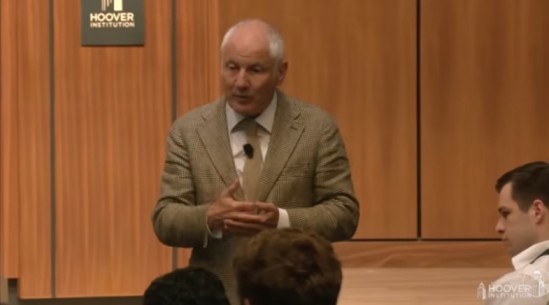
Editor’s Notes: In this insightful discussion, historian Stephen Kotkin examines the internal pressures facing American global leadership, identifying social media’s impact on national cohesion as one of the country’s most significant modern challenges. He draws parallels between today’s digital landscape and the historical disruptions caused by radio and television, arguing that a free society must once again learn to assimilate transformative communication technologies. Beyond technology, Kotkin explores the necessity of social solidarity and a shared national narrative to ensure the long-term resilience of U.S. institutions.
TRANSCRIPT:
Grand Strategy and America’s Direction
AUDIENCE QUESTION: So you outlined the American grand strategy that dominated for a long time — containment — and also referenced the Bill Clinton “We’re going to hold a contest to see who can define a new grand strategy, and enlargement wins out.” It’s replaced by the war on terror. Right now it seems like America doesn’t have a defined grand strategy. Could you speak to the importance of grand strategy, strategic planning and direction? Because even if America is on decline, it may seem to be adrift.
STEPHEN KOTKIN: Yeah. Thank you. So when I said containment was the strategy, that was half the strategy. The other half was invitation and into the U.S.-led order on a voluntary basis. So one half was an American sphere of influence that was open and voluntary, and the other half was containment of a non-voluntary, coercive, closed, hierarchical sphere of influence known as the unfree world. So the two pieces went together.
The war on terror and episodes — enlargement remained the strategy vis-à-vis China and Russia during what you’re referring to as the war on terror episode. And that enlargement has now failed. People recognize it’s failed and they’re looking for something else. And we’re now in this.
The Social Media Challenge to Free and Open Societies
So here’s our problem. Our problem is we have no idea how to manage social media. That is the biggest problem in the United States today. We’re a free and open society and we have to assimilate this new phenomenon, new technology called social media.
So I do history. We have radio, and radio bursts through, and these people could just broadcast into your living room and they could just say anything. They could make stuff up and nobody could stop them — right into your living room. It was the end of civilization. And the authoritarians — Mussolini was good at radio, and Goebbels, the Nazi regime, was good at radio. And it turned out that it wasn’t the end of civilization, that democracy was able to assimilate radio. We got Roosevelt. Roosevelt was our radio president. He mastered radio. Now you can like or dislike Roosevelt, but we were able to manage this breakthrough into our living rooms of radio.
And then it happened again. And this time it wasn’t just audio, it was images — it was television. And again they could just broadcast right into your living room, and nobody was in charge. Who could stop them? And these images that were manipulating people — good American people — were being manipulated by the images. And it was the end of civilization. “Oh my God, how are we going to deal with this?” And it turned out we got Kennedy.
Now we’re in the third version of this — social media. And again, they can just say anything and nobody can stop them. And not only are they broadcasting into your living room, but everyone is a publisher now. Everyone is the publisher. They can publish. They all have their own TV channels that they own. It’s on their phone and they can say anything and nobody can stop them. What are we going to do? It looks like the end of civilization. Maybe it is this time, I don’t know.
Psychopaths, Narcissists, and Political Engagement Online
But here we are. How do we assimilate, as a free and open society, social media? And we’re not managing that really well. It’s terrible. There’s a new study I read yesterday morning that psychopaths and narcissists are by far the most politically engaged online. It’s a really rigorous study with controls. It’s a fantastic study. It’s the first, I hope, of many along these lines. But social media has empowered psychopaths and narcissists in ways that they couldn’t get empowered before.
So when I was growing up, there were these things called militias — sort of paramilitaries, self-assigned paramilitaries. And they would have these typewriters. I wrote my PhD dissertation on a typewriter at first. And they would do carbon paper in between so that they could make five copies. And they would mail the copy of their newsletter, their anti-government newsletter. They’d mail it to some PO box in Utah hoping that they would pass it on.
Well, now they have a Facebook page. And every single militia member in the United States knows every single other one. They’re all friends. They all communicate in real time. They know exactly who they are and where they live. They’ve overcome the collective action problem through social media. On January 6th at the Capitol, every single militia member in the United States was present — except for the ones in jail — because they had organized through social media. All 3,000 or 4,000 of them. We have 340 million people and we have several thousand militia members. I know it’s a joke, but it’s not a joke.
Algorithms, Business Models, and the Limits of Free Society
And so how do you deal with that? What’s your answer to that? Prohibition? Censorship? Shutting them down? Voluntarily, they could change the algorithms. They could have the algorithms emphasize moderation — “let’s be moderate.” The algorithms could emphasize happiness rather than gloom and doom. They can do that. It’s just a tweak of the algorithm. They’re private businesses. They decide that outrage, falsification, anger, paranoia — that that’s a better business model.
And in a free and open society, you can’t come and say, “I’m sorry, your business model — I don’t like it.” Maybe if you’re President Trump, you can do things like that, but most politicians wouldn’t have the nerve in a free and open society to do things like that.
And so you’ve got a problem. How do you be free and open and how do you assimilate social media? We have no idea. And it’s wreaking havoc through our society in ways much greater than radio and television. Although there’s a continuum — it’s a radicalized or more extreme version of that continuum. And until we figure that out, we’re going to be in this state that we’re in now.
There are a lot of other parts to this — we’ve lost the national story and how we’re interconnected, the civics problem. There are many other pieces to this that I could go through, but the social media one is the core.
Social Solidarity, Trust, and the Strength of Society
But again, we’re a free and open society. That’s the most important thing to keep. You lose that, you lose everything. So you’ve got to stay free and open and you’ve got to manage the social media. Again, social media is very empowering to a lot of people. People who, for example, had children who had certain special needs and felt alone and unable to cope — now they have huge coping structures and communities to help them through social media that they didn’t have before. So it’s not all dark, it’s not one way, but it is definitely a challenge to a free and open society.
So I hope you guys figure that out because it’s a tough one, and it’s much bigger than the geopolitics because it’s about the internal cohesion of your own society. All successful societies are based on two things and two things only: competent and compassionate leadership, and social solidarity and trust. Once you lose competent and compassionate leadership, all you’ve got left is social solidarity and trust — the strength of your society, your self-organized, free and open self-organized society. Once you destroy social solidarity and trust, what do you have left? So that’s a big one for you guys to figure out.
All right, we’ve got another question. Someone give the microphone to whoever. Oh, you’ve got it already?
Foreign Interference and the Open Society
AUDIENCE QUESTION: Yes, thank you, Professor Kotkin. So I’m a bit lost because I was originally going to ask you something that is also about social media. So I am a bit of a YouTube fan of yours. And I’ve heard you make this point again and again that America is going to be fine, that parts and politics may shift this way or that way. I believe that was when you were asked about the current administration.
But this is the first time in history when hostile foreign actors actually have direct access to — just like contact with — the average American voter’s mind. You just go onto Twitter and like every five posts is going to a Russian bot. So now we have basically foreign interests among us. How is that going to play out with, say, our value of keeping a free and open society?
Foreign Influence vs. Domestic Vulnerabilities
STEPHEN KOTKIN: Yes, thank you. That’s another great question. So here’s what I would try. This is my entry point to try to get at that one.
When we have problems, we’re more vulnerable because we’re open. But that’s okay. That’s all right. If a spy from a hostile power joins my Hoover history lab, you know what they’re going to discover. We love history. Okay, come on in. Come on right in.
Let’s flip it around, though. Let’s flip it around. There are some serious issues with espionage and penetration of our society. A lot of spies are not captured on purpose because that’s how they’re followed. Once they’re identified secretly, we don’t want to haul them in. We want to let them do their thing so that we can follow them. We have that everywhere, including on this campus. Yes.
And then there’s the problem that you alluded to, which was penetration of the society and shaping people’s minds in the society. And the foreign influence compared to the domestic influence is miniscule, as it was with the Russian Facebook stuff. If you look at the number of people who were not Russian on Facebook compared to the Russians on Facebook, the Russians bought $100,000 worth of advertising on Facebook in 2016. If you look at the ratio of one to the other, we’re doing this to ourselves much more than outsiders are doing this to us.
But that’s not really the key issue for me. The key issue is, what about them? What about those adversaries that are trying to penetrate us? And you know what they look like? Their regimes are illegitimate. They’re illegitimate. Their people don’t like them, and they’re afraid of their people.
The Illegitimacy of Adversarial Regimes
You know, when China had zero Covid. Right. China had zero Covid. That was a big moment. Why? Because an individual, she knew that she didn’t like Communist Party policy on zero Covid, but she didn’t know what everybody else thought because she couldn’t find out. There was censorship. And asking neighbors about it was, let’s say, dangerous sometimes.
But what the zero Covid did, it revealed to all those people who were unhappy that they were not alone and that there were other people in the society that had the same anger vis-à-vis the government that they did. And so zero Covid, unwittingly, the Chinese regime performed a referendum on itself. And it taught its population that not just one person, not just five people, but many, many, many people didn’t like the Chinese regime. And so that’s a moment you can’t put back in time.
Once people see that, these regimes, they help each other, they teach them authoritarian techniques. Okay, you call civil society actors that get money from abroad foreign agents. We’ll do that too, right? So they teach each other. The one thing they can’t do for each other is to supply political legitimacy one to the next. They cannot supply each other with the key missing ingredient.
And so every day is existential for these regimes. They are illegitimate. They govern predominantly through force and intimidation, as well as opportunism. Yes, they have nationalism. Yes, many people love their country. But when push comes to shove, these regimes are vulnerable to their own people, to their own illegitimacy.
And so they can interfere in our society, and we’re vulnerable to that. And they can try to manipulate us and we can debate the scale of their manipulation. And maybe that’s the cost of being a free and open society and we just have to deal with it. Maybe there are ways that we can combat it better. But on their side, even if we don’t penetrate their information ecosystem, they remain vulnerable on a day to day basis.
And so as long as we remain true to our values, as long as our institutions continue to function, as long as we continue to invest in what made us successful in the long term, we have nothing to worry about vis-à-vis our adversaries, even if they’re penetrating our information space and attempting to manipulate our politics.
Political Landslides in Historical Perspective
Politics can look like a big deal every day. Presidents can look really important. Let me give you a countervailing view on that. What have been the landslides in American history, political landslides in American history at the federal level?
Well, there was Roosevelt. That was the landslide, one of the biggest landslides ever. That was really consequential. Roosevelt’s landslide empowered him to remake America for better or for worse. Again, I’m not telling you what politics you should have. So that was pretty big.
Then there was Lyndon Johnson’s landslide. Yeah, you don’t remember. In 1964, Lyndon Johnson had a landslide, not quite on the scale of Roosevelt, but pretty big against Barry Goldwater. And in 1968, Lyndon Johnson didn’t even run again. He was gone. And Goldwater, who was completely crushed, well, that was the next landslide and it was called Reagan. Similar policies to Goldwater, and instead of being on the receiving end of the landslide, he was on the giving end. And you can argue that Reagan’s presidency was also consequential.
But there was another landslide in the middle there and it was Richard Nixon, and he had a massive landslide victory. And he was gone too. So we’ve had four landslides, two of which have vanished into nothing — Lyndon Johnson and Nixon — and two of which have been really consequential — Roosevelt one way and Reagan the other way.
Are we having a moment like that now? Hell no. Nothing like that. Nothing systemic at that scale? Absolutely not.
The Current Administration and Its Limitations
We don’t even have a Trump administration. There is no administration. It’s just two thumbs. That’s all it is. There’s no interagency process. There’s no National Security Council. The State Department is empty. The Pentagon E Wing is half empty. Marco Rubio has six jobs.
Scott can tell you he was on the inside. What process or processes were lacking in the first Trump — there was quite a lot of process in the first Trump administration. Scott was in charge of some of those processes. There’s no process now. This is not an administration. It would be good if we had a Trump administration, then it wouldn’t just be two thumbs, there’d be follow through implementation. Right now it’s chaotic on purpose.
So it looks consequential because you’re living it. And to me, studying long term trends and structures, penetration or manipulation of our domestic scene like you asked for, or the role of any individual president, this stuff can vanish in the ether, as consequential as it looks in real time. Lyndon Johnson, Richard Nixon, as opposed to Roosevelt and Reagan.
So where’s the next Roosevelt-Reagan moment? That’s really a question that I’d be more interested in. Again, I’m not suggesting that the penetration of our public sphere is inconsequential or that we should do nothing about it. It is consequential and we should do something about it. But I’m weighing things in the scales. I’m doing the long term trends and I’m not seeing the kind of impact that some of the other things that I study are having. But again, we can disagree on that.
We got another one or two. I don’t have the mic to give you.
Polarization, Demonization, and the National Story
AUDIENCE QUESTION: Thank you very much, Dr. Kotkin. Those are really interesting. I’d like to kind of follow up. I know you referenced the loss of the national story and social solidarity and things like that. And so I agree, economically, militarily, there aren’t very strong signs of decline. But in sort of that cultural sphere where we don’t really agree on what America is, what the purpose of America is, is that a sign of decline? If it is, how do we fix that? And what does it mean for the global order if there is such division among Americans and what the purpose of America is?
STEPHEN KOTKIN: Yeah, thank you. That is the big one. So I’m not afraid of polarization. It’d be weird if America were not polarized. 340 million people, you’re going to have everything under the sun, far left to far right, and everything in between, including crisscross. That’s always been true of America that we have been polarized in our views.
The difference now is demonization. Demonization is not polarization. Demonization is: we disagree and you’re evil and a threat to the American way of life. Or I’m evil and a threat to the American way of life and therefore I have to be eliminated. That’s demonization. That’s not polarization. That’s different. That’s what we’re involved in now.
So people talk about polarization. I was at Berkeley. I was a PhD student at Berkeley during the Reagan presidency. I mean, come on, you’re going to tell me that we’re having a heated political argument and we disagree and we’ve lost the national story? The answer is, yeah, I remember that well.
Historical Context: The 1970s and Political Violence
I remember the 70s — again, not the happiest epoch. Donna Summer and John Travolta. It was pretty horrible. 1,800 firebombings in America in the 70s. 1,800. You can Google Patty Hearst. That was one of the most infamous. 1,800 firebombings. College campuses were full of not just anger, but of arson. It was a different time in America.
Now the arson, the anger is virtual. It’s on social media. There’s not nearly any level of political violence, let alone assassination, that we had in the 70s. So again, like Secretary Rice said, everything is unprecedented if you don’t know history.
So it’s troubling. A degree of it is natural, is expected in a 340 million person country. It’s always been the case. We fought a Civil War where 600,000 people died.
You want to understand Trump, you go read H.W. Brands’ biography of Andrew Jackson. Best book on Trump I’ve ever read. H.W. Brands’ biography of Andrew Jackson. Andrew Jackson abolished the Federal Reserve. Forget about appointing some hack to be head of the Federal Reserve — which, by the way, has a lot of problems with Trump. The problems are real. It’s the solutions that are sometimes dubious. But the problems that he’s identifying, he’s very talented at identifying the problems anyway.
So I’ve been down this road. That doesn’t mean I’m happy where it is now. I don’t like the demonization, and the demonization is also a social media phenomenon. But the social media space is different from firebombing real people, if you see what I mean. And so in some ways we’ve diverted that anger into the phones or onto the airwaves or into the ether. And again, I’m not happy with that, but I’m not overwhelmed that that’s the problem.
Reclaiming the National Story
The larger problem is just what you alluded to. The national story. What is the national story? What is the purpose of America? Where does America fit in history? Who are we as a people? That problem is a self-inflicted wound. We’ve done that to ourselves. We did that at universities, we did that in the culture, wider culture. We’ve continued to divide ourselves and emphasize the divisions rather than emphasize the commonalities.
The most amazing thing to me is that it’s the immigrants who know the answers to how American institutions work because they have to take the citizenship test. And it’s the people born here that are clueless because they don’t have the civics, they don’t take the citizenship test.
So like Secretary Rice said, national service is one really big and important idea to regain some sense of a national story as well as purpose, to bring that back. You don’t paper over the divisions. The divisions are real and they’re not something to be wished away, but they could be assimilated into a larger narrative of things that we share and why we’re here. And we’ve done that before, so we could do that again.
Thank you for your attention. I think I’m done.
Related Posts