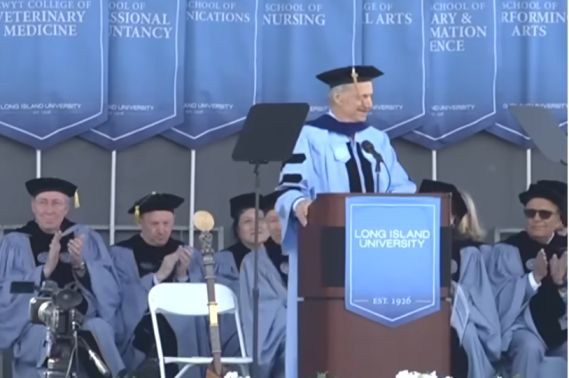
Read the full transcript of billionaire investor Ray Dalio’s speech at 2026 Long Island University Commencement.
Editor’s Notes: In his Long Island University commencement address, billionaire investor Ray Dalio connects with the graduating class by reflecting on his own graduation from the school 55 years prior. He candidly shares his journey from being a rebellious student on academic probation to discovering his passion for the markets, a transformation that eventually led him to found the world’s largest hedge fund. Dalio uses these life experiences to prepare the graduates for adulthood, emphasizing his core philosophy that encountering painful mistakes and reflecting on reality is what truly drives personal progress. To set them up for success, he pairs his wisdom by gifting the entire class copies of his book Principles and access to Transcendental Meditation lessons.
TRANSCRIPT:
RAY DALIO: Thank you, President Cline. Thank you, Dean Bates, [Dean Pallaro]. Congratulations to the class of 2026. Congratulations also to all the parents, the grandparents, the brothers, the sisters, and all of the family and friends who have been with the graduates through their journeys. There is nothing more valuable than meaningful relationships. Please give each other an enthusiastic round of applause.
Why This Moment Matters
I’m thrilled to be your commencement speaker because it’s an opportunity for me to tell you who I view as myself 55 years ago, what I’ve learned in the 55 years since I’ve graduated from LIU that hopefully will be of some help to you.
While I remember being where you are when I was 21 years old, graduating in 1971 from what was then called CW Post College, I don’t remember who the commencement speaker was or what he said, and I suspect that you won’t remember that later in your lives. But all I remember was nursing a hangover from celebrating the hard night before and being elated at graduating and reflecting on how hugely LIU had an impact on my life in improving my life.
A Rebellious Student Who Found His Path
You see, I got into LIU on probation because I was a lousy high school student with a rebellious nature. I remember hating high school because it seemed to me that most of my education consisted of teachers forcing me to memorize what they wanted me to remember, which included a lot of useless stuff, and it didn’t help that I had a very bad rote memory.
At the same time, I loved playing markets, which is where my attentions went. I got hooked on playing markets when I was 12 while working as a caddy at the Lynx Golf Club, which was not far from here. The stock market was hot, and the people I caddied for would walk around with me, and we would talk about stocks. So I took the money that I earned, and I put it in the stock market.
The first stock I bought was the only stock I heard of that was selling for less than $5 a share. I thought I could buy more shares so that if they went up, I’d make more money, which was a dumb strategy. The company that I bought was about to go bankrupt, but I got lucky. Another company acquired it. It tripled in value. I thought this game is easy, and I became hooked on playing this investment game at 12.
Finding a Love of Learning at LIU
So at the time when I came here, I hated school, and I loved playing markets until I got into Post. I loved being here because I could take classes that interested me and engaged me in quality thinking, and I did well. And so I went on to Harvard Business School, which was another eye-opening learning experience.
The Gift of Meditation
When I was 19 and a sophomore here, I learned something that I found even more powerful than my formal education. The Beatles went to India to learn to meditate, and they raved about it, so I learned to meditate, which has been invaluable to me. Meditation gives you an equanimity, aligns your subconscious with your conscious mind, and it is also restful and healthy. It also gives you a sense of spirituality.
What I mean by a sense of spirituality is connection to the whole. You have a sense of connection of where you are within the context of the whole. So as a graduation gift to those of you who want it, I’m going to give you lessons in transcendental meditation. It is the most valuable gift that I can give anyone.
What 55 Years Has Taught Me About Life and Success
Over my 55 years since graduating, I’ve learned a lot about how life works and how to deal with it in order to be successful, including what being successful really is. I learned that life is a journey of discovery in which the goal is to understand your own nature and find the right path to suit you. In that, there is nothing more important than having good principles to guide you. By principles, I mean ways of handling certain situations.
Over my lifetime, I’ve accumulated hundreds of principles, which is far too many to cover in this 15 minutes that I have with you, so I’m giving you also my book, Principles, Life, and Work, which I hope will help you find the right principles for you and to get what you want out of life. You can find it below your seat along with the card to sign up for the meditation.
I think I’m going to put this down and not struggle with it.
The Three Phases of Life
So it seems to me that you are about to travel along a similar life path, a similar arc in life to the one I’ve traveled on and most people travel on, experiencing the same phases and having many of the same encounters I had, so I want to tell you what to expect and give you some tips.
Looking back on my and others’ lives, I came to see that life unfolds in three big phases that are very different from each other.
In the first phase, you are learning and you’re dependent on others. In the second phase, you are working and others are dependent on you. And in the third phase, which is the phase where I am, you are free from obligations and able to pass along what you’ve learned.
The second phase, which you are about to enter, is more opposite than similar to the first. Rather than being in an education program and having instructors, you will guide yourself to achieve your goals and you will encounter thrilling opportunities and painful setbacks, which, if you reflect on well, will teach you what you want, what you’re like, and how to be successful. You will learn that thinking for yourself, making painful mistakes and learning from them, and knowing how to deal with what you don’t know is what is most valuable.
Entering Phase Two: The Next 10 Years
In the early part of this second phase, which will be about your next 10 years, the most important thing for you is to experiment and reflect well so that you discover your nature and what is the path that is best for you.
When entering this phase two, you are almost certainly making the mistake of thinking you know more than you actually know, especially if you got good grades in school. You don’t yet have a clue about what life is really like and you don’t yet know what being successful really means for you, let alone what to go after and how to get it. You couldn’t possibly know these things because you haven’t yet experienced or thought about what you will encounter.
In the first phase, your teachers and parents typically led you to believe that success is a matter of learning what you were taught and not making mistakes. And you were taught to take pride in what you know. That probably made you a bit arrogant, like I was a bit arrogant when I graduated from here. But it is living life and encountering your realities that will teach you. The question is, will you learn well?
Learning From Painful Mistakes
My nature and encounters with realities led me to become a professional investor, which led me to start an investment firm out of my two-bedroom apartment. While I ran it for 50 years, built it into the largest hedge fund in the world and then passed it along to the next generation, which many people consider a great success story, I know that it was learning from my painful mistakes that made me successful.
For example, when I was 34 years old and had run Bridgewater for eight years, I calculated that American banks had lent much more money to emerging countries than those countries were going to be able to pay back and that that would lead to a great debt crisis, almost the largest since the Great Depression. And it was a very controversial view. But in August 1982, Mexico defaulted on its debt and a number of other countries followed and we did have the greatest debt crisis since the Great Depression.
A Painful Mistake That Changed Everything
Because I had anticipated that, I was asked to testify to Congress and appear on Wall Street Week, which was the show at the time. I thought the stock market would fall a lot, but I couldn’t have been more wrong. The stock market in the economy went up rather than down and I lost so much money for myself and my clients that I had to let almost everybody go. And I was so broke that I had to borrow $4,000 from my dad to help pay for my family bills.
It was one of the most painful experiences of my life, but it turned out to be one of the most valuable experiences of my life because it gave me the humility I needed to balance with my audacity. Rather than thinking I’m right, I thought about how do I know I’m right and how do I find that out. That led me to find the smartest people who would disagree with me to understand their perspectives and have them, my own perspectives, stress test. It also led me to understand diversification, how I could reduce my risk without reducing my returns. In other words, I learned from that.
From that point on, my company, Bridgewater, did very well and it did well because what I learned, I never would have learned without that painful mistake.
Life’s Greatest Joys and Deepest Sorrows
My life journey also led me to meet and marry a wonderful woman who I’ve been married to for 48 years. It led me to have four children, which led me to have eight grandchildren who are the joys of my life. Such is life.
I believe that the most important decision in your life will be who you choose as your life partner. So that may be ahead, and that’s an important decision.
For me and for everyone, and will be true for you, there are lots of ups and downs along the way. Some unimaginably great and some unimaginably terrible. For example, I lost my son, which was worse than losing everything, including my life.
Pain Plus Reflection Equals Progress
What helped me through these challenges were two things. My meditation and my calmly reflecting on how reality works to get and write down the best principles for dealing with my realities. This habit changed my whole perspective on life. I began to see almost everything as another one of those, which happened to many people before in their own ways, and knowing that there’s a better way to deal for each one of those.
One of my favorite principles that I learned through these sorts of experiences is pain plus reflection equals progress. I got in the habit of viewing pain as a signal that I have a problem, which I view as a puzzle to solve that will give me a gem in the form of a great principle. I learned to value my painful experiences because they became my best learning experiences and led me to make my best advances.
I found that this approach to learning from encounters with reality to be a much better way of succeeding in life than remembering what others were trying to teach me. Those experiences and making the most of them, especially the painful experiences, are your opportunities.
What Does Success Really Mean?
Remember that you were born with a certain nature and you are on your journey to understand it and find what suits you. Knowing your nature is always critically important to helping you understand what success is for you.
People have different goals in life. So I can’t tell you literally what is best for you. But I can tell you that success is not having a lot more money or status than you need, though most people think that that’s what it is. And in fact, it can become an unhealthy obsession for a lot of people, so avoid that. Logically, having a lot more money than you need couldn’t possibly be a source of great happiness compared with the alternatives. For example, it isn’t more important than having the time and freedom to do what you most want to do. So what do I believe success is for most people?
I believe that it is a matter of having meaningful work and meaningful relationships. I’ll say that again, meaningful work and meaningful relationships. In other words, work and relationships that you are thrilled by. If you can make your work and your passion one and the same, and you can do it with people who you care about and care about you, you will have a happy, successful life.
Your Approach to Life
As you travel along on life’s journey, you have a choice of your approach to life. When life doesn’t give you what you want, you can be angry or sad for yourself, or you can learn about how reality works and develop principles that will work well to get you what you want.
I urge you to own your life and take responsibility to make it great. Think about how reality works. Be radically open-minded to hear how you can be better, and plan the moves to make in order to improve your life and make yourself a great life. And if you want to be really successful, recognize that you have to work damned hard at doing these things well. Excellence is worth it. That’s just how life works.
A Final Message to the Class of 2026
So the message that I want to leave you with today is that the most valuable thing you can have in the next phase of your life is not your diploma or even what you’ve learned thus far. It is your approach to life. If you take advantage of your experiences, good or painful, as opportunities to learn, you will find great principles that will help you deal with your realities well. In the process, you will discover your nature and find excellent work and excellent relationships that will suit you, which will give you the best possible life.
So class of 26, congratulations. Now get out there and count in your realities and your excellent sense of adventure. Thank you.
Related Posts