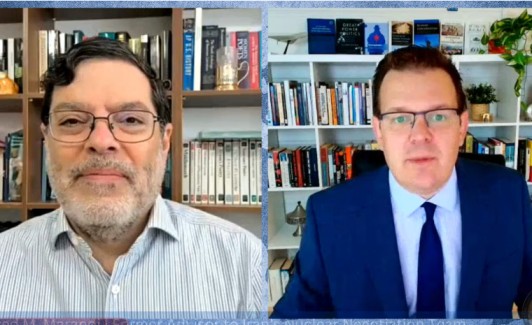
EDITOR’S NOTE: In this interview (August 30, 2026), Professor Glenn Diesen speaks with Seyed Mohammad Marandi, a professor at Tehran University and former advisor to Iran’s nuclear negotiation team. Marandi addresses Tehran’s warning that it could send Israeli Prime Minister Benjamin Netanyahu “to hell,” along with Iran’s plans to increase pressure on the United States in response to economic warfare and escalating regional tensions. The discussion covers the Strait of Hormuz, military capabilities, and the broader standoff involving Gaza, Lebanon, and Yemen. Read the full transcript of this interview below:
Introduction
GLENN DIESEN (00:00:00 – 00:01:14): Welcome back, everyone. Seyed Mohammad Marandi joins us today, a professor at Tehran University and also a former advisor to Iran’s nuclear negotiation team. Thank you for coming back on the program. I wanted to ask you today about the Trump administration. It seems to be very optimistic about this economic D-Day to incrementally squeeze the Iranian economy. And at the same time, we get all these messages now from the US Central Command arguing or claiming that they opened a passage for commercial ships on the Omani side of the Strait of Hormuz. And well, either the Iranians aren’t doing much because they can’t or because they decided not to, that they left that in the air. But the argument is that the leverage is now growing for the United States. And well, I guess yeah. Let me pack two questions in there. How accurate is this? But also, how may Iran respond to the U.S. if its economic pressures well, an economic war on Iran begins to take a real bite?
Iran’s Oil Exports and the Strait of Hormuz
SEYED M. MARANDI (00:01:18 – 00:06:39): It’s not really accurate what the Americans are saying. Iran does allow significant amount of oil to get through the strait, because there are countries that Iran is close to and it does not want to harm them. The Iraqis, they did not harm Iran during the war. In fact, the resistance in Iraq played a very important role in dealing with the aggression from Kuwait, from northern Iraq, the Kurdish areas where the U.S. and the Israelis have huge influence, and also in central Iraq.
So it’s not really something that the Iranians would want to do to block Iraqi oil exports. Or China, which is cooperating with Iran, has a very close relationship. They too take oil from the Persian Gulf region. And then there’s the unwritten agreements that exist between Iran and some of the countries in the Persian Gulf, such as the Emirates itself, where the Iranians and the Emiratis have very poor relationship. Obviously, the Emiratis helped the Americans in their assault on Iran, and the US continues to have a strong military presence there. But there are commercial aspects in the Iranian-Emirati relationship that are important for both countries.
So Iranians allow these small ships to take oil from tankers in the Persian Gulf. They load them all to these ships and then they go outside the Persian Gulf and transfer them to supertankers outside of the Persian Gulf, which is an expensive process and it is slow. You need many of these ships to fill up a tanker and it’s not really possible to do it for other goods. In other words, oil gets out this way. And by the way, Iranian oil is also being exported from the Strait of Hormuz. That is something that the Iranians want to do.
So you have these small ships, you have the Iraqis, you have the Iranians, you have the Chinese. That is going to be a substantial amount. But then amount of oil that in general flows from the Strait of Hormuz is substantially less than before the war, probably less than half of what it was. And now with what’s going on between Yemen and Saudi Arabia, the flow of oil from the Red Sea is not as high as it was, nearly as high as it was a couple of months ago. So perhaps about half.
So there is oil going to the market, including Iranian oil, but the shortages are growing. There’s no doubt about that. And in addition to that, the other shortages are accumulating even faster. Sulfur, the petrochemical products, the helium, the aluminum, the fertilizers. All the other goods that are produced, including fuel, because the refineries can’t export either. So diesel, part of the reason why there’s a shortage of diesel is not just because oil is, or diesel is so expensive, is partially because oil is more expensive, but also because diesel can’t be exported either.
So Iran is piling on the pressure, but Iran doesn’t want to create an imminent crisis for the entire globe, including its friends. So the pressure though is building on Trump and the United States. And you can see it from the bond market. You can see it with the yen. And it’s not just Russia. It’s not just the Chinese who don’t want US bonds. And the Japanese who need to sell their US bonds.
The countries in the Persian Gulf, they no longer have that excess wealth that they constantly send to the United States to purchase bonds, stocks, assets, to participate in the AI industry. And that money doesn’t exist anymore. And actually it’s vice versa. It’s the other way around. These countries are going to have to start selling their bonds and assets in the United States if the United States allows them in order to sustain themselves because they are very dependent on oil and gas. So they just cannot continue to exist without high expenditure rates.
Iran’s War Economy and Military Preparations
GLENN DIESEN (00:06:41 – 00:07:43): Yeah, well, I heard that’s one of the reasons Bessent was pushing this asset swaps with some of the Gulf states so their economic problems wouldn’t be offset by selling the US bonds and then, you know, start a cycle of unraveling everything.
SEYED M. MARANDI (00:07:45 – 00:10:36): Well, the government is shifting towards a resistance economy or a war economy, and a lot of money has been invested in the military. I’ve spoken to a couple of people in the military who are quite knowledgeable about the general situation, and they been saying that Iran is much more prepared today for war than it has ever been before, and that Iran, militarily speaking, is stronger today, substantially stronger today than it has ever been before.
So they are increasing their underground bases, the numbers of bases, and they’re expanding the existing bases. They’re building missiles and drones at a very high pace. Their R&D is very active. The missiles are becoming increasingly precise and more difficult for the United States to bring down. So the advantages with Iran, because Iran is capable of building missiles and drones very rapidly, whereas the United States has big problems in developing anti-missile systems and building up their own missile capacity, even though they’re spending infinitely more money than the Iranians.
So Iran is prepared for war, but I think it’ll depend on Trump and what they do. If they target the Iranian economy, try to strangle it, then yes, I think the Iranians will definitely use their military to increase the pain for its adversaries. Now, whether it’s to gradually or swiftly shut down the Strait of Hormuz quickly, shut down the Strait of Hormuz completely, or make it more difficult for ships to pass through or decrease the number of ships that are allowed to pass through, or whether they’ll even go further and strike, let’s say, Fujairah and block Emirati exports from that port, or ultimately block Saudi Arabia from exporting from the Red Sea, or bomb US assets in the Persian Gulf region, let’s say their AI centers, their banking sector can easily be hit.
And everything I think will depend on Trump, because if he tries to strangle the Iranian economy, then Iran will have no option but to retaliate.
Iran’s Threats Against Netanyahu and Israeli Leadership
GLENN DIESEN (00:10:39 – 00:11:44): But in the wider war though, you also see, I guess, a very unique character of this whole war was the United States going after the political leadership in Iran. Some would say that this is a big step in terms of normalising this kind of warfare. That doesn’t mean this is new. As we know, the US has gone after leaders before, but given that this war was intended to be a decapitation strike, a regime change, it was quite deliberate the way they went after killing a lot of the leadership. And there’s been a lot of speculation in media. I mean, in American media, there’ve been arguing that the Iranians might go after Trump or Barron. Others suggest that Netanyahu might be on the list. But again, one shouldn’t get too carried away with what appears in the media. So, well, I wanted to ask you, I guess, do you see something Iran might do, something similar against either American or Israeli leaders?
SEYED M. MARANDI (00:11:46 – 00:13:53): Well, the new chair of the Supreme National Security Council had an interview with Al-Manar TV, which is a Lebanese TV channel affiliated with the resistance, with Hezbollah. And he said that this talk about Trump’s son is just nonsense produced by the Zionists in order to create fear and terror. Iran wouldn’t have nothing to do with anyone who has no role to play or had no role to play in the war.
I think he also said that there’s been no move to unseat Trump or to remove him permanently from power on behalf of Iran. But of course, that doesn’t mean Iran doesn’t believe he deserves to be put on trial. Obviously, from the Iranian perspective, he has to be put on trial and he has to face capital punishment like all other war criminals.
But the chair of the Supreme National Security Council in that interview said that sooner or later, Iran will send Netanyahu to hell, which means obviously that Netanyahu is going to be targeted by the Iranian armed forces. And I would assume if Netanyahu is going to be targeted, then his senior colleagues who were involved in the war and the genocide in Gaza, that they too are considered as legitimate targets by Iran. And this situation has been created by themselves by assassinating people in Lebanon, assassinating people in Iran, assassinating people in Gaza and in Yemen. So they brought it upon themselves.
GLENN DIESEN (00:13:55 – 00:14:28): Is it mainly Netanyahu then, or do you think there could be a wider targeting of leadership or key officials? Or because I’m thinking back over the, not just over the past years, but the decades, the Israelis have had some very intrusive assassination campaigns, not just against political leadership, but nuclear scientists. And do you see Iran going down similar path? Or do you think assassination of Netanyahu would be the extent of it?
SEYED M. MARANDI (00:14:30 – 00:15:54): Oh, the Israelis have assassinated all sorts of people, artists, writers, intellectuals, religious figures across the region. They have a history of murdering people who are of any influence, whether political or cultural or educational or technological.
But what Dr. Rezaei said, the person who he named was Netanyahu. I’m speculating that that would also include other senior people like himself, simply because they’ve also assassinated other serious senior Iranian leaders, the previous chair of the Supreme National Security Council, the former foreign minister, senior military officers, senior researchers, academics, colleagues of mine, they’ve been assassinated.
So I think when Dr. Rezaei speaks of Netanyahu, and I’m just speculating, I think it’s probably not going to be limited to him. And it will include others as well. But that’s not what he said.
The Path Forward: All-Out War or Managed Conflict?
GLENN DIESEN (00:15:56 – 00:16:36): Well, it’s just taking a step back now that you see all of this uncertainty in the military development, but also the United States having depleted much of its weaponry. It seems to, you know, take this into account by focusing on more economic pressures on Iran. I think this would have to be delicate because on one hand, they want to squeeze Iran, but too much, then the Iranians would fight back. And how do you see this conflict evolving from here on? Do you think we’re going back to something like an all-out war in the near future, or do you think both sides would like to keep this at some moderate level?
Iran’s Strategic Calculations and the Escalation Ladder
SEYED M. MARANDI (00:16:39 – 00:21:28): Everything depends on Trump. When the 12-Day War began, the objective obviously was to undermine Iran. They wanted to overthrow the state and they failed. And instead of learning their lesson, they went and brought in everything they had and started this war. And of course, in both cases, they used deceit, in that they were negotiating with Iran, pretending to be serious about negotiations, although Iran knew what was happening. They weren’t blind. They could see the troop movements and so on.
But in this war, they failed too. Then after 40 days of failure, Trump demanded unconditional surrender. And after 40 days, he was the one who effectively surrendered and accepted the Iranian 14-point plan as the framework for negotiations. Then he started the siege warfare. Well, then he accepted a ceasefire. Netanyahu carpet bombed Lebanon. And instead of putting pressure on Netanyahu, he supported Netanyahu. And thus the ceasefire fell apart and we had siege warfare.
He began siege warfare, but after over 2 months, he failed. So he was going to strangle Iran back then. And then he had to accept the MOU. And he spoke about Herbert Hoover and the Great Depression to justify why he signed the MOU. But of course, and he personally signed it, but despite that, he was never serious. He restarted the war. We saw 13 days of fighting and then Iran responded. And then Iran took the initiative after the US stopped and continued to strike the United States in Jordan in particular. Showing that Iran is not going to wait for the United States to set the pace of confrontation.
So anything is possible. Trump is erratic right now. He’s waging a new form of warfare. Tomorrow he may move in a different direction. But also the Iranians have said that because the United States is, at least theoretically, at least Bessent is saying that he wants to overthrow Iran and strangle the Iranian people. The Iranians will have to use force if this really happens. They’ve said that. They said that US interests, economic interests will be destroyed across this region. That the only way that can be done is through Iran’s military capability and also the ability of Iran to further restrict the passage of ships through, big and small, through the Strait of Hormuz. And then Iran’s allies could also intensify their efforts in the Red Sea.
So it all depends on Trump. But I think, I don’t think it’s Iran’s policy, but I think that Iran does have an eye on the US midterm elections. And if I was an Iranian leader, I would probably assume that that is what they’re looking at. They want to make life tough for Trump in the next 2 months. I mean, till I think it’s November the 3rd, in the hope that after the elections, the anger of the American people are reflected in those elections, even though the Democrats are not any better than the Republicans, but the hatred for Trump is immense and the supporters of the Democratic Party are anti-Israel now and anti-war. That would put more pressure on Trump, and make life much more difficult for him and thus change perhaps the situation in the region.
So I think the next 2 months will be interesting. And then you have Netanyahu who seems to be losing in his election campaign so far. And that may push him to start another war because he is a desperate person. The whole, the last 3 years, almost 3 years now, all these crises have largely been about Netanyahu and his desperate attempts to remain in power so he won’t be put on trial. So Netanyahu could start a war. Trump could start a war. The Iranians could start war. Everything is possible right now. If I was a betting man, and thank God I’m not, I wouldn’t be betting on anything in particular.
Why Iran Hasn’t Struck the American Blockade
GLENN DIESEN (00:21:31 – 00:23:26): I did want to ask though, one thing that many people are curious about is why Iran isn’t attacking the US blockade. That is, blockade is an act of war. And this is Trump’s great pride, this “wall of steel,” as he calls it. I think he exaggerates this to a large extent, but something interesting happened, was it, yeah, 6 days ago on August 24th, that is Yemen, they launched missiles and they struck a Saudi tanker about 117 kilometers west of the Saudi port of Yanbu. And I thought that was interesting. That is, this ship was moving. This is a very, very far distance away from Yemen, and they were able to strike a moving ship this far away. And again, this is Yemen, and I’m assuming that the Iranians have vastly better technologies and capabilities.
So it would seem to me that the Iranians have the ability to strike the American ships. But let’s say, for argument’s sake, the Iranians do not have these capabilities. We still haven’t seen any real efforts to try to do it, which makes me suggest it’s not the capabilities, but rather it’s the intentions of the Iranians, which is why we haven’t seen this yet. And again, that brings me back to my question. Why? Why hasn’t Iran attempted to strike the American ships? I’m not advocating for anything here. I’m just trying to chart out the thinking here. Well, again, you’re not part of the Iranian government, so I— but what do you see being the thinking of the Iranian government here?
SEYED M. MARANDI (00:23:28 – 00:28:12): Well, the escalation ladder has many steps, and I think that the Iranians do have the capability to strike US naval ships, and they have struck US naval ships during the previous period of— it wasn’t a ceasefire, but a halt in hostilities. The previous siege, like 4 or 5 months ago, you recall that the United States carried out an operation to open the Strait of Hormuz. And the Iranians did strike 2 or 3, I’m not quite sure, US ships, but they struck them with drones. Why? Because they didn’t want to sink them. They wanted to tell the Americans that, look, we can hurt you badly. And so those ships, I think, were struck with multiple drones, not heavy drones, but they were struck and damaged. They were sort of approaching the Strait of Hormuz, and then they withdrew and never approached again.
Yes, my understanding is that Iran could sink US naval ships, but everything has its own place in the escalation ladder. And right now the Iranians could destroy a lot of US refueling jets, but I think that for the Iranians, the important thing is to win this war, but with minimal destruction for the region and minimal destruction of the infrastructure across the region. So Iran has the capability to go up the escalation ladder and very rapidly, very far. But so far they’re trying to do it in a way in which, when this comes to an end, the region can continue to provide the energy for the global markets.
This doesn’t mean that this will not happen. And I personally believe that we are entering the most sensitive stage of the war. Because if the United States really is seriously going to move to try to strangle Iran, then that means the Iranians will have to hit back very hard, and they’re going to have to wreck the US economy. And that would mean, of course, sinking ships, that would mean blocking ports, that would mean hitting oil installations. That would take the price of energy, it would increase very rapidly. And that would, I think, mean that the United States would respond, and then we could have all-out war again.
So this is not finished. When the Chair of the Supreme National Security Council says that sooner or later Netanyahu is going to be sent to hell. That means the expectation is that there will be violence. Netanyahu is not young. So my interpretation would be that the attempt to take him out is not some idea for the distant future.
Things are quiet, and I think many people have sort of moved on to other issues, sort of like the genocide in Gaza where every day they’re killing people. Literally right before our program, I saw that they killed this man who was moving food around in Gaza. Then, you know, it goes on. Last night they were busy, the Israeli regime, destroying forests in southern Lebanon and destroying villages and homes and bombing. But if one looks at Western media, you’d think that nothing is happening in Gaza and in Lebanon. But it is. The conflict continues, the genocide continues, the aggression continues, and the siege against Iran continues. So this could explode at any moment. If the Israeli regime, for example, were to carry out an assault on Lebanon, Iran would strike. There are many different scenarios through which we could see renewed war and all-out war very swiftly.
Diplomacy, the MOU, and the Road Ahead
GLENN DIESEN (00:28:14 – 00:29:43): If I would try to put myself in the shoes of the Americans though, I would think that the goal would be to create some incremental gradual leverage against the Iranians. But at the same time as trying to strengthen my position against Iranians, I would also want to push Iran out of the headlines. That is because it’s not a very popular theme in the United States before the midterms, which would be a very difficult balance to take. How would I grow the pressure on Iran all at the same time, yeah, make sure it doesn’t pop up in the news only in favorable terms, so don’t spark Iranian retaliation.
But given that you have to walk this fine line, and also that, as you said, all-out war could break out for many reasons, could be over Gaza, or Lebanon. So given all of this, what do you think is the role now for any diplomacy? Do you see anything coming? Would the US try to renegotiate the MOU, or how do you expect, putting yourself in the shoes of the Americans, how would you expect Americans to manage this period? Because they must know that the whole region is now a massive minefield, and they don’t necessarily want this to blow up right before the midterms.
SEYED M. MARANDI (00:29:45 – 00:33:17): Well, the Americans are doing exactly that. They are sending messages to Iran left, right, and center. Oman, Qatar, Pakistan, they’re constantly bringing messages. What it seems to me is that Trump wants to renegotiate the deal. So that he could say that he got something. But the Iranians are saying, no, you have to fulfill your obligations within the framework of the MOU in full, and we will accept nothing less. And not only that, there are certain things that you have to do as preconditions because you’ve already signed the MOU and you showed from day one that you were not serious.
And Western media tries to pretend that it was Iran that violated that, but it’s obvious that it was the other way around. The United States did not release Iran’s assets. It did not push the Israeli regime to end the genocide or to leave Lebanon. The United States continued to threaten Iran and Iranians. It expanded the sanctions. All of these were violations of the deal. And these were all done during the first week or two when the deal was being implemented by Iran.
And then of course, among other things, the most important thing that the Americans did was that they tried to cheat Iran through the MOU by undermining Iran’s authority over the Strait of Hormuz and creating an alternative route for ships or corridor. And in the MOU, it says Iran during that 2-month period will regulate shipping and normalize shipping through the strait. So what the Americans did alongside the Saudis and the Emiratis and the Kuwaitis and the Qataris was they tried to create this corridor to undermine Iran’s authority and then take away Iran’s leverage and not carry out any of its obligations and have a victory through deceit. Basically, that’s what the MOU was for. So the Iranians are saying, look, you signed the MOU and it was nothing but an operation to deceive Iran. So you’re going to have to fulfill obligations as preconditions for us to do anything.
That’s where we are right now. So the Americans are offering to do a deal with Iran, but the Iranians are saying, no, you have to do what you signed. You have to carry out what you were supposed to do in accordance with the MOU. I don’t think Iran cares if it’s done in the name of the MOU or in some other way, but those obligations have to be carried out. Iran is not going to allow Lebanon to remain occupied. It’s not going to allow the genocide to continue and have the trade through the Strait of Hormuz normalized. It’s not going to happen.
Now, the Americans can pretend all they want that they’ve normalized trade through the Strait of Hormuz. But if things are normal and if energy is going through, they wouldn’t be saying it every day that the trade is open. When a corporation every day comes out with a statement saying things are fine, our finances are good, don’t worry, that probably does not inspire confidence among shareholders.
Iran’s Strategy: Building Pressure on the U.S.
GLENN DIESEN (00:33:19 – 00:34:09): No, no, I agree. It’s whenever a country works this hard to sell an argument to you, there’s obviously something wrong with it. But the US though, it does appear that it’s trying to, again, to walk this careful line that they’re putting— they’re not going to end the genocide in Gaza, they’re not going to end the occupation of Lebanon, but it looks like the plan is let’s just put it on the slow burner so continue to move forward on these issues, that is, well, essentially wiping out Gaza as well as continuing, or if not expanding, the occupation of Lebanon, but not in such a dramatic fashion that the Iranians only would trigger an Iranian response. Yeah, it’s just going to be interesting to see if they pull this off. One other issue.
SEYED M. MARANDI (00:34:09 – 00:35:02): So what I can say, and I can’t say this for certain. But my understanding is that the Iranians are going to gradually, I mean, the plan is to gradually build up the pressure on the United States in the days ahead. And I think that would probably mean, that would probably include the Persian Gulf among other things. But, you know, we have 2 months till the US elections. And I think the Iranians take note of that fact that the Americans want to keep things quiet. So that gives Iran certain advantages, because if Iran makes life more difficult for Trump, obviously he will take note of that.
Turkey and Israel: A Brewing Conflict
GLENN DIESEN (00:35:06 – 00:36:19): Well, yeah, I wanted to ask this other conflict, which could erupt at any time, that is, well, it’s not as, I guess, imminent as all these other crises, but it’s the continuing conflict now between Turkey and Israel. Now, you and I spoke about this before, but how is this developing now? Because I would assume, again, if I was sitting in Turkey, I would be very worried that Iran would be knocked out by the US because then the Israelis have, well, more than hinted, they’ve been very explicit that their guns would turn on Turkey next. So it’s always good to have another demonized adversary in the neighborhood. But to what extent does this, I guess, impact the geopolitics of the region? And also, if the tables would be turned and things would worsen between Israel and Turkey, how would Iran position itself in such a conflict? Again, a lot of hypotheticals and speculation here, but nonetheless.
SEYED M. MARANDI (00:36:20 – 00:42:58): No, that’s a very important question. It’s a very good question. I have to be careful in my response, and I’ll explain why later on.
President Erdoğan is not someone who people trust, and one day he’ll say one thing, and then the next day he’ll say something else. One day he’ll be your friend, the next day he’ll be the friend of your adversary. And he’s cooperated with the United States in destroying Syria.
Western media and these Arab regimes in the Persian Gulf, their media empires would say that the Syrian government killed hundreds of thousands of their own people. But in reality, the destruction was largely due to the fact that it was a dirty war carried out by ISIS and al-Qaeda, which was funded by the West, funded by these Arab regimes, and of course coordinated largely by Erdoğan and less so by Jordan, the Jordanian regime.
So he helped destroy Syria, and of course he did it because he wants to expand his influence, but he did it in partnership with the United States. It was a part of Operation Timber Sycamore, and of course what happened subsequently, the Israelis were involved. Jordan was involved. The countries in the Persian Gulf were involved. NATO was involved.
So now he’s weakened his own position effectively because Syria was a strong country that stood as a barrier between Turkey and Israel. And now that powerful, that strong country is gone. And has nothing.
And Erdoğan had a much closer relationship with former President Assad than Iran did. They would go on vacation together with their families. Iran never had that sort of relationship. Iran’s relationship with Syria was much less significant. It was basically, though, the relationship linked to Iran’s support for resistance groups in Palestine and Lebanon. But so that is wrecked.
And now we have this situation. On the other hand, Erdoğan continues to transport oil from Baku and Central Asia to Israel, from northern Iraq, the Kurdish areas and Syria. I don’t know if that continues now, but that more or less goes to Israel. So most of the Israeli regime’s energy supplies go through Turkey. So there is a very strong business relationship between Turkey and Netanyahu and Erdoğan. That hasn’t ended. It continues.
So that causes a lot of people in Iran to be very suspicious about whether there’s really something important happening. I mean, if you’re going to— if you’re on the verge of war, those business relationships would probably be discontinued. You want to hurt your adversary. If he’s about to invade you, you don’t give them the fuel and the energy to carry out the invasion. So that creates suspicion among some Iranians.
So some Iranian elites don’t believe that this standoff is real. They think this is for show or saber rattling. It’s not really anything of real substance. There are those, of course, that view this as a possibility of war.
Iran’s Commitment to Defending Turkey
And regardless of what Netanyahu and Erdoğan, what sort of relationship they’ve had in the past, or present. If the Israeli regime attacks Turkey, Iran will go to the aid of Turkey, even though Turkey didn’t go to the aid of Iran, but Iran would go to the aid of Turkey. There’s no doubt about that.
And I sometimes see people online, people of influence who say, “Why should Iran do such a thing? Turkey, Erdoğan has done this.” It has nothing to do with Erdoğan, this, or any personality. This would be aggression. And the Israeli regime, just as when it carries out aggression, Iran defends Lebanon, it defends Syria, but the Syrian regime would like to cut off our heads.
So the Al-Qaeda regime, they’re not against Israel. Al-Qaeda has— does not, or ISIS has never had a history of attacking the Israeli regime except for once. And your viewers can look this up. Once Al-Qaeda, back when the Syrian government was, Assad was the president and the Israeli regime was helping ISIS and Al-Qaeda alongside its border. So alongside the Golan Heights, the occupied Golan Heights. And they’d give them financial assistance, ammunition, backup. Whenever they’d have fighting, they would be fighting with the Syrian government, they would shell or carry out airstrikes against the Syrian army.
But once someone from Al-Qaeda, from ISIS, I think, fired at the Israelis and they apologized. They apologized to the Israelis for the strike. And I kid you not, you can probably still find this on the internet. So ISIS and Al-Qaeda has never gone after Israel. And that I think says a lot about the nature of these organizations and where they came from and why they were created.
But if Syria wanted Iran’s assistance, Iran would definitely assist Syria. More so than Turkey under Erdoğan ever would.
Now, the reason why I have to be cautious is because the Iranian government has said, “You attack President Erdoğan a lot.” And so I’m trying to be nicer. Well, I was fine too. I look very nice right now, but no.
GLENN DIESEN (00:42:58 – 00:43:00): Well, that’s okay.
Distinguishing Leaders from Their People
SEYED M. MARANDI (00:43:02 – 00:44:58): But let me stress something. When I criticize President Erdoğan or Abdullah Jordan or Mohammed bin Salman, I’m not talking about the Turkish people or the Jordanian people. I’m talking about an individual and his entourage.
Otherwise, the people of Turkey are among the staunchest supporters of the Palestinian cause. Just like, as you know, I always, always, always defend Jews and some of the most heroic people who are resisting Zionism and the genocide are Jews. And they’re growing in number.
So when I criticize an individual or a government, when I criticize the West, I know that the American people oppose this war. I’ve seen the huge protests against the genocide across Europe.
Before, unfortunately, these very same governments in our region, including Erdoğan, before they went and joined that, what is it, the peace, in Egypt, the border peace, which I think was a major betrayal because the momentum against the genocide was growing across the world. And then they went and had this Board of Peace. They all praised Trump, whitewashed him and his crimes. And then that momentum across the world collapsed. But the genocide continued and continues as we speak. And these leaders all praised Trump and Trump praised them.
So there’s an enormous distinction to be made between Europeans, Americans, the elites, the Epstein class, Jews, Zionism, Muslims, ISIS, and so on and so forth.
Turkey as an Independent Geopolitical Actor
GLENN DIESEN (00:45:00 – 00:47:55): Yeah, well, now I think that Turkey is a very interesting actor though, because it obviously has this goal of being an independent pole of power, which means it has to take an independent position. It tends to link this with its own national interest. I think often that can make it reasonable and more rational, depending on the situation, of course.
When it comes with, you know, when the Russians want to deal with Turkey, they find it sometimes an easier actor because they’re prepared not to toe the line with the Americans and NATO. And this can be good at times because a problem you see in Europe is even though it’s the national interest to do something, the alliance solidarity, as they call it, which means do what Washington tells you, it doesn’t permit them to do so.
So Turkey, sorry, Germany being the key example, they will deindustrialize if necessary. But while Turkey, if it sees an interest in stabilizing the Black Sea as a national interest, then they will not necessarily take orders from Washington.
That being said, Turkey seems also very unpredictable and not very trustworthy as well. It’s as you said, a lot of the politics is this almost like Game of Thrones thinking. That is, you know, “We’re friends today and then tomorrow we’ll stab you in the back” kind of thing. And you’re going to see this in how its foreign policy has developed as well, because a key objective of Turkey was to have stable, good relations with its neighbors, and it kind of created a ring of fire for itself instead with just conflict with pretty much all of its neighbors now.
Iran’s Goal: Expelling the U.S. from the Region
My last question to you, though, was about how you see the Iran objectives regarding expelling the US from the region is moving along. That is, well, Iran is quite open about its goal. It doesn’t want what it’s seen the past 47 years to continue, that is the US bases in the region continuing to threaten Iran.
Now, if you would, I guess, translate this objective into measurable and observable variables, you would think, yes, getting rid of the US in the region or expelling it means getting rid of the bases, dismantle perhaps the petrodollar system, which ties the economic and security issues together in the region, and also wear down the alliance system.
And how is that progressing? I mean, how do you, in terms of wearing down the US alliance system, I’m not sure how that would be done, make it less in the interest of the Saudis, Qataris, and so forth to rely on the US, or how is this, how do you see the development or trend here?
The Decline of the U.S. Empire
SEYED M. MARANDI (00:47:57 – 00:51:51): I think it’s going ahead as planned. A lot has been achieved during this period. The foothold in the United States in Iraq is weakening very rapidly. And when the foothold in Iraq weakens, that means that they cannot be involved in Syria, because they use Iraq for Syria. And so now you see that they’ve withdrawn their support for the Kurdish militia in Syria. And their support is said to be on the decline in Iraq. Their forces are being forced to leave Iraq gradually.
There are conflicting reports as to the status of US forces in Iraq and, what’s going on in the northern part of the country in the Kurdish areas. But in any case, the foothold is definitely weakened. And of course, all US bases and CIA bases, very important CIA bases have been destroyed in northern Iraq, in Saudi Arabia, across the Persian Gulf, and all US military bases have been devastated.
Now, I don’t think any of this is going to, we’re not going to see a return to normal because the United States knows that anything that it has in Iraq and the Persian Gulf region and Jordan, all of these are vulnerable to Iran. So the United States will have to withdraw its armed forces, but it will also have to withdraw significant elements of its intelligence gathering capabilities.
And the economic toll on the United States, because this siege warfare on Iran is a double-edged sword, and it is also devastating the US economy. Again, the ongoing situation with the Japanese currency, it’s been going on for years, but this sudden, let’s say, mode, this crisis mode that we’re seeing emerge is because of the war. And the same is true with the bond market and other problems that the United States is facing. And in order to project power, you need a strong economy. You need to spend a lot of money.
The fact that the US Navy, US naval ships had such a terrible time, and which was reported widely in the media, is because the United States no longer has the ability to give these ships supplies because its presence in the Persian Gulf has been wrecked. And the United States does not have that capability to bring in supplies from elsewhere and to keep those sailors there, to keep their morale high. So this is all indicative of a declining empire.
And I think Robert Kagan, again, he spoke, he wrote and spoke more recently about how this was— I mean, of course he hates Trump, but I think it’s true that this is the most devastating defeat of the United States since World War II. And of course, they were one of the victors in World War II alongside the Russians.
But I think that this, while they speak about trying to strangle the Iranian economy, Iran, after this war is over, will rebuild. But the United States will not be able to rebuild its empire. This is the beginning of the end of the US empire that reigned since World War II.
Closing Remarks
GLENN DIESEN (00:51:53 – 00:52:41): Well, thank you very much for your insights. And no, this is, I feel this situation is so explosive. And I guess what makes it so dangerous is there’s so many things that could go wrong here. Well, as you said, all these different pathways to an all-out war, it’s quite troubling. And given we watch who the leaders are in the world today, especially Trump, but also desperate, declining US, which is willing to take great risks, it’s hard to imagine navigating through these difficult times without at least either accidentally or intentionally stumbling into another all-out war. But I was going to say thank you for taking time on a Sunday morning again to speak with me. I always appreciate it.
SEYED M. MARANDI (00:52:42 – 00:52:48): It’s always a great pleasure and an honor being with you, Glenn. Thank you very much for inviting me.
Related Posts
- Pepe Escobar: Rise of a Post-Western World at the SCO Summit (Transcript)
- Alexander Mercouris: Ukraine Unravelling – War Enters New & Dangerous Phase (Transcript)
- Transcript of Nepal Floods: China’s Silence, Medog Dam And India’s Himalayan Nightmare w/ Abhijit Iyer-Mitra
- Chas Freeman: U.S. & Iran Back at War & NATO’s Abuse of Ukraine (Transcript)
- Transcript: ‘China Had 20 Minutes to Warn People’ – Lobsang Sangay on Nepal–Tibet Floods’