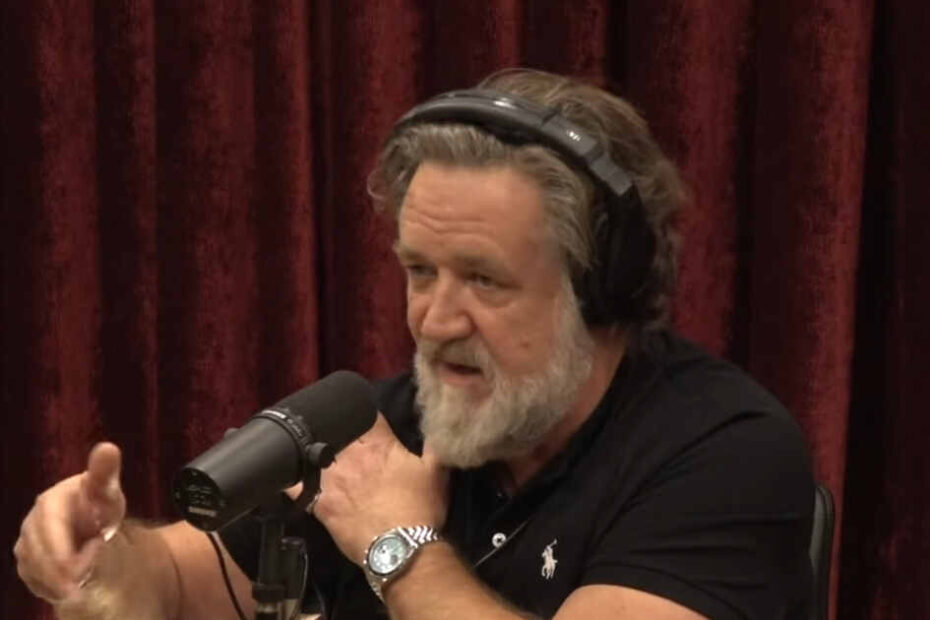
Here is the full transcript of Academy Award–winning actor Russell Crowe’s interview on The Joe Rogan Experience #2406, on “Movies, Human Nature, and Cricket”, November 5, 2025.
The Nuremberg Movie
JOE ROGAN: How are you, sir?
RUSSELL CROWE: Good to see you, Rogan.
JOE ROGAN: Yeah, good to see you.
RUSSELL CROWE: Nice to see you, man.
JOE ROGAN: Your movie’s great.
RUSSELL CROWE: Thank you very much. When does it come out in the United States? Comes out November 7, and then various dates over the next month and a half or so around the rest of the world.
JOE ROGAN: F*ing heavy movie, man.
RUSSELL CROWE: Yeah, it’s a heavy movie. Yeah.
JOE ROGAN: The trial, that footage. Was that all real footage? The Holocaust footage?
RUSSELL CROWE: Real footage. That was one of the reasons that inspired Jamie to go ahead, that he was given access to that footage, some of which has never been seen since 1946. It’s a very interesting way that he makes the subject matter accessible because it’s such a dry topic from the outside. Right. Here’s a court case, here’s yet another courtroom drama, procedural or whatever.
So I can imagine that people would see that and go, well, it might not be an exciting watch or something. But he sort of puts the audience in this position where he allows them to start to be amused by some of the things that are going on and the interpolation, personal relationships. When the commandant of the prison has to call up his two top mental health experts and dress them down for getting into a fistfight, things like that. There’s a charm to it.
And then he gets you into the courtroom and he locks the door and he goes, “Now you’re going to see what we’re talking about.” So I think it’s a very interesting film device to disarm people before he starts giving them the real juice.
The Psychology of Evil
JOE ROGAN: Yeah, it’s also a fascinating psychological take from the psychiatrist, from Kelly’s perspective, because the way he’s describing all human beings, that all human beings are capable of these horrific acts.
RUSSELL CROWE: Yeah, and that’s the thing that was a very unpopular take at the time. Actually led to his removal from the process because he wasn’t fulfilling what the War Department wanted him to say, which is all Nazis are crazy, ruled by a madman. And this is a unique experience.
But that’s not what he found in sitting down talking to the 22 major Nazi names that he was assigned to post war. He realized that every single one of these people was as normal. Well, there was a couple that were pretty out there, but for the most part, he was dealing with rational men.
JOE ROGAN: Yeah, that’s what’s scary.
RUSSELL CROWE: How the hell did they end up making this series of decisions if they’re rational men?
JOE ROGAN: Well, it just seems like things just get pushed slowly but surely into this unbelievably horrific place.
RUSSELL CROWE: Right.
JOE ROGAN: Like it starts off, it’s just a war. It starts off, Hitler’s in power, and then slowly but surely things get incrementally…
RUSSELL CROWE: Yes, and that’s the thing that’s difficult because gigantic jumps we can all read, right. But little incremental changes, the boiling of the frog. You take away this person’s rights, that person’s personal power, slowly. You get to a point where the average person then turns around and goes, “How did we get to here?”
I thought it was about something else. There’s a smoke screen going up and I thought we were doing that. And as it turns out, it’s very different.
Dehumanization and Division
JOE ROGAN: Yeah, that’s one of the scariest aspects of human beings, is our ability to dehumanize others, to turn others into something less than us, non-human and other humans with families, with mothers and fathers and children.
RUSSELL CROWE: It’s one of the most dangerous things. I see it going on everywhere at the moment that we’re trying to say that you’re either, for one, or of a better team name, that you’re either red or that you’re blue. Right.
And humans are far more nuanced than that. We’re not that extreme. And that idea that you can split all of us into two camps is kind of nuts. It’s nuts. And it takes out all the room for subtlety in a discussion, and therefore it makes communicating with each other less and less available.
JOE ROGAN: Well, it’s just in this country in particular, I don’t know about Australian politics, but we only have two parties and they’re both essentially financed by enormous corporations.
RUSSELL CROWE: So it’s a ruse.
JOE ROGAN: The whole thing’s a ruse. And you have different social issues on each side that come up. And then it becomes this “you’re with us or against us.”
RUSSELL CROWE: Versus left, but it’s going nowhere good.
JOE ROGAN: Nowhere good. Yeah.
Australian vs. American Perspectives
RUSSELL CROWE: We have the same sort of two principal party system in Australia as well, but we have a slight advantage in that we’re kind of on the edge of the world in a lot of ways. So what I’ve always said is when you’re growing up in Australia and New Zealand, you grow up looking out. Yes, you understand your own culture and all that, but you grow up looking at what else is happening in the rest of the world, what’s happening in Europe, what’s happening in America. But by and large, Americans grow up looking in.
JOE ROGAN: Right.
RUSSELL CROWE: The principal sports are only played by American teams. American football, in some instances, baseball. But they’re not the types of sports that we play where the pinnacle of that sport is international competition. Rugby union, rugby league, cricket, football, soccer.
So we grow up with that as being the pinnacle of any particular sport if you get to represent your country.
JOE ROGAN: Right. That’s it.
RUSSELL CROWE: Yeah.
JOE ROGAN: We never think about other sports. We mock them. We think about, like, what are you doing playing cricket?
The Gentleman’s War: Cricket Explained
RUSSELL CROWE: And it’s a fascinating game. And anybody who loves baseball generally, I found baseball lovers are all about the minutiae, about the stats and what those stats mean. There might be a certain score on the board, but they see in the stats that there’s a certain dominance in an area and so they still have a hope that the outcome of the game may come their way.
And cricket fans are the same as that. So the fact that the two never seem to meet is odd to me. It is odd because it’s the same type of game.
JOE ROGAN: Cricket is larger worldwide, right? Much larger, yeah.
RUSSELL CROWE: Well, you have India, India and Pakistan and Sri Lanka and countries like that with huge populations playing the game.
JOE ROGAN: Do you guys have home runs in cricket? Like where someone really cracks the ball?
RUSSELL CROWE: It’s called a six. Out of the park, it’s called a six. If you hit the ball over the fence without it bouncing, you get six runs.
See, there’s different forms of the game. You have T20, then you have one day. So this is going to be difficult. T20 means that each team gets to bowl 20 overs. An over is six balls. So you have 26 ball overs that you’re bowling to the batting team and they’ve got to try and get as many runs as they can and then you will have a go at batting. So you have that version of the game which is very short, it can happen in an evening.
Then you have a one day game which maybe starts in the afternoon, finishes by 8 or 9 at night. But then you have the test match and this is what I grew up with. It’s sort of been dialed down a little bit now because they brought in shorter forms of the game. But the test match is between two countries and it’s played over five days.
And the idea is that both teams have to bat and bowl twice and the result will be whatever it is at the end of five days. Five days, man. Five full days. And they start and then they have morning tea and then they have another break, they have lunch and then they have afternoon tea. And if it’s really hot, every now and then somebody will walk out and give them drinks. It’s very civilized.
My cousin Martin was a great cricket player. He was the captain of New Zealand. My other cousin Jeffrey was also a captain of New Zealand. So I kind of grew up in a cricketing family and it was one of the pathways for me. There was potentially play cricket. But when you’ve got two of your cousins who are as good as they were, it’s a very crowded room. How am I going to make any kind of statement here?
When one of them, Martin at his peak, he was called by Sports Illustrated, I believe, the Michael Jordan of world cricket.
JOE ROGAN: Wow.
RUSSELL CROWE: He was a very dominant player in his day and he used to call… We used to discuss test matches as the gentleman’s war, because you have a defined space, you have X amount of players and you’ve got to stop that little ball in this gigantic 180 meter by 120 meter oval. You’ve got to stop that little red ball from going between the players and therefore preventing the batsman from scoring runs.
But that five day game, the way that it ebbs and flows, once you’re into it, it’s the only way you want to watch cricket because at one moment your team can be just so far ahead, and then it’ll turn on a dime. And day two, things get really dark for your team. Day three, you got an edge back again. Day four, it’s fantastic, man. And as a kid I used to go and attend every day of a five day. It was crazy.
JOE ROGAN: Yeah, there’s nothing like that here.
Broadcasting and Commercial Breaks
RUSSELL CROWE: No, no, I mean it really requires… Five day game, it’s like five news cycles, right? We’re not really set up for that sort of patience. And how’s it broadcast? Is it streaming television?
JOE ROGAN: Television, yeah.
RUSSELL CROWE: I mean, there’s cables and companies and stuff have got involved now, but it used to be national network. And when cricket season was on, back in the day, people would come from overseas and into Australia this summer and ask the question, “Is there anything else on television except sport?”
JOE ROGAN: So when you’re playing, do they take commercial breaks?
RUSSELL CROWE: Yep.
JOE ROGAN: Okay, they do. So that’s the problem with soccer, right? Soccer in America. The reason why it’s very hard to sell is not just that a lot of people don’t play it, but it says there’s no commercial breaks.
RUSSELL CROWE: They just have a huge number of people who play association football, soccer in this country.
JOE ROGAN: Oh, for sure. Listen, they have a professional team here. I’ve been to the game. But it’s nowhere near the involvement that football has.
RUSSELL CROWE: American football in this country?
JOE ROGAN: No, not even close.
RUSSELL CROWE: Yeah, all of our sports that we like in Australia, apart from cricket, tend to be quite compact. 80 minute game, 90 minute game, 10 minute halftime. And it’s part of your day, it’s not your whole day. It’s like we’ll go to a football game and then we’ll go and have dinner or go and do something else.
So we have that same thing where the action is so continuous that the idea of stopping for a commercial break gets quite tricky.
JOE ROGAN: Yeah, that makes sense. It’s always been fascinating to me that rugby never took off in America because it seems like kind of a more savage version of football.
Rugby League vs. American Football
RUSSELL CROWE: Yeah, well, the way I think it sort of plays out is you’ve got rugby union, right, which is 15 men aside. Every time a player is tackled, you recompete for the ball. You have rocks malls, you have line outs. It’s a very different game. But there’s another version of rugby called rugby league, which was played in the north of England, and that has a defined period of offense and defense. And I think that’s where American football comes from.
I actually own a team in Australia in the NRL, the National Rugby League, the South Sydney Rabbitohs, the oldest team in the game, 1908. We were formed, bought the team in 2006, and it’s very easy to explain to Americans. Have American friends come down. I spend maybe 20 minutes talking to them and they get the game and they start to dig it.
My girlfriend at the moment, actually Brittany, was one of the reasons why I really started being attracted to her, because she understood the game straight away. Then I find out that when she was younger, she was a cheerleader for the New Orleans Saints.
JOE ROGAN: Oh, wow.
RUSSELL CROWE: While she was studying electrical engineering. So, yeah, it’s a very similar. Rugby league is a very easy game for Americans to follow. Now how it’s refereed becomes frustrating for an American audience because there’s so much room for interpretation, referee to referee, game to game, situation to situation. So it can get frustrating.
I think one of the greatest things about American football, from the outside or from an objective point of view, it seems that every single thing that the NFL try to do is based on an across the board fairness for everyone. So those conversations between the referees and what have you seem to be everybody’s on the same page.
And sometimes when you’re watching rugby league, something that you saw somebody else get sent from the field for the week before and now nothing happens this week, but it’s the same kind of hit or whatever, it’s like, well, you know, so I’ve had a few Americans. Is that corruption? No, I think that, yeah, I think it. The game moves very fast, right. And referees don’t have eyes on all sides of their head.
Gambling and Corruption in Sports
JOE ROGAN: But do you have referee corruption over there because you have gambling?
RUSSELL CROWE: We definitely have gambling.
JOE ROGAN: Yeah, I know you have gambling. So I read ads for them Ladbrokes.
RUSSELL CROWE: Absolutely crazy the way gambling has become such a significant player. I also read the other day that now turns out that 50% of ownership of all the major gambling things are in the hands of sports teams. Oh boy. What’s going on?
I think what we have, as opposed to corruption is natural bias because guys come out of the game. So there’s 17 clubs in the NRL at the moment and guys who are in positions like referees or video refs or whatever, they have a club. They grew up associated to one particular geographic area and that’s their club. So it’s very difficult for anyone to truly objectively see their own natural bias.
JOE ROGAN: But also there’s got to be some corruption if there’s gambling. If it’s so subjective that you can make calls that you would. That someone got in trouble a week before and then this week. Nothing like that kind of subjectivity where it’s up to the referee to make a decision. If I was a corrupt person, a gambler, especially if I was a mobster, I would reach out to that referee and say, it’s within our best interests to work together on this. Yes, let’s make something happen.
RUSSELL CROWE: I would hope in all innocence. Well, you have to say that you.
JOE ROGAN: Own a team yeah.
RUSSELL CROWE: And you’ve got to sort of remain a little impartial in these things.
JOE ROGAN: What was that scandal in America, Jamie? The most recent one, the basketball one. It had to do.
RUSSELL CROWE: Still ongoing.
JOE ROGAN: It’s still ongoing, yeah. Yeah. What are they accusing these guys of, though? I know they rigged poker games, but there’s also accusations about the basketball games itself.
RUSSELL CROWE: Most of it would have been like based off of player props. So like they know that they’re not going to take themselves out of the game. So I just take the underground on. I’m not going to score 20 points. I’m only going to be there for 10 minutes, wink, wink. Or like, these players aren’t going to play in this game, bet against us. That’s sort of what this is, players gambling. Is it? One of the coaches was doing it too, or like giving information and he was. Thing is, they would. They were tied to the poker game too.
JOE ROGAN: Oh. And so just a full on criminal one of them.
RUSSELL CROWE: I just saw on the news today that the one player who’s been tossed around, he had a big IRS debt and all of this sort of started around the same time.
JOE ROGAN: Oh, he’s trying to pay off his debt.
RUSSELL CROWE: So he got corrupt. Who knows?
JOE ROGAN: Who knows?
RUSSELL CROWE: But they.
JOE ROGAN: Weren’t they ripping off their friends in the poker games?
RUSSELL CROWE: That I don’t know because I’ve allegedly, I’ve seen clips of this. People knew about this a year or two ago on Instagram. They’re like, I was at a f*ing rigged game and I know the people involved and know that I should not have, like, I’m not going there and losing my money. How did they know it was rigged, the people involved? He said, he’s like, someone else told me this. It’s all in the up and up. And then he’s like, I know everybody in the game. It’s definitely not. What are you talking about? How that guy knew? I. He didn’t really.
JOE ROGAN: Well, they had crazy shit, like they could read the cards. They had like an X-ray machine.
RUSSELL CROWE: They had cameras and the chip holders. They had all sorts. I don’t know who they were communicating to though. There’s a lot going on. But it was happening in LA, Vegas, New York, all over the place. God.
Russell Crowe’s Gambling Experience
JOE ROGAN: Lot of money gambling.
RUSSELL CROWE: I stay away from it. I don’t know how you feel about.
JOE ROGAN: It, but about gambling?
RUSSELL CROWE: Yeah. I had an experience when I was a young fellow. It was the first time I was in America actually. And I’d had all these intense meetings and what have you. And it was, I had a decision to make. I had 10 different people wanting to be my agent. So I rented a car and I went for a drive and I went up to San Francisco along the coast and then I turned inland thinking I’ve heard of Reno, so I’ll go there, right?
So I went to Reno, Nevada and I had X amount of money, right? It was a very, I wasn’t, you know, I was doing well in my career but I didn’t have a lot of cash so I had a couple hundred dollars in my pocket. That’s all. So I went and had a beer and I started playing blackjack on a five dollar table. And this is single deck. This is how long ago this was? 92 or something, right?
So I’m playing and I did pretty well, amassed a few hundred dollars, feeling very cocky and confident about myself. And I probably just then had one beer too many and I went for a walk down the street and I saw a roulette table and I think that’ll be me sucker. And so everything I won, I lost. And by the time I sort of got my shit back together, I had $25 in my pocket. I’m in Reno. I got a quarter of tank of gas and I got to get back to LA. I don’t have a credit card.
JOE ROGAN: Oh, boy.
RUSSELL CROWE: So as it was, I paid for my hotel in advance, so that’s all cool. But I was like, okay, I got a server up here. So I go back to the place I started, back to that same $5 table, and I just very carefully. When I got to like $190, which I knew was going to be enough to get me back with petrol and food and all that, so I stopped, I go out into the car park, this hotel, it’s like 11 midnight, something like that, and I just started vibrating and my whole body was like shaking, like I was having some kind of fit, and it was just really weird.
I got back to the hotel room and I called my mom collect in New Zealand. And I just did this. I went through this. She goes, oh, darling. Something I’ve never told you, but your great grandfather was a professional gambler. And at one point in time, he gambled his house away. He had to go and get his daughters, wake him up, get his wife and tell them this is where they no longer live.
And that one act kept that family in, relative terms, poor for another two generations. That one impulsive act to gamble his house. Yeah. So I know it’s in me, so I don’t go anywhere near it.
JOE ROGAN: That’s fascinating.
RUSSELL CROWE: There’s a horse race in Australia called the Melbourne Cup, and I will focus on that. And if I happen to be at home and I have the day off kind of thing, I’ll put a bit of money on that, but that’s it. Everything else that I do in my life is gambling, becoming an actor, massive gamble. What are you talking about? It’s ridiculous. Buying a football team, it’s all a version of gambling.
But the idea that you’re just giving money away to a system where it’s not fair, it’s not going to benefit you, and at the end of the day, in the longer term, you’re simply not going to win. It sort of. That drives me a little crazy. I don’t want to get involved in that.
The Genetics of Gambling
JOE ROGAN: The vibration thing. Do you think gambling is genetic? Like, there’s a thought that a lot of. There’s certain behaviors that are in people that are passed down from their parents. There’s certain thought processes, there’s certain inclinations that it’s some genetic proponent that we haven’t clearly identified yet, that it’s, they used to think that people are a blank slate. You’re born, you’re a blank slate. You learn everything from your environment, but.
RUSSELL CROWE: We know that’s not real.
JOE ROGAN: It’s not real. No. There’s a shit ton that you get from your genes. It’s very weird. And I wonder if you got that from your grandfather.
RUSSELL CROWE: It really feels like it’s in me and I have to work against it.
JOE ROGAN: Thank God you have discipline that you could go back to the table in one area. That’s a good area to have it in.
The Perfect Day in Vegas
RUSSELL CROWE: But that’s how desperate the situation was. I’m standing there in Reno realizing I can’t even get back to LA, right? I’ve got a rent for the car, so I had to. I just took it really, really slowly.
And I do this thing if I’m playing in a situation like that, because occasionally I will go and play blackjack at a casino if I’m in a group of people. Because if you’re all disciplined and if you hold every seat on a table, you can turn the tide against the house very easily. They hate you doing it and they try to break it up and put somebody in the middle of you or whatever.
But if you actually, funnily enough, it was Tom Cruise that told me this. If you have it, so the first chair and the last chair make the calls and decisions, and everybody else just sits on 12 and above, and you watch the mathematics come your way.
Now, way, way back in the day, right, it would have been 95, 96, 97, something like that, right? Tom calls me. He’s married to Nicole Kidman at the time, calls me and he goes, “Hey, bud, we got this thing set up. Steve Wynn has put on a jet. He’s going to fly us to Vegas, right? We are allowed to play at Shadow Creek. We’re allowed to play golf at Shadow Creek.”
So I’m not really a golfer, but sounded good to me. Jumped on the plane, went there. We’re playing Shadow Creek. Lightning storm comes up. Tom’s in the middle of the fairway still trying to play. We’re going, “Dude, put the iron down. This lightning,” you know, so we enjoyed ourselves at the golf course.
Then we go back to the Wynn’s hotel and they’ve given us Michael Jackson’s lanai to change clothes in or whatever. We go and get some Chinese food. The jet’s comped, the golf’s comped, the lanai’s comped, the food’s comped, and then we go and play blackjack together. Tom explains what the team’s going to do.
And we take $25,000 or more off the table, go back to the airport, get on the comp jet, fly back to LA. But we finished as a group. We then attacked the New York Times crossword and we did the last word as we were landing in Los Angeles. So to me it was like that, I believe was a perfect day.
JOE ROGAN: That’s a team effort.
RUSSELL CROWE: Yeah, that sounds like a lot of fun. It was a great day. But that sort of like that was one of the early experiences where, okay, so you can have fun with these sort of games as long as you don’t take them too seriously.
My current girlfriend is a massive poker player. She loves it and she’s really quite good at it. She’s played in a couple of female only tournaments and things like that, you know, so I watch them play, but I don’t get involved. I don’t want to get involved. I don’t want to activate that.
Because I am kind of, you know, I do have a reckless streak. You know, I can imagine in the wrong moment if I’m, you know, tipsy. Well, not, it wouldn’t be tipsy. It would be more like drunk on some kind of ego power kind of thing where, yeah, I can turn the universe. I can make it come my way. I’ll bet my house. I just got to stay away from that.
Uncut Gems and Adam Sandler
JOE ROGAN: Did you see Uncut Gems?
RUSSELL CROWE: No. Oh, it’s the…
JOE ROGAN: Probably the best gambling movie ever. Adam Sandler plays a degenerate gambling junkie.
RUSSELL CROWE: Okay.
JOE ROGAN: It’s not a comedy at all. Amazing movie.
RUSSELL CROWE: I love how he’s getting, he just seems like he’s getting some due respect these days.
JOE ROGAN: Yeah.
RUSSELL CROWE: Really starting to see how big his effect was and what he can do.
JOE ROGAN: Also those movies are fun. All those Happy Gilmore and they’re fun movies. I love those movies. They’re innocent, enjoyable entertainment and he’s really good at them. Jack and Jill. They’re hilarious movies.
RUSSELL CROWE: Yeah. And that right these days because I’ve got a project at the moment which on the surface you would have to call a comedy. Nobody wants to discuss it. Nobody wants to talk about adult comedies. So where does that mean? Where does that mean we’re going to, if we’re sort of reducing comedy as a genre?
JOE ROGAN: It’s only in the film world. In the standup world, it’s exploding completely, push back against it and they’re going the other direction. They just, they’re going back to 1990s style comedy.
RUSSELL CROWE: Right.
JOE ROGAN: Which is just say whatever the f* you think is funny.
RUSSELL CROWE: Confrontational stuff.
JOE ROGAN: It’s not, no one means these things. You’re saying things because they’re funny. That’s it. You know, we’re, it’s just like, Bob Marley didn’t really shoot the sheriff. You get it, right? You know, it’s like we’re just talking shit.
RUSSELL CROWE: I heard a funny story about that, actually. Yeah, it’s just in person. I can’t remember who told me. Maybe I won’t even guess, but I think Clapton was living in New York or London or somewhere, and he had a party at his house because he just had that record come out and it was gone number one.
And he had it stuck on his fridge with a magnet, you know, like the charts with a circle around it, you know, “I Shot the Sheriff. Number one, Eric Clapton.” And Bob Marley was at the party, and apparently he found a pen and he wrote onto Clapton’s fridge, “No, Eric, I shot the sheriff.”
JOE ROGAN: I shot him first, bitch.
RUSSELL CROWE: That’s hilarious.
The Grip of Gambling Addiction
JOE ROGAN: But that Uncut Gems film is, it is a perfect movie in regards to the way it treats a degenerate gambler. He’s a jewelry broker, jewelry salesman, and he’s just out of his f*ing mind. It’s always sports. It’s always this. There’s always a game that’s going on. He’s betting this.
And you get so much anxiety watching the movie. Like, oh, God, don’t do that. Don’t do that. Don’t, oh, Jesus, what are you doing? It’s like the whole movie. My palms are sweating. I’m moving around in my chair.
Because I, as a kid, grew up in pool halls, like from the time, not grew up in pool halls, but I spent so much time between age 23 and, you know, into my 30s, I was in pool halls all the time. And I played a lot of pool, and I was around a lot of addicted gamblers.
And I never got it. It never hit me. But I was always just fascinated by the grip that it had on people. It was like they would, their eyes would be going back and forth, their f*ing skin would be pale. It gripped them like a drug. It gripped them like crystal meth.
RUSSELL CROWE: I really dislike the way in Australia we have normalized it. You know, they’re doing the sports report on the news, the national news, and they’ll tell you the odds, the odds.
JOE ROGAN: Well, we do that with the UFC. With the UFC, we give the odds. They even, I don’t know if they announce round by round odds, but the, I think they do but the, I don’t, I try not to pay attention to it because I don’t vote. Excuse me. I don’t gamble on the UFC, but I used to.
So I used to gamble on the UFC when I first started working for them. And then I was like, I don’t…
RUSSELL CROWE: Think I should do this anymore.
JOE ROGAN: This is a long time ago, though. So what I started doing is giving my friend Aubrey, who’s my business partner at Onnit, I started giving him tips and he was like 84%, because I know the sport. And a lot of these guys would be coming from Japan or coming from Russia, and I’d be like, oh, this guy from Brazil, Anderson Silva. Bet the fing house. I go bet the fing house. Because people do.
RUSSELL CROWE: Not my house, though.
JOE ROGAN: Not my house. But there’s people that were coming across from other organizations that I was a giant fan of, and the bookmakers were woefully uneducated about especially foreign fighters.
And there’s a thing, like, if you are gambling on MMA and you don’t know how to fight, you’re just guessing. You don’t really, we’re all just guessing when two guys get into the cage together, but you’re really guessing. You really don’t, you can’t recognize how fast a person is. You can’t recognize how good they are at countering. You just know stats and you know, but you don’t know how to do it.
And if you don’t know how to do it, you can’t really see it. You don’t really know. So at a certain point in time, I stopped just on my own gambling. So, like, I don’t…
RUSSELL CROWE: Because I was…
JOE ROGAN: People were accusing me of being biased one way or the other anyway, which maybe I was, you know, I got better at that, but I wanted to make sure that no one thought that. So I was like, I’m only gambling a couple hundred bucks or something like that. I wasn’t doing anything crazy.
But the fing people that I have friends, like good friends that are just hooked, and when they start talking about fights that they’re gambling on or they put so much money on this and money on that, I’m like, oh, my God. I know guys that put millions of dollars on a fight. I’m like, oh, my God. Yeah, you’re freaking me out. Fing freaking me out, man.
I don’t care how wealthy you are, if you put a three million dollar bet on a fight and you lose, you’re not going to sleep for a week.
RUSSELL CROWE: I just wouldn’t be able to wake up with myself the next day.
JOE ROGAN: And then if you win, so foolish. If you win, it might be even worse because now you’re going to keep doing it.
Protecting the Next Generation
RUSSELL CROWE: Now you get that. You get the sting. Yeah. The thing is with what we do in Australia, like the newspapers, like, you know, network news services, we allow betting ads. It is so all prevailing.
You know, I had an experience probably a year or two ago and I see my two boys are talking to a mate of theirs and they’ve all got their phones out and I realized they were checking up on their bets, you know, so I had to have a big conversation with my boys and say, “Look, every single dollar that you have comes out of my pocket. If I give you a dollar, that’s not a dollar to gamble with.”
Have very serious conversation with them about, it’s like, I don’t care if you think it’s fun, you know, I get, you’ve got to actually see it for what it is because what’s five or ten dollars now is easily going to turn into four or five hundred dollars in a minute. A thousand dollars.
You know, sooner or later you will allow yourself to think that this thing is, you know, beyond fun and it’s a way for you to earn back your losses or whatever. So I just had to have a chat with them and they were probably looking at me going, how old is our father that he doesn’t understand that everybody does this? But I just had to let him know from my point of view, I didn’t appreciate them taking my hard earned dollars and wasting them.
JOE ROGAN: I get it. But I also like that it exists because I want the ability. If I wasn’t working for the UFC and I could go to the fights and gamble on the fights, I would definitely do it. Because knowledge to me, right?
RUSSELL CROWE: I don’t need it. If I’m into the sport.
JOE ROGAN: Yeah.
RUSSELL CROWE: I want to see the game, you know, I care about…
JOE ROGAN: Oh yeah.
RUSSELL CROWE: What happens in the game.
JOE ROGAN: I get it.
RUSSELL CROWE: Possibly because from the owner point of view, I don’t, I wouldn’t want any extra pressure, of course. So I don’t understand why here’s this game. It’s like two teams of pristine athletes who have busted their nuts to get in this situation. And the competition, the physical competition between these two teams isn’t enough. You got to put something else on the line.
JOE ROGAN: You know, it adds for some people.
RUSSELL CROWE: For some people, yeah.
The Ethics of Gambling and Sports Commentary
JOE ROGAN: They get that extra juice out of knowing. The thing is, also as a commentator, I am as unbiased as humanly possible. And it’s a hard thing when friends fight because there’s some guys that fight that are my good friends and I’m like, I just hope they don’t get hurt. I want them to win, but I have to be excited about the other guy winning, which is kind of crazy.
The other guy’s beating up your friend and you have to be excited about it. So it’s good that I don’t have any money riding on fights because I don’t have. I’m not happy if one person wins or loses. My idea is we’re going to see who’s the better athlete, who’s the better fighter.
And I can handle gambling. I’ve never had a gambling problem because I’m not a risk averse person. Obviously I like risks, but I’m also, I’m safe. Like I know what I’m doing even though I do dangerous things.
RUSSELL CROWE: You’ve had a look at it first.
JOE ROGAN: Yeah.
RUSSELL CROWE: Examined it. But you do have, you have that ability and inclination for examination.
Personal Freedom vs. Public Safety
JOE ROGAN: You have to have that. And I feel like that’s the case with alcohol, that’s the case with cigarettes. I’m in favor of all those things being legal, but I know so many people that have a problem with alcohol, like cannot live without alcohol. I know so many people that can’t quit smoking cigarettes. I feel like you should be able to do whatever you want to do. And I want freedom and that comes with gambling.
And I think gambling freedom, like the ability to decide that you want to take a risk or something that should be available. But we should educate people as to what is actually going on in your mind that’s allowing you to get captured by this thing. And now you’re chasing bad money and you’re in a downward spiral. Management, like understanding, okay, this is a thrill, but this thrill could take over your whole life.
If you are maybe genetically susceptible, psychologically susceptible, understand what it is. But I don’t think we should take away cars that can go over 60 miles an hour, because some people crash their cars and die. You know what I mean? I feel like I like that gambling exists, and I always wish that it exists.
Back in the day, I was like, it’d be fun, bet 100 bucks on this or 100 bucks on that. But I don’t have the problem. Like, I could see if I came from a family that was torn apart by gambling, you’d go, you know, you don’t understand. My dad lost our house. Like, okay, but that was a bad decision.
You know, your dad could have died drinking and driving and smashed into a tree. These are bad decisions. You don’t have to make bad decisions just because something is tempting you. It’s an interesting debate because do you nanny state the whole world? Do you think gambling should be illegal? You think you should have to go to Vegas for it? That seems kind of crazy.
I mean, it’s certainly not a black or white issue to me. There’s a lot of gray area involved in it. And I know there’s a lot of people that push back on the idea of whether these gambling apps and all these different things should be legal.
RUSSELL CROWE: It’s the normalization process that bothers me the most, that it’s part of the new service with the ads that it’s, but it’s just put in front of you whether you’re interested in it or not. You know, this team is playing that team. And here’s the odds. I just don’t think it’s healthy to have that as much of, you know, those stats as much a part of the actual news report as who’s playing and what’s on the line.
The Role of Odds in Sports Discussion
JOE ROGAN: The thing about it, though, is it does lead you to have debate about, like, here’s a perfect example. Canelo Alvarez versus Terence Crawford. Terence Crawford was going up two weight classes. In my mind, though, he’s so skillful, I gave him a chance. I was like, I favor him to win, but I believe he was the underdog.
Find out what the odds were for the Canelo Alvarez Terence Crawford fight. I believe he was the underdog even though he was an undefeated multi division world champion, like one of the greatest of all time for sure. But he was jumping up from the 154 pound weight class where he just won the belt. He was the 147 pound weight class all the way up to 168. That’s a big leap. 14 pounds.
And everybody thought, Canelo’s going to have too much power. He’s going to be too big. I’m like, I don’t think so. I don’t think that’s correct. Was odds. Yeah. Crawford was the underdog, so not a huge underdog. Plus 135 versus plus 140. Somewhere around there. So it’s not huge. Not even two to one. Not even one and a half to one.
But enough where I was like, I think they’re wrong, you know, so it’s like, it fosters debate, you know, even if you’re not gambling. And I didn’t gamble on that fight, but I did. I was telling my friends, like, I had a long discussion with a good buddy of mine who’s a real boxing connoisseur. He’s like, Canelo’s too big. He hits too hard. Like, that guy doesn’t get hit much.
Like, I don’t think that’s as big of a factor as we’re thinking. I think it’s a skill thing. They’re not that different in size. I’m like, I don’t think so. And so that odds thing is, to me, exciting. Like, it fosters debate. Like, you get, you start talking about, you know, and if it’s a game, you start talking about players.
Like, he chokes in the outfield, he does this, he does that. He’s always stealing bases. I’m factoring that in. And, you know, the odds become a part of the discussion. But, yeah, it is. Ultimately, the problem is, first of all, kids are addicted to apps as it is. They use them. They’re always on their damn phone.
And they’ll go from TikTok to Instagram to X to, you know, they’ll check this and then they’ll check that, and they’ll check their Snapchat and they’ll check the gambling app. And then it’s like, you’re just addicted to this goddamn phone. So something on your phone that’s also addicting. It’s like addiction on top of addiction.
Because you’re already getting your little dopamine rush just by looking at your phone. But then if you’re also getting a gambling rush on top of that. Yeah, we got to educate people. Yeah, but I think we got to educate people on social media addiction, which I think a giant percentage of our population is completely addicted to social media.
Social Media Addiction and Algorithms
RUSSELL CROWE: Probably including me. I spend a large amount of every day scrolling through TikTok. For some reason.
JOE ROGAN: And what’s your algorithm like? What kind of stuff are you getting?
RUSSELL CROWE: I’m getting a lot of dating apps at the moment, which is really embarrassing because I’m not looking on any. I’m not on any dating apps. So I’m not sure that the algorithm is fully truthful. I think there’s a certain amount of things you just get fed. Right.
JOE ROGAN: Especially like a dating app, because that’s a promotion they’re promoting.
RUSSELL CROWE: That seems to be a lot coming up. But that’s the problem, isn’t it? Because the way the algorithm shapes it, pretty much everything that comes up on your phone you have some form of interest in. So that keeps you looking at what you’re looking at.
I’ve got to probably got to dial it down a little bit, but I’ll be in the bush in a minute. This has been such a crazy year, man. We finished Nuremberg last year, and then I went on that big tour, which is when I was here, when I came to see you the first time. But this year, since between December and August, I made five movies.
JOE ROGAN: Wow.
Burnout and Recovery
RUSSELL CROWE: And I was on the set of the sixth, and so weary and I had no juice. I still feel it a little bit, actually, man. You know, I’ve had a little bit of time off, but I’ve still had so many responsibilities. I kind of feel like I broke my brain or something in August, and I’m still trying to recover, and I won’t really recover till I get home the next time.
As I was saying to you before, because when I land at home now, I won’t know when I’m flying out again. And that is such a relief, because when you do know when you’re flying out again, every day is just counting down, counting down. You might have three weeks, but it doesn’t feel like three weeks because you 100% know when you’re leaving again.
But this time I’ll get home and I’ll have three months and I’ll be in the bush and I’ll be waking up with the birds. And, you know, hopefully all of those things that I emptied out through the earlier part of the year will fill up again, because I was on that set and that was the set for the remake of Highlander with Henry Cavill.
So I’m playing Ramirez, which was the Sean Connery character. So I’m excited by it. I’m really looking forward to it. But there I was, turning up to the gym to do my katana sword and, you know, going to these meetings and everything. But I was empty. I was absolutely empty.
And it was just to the point where I, you know, I texted my agent and I’d said, you know what? I maybe need to talk to these guys because I’m not sure if I don’t have any juice here. I don’t know what I’m going to be bringing. You know, I’m sitting in these meetings and everybody’s talking, but it’s all just bouncing off my face. You know, I’m not really taking anything in.
And that same night, I get a phone call around 10:30, and it’s so unusual because I have everything turned off on my phone. It never rings. But for whatever reason, it did ring. It was the director saying, look, I’m so sorry to tell you that Henry’s injured himself. He’s ruptured his Achilles, so we’re going to have to push the film now.
The Henry Cavill Connection
I love Henry. I’ve known him for a long time. Known him since he was a schoolboy. And like, I met him at a place called Stowe School in England. I was doing a scene in a movie called Proof of Life, talking to my son in the movie. And in the background, a rugby game’s going on and, you know, we’re doing the scene and everything, but I’ve got my eye on the field.
And there’s one guy on the field and who is just displaying, he’s got a great brain for the game. And as it happens, we finish the scene and they break up the what’s going on behind us. And that one kid is walking towards me, and he’s the kid that I’ve been watching, and he wants to have a chat.
He introduces himself and, you know, he just asked me, how do you get into acting? And so we had this very brief conversation and we got swamped by these other kids. A couple of days later, I was doing a present for the kid from that school who played my son, who was a boy called Merlin Hanbury Tennyson, his name was.
And so I was doing a thing for him. And then I had some other things left over. And I was like, what was that other kid’s name? Oh, Henry. So I wrote on a photo of Gladiator of Maximus, which was a movie that had not actually been released yet. “To Henry, Journey of a thousand Miles begins with a single step. Russell.”
JOE ROGAN: Wow.
RUSSELL CROWE: He kept that photograph with him for wherever he lived or place to place. And he kept his dream alive and burning. The next time I see Henry Cavill is in a gym in Illinois, the outskirts of Chicago. And I’m working on one side of the gym, he’s working on the other.
And I’m thinking to myself, well, I’m Superman’s dad. I reckon that must be Superman over there. Kind of looks like it, you know. So we worked in the gym a week or more together before we talk, you know, and finally one day he comes over, puts his hand out, and we start talking.
And I just at one point, I went, do I know you? He goes, yes, sir, you do. And he remind. And I went, Henry. That Henry? Is this Henry? It was crazy.
JOE ROGAN: That’s wild.
RUSSELL CROWE: Absolutely wild, right? And so now we have this other situation where, you know, he’s kind of in the position of being the Highlander. And they asked him who he wanted to be Ramirez. And he said, I’ve only got one option, and you got to get him. And so, you know, that’s fantastic. Going to be a lot of fun when we do eventually get around to making it.
JOE ROGAN: How must that be for him to have been a kid and met you and got you to sign that and then working with you when he’s Superman.
RUSSELL CROWE: Superman.
JOE ROGAN: Oh, my God, that’s amazing. What a great story.
The Challenges of Back-to-Back Productions
RUSSELL CROWE: And so now we’ve got the third stage of our connection, and when we get to do it, it’s going to be great. But I know this sounds really weird because I love Henry, and the last thing I want is for him to be under any pressure or injured or whatever, but it wasn’t a prayer answered. I’m talking to the director, expressing that I’m so… that’s terrible. But I’m also shaking my girlfriend going, we get to go home.
Yeah. As I said, it’s been a big year. I have never done that many individual films in that space of time.
JOE ROGAN: What caused you to say yes to that kind of a schedule?
RUSSELL CROWE: Well, but that’s not what you do, because most of these are independent films. So, for example, I agreed to do Nuremberg in 2019, but we don’t shoot it till 2024. Set up and collapsed three different times before we actually made it. Because it’s a… you know, there’s a lot of variables in independent film.
So a bunch of these things that I did, you know, I agreed to do two years ago, and it never got together. And then suddenly they all just started landing one after the other. So everybody’s got to start working like it’s air traffic control, and I’m literally having a few days between sets, flying from one place to the other.
And now it’s… you know, what I always describe it as? It’s like going to a new school now. You’re going to meet hundreds of new people and all of the different things that you got to answer in terms of your costume and your makeup and blah, blah, blah. Am I wearing a fake nose? Have I got scars? What am I doing this time? All of those things you got to do very rapidly and get onto the set.
And they’re not… that sort of string of movies was not… they’re not easy.
From MMA Films to Albanian Money Launderers
RUSSELL CROWE: The first one was called The Beast in Me, which is an MMA movie. I think we talked about that briefly. It was going to be a UFC thing, but we ended up doing a deal with One Championship. So it’s set in Australia and Thailand. Doing some little private screenings in Los Angeles at the moment and getting a lot of really positive reactions.
The kid… that’s the… he’s not a kid. But the lead role that Daniel McPherson has done an extremely good job, by the sounds of things. I’m also attached to that. I only play a very small role, but I rewrote it for them just before we started. And I’ve done a lot of writing in my career, but it always goes uncredited. But in this particular occasion, I think I believe I’m going to get my first actual writing credit.
JOE ROGAN: Oh, wow, that’s cool.
RUSSELL CROWE: But I wrote the character that I play specifically to not be the character you think it’s going to be, to not be Burgess Meredith. You think this guy’s going to be, you know, the old coach who sort of comes back out of retirement, everything. But I know enough people in the boxing world or, you know, to know that once an old bloke makes a decision about you being a shithead, he’s not going to change his mind. So I wanted to play that guy.
So I went from that set to then, I think, called Bear Country, where I play an Albanian money launderer. And that’s got a great cast. Theresa Palmer, Luke Evans, Nina Dobrev, Aaron Paul, Danny Zavato. And it’s funny. It’s really funny. That’s with the same director that I did Unhinged with, a guy called Derek Port. And it’s… I mean, it’s goofy and dramatic, but it’s just funny.
JOE ROGAN: When does that come out?
RUSSELL CROWE: Not sure when that comes out. That’s also… I think they’ve got like six or seven different offers at the moment from different distribution companies, because everybody’s digging it and they’re looking at it going, that would be a hilarious movie to follow up Nuremberg.
JOE ROGAN: Well, that would be, yeah, because Nuremberg’s not…
Russian Spies and Harvard Professors
RUSSELL CROWE: So then after that I go back to Budapest and I make a thing with a young British director Amos Ante called Billion Dollar Spy, with a young English actor called Harry Laughty, who is the… his… the… he’s the future of British cinema. He’s a very intelligent, classy actor. So… and that one I play a Russian selling state secrets to the Americans, a Russian scientist.
And then after I did Billion Dollar Spy… oh, I did… I went to Montreal and made thing called Unabomb where I play a Harvard professor, the man who taught Ted Kaczynski at Harvard, who put him into this series of tests and things that he was doing. And some people say that he very much affected Kaczynski’s brain.
JOE ROGAN: You know, he was a part of the Harvard LSD studies.
RUSSELL CROWE: The guy I play was. Yeah, Kaczynski was sort of associated. He was there at the time. Then that Leary also started working at Harvard. But the study that my character was doing is more based on sort of intellectual confrontation and stripping people of their self-belief and stuff. So there are people who think that it was the character I play’s intellectual aggression towards Kaczynski that turned Kaczynski the way he turned.
So there’s that. And then I just did a movie in Germany. It’s set in Portland, but we shot it in Munich. Okay, how weird. With a guy called Patrick McKinley who I’ve done other projects with before, but he doesn’t always get the credit he should get. But he’s the guy that cut The Loudest Voice, which made it as dynamic as it was. And he also cut a movie called Poker Face for me. And we’re working together on music doco, but usually I work when I work with him as an editor, but this is him as a director and that’s with Ethan Hawke again, that’s a smaller role in that one as well.
But there was a very strong vibe on that set. And Patrick’s a great filmmaker, so I imagine that’s going to be a good movie too. So if you’re a film fan, that…
JOE ROGAN: Sounds like you’re killing it.
RUSSELL CROWE: There’s a few things to come out.
The Return of Comedy
JOE ROGAN: That’s very exciting. The comedy is very exciting because there’s just not a lot of comedies anymore. It’s hard to see, to find a really good comedy.
RUSSELL CROWE: Yeah, yeah. And this is one of those ones where it’s not like a series of jokes. It’s just certain types of characters put in certain situations and then you see how that plays out. And Aaron Paul and Nina Dobrev, just hilarious. I can’t even begin to explain what they do in the film because you’ll just go, what the f* are you talking about? This just sounds so stupid. And it is stupid, but it’s also very funny to experience.
JOE ROGAN: I can’t wait to see it. So it just sounds like all those things just sort of came together coincidentally at the same time.
RUSSELL CROWE: And so you have things that you might have agreed to years before or whatever. And it just so happened that they got their financing and they just went one after the other.
JOE ROGAN: Do you take, do you do anything like IV vitamin drips or anything when you’re on set?
RUSSELL CROWE: I haven’t really done that well, potentially. But the other thing is, man, you just stay disciplined. You get to bed.
JOE ROGAN: Yeah, that too.
Finding Balance: The Panacea
RUSSELL CROWE: I’m actually going through a really weird time at the moment. For the last month, doesn’t matter where I am in the world. If I’m in Spain, if I’m in Australia, if I’m in America, I cannot sleep between midnight and 5am. It’s just very odd. And I think it’s related to the feeling that I was expressing before that somewhere in August I broke my head. I’d just done too much and I need to go home and I need to be in that rhythm.
You know, I call the place I have in the bush, you know, it’s not its official name, but I call it the Panacea. It will fix all ills, but you have to give over to its rhythm. You have to wake before the birds. You have to sort of put yourself in a situation where you’re going deep into the bush so you’re getting that kind of oxygen. You just have to really give yourself over to it, you know, and spend your days just, you know, checking if the cows are okay, having a look, you know, if the new trough system is working. Just getting your sort of hands a little bit dirty and forgetting all the other stuff.
Yeah. And you know, but we’ll hopefully see me come charging back out next year.
JOE ROGAN: You’ll be charging, but that sounds like a perfect balance to offset the charging.
RUSSELL CROWE: Yeah, well, that’s the recharge. I always like… I look back at my 30-year-old self who made the decision to take the little bit of money that I’d earned at that point, 31, 32 I was, and buy 100 acres in the bush because somehow I knew I would need that place. So it’s like, you know, I could have bought, you know, an apartment in the city, but I didn’t. I bought 100 acres of basically blank bush, no fences.
And the fact that it’s been in my life. Listen, January 20, 1996, I paid for that first hundred acres. Wow. So that’s… that’s before LA Confidential comes, before I even shoot LA Confidential. Wow. So it was… I don’t… I don’t know where it came from, but I look at that 32-year-old and go, mate, well done.
JOE ROGAN: You gave yourself a battery.
RUSSELL CROWE: Yeah. You know, I go through that gate and because you know what it’s like, people don’t just call you Joe, they call you Joe Rogan, called me Russell Crowe. Russell Crowe, Ross Crow, you know, so this brand name, this sort of stamp and that’s all you hear, you know, Russell Crowe, Russell Crowe. And then I go beyond that gate and I’m no longer that. I’m a son, I’m a brother, I’m an uncle, I’m a dad, you know, all of those things, you know, I’m the boss of the operation of the farms and stuff and all that as well.
But all of those things come into play and the whole brand thing drops away and you got to prove yourself on a way different level when you’re at home.
The Reality Behind the Glamour
JOE ROGAN: You got to exist in a natural world as opposed to in a world where you’re the center of attention constantly. People are at your beck and call. People are, Mr. Crowe, Mr. Crowe. Yeah, it’s not good for you. But it’s also the amount of attention that you… time you have to spend when you’re on that many sets in a row, five movies in a row, a lot of people are probably like, oh, boo hoo. You had to be in five movies. Boo hoo.
RUSSELL CROWE: But that’s… and that’s the brilliant thing.
JOE ROGAN: Oh, famous Russell Crowe.
RUSSELL CROWE: The big gap between people who are not in the business’s understanding of what it really takes.
JOE ROGAN: Right.
RUSSELL CROWE: And you know, the realities that you deal with. And look, you know, I’m the last person. I’m not whinging about the job at all, but I am just pointing out that I went a little bit too hard and I burnt my brain and I need a bit of a break, you know.
JOE ROGAN: Well, if Nuremberg is an indication or if it’s an example of what you did, if it’s on par with the rest of them, it’s going to be an awesome run because Nuremberg is great. It really is. It’s very disturbing. And just to see that footage… the footage in the trial is just, people should see that. And the fact that it’s never been released before, just to cement into our heads, you know, that’s the thing.
It’s like that war was one of the first wars where we got regular footage, you know, I mean if you think about people going into World War I, they’re going blind, they have no idea what to expect, what they’re going to see. And then by the time Vietnam comes and now it’s on television and that seeing horrific things at least cements into your head like this is where this all could go. This is where this all can go.
Growing Up in the Shadow of War
RUSSELL CROWE: Yeah, well just think about that because in my lifetime, when I was a little boy and I’m watching the news at night with my parents, this Vietnam footage, I see the Anzac Day, which is Australia, New Zealand version of Memorial Day. I see those marches every year, the old soldiers getting together, that history is so fresh.
I’m surrounded by older people who fought in the war in World War I, and then there’s another generation of guys who still appear to be young and they fought in World War II. And now I’m watching Australia at war because we’ve been through Korea, now Australia is at war in Vietnam. I’m seeing that on the nightly news.
So at the age of 6, 7, 8, I believe I’m going to be a soldier. Really? And everybody at school believes they’re going to be a soldier because that’s what we do, because the parents generation are connected to the second World War. Our grandparents generation is connected to the first World War. And here it is, we’ve now got this new war, right?
So it was very definitely part of the cultural upright. I mean I was in army cadets in high school so that was a couple of days a week. You dress up in an army uniform and you go to school instead of in your school uniform in jungle greens.
JOE ROGAN: Just get you ready.
RUSSELL CROWE: Just get you ready, man. They’re putting SLRs in the hands which is like, it’s not an unusual thing for this country, but definitely is for Australia. Put a self loading rifle in the hands of a 13 year old and teach him how to use it.
JOE ROGAN: Wow. Jesus.
The Consequences of War
JOE ROGAN: That was one of the things about the Iraq war too where they stopped showing people coffins. They were preventing photographers from taking photographs of coffins. Flag draped coffins, like that’s crazy, that should not be legal. You shouldn’t be able to prevent someone from documenting history that’s what that is, and that’s the consequences of what’s going on. You’re seeing American people coming home in boxes and you’re not even allowed to take photographs of it. Kind of crazy.
RUSSELL CROWE: Yeah. Well, this is the thing where, Anzac Day that I talked about, it’s April 25th. Anzac stands for Australian New Zealand Army Corps, because both the First World War and the Second World War, Australia and New Zealand combined their armed forces and in a lot of places fought alongside each other.
But we had that day as a memorial day, as you have in this culture as well. But we tend to forget that we have that day as a reminder that we should never do this again. That’s what it’s there for, to respect the passing of these young people who died in battle, but to also remind ourselves of how pointless that whole thing was, how pointless the First World War was, how pointless the Second World War.
Ultimately, it’s just death. And the people that started the war, the people who benefit from the war, are not the ones generally standing at the graveside mourning their dead, because they will protect themselves. Their children don’t have to go to war. Their children are not going to get conscripted.
So it’s like every time this stuff comes up, and we now have almost constantly the words of war being spoken as if it’s just sort of an offhand thing that we should attack these people, invade these people. It’s like this goes absolutely nowhere good.
We were talking earlier about the technology we can hold in our hands. We get out our phones, we can explore the entire world. There’s no piece of knowledge which is held back from us. We can get it through this device we carry in our hands. So here we are all of these millennia later, as a species, we have that level of technology available to us, but we still think that war is some form of solution. It just blows my mind.
JOE ROGAN: It’s hard to imagine if you were living in the past, if you could come up with the circumstances that we live under today. Like you just described, a device in your pocket that provides you with all the information you could ever want. We would say, oh, well, that would be the solution to most of what ails us.
RUSSELL CROWE: You think once we have that available.
JOE ROGAN: Yeah, it’ll all sort itself out. We’ll see each other clearly and understand, celebrate our differences, that there’s more that connects us than divides us. All of those things.
Social Media and Misinformation
JOE ROGAN: I don’t think they ever anticipated social media and the divisive nature of that.
RUSSELL CROWE: It accelerates, but it’s only divisive because we let people pervert it.
JOE ROGAN: Right. With an algorithm.
RUSSELL CROWE: We just let people actually take something. I remember when I started on Twitter, I thought it was the stupidest thing I’ve ever heard of. But when I started, which was about 2009, 2010, and suddenly from a couple of decades of having who I was described by others and pushed across to people, this breath of fresh air where I could just express myself and people would know exactly what my real opinion on something was and how I felt about something. It was fantastic.
Didn’t last very long, though. People were like, oh, we’ve got a whole lot of truth going on here. We’re going to shut that sht down. As soon as individuals started using their power to say, I had an experience with this company or that company, and it wasn’t very good. Those companies were like, man, we didn’t spend millions of dollars a year on advertising just for this ahole to tell the truth about how sht we are.
So they had to turn it around somehow. So that’s when you start, quite frankly, if you run bots and stuff like that, you should be put in prison. That’s not the way it should be.
JOE ROGAN: No, it should be that way.
RUSSELL CROWE: You shouldn’t be perverting people’s understanding of something because it benefits you.
JOE ROGAN: Yes. That’s a great way to put it. That should be illegal. It’s kind of amazing that there’s no laws, because it’s essentially, I mean, you could propagate through bots, a complete and total lie, and it catches traction, makes its way through, and there’s zero consequences.
RUSSELL CROWE: Yeah. And then people get upset about it, and they’re fighting over the family dinner table based on pure misinformation.
JOE ROGAN: I think a lot of it, but we can’t trace who’s doing it. That’s where it gets really weird.
RUSSELL CROWE: Yeah. But why?
JOE ROGAN: Well, I get that it’s complicated, right? You can hide your IP, you can do it through a virtual private network, so they don’t know what country you’re in. And you do it with AI. They busted China, was using ChatGPT to run a bunch of accounts. I don’t know how many accounts, but a huge amount of accounts.
And they were all sorts of stuff that people are fighting about in America, like immigration, closing down USAID, those kind of things. And they were just involved with these chatbots that they were running and these things would argue specific points and get everybody inflamed and just start wars and call everybody f*ing.
RUSSELL CROWE: There was a moment a little while ago where there just seemed to be all social media was just flooded with violent images, flooded with people fighting, people getting knocked out by king hit in a bar or whatever. And it was like, where is all this coming from?
Violence on Social Media
JOE ROGAN: It’s just Instagram is loaded with it. I see more violence on Instagram, more accidents, more people falling off balconies, more people climbing trees and falling. It’s like, all over Instagram. And I don’t know if they can stop it. I don’t know if they can even recognize what these things are until somebody reports.
RUSSELL CROWE: I know it sort of speaks to sort of a low level of intellect, but I do like the occasional falling down a hole kind of, I have to admit.
JOE ROGAN: Well, there’s a reason why it’s out there. It’s because a lot of people agree with you. I mean, I’ve watched a lot of horrific accidents. I don’t know why. I don’t want to watch anybody get run over by a truck.
RUSSELL CROWE: Yeah, for me, that’s not a thing. It’s like the innocent sort of like, pie in the face kind of thing is what amuses me. But if somebody really gets hurt, it’s not, it doesn’t.
JOE ROGAN: Very much desensitize people, which is a problem already. We’re already desensitized from violent video games and violent films and then now you’re seeing real violence and real horrific dismembering accidents all day long. And you’re 13. That’s the thing.
RUSSELL CROWE: That is the thing. We can discuss it as adults and what sort of like, what we can deal with and what we can rationalize. But the same thing I was talking about, the gambling. My kids don’t know or didn’t know that there was a negative to that. They just see it all the time. So I think it’s normal.
JOE ROGAN: Yeah, no, that makes sense. And think, how old do you have to be to sign up for those sites? And is it possible to spoof that? Like, it seems like you could probably, if you’re a wizard at 14.
RUSSELL CROWE: What’s the security? Are you over 18? Press here. Like, what is it? It doesn’t take a lot.
JOE ROGAN: Does it make you enter in your driver’s license? What do they do?
The Muff Liquor Company
RUSSELL CROWE: You see that thing from TikTok that I sent you with Jimmy?
JOE ROGAN: I don’t have TikTok.
RUSSELL CROWE: Oh, you don’t?
JOE ROGAN: No.
RUSSELL CROWE: So I sent it to you and you can’t watch it?
JOE ROGAN: Yeah, I can’t watch it. What was it about?
RUSSELL CROWE: It was just him on stage talking about a company that he and I and Ed Sheeran got involved in. I was shooting the Pope’s Exorcist in Ireland, right? And I got told this story about this lady, Laura Bonner, whose grandfather was an Irish potato farmer and wondering what he should do with his leftover potatoes, the unsightly shaped ones that nobody wants in a supermarket.
And he came up with the idea of making this Irish sort of moonshine called Perchin. So every Friday his relatives and his friends and everything would rock around to Phil’s house and they’d bring their old medicine bottles and whatever and just fill up from the still. So they had a weekend.
And when she was a little girl, she would see this party being created every Friday in the island. And so they’re singing songs and they’re enjoying each other’s company and laughing uproariously and all that. And she said, one day I’m going to legitimize what granddad does for fun and make it into a business.
So around about her mid-20s or something, she was a lawyer. She got involved in this big deal. It went well for her. So she was sort of faced with a crossroads. Okay, now I’ve got money to finance my idea or I can continue in the job that I’m in. And so she decided to back herself.
She comes from a little town in the north of Ireland that is called Muff. It’s actual town, it’s across the river from Derry. And she formed a company called the Muff Liquor Company. And that amused me. I called Jimmy Carr and I said, does this amuse you? And he goes, it actually does. So then I called Ed Sheeran and I said, does this amuse you? And he goes, it does.
So we formed a company called the Muff Liquor Men. And we bought a big slice of the company. It’s now, I think it’s in about 40 states here in America now.
JOE ROGAN: Oh, that’s awesome.
RUSSELL CROWE: Pretty sure you can get it in Texas.
JOE ROGAN: We’re a sucker for a good name.
RUSSELL CROWE: Yeah. So I brought you a dozen whiskey.
JOE ROGAN: Oh boy.
RUSSELL CROWE: A dozen potato based gin.
JOE ROGAN: Oh boy.
RUSSELL CROWE: And a dozen potato based vodka. But there it is with the bottle sort of shaped like an old medicine bottle.
JOE ROGAN: It looks great. That’s an awesome bottle.
RUSSELL CROWE: Yeah, it’s great. And that whiskey is what I call like a cowboy whiskey.
JOE ROGAN: Ah, it’s peat smoked.
RUSSELL CROWE: Yeah. But it’s very light.
JOE ROGAN: I like that.
RUSSELL CROWE: It’s very light. You’ll see when you have it. It’s not the sort of whisky where everybody ends up crying in a corner remembering the things that they did wrong in their lives. It’s the sort of whiskey that’ll keep you laughing all night, you know? So that’s why I call it a cowboy whisky, because you can sit with it with your mates all night and have a laugh.
JOE ROGAN: What do you think is more addictive? Alcohol or gambling?
RUSSELL CROWE: Well, the problem that we have with alcohol is what’s becoming the burgeoning problem with gambling is that we just accept it. It’s everywhere, accept it completely as the thing that you do. And as long as you’re a certain age, you can do it. We’d never look at the damage that it causes.
Now I’m a big proponent of having a drink, you know, it’s my cultural heritage and as a working class man. It’s my goddamn right, Joe. And you enjoy it and I do. But as you get older, you know, there’s certain things that you start to learn about your capacities and stuff when you’re a younger fellow.
And now that I’m an older guy and I know that, you know, one night a week, if I’m having fun is plenty, that’s plenty, you know, and I try to cut out the interstitial stuff. If I decide I’m going to have a glass of wine with dinner, then it’s going to be a really nice wine, it’s going to be an occasion. And I try not to have the casual drinks now. Just have a drink for the sake of it.
JOE ROGAN: Those add up. Yeah, yeah. There’s definitely a great social quality to drinking. There’s a thing to it that I enjoy, I always enjoyed.
RUSSELL CROWE: And bonding. You never really find out about your mates until you’ve had them on the piss and you see who they really are.
JOE ROGAN: Some people.
RUSSELL CROWE: Yeah. Yeah.
JOE ROGAN: Alcohol, it’s weird because it’s the only drug that they offer you when you sit down for dinner.
RUSSELL CROWE: Right.
JOE ROGAN: We’ve agreed that this drug goes really…
RUSSELL CROWE: Well with a good steak that everybody can have, that this drug is fully available. And like I said, we never count the social costs. We don’t count, you know, I mean, this would be true for pretty much a lot of countries that have a focus on sport. But, you know, three to five of the worst nights of any given year in Australia in terms of domestic violence are 100% connected to a sporting event. Really? Yeah.
JOE ROGAN: So a sporting event connected to alcohol.
RUSSELL CROWE: And then that drives the thing that, you know, brings terror to wives and children. So it’s, you know, it’s the same thing with all of this stuff. We always talk about that, everything in moderation kind of thing, but we always have to remember that we got to move at the pace of the slowest member of our community.
The Importance of Education
JOE ROGAN: That’s a great way to put it, because that’s the real issue. Right? It’s not, well, I can handle it, so everybody else can, too. That’s not it. It’s like, why can some people handle it? And what could have been done?
Like, if you just, in school, you’re going to have to accept that some kids are going to try marijuana, some kids are going to try acid, some kids are going to try alcohol. They’re going to. Most kids are going to try alcohol. Like, why don’t we have education on the proper way to use these things where you don’t get in trouble?
At least most people, I would imagine most kids are not going to listen anyway. But more will than would if you didn’t talk about it at all. If you don’t talk about it at all, there’s no information out there. At least they can talk.
RUSSELL CROWE: It should be an ongoing process of education and not just education through failure.
JOE ROGAN: Right?
RUSSELL CROWE: Not just, let me talk to you about it now that you’ve crashed your car into a tree.
JOE ROGAN: Or now that one of your friends has done that. There’s a lot of that. You see your friends doing something horrible.
RUSSELL CROWE: I’m like you. I’m open to all of this sort of stuff being available and freedom of choice being paramount, but the responsibility to educate has got to start at a young age.
JOE ROGAN: Yeah, I think so. Especially if you’re using things that are on apps. You know, apps are just, young people are so accustomed to using apps, and most apps are giving you that same jolt, that same dopamine rush.
It’s just, I think you should be able to do whatever you want to do, but you should know what you’re doing, and that’s where the problem is. You kind of have to figure out what you’re doing from your knucklehead friends.
Managing Energy and Alcohol
RUSSELL CROWE: I was going to suggest that we had a whiskey, but I know that’s going to ruin my day if I do, because I’ll get nothing else done. Some people have such a great time drinking during the day. It just doesn’t suit me, man. If I have a drink at lunch, either I’m asleep by 5 o’clock or I’m raging at 5am. So it’s like I’ve learned over time, don’t drink during the day.
JOE ROGAN: Yeah. I stopped drinking entirely for about seven months, something like that. And then I decided to occasionally have a drink. So I’ll have like a glass of wine at dinner or a margarita. I’m out with my wife. But that’s it. I stopped there.
I don’t drink drink anymore. Like, let’s go get drinks. I haven’t done that in a long time. And the reason why is because I just felt like sh*t because I was just doing it too many nights a week. And then my workouts would suffer in the morning and I’m like, why am I doing this? I do everything so healthy in this one stupid thing that I do that let me just try not doing it, see if I miss it.
RUSSELL CROWE: But you also noticed as you got a little older that the hangovers, they don’t go away after a couple of hours.
JOE ROGAN: Sure. It’s also one of the most important things in my life is energy. Like how much energy do I have to do things? Like, it’s not just about doing things, it’s about doing them with focus and enthusiasm. And when you don’t have energy, it’s very difficult to muster up that enthusiasm.
RUSSELL CROWE: I hate that feeling that the follow, you know, I’ve had a great time the night before.
JOE ROGAN: Yeah.
RUSSELL CROWE: But the following day nothing gets done because I had fun the night before.
JOE ROGAN: You’re foggy.
RUSSELL CROWE: Yeah. I just feel that, you know, such a waste. It is. We’ve only got X amount of days. Right.
JOE ROGAN: But just managing the human mind and managing, like what to do and what not to do and when to do it. It’s such an important part of being an adult. And it’s one of those things that’s just not explained to kids. It’s weird.
Alcohol Versus Marijuana
RUSSELL CROWE: I love that old Bill Hicks routine where he asks the question, you know, the last time you were in a social situation, be a private party, a concert, a sporting event, and people started fighting. Were they stoned or were they drunk?
JOE ROGAN: Right.
RUSSELL CROWE: Yeah. It’s like, yeah, I don’t get why people can be so aggressively negative towards marijuana yet, you know, half a dozen dozen drinks for them socially is a, of course, you know, it’s easy. It’s like these two things, you know, are very different outcomes.
Yeah, you’re not going to have the, you know, people aren’t going to be attacking the base camp when they’re all stoned. They may well have a go at it when they’re on the piss.
JOE ROGAN: Well, all that’s because of propaganda from the 1930s. That’s all that is down to Harry Anslinger and William Randolph Hearst.
RUSSELL CROWE: But, you know, it also connects to the formation of the United Nations. Does it? Take Thailand, for example, the country that’s had hundreds of years of cultural marijuana use, but in order to join the United Nations, they had to accept an American attitude towards drug laws.
Just recently, they’ve taken those drug laws away and now they’re in a bit of panic because they didn’t plan it very well. Because, like, you know, reality break is, I think, you know, California did it through Arnold Schwarzenegger properly knowing exactly how you’re going to tax and where the money’s going to when you do tax for the consumption.
And so I think, you know, 140 or something or more shops sprung up overnight in Bangkok and they’re like, oh, gee, that went quicker than we thought it was going to go. But I think it’s actually great for Thailand. It’s a, you know, a drug that particularly suits the groove of that country.
The food is so incredibly tasty and the beaches and the sunshine and, yeah, and the heat. But that’s what I was told. I was told that it comes down to decision that they had to make in order to join a global community.
JOE ROGAN: That makes sense. That makes sense. The United States has pushed that on everybody else. In Texas, there’s a lot of push from the alcohol lobby to try to make marijuana even more illegal.
RUSSELL CROWE: Yeah. Because people don’t necessarily have to drink that much.
The History of Hemp Prohibition
JOE ROGAN: Yeah, that’s what they’re worried about. They’re worried about people talking about alcohol. It’s a stupid, I mean, the fact that it works is crazy, that people are still with like zero deaths ever, that they’re still pushing to take this one drug away. When you’ve got one drug that everybody uses, it’s very strange.
But it all really goes back to the 1930s, and it was really just about the commodity of hemp more than it really was even about the drug. You know the history of that.
RUSSELL CROWE: Yeah, well, I know a bit about the making of rope from hemp because of Master and Commander and spending a lot of time on tall sailing ships.
JOE ROGAN: The whole thing was about an invention and there was a new invention called the decorticator, and it allowed them to effectively process hemp fiber with a machine. Because before that, it was very time intensive, very labor intensive to break it down because they’re very, very strong fiber.
So then Popular Science magazine has it on the cover, “Hemp the new Billion Dollar crop” because of this machine. And so then William Randolph Hearst, who also owned Hearst Publications, he also owned paper mills, so paper mills and cereal. He owned forests where he’d make paper out of the forest.
All of a sudden there’s this competing commodity where they’re going to use hemp for paper. It’s a far superior paper. Hemp is going to, it’s way quicker to grow. You can grow entire fields of it in a year. You get a whole new crop. It’s not like trees that take years and years to grow before you can chop them down and make paper out of them.
And so then they started printing these stories about Mexicans and blacks that are raping white women because they’re on this new drug called marijuana.
RUSSELL CROWE: Right, the jazz cigarette.
JOE ROGAN: Yeah. And so marijuana was really the term for a wild Mexican tobacco. It didn’t even apply to cannabis. So they made a new name for it and they attached this new name and they got Congress to ban it. And before, they didn’t even understand it was hemp. Most people didn’t know what was going on.
They thought there was this new drug that was like running through the world and they just pulled the wool over everybody’s eyes, and they did it because of a commodity. And then they made Reefer Madness and all those crazy movies, and everybody’s like, oh, my goodness, if you smoke reefer, you’re going to die. You’re going to jump out of buildings.
Meanwhile, people had been smoking it for thousands of years. It was like, pretty amazing way of manipulating public perception and using propaganda. And, you know, William Randolph Hearst, obviously the subject of the movie Rosebud, who’s…
RUSSELL CROWE: A real piece of sh*t Citizen Kane.
JOE ROGAN: Yeah, yeah, yeah, excuse me. Citizen Kane. He was a real piece of sh*t.
Orson Welles and Citizen Kane
RUSSELL CROWE: It’s a real bad guy. You know, according to folkloric tales, he did everything he could to prevent Orson Welles from becoming the filmmaker that he should have become right after he made that film.
JOE ROGAN: Yeah, and it seems like he was effective with it because, you know, Citizen Kane was so good. And then years later, he’s doing wine commercials, right, for money.
RUSSELL CROWE: There’s a funny thing, it’s like a recording where he’s trying to do a voiceover for Norwegian salmon or something. He’s getting more and more pissed off with the young producer who’s trying to get him to…
JOE ROGAN: Yeah.
RUSSELL CROWE: To read it in a certain way.
JOE ROGAN: Yeah.
RUSSELL CROWE: It’s kind of man. Have you seen those little footage bits of the, who’s the tilting at Windmills fella? Don Quixote. Yeah. He went to Mexico somewhere and he sort of started shooting little bits and pieces for potentially a Don Quixote movie. But it’s just madness. It’s like there’s nothing, there’s nothing in there that could actually be in a film.
JOE ROGAN: He just had gone crazy.
RUSSELL CROWE: He’s a bloke. We’ll get a bloke with a donkey, we’ll have him walking over there, we’ll shoot that. You know, it’s like, but it’s like there’s nothing cohesive in it that you could make a movie from.
JOE ROGAN: I wonder if that’s just from the pressure of essentially being like one of the first guys to ever get canceled.
RUSSELL CROWE: He just probably lost his mind potentially, right?
JOE ROGAN: Absolutely.
RUSSELL CROWE: Because you would think that Citizen Kane is your passport to a lifetime of being financed for whatever idea you want to put onto film.
JOE ROGAN: Yeah, yeah, yeah. I mean, it’s to this day a classic film that people talk about. And then also you’re the same guy that did the War of Worlds. You read that on the radio and freaked half the country out. The same guy. And so, I mean, he was a wunderkind.
RUSSELL CROWE: Right.
JOE ROGAN: He was this guy that like everybody thought was like a once in a lifetime talent and he snuffed out.
RUSSELL CROWE: Yeah.
JOE ROGAN: And back then you have to consider if you’re William Randolph Hearst, you have Hearst Publications, you’re essentially in control of whatever narrative you want to push forth and no one’s going to get in your way. So all we would have to do is make some phone calls and that guy, f* him. He doesn’t work again. Crazy.
Media Consolidation and Power
RUSSELL CROWE: A little bit. Little bit. We got way too much power in the hands of media moguls. As we go on, that reduction of opinion just keeps happening. You know, one company swallows another, swallows another. I think we’re in situation now in America, right, when 20 years ago there was two dozen major media companies or 30 years ago, and now it’s three.
JOE ROGAN: I know.
RUSSELL CROWE: And just like with the share market and the biggest companies in the world, they end up owning each other. So it’s not three big companies, it’s really just one with three different names. Yeah.
JOE ROGAN: And they decide what the news is. It’s nuts. But that’s the one beautiful thing about today is that independent media takes up the slack and often gets more views than, you know, air quote, mainstream corporate media. And so now corporate media is forced to report on things eventually. Like the New York Times is forced to report on certain things that are inconvenient eventually, where they would have just liked to have ignored it.
But it gets so big in the zeitgeist that it has to become something that’s discussed. And that’s, that’s fascinating because it’s like dragging them into the reality that the Internet lives in, which is a reality of a free exchange of information.
The Changing Television Landscape
RUSSELL CROWE: The whole horizon of television just so dramatically different now.
JOE ROGAN: So different.
RUSSELL CROWE: I get to a hotel and I’ll scroll through 160 available channels. There’s nothing I’m interested in watching. It’s like, how is that even possible?
JOE ROGAN: It’s also watching something that’s already going like, it starts at 7. Why, why doesn’t it start whenever I sit down, right? This is stupid. Like, you have an old model. This model’s dumb. It’s like radio versus podcast, the same kind of thing. It’s like no one wants to have to be listening, sitting in their car waiting for you to finish a sentence.
They want to hit pause, go do whatever the f* they’re doing, come back and play again. This is a dumb way. You’re doing things. You’re doing things. And on 8pm it’s Mikey and the boys.
RUSSELL CROWE: See, I never had that life. You know, the last time I remember that being a thing is maybe in high school, right, where my mum and dad, my mom particularly, would like to watch Dallas. So we would all get together and watch Dallas at 8 o’clock or whatever, on a Tuesday or whatever. And that just doesn’t, it just hasn’t happened in my life at all anymore.
JOE ROGAN: The last time it happened, I think for me was the Sopranos on HBO, because it was on, I believe it was on Sunday nights and everybody knew what time it was on. And you’d go home and I had a TiVo back then. You remember those, where you could record shows and go back and watch them later and pause them and stuff like that. It was like revolutionary before streaming, oh, my God, you could record shows and watch them whenever you want.
James Gandolfini and The Sopranos
RUSSELL CROWE: Embarrassingly, I’ve only ever seen maybe four or five Sopranos episodes.
JOE ROGAN: Really?
RUSSELL CROWE: Yeah, yeah, yeah. And every time I watch it, I go, I cannot believe that I didn’t get overtaken by this at the time. Because Gandolfini was a mate. He was a, I met him like early 90s or, yeah, early 90s in New York. He, him and a friend of mine called Lenny Lofton used to rent a place together on 44th and 9th in Hell’s Kitchen.
And, you know, this is like an apartment on maybe the fourth floor of a building. And a couple of windows didn’t even have glass in. They had, like, plastic sheets and a blanket nailed up against the window. And that’s what, you know, the situation that Gandolfini was in when I first met him.
JOE ROGAN: Wow.
RUSSELL CROWE: A few years later, he was obviously very successful. But my youngest son, Tennyson, is like Sopranos expert. Like, you can say a line to him, he’ll know what episode, what season and who said that. Wow. It’s like he’s so into it. And, you know, when I have started watching very recently, actually, some ducks landed on a pool on the farm.
So I took a photo and there was, like, thousands of comments. Whatever it was straight away going, ah, just like Tony Soprano. I had no idea what people were talking about. I had to discuss it with my son. He goes, oh, yeah, there’s this sequence. So I watched that sequence with the duck. Yeah. But Gandolfini, man, what a great actor he was. He was good on that show.
JOE ROGAN: He was. So he was. It was the first guy who was essentially the hero of the show who was a murderer. A murderer. A terrible person. A mob boss. And you liked him, right? It was insane like that. The fact that he could pull that he had the depth to pull off that, where he’s doing horrible things to people. And you’re rooting for him, right? You’re rooting for him. You’re not hoping he gets shot. You want Tony to live.
Joey Diaz and Jimmy Carr
RUSSELL CROWE: Who’s that guy that you have on here every now and then? Joey Diaz?
JOE ROGAN: Yeah. Yeah.
RUSSELL CROWE: He’s a funny guy.
JOE ROGAN: Oh, he’s the funniest guy that’s ever lived.
RUSSELL CROWE: I heard him tell that story one time about the same week that Cinderella Man came out. I went to the premiere of Longest Yard because, you know, Chris Rock was in that and stuff. And there’s a few people in that cast who I really like. And so I went to the movie and I just remember him telling a story about the lights come up and he didn’t realize he was sitting next to me or whatever. I think it’d be a very dangerous room for me and Joey Diaz to be in. I think we’d be having a good time.
JOE ROGAN: You guys would have a good time?
RUSSELL CROWE: Yeah, a little bit. Joey brings a party.
JOE ROGAN: He’s the funniest guy I’ve ever met.
RUSSELL CROWE: Oh, man, he’s got some stories.
JOE ROGAN: Oh, my God, they never ended. I’ve met, I’ve known him for f*ing 30 years. He’s always got a new story. He’s just a maniac and, you know, I mean, went to jail for armed kidnapping. Kidnapped a drug dealer with a machine gun. Yeah, he was out of his mind on coke. Yeah, he was. He was a wild fella. He was a wild fellow when he was young. When I met him, he was, like, right out of jail.
RUSSELL CROWE: How did you meet Jimmy Carr?
JOE ROGAN: I think I met Jimmy at the Comedy Store, I believe.
RUSSELL CROWE: Pretty sure.
JOE ROGAN: You know, I’d already known about him. Yeah. Yeah, I’d already known about him. What a f*ing great guy. Yeah, man, it’s so funny. Oh, my God. He performed at the Mothership. Last time he was in town. We were all in the balcony watching. He’s so good. So crisp. The punchlines are so, oh, he’s so good. Such a pleasure.
RUSSELL CROWE: And he just keeps educating himself.
JOE ROGAN: Yeah.
RUSSELL CROWE: You know, he’s got this voracious mind.
JOE ROGAN: Well, he’s a brilliant guy, you know, and to see that brilliance applied to an art form, you know, to comedy. It’s like you’re seeing this.
RUSSELL CROWE: He’s just as funny in casual conversation.
JOE ROGAN: Oh, yeah.
Learning to Take Vacations
RUSSELL CROWE: You know, you sit down, we have a chat because we spend a little bit of time together. And it’s funny because he’s, you know, significantly younger than me, but he’s teaching me stuff. You know, I’ve never been a vacation person. For example, you know, there’s work and home, but home isn’t often fully restful because, you know, I’ve got a football team, I’ve got other businesses. I’ve got the farm to run, you know, cows to look after and all that sort of stuff.
JOE ROGAN: So.
RUSSELL CROWE: But a couple of years ago, he just put it in my mind, like, let’s just say we’ll take these dates and I’ll meet you somewhere, you know, so the first time we did it, we met up in Puglia in southern Italy, and earlier this year, we met up in Marbella. But I’ve already booked a vacation for next year. I don’t do that.
But it’s like that thing of going somewhere which isn’t home and isn’t work, having no agenda, sort of hanging out by the pool, reading a book right from beginning to end without having to sort of put it aside and come back to it a week later and go, oh, what was the protagonist doing again? Very interesting. It’s very interesting that I should be, you know, I’m getting this late life education from a British comedian. That is funny that he’s teaching you how.
JOE ROGAN: No wife taught you how to do that. I think there’s a reason why people go on vacations. They’re not all stupid, you know, there’s a benefit to it, I think.
RUSSELL CROWE: But see, I didn’t grow up in that sort of family. We didn’t have the money for that sort of thing.
JOE ROGAN: Right.
RUSSELL CROWE: You know, we went on one big family holiday in 1970 where we all piled into my dad’s station wagon and we drove from Sydney up to northern Queensland. But a cyclone came through on the way. So we had like four days of sunshine and 26 days of rain. So living in a caravan, playing Monopoly.
So it’s not like I look back, oh, I remember the great vacations of my childhood. So it was like, you know, my dad used to run pubs. So you don’t get holiday based on the licensing laws. You have to be the first person there in the morning, you have to be the last person there at night. So we kind of lived that sort of life where everything was based on running the pub. But it’s cool. It’s good time for me to learn about it now.
JOE ROGAN: Well, don’t you think as a person who does anything creative, you have to have a bunch of different kinds of experiences to draw from. And if you just stay in the same environment all the time, it’s probably generally not good for you. Like you need to go see other people, you need to go different places. Not just to refresh and relax, but also to take in.
RUSSELL CROWE: But you see, I do so much traveling for work, you know. Yeah, for work.
Film Production and Tax Incentives
JOE ROGAN: Oh, that’s what I was going to ask you. Why are they doing a Portland film in Munich? Is it that cheap to go? Like how bad they f* up Portland, that it’s cheaper to go to Munich to film?
RUSSELL CROWE: Is that what it is? You have tax incentives that are being offered in various places and that happens a lot here. There’ll be X amount of movies pretty much in every state who can apply for a tax incentive. And some states are more competitive than others. Louisiana, for example, Georgia, they, California basically gives you nothing. So it’s very hard to shoot in California.
JOE ROGAN: Those silly fox.
Australian Film Industry and Studios
JOE ROGAN: Well, that’s great. That’s a great aspect.
RUSSELL CROWE: Well, the thing is, it’s such a busy place and the studios there. The studios would rather have a television show that’s going to be there for a decade than a movie that’s in and out in four months. It’s better for them. Right.
But the world has opened up hugely in the last 30 years in terms of film production. You’re taking advantage of homegrown film talent and then building on that with international investment.
You know, Australia has a big history, for example, of making films technically. Arguably the first full length feature film, the True History of the Ned Kelly Gang might have been called. That was like 1906, 1908, something like that was made in Australia.
JOE ROGAN: Really?
RUSSELL CROWE: Yeah. And all the way through, but it takes till about the 70s or whatever. Then you have this sort of new generation of Australian filmmakers who are actually making stories that reflect the current culture. And I think that’s sort of happening worldwide as well.
Talk to Me and Australian Horror
JOE ROGAN: Have you seen Talk to Me?
RUSSELL CROWE: No.
JOE ROGAN: Talk to Me is a fantastic horror movie that these two young guys from. I’m saying the right name, right? They were on the podcast. I’m pretty sure it’s Talk to Me. It’s about this dead hand that someone found. What are the gentlemen’s names?
RUSSELL CROWE: Danny and Michael Filippoo. I think that’s how you say it, how you say Philippu.
JOE ROGAN: Philippu, yeah. Hilarious guys. Just bundles of energy. They’re f*ing nuts. But this was like their first real film that they made. They put together this. They did it all themselves. And it’s a horror movie and it’s really good.
RUSSELL CROWE: It’s like, where are they from?
JOE ROGAN: They’re from Australia. I don’t know what part. Jamie will find out. There they are, these two fellas. And they finish each other’s sentences. They’re just nuts. And they’re just like. They’re on 10 all the time.
RUSSELL CROWE: Oh, cool.
JOE ROGAN: Does it say Adelaide? There you go.
RUSSELL CROWE: Right?
JOE ROGAN: So they’re 32, but that’s a completely Australian made movie that was a hit worldwide recently. Obviously Mad Max was a giant.
Australian Talent in Film
RUSSELL CROWE: When you start going through it, you sort of do realize there’s been probably a much larger percentage than you would expect given the population of the country. In terms of people in film, whether it’s directors of photography or directors themselves or actors, editors, and the actors.
JOE ROGAN: Think about how many famous actors. It’s crazy.
RUSSELL CROWE: It’s crazy, man.
JOE ROGAN: It’s really bad.
RUSSELL CROWE: When I was a young fella making my first movies, you had Mel Gibson and Judy Davis, but Mel was born in America, so it didn’t really count. There was other guys around, like Brian Brown had done Cocktail and Gorillas in the Mist. Prior to that you have guys like Jack Thompson, but when you really look into it, then you have these other guys.
It goes all the way back to Errol Flynn. There is a connection all the way through that. There are certain people working in the business.
JOE ROGAN: Errol Flynn was Australia.
RUSSELL CROWE: What’s that?
JOE ROGAN: Errol Flynn was Australia. Yeah.
RUSSELL CROWE: He was born in Tasmania. Wow. And either born in Tasmania or born in Papua New Guinea and grew up in overplace. But I think he was born in Tasmania.
But if you think about it since the early 90s, Nicole Kidman, Cate Blanchett, Hugh Jackman, Chris Hemsworth, Crazy Margot Robbie. It’s just outrageous. Geoffrey Rush. This like name after name after name of people who’ve made a significant contribution to cinema.
JOE ROGAN: Yeah. I mean, you consider the population size, which is obviously the population of the entire country is basically LA, right?
RUSSELL CROWE: 25 million. Yeah. It’s basically Southern California and it’s gigantic. But it’s hard to explain to people. You show them where the major cities are and they go, oh yeah, what happens in the middle? Yeah, not a lot.
JOE ROGAN: Yeah, you don’t want to be there.
Dangers of the Australian Outback
RUSSELL CROWE: It’s mainly desert. It’s like if you like wide open spaces, you’re welcome. And a lot of things can kill you. A lot of things. A lot of things, yeah.
Just had a little sort of thing on the farm actually. My girlfriend’s got a Papillon dog, which is beautiful dog, sort of long haired, and it got a paralysis tick and they realized, she realized that between her and this other girl that looks after the puppy and were not there, they’d got their dates mixed up. And so it wasn’t actually covered for flea and tick stuff in its bloodstream.
So very dangerous. So they had to shave the dog completely and everything. And they pulled off another couple of ticks, but there was only just the one paralysis tick. So it’s okay, but if you leave that and if you don’t deal with it, the dog’s going to be dead in a minute.
JOE ROGAN: Paralysis ticks.
RUSSELL CROWE: Yeah, it gets into their body and it is, it affects them the way the name says on the box, Paralysis.
Tick-Borne Diseases
JOE ROGAN: There’s one that’s going on in America now called the. Well, what it gives, it’s. It’s Lone Star tick is what gives you this bite. And this produces something called Alpha Gal. And it makes you allergic to red meat. Yeah.
My friend, my good friend Evan Hafer got it. And he was allergic to red meat for a good solid year. And then eventually it went away, and then it came back again recently.
RUSSELL CROWE: It’s.
JOE ROGAN: It’s a huge pain in the ass.
RUSSELL CROWE: So we have ticks in Australia, but we’ve never had to deal with Lyme disease like you have here. But in the last four or five decades, people started raising deer in Australia for meat and what have you. And a few of them get away.
There’s no deer farms around where I am, which is north of Sydney by 600 kilometers. But recently a couple of the guys that work for me on the farm said they’ve seen deer going through the bush at the back of my block. So that means that there’s some just animals that have escaped. And they’re most likely to have been in the southern highlands, which is south of Sydney. Somehow they’ve got themselves all the way up to where I am.
JOE ROGAN: How many miles is that?
RUSSELL CROWE: Or kilometers? Well, we’re probably talking about 700 something kilometers.
JOE ROGAN: They just wandered.
RUSSELL CROWE: Yeah.
JOE ROGAN: Wow.
RUSSELL CROWE: And didn’t get run over or didn’t get.
JOE ROGAN: That’s crazy.
RUSSELL CROWE: Absolutely.
JOE ROGAN: And they probably bring in ticks, probably.
RUSSELL CROWE: And the wrong kind of ticks.
Chronic Wasting Disease
JOE ROGAN: In America, they have a problem with that, too. Deer farms and this disease called chronic wasting disease, it’s spread throughout large swaths of America, have a giant issue with this, where deer herds get infected.
My friend Doug Duran, he has a farm out in Wisconsin, and they’ve had a significant problem with it to the point where they’ve started issuing more tags and thinning the herd. They’re trying to kill more deer to try to lessen this spread of this stuff.
Because chronic wasting disease, it’s a prion disease. So it’s like it gets on plants, it stays on them for a long time. So they start drooling when they have it. And in that drool is more chronic wasting disease. So another deer will come along and graze on the ground where they drooled. And then they get it. Horrible, horrible disease. And a lot of it emanated from these deer farms.
Invasive Species on the Farm
RUSSELL CROWE: When I first bought the farm, which was 100 acres to start with, but it’s now like 1700. And it’s attached to a state forest as well. So I can get up behind my place and go for days. Oh, wow. Which is just sort of like, which is cool.
But back in the day, we used to have platypus in the creeks. We have wombats. And now I see more foxes than I see native animals, or I see an equivalent amount of foxes. As I see wallabies are foxes.
JOE ROGAN: Invasive.
RUSSELL CROWE: Yeah. And they’re absolute, because they eat anything and everything. I used to have a big family of what we call bush turkeys living behind a house. And they’re still there, but they used to just proudly walk around. And it was fun. You go through the bush, and then suddenly there’s a road full of bush turkeys. It’s great.
But now the population is right down, and they’re totally ninja now. You don’t see them very often. When you do, they’re like, very suspicious, checking you out, being hunted.
JOE ROGAN: 24 seven foxes, man.
RUSSELL CROWE: Yeah.
JOE ROGAN: You also have a lot a large feral cat problem, right?
The Feral Cat Problem
RUSSELL CROWE: Gigantic. Gigantic. The one and only cat that I let my mother have at the farm. This is way back, man. I was training for Cinderella Man. And they sent me this group of boxes, Olympic guys and stuff like that. And every single one of them can smash the piss out of me in the ring.
So I’ve got to smash the piss out of them in other areas. So I train until they drop, getting them on bicycles and taking them into the bush and things like that, just to sort of keep the balance. And this one particular day, and I had it in my mind that I was just going to absolutely smash them. I was going to get into this situation because it’s one road. And I was just going to get so far in front of them, psychologically damage them.
JOE ROGAN: Devious.
RUSSELL CROWE: Just had a conversation with my mom, and she was like, oh, darling. I’d really love to have a cat. And I’m like, mom, we lived in this privileged situation. We’ve got sulfur crested cockatoos, rosellas, king parrots, all these beautiful birds. And the worst thing that we could do for them is put a cat into that. So you can’t have a cat.
I’m riding through the bush 25, 30 kilometers in at this point, right? I’m getting to the top of this hill. I’m looking down. I’m seeing these boys struggling quite some distance, probably about a kilometer and a half away from me. Good. I’ll just have a little rest here.
And I just hear this little noise, and I’m like, what the hell is that? So I just take three or four steps off the road. Probably about seven or eight minutes ago, I was coming around this corner and a car was there on the road, which is kind of unusual for the state forest in that particular area, right?
So I take these three or four steps in, and there’s a little kitten sitting in the bush. Like, what the hell? So I pick it up, it’s warm. I can’t leave it here. So I put it in my backpack, right? And I complete the ride. I get to the top of this hill where this trig station is, and everybody’s standing around, and I go, oh, I found a cat. So I bring it out. Everyone’s all these big boxes go, oh, cute little kitten.
So I took it home to my mum. I said, okay, here’s your cat. And the way that I reasoned it is like, this is me saying to my mother, you cannot have something that will make you happy. And then the universe goes, listen to your mother.
Now, that cat hated human beings for the rest of its life. The only person it got on with was my mom. And we used to have like, four bells around its neck so to give the birds enough warning so it didn’t cause too much damage.
JOE ROGAN: So it was a feral cat then, I think. Or was it tossed out of that car?
RUSSELL CROWE: I think so, yeah. It was too clean and too warm for it to have been living. But that’s what people do. They have a problem. They have a cat that has a litter. They don’t know how to solve it. Pet stores don’t want it, their friends don’t want it, so they come up with the concept of just chucking them into the bush.
JOE ROGAN: Well, didn’t it start out what they brought? They introduced cats to try to eliminate some other animal.
RUSSELL CROWE: We have such a history of stupidity in that regard. Have you heard of the cane toad?
JOE ROGAN: Yes.
RUSSELL CROWE: So fantastic, right?
JOE ROGAN: Yeah.
The Cane Toad Invasion
RUSSELL CROWE: So, you know, they’re growing sugar cane in Queensland, and there’s a particular flying creature that they want to control, so they start looking around. We always blame the British for this because it’s usually a naturalist, a British naturalist or scientist that comes up with the concept. And so they looked through all the islands, can’t remember where they found it from, but they found this toad who seemed to have this appetite for this particular insect, and they would feed it and it ate it. They were great.
So they introduced the cane toad to get amongst the sugar cane and lessen that creature. When they were checking if the cane toad would eat the creature, they were feeding it dead ones. Right. It’s a flying creature. Toad doesn’t have a tongue like a frog. Can’t catch this thing if it’s flying. So it was of no use at all in controlling that population. However, it became like a dominant species.
And it was in Queensland, but now it’s starting to come into New South Wales. So they’re basically marching south. And it’s a problem, man. It’s like a serious problem. They secrete poison. So if a dog gets interested and the toad gets afraid, the dog can sort of sniff or lick its head, then get poisoned, and that’s the end of your dog, you know?
But there was a period of time there where there’s actually a documentary from the 90s called “Cane Toads,” and it sort of just points out how crazy people were getting with it. You know, people in small country towns walking from their house to the pub, taking a cricket bat and just smacking the cane toads off the road as they went. You know, it’s like all these people becoming crazed with the idea of getting rid of the cane toad population, but they just keep growing.
JOE ROGAN: How much is the population now? How big is it?
RUSSELL CROWE: So big. And these things, Jamie, can you do me a favor? Look up the weight of the largest cane toad that they found, because it’s always a surprise. These things grow, and if they’re in the right environment and things that they can eat and feed on, they just get bigger and bigger. Look at this thing. Look at this thing, man.
JOE ROGAN: Whoa. That’s like an English bulldog.
RUSSELL CROWE: Howdy, duty. It’s bigger than my dog.
JOE ROGAN: Oh, my God, look at his head. What is the weight on that?
RUSSELL CROWE: What does it say?
JOE ROGAN: That’s crazy.
RUSSELL CROWE: Hold on.
JOE ROGAN: Let’s see how big, how fat that is?
RUSSELL CROWE: 2.7, 5.8 pounds. Wow. That looks bigger than 5.8 pounds.
JOE ROGAN: It does, but it might be a perspective thing. Either way.
RUSSELL CROWE: I said that was the current one.
JOE ROGAN: Oh, show the video. Scroll up so you can see that video. Or make it larger. She’s holding it. Yeah, it looks like about five pounds. Boy. Have you ever seen when they, there’s a lot of horrible videos online where they take toads and they put them in a box with mice. Ever see what toads do to mice? You would never think that toads are ferocious. You know, you never think that toads are basically monsters. These just giant mouthed monsters that swallow mice whole. But they do. They’re super aggressive. It’s crazy to watch. Jamie, I know you’re going to get one. Is this a good one?
RUSSELL CROWE: Yeah, but there’s…
Toads as Predators
JOE ROGAN: There’s ones where there’s a bunch of them in boxes. See, this one is kind of weird because he’s not freaking out yet. Look at that head.
RUSSELL CROWE: Look at his head.
JOE ROGAN: I mean, if that thing was giant, like that was hippopotamus shaped chasing after you. Look how quick that is. How did he get it?
RUSSELL CROWE: Must be closer than me.
JOE ROGAN: He just swallowed them whole. Watch how quick he does it.
RUSSELL CROWE: This bit here. Oh, it’s just one step forward and bang.
JOE ROGAN: Yeah, just snap. Go see if you can find one of them.
RUSSELL CROWE: Video.
JOE ROGAN: He just inhales them like he literally inhaled them. Oh, he grabbed him with the tongue first, yanked him in. Oh, God. See if you can find those videos where there’s a ton of them in a box. Either way, giant bullfrog.
RUSSELL CROWE: It’s not a cane toad.
JOE ROGAN: Slightly different giant African bullfrog. Either way, point is, they eat mice. They eat them whole. And how many of them are now in Australia? How many million?
RUSSELL CROWE: Oh, here we go.
JOE ROGAN: This guy’s just going to go ham. So he starts, he’s going to eat all of them.
RUSSELL CROWE: Look how gross those things are.
JOE ROGAN: They look so dumb. Just so mindless and gross.
RUSSELL CROWE: I don’t think he’s going to get all of them.
JOE ROGAN: He hasn’t gotten any of them. What’s going on here?
RUSSELL CROWE: Just gathering them in a corner.
JOE ROGAN: It’s a creepy animal. So what are the numbers? Put that into perplexity. Yeah. How many cane toads? Ask our sponsor how many cane toads are in Australia. What was the initial deposit like, how many they drop off?
RUSSELL CROWE: It was only a couple hundred and then they bred like 60,000 in 1937. And the answer for now is estimated at 200 million. And that little fly that eats the sugar cane, it’s still there.
JOE ROGAN: Oh, my God. 200 million.
RUSSELL CROWE: But see, look, if you see where those, that, see that cluster of light blue balls, right? They’re basically in there. In the middle of that cluster is where they dropped them to start with. And look at how they’ve…
JOE ROGAN: Well, they’re going to make their way.
RUSSELL CROWE: Across the whole cluster.
JOE ROGAN: There you go.
RUSSELL CROWE: So the white one is actually where they put them to start. Wow. Everything else is migration.
JOE ROGAN: And by 2000, look how far they’ve gone. Wow. What’s the plan to get rid of those things?
RUSSELL CROWE: I’m not sure that there is a cohesive plan.
JOE ROGAN: There’s no plan. Well, that’s the problem. If they have a plan, they’re going to bring in some lizard or something.
RUSSELL CROWE: Or frogs that’s going to end up doing something else.
JOE ROGAN: Yeah.
Invasive Species Problems
RUSSELL CROWE: It’s going to kill everything else every single time. They’ve done that in New Zealand, for example. They introduced the gorse bush as a way to have hedging instead of fences. But New Zealand’s got a way higher rainfall and sunshine hours than England, where it came from. So now it’s just everywhere, you know, so beautiful arable farmlands just taken over by gorse.
And when it grows in Australia, in New Zealand, it grows thicker and more prickly and much harder to deal with. We have the same thing in Australia with plants like lantana just everywhere. All through the bush, you know, in my lifetime. So in ’96, I used to be able to walk through certain areas of my property just under tall trees with, you know, subtropical ferns and vines on the ground. Now there’s many areas of my property that are just impossible. You cannot get through it anymore because it’s choked out with introduced weeds.
JOE ROGAN: What is that crazy plant down south that we talked about once that has overrun some of these forests? It’s pretty beautiful, but it’s also very creepy to see what it’s done. Just like, taking over all the trees. All the trees. Anything on the ground just covered. Wisteria, kudzu.
RUSSELL CROWE: Yeah. I’ll make sure this is the right stuff.
JOE ROGAN: Yeah, that’s it.
RUSSELL CROWE: Look at that. Right?
JOE ROGAN: Isn’t that nuts?
RUSSELL CROWE: Yeah.
JOE ROGAN: That image is creepy.
RUSSELL CROWE: Yeah.
JOE ROGAN: I mean, that’s like…
RUSSELL CROWE: Back in my place, man, I used to have waterfalls and creeks.
JOE ROGAN: Look at that. It’s taking over that whole building.
RUSSELL CROWE: Crazy.
JOE ROGAN: Everything. Yeah. Just where did they come from?
RUSSELL CROWE: So that’s in Fiji.
JOE ROGAN: Yeah. It’s in the United States, though. So how was it brought in?
RUSSELL CROWE: China, Korea, Japan.
JOE ROGAN: Oh, did people bring it in on purpose?
RUSSELL CROWE: That’s where it’s originated from. Sorry.
JOE ROGAN: Right. History of US Introduction. Introduced from Japan in 1876, New Orleans Exposition. Oh, that’s where I heard there’s a lot of it. Vine was widely marketed in the Southeast as an ornamental plant. And then it just took over. Wow. It’s funny when people try to do that because they never learn, and yet they still try the same thing over and over.
RUSSELL CROWE: Yeah.
JOE ROGAN: There’s so many times they’ve introduced invasive species. I have a buddy of mine that’s not necessarily an invasive species, but I have a buddy of mine who lives in Colorado, and they just reintroduced wolves into this area where they have farms. And so they took wolves from Washington state where they had been killing cows, and so they had to relocate them. So where did they relocate them to? They relocated them to a place with cows. Of course, these wolves start killing cows again.
The Wolf Reintroduction Debate
RUSSELL CROWE: Haven’t they shown though, in one of the national parks here that by supporting the apex predator, a whole bunch of other problems get solved by the reintroduction?
JOE ROGAN: That’s the Yellowstone reintroduction. And so that’s called “How Wolves Changed Rivers,” that documentary. There’s a lot of people that push back against that. I think you definitely need predators because there was at one point in time an overpopulation of elk in Montana to the point where they were having winter seasons, winter rifle seasons, where they would issue a lot of tags. So in the winter they’re stuck in deep snow and you just go pick them off.
And it was because they had so many that it was actually detrimental to the herd itself, to the health of the herd itself. So they reintroduced wolves. The population dropped by, I think, more than 40%. It might have been more than that. It might have been, I don’t know. See how much elk’s population has dropped since the introduction of wolves into Montana. In the Yellowstone introduction.
So there’s definitely a balance that needs to be achieved. The problem is that area where they’re doing that, then the elk are going to, the wolves rather are going to eat the elk and occasionally they’ll stray onto cattle and then they’re allowed to issue depredation tags and you can get a problem wolf killed. But what they did in Colorado is they brought them right to where the cows are. They took wolves that had a history of, they know how to kill cows. That’s what they do. They know how to kill calves. They’ve been doing it for their whole life.
And they took them and they introduced them to a place where there’s no protection. No one’s ready for it. No one has guards set up. They don’t have dogs set up. They don’t have anything set up to stop wolves. So let’s see. When the reintroduction was 1995, the winter count was approximately 17,000 elk when wolf reintroduction began, fell to 10,000 by 2003. By 2013, only 3,915 elk represents a drop of roughly 75% from pre-reintroduction numbers.
That’s kind of crazy, but 19,000 is too many. That’s kind of nuts. That’s an overpopulation that can lead to disease and famine and all kinds of things. And you don’t have a good stable ecosystem with both predators and prey. You get a situation like you have in New Zealand where they have to gun down stags. Sometimes they have to helicopter stags because they just get overpopulated.
You know, New Zealand is one of those places where all these game animals from Europe were introduced specifically to set up New Zealand as a beautiful hunting refuge. They would go there and hunt stag. But you know, the problem is you have to have balance.
RUSSELL CROWE: Like this whole set.
JOE ROGAN: You can’t just enter into human ideas, you know, like, “Oh well, one plus one is two. So we’ll just add one. Now we got…” No, it’s not how it works. You have to maintain the population of these creatures that you’ve now dropped off with no natural balance.
Wild Horses and Ecosystem Balance
RUSSELL CROWE: We have a big problem in certain areas of Australia with wild horses. Yeah, you guys call them mustangs, we call them brumbies. You know, obviously a horse was really important in Australia when it was being opened up and first colonized and populated and what have you. And then, you know, First World War we still had light horse cavalry and what have you.
So in certain areas, but mainly in the area where the mountains are in Australia, which crosses between New South Wales into the state of Victoria and you know, we name things pretty simply in Australia. You know, the black snake with red on its stomach is the red bellied black snake. You know, we keep it pretty simple for the tourists. Now what’s that brown snake called? It’s called a brown snake.
So that area of the country is called the Snowy Mountains. And you know, we have this sort of cultural connection to the brumbies, which is things like, you know, the man from Snowy River is based on guys going out to capture wild horses. But the population of wild horses has got to a point where it’s destroying the ecosystem of that area. So now they have to go and find a way of bringing that population down.
JOE ROGAN: Yeah, they hunt wild horses.
RUSSELL CROWE: And it’s very difficult for people, particularly like somebody like me who I love, I love horses. But I have to put that love for horses aside to what it’s doing to the rest of the native animals. And in Australia we’re blessed with so many unusual and fantastic creatures, but we haven’t really been good husbands of the land and we haven’t really focused on what’s good for that.
JOE ROGAN: So yeah, I have a good buddy of mine, Adam Greentree, who lives in Australia and he tells me that people actually hunt the wild horses.
RUSSELL CROWE: Yeah, it sounds rough but you know, we got to do something because quite frankly the wombats and the platypus and the quokkas and the kangaroos and the wallabies are a little bit more important than the wallpaper.
Rewilding and Nature’s Balance
JOE ROGAN: It’s a strange thing, you know, the balance of nature is a very strange thing. It’s very complex. There’s so many elements to it. That’s what they were trying to highlight in that Wolves Change River documentary. The problem with that Wolf Change River documentary is the guy who created that is a proponent of rewilding to the point where I think he wants to reintroduce dangerous predators to Europe. He’s got some crazy ideas about rewilding going way back.
RUSSELL CROWE: That kid that I was talking to you about, Merlin Hanbury Tennyson, came out of school, went in the army, did two or three tours, but now has found himself in a situation where he’s taken over a block of land that his father bought in the 50s or 60s or something and he’s turning that block of land back into temperate rainforest and seeing all of these benefits because of it.
So instead of trying to run sheep or run some other commercial herd, he’s just letting the country go back to what it should be and seeing incredible results because of it.
JOE ROGAN: Like what kind of results?
RUSSELL CROWE: Well, what he’s shifted now and is using it for now is PTSD recovery. So former soldiers or what have you just go to this place and you know, find a new balance because they’re in that sort of natural environment. But just without certain creatures eating types of trees as shoots and fresh shoots, those trees are actually getting a hold.
So it should be oak trees for example. And there’s only was only just a few there. But by taking out the non-native animals you’re seeing those trees increase. I mean there’s a book, I forget it. If you could look it up for me, Jamie, Merlin Hanbury Tennyson. The book just came out. It’s a great book. It really is.
It’s unusual read. You’re sort of reading it and you think okay, it’s the re-establishment of a temperate rainforest. How can this be good? But then when he ties it in to the life journey of his father and his father’s health problems and stuff, it gets really emotional and it’s quite a beautiful read. I highly recommend it. Could you find it? Our Oak and Bones? Our Oak and Bones. It’s a really good read.
JOE ROGAN: Yeah, nature in that form and its pure form is like a vitamin. I think it really is. I think it’s an actual good, you know, like you go out in the sun, the sun produces vitamin D. I think there’s something that we haven’t quantified yet that you’re producing that you get.
Reforestation and Long-Term Vision
RUSSELL CROWE: Yeah, they’re getting around to it though. And things like what he’s doing where you can actually read the physical benefits of people going in the bush. But that’s what I get when I go home 100%. I get out into the bush and sometimes I might drive a machine to a certain point and I just get off and I walk and I just listen and I go and visit trees that I like or areas that I like.
I’m actually going through, a long time ago, I planted 38,000 trees as a kind of an offset, carbon offset. Now some of those trees are 25 plus years old. So I’m going through the process in that 44 acres where I planted that plantation of taking out all the non-native undergrowth.
And then the next stage is going to be putting back into that area the trees that were ripped out of there prior to the First World War. Red cedar and white mahogany and all these things. Beautiful trees. And with the hope that I put enough in the ground that over time red cedar starts popping up all through the valley.
But this is going to be stuff that happens way after I’m dead. But that process of stripping out the non-native stuff, I’m starting to look at that go, okay, well, I’m doing that 44 acres there. I got another 200 acres over here. I know there’s waterfalls, I know there’s creeks. I want to take all of that lantana and stuff out and revive all that so you can walk through the bush, you know.
But these are processes that I hope that will excite my kids to carry on with. We’ll see.
JOE ROGAN: Well, that’s exciting. It’s exciting to know that you have this long term thing that you’re doing that’s actually beneficial to the land and brings it back to the way it used to be.
RUSSELL CROWE: Yeah, not in a sort of overbearing way, but just mud. That little 44 acres, hopefully over time. And we’re already seeing it now. We sort of, because we’re clearing things out, we’re finding lots of little tiny red cedars that are already there because I put in 450 to start with, but my aim is to have within about the next, probably two to three years, have 5,000 red cedars in the ground in that area.
Human Impact on Landscape
JOE ROGAN: It’s just amazing when you think about the kind of impact that human beings can have on landscape. It’s just humans. Whatever we’ve done, wherever we go, we inevitably alter everything forever. And if you could just take a little bit of it, put it back to the way it was, and then start contributing to these plants regrowing again, there’s a balance to that. It’s very cool that you can achieve that. It’s also exciting. It seems like a cool project.
RUSSELL CROWE: It thrills me.
JOE ROGAN: That has the kind of pressures that you have and the work that you have to do and the intensity and the long hours on sets. Having something like that is a godsend. Your 32 year old self, whoever it…
RUSSELL CROWE: It was crazy.
JOE ROGAN: You nailed it.
RUSSELL CROWE: I look back and I see this. How did I know? Because at 32, you know, I had a little bit of fame in Australia, but it was nothing compared to what I would have to deal with after that. So having that sort of forethought is just interesting.
Choosing Roles and Characters
JOE ROGAN: Is there anything that you ever always wanted to do, like a type of film you’ve always wanted to do, that you never got a chance to?
RUSSELL CROWE: Well, see, I’m… there are definitely guys in my business that covet, you know, they go, “I want to do this kind of role. I want to be perceived like that,” you know. But for me, that’s not what I pursue. I pursue character and I only, you know, I’m just very practical. I get to choose from everything. I only get to choose from what’s sent to me.
So from within what is sent to me, I always try to look for fresh ground. You know, people will ask me, “Why would you play that kind of character?” It’s like the bottom line is because I didn’t do it before, you know. “Why you want to play Herman Goering?” Nobody’s offered it to me in the past. And it’s a fascinating character.
Yeah, it’s a dangerous character. And there’s, you know, a lot of stuff that goes into being able to play a character like that. But that danger is part of the excitement of the job. And it’s not always going to be that way. Sometimes you’re playing a character that doesn’t really require a lot from you, but you’ve got to play the weight of the character.
You know, you can’t just sort of suddenly make a New York detective act like a superhero because you feel like being a superhero.
JOE ROGAN: Right?
RUSSELL CROWE: So it’s sort of, you know, you just play the weight of what’s required. And then every now and then, you know, you play a character that sort of has a principal sort of role in the narrative or is the focus of the narrative.
JOE ROGAN: But the decision to take on the weight of playing a character that’s a Nazi, the second in charge, that’s what was out. That’s heavy, right?
The Challenge of Playing Hermann Göring
RUSSELL CROWE: Yeah, yeah. But that thrill comes from that thing of saying, this challenge is so big, I don’t know if I can do this. And then part of you goes, I should leave that aside. And then the other voice goes, let’s just have a go. Let’s just have a go, see what we can do.
And see someone like Göring. That word nuance is coming up a lot today because we can look at him in the stark sort of caricature version that a lot of people have in their minds of who he was, but that against the reality of his life and how he grew up, how he was educated, what his experiences were, who he really was as a man, there’s a lot more to go than just looking at this, going all bad, man, Nazi.
One thing I find fascinating, when he was a kid at school, he was one of the dumbest students in his class at a normal school. And because of his sort of continuous failure as a punishment, he got sent to military school. In military school, he was a top student because it was stuff that interested him.
He comes out of school pretty much on the dawn of the First World War, has his first military experience in the infantry as a young officer. Gets wounded and realizes that standing on the ground on a battlefield is not really the right place for him. What’s interesting him is what keeps going on overhead.
So he manufactures a way to get himself assigned to a fighter squadron. It’s supposed to turn back up for duty with his infantry squadron, but sort of manufactures a way to keep him associated with the fighter squadron, learns how to become a pilot while he’s doing that.
And at a certain point in the war, they’re losing more pilots than they train. So they go, he knows how to fly. He can be a pilot. Finishes the First World War with 22 kills. Air to air kills. That’s three times the fighting ace.
And he’s also, because he recently passed in battle at the end of the First World War, he’s in charge of the Baron von Richthofen, the Red Baron’s squadron, which is the pinnacle of the German air force. So here he is as a young man, he’s finishing that first war experience, and he is a fair dinkum, which means true. He is an actual war hero.
And so through the 20s, he’s on cigarette cards in Germany. You buy a packet of cigarettes and there’s a picture of Hermann Göring. So he goes into that political environment, that post-Versailles environment, with a very definite belief in his country as being something special. And he wants to make a contribution to bring lifting his country out of the mire that it’s currently in.
So he starts looking for a political connection and ends up going upstairs in a coffee house in Munich, I think it was, and hearing a fellow called Adolf Hitler talking and realizes that he has a lot in common with this guy, or he sees things and knows that Hitler was a soldier.
It’s a funny thing we put into the movie at one point because there’s a speech about Rami that Rami Malek makes about Hitler being a failed painter and a not very good soldier. And I think the response I gave Göring at the time, which is not in the film, but he talks through Hitler’s actual military record.
And yeah, he didn’t rise above lance corporal, but he turned down promotion three different times. He won an Iron Cross in 1914, and then he won a second one in 1918, and doing things that were showing such extreme courage that he was awarded the Iron Cross.
And he delivered messages on the battlefield. He would take the messages from headquarters and take it to the front line troops and then bring their response back, things like that. So one point in time I had Göring say, you call him a failed painter, but maybe he got to a certain point in his life where there were more important things to address than painting. So, nuance.
The Drug Addiction Factor
JOE ROGAN: I thought it was also fascinating that you guys delved into the fact that he was an addict.
RUSSELL CROWE: Yeah, we only touch on a little bit, but that is crazy. There’s a really good book. I can’t remember the name.
JOE ROGAN: Norman Ohler. Yes.
RUSSELL CROWE: Yeah. Which gave me a lot of information because when Göring was arrested, he had something like 40,000 pills on him, 40,000 in his car. Right. He had a habit of 40 to 50 a day. Right.
So you look at him and you can see it when you know that fact and you start looking at photographs, you can see him kind of leave the planet at a certain point where he’s just off his tits all the time. From about ’42 onwards, he doesn’t really have Adolf’s ear anymore.
Goebbels, Himmler, Heydrich, they’ve all taken those positions. The things that he promised he could do with the Luftwaffe didn’t actually come off as strongly. They didn’t know it at the time, but that’s the Enigma machine. Everything, the codes being broken. So no matter what they did, they’re always being second guessed.
So Hitler’s trust of him was adjusted a little bit. And I also sort of liken it to him knowing he’s going to get stabbed. So he just doesn’t bother going to the place where he would get stabbed. So he does a whole bunch of other stuff and he keeps his authority, but he’s not in the center of things anymore.
JOE ROGAN: Because of the pills. A big part of it.
RUSSELL CROWE: Big part of it is personal safety. Because he thinks he no longer has the definitive ear and trust of his leader. The pills overtake his lifestyle. And he decides to interest himself in other things for the greater good of Germany. Like the collection of great works of art and things like that.
But there’s a lot of things in this story that are just bigger once you start looking at it and examining. They’re way bigger than what we know or what we commonly understand. And that’s what I was looking for to try and find a way to understand his base motivations.
And at the end of the day he, in his own way, he’s a pure patriot. Just so happens to be a sort of set of beliefs or whatever that most of us in the western world would call abhorrent.
The Drug-Fueled Nazi War Machine
JOE ROGAN: And you’ve got to take into consideration the drug aspect of the entire Nazi movement. All the troops were on meth, Hitler was on opiates. I mean, Norman Ohler, that book just, I can’t recommend it enough. It’s so eye opening. Because you’re like, well that makes sense. That’s why they were so f*ing psychotic.
RUSSELL CROWE: That’s why they could march through the night. They could three nights in a row.
JOE ROGAN: Yeah.
RUSSELL CROWE: Through the Belgian forest.
JOE ROGAN: But it’s very rarely taught. This is not like when we grew up, we didn’t grow up thinking that they were just drug psychotic animals that were on meth in tanks. And the most, they gave the people, the front line, the most meth. So they had different dosages for different people depending on what they were required to do.
RUSSELL CROWE: And the tank guys got the most. And Göring’s position, he’s the one ordering the drug. Right. How many pilots have we got? How many planes? How many missions are we doing? How many sorties? Right, do that multiplication, add 10%. For me, it’s a drug fueled war.
JOE ROGAN: Probably the most drug fueled war ever. I mean the Kamikazes were using meth. And then the Hitler thing was, I always thought that Hitler was meth as well, but Norman was saying that he was opiates as well.
RUSSELL CROWE: Right.
JOE ROGAN: So just like Göring, maybe it was how they dealt with what they were doing. They all just stayed blasted out of their f*ing head all day long.
RUSSELL CROWE: Well, I mean, look, you’re surrounded by guys that have a sort of a fanatical mindset. You’re going to want to be awake. Yeah. You don’t want to fall asleep at the wrong time if that’s the group of people that you surrounded yourself with.
And that’s the thing that I keep saying. It’s an old cliche, but I think it’s something that he really learned. If you lie down with dogs, you’re going to get fleas, Hermann.
JOE ROGAN: Yeah. Yeah.
RUSSELL CROWE: But I think him cleaning up by being forced, by being in a prison environment, being forced by the Allies to go cold turkey nearly killed him. He had sort of heart problems because he went from 40 or 50 a day to nothing.
But that clarity of thought that he had after being clean for six or nine months when the trial starts, that became dangerous because now he’s sort of got his faculties back, and he’s intent on breaking down this whole idea of international law as being ridiculous, that he’s a man who served his country.
He is still in a uniform. He’s still a military guy. So he’s, quote unquote, following orders. And they were a democratically elected government who then, step by step, dismantled democracy once they were in power.
The Range of the Character
JOE ROGAN: And the fascinating thing about this character and the way you play him is, in the beginning, he seems like a guy on opiates because he’s so relaxed about everything. It’s like he doesn’t seem to be carrying the weight of what’s happened to him.
RUSSELL CROWE: Right.
JOE ROGAN: And for you to, and then there’s dark moments, particularly during the trial, where you’re like, whoa, there’s a lot of range to this guy. And that’s got to be a weird place to be for you to try to put yourself in the mind of what ultimately became one of the most horrific figures in modern history.
RUSSELL CROWE: Yeah, it’s not complicated. It’s not comfortable. But that pain’s part of the gig. It really is. And you sort of learn to accept it. I say this to people quite a lot because the big question is, how do you turn off. When you’ve been a Nazi for a day, what do you do to relax.
JOE ROGAN: Definitely don’t do meth, but.
RUSSELL CROWE: You ask anybody and you would be the same. Just because in a little while the podcast is over for the day doesn’t mean that that’s the end of your job. Doesn’t mean you’re just going to turn off and never think about it again until you’re going to.
Obviously, anybody has a passion for the thing that they do is going to continue the process. Five o’clock might be when the office closes, but you’re going to go home, you’re going to have dinner, you’re going to think about the deal that you’re currently doing, the presentation that’s ahead of you or whatever it happens to be. You’re going to keep processing.
And that’s what happens when you’re playing a character, because you might have delivered X amount of dialogue today, but you’ve got X amount tomorrow, too. So you’ve got to keep that process going.
JOE ROGAN: So you’re just thinking about it all the time.
RUSSELL CROWE: 24/7 all the time. There’s no, it’s relentless. One description of making a movie is that it’s a train journey. It’s not like a car where you can pull over and have a wee on the side of the road. So it’s a train journey. And once you get on that train, you’re staying there until it gets to its destination. And you’ve just got to accept that.
And there’s good and bad, and there’s a saying that goes with this. The best thing and the worst thing about the job that I do is that one day it’s going to finish. Always finishes. You can be having the worst time of your life, but it’s going to finish. But you can be having the greatest time. You have an incredible relationship with the crew and the cast and the director, but it’s going to finish. And you have to get used to that. You have to understand that.
The Preparation Process
JOE ROGAN: How much time did you prepare and how much time did you film for? So, how much time were you actually in the head of this Nazi?
RUSSELL CROWE: Well, I signed on in 2019.
JOE ROGAN: So you started thinking about.
RUSSELL CROWE: I thought I was going straight from Loudest Voice, which finished shooting around April or something like that. And I thought by the end of that year we’d be doing, we would have shot that film.
JOE ROGAN: So that’s when you started researching it.
Hermann Goering: The Mountain Climber
RUSSELL CROWE: Yeah. And then as it turns out, we got set up and collapsed three different times. And so I had five years. Five years of scratching around, trying to find little bits of information to humanize him in my mind, but also for me to try and understand him and understand what he got in.
Because it doesn’t make a lot of sense when you read about his history and stuff, where he gets to. Doesn’t make a lot of sense. He was a mountain climber really when he was a young man. There are traverses in the Austrian Alps that Hermann Goering was the first person to do that traverse of that peak.
You think about the mentality required of a mountaineer to stand at the base of a big rock and look up and say, I’m going to keep going until I reach that summit. That says a lot about who Hermann Goering really was. And he’s Bavarian, right? So from southern Germany.
And once I, because I didn’t know he was a mountain climber, once I knew that, then I started looking around for what does that mean to be a mountain climber? Prior to the First World War, what kind of equipment would you have? And it’s very basic, man. It’s nothing. You’re relying on your wits and your strength just completely.
JOE ROGAN: Yeah, they didn’t even have nylon ropes.
RUSSELL CROWE: Probably not. No, not then. Just all stretchy hemp. That’s going to behave completely differently once it gets wet. But it gave me some real insight to him and it also ended up giving me this great way of connecting to the other German guys who were playing the other Nazis.
Because I just knew from the first day when they all arrived and they were sitting together in a group, I could see that they were already feeling the punishment of playing that kind of character. So I just brought them together and I asked them because now these guys, some of them are German, some of them are Hungarian and I said, look, there’s this song that I found and I’d like to learn the song together.
And they all, most of them knew the song, but that’s what we would do every day as a group. We’d get together, we’d sing that song, and then we’d walk into court together feeling connected as a unit.
JOE ROGAN: What kind of song was it?
RUSSELL CROWE: It’s called Musi Den.
JOE ROGAN: Is it a German song?
RUSSELL CROWE: It’s a German song. And what I didn’t realize when I first came across the song, it’s a Bavarian mountain song. So he definitely knew that song. It’s actually the melody that Elvis Presley uses for the song Wooden Heart in the movie GI Blues. That’s, but I don’t have a wooden heart. That’s what we’re busy singing.
JOE ROGAN: You guys would sing this to get into the character. Wow.
RUSSELL CROWE: Yeah. So this, just a little thing just to remind that particular group of guys that we’re just actors. We’re just playing roles, and this will finish.
Understanding Monsters
JOE ROGAN: There’s a lot of people that don’t want to show a human side of a monster.
RUSSELL CROWE: Which I think is very dangerous and quite stupid, because it gives you a complete misunderstanding of what a monster is. Yes. Okay, here’s somebody with horrific acts, but as the joke used to be, even Hitler, he used to love dogs. That’s the joke. Right.
And there’s some real truth in understanding the human process in that. That somebody who makes the absolute worst decision in the world can still be a loving father, can still have a group of friends, but in a particular moment, that is the same person who’s made this horrific decision that will have terrible effect on a generation of people.
JOE ROGAN: Yeah. I mean, it’s really the same kind of thing we were talking about with Tony Soprano.
RUSSELL CROWE: Right.
JOE ROGAN: This person is a terrible person, but yet loves his kids, loves his friends.
RUSSELL CROWE: Yeah. Well, charm is one of the greatest weapons of evil. It’s a really, it’s a fun thing for us. We see somebody who can tell a story, tell a joke, hold the tension in the room. It’s cool. But when that process of charm goes to this other place, which becomes about life and death or the taking away of people’s rights, the dehumanizing of people, as we were discussing earlier, I don’t want to get into politics because I have this, my boys have this rule. If you’re going to talk to Joe, you’re not allowed to discuss politics because they know once I start.
JOE ROGAN: Your boys?
RUSSELL CROWE: My two sons, yeah. Because my youngest boy, I think I told you, he became obsessed with you. You and listening to your stuff for a while, and you became one of his sort of points of education. So that’s why I started listening to you, because I wanted to know what he was hearing.
And I got, after listening a few times, I was like, you know what, man? It’s cool, because again, we’ll use that word. You do actually have the allowance for nuance. And that’s the greatest thing about this situation where you sit down to talk. We’re going to be talking for a couple of hours, so I don’t have to reduce everything I want to talk to you about to make it pop in three minutes.
JOE ROGAN: Right. And worry about things being taken out of context in a sound bite. Yeah. This is the issue with discussing any positive attribute to a Nazi. You know what I mean? You open up that door, oh, my God, Russell Crowe’s a Nazi sympathizer.
RUSSELL CROWE: The people that don’t like you are just going to take that. And here’s what Joe Rogan’s discussing. Yeah.
JOE ROGAN: But I think what you’re saying is absolutely true, that it is stupid to think that way because that’s a human being and a very f*ed up, evil human being that did horrific things. But know that that is a path that people can go down even if they think they’re doing the right thing.
The Complexity of Leadership
RUSSELL CROWE: So we are taught, for example, to regard Gaddafi in a certain way. Okay. But if you look into what happened in his country while he was the leader, you look into the fact that every person is given a house at a certain age. You look at the fact that everybody’s education and health care is free.
You look at if somebody showed a particular talent for something that required further education overseas. All of the costs of that were paid for by the government. Now, these are all things put in place by the same country’s leader that we’re told is evil and corrupt.
JOE ROGAN: Yeah.
RUSSELL CROWE: So it doesn’t quite balance.
JOE ROGAN: Well, there’s also U.S. government interference. That’s a, that is one that we definitely monkeyed with. I mean, he ran afoul of the United States government.
RUSSELL CROWE: Well, what he was trying to do, as far as I understand the situation, is he was trying to unite Africa and a united Africa is going to be a problem. Well, either it’s going to be fantastic, it’s going to be amazing.
JOE ROGAN: A problem for the people that want to run things.
RUSSELL CROWE: Yeah, yeah.
JOE ROGAN: If all of a sudden there’s a new super…
RUSSELL CROWE: You’ve got a whole bunch of countries that have a connection with a certain African nation or whatever, they suck their minerals out of the ground or whatever, don’t pay them properly for it, and greatly benefit financially. And that’s pretty much every European country’s got some kind of African connection in that regard, including China.
Well, China’s now coming in because it’s able to offer a slightly better deal than they’ve been used to. But people have to understand the population of Africa is enormous. Enormous. You’ve got multiple countries with hundreds of millions of people.
The True Size of Africa
JOE ROGAN: Well, when you see the continent of Africa and you see all these other countries, how many would fit inside of it?
RUSSELL CROWE: You’re like, oh, boy.
JOE ROGAN: Because that’s the weird thing about maps and globes is you get a distortion of the actual true size.
RUSSELL CROWE: Well, there is a distortion, right? Yeah, whatever that’s called. Which shows America at the center and being physically a larger landmass than it actually is in relative terms. Oh, it’s a little itty bitty.
JOE ROGAN: It’s the size of Australia.
RUSSELL CROWE: 100,000 square miles. Continental USA is 100,000 square miles larger than the island of Australia.
JOE ROGAN: That’s not much.
RUSSELL CROWE: Not much.
JOE ROGAN: That’s not much. Especially when you think that you guys have 20, what, 25, 25. And we have probably 325 plus. I don’t think we know really how many people we have, but we have at least 320 million. That’s a lot of folks.
RUSSELL CROWE: A lot of people, man. Yeah, that’s a hell of a lot of people.
JOE ROGAN: So we’d like to think we’re a lot bigger than we are. But then you look at where we fit in Africa, you’re like, oh, it’s a little, tiny, little tiny thing.
RUSSELL CROWE: I think there’s something like 55 countries or something in Africa.
JOE ROGAN: I don’t know, probably. I mean, it’s also Egypt. That’s the other thing. It’s also like the most advanced civilization possibly that ever existed before today. And they were there too. Like, it’s a wild place, like, from top to bottom. It’s a very, and it’s the origin possibly of humankind.
RUSSELL CROWE: And a lot more desert, I think, than people realize. You have the Sahara stuff, we all know that. But then there’s these other gigantic areas like that. What would that be? The West Coast? Have you seen those roads in, like Namibia or whatever? It’s just, it’s like a sand dune is 40, 50 meters high, drops down to the ocean.
There’s one little flat bit that there’s a road and that’s passable, at certain times or whatever, if the tides are not doing this and that. But that’s the road. It’s like a mountain of sand and an ocean and one little ribbon.
American Perspectives
JOE ROGAN: Jeez. It’s, you know, United States is, one of the weird things about us is that we’re a country that thinks mostly of ourselves and hardly ever leaves. You know, some people leave, but I bet there’s a solid percentage of people that never leave the United States and maybe never even leave their city.
RUSSELL CROWE: Right.
JOE ROGAN: And your version of the world, you’re relying on other people to give you the story of what the world is until you go somewhere, until you go to Thailand. Do you go somewhere where you’re like, wow, this a totally different way of living out here. Yeah.
RUSSELL CROWE: I’ve even had people, come down to help me with movies or whatever, like guys that are coming down to train me in some weapon or other or whatever. And they do a lot of traveling, but it’s all within the continental USA. Yeah. And they come to Australia and they didn’t realize that other people have opinions.
You’re not going to find a heck of a lot of agreement to some very basic tenets. If you sit in an Australian bar, you’ll find a whole bunch of people go, that’s f*ing stupid, mate. Yeah. But it’s still, to me, the greatest country in the world is the United States of America. Absolutely. Greatest potentials are all here.
But how it’s founded on balance and fairness and opportunity, that’s how it remains great. Not because you start taking opportunity away from people because you are affording them opportunity. And let’s just keep that in mind, ladies and gentlemen.
JOE ROGAN: Yes.
RUSSELL CROWE: Because nothing’s finished, nothing’s done. We’re just in the process. And it can all get better for sure. Yeah.
JOE ROGAN: And it’s the rare country that is almost entirely founded by people moving here over time.
RUSSELL CROWE: Yeah. It’s all immigration.
JOE ROGAN: Yeah.
RUSSELL CROWE: Which is…
JOE ROGAN: The strength. And also, you know, the problem with the last four years was that they were just letting anybody in and they weren’t vetting people and they were inviting people in. And the problem now is they’re grabbing people that are productive citizens and they’re grabbing them and taking them out because they don’t have the right paperwork.
So neither one is a good solution. And both of them cause huge problems. And one of the scary things, but…
RUSSELL CROWE: You do have to be aware too, though, a lot of the information that we know about that is coming to us from a motivation that we don’t necessarily read. They want us to think of things in negative terms.
JOE ROGAN: Sure. Both sides. On both sides of the issue.
RUSSELL CROWE: Yeah.
Political Manipulation and Self-Serving Politicians
JOE ROGAN: 100%. Yeah. We’re constantly being manipulated. I had Representative Luna on the podcast and one of the things that she said that I kind of knew was probably true, but I didn’t want to believe it. She was like, there’s a lot of problems they never solve on purpose so they could campaign against them.
That’s why they keep these things in play that resolutions could have been reached, problems could have been solved. But these politicians are so self-serving that they don’t ever want that to take place. These people that run these two individual parties want to keep that banter back and forth. They want to keep the argument going.
RUSSELL CROWE: You see how absolute they are. If somebody with that color hat is trying to promote something, the person with the other color hat says it’s absolutely ridiculous. Then it changes and election happens. Now the person with a different colored hat, they’re in charge and they’re going to put in place exactly what they said that the other person was doing that was wrong is now part of their policy platform.
JOE ROGAN: What is wrong with the way Australia’s run?
Australia’s Political Landscape
RUSSELL CROWE: Well, we’re a little bit lucky at the moment. We have a prime minister who’s very much motivated by trying to help everybody, which should be the job of a politician, right? To improve the lives of the people that they represent. And he’s kind of inherited a conga line of stupidity that was going on, and he’s trying to fix things.
But of course, just the way things are reported, there’s just haters on every corner. But he’s a good man and he’s doing his very best and he’s working extremely hard. But he arrives off a plane the other day, he’s just come back home from some very successful international meetings where he’s established various trade things and opportunities and situations for Australia.
Gets off the plane wearing a Joy Division T-shirt, right? Big band from his youth, and he’s just a relaxed character. He’s been wearing a suit and tie for weeks on the road, just walking off Australia’s version of Air Force One in a Joy Division T-shirt.
So the member of the opposition wanted to point out, and did so in Parliament, that Joy Division is a Nazi term and comes from a section of a particular camp where the women were prostituted. And that’s why it was called the Joy Division. And it’s like, okay, what’s the point of that? We all know it’s a band name. We know it’s a band name, right?
Just because you like the Rolling Stones doesn’t mean that you want rocks to be falling on people. What are you f*ing talking about? This whole stupidity, and that’s what you’re facing all the time. Picking up some pointless piece of minutiae and lighting it on fire and making a smokescreen to cover up the reality of the fact that that prime minister just worked his ass off on behalf of the country and successfully achieved a bunch of things and should be patted on the back, not pushed down the stairs.
JOE ROGAN: Yeah, well, we have a lot of that here, too.
The Gambling Problem in Australia
RUSSELL CROWE: But there is a timidity. A timidity I think is probably the thing in terms of how Australia is run. Things like the gambling ads and stuff like that. Common sense would tell you this is not a good thing to allow. Put the timing of these ads back so kids are asleep or whatever. Don’t let them read out the odds on the news. You could fix that pretty quick.
But that gambling section of the community is worth a lot of money. And people in positions of power, it’s not the guy that’s going to spend his whole wages gambling through an app that gets to have a say in this. It’s the guy whose family money allows him to run a string of 18 racehorses, and he enjoys going to the races on the weekend.
And gambling for him is not such a big deal because he’s got an income from other things. So it’s the wrong perspective on a problem sometimes is the actual problem.
JOE ROGAN: And the fact that this is a fairly new thing and that young people growing up with this, there’s not a history of people abusing gambling apps.
RUSSELL CROWE: Right.
JOE ROGAN: It’s not something their parents had to deal with.
RUSSELL CROWE: Right. Generationally. It’s not something that I can, from my experience, I can tell you this. So I had to have a, when I had that conversation with my boys, it was a broader conversation about gambling and about what it takes to earn a dollar.
JOE ROGAN: Yeah. I think the accessibility issue is something that people have problem with. The fact that it’s on a phone versus going to a place. You choose to get your buddies together, you’re going to go play poker in a casino.
RUSSELL CROWE: That’s a different decision than just sitting at home and just constantly frittering away your money.
Advertising and Public Health
JOE ROGAN: Well, this is the thing. It’s just there’s always some sort of point of attack. There’s always an attack vector for people getting your attention or getting your money. And then we have to decide as a society, do we want freedom, but do we want to, you can’t advertise cigarettes on TV anymore. Right. They decided at one point in time, this is crazy. Cigarettes are bad for you.
RUSSELL CROWE: You can’t advertise alcohol.
JOE ROGAN: You still can.
RUSSELL CROWE: Yeah, yeah. Which is weird at that time of day. Yeah.
JOE ROGAN: It’s weird. It’s weird because alcohol probably kills more people than cigarettes.
RUSSELL CROWE: That funny thing that we have that was fed to us that cigarettes are this incredible burden on our healthcare system. In reality, if you look at it, it’s a burden, but there’s a lot of people dying of lung cancer who’ve never had a cigarette. So we haven’t really solved that. We don’t really know where that’s coming from.
But in reality, the burden on our healthcare system is obesity. And all the problems that come from obesity, that’s the biggest. Yet we allow food production systems that we know to be extremely unhealthy and very bad. We just allow them to continue on.
We’ve got items of food that have been tested, and it turns out there’s no actual food in this. It’s just a manufactured product. I think the famous one here is the Twinkie thing. When they actually got around to looking at what was in a Twinkie, they realized that every single part of it was completely unhealthy.
JOE ROGAN: Yeah. It’s just mostly sugar. Yeah. But Twinkies are delicious. And I think you should be able to buy Twinkies. So I’m on both sides of it. I’m a healthy person. I eat 99% of my food is very healthy. But I think you should be able to do whatever the f* you want.
It’s just education that’s the most important thing. And letting people know what they’re eating and then teaching people some discipline and how to be able to exercise some control over yourself.
Russell Crowe’s Health Journey
RUSSELL CROWE: So I was 126 kilos when I finished Nuremberg. I’m 100.9 right now.
JOE ROGAN: That’s amazing. Congratulations.
RUSSELL CROWE: Well, a lot of that…
JOE ROGAN: You look great, by the way.
RUSSELL CROWE: Thank you.
JOE ROGAN: Really do.
RUSSELL CROWE: A lot of that is because you introduced me to your mate, Brigham, from Ways2Well.
JOE ROGAN: Well, yeah, yeah.
RUSSELL CROWE: And so I’ve probably connected with them about five times since that first time we went. And the real benefit that I’m getting, I think, because I’m not completely over the science, but it seems to be with these injections that I’ve been getting into my shoulders, into my knees, but also IV, that it’s calmed down my body’s inflammation.
I think we talked before about just how many old injuries I carry, and how injuries in my shoulders, I’m deeply arthritic. But we can now see in an ultrasound over time how what was messy a year ago, big, thick bands of arthritis, now is just lessened, probably by about 70%. And one area in my right shoulder probably about 90%.
So my range of motion, if we’d done this last year, would have been about there, right? But now it’s f*ing rock and roll.
JOE ROGAN: Isn’t that great?
RUSSELL CROWE: It’s all going good. And just feeling like the musculature starting to build and everything. I’m taking it really slowly. And that was one of the things I was worried about with Highlander because jumping into that role with the shooting date coming, it was like, man, I’ve got to do three workouts a day.
And that for me is a bad recipe because yeah, I can do that for X amount of time, but once I stop, I’m going to stop completely. And what I want to do is I want to make all these changes and make it a long-term situation.
So I think the Ways2Well was a great call for me because it’s calmed down a bunch of stuff. It’s taken a bunch of pain away, so I can go and work out and not have to suffer for two or three hours afterwards.
I’m still picking up injuries because I’ve got to face the fact I’m 61. The other day I’m doing my katana sword, trying to get this freaking move going on. I frickin’ tore the tendon here on the ulna. So that’s going to be bad for sword fighting, but I’m trying to fix that without having to have a surgical.
JOE ROGAN: How bad is it torn?
RUSSELL CROWE: A little bit. Really.
JOE ROGAN: Okay, you just got to make sure you don’t overuse it while it’s healing. Can you brace it?
Training for Highlander
RUSSELL CROWE: The problem I’ve got is I’ve got X amount of time to claim the skill. And either way, right, if I do the rehab exercises without doing surgery, if it fails, I’m now falling right on production and I’ve retorn or something. Right.
JOE ROGAN: But I can help you with that. Just do the skill slowly.
RUSSELL CROWE: Yeah.
JOE ROGAN: Here’s the thing about skills. Skills that you learn slowly, you can translate into high speed quickly because you develop a neural pathway. So instead of using an actual sword, use a foam sword. Use one of those little f*ing noodle things that people put in the pool. Use that. So you just develop them.
When I was teaching martial arts, one of the things that I always tell people is don’t try to do it quickly. When I show you something, I want you to do it slowly.
RUSSELL CROWE: It’s exactly what I did.
JOE ROGAN: Yeah.
RUSSELL CROWE: I’m in a car park and we were talking about the speed of something and I went, oh, yes, you get… And I went, oh, I knew I’d torn it, but I just put my sword away and I kept the conversation going, didn’t mention it, but I got home and I was like, oh.
JOE ROGAN: You rushed, you didn’t warm up.
RUSSELL CROWE: Yeah, well, the thing is we were warm, but it was a thing that I just, just in that split second I thought, I wonder what it’s like to go full speed. Oh. And I did it and I just, no, way too early.
But you’re absolutely right, pace is deceptive. Yeah. If you learn something, I mean that’s like that old fashioned sort of stuff with the karate I first did when I was a kid. They aim for you to do 10,000 of something before you have to use it in an actual competitive fight. Yeah.
The Art of Learning Skills Slowly
JOE ROGAN: People who train people with guns have a saying, slow is smooth, smooth is fast.
RUSSELL CROWE: Right? Yeah.
JOE ROGAN: You don’t want herky jerky movements. And with martial arts and specifically sword fighting, there’s very specific movements that you’re learning. And if you learn those movements slow, as you speed up, you’ll be going along the right pathway.
And when I would teach people kicks in particular because it’s a weird thing to learn how to kick something. You’ve got to do it slowly because if you try to muscle it, you’re going to develop a bad habit that’s going to keep you from achieving full power because you want a proper technique.
RUSSELL CROWE: Yeah. And you have to process where your balance is, how you’re pushing your force, but how you retain the ability to reset.
JOE ROGAN: Jiu jitsu as well. People that learn by drilling, they get way better way quicker by doing it flowing and doing it more easy. And play. The Gracie’s always say, keep it playful.
RUSSELL CROWE: See, the thing is, I know all this stuff, but I was in such a point of weariness that I was just trying to please people. And so I mucked myself up. But I got a bit of time now for it to heal and for me to start and actually do like I like to do.
JOE ROGAN: Have you visited Brigham while you’re here?
RUSSELL CROWE: Yeah, I just saw him.
JOE ROGAN: Okay, great.
RUSSELL CROWE: Yeah, he’s looking great.
JOE ROGAN: Yeah, he looks great, right?
RUSSELL CROWE: He’s looking good. The new place. Now, here’s the thing. We talk about this and your listeners are probably, it’s expensive, no two ways about it. So it’s possibly not at everybody’s grasp, the sort of things that I’m doing. But I think, I’m not sure if this is absolutely right, but I think one of his fervent ambitions, Brigham, is to make it more available.
JOE ROGAN: Yes.
Regenerative Medicine vs. Traditional Surgery
RUSSELL CROWE: Because this should be cutting edge medicine. If we can sort of write things in our bodies with an injection as opposed to an operation. The problem I had in my left shoulder, I go and see my shoulder surgeon who fixed it while I was doing Cinderella Man. So I did two operations with this guy, one in 2001 and the second one in 2004. But it’s always had a problem.
And he did say at the time after the second operation that he had to cut a few corners and it would probably cause me problems later on in life. So I probably went to see him about five or six years ago and he said, okay, so this shoulder is at a point of arthritis. Now what we have to do is we have to cut through the muscle bar, we have to pop out the humeral head of your arm bone, we have to shave off the top of the humeral head, and then we have to put a carbon fiber cap, and then we have to put it back in, sew everything back up. You get about 12 months of rehab.
Right. Just sounds wrong. It just sounds wrong. So this process that I’ve been going through with Brigham is basically having the effect of layering. So I can now see that if the arthritis was that deep, it’s now this deep. It’s still there. I haven’t solved it yet, but I’m giving my body what it needs to make it better.
JOE ROGAN: Also, there’s new breakthroughs almost every week. And these new breakthroughs they’re able to achieve, they’re growing actual cartilage on people that were bone on bone. So they’re developing new methods to regenerate tissue. That’s the cushioning in between your knees and your elbows and all these things that were, and shoulders that were requiring people to get those horrific things. Putting an artificial joint in place because everything is so arthritic.
Healthcare Costs in America
RUSSELL CROWE: That’s one of the things that does trouble me greatly for this country, health medical systems, to benefit everybody. Something has perverted here where the drug that I might need, that I can buy for $50 for a month supply in Australia is two and a half thousand dollars for a month here. Yeah, come on, man. I know what’s going on.
JOE ROGAN: It’s crazy.
RUSSELL CROWE: And where’s, see, you’ve got all these elected representatives here and this country’s got a lot. That’s what you should be working on, man. Yeah, but they can’t, because everybody’s got their…
JOE ROGAN: Everybody’s got their hands tied. Yeah. They’re all got, including the media. That’s the crazy thing is the amount of money they spend on advertising for the media. That really just serves the purpose of now the media can’t criticize the pharmaceutical drug companies.
RUSSELL CROWE: Yeah. So interesting because I get back here, my girlfriend’s from New Orleans, and we’re sitting and watching TV here and she’s now seeing America from the outside because she spends most of the time traveling with me. And we don’t spend that much time within America. We live in Australia, but we’ve been working mainly in Europe the last few years.
So she’s now coming back to her country, but she’s got fresh eyes and she’s sitting there the other night, she was watching something, she came out, she said, “I’ve just watched 12 ads for drugs. Just one after the other after the other.” What’s this tiny little problem that you might have or, if I can say it in a certain way to make you think that you’ve got it, bang, I got a drug for it. Bang, bang.
And yeah, I mean, 600,000 plus people in this country in the next 12 months will go bankrupt because of their medical bills. You know how many people will go bankrupt in Australia because of their medical bills in the next 12 months?
JOE ROGAN: Zero.
RUSSELL CROWE: Zero.
JOE ROGAN: Yeah. Yeah. It’s one of the biggest problems we have, and the idea that you would let that happen and not do anything about it because you’re bought and paid for by these enormous companies is kind of insane. It’s insane. And they’re trying. They’re trying to do something about that. RFK Junior is fighting an uphill battle trying to do something about that. But it’s a captured industry.
RUSSELL CROWE: Yeah.
JOE ROGAN: Yeah. And socialized medicine, that’s the…
RUSSELL CROWE: Largest Western economy is punishing its citizens in that way. Yeah. Just beggars belief. That’s crazy. That health care isn’t a principal thing. Because if we’re not looking after ourselves and aiming for the longest life, what’s the point of the human existence kind of thing? So that should be a principle. Everybody’s health should be a principal focus of our elected representative.
JOE ROGAN: Well said, Russell Crowe. You’re the f*ing man. Thank you for being here.
RUSSELL CROWE: Joseph. Joseph. Always great to see you, sir.
JOE ROGAN: It’s always great to talk to you. Continued success and enjoy your vacation.
RUSSELL CROWE: Cheers.
JOE ROGAN: All right, brother. Bye, everybody. And see Nuremberg. It’s amazing. And all the other films when they come out. Bye, everybody.
Related Posts
- Transcript of Nara Smith Interview: Call Her Daddy Podcast
- Transcript of Pop Base Interview: w/ Cherien Dabis on All That’s Left Of You
- Transcript of Actor Tim Robbins Interview: Joe Rogan Experience #2532
- Transcript of Paul Wesley Interview: Call Her Daddy Podcast
- Transcript of Madonna Interview: Howard Stern Show