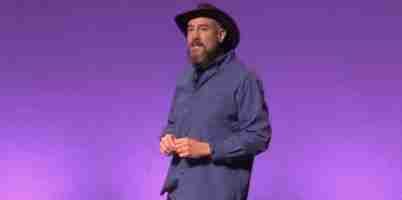
Here is the full transcript of musician David LaMotte’s talk titled “Why Heroes Don’t Change The World” at TEDxAsheville 2024 conference.
Listen to the audio version here:
TRANSCRIPT:
The Challenge of Addressing Large-Scale Problems
Friends, we’re up against some difficult things. We may disagree about what the biggest problems are, what the best solutions are, but I think almost everybody agrees that as communities, as cities, as states, as nations, as the world, we’ve got some problems that need addressing. So it makes sense to ask, like, what works? How do you actually address large-scale problems effectively?
I think our culture has an answer for that question, and I think that answer is everywhere. And here’s the answer. What you need if you’ve got a really big problem is somebody really special. Somebody extraordinary.
The Hero Narrative
Somebody extra smart, extra brave, extra strong, extra wise, to come and do something dramatic in a moment of crisis, and then the problem is fixed and we roll the credits. I know it sounds cartoonish when I lay it out that way, but if we went out and got in our cars and drove to the nearest multiplex movie theatre, how many of those 15 movies would have that plot?
And I’m not just talking about the superhero movies, I’m talking about the dramas, and the comedies, and the romances, and the horror films, and the children’s entertainment.
But here’s where it gets sticky, I’m also talking about the documentaries. This is how politics is presented. This is how religion is often conveyed and understood, and it’s not an unusual plotline even in a history class.
The Reality of Change
Here’s the crazy thing. I’ve been working on this for over 20 years, and I have yet to find one single example of this actually happening in the whole history of the world. Not one. Where some extraordinary person came and did something dramatic in a moment of crisis, and effectively addressed a large scale problem by themselves. It has simply never happened.
Fortunately there’s another narrative. It’s a lot less popular, but it has the added benefit of being true. That’s called the movement narrative, and it says if you want to address a large scale problem effectively, what you need is a lot of people to move in the same direction and do a little bit each.
The Power of Movements
And I contend that that is always how change has happened. But this hero narrative is so powerful in our culture. It might help to look at a historical example of a large scale social change and see how it looks when we look through these two different lenses, the hero lens and the movement lens.
Before I do, I need to acknowledge that I’m a cisgendered, straight, white male, and there are things about this story that I will never understand because of lived experience. But I’ve studied it a great deal, and I think we should all be studying it a great deal, because it’s an archetypal story. It’s a story that teaches us lessons about how change happens. It’s a story about civil rights and racism, and I suspect that everybody in the room knows at least some version of this story.
The Rosa Parks Story: Hero Narrative
When Rosa Parks got arrested, and the Montgomery bus boycott ensued, here’s how I learned the story when I was in elementary school. I’m curious as to whether you learned it in a similar way.
Rosa Parks was a little old black lady who was on her way home from work and tired at the end of a long day, and she made the spur of the moment decision not to give up her seat to a white man who had entered the bus as she was expected to do by the laws and customs of the day.
She was arrested, and that arrest gave flame to the nascent civil rights movement, and the nation changed, and the world changed. Is that roughly how you learned the story the first time? Well most of that is technically true, although I would like to get a shout out if 42 does not qualify you as old.
The Rosa Parks Story: Movement Narrative
I’m looking at that one in my rear view mirror, and it’s getting small. But other than that, most of those details in that story are technically true. But there comes a point where you carve away so many facts from a story that even if it is technically factual, it stops being capital T true. Here’s what nobody told me in elementary school.
Nobody mentioned that by the time she was arrested on December 1st, 1955, Rosa Parks had already been a civil rights activist for over 20 years. She had been in the work for a very long time. Nobody mentioned that by the time she was arrested that day, she had been the secretary of the NAACP for 12 years in Montgomery.
The Untold Preparation
Nobody mentioned that three months before she was arrested, Rosa Parks went all the way to Tennessee. This blue collar woman took a week off of work and went to the Highlander Center to train in nonviolent activism and voter registration, which of course was a life-risking activity in those days. The story begins to change a bit when you know those details, right?
But perhaps even more importantly, nobody mentioned the Women’s Political Council. The Women’s Political Council was an organization of over 200 African American women in Montgomery organized into three chapters around the black part of town. These women met regularly and had meetings to figure out how to move things forward for civil rights, and they had been doing it for nine years by the time Rosa Parks was arrested.
The Women’s Political Council
The year before she was arrested, they wrote to the bus company, and we still have a copy of this letter, and they said, we have some concerns we need you to address, and if you don’t address them, we are prepared to launch a boycott that we have organized.
They said, once you’ve paid for your seat and sat down in it, we would like to be able to remain there. We would like some black bus drivers for black routes through black parts of town, we would like for the driveways to stop, because in 1955, if you were white, you paid at the front and you walked down the aisle and you sat down.
If you were black, you paid at the front and you got back off the bus, and you walked back halfway and came in a back entrance, and there were bus drivers who thought it would be amusing to drive away.
Let’s look at the timeline of Rosa Parks’ arrest. It’s a Thursday night, according to her arrest warrant, it was 6:06 p.m. when she got arrested on that bus.
The Immediate Response
There were people on the bus who got off the bus and said, this is drama that I’d better not get involved with, and they just found other ways home. There were other people who, of course, took out their phones and took pictures and posted them on Instagram. No, no, y’all are with me, that’s good, you’re paying attention.
No, they went into nearby houses and they picked up phones with heavy handsets that were sitting on tables or attached to walls and they called people to say, “Hey, check out what just happened.” And the word got very quickly to Joanne Robinson. Joanne Robinson was the president of the Women’s Political Council.
The Launch of the Montgomery Bus Boycott
She made another couple of phone calls to talk to a couple of other activist friends, and then she made a decision to launch the Montgomery bus boycott. So she made three more calls. She called two of her English students. She was a professor at Alabama State, which was then a college for black students, and she had two students in her Friday morning class that she trusted, and she invited them to meet her at the school at midnight.
Then she called the guy with the keys to the copy room and asked him to come down, and he came down, unlocked the copy room, went home.
The Night of Action
So Joanne Robinson and her two students then made 17,500 copies of a three-up flyer calling for a one-day boycott on Monday. They put in 17,500 and hit the green button. No, they did this for four hours, right? Old school mimeograph machine, some of you can still smell the ink, right?
They did this for a very long time, four hours, and then they cut them all, they bundled them, and they put them all in Joanne Robinson’s car, and they drove them around town, and they dropped them off at the homes of Women’s Political Council members who had agreed in advance to pick them up and paper their own neighborhoods.
So between four and seven, all these bundles get dropped off, and by seven, almost all of the houses and the churches and the businesses in the black part of Montgomery had this flyer on the door. This was possible because they did not wait until the fire broke out to build the fire station. They had been doing the work for years.
They were ready to go. They had done the mundane, boring meetings to make this possible. But think about it, friends.
The Women’s Political Council organized the Montgomery bus boycott, Joanne Robinson called the Montgomery bus boycott, and I suspect that almost none of you have ever heard her name. We don’t tell movement stories, we tell hero stories. And of course it’s natural for stories to be simplified over time, and hero stories are a lot easier to tell, there are fewer characters.
The Importance of Movement Stories
But what we lose in cutting out the movement part of that story is important. Because human beings understand the world around us through story. We take lessons from stories, especially stories we hear over and over and over again, and we take those lessons both consciously and subconsciously.
So things that you are soaked in your whole life get in you, right? And then we make decisions based on those stories, because they explain to us how the world works. So if we tell the story wrong, we take the wrong lessons, and we can make some poor decisions based on those understandings.
The Impact of Narratives
I think it’s important for us to think about how we’re hearing the stories and how we’re telling them. If the hero narrative is our model of change, how do we deal with large scale problems? How are we going to work on climate change?
Are we going to just head up to the North Pole and catch polar bears as they slide off icebergs? I mean, it’s not an effective strategy. The Montgomery bus boycott, of course, did not go on for one day, it went on for over a year.
The Reality of the Montgomery Bus Boycott
It was very effective, they were putting the pressure on, and not only did they have to keep the pressure up on the mayor and the city council and the bus company, but they also had to get people where they needed to go. Lots of people walked, but sometimes grandma’s got to get to the doctor and she’s not going to be able to walk there. And so they set up a central dispatching phone number, and the NAACP took up a collection and bought six station wagons, and basically they created Uber in 1955.
People volunteered their cars and themselves as drivers, and they got people where they needed to go. It was an extraordinary feat of organizing. And you know what Rosa Parks was doing?
Rosa Parks’ Continued Involvement
Rosa Parks was a dispatcher, answering the phone, volunteering again. Right after her international fame, she was on the cover of Le Monde, not just the New York Times. She went right back to the movement work, because she understood that the movement work is what moves things forward, that’s why we call it movement work.
So as we switch lenses, our instructions change. If we are people who care about the world around us and want to have a positive impact, want to deal with some of these big problems we’re facing, it may be helpful for us to consider the instructions we’re getting from these two different stories. Because if we have internalized the hero narrative, if we believe that either consciously or subconsciously, well then what are our instructions?
The Hero Narrative Instructions
First you need a crisis. And where do you get the crisis? What’s your job? Well, you don’t really have one. The crisis just kind of happens, and you wait for it. So then the crisis happens, and then what do you need?
You need a hero, right? And the hero shows up, usually right in the nick of time. And then, so I don’t know about you, I don’t wake up feeling particularly heroic most days. So the hero comes, and then they do something dramatic and fix the problem. And then we have a role. Our role is to clap.
So your instructions, if you want to change the world according to the hero narrative, are step one, wait. Wait for the crisis. Step two, wait some more. Step three, watch. Step four, clap. And that’s how you change the world.
But the movement narrative offers a very different set of instructions. The movement narrative says, number one, figure out what you’re going to work on. You can’t work on everything. What’s tugging on your heart right now? Number two, find your people. Where are there other people who care about the thing that you care about?
Go and find them and join them and offer to help. Most movement people are going to be really happy to see you at the door. If you can’t find them, then get a few friends together for coffee to talk about it and see if there’s some energy to work on some things.
Number three, do an asset inventory in your group. Think about what you have to work with, what skills, what knowledge, what social connections. Make a virtual pile of that on the table and then think about step four, which is to make an achievable short-term goal.
Setting Achievable Goals
If the goal can’t happen in the next few weeks, it’s too big. Break it down in component parts. Number five is do that thing. Give yourself a deadline and make it happen. Number six used to have more literal meaning for me back in the day, but the metaphor still holds. It’s the instructions on the side of a shampoo bottle that say, “Rinse and repeat.”
The Importance of Iteration
Y’all remember, huh? But the metaphor still holds, right? Rinse meaning, figure out what went right, what went wrong, how we’re going to course correct and then go back to the top and start over.
Those are really different instructions, friends. Now some of you might be thinking, look, I didn’t believe the hero narrative to begin with, but I want to suggest if we’ve been marinating in this our whole lives, it can still influence our decision making, even if we reject it intellectually. Have you ever opened the news and thought, this is horrible, but what am I supposed to do?
Challenging the Hero Narrative
I’m not Gandhi. I’m not Rosa Parks. That’s the hero narrative telling you that it’s special people. It’s a different kind of people, heroes over here that changed the world and normal people don’t. We need somebody extraordinary, not ordinary, not you. But it’s not true.
The Reality of World Change
So friends, I have got bad news and have got good news. I’m going to do the bad news first and it’s really bad news. So brace yourself.
You know what changes the world? Committees change the world. I know. I’m sorry. I’m sorry to tell you this. I hate to be the one, but it’s true. People getting together to figure out what needs to be worked on, what we’re going to do, who’s going to do what, when we’re going to meet again to make sure we did it. That really is how the world changes.
But I know that if you run into a friend this evening and your friend says, “How’s your day been?” And you say, “Oh, I went to this TEDx talk.” “Oh yeah? What did people talk about?” “Well, this one guy talked about changing the world.”
Right. I heard the chuckles. It sounds kind of ridiculous. It sounds kind of naive. But it’s not naive. Here’s the thing, friends.
The Power of Individual Actions
We use the phrases “change the world” and “fix the world” and “save the world” like they mean the same thing and they do not. If you think you can fix the world, guilty as charged. That’s naive.
If you think you can save the world, you might be shooting a little high. But if you think you can change the world, you’re just paying attention. The truth is, it’s not naive to think you can change the world. It’s naive to think you could possibly be in the world and not change it. Everything you do changes the world, whether you like it or not. We need you. So which changes will you make?