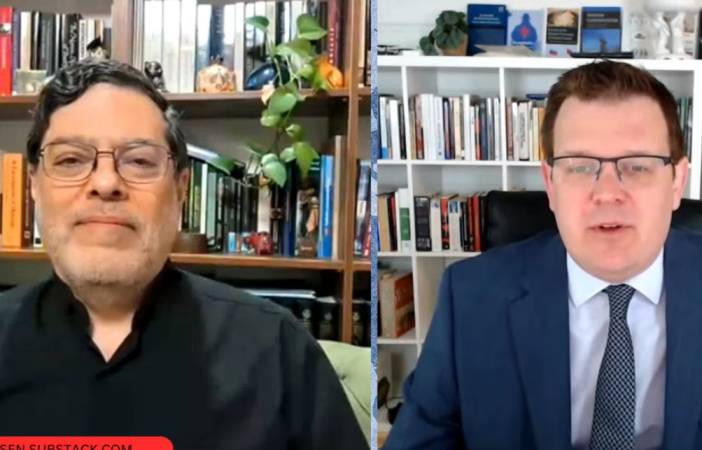
Editor’s Notes: In this episode, Glenn Diesen is joined by Professor Seyed Mohammad Marandi to discuss the fragile state of Middle Eastern geopolitics following a breakdown in ceasefire agreements. Marandi provides an on-the-ground perspective from Tehran, detailing Iran’s retaliatory missile strikes after reported Israeli violations in Lebanon and the strategic closure of the Strait of Hormuz. The conversation explores the shifting power dynamics between the U.S. and Iran, analyzing how recent escalations have impacted global energy flows and the credibility of international diplomatic efforts. Together, they unpack the broader implications of these conflicts for the global economy and the potential for a transformative shift in the international order. (April 8, 2026)
TRANSCRIPT:
Introduction
GLENN DIESEN: Welcome back. We are joined today by Seyed Mohammad Marandi, a professor at Tehran University and a former advisor to Iran’s nuclear negotiation team. So it’s good to see you again, and I’m glad to hear Tehran is more quiet today.
Iran’s Missile Response and the Ceasefire Breach
SEYED MOHAMMAD MARANDI: Thank you very much for inviting me, Glenn. It’s always a pleasure being on your show. Yes, I’m at home and things are more quiet, but the Israeli regime has been slaughtering Lebanese today and they’ve been carpet bombing all sorts of different cities in violation of the ceasefire agreement.
Although Trump says it’s not a part of the ceasefire, the Pakistani Prime Minister has said very clearly, and he tweeted, that Lebanon is part of the ceasefire. And since the regime is continuing its slaughter, and they’re just targeting ordinary people, the Iranians have fired missiles and they’ve shut down the Strait of Hormuz again.
So it’s unclear where things are going to go, whether we’re going to have continued airstrikes against us by the Israeli regime or not. I think that probably will continue and we’ll have to see what the Americans do.
GLENN DIESEN: Yeah, I should have said we’re recording this now today on the 8th of April. And you were just saying before we started recording that as we speak, Iranian missiles are now flying towards Israel in response to Israel’s breach of the ceasefire agreement.
But I guess a good place to start would be then, what are the actual terms? Because I find this to be quite extraordinary that it’s quite an important ceasefire. I mean, the whole world is captured by this war against Iran, and we’re getting Wall Street Journal saying this, Reuters saying that. I mean, what are the actual terms, and why is it so difficult to get a very clear-cut answer to this?
The Ceasefire Framework and Iran’s 10-Point Plan
SEYED MOHAMMAD MARANDI: Well, first, the United States said that Iran must surrender. They said unconditional surrender, at least Trump did, like in the previous 12-day war. And then gradually that evolved into the 15-point plan, which Iran rejected. And then Iran began to develop its own plan, which the Supreme National Security Council gave to the leader, Ayatollah Sayyed Mujtaba Khamenei, and he made some changes. They finalized the plan and sent it to Pakistan. And ultimately, Trump agreed that this would be the framework for negotiations.
Now, that doesn’t mean that we’re going to have peace. It doesn’t mean that the United States will agree to these 10 points, even though they are very reasonable. But the United States being an empire and an extremely arrogant empire, it’s very difficult to imagine them capitulating and accepting the rights of a nation.
So my personal view is that either we’re going to go back to war, but it would be difficult for the United States for a number of reasons. One is that there’s a lot of internal pressure in the United States. That’s why Trump accepted this in the first place, the Iranian framework. And there’s a lot of international pressure on the United States. And remember, the Strait of Hormuz right now as we speak is closed.
In addition to that, I used to — I was in the war many years ago. So I can’t say I’m an expert on military affairs. When I fought, it was the 1980s as a volunteer. But that was a long time ago. US equipment brought to them — this has to remain in the region. The Persian Gulf gets very humid and hot, and they will have sandstorms in the Arabian Peninsula. And if I recall correctly, in the past wars against Iraq, subsequently, the US military had lots of damage and they had to spend literally hundreds of billions of dollars to repair all the trucks and the planes and all that.
And this time around, they’re not even well protected because their bases have been destroyed and they were rushed into the region and it was supposed to be a very short war where they would easily defeat Iran. And so I think it’s going to be very difficult for the United States to maintain this force in the region without it becoming a larger and more difficult burden as each day goes by.
But still, the Iranians are preparing themselves for the worst. They’re not going to — because we already negotiated with Americans twice and we saw how both of those attempts to negotiate turned out. One, as we were negotiating, they carried out — they launched a 12-day war, a blitzkrieg attack. And then last month, again, we were negotiating, making progress, and they launched another war. So it’s not as if the Iranians are going to have any faith in the upcoming negotiations.
And as I said, as we speak, Israelis are doing whatever they can to prevent peace from spreading. These vicious attacks on Lebanon, just slaughtering women and children. Hundreds so far have been murdered in the last few hours. That’s just unbelievable carnage. This is being done to prevent the ceasefire from working. And Trump, by changing his position, by saying that Lebanon is not a part of it, is showing both his own weakness and it is showing us that we should be prepared for renewed war despite the difficulties that that would have for the United States.
Israel’s Role in Disrupting the Peace Deal
GLENN DIESEN: Yeah, so Joe Kent, he was tweeting out a recording of himself where he was making the argument, if the US wants this peace deal to work, then they have to find a way of restraining Israel.
His argument was that Israel will do anything possible to disrupt this peace or prevent it. And again, that’s not really delving into conspiracy theories because if you follow the Israeli media today, they are devastated almost. I saw also video of people like Mark Levin, not in Israel, of course, but almost shaking out of frustration that this ceasefire could have been accepted. And so again, I guess—
SEYED MOHAMMAD MARANDI: I’m sure they’re taking a lot of pleasure in the bombing of Lebanese cities and the massacre of women and children because that’s how they really are. And that’s really what Netanyahu is doing. He’s trying to destroy the ceasefire, but also he wants to kill people so that the Israeli people will give him some more leeway, give him more — because this is a genocidal society as we’ve seen in the polls.
GLENN DIESEN: Yeah, no, I’ve been watching those videos out of Lebanon today as well. Apparently been just bombed nonstop the whole day. And also, yeah, the videos are coming out of residential areas. So just men, women, and children slaughtered. And for all the people who say that they’re relieved that there’s a ceasefire, it’s very strange that there’s not more of them speaking out against this because this is, well, predictably, this is destroying the ceasefire. Well, it’s a violation of the ceasefire.
Western Media Silence and the “Epstein Class”
SEYED MOHAMMAD MARANDI: But well, Glenn, I’m sorry for interrupting you, but why would they say anything? I mean, Trump has been saying that he is going to obliterate Iran for a few weeks now. Recently, he’s been saying he’ll take Iran back to the Stone Age and just less than 48 hours ago, he said that he’s going to erase the Iranian civilization from the earth.
Have you seen any major Western journalists speak up in outrage about the threat to carry out the greatest holocaust in human history by far? Have you seen any Western, even opponents of Trump — have you seen the Washington Post, the Guardian, or any of these progressives mainstream, or liberals or conservatives, those who are in the mainstream? Have any of them expressed outrage saying you want to commit — have you seen the New York Times put out a big piece shaming Trump and saying you’re a war criminal?
No, because for the empire, we are all worthless. We are all Amalek, just like with the Zionists. We are all Amalek. We are subhuman to them. We’re subhuman to those journalists who have 2 million, 3 million followers, hundreds of thousands of followers, but have said nothing.
So why should they be outraged by the slaughter of Lebanese women and children? In fact, what they will try to do is justify it. You’ll see in Western reports that these are Hezbollah strongholds or Hezbollah bases, whereas they’ve known throughout that the Israeli regime carries out the Dahya doctrine. In other words, flattening the city, just like mowing the lawn in Gaza. Dahya is southern Beirut. They mean, destroy it. And mowing the lawn means Gaza, flattening it. That’s open policy.
But none of these Western journalists say anything because they have no moral compass. When I say the West is governed by the Epstein class, that’s exactly what I mean. The media is owned by the Epstein class. These are just media workers for the oligarchy, and the governments are owned by the Epstein class. Otherwise, what sane person would watch this slaughter and not be outraged?
The Genocidal Mindset and the West’s Legitimacy Crisis
GLENN DIESEN: I think that’s a fair point. I saw this, yeah, also a news report coming out of BBC where they allegedly interviewed an Iranian in Tehran who argued that, well, if the US will destroy all power plants, bridges, and also even drop a nuclear bomb on Tehran and wipe out everything, it would be better than living under this government, sorry, regime. And this is kind of the — yeah, so it’s the — I think it’s important because it’s not as if this genocidal mindset is limited to Trump alone. It’s very much something you see beyond, which is kind of frightening.
And also it’s very self-destructive for the West, you can say, because in the West, the whole political West bases its legitimacy on the whole humanitarian, liberal democratic narrative. So when you, on the other hand, go in providing legitimacy for a holocaust against the Iranian civilization, then you spark a legitimacy crisis within as well.
But I did want to ask, this ceasefire is supposed to be the terms over the next 2 weeks, but over these 2 weeks, negotiations have to persist for something more concrete, something where Trump can’t just tweet something out in 20 minutes from now where he essentially puts Lebanon out of the deal. How is — is the 2 weeks enough? Do you think anything can actually come out at the end of these 2 weeks?
Prospects for Negotiations and Iran’s Military Preparedness
SEYED MOHAMMAD MARANDI: I think if things go very well, the 2 weeks will be extended and maybe they’ll agree on some minor issues or some easier issues to deal with, but I don’t believe that we’re going to have an agreement with the United States over the 10 points that Iran has put in the plan, because that’s not just how — that’s not how the United States works. It is an empire and it’s an arrogant empire and Trump is the most arrogant of the arrogant emperors of empire.
And in addition to that, Trump is all over the place. He’ll say something today and something else tomorrow. He’ll say something this morning, something else this afternoon. He’ll say something in one sentence and say the opposite in another. So I do not envy those who are going to be negotiating with the United States directly or indirectly or passing messages back and forth.
But what I think is — right now, the big question is whether we’re going to have renewed fighting between Iran and the United States in the coming weeks. Again, I think the Iranians — I’m sure that the Iranians are preparing themselves as we speak for further bloodshed and further attacks. But I think that it will be, as I said earlier, difficult for Trump to restart this war because it’s already very unpopular and it has gone nowhere. And there’s absolutely no sign that Iran has grown any weaker.
For 40 days, the Iranians have been firing missiles day and night at the Israeli regime, at the US, missiles and drones, at US assets in the Persian Gulf, and at proxies that are complicit in the war. There’s no end to the capabilities of Iran for the months to come. My understanding is that Iran has far more missiles and drones than anyone can imagine. We’ve discussed this before. Iran has been preparing itself for this war for 25 years. And Iran is very confident about its capabilities and the failure in that operation that was to steal Iran’s uranium. I think that also contributes to the pressure on Trump.
So I think for a host of reasons, it’s going to be difficult for him to restart it. But I think that, again, Iran is not going to take any chances. It’s going to prepare itself.
Could the War Transition to an Iranian-Israeli Conflict?
GLENN DIESEN: Well, is it possible that the war takes on a different form if the US wants to exit from the war and essentially hand it over to the Gulf states or hand it over to Israel? Is it possible that it will only, well, transition to only an Iranian-Israeli war? That is, they say, well, Lebanon’s not part of the ceasefire. Iran says, well, then Israel’s not part of the ceasefire. And it just takes on a different format.
Because I also saw a report right before we logged on that a Mirage fighter from the United Arab Emirates was apparently attacking an Iranian target, that is the petrochemical facilities on this, I guess, Lavan Island. And yeah, so again, I saw some statements coming out of the UAE as well that they wanted the reparations from Iran. So I’m not sure why they want to keep this war going. I mean, they’re very vulnerable, especially if the US doesn’t want to have a leading role anymore. But is it possible that this becomes the US excuse itself and hand over to the Gulf states and the Israelis?
The Persian Gulf Regimes and Iran’s Strategic Position
SEYED MOHAMMAD MARANDI: Well, the Persian Gulf regimes are not in a position to fight Iran. And if they do, again, as I said earlier, we are heading towards warm weather here. You’ve been to Tehran. We have mountains full of snow right now. If we have no electricity, let’s say it’ll get very hot in the summer and it’ll be difficult for us to sleep at night in the heat if we don’t have our cooler or the AC on.
But in the Emirates, if they don’t have electricity, if they don’t have their critical infrastructure, everyone will have to leave. The same is true with Kuwait and Qatar. And all the assets of these regimes are right alongside the coast. They’re deserts. In fact, Yemen and Iran and Iraq and Lebanon have forests, they have 4 seasons. But these countries are deserts. All they have is oil and gas. And they’re totally dependent on this for their economy. And all of their installations are right in front of Iran. They’re not deep inside. These countries are small, except for the Saudis.
So if they want to get into conflict with Iran, I think that would be the end of these regimes. It would end very swiftly. So the Emirates should remember that they are not important and know their place. And the Iranians will control the Strait of Hormuz. So if the Emirates wants to fight, then Iran will hit it and it will not allow it to use the Strait of Hormuz. And probably the ruling family will be gone within a few days. And the same is true with the others. So I don’t see them being in any position to confront Iran.
Israel’s Ceasefire Violations and the Risk of Escalation
Regarding the Israeli regime, that is quite possible. As Iran strikes because of the violations and the slaughter of women and children in Lebanon, the Israeli regime may retaliate. And then since the Israeli regime uses American help — Americans help them refuel Israeli jets — then we’ll have to see what role the United States will want to play in all this. So that could lead again to an Iran-US confrontation.
But we’ve had Iran and the Israeli regime strike at each other before. That was the 12-Day War. And we’ve been seeing that in the past 40 days. The Iranians are more than prepared to continue to do this, to strike them time and time again until they stop, but then the Strait of Hormuz will remain closed. And then the world will recognize that it is the Israeli regime that is taking their people, their societies, their countries towards catastrophe.
Netanyahu and the Zionists are pushing the world towards a global depression. And so by violating the ceasefire, slaughtering people in Lebanon and restarting the fight, they are blocking the normalization of the flow of oil and LNG and fertilizers. So the pressure will build on Trump and the Israeli regime. And for example, India, whose government has been close to the Israeli regime, I think they know quite well where their economy is heading and who is responsible. So will the Indians continue to show the sort of support they did after all the Israeli regime has done to their economy? Who knows?
Trump’s Effort to Sell the War as a Victory
GLENN DIESEN: Well, I saw Pete Hegseth giving a speech. He gave a lot of speeches, but it appeared, the way I interpreted it, as a great effort to try to sell this war as a victory. So he said the Iranians were begging for this deal. He went on listing all the people they had killed as a way of portraying this as a victory.
But it did make me think though that the pressure that Trump must be under, because he has to sell this as a victory. As you said, he initially argued that the only acceptable outcome was the unconditional surrender of Iran. But now suddenly the Iranians and Americans will meet again to negotiate. But instead of negotiating Iranian enrichment, ballistic missiles, regional partnerships, they will start to negotiate Iran’s control of Hormuz, how it should set up the toll booth, essentially, to charge ships for transit. They are going to negotiate removing all sanctions on Iran.
It’s going to be very difficult for Trump, I’m thinking, to sell this as a victory when this is not what you would negotiate with an adversary which just capitulated. It doesn’t really make much sense. I don’t mean to demean his skill at the BS, but this goes far beyond that, I think.
Reparations, Arab Regimes, and the Path to Negotiations
SEYED MOHAMMAD MARANDI: Yes, we’ve reached new heights in BS when it comes to Trump. But I think the important thing right now is that until we have a real ceasefire, I don’t see the normalization of the flow of energy from the Persian Gulf region happening. And on the other hand, if these Arab regimes in the Persian Gulf want to behave in a confrontational manner to Iran, they are going to have to pay compensation. They are going to have to pay reparations for what they’ve done. But if they want to push, then they will definitely be on the losing end.
I think after 40 days, when the superpower and its Israeli ally — which of course has all the weapons that the superpower can give — along with all its proxies in the region who directly supported them, and other regimes who indirectly supported them like Turkey and the Republic of Azerbaijan, who helped the Israelis and Americans in their own way, the governments. If the United States couldn’t defeat Iran under those conditions and was seeking a ceasefire, then what in the world does the United Arab Emirates or Kuwait think they are going to do to Iran? So they should stand down, be calm, and accept the fact that they lost this war. They were complicit. They helped carry out this war.
But again, I think the big question is what’s going to happen in Lebanon? Iran is now hitting the Israeli regime. Is the Israeli regime going to keep striking Lebanon? Is it going to now start striking Iran again? So it’s not at all clear that we’re even going to get to the negotiations. And if we do get to the negotiations with the Strait of Hormuz being closed, it’s not clear how much forward we can go. Because if the United States is not willing or capable of reining in their mad dog in Tel Aviv, then I think the purpose of the talks will be — there will be no purpose for those talks.
The Ceasefire Deal and Israel’s Continued Occupation of Lebanon
GLENN DIESEN: Yeah, well, how do you unpack the deal now for the ceasefire? Because when they said no more strikes on Lebanon, but the Israelis are already occupying Lebanon, they’re in Lebanon. Are they under this deal withdrawing or are they holding their positions? What exactly is expected from each side here?
SEYED MOHAMMAD MARANDI: I don’t know those specific details. That’s a very good point. And actually, I asked someone about this who didn’t know either. So I guess that’ll come out in the days ahead. If I get any news on that, I’ll send it to you so that you could use it for your subsequent programs.
But I don’t know. That’s a very good question because the method in which Hezbollah has been fighting this time around is very different from what it was during the previous war. And Hezbollah has been much more fluid this time around. They’ve been fighting less like a conventional force than a commando force. And they’ve been hitting the Israeli regime very hard. So where are the lines exactly? That is an open question.
Last time, Hezbollah held them back. But Hezbollah gave a high voltage that way. And the only reason why the Israelis came in was after the ceasefire, the Israeli regime violated it. This time around, since the battlefield is much, as I said, a different type of war and Hezbollah has been very successful, it’s unclear to me what a ceasefire would be, unless of course it means that the Israelis would have to return to the borders, which are clear, or to where they were before this war, which is more or less clear. But I don’t know.
Lebanon as Part of the Ceasefire Deal
GLENN DIESEN: It just seems extraordinary that this is what’s disrupting the entire ceasefire, because again, if the Pakistani Prime Minister — the go-between guy — argues that Lebanon is part of the deal, and now we hear from President Trump that no, it’s not part of the deal. He called it a “separate skirmish.” I mean, it is quite extraordinary. There must be some document. It’s just shocking to me that there’s nothing to be said there.
But also, even if it was or wasn’t, either way, one would have to explain why this intense bombing began exactly today on the first day of the ceasefire. Why this brutal carpet bombing of Beirut? One can only interpret it as an effort to disrupt the ceasefire, but if the US wants the ceasefire, why no pushback then against the Israelis for doing this? I mean, at least wait a week until the ceasefire seems to be settling. It just seems an obvious effort to disrupt the whole thing.
Western Silence on Israeli Carpet Bombing
SEYED MOHAMMAD MARANDI: Again, it’s repetitive what I’m saying, and I apologize, but is there any condemnation coming from Europe or the United States for the carpet bombing? Is anyone outraged? Are there any sanctions going to be put in place? No. So the Israeli regime can do whatever it wants. And that is basically why the Iranians are going to have to meet force with force, because the United States and the West allows the Israeli regime to get away with everything. I mean, they’ve gotten away with genocide for 2.5 years.
True, the world has turned against it. Public opinion has turned against it. Ordinary Americans are turning against it. But still, the elites in Washington and across Europe fully support the genocide and the genocidal acts.
So for Iran, how can you negotiate with the Trump regime, where the president changes his position? As you said, the Pakistani Prime Minister very clearly says it’s a part of the agreement. And this is the Pakistani Prime Minister who listens carefully to what the Americans say. I don’t want to be insulting or anything, but I think you saw his tweet where he basically cut and pasted the American tweet and then tweeted it as his own, and then they had to change it. It was clear that the text was an American text. So when the Pakistanis are so deeply influenced by the United States, when it says that Lebanon is a part of the ceasefire, it is definitely a part of the ceasefire.
Iran and Oman’s Co-Management of the Strait of Hormuz
GLENN DIESEN: Well, let’s just move one step further, that is into the actual deal that’s being made, because what shocked much of the American media was that Trump accepted that the Strait of Hormuz would be controlled by Iran, or more specifically, it’s supposed to be both the Iranians and Oman who are supposed to co-manage it, or both at least be able to get some fees for using the strait. Is this an effort to set up a collective security arrangement or economic arrangement as opposed to only having Iran do it? Or was this part of a compromise? Because I can see why Iran can claim it — that is, if you want reparation for what was done against it. But Oman, is it more just about the geography or is it about the collective security, or how do you make sense of this?
Iran’s Growing Power and the Future of the Region
SEYED MOHAMMAD MARANDI: Well, first of all, Oman has had a much more reasonable relationship with Iran. And during the last 40 days, I’m sure you’ve seen, your viewers have noticed, that Iran has left Oman untouched, even though they too have American bases. Iran has, because Oman has behaved better than the others, it’s treated it differently. And Oman, of course, is the country that owns the other side of the Strait of Hormuz. And it would be easier for Iran if Oman was cooperating with it with regards to the status and the management of the Strait of Hormuz.
Now, what exactly would the relationship be and what would Oman get out of this? What would Iran get out of this? That I think is something that will have to come out of negotiations. But those negotiations have been taking place already. And the Iranian parliament is preparing a law with regards to the management of the Strait of Hormuz.
But the interesting thing is we would have never moved in this direction if the United States had not launched this war. We had no plans to take control of the Strait of Hormuz, but the United States basically pushed us in that direction. And I must say, Glenn, that by controlling the Strait of Hormuz, Iran becomes a much more powerful country than it was before, but also by really winning the war. And I’m not saying the war is over, but by winning the war, the Iranians, I think, have turned into a much more powerful country.
This is something that I think we discussed earlier, a couple of weeks ago, maybe. Iran is much more powerful today. And in my opinion, the United States is a much weaker entity than what it was before. And I think countries across the global south will see this as a major sign of US weakness. Countries that almost universally, except for China, whenever the United States bullied them about trade and tariffs, now perhaps they will become a bit more assertive in defending their rights. The Indians, the Pakistanis, the Bangladeshis, across the world, across the global majority, they’ve been bullied, and now Iran has basically told the Americans no, and the Americans did the worst crimes against the country along with their allies, and they failed.
So I think that Iran becomes much more powerful. The United States becomes, relatively speaking, much weaker. And the Israeli regime loses because it did not succeed in this war, and its main supporter has lost a lot of credibility and authority, and that is bad for the regime itself. But also, the big losers are these five family dictatorships in the Persian Gulf. They wanted to have their cake and eat it too, and now they are hungry and have no cake.
A Transformative Shift in the International System
GLENN DIESEN: Yeah, I interviewed yesterday a common friend of ours, Alastair Crooke, who was making the same point that Iran’s, well, seeming victory in this war is quite transformative to the entire international system. That is not just a military victory over the former global hegemon, but also the economic aspect of it. That is, yeah, you can argue only controlling the Strait of Hormuz, only the fees would, well, some say would amount to somewhere up to $100 billion a year. I’m not sure, I haven’t checked the numbers, but anyways, it’s quite significant. Yeah, just the money, but it’s not just this.
It’s also, as you said, the ability to stand up to the United States. This trade can then be organized in other currencies, which then puts the petrodollar under stress. It would also essentially elevate the cost of being an American frontline state, vassal, ally, whatever one wants to call it. And this again would have ramifications even beyond the Middle Eastern region. That is, Europe, East Asia. So this is going to have a huge impact.
But it’s quite extraordinary what has happened and how foolish it was for Trump to actually get into this war. I mean, when he saw all the former presidents who had great pressure to attack Iran but never did, the idea that this was just because they weren’t as strong as him, not as decisive, as opposed to not being as foolish. It’s just quite amazing.
But there have been some reports that it was China that also called Iran and asked them to accept the ceasefire deal to get an end to the war. Do you have any information on this?
Iran’s Position on the Ceasefire and the Strait of Hormuz
SEYED MOHAMMAD MARANDI: I doubt that such a thing is true, because what was important for Iran was for Trump to give up his 15-point plan and to recognize Iran’s 10-point plan. And that, again, Iran is under no illusion that Trump is going to come to the negotiating table and say, okay, I accept, and everything is finished and let’s move on. But that, I think, was important. It was a very symbolic moment, I think, for the entire world. I think it symbolizes a major shift in global affairs.
Perhaps, and again, we could have war, but perhaps in a way, one of, if not the most significant, one of the most significant moments since the Second World War. I personally think it may be the most significant, the last 40 days. But for Trump to make that transition, to accept that, that is a humiliation. There’s no way, there’s no other way to look at it. And that was important for Iran.
But at the same time, Iran is again under no illusions. It’s continued right now. It briefly opened the Strait of Hormuz and closed it again because of what the Israeli regime did. It’s firing missiles at the Israeli regime and it’s also fired missiles and drones at these Arab regimes after that strike was carried out against Iran. So Iran is going to prepare itself in case Trump wants to go back to war or feels that he has to go back to war.
But I should also, by the way, point out that the Strait of Hormuz — Iran is going to be treating friendly countries in a different way than countries that have cooperated with Americans in this aggression. So I think that Chinese ships and Russian ships and Iraqi ships will be treated differently than Saudi ships or British ships or American ships or Canadian ships or Australian ships.
Regional Consequences and Shifting Borders
GLENN DIESEN: Well, just a last question. Given that this war has already spread, and it’s not merely a war only between the United States and Israel — oh no, sorry, and Iran, as obvious with Israel attacking Lebanon. But also, you mentioned previously that some borders could be changed in this war. For example, Iraq might seize Kuwait. Well, I mean, it’s not as if Iran is this puppet master who controls everything in the region. It has regional partners and allies, but they have some autonomy and their own interests. I mean, how much can be expected — well, can we expect everything to die down as a result of this? I know this is the driving force, but do you see other parts of this conflict continuing? For example, Kuwait ending up as Iraqi territory?
SEYED MOHAMMAD MARANDI: Well, the strength of Iran, part of it lies in the fact that it has these alliances. There’s no doubt about that. Iraq has played an enormous role in this war, and it has, to a degree, liberated itself of American occupation, not fully, but it has made major results. Yemen too, and of course Hezbollah taking this opportunity to hit back at the Israeli regime so that it can take back its country, the occupied territory, and have a real ceasefire, because the Israeli regime has been killing Lebanese civilians every day since the so-called ceasefire, just like they do in Gaza. So this is a collective strength.
But the future depends on these Arab family regimes. If these regimes did not allow the United States to use their airspace and their territory and their sea and their shoreline, we would not have had this war. Americans could not carry out a war under those circumstances. It would have been much more difficult. And I don’t think that they would have launched the war in the first place.
If these regimes rethink their foreign policy and behave normally like normal countries instead of conspiring and bringing in foreign powers to create a platform for them to invade other countries, if they discontinue that policy, they will be safe. It will never be like what it was before. Those Epstein-class billionaires are not ever going to come back to the Emirates and Qatar and all those corruption there that I can’t explain here, that they’re very well known for. That’s not going to come back, fortunately for them, for their own people, but they can live normally. But if they choose a different path, I don’t think their countries will exist in future, and then the borders will change.
The Long-Term Repercussions of the War
GLENN DIESEN: Yeah, no, that’s a great point. I mean, even if the ceasefire would hold, a permanent peace deal would come through after this, the damage that has already been done — I mean, people focus on the global economy with the energy and the fertilizers, all of this, but for the Gulf states, it’s going to be very hard for Qatar, the United Arab Emirates especially, to recover from this, it seems.
But no, I feel like we’re going to be dealing, even if a peace is reached, the repercussions of this is something we will have to deal with for many years to come. So yeah, interesting is one word to say, but yeah, it’s quite disruptive. And I keep going back to the point, it’s quite amazing given how predictable a lot of this should have been that they still chose this war. But yeah, let’s hope the ceasefire holds. But I share your pessimism. So thank you very much for checking this out.
The Role of Zionism and the Road Not Taken
SEYED MOHAMMAD MARANDI: Just one final point. And I’ve said this in a couple of other places too, if not more, that it didn’t have to be this way. If the Americans didn’t listen to the Zionists, we would not be in this situation at all. And the global economy would be much better. It was the Zionists that brought this about.
And you know, two American authors, as I said earlier, I said to you, Flint and Hillary Leverett, I don’t know if you know them. Have you read their book yourself, Going to Tehran?
GLENN DIESEN: No.
SEYED MOHAMMAD MARANDI: It’s a very good book, and I advise people to read it. They both worked in the White House under George W. Bush. And Flint resigned — Flint Leverett resigned over Iraq. But they were people in power and they wrote a very good book on Iran. I don’t agree with everything in it, called Going to Tehran. And they were attacked from both the Republicans and the Democrats and all the think tankers. They were demonized and marginalized. But if they had been listened to, if that book had been read and people had listened to them, we wouldn’t be where we are today. And by now, Iran and the United States would have had normal relations.
But the Zionists wouldn’t have it. And even though Hillary Leverett, she’s Jewish, but she was demonized for this book. Two very, very, very decent people. Very, very, very principled people. But you know, this is what Zionism does. It is destructive, just like they carpet bomb Beirut. They carpet bomb everything in our region, and they carpet bomb the prospects for peace, stability, and prosperity for people across the world. And the energy crisis that is now beginning to show itself is a result of this.
GLENN DIESEN: Oh, this — well, it’s an important historical fact that especially after the September 11th attacks, that Iran was working very hard to improve and even work relations with the US, even work with the United States, and sought so many times to normalize relations. And Russia too, by the way. It’s often pointed out that Putin was the first one who called Bush after the attacks, and he saw this as an opportunity to transcend the whole Cold War legacy and instead find himself on the same page. Work together, but sometimes they don’t take yes as an answer.
Reflections on 9/11 and the Plan to Invade Seven Countries
SEYED MOHAMMAD MARANDI: Yeah. And also because Iran at that time, and I at that time, believed the official narrative of 9/11. And we thought that the United States had learned its lesson. Only years later — and I’ve ignored a lot of people and probably have done injustice to some — 9/11, for many years. And now my views have, during the last couple of years, evolved very drastically. I’ve seen Tucker Carlson’s documentary and other evidence. But back then, Iran really thought the United States had learned a lesson, that not using extremists and terrorists and takfiris — that that caused such damage and that they would change.
But soon we saw Wesley Clark tell us that the plan is to invade 7 countries in 5 years. And now when you look at it, I think it becomes clear what all that was about. The only thing was that instead of 5 years, it took 25 years and the last country didn’t work out as planned.
GLENN DIESEN: And now we installed an Al-Qaeda leader in Syria. I just feel like we’ve seen this movie before. I didn’t care for it, but here we are again. So no, lessons not learned, it seems. Well, I know you’re quite busy there in Tehran, so as always, thank you very much for taking time.
SEYED MOHAMMAD MARANDI: Thank you, Glenn. It’s always a great honor being on your show.
Related Posts