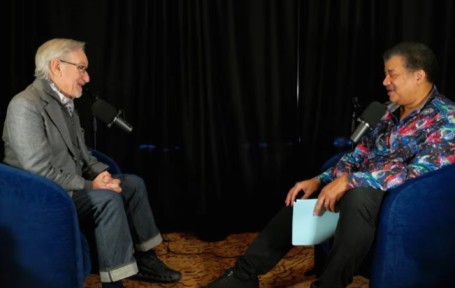
Read the full transcript of Steven Spielberg’s interview on StarTalk Podcast, June 16, 2026. Screenwriter David Koepp joins later in the program.
Editor’s Note: In this episode of StarTalk, Neil deGrasse Tyson sits down with legendary director Steven Spielberg and screenwriter David Koepp to discuss their latest film, Disclosure Day. The conversation explores the intersection of extraterrestrial life, the evolution of empathy in storytelling, and the public’s complex relationship with truth in the modern age.
Neil’s New Book and Steven’s Early Fascination with Aliens
NEIL DEGRASSE TYSON: Why do UFO sightings persist? Are at least some of them figments of our imagination? Or are we missing something? In my latest book, “Take Me to Your Leader,” I actually explore what’s possible in this universe, given the universal laws of physics. If the aliens are out there, the laws of physics will dictate how they find us. I also narrated the audiobook, so I’m duly informed that the audiobook and the print version are available now wherever books are sold.
Steven, good to see you again. Good to see you too. Thanks for coming onto the podcast. We did a little bit of homework, and I did not know your first student film was about aliens.
STEVEN SPIELBERG: Yeah, it was called Firelight. I made it in 8mm, on 8mm film. I was 17 years old, I was in high school.
NEIL DEGRASSE TYSON: So aliens have just been a thing.
STEVEN SPIELBERG: Well, it was more about UFOs, and it wasn’t peace-loving aliens. The first one I did was much more of the formulaic monogram movie exploitation, but it was in an area of interest ever since I was a kid.
NEIL DEGRASSE TYSON: And I mean, why wouldn’t it be? Because everybody’s interested in aliens at some point. But you have the power to bring it to life on levels that no one could have imagined.
STEVEN SPIELBERG: Well, it’s not really so much my interest in aliens, it’s been my interest in the unknown. And the feeling I’ve had for a very long time, having been a consumer of everything involving the unknown — not the unknown a million light years from here, but the unknown right here. And it’s always been something that’s really interested me. And I’ve always wondered, if the unknown is known by a very small group of people, the injustice of not everyone knowing what they know is kind of what drives me, especially to tell the story of Disclosure Day.
NEIL DEGRASSE TYSON: It never occurred to me to think of people left out as being the consequence of an injustice.
STEVEN SPIELBERG: An inequity maybe is a better word for it. Yeah, no, but still, I’m applauding.
The Power of Eyes in Storytelling
NEIL DEGRASSE TYSON: Using the term because when it’s an injustice, you want to correct that as a viewer. You want to right the wrong. And you clearly established that in Disclosure Day. I mean, it was — that was the greatest feeling any of us had as we watched this.
A question that I’ve always had as a director: what is the value of the eyes of whatever it is you’re looking into? Not only in Disclosure Day was there a lot of eye contact from animal to non-human animal to human animal, but also human to human, where you’re kind of seeing into their soul, imparting a bit of empathy — I guess, for lack of a better word there.
STEVEN SPIELBERG: That is the word.
NEIL DEGRASSE TYSON: That is the word of the day.
STEVEN SPIELBERG: That is the key word of the day.
NEIL DEGRASSE TYSON: But aliens tend to, as we now think of them, they all have big eyes, and eyes seem to matter. Can you just speak a little bit as a director? And let me throw in the mix the eye contact with a Velociraptor.
DAVID KOEPP: Yeah.
NEIL DEGRASSE TYSON: Right? I mean, at my museum, the Velociraptor is not much bigger than a big dog, but they were sort of pumped up in Jurassic Park so that you’re making eye contact with something that’s going to eat you. So, not only as a source of fear, but as a potential source of empathy. Just, how does that feel to you?
STEVEN SPIELBERG: Well, with human beings, eyes are the mirrors of the soul. And to animals, I guess eyes are the mirrors of the appetite. But they both serve a similar purpose — they both give a kind of satiation. And I think everything is in the eyes. It’s in the eyes. From any movie experience anybody’s ever had, it’s all about E.T.’s eyes in my film. That was critically important. The design of those eyes were critically important.
It’s a little bit harder with what people report when they report non-human entities. There’s no iris or pupil. So it’s —
NEIL DEGRASSE TYSON: I never thought about that. They’re never drawn with anything inside the eye.
STEVEN SPIELBERG: No, but there are other things happening when people have close encounters of the third kind — which is how that sort of defines itself — that there is something that is also a psychic part of looking into an eye of a non-human, as has been reported, and still feeling something without needing the pupil or the iris.
The Context Behind Disclosure Day
NEIL DEGRASSE TYSON: So in Disclosure Day, because they actually had an alien, I always felt like, what’s the need to even disclose any video if you’ve got the alien? What do you need the video for?
STEVEN SPIELBERG: You need the context. You’ve got to have 80 years of context. He steals 80 years of the truth that has been hidden from the public and even from the government, because it’s very hard for elected officials to keep secrets.
NEIL DEGRASSE TYSON: Unless there’s a mutiny, as in Disclosure Day.
STEVEN SPIELBERG: Exactly. And there have been whistleblowers that went to the House Intelligence Committee and gave their testimony — Grusch, Fravor, and Ryan — sworn under oath.
NEIL DEGRASSE TYSON: Yeah, sworn under oath. 2023.
STEVEN SPIELBERG: Yeah, 2023, in front of Congress and the American public.
The New York Times Article as the Trigger
NEIL DEGRASSE TYSON: So that’s quite the setup for this movie. But presumably the movie was percolating even before then, right? It takes time to make a movie. Were those testimonies the trigger for this whole idea?
STEVEN SPIELBERG: The trigger for the whole idea was the New York Times article.
NEIL DEGRASSE TYSON: Right. That article that came out in the New York Times in 2017.
STEVEN SPIELBERG: Yes. And that was the trigger for me, which was the first time we ever heard the term Tic Tac being used instead of UFO, because first it was UFO and then it was Tic Tac. And then we hear something called UAP. It’s all confusing — unidentified anomalous phenomenon.
NEIL DEGRASSE TYSON: Yeah, it’s who are they fooling? They’re targeting UFOs.
STEVEN SPIELBERG: Can we go back to UFOs?
NEIL DEGRASSE TYSON: Who are they fooling? Please. Completely. Yeah. I remember speaking of a Tic Tac at the time, and a few weeks later at my office, a whole crate of Tic Tacs showed up. So it’s free advertising for them.
I just had questions about the story. All the places are mentioned. We’ve heard tension occur in Korea and Russia and Ukraine. And so that’s kind of this buildup behind the disclosure because that’s the backdrop, that’s the landscape on which this is unfolding. What was your goal there?
STEVEN SPIELBERG: Well, my goal was not to lay it on thick. My goal was to suggest that there was something approaching critical mass happening in the world that at least was bringing back the word DEFCON. And people tend to take these things in their stride. I remember during the Cuban Missile Crisis, I was in high school, and when it was hitting the television — my parents went to a dinner party, and I was home with my 3 sisters worrying about the world ending. My parents weren’t worried about that during the Cuban Missile Crisis. And so there are people who aren’t going to really be focused on the DEFCON situation, but there is a crisis happening in the world which has something to do with the timing of Disclosure Day.
NEIL DEGRASSE TYSON: Yeah. And it’s coincidence, surely, that the government is releasing files right around when you’ve got your movie coming out.
STEVEN SPIELBERG: That is complete coincidence. Unless you have access.
NEIL DEGRASSE TYSON: I know. You can tell me. I won’t tell anybody.
STEVEN SPIELBERG: No. My movie is not a holistic review of the entire UFO phenomenon as fed to me by any actors inside or outside the government. I’ve had no government contact about this at all.
Spielberg’s Imprimatur as Director and Storyteller
NEIL DEGRASSE TYSON: We’re going to have quality time with your writer, your longtime partner, David Koepp, in this. But let me just ask, what would you say of this movie is your imprimatur as director and storyteller?
STEVEN SPIELBERG: Well, I wrote the story. I wrote it from scratch based on my deep interest in this subject, and so much was starting to come out in 2017. I was very satisfied with Close Encounters, very satisfied having made E.T., and then even War of the Worlds, which was more analogous to 9/11 than to aliens.
But this — when I saw that everybody that has a smartphone has been photographing and capturing some extraordinary things happening — we’re crowdsourcing any possible alien invasion. It’s incredible how much is out there right now. And some of it, yes, can be faked, but a lot of it I don’t think is.
I didn’t think I would get interested again in this subject. And then when the 2017 New York Times article came out, I thought, well, something’s about to happen. May not be this year or next year, but something is going to happen. And I really would like this movie to be my summation story in my entire filmography of UFOs and extraterrestrials.
Empathy as a Running Theme
NEIL DEGRASSE TYSON: So let’s explore empathy some more. Because that really mattered in this film. Who trusts whom? Right. How and why? Trusting a stranger, a complete stranger. So, how did empathy land as a running theme?
STEVEN SPIELBERG: Well, I’ve dwelled a lot about not just empathy, but the lack of empathy. And the feeling that empathy is sort of in short supply. It used to be a lot more taken for granted, and now you have to kind of find it, reach for it. The way the world’s — the country, our country’s — divided, and the way people go to their silos and they stay with their groups —
NEIL DEGRASSE TYSON: Heels dug in.
STEVEN SPIELBERG: Yeah, heels dug in. It’s sort of like sports too, in that sense. There’s not a lot of empathy between crowds competing against each other. And in any sporting event, empathy is toward your team, toward your home team, but not toward the opposition. And so more and more we’re having less and less common ground that we can find.
I do a lot of philanthropic work through our Hearthland Foundation, trying to fund things that bring people of different ideologies and beliefs together — not to change their minds. I’m not interested in changing anybody’s mind, just finding common ground so we can start joining together as opposed to separating further and further. Disclosure Day has a lot to do with that, and empathy is the key.
National Security vs. The Right to Know
NEIL DEGRASSE TYSON: So how would you draw the line between national security and the public’s urge to know?
STEVEN SPIELBERG: I think the public’s urge to know is more like a right to know. And I think you can always look back at all of the conspiracy theories and all of the urban myths, and you could look at all of the legends that haunt us constantly, that television shows are made from. It’s great material for entertainment. But when you look at it, the one thing that hasn’t changed — the one thing that could be considered mythology, which is ufology, could be considered by some mythology — but when you look at the consistency of the reporting, how it’s so consistent for 80 years, I am on much firmer ground now, certainly with all the circumstantial evidence that’s out there, for me to believe that they’re here.
War of the Worlds and the Absence of Empathy
NEIL DEGRASSE TYSON: Now, empathy is something that the aliens in War of the Worlds did not have. No. They just came and they just want to slaughter. With abandon.
STEVEN SPIELBERG: Yeah, that was a 19th century book written by the great H.G. Wells.
NEIL DEGRASSE TYSON: I’m not blaming you.
STEVEN SPIELBERG: No, I’m just saying that I made a choice to make it a very aggressive film. It was a very dark film. About invasion and annihilation and genocide.
Alien Attitudes and the Nature of Disclosure
NEIL DEGRASSE TYSON: Do you have any feelings— oh, that’s the wrong word— do you have any thoughts on whether aliens would be sympathetic, empathetic, evil? What might be their motives or their attitudes towards us, just given your sense of the world?
STEVEN SPIELBERG: Well, my sense of the world is obviously already on film with Close Encounters. A benign, non-human civilization coming here. And E.T. is as benign as you could possibly imagine any entity could be. And I believe that what’s been going on is not something that we should fear. It’s something that we should be very open to.
NEIL DEGRASSE TYSON: In spite of how cinema has trained us to just completely believe in evil aliens. I mean, that’s— hope is with us.
STEVEN SPIELBERG: Yeah, if I hadn’t made War of the Worlds, and that was not in my filmography, I would say, well, I’ve been trying to train us too between 3 movies, but War of the Worlds kind of makes me a hypocrite to say—
NEIL DEGRASSE TYSON: It totally undoes your—
STEVEN SPIELBERG: It undoes my good intentions. And yet I do have good intentions. And I am optimistic that whatever is interacting with us, whatever is here, out there, under the water, wherever it— and whoever knows the truth knows that this is not something that we need to flee and panic.
There’s going to be a lot of ontological shock if this ever gets announced. And the stuff that the government or the Pentagon has been releasing in drips and drabs, it’s kind of hard to see what it is. But what they’re releasing is not going to cause any social dislocation because it’s not enough. And nobody’s coming out and making that big public announcement, “They’re here, they’ve been here, they’ve always been here.” Short of that, there is no culture shock.
But ontological shock happens when your fundamental beliefs of what you consider reality are shattered by a new world reality.
NEIL DEGRASSE TYSON: And that was, of course, comically addressed in Men in Black. Your whole understanding of the world is changed.
STEVEN SPIELBERG: That’s right. That’s why they have to keep it quiet.
NEIL DEGRASSE TYSON: And they got that magic light thing.
STEVEN SPIELBERG: They have the Neuralizer. And of course, it could only happen in New York City.
Disclosure and Public Resistance
NEIL DEGRASSE TYSON: Another element about empathy. You expect everyone to want the government to disclose aliens. No, there are people who don’t want the government to disclose any of this.
STEVEN SPIELBERG: Because it’s not going to shake up our core truth of our core reality.
NEIL DEGRASSE TYSON: They just want to keep the rest of us in the dark.
STEVEN SPIELBERG: Yeah, there are people who don’t really want this disclosed. Not just government people, but there are people in the country that would rather get the price of eggs down and not have to worry about all this.
NEIL DEGRASSE TYSON: But in America, our movies are our culture. They’re our binding force among us. So with Disclosure Day, you’ve already disclosed the aliens. I don’t need the Pentagon anymore because Steven Spielberg has done so. At least some people are surely going to feel that.
STEVEN SPIELBERG: Well, I’ve told a story from my imagination based on credible things that I have seen and heard about and read for years. But it did go through a process to be able to find a great story. It’s a chase film. This is an action picture. You need to put on a seatbelt and a chest harness when this film starts. And it shoots you kind of out of a cannon. And you’ve got to really pay attention and keep up and don’t go on your phones and text other people. You’ve got to go see this movie. Wait until the movie’s over before you talk to anybody. Watch the screen. And that’s very important. Important to be able to comprehend it all.
But at the same time, this is not a documentary. This is a story. But you ask the great questions because that’s what you’ve done your whole career. And you’re one of the greatest science people that I know.
NEIL DEGRASSE TYSON: Oh, thank you. I’m just trying to keep it real.
STEVEN SPIELBERG: You do.
NEIL DEGRASSE TYSON: Steven, thank you for your time.
STEVEN SPIELBERG: Thank you so much. Great to talk to you again.
Welcome to StarTalk: David Koepp
NEIL DEGRASSE TYSON: David, welcome to StarTalk.
DAVID KOEPP: Thank you, great to be here.
NEIL DEGRASSE TYSON: It’s not often we get to hang out with a screenwriter.
DAVID KOEPP: Well, we keep to ourselves.
NEIL DEGRASSE TYSON: We are in our room because the actors get all the shine and the red carpets, but they’re just speaking your words.
DAVID KOEPP: On a good day, yeah.
NEIL DEGRASSE TYSON: If you’re nice to them, right? They’ll do that. You’ve got quite the portfolio here, especially in the geek-averse, if I may. Going back to Jurassic Park, we love it. Spider-Man, personally, that was my favorite of all the Spider-Mans, the first one, if I may say.
DAVID KOEPP: Ah, well, thanks. The advantage of novelty and getting to tell how something started is everything.
NEIL DEGRASSE TYSON: And we got War of the Worlds, of course, in the remake from ’05. And is Steven Spielberg your primary guy that you collaborate with, or you freelance and he just plucks you when he needs you?
DAVID KOEPP: Well, we’ve done— I think this is 9 or 10 together, so that’s quite a bit. It’s been a great collaboration. Over 30-some years since Jurassic Park, I have worked repeatedly with a few others— Steven Soderbergh, Brian De Palma. There are different aspects of yourself and your interests that people are suited to. But Steven’s one whose interests most frequently line up with mine.
The Screenwriter’s Craft
NEIL DEGRASSE TYSON: Could you correct something in my understanding, or at least highlight for me— when you’re a screenwriter, you’re not just writing the words people speak. Aren’t you also conjuring the scene in which those words are communicated?
DAVID KOEPP: Most certainly, yes, you are. The screenwriter’s responsibility is everything an audience sees or hears.
NEIL DEGRASSE TYSON: And I don’t think people think that. They think it’s just what the script line— but you’re putting the image in front of us.
DAVID KOEPP: And if you’re writing a scene really well, you’re not using so much dialogue. You’re using images, visuals. Movies are visual experiences. Those are the powerful memories that we have from them.
NEIL DEGRASSE TYSON: In fact, I’ve heard that you can always tell a first-timer when they put everything in the script. They don’t know how to use the visual medium for all that it’s worth.
DAVID KOEPP: Yeah. The only things we can perceive in a movie are what we see and hear. Those are the two senses we bring to a movie.
And so where does the director come in? The director can come in from the very beginning and ask you to start. The good ones don’t just record what you wrote, they interpret it. So they will say things that look at your material from a different point of view.
I wrote this movie called Snake Eyes. Brian De Palma directed, and he asked me after one or two drafts, “Can you make this first 15 pages so I can do it in one shot?” And I said, “No.” And he said, “Okay, give it a shot.” So I went and gave it a shot and rewrote it. It never would have occurred to me. I never would have imagined it that way. I never would have interpreted it that way. And that’s what the director does.
NEIL DEGRASSE TYSON: Okay, then that’s a collaboration at its best. Tension at first, and then you resolve to something greater than either would have been.
Balancing Science and Fiction in Disclosure Day
NEIL DEGRASSE TYSON: So with Disclosure Day, as presumably existed with other films, there’s some mixture of science and fiction, hence the word sci-fi, science fiction. How do you navigate that boundary?
DAVID KOEPP: I always want to get it right if I can. I think anything that involves science, I start the idea by doing as much research as I can possibly do. Talking to people is always better than the internet, and certainly it’s better than AI sources.
NEIL DEGRASSE TYSON: You mean a human-to-human conversation?
DAVID KOEPP: An actual conversation with a person. ‘Cause then you’ll come up with unexpected things and little character things and stuff. But I stop at a certain point because I now realize, well, okay, now I have to write the story and the foremost responsibility of this movie is that it be entertaining. So I cannot let reality and truth intrude too much on entertainment. But then once I’ve written it, now there’s another round of research. Let’s make this as close to reality as we can.
NEIL DEGRASSE TYSON: Okay, interesting. So the entertainment— because someone has to pay to see the movie and they want to do that willingly.
DAVID KOEPP: And it’s not a documentary. They understand that going in, so I don’t feel like I’m misleading society. They understand this is not a documentary. But anything I do that’s real and grounded in truth and reality and actual research works better.
NEIL DEGRASSE TYSON: So you have a little black book with your science consultants in there?
DAVID KOEPP: Yeah, kind of. I’d written a novel once that I needed to talk to a microbiologist for. And I wrote the whole novel and then I gave it to him— I found one through friends— and said, “Listen, read this. I want you to have a good laugh. And then I want you to, if you’re interested, work with me. Let’s make it closer to reality.”
And he read it, and he called me and said, “Okay, well, it’s not terrible.” And I took that as huge praise. I was like, “All right, then let’s work on it.”
NEIL DEGRASSE TYSON: It’s good to know that that can happen. One of my great frustrations is to hear a creative person say, “I didn’t want reality to constrain my creative plot lines.” And often 80%— not 100% of the time, 80% of the time— had they known scientific reality more deeply, the plot could have even been strengthened. Rather than constrained.
DAVID KOEPP: Exactly.
NEIL DEGRASSE TYSON: Because the universe is often stranger than you have imagined.
DAVID KOEPP: It’s a pretty wondrous place. And life forms are pretty unusual and varied. And you can draw more from reality, then it’s better in reality. Nature has come up with something more interesting than whatever’s in your head, I guarantee.
NEIL DEGRASSE TYSON: So the science advice can come in presumably at any phase of this, right? You want to get the story idea down, but then you touch it up as you go forward.
DAVID KOEPP: Yeah, well, in this case, there was a lot of research first because there’s been a lot of material.
NEIL DEGRASSE TYSON: And you have access, right?
DAVID KOEPP: Then you have access. It gives you access. It doesn’t hurt if you can say it’s a Steven Spielberg movie, then they really want to talk. They actually return your phone call.
The Art of Adaptation and Empathy in Storytelling
NEIL DEGRASSE TYSON: Henceforth, when we say it’s a David Koepp movie, that—
DAVID KOEPP: That gets one kind of return phone call. But a better one is it’s a Spielberg movie.
NEIL DEGRASSE TYSON: So what is the process you go through as a screenwriter if you’re starting with pre-existing material, a novel? War of the Worlds, a very famous novel. In fact, it’s already been made into a movie in 1951. So what do you see as your role doing that a second time in a well-established piece of sci-fi?
DAVID KOEPP: Well, the first thing you want to do is reread it. I’d read it as a kid and I knew the book well, but I had not read it with the intention of making it into a movie. So I read it again. I didn’t watch the George Pal movie yet because I didn’t want to remake that. I wanted— we were trying to reinterpret the book for modern times.
You reread the novel and start to think what applies, what doesn’t. But you have to have an idea for how do I make this different from a book where everything is explicit and everything is said and you know what people think and you know what they feel and science can go on for pages. How do I make this a movie experience?
And the big thing in that was limiting the point of view. You have to have an idea. Our idea there was, okay, let’s go from one person’s point of view and if they don’t see it, we don’t see it. And observe that rule stringently for the whole movie.
NEIL DEGRASSE TYSON: That’s brilliant, because now I’m in suspense the whole time. Right.
DAVID KOEPP: And Steven’s done very well by suggesting more than he shows. So if that’s a trademark, it’s a trademark. It’s born out of necessity, which is what’s brilliant about it. It’s the famous stories about Jaws and the shark not working. And it also didn’t hurt that our main character— we had Tom Cruise, who was going to be an interesting person you want to watch anyway. So if you’re going to restrict a point of view, that’s the rule— do it with someone interesting, right?
Jurassic Park, Eye Contact, and Primal Fears
NEIL DEGRASSE TYSON: Right. So let’s go to Jurassic Park for a moment. I work at the Museum of Natural History. You’re a neighbor. And surely you’ve seen our velociraptor. Yes, we have a fossil velociraptor on display. It’s not much bigger than a large dog. In Jurassic Park, it was sort of pumped up to be human-sized so that eye contact is a thing. Could you describe to me the role of eye contact in storytelling?
DAVID KOEPP: Ooh, that’s not where I thought you were going with that.
NEIL DEGRASSE TYSON: That’s good. Well, no, I mean, because it can be love or you could be the person’s next meal.
DAVID KOEPP: Eyes are everything here. Particularly, one of the ideas behind Jurassic Park— there’s the central brilliant Crichton once-in-a-lifetime idea of the preservation of the DNA in amber, which is fantastic.
NEIL DEGRASSE TYSON: Michael Crichton.
DAVID KOEPP: Michael Crichton, yes. The other idea is rearranging our place in the food chain. That has worked in a couple of Jaws, notably, and certainly Jurassic Park. We love to think about that. I think because it hits us in a very elemental place.
NEIL DEGRASSE TYSON: Viscerally. We used to hide in caves and worry about the cries of the tigers at night. And you’re bringing that back to life.
DAVID KOEPP: Waking us all up. Exactly. That’s why you get the big bucks. That’s how we know we’ve got your attention. You know how Disney movies always kill a parent early on? Grab those kids’ attention and hold on to it. And I think I kind of—
NEIL DEGRASSE TYSON: And the superheroes, they’re all orphans, right? Yes, yeah, yeah.
DAVID KOEPP: But you’re quite right. Eye contact is a vital part of that. And I think the sequence— one of the sequences people really remember is when the great hunter is stalked and defeated by the velociraptor that comes around the side of him. And the thing we see that reveals the velociraptor is the eye. Eyes really are portals to everything.
Empathy as an Evolutionary Advantage
NEIL DEGRASSE TYSON: Okay, so you’re affirming what I suspected, is that this is an important part of your— of the intensity of a scene. I’m intrigued as you describe your access to our primal fears, and how you exploit that in the storytelling. But there are also perhaps other primal emotions that perhaps serve your storytelling needs. In Disclosure Day, empathy was an important piece of that.
DAVID KOEPP: Oh, it’s everything. It was Steven’s notion, which is embodied in a beautiful monologue Colman Domingo delivers. “Oh, don’t condescend to me.”
STEVEN SPIELBERG: “I’m listening to you, Noah. Something I’ve learned quite a bit about. From your friends? Yes. They regard empathy as an evolutionary advantage, as the foremost evolutionary advantage. In fact, the core of animate existence. Our rejection of this understanding is leading us to our extinction.”
DAVID KOEPP: Empathy can be seen as the foremost necessary evolutionary quality. It’s another way I think of saying cooperation. Any great human accomplishment is only done through cooperation. You can go back to the agrarian revolution and say the idea that we all must plant and harvest this stuff and then help each other store it is what led to the massive explosion in population. It’s what led to the success of the universe.
NEIL DEGRASSE TYSON: What we call civilization.
DAVID KOEPP: Civilization. Building a bridge. No one can do it unless we do it together. And I think that that’s— that sometimes gets overlooked as a necessary next evolutionary step, which is increased empathy, understanding others, and working with others. This is the only thing that’ll let us succeed and prevent our own destruction.
NEIL DEGRASSE TYSON: I don’t want to speak for you and your craft, but the greatest of the villains are the ones that you have some feeling for in some way. Otherwise, they’re just, you know, kill them off.
Character, Villains, and Emotional Fallout
DAVID KOEPP: That’s what Mr. Spielberg is so good at, is insisting that every character is a character, even a villain. Why are they a villain? What is it that’s pushing them? Please let no one twirl their mustache.
And there’s a scene in the movie that follows a massive train chase. You see it in the trailer, so I’m not giving anything away. It’s thrilling. It’s great action filmmaking. The traditional end of that scene is the release of, “They escaped. Oh, thank goodness.” But there’s another scene that follows it, which is an incredibly emotional scene in the boxcar. And that’s Steven— the early drafts of the script didn’t have that scene. And he said, “But this is the most frightening thing that’s ever happened to them in their entire lives. There would be emotional fallout. Can we see that?” And that’s just being attuned to character.
NEIL DEGRASSE TYSON: I deeply remember that scene because it was wholly unexpected. They drop into a boxcar. It could have been anything. And it’s a quiet tender scene.
DAVID KOEPP: Yeah. Emotionally violent inside, but they’re people working together to try to resolve those feelings.
NEIL DEGRASSE TYSON: Yeah. Because at different times we’re asking ourselves, does the Colin Firth character have it right? Is he protecting civilization? Whose side should we be on? And I can tell you that, yes, I want disclosure, of course. But you can see where he’s coming from.
DAVID KOEPP: He makes a fair point. We have not traditionally done well with sudden, dramatic cultural change. And we’re not doing well right now.
NEIL DEGRASSE TYSON: Speak to me again the importance of being able to sympathize or empathize even with people branded as evil in a story.
DAVID KOEPP: Well, you have to do your honest best to understand their point of view and to actually believe it. We did an interesting process on this script where there were 5 main characters, and at one point we did a draft solely from the point of view of that character. I’m not saying we rewrote the entire script so it’s only them, but thinking about every scene and every moment only from their point of view. And that really helps you strengthen their arguments.
I think Colin’s character is quite right about most of what he says. He goes too far, but I think he’s right about what he says. And I don’t think if the action of the movie continued after the last moment of the movie, I don’t think it’s all peaches and cream. I think there’s a lot of tumult that’s coming.
The Alien Footage and the Power of Empathy
NEIL DEGRASSE TYSON: So given the points of view that we were treated to, really, because then at the end we’d make our own resolution, right? And that’s allowed. I kept asking myself, would my level of empathy for the aliens— because that’s really what it came down to— I just wonder, suppose that footage wasn’t there. And you just had sort of UFO sightings and maybe an alien from a crashed saucer lifted onto a stretcher, would we still feel as much as we did were it not for that just one squealing alien?
DAVID KOEPP: No, I don’t think we would have. And I think it’s telling that Josh’s character says, “That’s the footage Hugo showed me to get me to—” agree to do this. To join the mutiny. And that means everything because it’s a great turn on every single thing we’ve always thought about aliens.
They’re omnipotent, right? Because they can handle interstellar travel, they’re gods. They can do everything we can’t and they’re invulnerable. But no, they’re not. And their ships can crash and they can be injured and we can do terrible things because we have kind of a history of doing terrible things. D*s. Sometimes.
NEIL DEGRASSE TYSON: Okay. I don’t know, sometimes. Say it. Yeah, okay. So that— I don’t want to call it a turning point, but that was a key shift in the depth of my empathy that I would have for the aliens.
Now, of course, in E.T., they grab him and towards the end, they want to operate on him and cut him open or whatever they were going to do. The medical doctors, out of curiosity, I suppose, but it’s still— once you’ve built a relationship with the character up until then, that’s just evil at that level. However, in Disclosure Day, we don’t yet have a relationship with the alien.
DAVID KOEPP: No.
NEIL DEGRASSE TYSON: We didn’t look it in the eyes yet. So why did that work so well?
DAVID KOEPP: It’s— I hadn’t thought of it that way until you said it. It’s a really strong structural underpinning of the script because it subverted our expectations and it demanded that we question things we had just taken for granted.
Oh, very good. You see this kind of deep empathy is in Spielberg’s work all the way through. I just, as you were talking, was thinking about Jaws.
STEVEN SPIELBERG: And while the shark is—
DAVID KOEPP: No one has sympathy for the Jaws. No, but it’s no sympathy for sure, but it’s presented as just doing what it does. It’s an animal. It needs to eat. It needs to eat, sleep, and make baby sharks. And that’s what it’s doing. You can’t judge it for that.
NEIL DEGRASSE TYSON: And you just gotta deal with it. It’s just being a—
DAVID KOEPP: Maybe stay out of its lane, you know?
NEIL DEGRASSE TYSON: It’s just being a shark. You can’t blame a shark for being a shark. And maybe it’s because we know the alien has intelligence, and that’s a threshold above which we care about or we resonate with. You’d agree with that?
DAVID KOEPP: I think so, yeah. I mean, I think with some animals we kind of are kidding ourselves that they don’t have an intelligence where they might understand what’s happening to them.
NEIL DEGRASSE TYSON: Of course. And the more we study animals, the more intelligent we find out that they are.
DAVID KOEPP: Yeah, my daughter, who’s a vegetarian, would say we are all kidding ourselves and we’re horribly cruel.
Aliens as a Mirror to Ourselves
NEIL DEGRASSE TYSON: Okay. So you’ll never be as woke as your daughter.
DAVID KOEPP: No, maybe not.
NEIL DEGRASSE TYSON: Have you considered the possibility that the evil alien trope— which was not what Disclosure Day was about— but we, when we’ve encountered other humans of lower technological prowess, it’s never boded well for them, in the whole era of colonization. People were enslaved, killed. And so we imagine these evil aliens. Would you agree that that might just be a mirror to ourselves?
DAVID KOEPP: Yeah, I think we’re imputing our history onto them. I think we assume, well, the Spaniards wiped out the Aztecs, therefore this is what’s going to happen. Just right on down.
NEIL DEGRASSE TYSON: And that’s just one of many examples that could be given. So for Steven, in multiple movies, War of the Worlds excepted, to have an alien that does not want to harm you. This is a little weird, given the tropes we are fed.
DAVID KOEPP: Yeah, it’s another way of thinking about it— but that’s it. And it’s fairly consistent across his 4 movies where he’s touched on the subject. In 3 of the cases, maybe they are— I don’t know if they’re benevolent or not, but they’re certainly not malevolent. And then in War of the Worlds, it’s, you know, anything goes. But that’s just for diversity of viewpoint.
The Complexity of Villains and Character Motivation
NEIL DEGRASSE TYSON: What do you think of people who are capable of great harm, but inside they think they’re doing the right thing? As a screenwriter, what do you do about that?
DAVID KOEPP: Well, you have to have the second part of what you said. You have to have the inside they think they’re doing the right thing. And you have to think of it from their point of view and find real reasons to justify why that might be the right thing. Why might they be correct? Because any good actor is going to come in. Well, first of all, your story’s better that way, but any good actor is going to come in.
NEIL DEGRASSE TYSON: Otherwise it gets two-dimensional, right?
DAVID KOEPP: Yeah, and you’re not really— you stop paying attention. You don’t take the movie as seriously. You’re not as engaged. But any good actor is going to come in and act like their character’s lawyer. And they’re going to say, “Now you’re not fairly representing my client’s interests here.” And you better be right. Seriously? Absolutely. Oh my gosh. Single-minded person. Point of view.
NEIL DEGRASSE TYSON: I never thought about that. Okay. Because this is— that’s their craft.
DAVID KOEPP: Yeah. And they have to do it. They have to stand up. Colin had to stand up there and say these things. And find them believable and justifiable. Genuinely for himself. So you have to write better material.
The Day the Earth Stood Still and the Power of Disclosure
NEIL DEGRASSE TYSON: Now, I can’t have been the only one to have immediately thought of The Day the Earth Stood Still when disclosure day comes and everyone has stopped and is looking at their smartphone. The world stopped. All I could think of was The Day the Earth Stood Still. And were you thinking that as well?
DAVID KOEPP: Sure. But that is how it happens. I mean, that’s what we all remember. Take the pivotal events in history and remember where you were when. We all do. And there are some things that happen that are so consequential, you stop. Everybody stops. That movie’s a landmark and I adore it. And so some reference— not necessarily that you’re consciously referring to those things, but you’re not running away from it either. You’re not saying, “Well, we can’t do that because Day the Earth Stood Still did it.” Well, yes, because that’s what would happen.
NEIL DEGRASSE TYSON: Because it would happen. Yeah. You’re not just— you’re both representing a reality. You’re not copying each other. There’s a separate reality that you’re both trying to capture. Yes. And it was clearly manifest where on the front lines where people might have been ready to fight, which is, of course, a persistent theme in the background of the entire film. These are hotbed spots in the current news with Russia and Ukraine and Korea, South Korea, North Korea. It’s there. And when Earth stood still, there were these soldiers looking at their smartphone.
DAVID KOEPP: There’s a moment that everything stops, and no matter who you are— no matter who. And it reminded me—
NEIL DEGRASSE TYSON: That was conveyed brilliantly.
DAVID KOEPP: Silently and brilliantly. Yeah, well, a lot of the best things in movies are done without dialogue. And it reminded me of the astronaut who— most of them, actually, when they are in space and they look back on Earth, there is an inevitable feeling of, “Oh my goodness, we’re very small and we’re all in this together.”
NEIL DEGRASSE TYSON: But there are two layers of that. There’s the overview effect that the astronauts who have gone into orbit have experienced. Then there’s what I would— I’d pump that up a bit and call a cosmic perspective, when you’re on the Moon and the entire Earth is there, just adrift in darkness. That would be a full-up cosmic perspective.
DAVID KOEPP: Yeah, but you don’t get that perspective unless you step out. Yes. And so our challenge is, how do we get that to happen? But obviously, we stay here on Earth.
Setting Up the World for Disclosure
NEIL DEGRASSE TYSON: So the whole movie, you’re treating us to chaos of the world with familiar places we’ve seen in the news where there’s conflict. You didn’t have to do that, but it was there. So you’re kind of setting us up to believe that disclosure might remedy that, I guess. Was this an explicit thought that you had?
DAVID KOEPP: That’s an excellent speculation, and I hope so. What we wanted the end of this movie to be was like somebody clapping their hands together in front of your face to say, “Hey! Wake the f* up.” And then in that moment, what’s next? I would love to see what’s next. I have my own ideas about what’s next, but the—
NEIL DEGRASSE TYSON: I smell sequel!
DAVID KOEPP: Because you can’t answer every single question all at once. We wanted— the whole notion of getting this— what we’ve been fighting the entire movie to do is to get this information out, get the truth out to people. Now, what effect will that truth have? It’s a part of what you said earlier. You don’t have to have the empathy for these extraterrestrials. You don’t have to have Earth in such terrible chaos. But that’s the purpose of the story, and that’s what makes us involve ourselves more.
What Do Aliens Actually Look Like?
NEIL DEGRASSE TYSON: So I have just some more sharpened technical questions. What’s funny to me is no one has ever actually seen an alien or brought forth an alien.
DAVID KOEPP: That we are aware of.
NEIL DEGRASSE TYSON: But we all know what aliens look like. I just find that you can draw an alien with big eyes, bald head. Just once, give me an alien with hair. If an alien is humanoid, they could be mammalian, and all mammals have hair. Give it like a nice hairdo.
DAVID KOEPP: I’ll tell you what really fascinates me. We do have a sort of universal perception of what we think aliens look like, based in part— and it’s embedded. It’s embedded, it’s based on movies, it’s based on lore, it’s based on what we think, an interpretation of our physical self. Here’s what’s interesting to me. We can perceive— what do we see between about 4,000 and 7,000 angstroms, right?
NEIL DEGRASSE TYSON: Well, that’s visible light, yes.
DAVID KOEPP: Yeah, that’s what we can see. What we can hear— I don’t know how many decibels, but I know our dogs can hear more than we can.
NEIL DEGRASSE TYSON: So we’re 20 to 20,000 hertz. Thank you. It’s very easy to remember, and dogs can hear higher pitches than 20,000 hertz. But not lower than 20. No, not lower than 20, right. But they might feel it, because it becomes a pulse.
DAVID KOEPP: So I asked the right guy. But those are fairly crude senses. So we invented some devices that could help us see other things, like the telescope. All the things we’ve invented in the last—
NEIL DEGRASSE TYSON: That is modern science.
DAVID KOEPP: The last 100 years, it’s really gone far.
NEIL DEGRASSE TYSON: That is modern science.
DAVID KOEPP: But who’s to say we certainly aren’t still perceiving everything that exists around us? We’re perceiving a lot more with the help of our gizmos, but who’s to say these alien life forms don’t exist in a form that we can’t yet perceive? I find that as the agnostic’s most reasonable explanation for why things exist that I don’t understand.
NEIL DEGRASSE TYSON: They sit outside of your sensory—
DAVID KOEPP: They may well, and not just our sensory, but all the technical equipment that we have to perceive things.
Language, Communication, and Emily Blunt’s Character
NEIL DEGRASSE TYSON: So let me pick up on language for a moment. The lead character, Emily Blunt’s character, speaks in a couple of different scenes fluent Russian, another one fluent Korean. And she’s not self-aware of that. She just thinks she’s speaking. Is this alien powers imbued within her that they gave her? Can you give us some place to anchor what was going on there?
DAVID KOEPP: I think we see with Emily’s character, when the bird appears, something happens. They make eye contact. They make eye contact, which is what it’s all about. And then she starts speaking in Russian in a way that she doesn’t understand. I think that notion that something is activated in her somehow, or given to her somehow, that causes her to have these powers she doesn’t even know she is implementing, that she’s using.
And certainly we’ve seen in all the trailers, she is communicating in some sort of language that we understand that isn’t based in the sounds that we know from Earth. So I think it’s a fair assumption that maybe this is coming from somewhere else. This isn’t coming from her elementary school. This is coming from somewhere. Some long-forgotten Russian class she took. Right. This is from deep within or far without.
NEIL DEGRASSE TYSON: Ooh, I like that.
DAVID KOEPP: I like that too, as it came up. You must be a writer. Yeah, I was really happy with that one.
NEIL DEGRASSE TYSON: So I just like that because communication— we take for granted that we understand each other when we’re speaking, but half the world can’t understand the other half of the world because we all speak different languages, though we are the same species. So that’s just a—
DAVID KOEPP: Well, I think it’s the heart of empathy and understanding. How can you understand someone if you don’t even know the words they make?
The Alien Language and the Role of Math
NEIL DEGRASSE TYSON: Right. So she not only speaks Korean and Russian, she speaks alien with these clicking noises. And I loved it. After I saw a screening, I went home and just started speaking that way to my family. And they’re just looking at me. Uh-huh, sure. So is that like Klingon? Is that a real language that we can buy a book on and speak to each other at Comic-Con? Or was it just some noises that you just threw in?
DAVID KOEPP: God, I hope somebody writes that book and wants to learn how to do that language. We wanted to make a language that was based on sounds we don’t normally hear in spoken communication. But they still had to come from a human throat somehow, or out of the human mouth. So the idea was to create that language. Then more interestingly, with Josh’s character, we see that he hears or interprets those same sounds, but in terms of math.
NEIL DEGRASSE TYSON: Right, because he’s math fluent.
DAVID KOEPP: He is math fluent. And that is— math is the language in which the universe was written. And so we wanted to create that language that was based on quasi-human sounds and math, which seemed to us like the best way we would— the best and perhaps only way we could communicate with another species.
NEIL DEGRASSE TYSON: So how much thought was put into the actual sounds, or were they just sort of random clicks? Because if you put some thought into it, then some geek somewhere is going to write a whole dictionary. You know, that’s what’s going to happen.
DAVID KOEPP: You’d have to ask Steven Spielberg and Gary Rydstrom, the sound designer who came up with it together, I’m afraid.
Deepfakes, Media Trust, and Local News
NEIL DEGRASSE TYSON: Clearly, the movie had to address our modern understanding of what is true. Is this person speaking the truth? Is this video real? Is it a deepfake? Why should I believe this and not that? The medium, the media vessel through which this was released, was local news. Is there some implicit or explicit statement being made there that we kind of trust our local news people more than we might trust the anchor on a network news? Was there any subtle thinking about that?
DAVID KOEPP: I think so. You know, you’re not always conscious of what you’re doing and how you’re doing it, but building the story, I think we certainly trust what is near to us and perhaps smaller and manageable and with someone we know.
NEIL DEGRASSE TYSON: Because that’s the person reporting on news around the block from me.
DAVID KOEPP: Right, somebody’s talking about what’s happened in Chelsea. I believe it because I can see they’re standing in Chelsea and they know Chelsea. And so that’s my neighborhood. So I get that.
NEIL DEGRASSE TYSON: Chelsea’s not a person, it’s a neighborhood in New York City. That he just referred to.
DAVID KOEPP: Right. The further it goes, the bigger it gets, the bigger the institution, the less we trust it. And what I think is really interesting about this movie as a bookend to Close Encounters — Close Encounters, late ’70s, great deal of paranoia is the government, I think the government might be lying to us, we said in the 1970s. In 2026, we say— Yeah, Watergate set that up for us nicely.
NEIL DEGRASSE TYSON: Right. Yeah.
DAVID KOEPP: Well, then that very much grew out of that. That was the suspicion they might be lying to us. Now it’s 2026. Oh, we know they’re lying to us. We know all y’all are lying to us. We want to know what is true. We’ve gone further and said, you’ve been lying, you’ve been lying, you’re busted. We all know. We don’t believe a thing, but we’re going to find out what’s true. And I think this movie’s, from the first frame of the movie, there is this desperate urge to find out what’s true, to get the information out.
NEIL DEGRASSE TYSON: But you accurately and justifiably represented the skepticism that people might have on their feed when they’re looking at their smartphone. Is this true or is it not? Is it a deepfake? You hear the questions being asked. The skepticism is all legit. It’s what any of us would ask. And then you see it in all the news outlets and then people come, they have the moment where they say, oh my gosh.
DAVID KOEPP: Well, and the trick is we know, of course, there’s skepticism. The trick is to have such an overwhelming amount of information that it can no longer be denied. Right.
Closing Thoughts
NEIL DEGRASSE TYSON: So thanks for shedding some light from your literary artistic skills.
DAVID KOEPP: My pleasure.
NEIL DEGRASSE TYSON: Delightful to talk to you. And storytelling — I mean, I write books and I like to think I tell stories, but it’s not these kind of stories. I mean, you’re immersing a person in a world and have them believe it and feel it and think it and possibly change them in a way for the better. I mean, that’s — you have the world in the palm of your hand, dude. Anyone ever tell you that?
DAVID KOEPP: Movies do have a responsibility because we touch people, we reach them in an emotional, not just an intellectual way. And emotions can be very powerful and very positive, and they can be very negative.
NEIL DEGRASSE TYSON: And they’re usually negative. Well, thanks for being on StarTalk.
DAVID KOEPP: My pleasure.
NEIL DEGRASSE TYSON: I just heard you’re a neighbor of the American Museum of Natural History.
DAVID KOEPP: This is true. I’m going to find you.
NEIL DEGRASSE TYSON: I’m going to find you at a coffee shop and we’ll drag you in for another interview. So this has been yet another episode of StarTalk, Disclosure Day Edition. Neil deGrasse Tyson, your personal astrophysicist. Keep looking up.
Related Posts
- Transcript: Christopher Nolan Interview with Podcaster Zhong Shu
- Transcript of Nara Smith Interview: Call Her Daddy Podcast
- Transcript of Pop Base Interview: w/ Cherien Dabis on All That’s Left Of You
- Transcript of Actor Tim Robbins Interview: Joe Rogan Experience #2532
- Transcript of Paul Wesley Interview: Call Her Daddy Podcast